
Math Review Chapter 1 Preliminaries Groups of Numbers
Math Review Chapter 1: Preliminaries
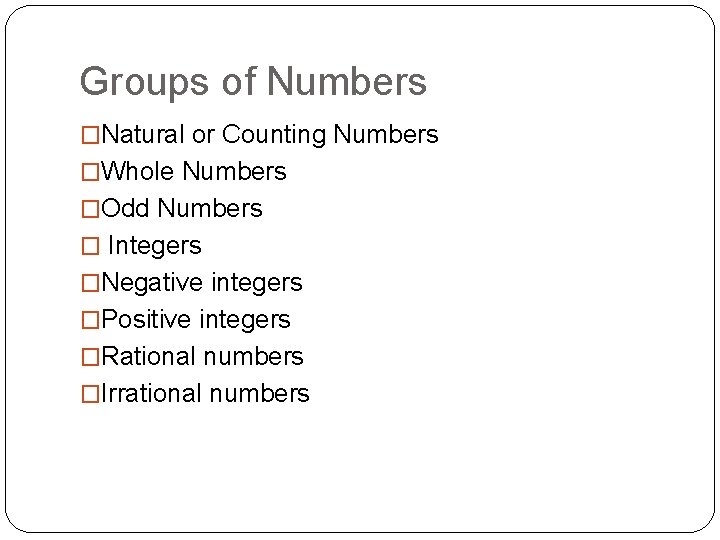
Groups of Numbers �Natural or Counting Numbers �Whole Numbers �Odd Numbers � Integers �Negative integers �Positive integers �Rational numbers �Irrational numbers
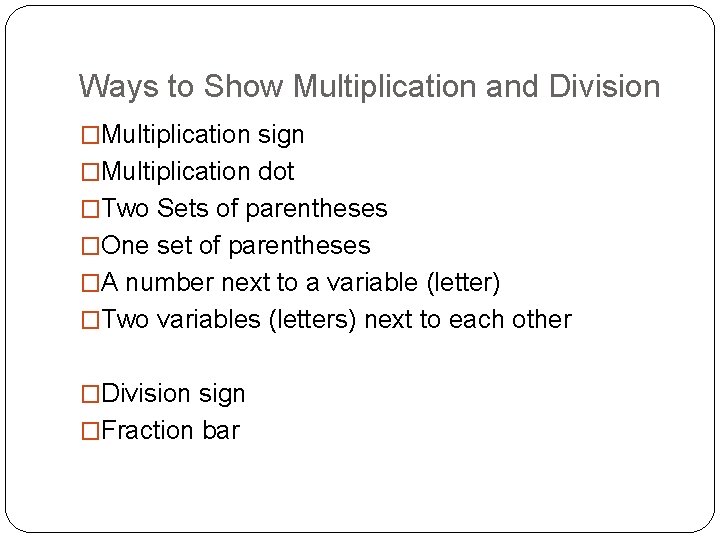
Ways to Show Multiplication and Division �Multiplication sign �Multiplication dot �Two Sets of parentheses �One set of parentheses �A number next to a variable (letter) �Two variables (letters) next to each other �Division sign �Fraction bar
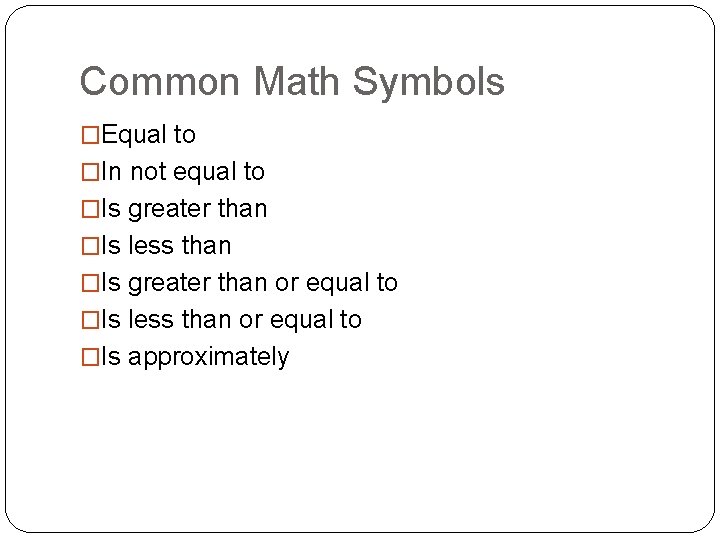
Common Math Symbols �Equal to �In not equal to �Is greater than �Is less than �Is greater than or equal to �Is less than or equal to �Is approximately
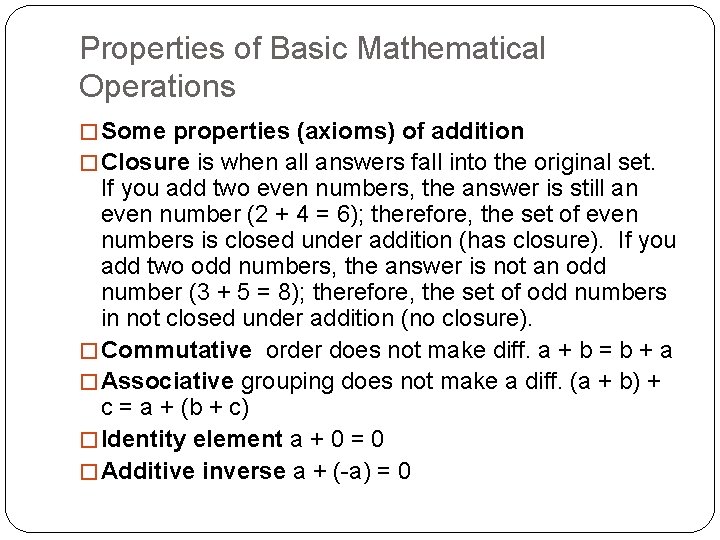
Properties of Basic Mathematical Operations � Some properties (axioms) of addition � Closure is when all answers fall into the original set. If you add two even numbers, the answer is still an even number (2 + 4 = 6); therefore, the set of even numbers is closed under addition (has closure). If you add two odd numbers, the answer is not an odd number (3 + 5 = 8); therefore, the set of odd numbers in not closed under addition (no closure). � Commutative order does not make diff. a + b = b + a � Associative grouping does not make a diff. (a + b) + c = a + (b + c) � Identity element a + 0 = 0 � Additive inverse a + (-a) = 0
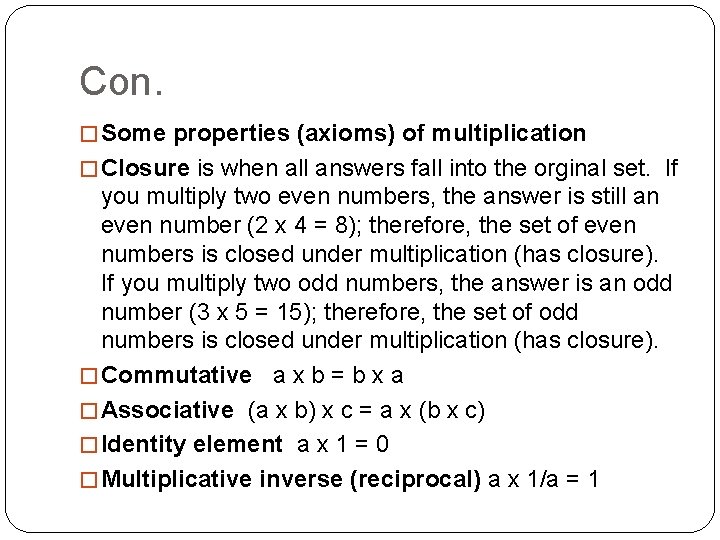
Con. � Some properties (axioms) of multiplication � Closure is when all answers fall into the orginal set. If you multiply two even numbers, the answer is still an even number (2 x 4 = 8); therefore, the set of even numbers is closed under multiplication (has closure). If you multiply two odd numbers, the answer is an odd number (3 x 5 = 15); therefore, the set of odd numbers is closed under multiplication (has closure). � Commutative a x b = b x a � Associative (a x b) x c = a x (b x c) � Identity element a x 1 = 0 � Multiplicative inverse (reciprocal) a x 1/a = 1
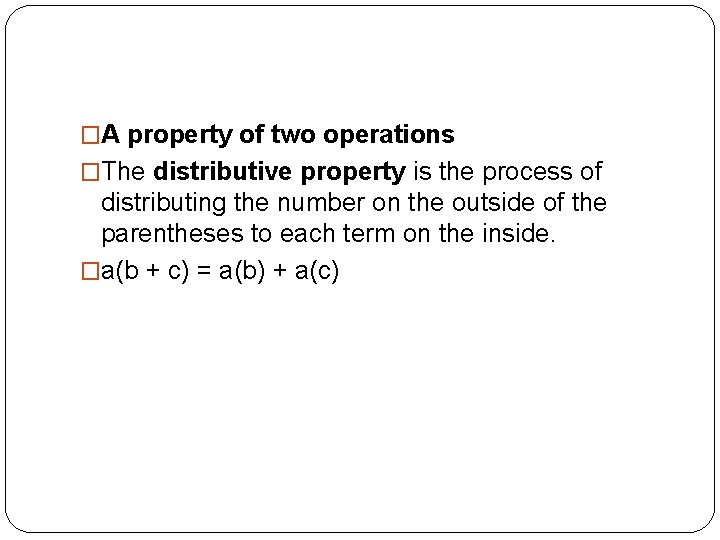
�A property of two operations �The distributive property is the process of distributing the number on the outside of the parentheses to each term on the inside. �a(b + c) = a(b) + a(c)
![Grouping Symbols and Order of Operation �Parentheses ( ) �Brackets [ ] �Braces {](http://slidetodoc.com/presentation_image_h2/32b901b9d305ae09b3e64ac0ff4e7f25/image-8.jpg "Grouping Symbols and Order of Operation �Parentheses ( ) �Brackets [ ] �Braces {")
Grouping Symbols and Order of Operation �Parentheses ( ) �Brackets [ ] �Braces { } �Remember: curly braces and square brackets.
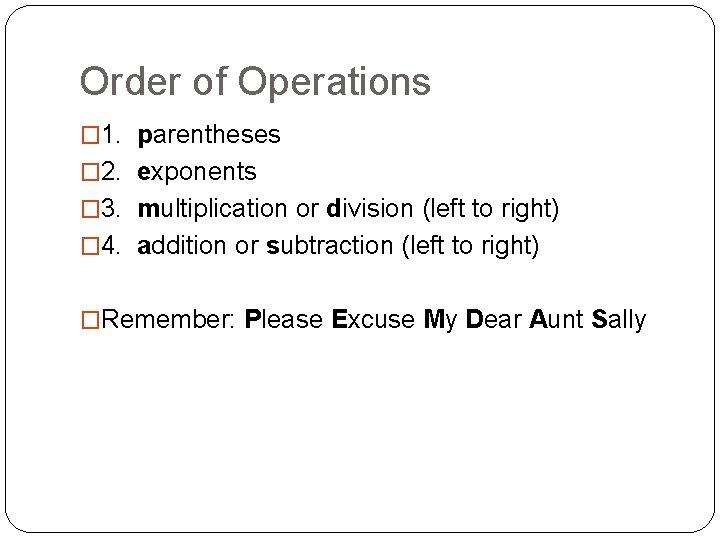
Order of Operations � 1. parentheses � 2. exponents � 3. multiplication or division (left to right) � 4. addition or subtraction (left to right) �Remember: Please Excuse My Dear Aunt Sally
- Slides: 9