
Math Reminders Number Talks Manipulatives Afterschool Math PD
Math Reminders – Number Talks & Manipulatives Afterschool Math PD – Grades 2&3 – Sept. 17, 2019 Pamela Dombrowski, District Math Specialist
Review Best Teaching Practices with: Agenda Number Talks Using Manipulatives Remember if we aren’t doing things systematically, we have to reinvent the wheel every year! Work smarter not harder – let’s set up procedures and expectations right away to make life easier on you.
Purpose of walkthroughs Walkthroughs What people are looking for when they come into your room v Student Engagement v Student talk is greater than teacher talk v Collaboration v Use of Manipulatives v Higher Order Thinking v Learning Target posted and referenced throughout the lesson You must lesson plan: You have pacing guides & teacher’s editions, but you have to know the math and decide what you can do in the amount of time you have – use the ksde. org Flipbooks to make sure you are making connections and meeting standards
This should be whole group Fluency Number Sense Routines to Warm Up A Eureka lesson is planned at 60 minutes and you have 90 minutes of math…. Do not skip fluency Number talks(5 -15 min) plus the Eureka (10 min) fluency which may include Sprints REMINDER: Sprints are not mad minutes – The power comes from the discussion of strategies in between. It is a personal goal to do one better the next time, not to complete them all or get to a certain level.
What is a Number Talk? “Simply defined, number talks are five - to fifteen-minute classroom conversations around purposefully crafted computation problems that are solved mentally. ” - Sherry Parish
We want students talking about math!!!! Why do Number Talks? ◦We want students to feel free to share their ideas ◦We want students to be ok with making mistakes and know how to learn and grow from them ◦We want students to hear how others think and gain new ways of thinking ◦We want students to be able to persevere in math and have ideas or strategies to draw on when they get stuck
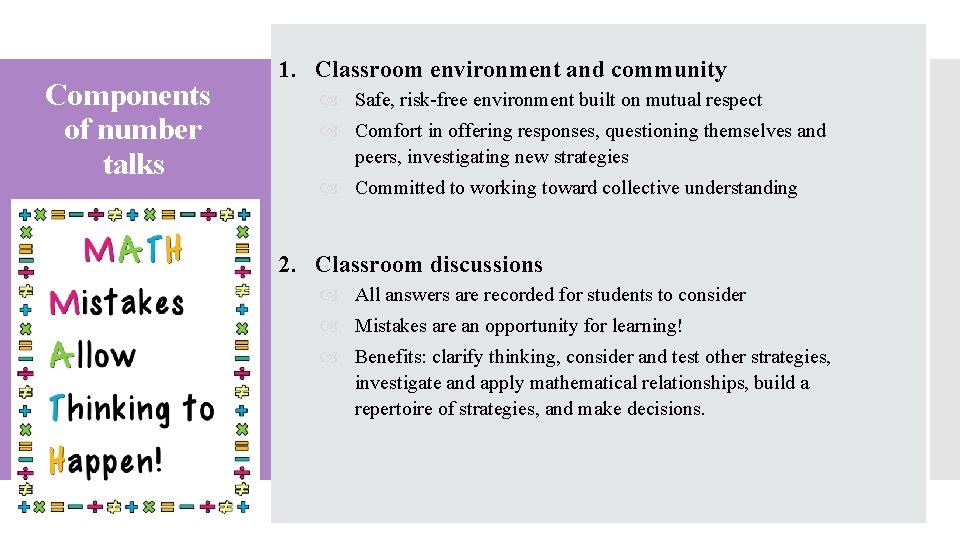
Components of number talks 1. Classroom environment and community Safe, risk-free environment built on mutual respect Comfort in offering responses, questioning themselves and peers, investigating new strategies Committed to working toward collective understanding 2. Classroom discussions All answers are recorded for students to consider Mistakes are an opportunity for learning! Benefits: clarify thinking, consider and test other strategies, investigate and apply mathematical relationships, build a repertoire of strategies, and make decisions.
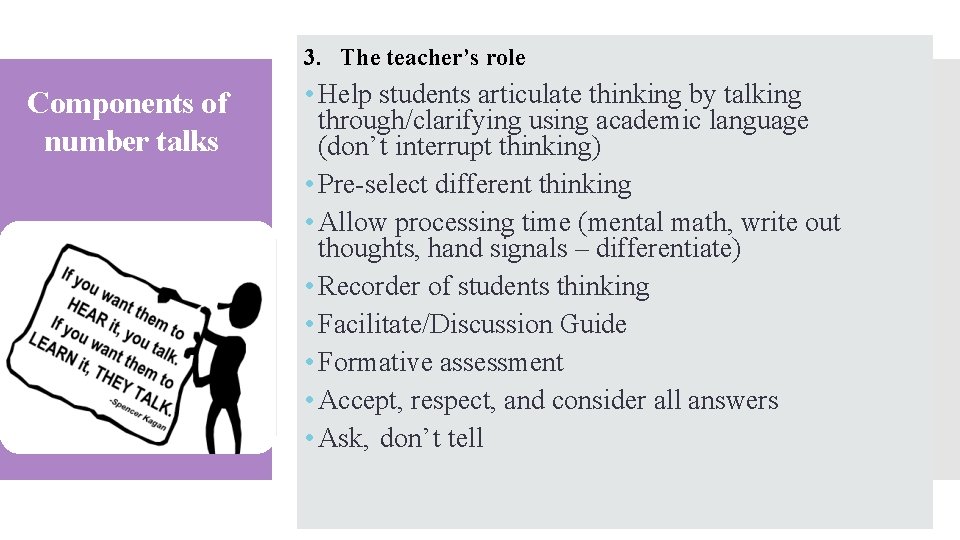
3. The teacher’s role Components of number talks • Help students articulate thinking by talking through/clarifying using academic language (don’t interrupt thinking) • Pre-select different thinking • Allow processing time (mental math, write out thoughts, hand signals – differentiate) • Recorder of students thinking • Facilitate/Discussion Guide • Formative assessment • Accept, respect, and consider all answers • Ask, don’t tell
4. The role of mental math Encourages students to rely and build on number relationships Components of number talks Helps students strengthen understanding of place value (horizontal problems ) 5. Purposeful computation problems Goals and purposes determine the numbers and operations chosen Specifically designed to foster use of efficient strategies Careful planning is a must Do Not Do a Number Talk with Brand New or Recently Learned Material. We want students to have some experience with the content to have strategies
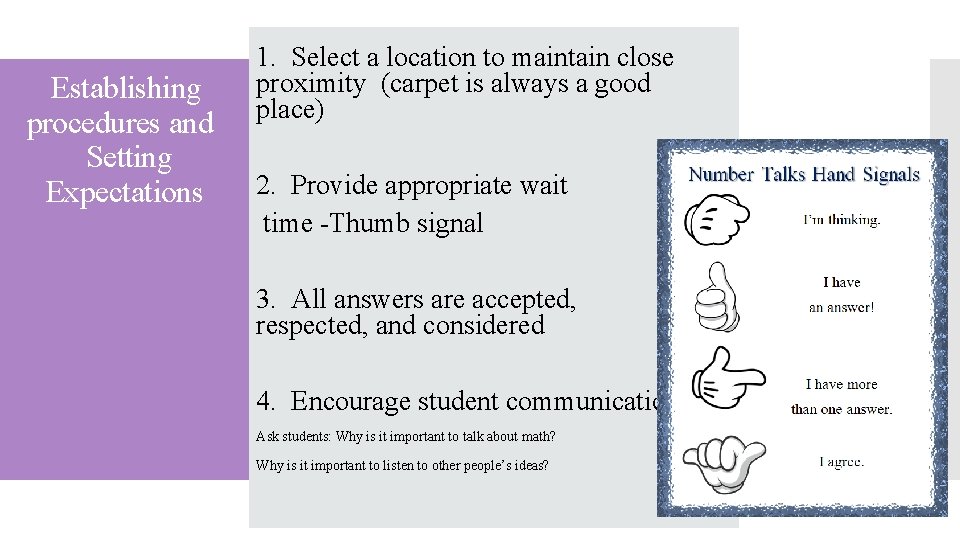
Establishing procedures and Setting Expectations 1. Select a location to maintain close proximity (carpet is always a good place) 2. Provide appropriate wait time -Thumb signal 3. All answers are accepted, respected, and considered 4. Encourage student communication Ask students: Why is it important to talk about math? Why is it important to listen to other people’s ideas?
1. Developing number sense Goals for K 2 number talks 2. Developing fluency with small numbers 3. Subitizing 4. Making tens In Kindergarten and 1 st – Really looking at dot cards, ten frames and then simple addition & subtraction
2 nd grade • Focus on building a toolbox of strategies for addition and subtraction • Start with small numbers
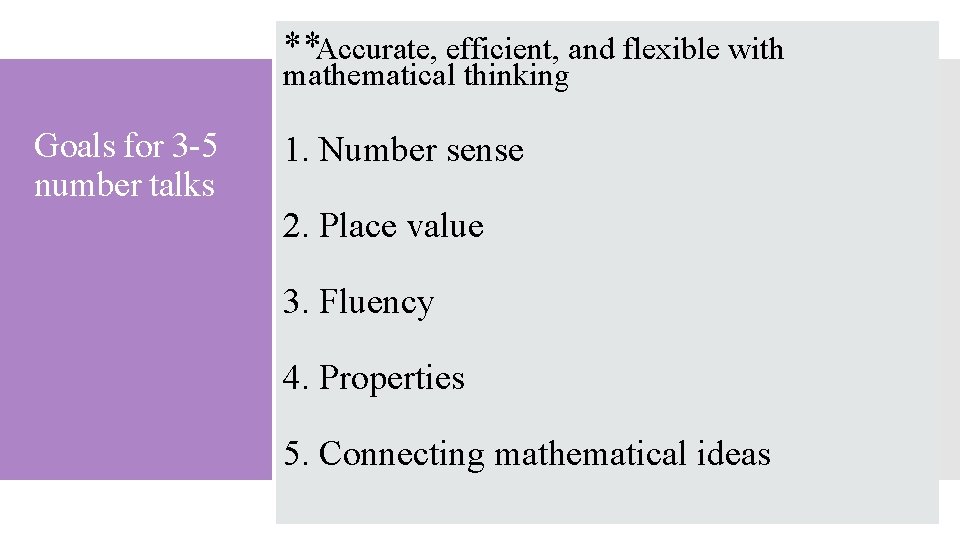
**Accurate, efficient, and flexible with mathematical thinking Goals for 3 -5 number talks 1. Number sense 2. Place value 3. Fluency 4. Properties 5. Connecting mathematical ideas
Let’s Watch Some Examples What did you notice? What do you wonder?
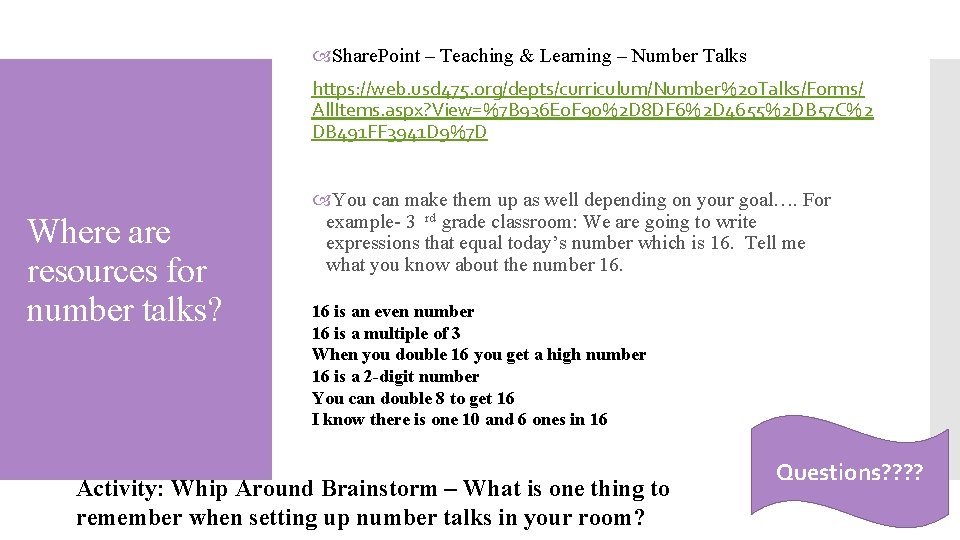
Share. Point – Teaching & Learning – Number Talks https: //web. usd 475. org/depts/curriculum/Number%20 Talks/Forms/ All. Items. aspx? View=%7 B 936 E 0 F 90%2 D 8 DF 6%2 D 4655%2 DB 57 C%2 DB 491 FF 3941 D 9%7 D Where are resources for number talks? You can make them up as well depending on your goal…. For example- 3 rd grade classroom: We are going to write expressions that equal today’s number which is 16. Tell me what you know about the number 16. 16 is an even number 16 is a multiple of 3 When you double 16 you get a high number 16 is a 2 -digit number You can double 8 to get 16 I know there is one 10 and 6 ones in 16 Activity: Whip Around Brainstorm – What is one thing to remember when setting up number talks in your room? Questions? ?
Concept Development This should also be done whole group! Biggest chunk of your math class Students are constructing knowledge Keep this portion as hands-on and student centered as possible Use the manipulatives – they can be expensive in terms of instructional minutes, but omitting them can sometimes result in elongating the learning process if students fail to miss a critical connection
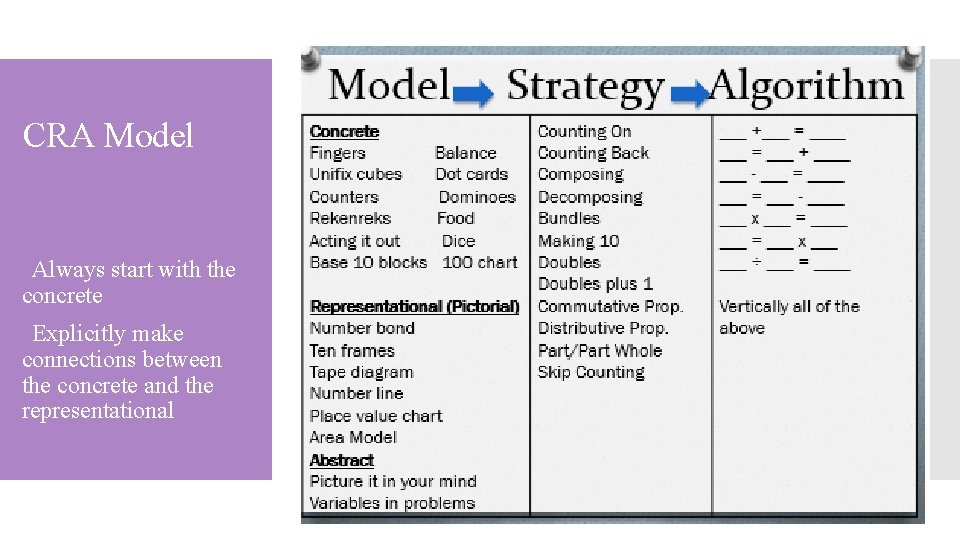
CRA Model Always start with the concrete Explicitly make connections between the concrete and the representational
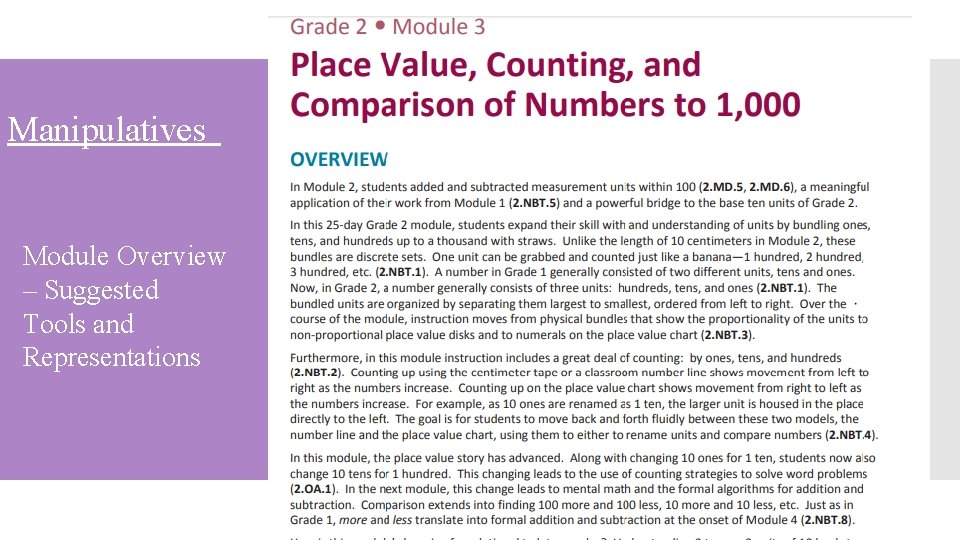
Manipulatives Module Overview – Suggested Tools and Representations
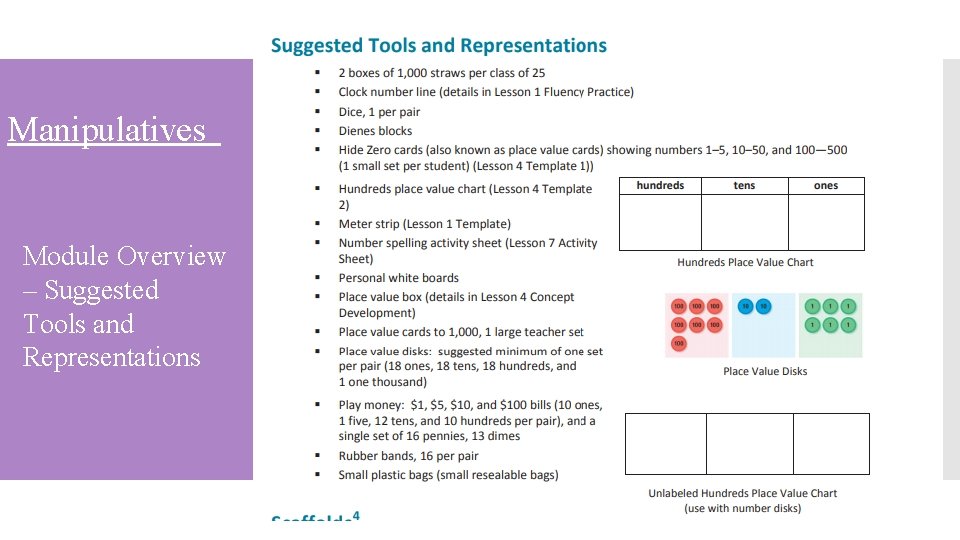
Manipulatives Module Overview – Suggested Tools and Representations
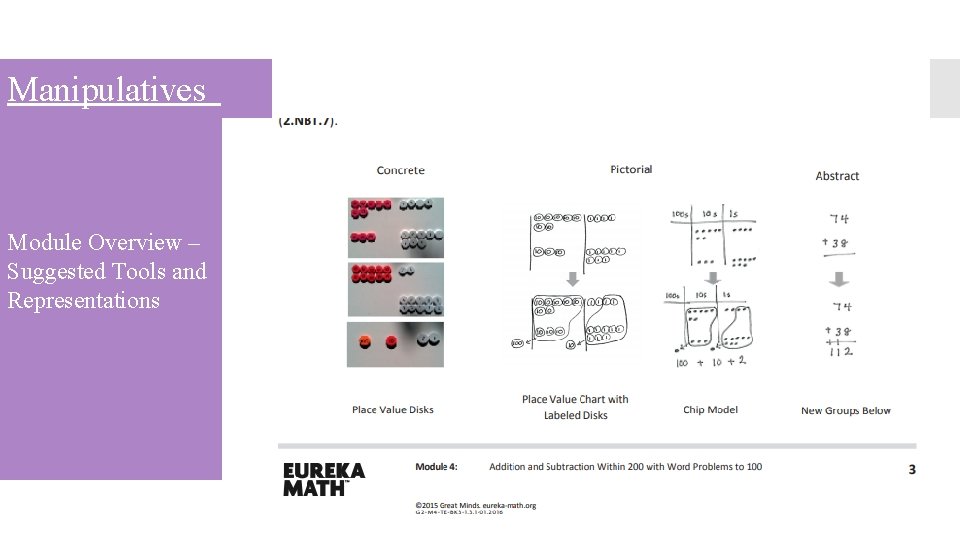
Manipulatives Module Overview – Suggested Tools and Representations
Share…. What manipulatives will you use in your upcoming modules? Manipulatives What manipulatives would you like to discuss or learn more about? What topics are you teaching that you would like help in figuring out what manipulative would be good to use?
Base 10 Blocks Two Color Counters Unifix Cubes Math Manipulatives Pattern Blocks Fraction Cubes and Sets Cuisenaire Rods Place value discs
Number Talks Using Manipulatives Summary – We Reviewed a Lot in a Little Bit of Time Questions? ? Next Afterschool PD for Math Grades 2 & 3 – Nov. 12 th 4: 00 -5: 00 Working on Proficiency Scales
- Slides: 23