
Math of Chem I Textbook Chapter 1 Aim
Math of Chem I Textbook Chapter 1 Aim: a) Determining the number of significant figures in a value. b)To round the solutions of calculations using significant figures.
Significant Figures Significant figures represent the accuracy and precision of a measurement The more significant figures in a number, the more precise the Significant figures: All known (certain) values measurement. read from an instrument plus one estimated value.
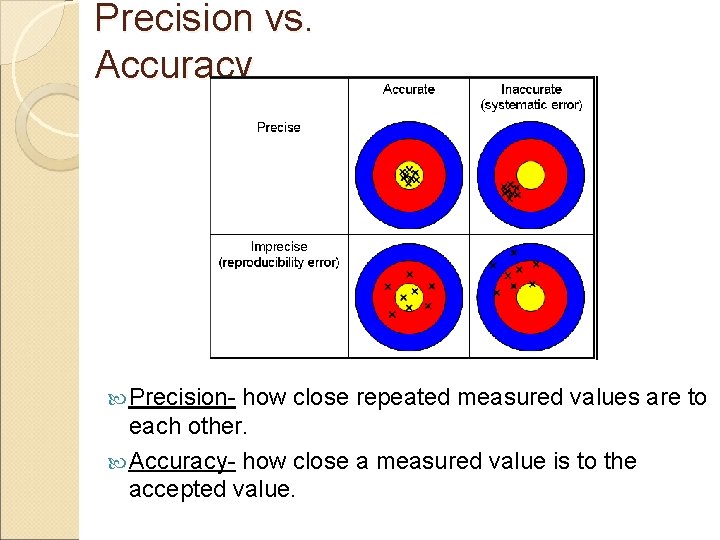
Precision vs. Accuracy Precision- how close repeated measured values are to each other. Accuracy- how close a measured value is to the accepted value.
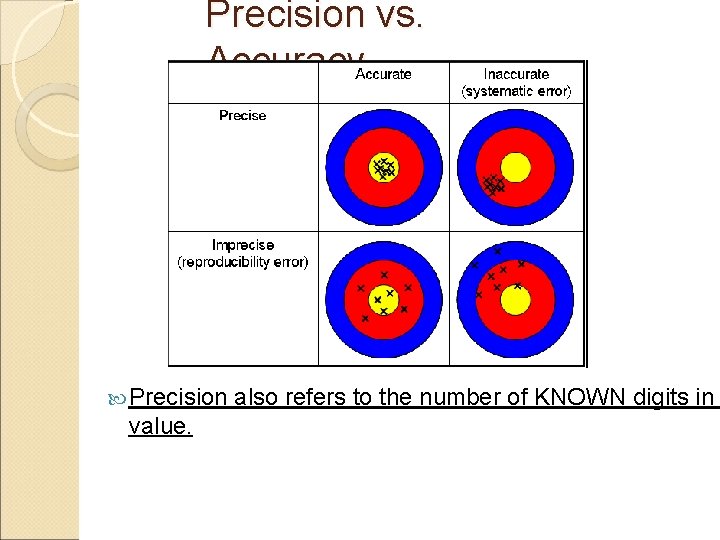
Precision vs. Accuracy Precision value. also refers to the number of KNOWN digits in
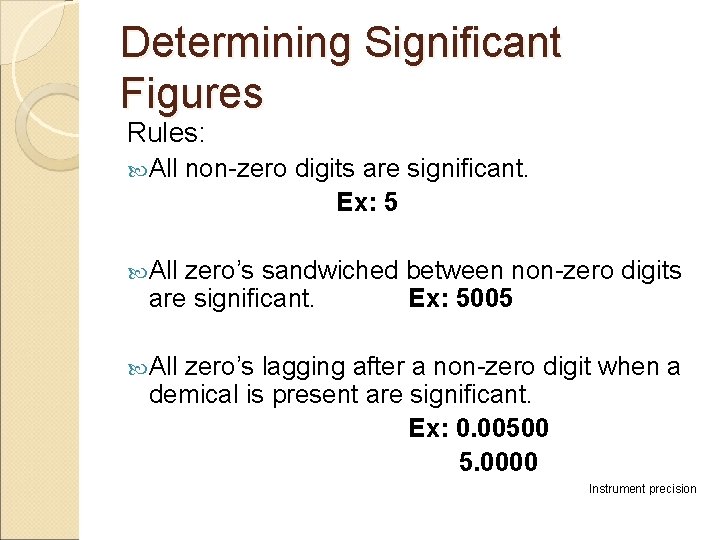
Determining Significant Figures Rules: All non-zero digits are significant. Ex: 5 All zero’s sandwiched between non-zero digits are significant. Ex: 5005 All zero’s lagging after a non-zero digit when a demical is present are significant. Ex: 0. 00500 5. 0000 Instrument precision
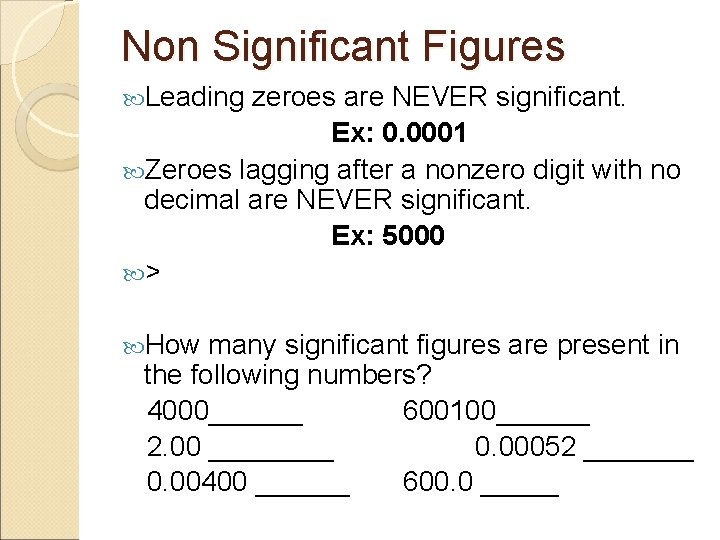
Non Significant Figures Leading zeroes are NEVER significant. Ex: 0. 0001 Zeroes lagging after a nonzero digit with no decimal are NEVER significant. Ex: 5000 > How many significant figures are present in the following numbers? 4000______ 600100______ 2. 00 ____ 0. 00052 _______ 0. 00400 ______ 600. 0 _____
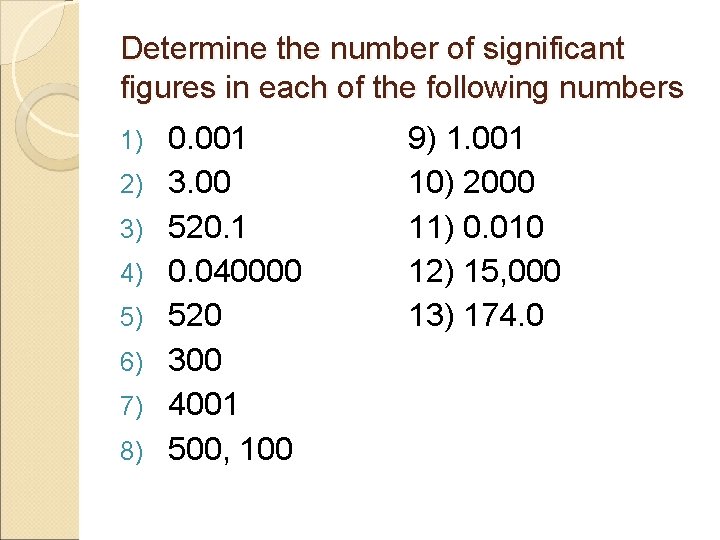
Determine the number of significant figures in each of the following numbers 1) 2) 3) 4) 5) 6) 7) 8) 0. 001 3. 00 520. 1 0. 040000 520 300 4001 500, 100 9) 1. 001 10) 2000 11) 0. 010 12) 15, 000 13) 174. 0
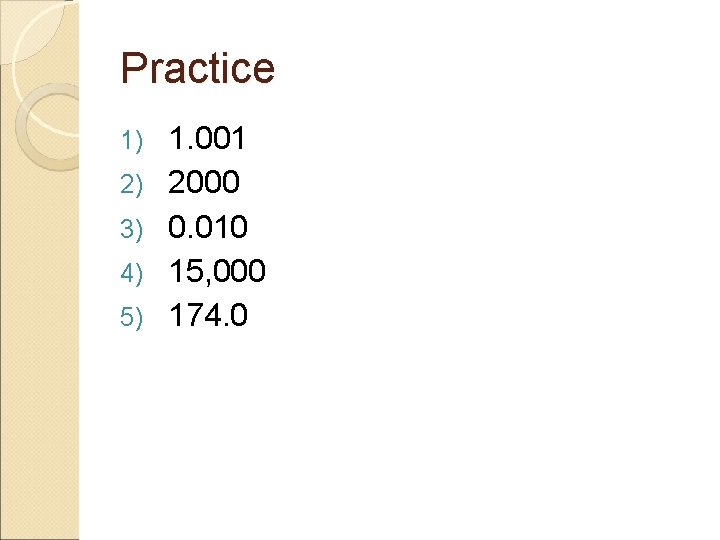
Practice 1) 2) 3) 4) 5) 1. 001 2000 0. 010 15, 000 174. 0
Math with Sig Figs When performing calculations in Chemistry you must round your answer to be as precise as the LEAST precise measurement value. This type of rounding takes significant figures into account in order to maintain
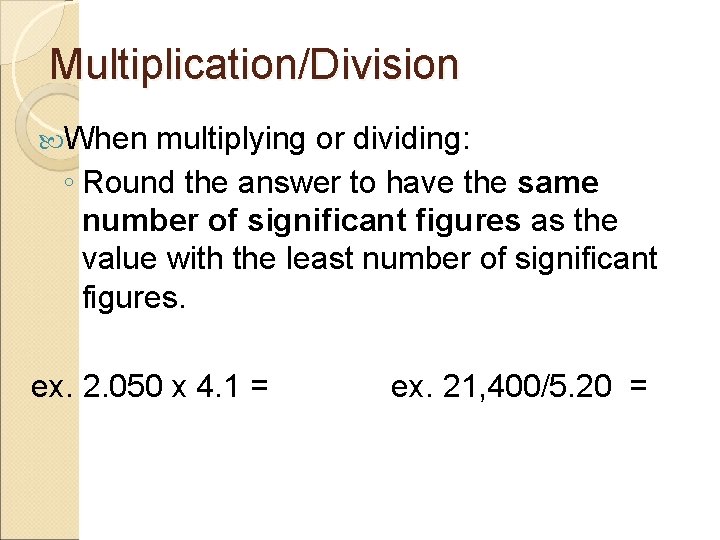
Multiplication/Division When multiplying or dividing: ◦ Round the answer to have the same number of significant figures as the value with the least number of significant figures. ex. 2. 050 x 4. 1 = ex. 21, 400/5. 20 =
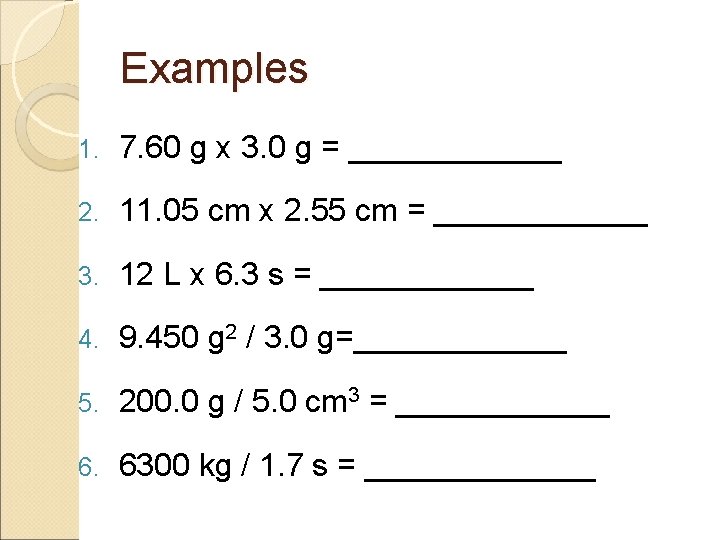
Examples 1. 7. 60 g x 3. 0 g = ______ 2. 11. 05 cm x 2. 55 cm = ______ 3. 12 L x 6. 3 s = ______ 4. 9. 450 g 2 / 3. 0 g=______ 5. 200. 0 g / 5. 0 cm 3 = ______ 6. 6300 kg / 1. 7 s = _______
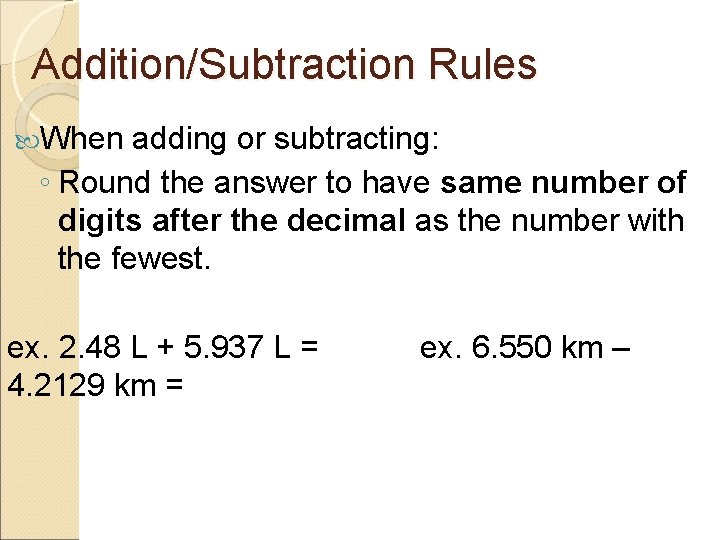
Addition/Subtraction Rules When adding or subtracting: ◦ Round the answer to have same number of digits after the decimal as the number with the fewest. ex. 2. 48 L + 5. 937 L = 4. 2129 km = ex. 6. 550 km –
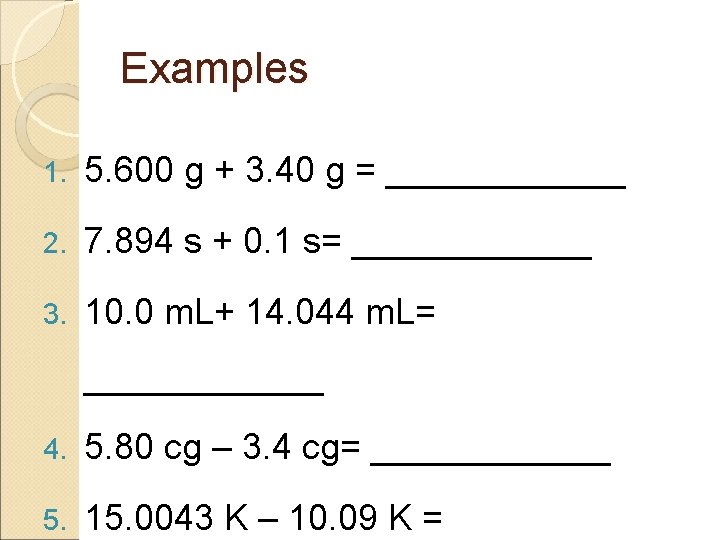
Examples 1. 5. 600 g + 3. 40 g = ______ 2. 7. 894 s + 0. 1 s= ______ 3. 10. 0 m. L+ 14. 044 m. L= ______ 4. 5. 80 cg – 3. 4 cg= ______ 5. 15. 0043 K – 10. 09 K =
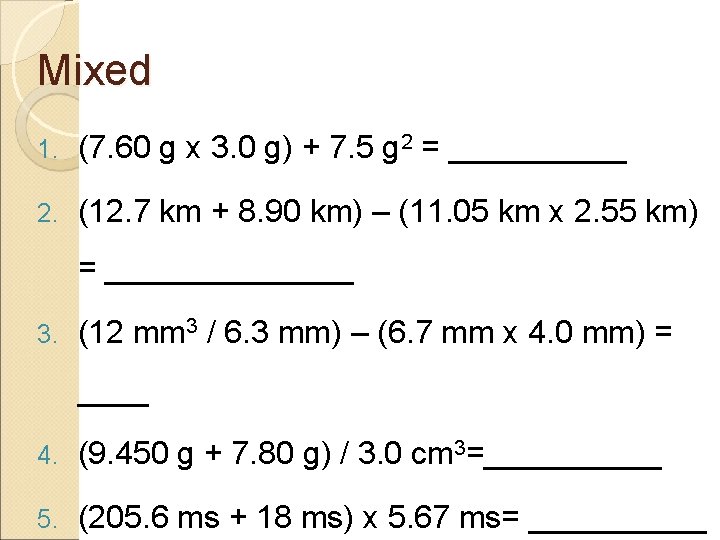
Mixed 1. (7. 60 g x 3. 0 g) + 7. 5 g 2 = _____ 2. (12. 7 km + 8. 90 km) – (11. 05 km x 2. 55 km) = _______ 3. (12 mm 3 / 6. 3 mm) – (6. 7 mm x 4. 0 mm) = ____ 4. (9. 450 g + 7. 80 g) / 3. 0 cm 3=_____ 5. (205. 6 ms + 18 ms) x 5. 67 ms= _____
- Slides: 14