
Math for Liberal Studies Section 2 5 Miscellaneous
Math for Liberal Studies Section 2. 5: Miscellaneous Voting Methods
More Methods �There are many more methods for determining the winner of an election with more than two candidates �We will only discuss a few more: sequential pairwise voting contingency voting instant-runoff voting

Sequential Pairwise Voting �Idea: We like pairwise voting since we can use majority rule �If we look at all pairwise elections (Condorcet’s method), we sometimes don’t get a winner �In sequential pairwise voting, we put the candidates in order on a list, called an agenda
How It Works � We pit the first two candidates on the agenda against each other. The winner moves on to face the next candidate on the list, and so on. The candidate remaining at the end is the winner. � This process resembles a tournament bracket, and has the advantage that, unlike Condorcet’s method, we always get a winner
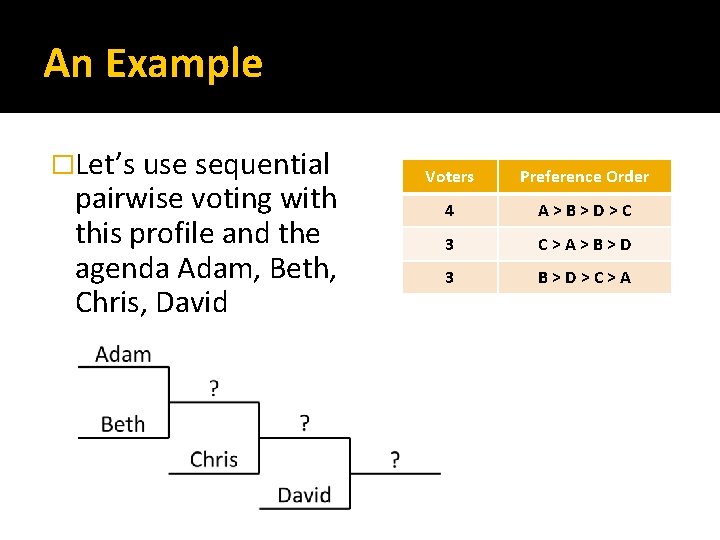
An Example �Let’s use sequential pairwise voting with this profile and the agenda Adam, Beth, Chris, David Voters Preference Order 4 A>B>D>C 3 C>A>B>D 3 B>D>C>A
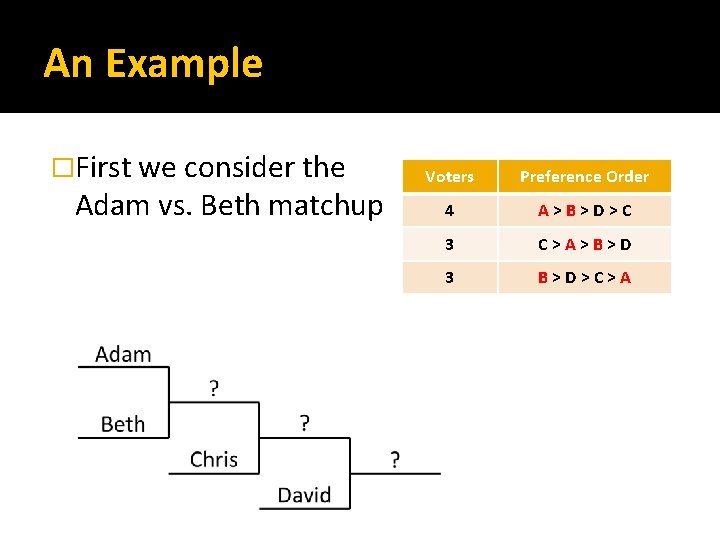
An Example �First we consider the Adam vs. Beth matchup Voters Preference Order 4 A>B>D>C 3 C>A>B>D 3 B>D>C>A
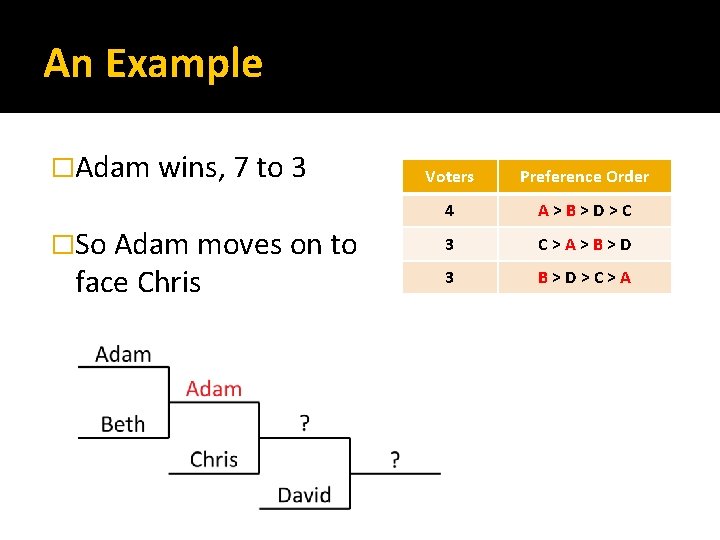
An Example �Adam wins, 7 to 3 �So Adam moves on to face Chris Voters Preference Order 4 A>B>D>C 3 C>A>B>D 3 B>D>C>A
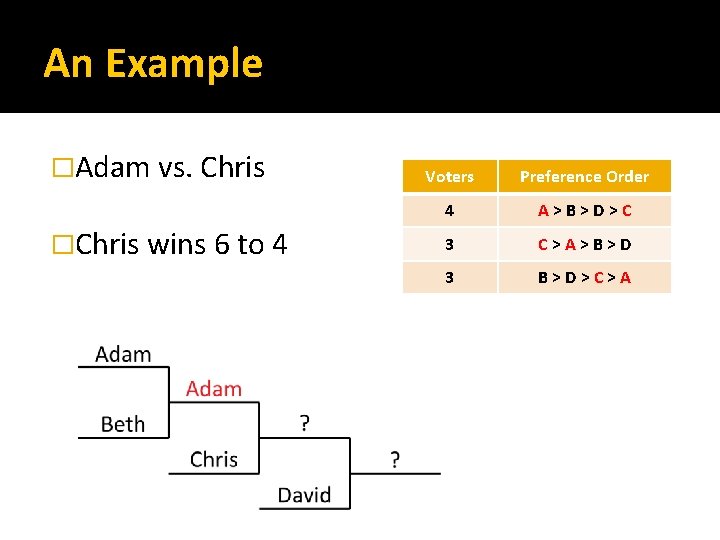
An Example �Adam vs. Chris �Chris wins 6 to 4 Voters Preference Order 4 A>B>D>C 3 C>A>B>D 3 B>D>C>A
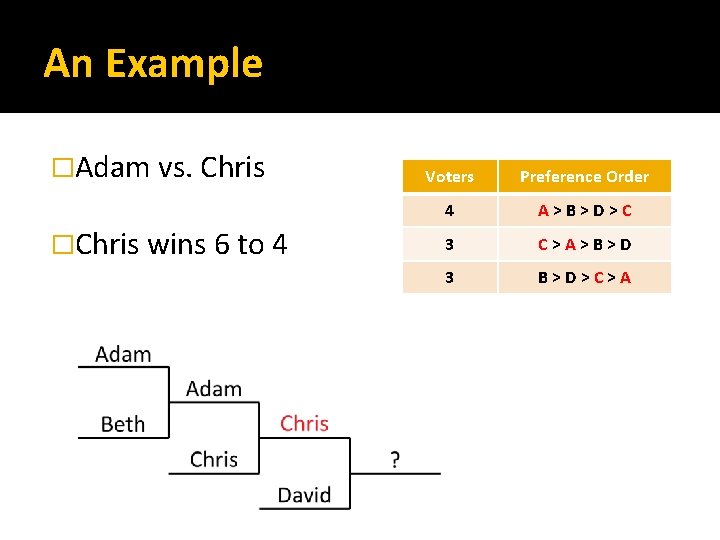
An Example �Adam vs. Chris �Chris wins 6 to 4 Voters Preference Order 4 A>B>D>C 3 C>A>B>D 3 B>D>C>A
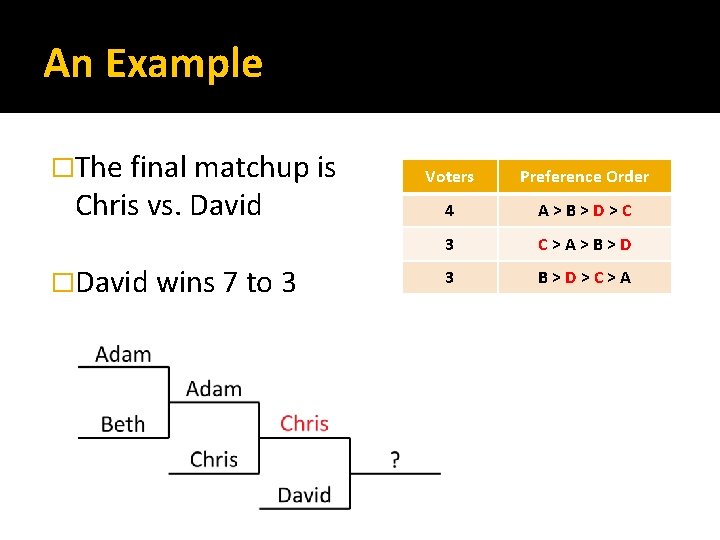
An Example �The final matchup is Chris vs. David �David wins 7 to 3 Voters Preference Order 4 A>B>D>C 3 C>A>B>D 3 B>D>C>A
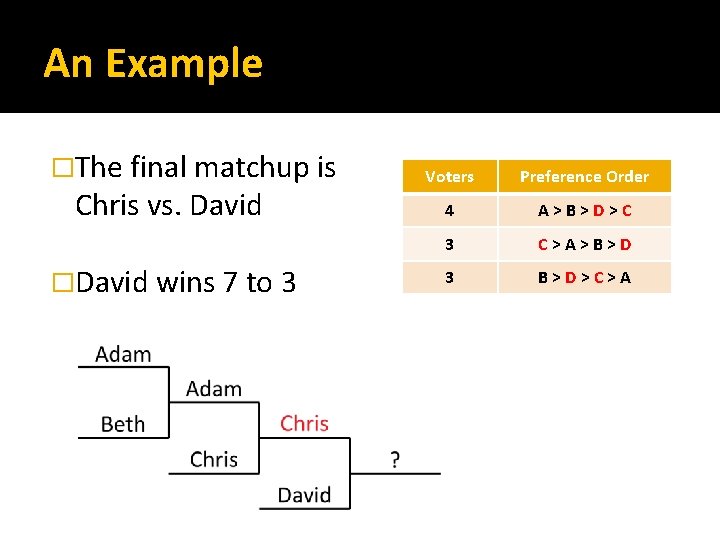
An Example �The final matchup is Chris vs. David �David wins 7 to 3 Voters Preference Order 4 A>B>D>C 3 C>A>B>D 3 B>D>C>A
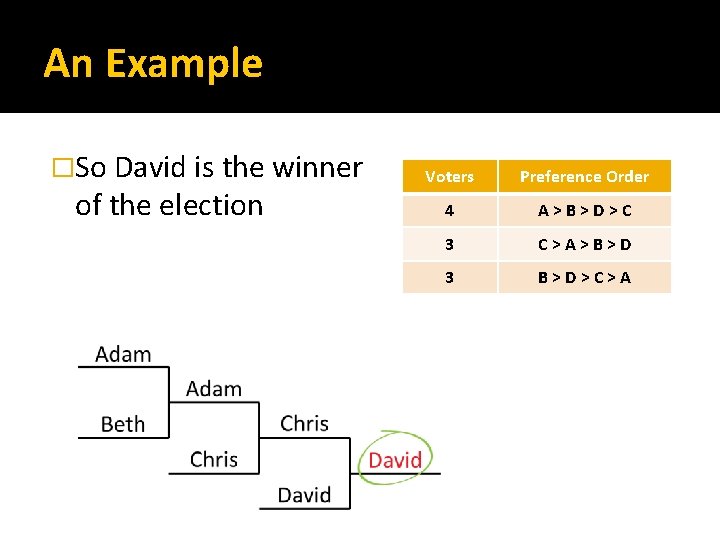
An Example �So David is the winner of the election Voters Preference Order 4 A>B>D>C 3 C>A>B>D 3 B>D>C>A
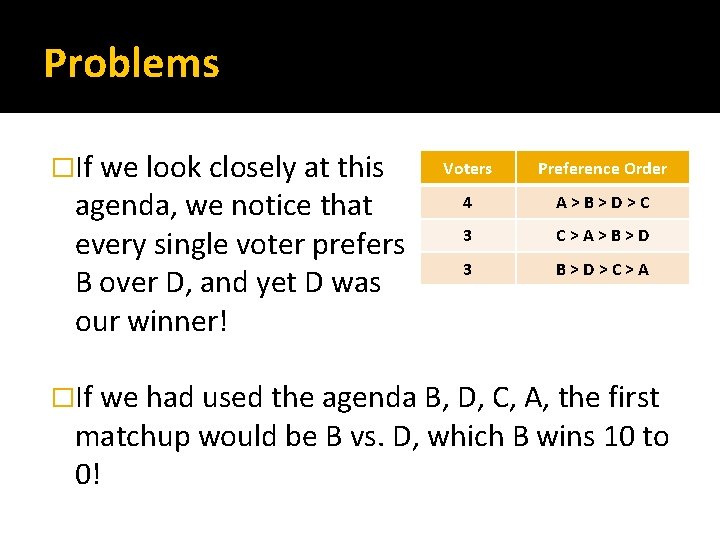
Problems �If we look closely at this agenda, we notice that every single voter prefers B over D, and yet D was our winner! Voters Preference Order 4 A>B>D>C 3 C>A>B>D 3 B>D>C>A �If we had used the agenda B, D, C, A, the first matchup would be B vs. D, which B wins 10 to 0!
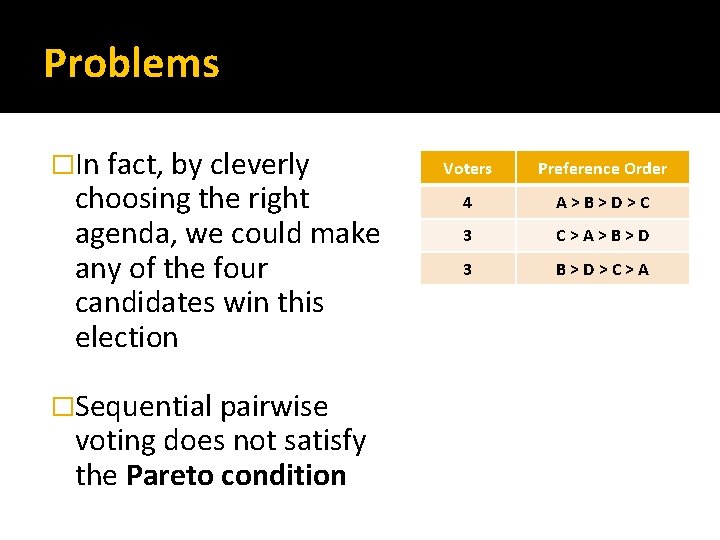
Problems �In fact, by cleverly choosing the right agenda, we could make any of the four candidates win this election �Sequential pairwise voting does not satisfy the Pareto condition Voters Preference Order 4 A>B>D>C 3 C>A>B>D 3 B>D>C>A
The Pareto Condition �If every single voter prefers one candidate over another, then the second candidate should not be the winner �Named for Vilfredo Pareto (1848 -1923), Italian economist �Does plurality satisfy the Pareto condition?
Plurality and Pareto �If every voter in a plurality election prefers A over B, then how many first-place votes does B get? �Zero! Therefore B cannot be the winner �So plurality does satisfy the Pareto condition
Runoff Voting �A runoff election occurs after an initial election when a clear winner has not been decided. �Runoff elections are common in situations where there are three or more candidates and none of them get a majority of the votes. �For example, there was recently a runoff election during the 2008 Georgia Senate race.
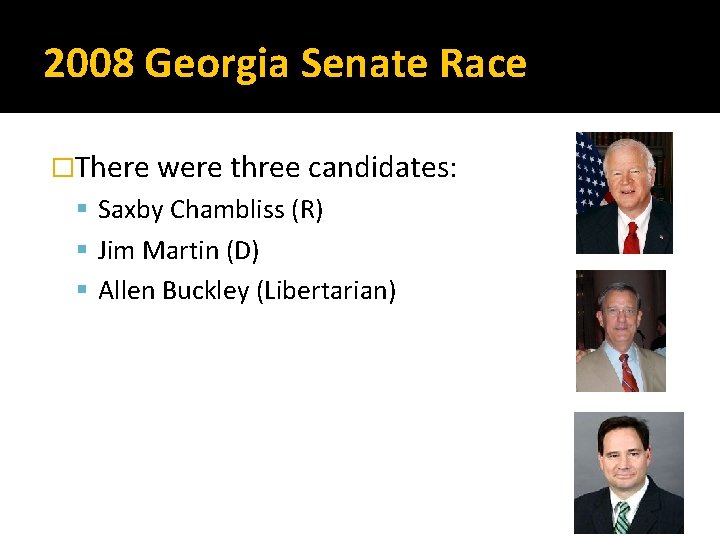
2008 Georgia Senate Race �There were three candidates: Saxby Chambliss (R) Jim Martin (D) Allen Buckley (Libertarian)
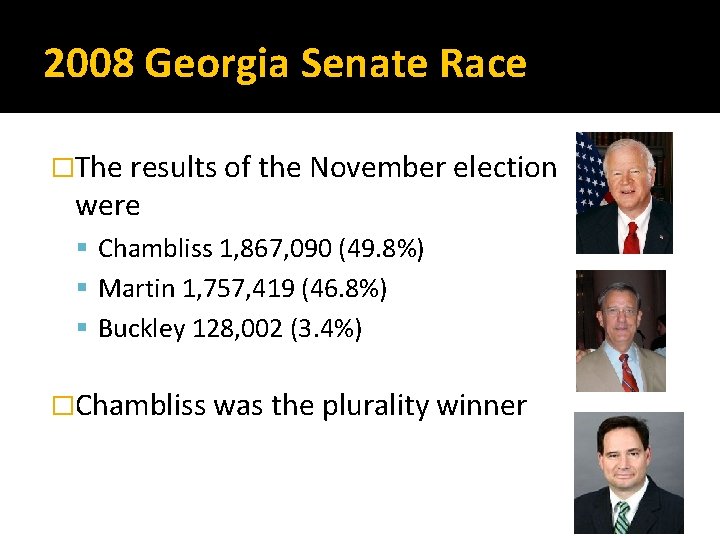
2008 Georgia Senate Race �The results of the November election were Chambliss 1, 867, 090 (49. 8%) Martin 1, 757, 419 (46. 8%) Buckley 128, 002 (3. 4%) �Chambliss was the plurality winner
2008 Georgia Senate Race �However, Georgia law mandates a runoff election when no candidate receives a majority �The runoff is a majority rule vote between the top two candidates �In this case, the runoff was in December between Chambliss and Martin
2008 Georgia Senate Race �Why did there need to be a second election? Couldn’t we just eliminate Buckley and use the existing votes? Chambliss 1, 867, 090 (49. 8%) Martin 1, 757, 419 (46. 8%) Buckley 128, 002 (3. 4%) �If we do that, we disenfranchise 128, 002 voters!
2008 Georgia Senate Race �There is no way to know who those 128, 002 voters would have chosen with only Chambliss and Martin as their choices �The runoff election was held in early December 2008
2008 Georgia Senate Race �Since the runoff was only deciding this one contest, turnout was much lower than in November �Chambliss 1, 228, 033 (57. 4%) �Martin 909, 923 (42. 6%) �Chambliss won his 2 nd term in the Senate
Using Preferences for Runoffs �If the voters in Georgia had been asked for their full preference orders rather than just their top choice, then the second election would not have been necessary �We would know who the Buckley voters would have voted for, and the winner could have been calculated instantly
Contingent Voting �Voters rank all candidates in a preference order �If one candidate wins a majority of the firstplace votes, then that candidate is the winner �If not, then we eliminate all candidates except the two who got the most first-place votes. �Then, using the full voter profile, the winner of an election between those two candidates is decided by majority rule.
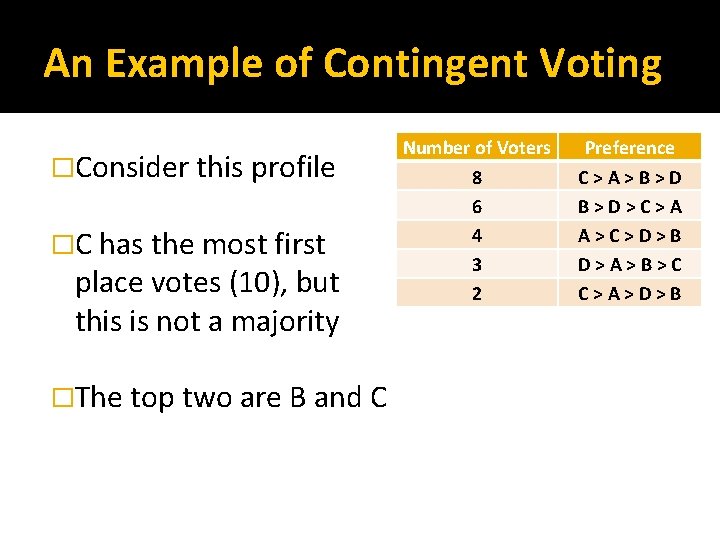
An Example of Contingent Voting �Consider this profile �C has the most first place votes (10), but this is not a majority �The top two are B and C Number of Voters 8 6 4 3 2 Preference C>A>B>D B>D>C>A A>C>D>B D>A>B>C C>A>D>B
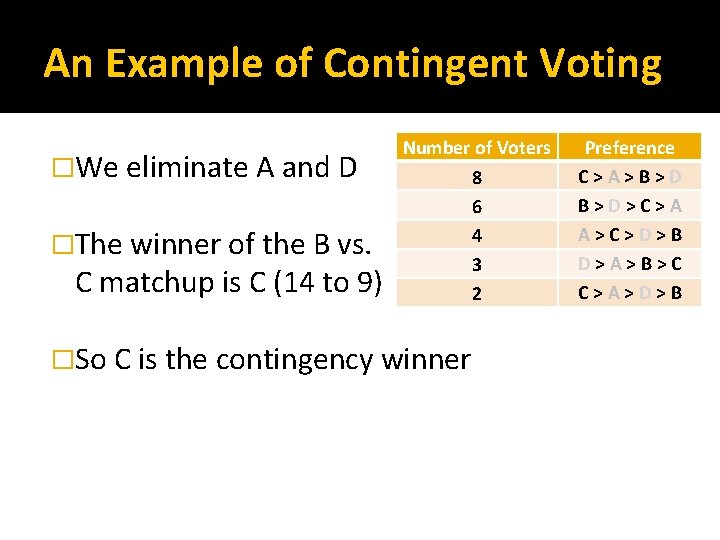
An Example of Contingent Voting �We eliminate A and D �The winner of the B vs. C matchup is C (14 to 9) Number of Voters 8 6 4 3 2 �So C is the contingency winner Preference C>A>B>D B>D>C>A A>C>D>B D>A>B>C C>A>D>B
Another Example �Contingent voting seems like a good method �However, it has a serious problem that we will see in the next example �Suppose we have an election with three candidates: Alison, Barbara, and Christine �We’ll use contingent voting to decide the winner
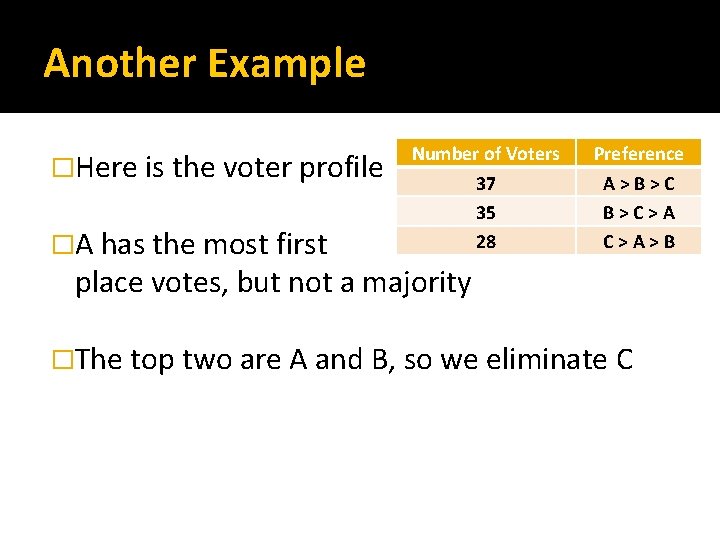
Another Example �Here is the voter profile �A has the most first Number of Voters 37 35 28 Preference A>B>C B>C>A C>A>B place votes, but not a majority �The top two are A and B, so we eliminate C
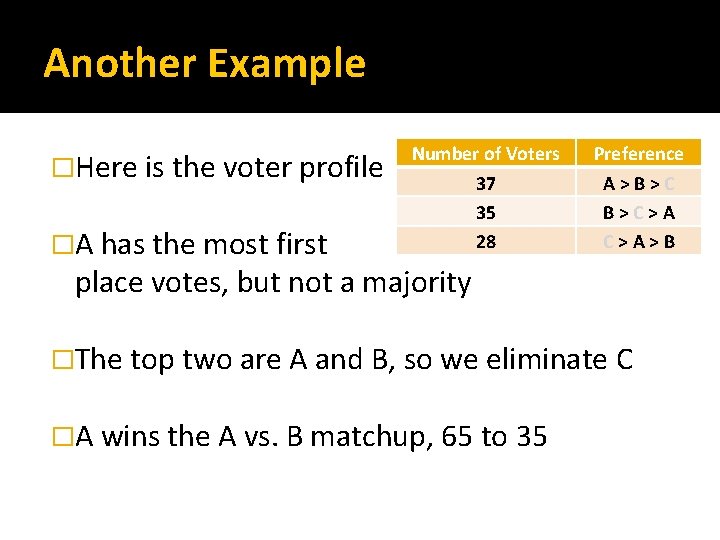
Another Example �Here is the voter profile �A has the most first Number of Voters 37 35 28 Preference A>B>C B>C>A C>A>B place votes, but not a majority �The top two are A and B, so we eliminate C �A wins the A vs. B matchup, 65 to 35
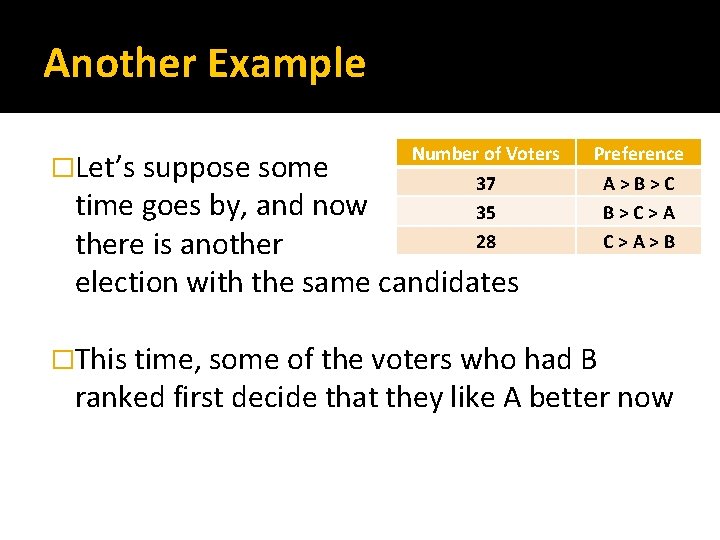
Another Example �Let’s suppose some Number of Voters 37 35 28 time goes by, and now there is another election with the same candidates Preference A>B>C B>C>A C>A>B �This time, some of the voters who had B ranked first decide that they like A better now
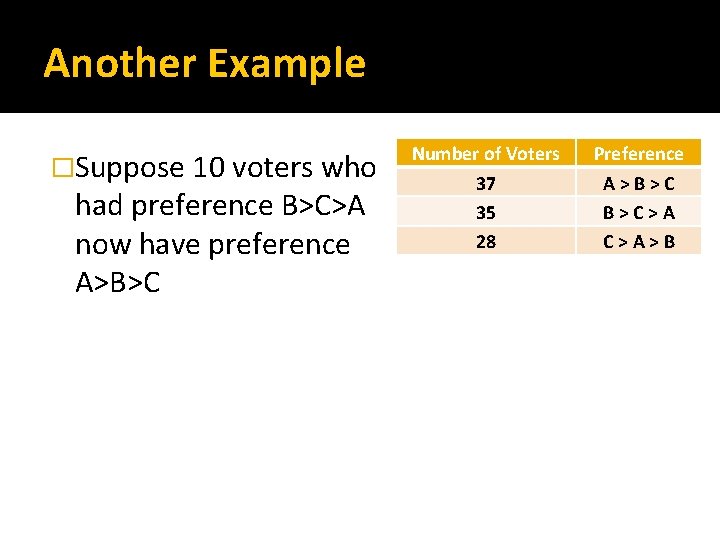
Another Example �Suppose 10 voters who had preference B>C>A now have preference A>B>C Number of Voters 37 35 28 Preference A>B>C B>C>A C>A>B
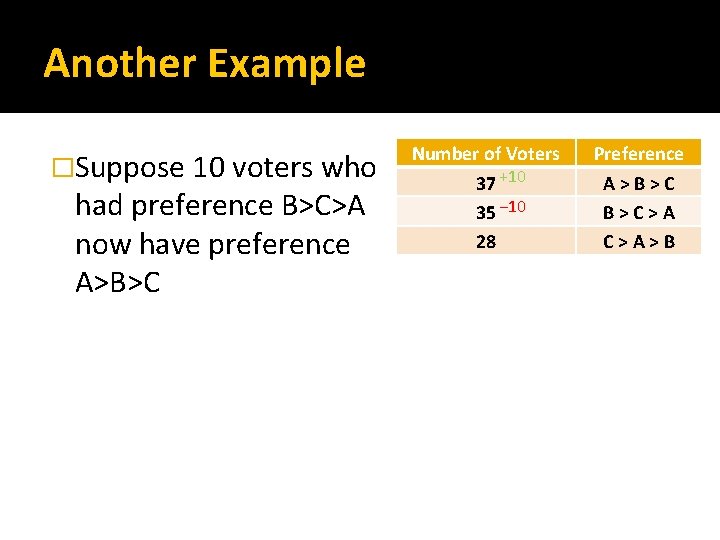
Another Example �Suppose 10 voters who had preference B>C>A now have preference A>B>C Number of Voters 37 +10 35 − 10 28 Preference A>B>C B>C>A C>A>B
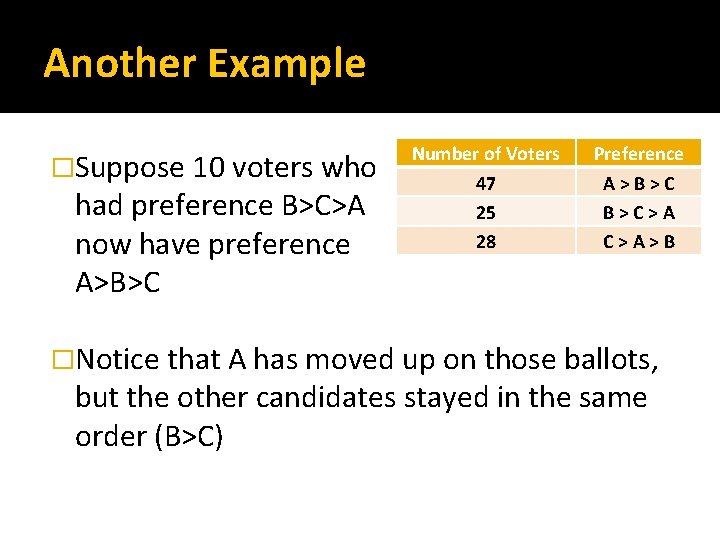
Another Example �Suppose 10 voters who had preference B>C>A now have preference A>B>C Number of Voters 47 25 28 Preference A>B>C B>C>A C>A>B �Notice that A has moved up on those ballots, but the other candidates stayed in the same order (B>C)
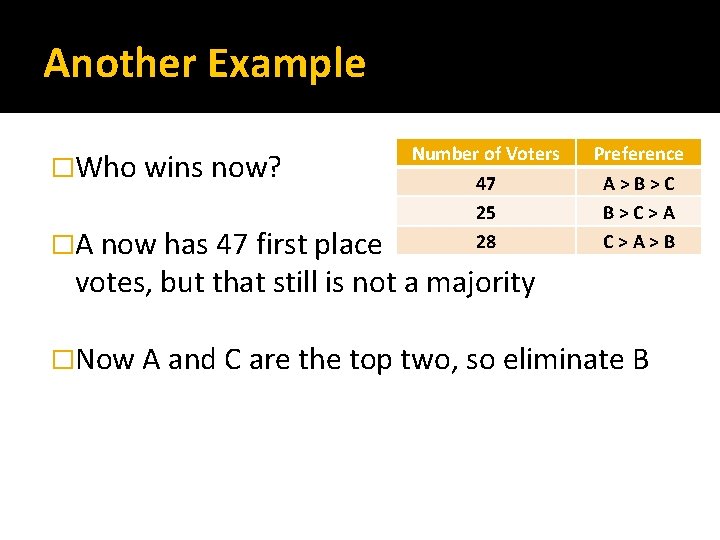
Another Example �Who wins now? �A now has 47 first place Number of Voters 47 25 28 Preference A>B>C B>C>A C>A>B votes, but that still is not a majority �Now A and C are the top two, so eliminate B
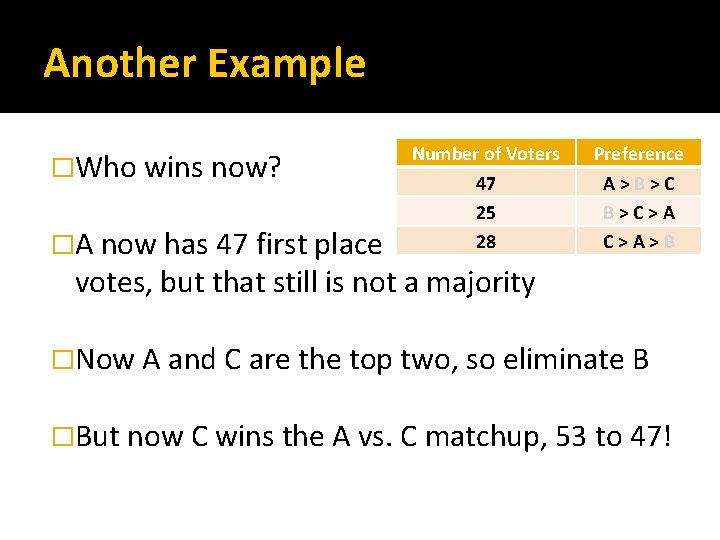
Another Example �Who wins now? �A now has 47 first place Number of Voters 47 25 28 Preference A>B>C B>C>A C>A>B votes, but that still is not a majority �Now A and C are the top two, so eliminate B �But now C wins the A vs. C matchup, 53 to 47!
What the %@$# happened? �By moving A higher on their ballots, those 10 voters caused A to lose the election! �This shows that contingent voting is not monotone
Monotone Again �Recall that we used the word “monotone” when we discussed two-candidate elections �With two candidates, monotone means: if one or more voters change their votes from the loser to the winner, then the original winner should still be the winner
Monotone Again �Recall that we used the word “monotone” when we discussed two-candidate elections �With more than two candidates, monotone means: if one or more voters change their ballot so that the original winner is ranked higher (but the order of the other candidates is not changed), then the original winner should still be the winner
Monotone Again �In our example, the original winner was Alison �Then some voters moved Alison from last place on their ballots up to first place, but kept the order of the other candidates the same �The result was that Alison was no longer the winner!
Another Method: Instant-Runoff Voting �This is a variation of the contingent method �Instead of eliminating all but the top two right away, we eliminate candidates one at a time
Instant-Runoff Voting �First check to see if any candidate has received a majority of the first-place votes If not, then the candidate that received the fewest first-place votes is eliminated �Recalculate the voter preferences, and again check to see if a candidate now has a majority of the first-place votes. If not, then repeat this process, eliminating candidates until one candidate has a majority.
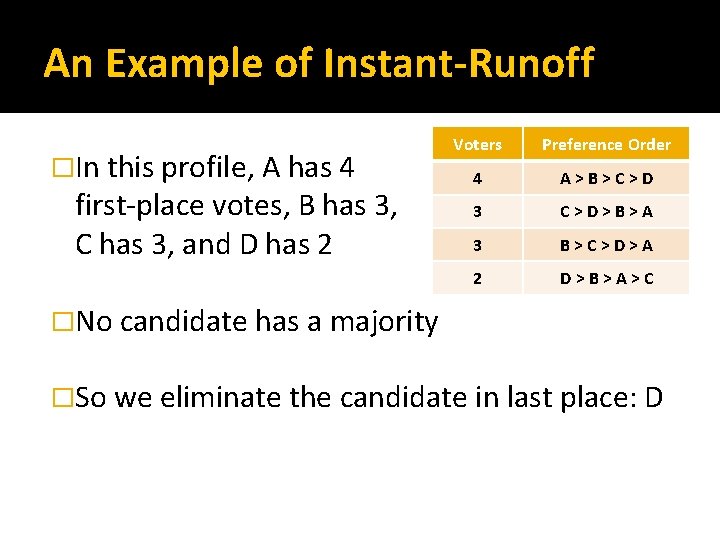
An Example of Instant-Runoff �In this profile, A has 4 first-place votes, B has 3, C has 3, and D has 2 Voters Preference Order 4 A>B>C>D 3 C>D>B>A 3 B>C>D>A 2 D>B>A>C �No candidate has a majority �So we eliminate the candidate in last place: D
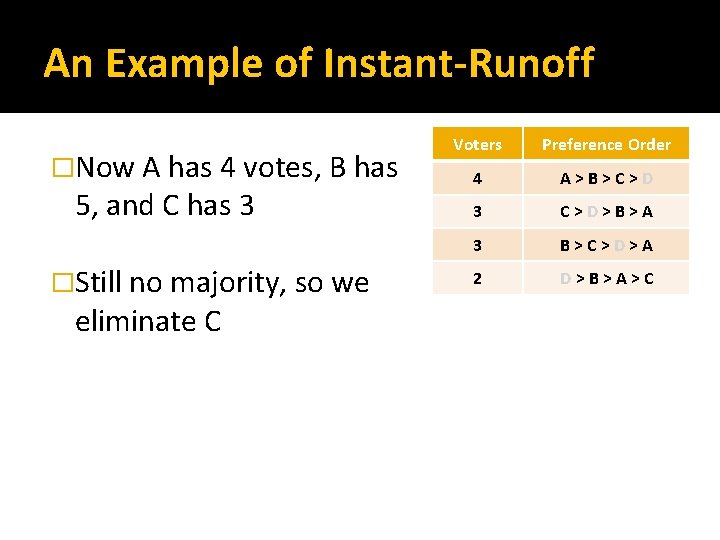
An Example of Instant-Runoff �Now A has 4 votes, B has 5, and C has 3 �Still no majority, so we eliminate C Voters Preference Order 4 A>B>C>D 3 C>D>B>A 3 B>C>D>A 2 D>B>A>C
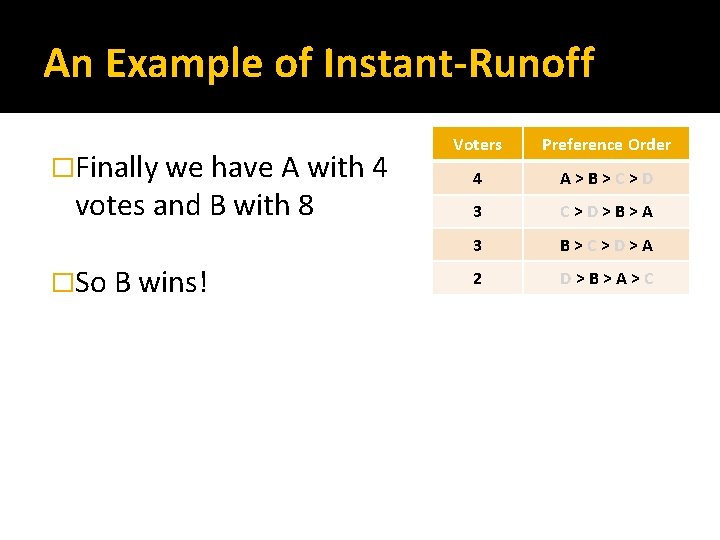
An Example of Instant-Runoff �Finally we have A with 4 votes and B with 8 �So B wins! Voters Preference Order 4 A>B>C>D 3 C>D>B>A 3 B>C>D>A 2 D>B>A>C
Dealing With Ties �If there is a tie for who to eliminate when you are using the instant-runoff method, eliminate all the tied candidates, unless this would eliminate everyone
Instant-Runoff Problems �Notice that with three candidates, contingent voting and instant-runoff voting are the same thing �Since we showed contingent voting isn’t monotone using an example with 3 candidates, that same example shows that instant-runoff also fails the monotone condition also
Enough Already! �We have studied many methods, and found problems with each one Condorcet’s method sometimes doesn’t give a winner Plurality voting fails the Condorcet winner criterion Rank methods suffer from the spoiler effect Sequential pairwise voting fails the Pareto condition Runoff methods fail the monotone condition
Where do we go from here? �We could continue to search for a “fair” voting system that doesn’t suffer from any of these problems �We could also consider trying to use a different kind of ballot, since all of the systems we have considered so far use preference-order ballots �We’ll explore these ideas in the next section…
- Slides: 49