
Math Circles Mathematicians Fostering Habits of Mind in
Math Circles – Mathematicians Fostering Habits of Mind in K 12 Teachers and Students Diana White Director, National Association of Math Circles (NAMC) (Mathematical Sciences Research Institute) Associate Professor, University of Colorado Denver Presented at International Math Outreach Workshop at Banff International Research Station November 24, 2015
MATH CIRCLES – MATHEMATICIANS FOSTERING HABITS OF MIND IN K 12 TEACHERS AND STUDENTS Mathematical Sciences Research Institute – Outreach Efforts § National Math Festival § Mathical Book Prize § Numberphile § Navajo Nation Math Circle Film § Guerilla Science – Fire Organ § National Association of Math Circles
MATH CIRCLES – MATHEMATICIANS FOSTERING HABITS OF MIND IN K 12 TEACHERS AND STUDENTS National Association of Math Circles § Programs to launch, support, mentor, and sustain Math Circles » Grants – support and exchange visits » Math Circle - Mentorship and Partnership Program § Resources » Online – website and handbook (in development) » AMS/MRSI Math Circle Library Series
What is a Math. Circle?
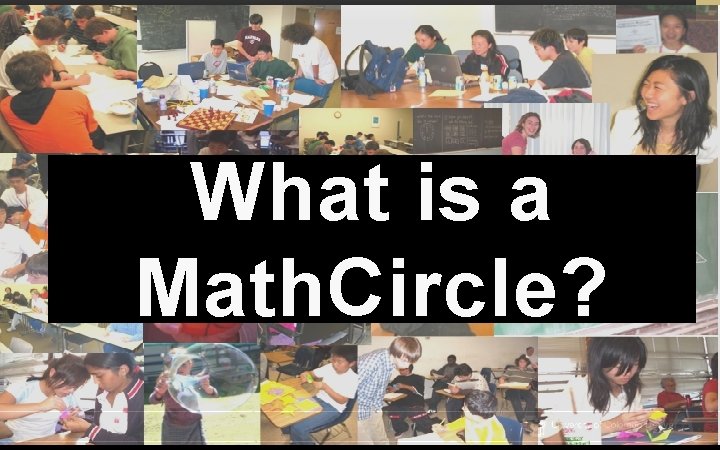
MATH CIRCLES – MATHEMATICIANS FOSTERING HABITS OF MIND IN K 12 TEACHERS AND STUDENTS Math Circles § Loosely defined, goal of inclusivity § Participants are K 12 students or teachers § Focus is generally on learning to explore, conjecture, create, collaborate and communicate substantive mathematics --» All those things that a mathematician does while engaging in the practice of mathematical research 5
MATH CIRCLES – MATHEMATICIANS FOSTERING HABITS OF MIND IN K 12 TEACHERS AND STUDENTS Math Circles - Goals § Put mathematics professionals in direct contact with K 12 students and teachers § Increase problems solving skills § Develop enjoyment of mathematics § Learn disciplinary skills of mathematics 6
MATH CIRCLES – MATHEMATICIANS FOSTERING HABITS OF MIND IN K 12 TEACHERS AND STUDENTS Types of Math Circles § Math Teachers’ Circles » Started in 2006 at American Institute of Mathematics (AIM) § Math Students’ Circles » Originated in Eastern Europe » Spread to U. S. in 1990’s § Both » Rapid growth in past decade due to intentional efforts by AIM and NAMC 7
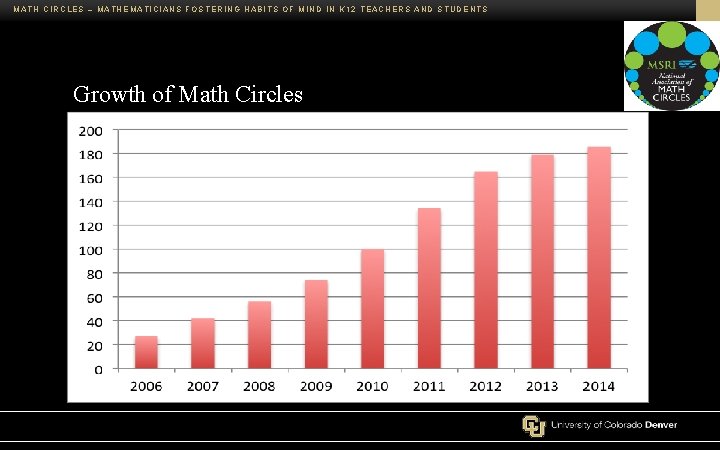
MATH CIRCLES – MATHEMATICIANS FOSTERING HABITS OF MIND IN K 12 TEACHERS AND STUDENTS Growth of Math. Growth Circles Math Circle
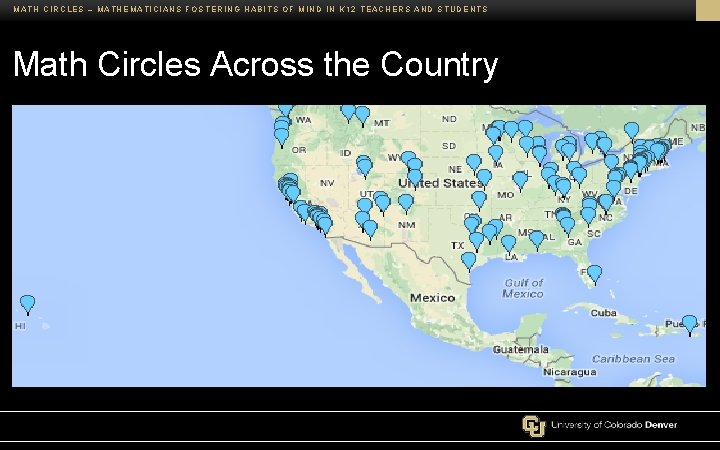
MATH CIRCLES – MATHEMATICIANS FOSTERING HABITS OF MIND IN K 12 TEACHERS AND STUDENTS Math Circles Across the Country
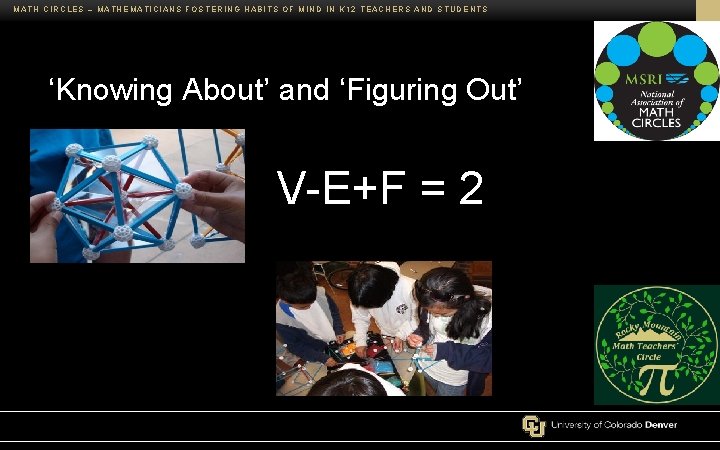
MATH CIRCLES – MATHEMATICIANS FOSTERING HABITS OF MIND IN K 12 TEACHERS AND STUDENTS ‘Knowing About’ and ‘Figuring Out’ V-E+F = 2
MATH CIRCLES – MATHEMATICIANS FOSTERING HABITS OF MIND IN K 12 TEACHERS AND STUDENTS Problem § Write numbers from 1 to 100 on the board. Select any two of the numbers, erase them, and write on the board the sum plus the product of the two numbers. For example, if you erased 2 and 5, the sum plus the product is 7 plus 10, or 17, and so you write a 17 on the board. Now there are two 17 s, but that’s OK. Repeat this process of selecting two numbers and replacing them with their sum plus their product. What are the possible outcomes? 11
MATH CIRCLES – MATHEMATICIANS FOSTERING HABITS OF MIND IN K 12 TEACHERS AND STUDENTS Problem Posing § Does there exist c such that there a, b with ab+a+b=c? § Can you unerase a number that you erase? § How big does it get? § Does order matter? § Is there a smaller problem? § Why not a trinary relation? 12
MATH CIRCLES – MATHEMATICIANS FOSTERING HABITS OF MIND IN K 12 TEACHERS AND STUDENTS Key Aspects of Problem § Connections to K-12 Mathematics » Commutative and associative properties » Structure and symmetry » Algebraic representation: xy+x+y § Connects to higher level mathematics » Combinatorics » Geometry » Algebra 13
MATH CIRCLES – MATHEMATICIANS FOSTERING HABITS OF MIND IN K 12 TEACHERS AND STUDENTS Key Aspects of Problem § Low Threshold, High Ceiling § Ideal for Problem Posing, Flexibility with Pathways § Problem Solving Techniques/Skills » Ask a simpler question § Use fewer numbers § Use simpler operation » Generalize » Ask related questions 14
MATH CIRCLES – MATHEMATICIANS FOSTERING HABITS OF MIND IN K 12 TEACHERS AND STUDENTS Teacher Professional Development § Tendency to teach how they were taught § Teachers being asked to teach in ways they have not experienced as learners § Need experiences as learners of mathematics that model mathematical habits of mind and the process of doing mathematics 15
MATH CIRCLES – MATHEMATICIANS FOSTERING HABITS OF MIND IN K 12 TEACHERS AND STUDENTS Out of school learning § Kids spend lots more time out of school than in school § Out of school STEM learning is known to have significant affects » Content » Sense of belonging, identity » Willingness to consider STEM careers 16
MATH CIRCLES – MATHEMATICIANS FOSTERING HABITS OF MIND IN K 12 TEACHERS AND STUDENTS Mathematicians – benefits each way § Deep understanding of mathematics » Content » Process » Questioning skills » Ability to respond in the moment to student directions » Role models § Can affect our own teaching 17
MATH CIRCLES – MATHEMATICIANS FOSTERING HABITS OF MIND IN K 12 TEACHERS AND STUDENTS NAMC Goals - Partial § Provide support to Math Circle leaders » Resources (materials, videos, funding, journal) » Training, mentoring § Professionalization » Connect to informal STEM education community » Math Circle/Informal Mathematics Education Journal » Build a community of practice » Conferences and workshops § Catalyze research efforts
Thank you!! Questions? Dr. Diana White diana. white@ucdenver. edu For info about NAMC: info@mathcircles. org
- Slides: 19