
Math and Cultural Identity What is cultural identity




- Slides: 25
Math and Cultural Identity
What is cultural identity?
Cultural Identity • Sense of belonging to ones ethnic group. • The major cultural ethnic groups in America have been defined as: -White -African American -Hispanic -Asian/ Pacific Islander -Other
What is culturally responsive teaching? • Most educators share the belief that culture plays a critical role in adolescents’ development and learning. Culturally responsive teaching involves the use of teaching practices which incorporate students’ cultural values in order to promote student engagement in the learning process.
US Population 18 – 24 year olds by Race/ethnicity from 1990 - 1999 projections to 2050 • Provided by US Bureau of the Census Current Population Survey 1999 -2100
The Topic: Connection between Math and Cultural Identity - goal is to develop culturally relevant math programs which highlight and draw upon the connections that mathematics has to the knowledge and life experiences of the learner. - Teachers need to de-center the source of knowledge from only the teacher or the textbook and include student knowledge and skills. The
To foster a culturally accepting classroom educators must: • build trust with their students by forming authentic and caring relationships. • engage in their students personal culture • confront social dominance and social justice • transform instructional practices to include a curriculum which honors each students’ life experiences and culture.
Why is this a “Hot” Topic? • - By 2050 minorities will comprise more than 50% of American society. • -Data from the National Assessment of Educational Programs ( NAED) has reported that there achievement gaps on tests in math between (Whites and Asian student)s and (African-American and Hispanic students) • Studies have affirmed that some key variables which affect this achievement gap include: a student’s sense of belonging, self confidence, social network, and parental aspirations. • Therefore, there is a growing demand for mathematical programs which pay attention not only to cognitive variables but also these affective social variables as well.
No Child Left Behind • The No Child Left Behind legislation requires that educational intuitions achieve adequate yearly progress toward meeting educational goals of grade level proficiency in math and reading for all sub groups of students.
What does research say? • There have been significant increases in math scores for students of cultural minorities who have been enrolled in after school or Saturday enrichment programs which have affirmed their cultural identities. • Project Excite is a collaborative program of Northwestern University’s Center for Talent Development which aims to nurture minority students’ interest and talent in math and science and to build belief and confidence in their ability to pursue higher education.
• After 6 years, 15 of 17 students, who enrolled in Project Excite, completed Algebra I before enrolling the in grade 9. On the 2006 Illinois Standards Achievement Test ( ISAT) 90% of the African American students enrolled in Project Excite exceeded the standards compared to only 18% of the African American students in their school district.
Some of the factors associated with the success of Project Excite included: - using the latest and newest math texts available. - a wide array of learning opportunities - high quality teachers. - high level of parent support
Effect of Project Excite
What research says: • Results of another federally funded program at San Diego State University that served 10 th grade students from underrepresented backgrounds found the following practices to be effective in raising math achievement scores: • the use of student centered instruction • the use of hands on activities and manipulations which allow instructors to meet the learning needs of their students in a context that affirms their cultures, languages, and values.
The San Diego project was guided by several culturally responsive practices. • Development and learning occur within the classroom in a socio-cultural context that is defined by the relationship between the teacher and the students. The teacher must have high expectations and standards for al students. • Social interaction is considered critical to the child’s mathematical development. • Culturally relevant classrooms provide many opportunities for students and teachers to interact with each other.
Further research also highlighted the success of a Math club in Arizona. • - The students connected math to the lives of their communities. • The students carried out math activities in a friendly environment where they were free to express and explore connections to their own lives. • The students took a walk around the community then engaged in math projects connected to their experiences. •
Some of the activities included: • Measuring fields and walls with murals from the community. • Graphing and analyzing statistics concerning the calls to a local fire department. • Figuring how long it would take an immigrant to walk from Mexico across the border and how much water a person would need to accomplish this trip. • The results of these activities helped to bridge the gap between math class and the need for math in the real world.
What is the best practice related to this topic? • Some of the best practices and conclusions of the researchers were: • to use multiple tests when measuring the progress of minority students in math. • use oral measures as well as performance based assessments. • Teachers must become aware of the cultural identities of their students. • Teachers must maintain a respect for all cultures and support a multicultural curriculum. • Teachers must work with and help families to support the education of their children. • Teachers must recognize gifted minority students and prepare them for high level educational programs. • Teachers should make use of manipulatives and hands on approaches to learning. • The lessons should support and connect to the culture of the students and be student centered.
Best Practices continued: • Social interaction should be incorporated into the classroom activities. • Learning should be scaffolded by allowing students to work with more gifted peers. • Math projects should be connected to the students’ lives and communities.
Why is this important for future teaching? • To be successful teaching minority students educators must become culturally responsive teachers. • Culturally responsible teaching demands a new way of looking at teaching that is grounded in understanding.
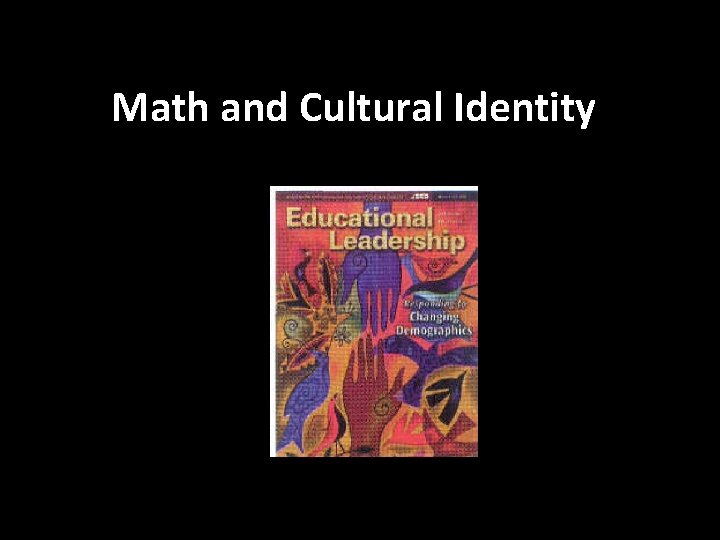
According to Educational Leadership, the culturally responsive teacher must: • Understand how the learner constructs knowledge and beliefs and help build bridges between his knowledge and what he needs to know. • The teacher must learn about the students’ lives and activities. He must be an active member in the community and the school. • The teacher must be socio-culturally responsible. The teacher must understand that a students’ world view is influenced by his experiences. • The teacher must hold affirming views about diversity. He must believe in his students’ abilities and call on each student while presenting an academically rigorous curriculum. • The teacher must use appropriate instructional strategies. He must assign meaningful projects which connect to students’ lives. • The teacher must be an advocate for his students and consider it an obligation to all students achieve. •
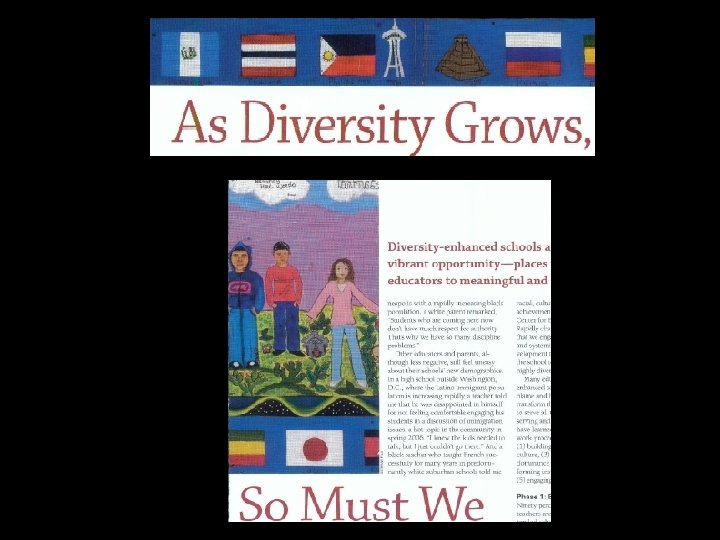
References: Allexsaht-Snider, M. , & Hart, L. E. ( 2001). ” Mathematics for all”: How do we get there? Theory into Practice , 40, 2. 93 -101. Retrieved November 22, 2009 from http: //www. jstor. org/pss/1477270. As diversity grows, so must we. ( 2007, March ). Educational Leadership, 64, 6. 16 -22. Retrieved November 22, 2009 from Wilson Web database. Diez-Palomar, J. , Simic, K. , & Varley, M. ( 2006, December). Math is everywhere: Connecting mathematics to students’ lives. The Journal of Mathematics and Culture, VI, 2. Retrieved November 22, 2009 from http: //www. google. com/search? hl=en&riz=1 G 1 GGLQ_ENUS 331&q=The+Journal+for+Mathematics + and + Culture%2 C+Math+is+Everywhere&aq=foq=&aqi= Hot Button Issue. ( 2007, March). Educational Leadership, 64, 6. 7. Retrieved November 22, 2009 from The Wilson Web database. Promoting academic achievement and identity development among diverse high school students. ( 2004, March). High School Journal. Retrieved November 22, 2009 from The Wilson Web database. The culturally responsive teacher. ( 2007, March ). Educational Leadership, 64, 6. 28 -33. Retrieved November 22, 2009 from The Wilson Web database.
References Continued… • Young-Lee, S. , Olszewski-Kubilius, P. & Peternel, G. ( 2009). Follow – up with students after 6 years of participation in Project Excite. Gifted Child Quarterly, 53, 137. Retrieved November 22, 2009 from http: //gcq. sagepub. com/cgi/content/abstract/53/2/137