
Math Analysis for Managers This lecture flows well

- Slides: 34
Math Analysis for Managers This lecture flows well with Managerial Economics, Mark Hirschey, 12 th edition, chapter 2.
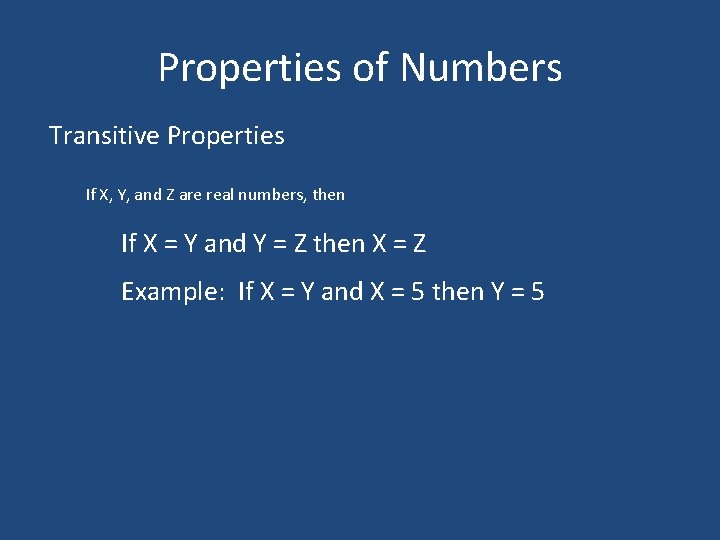
Properties of Numbers Transitive Properties If X, Y, and Z are real numbers, then If X = Y and Y = Z then X = Z Example: If X = Y and X = 5 then Y = 5
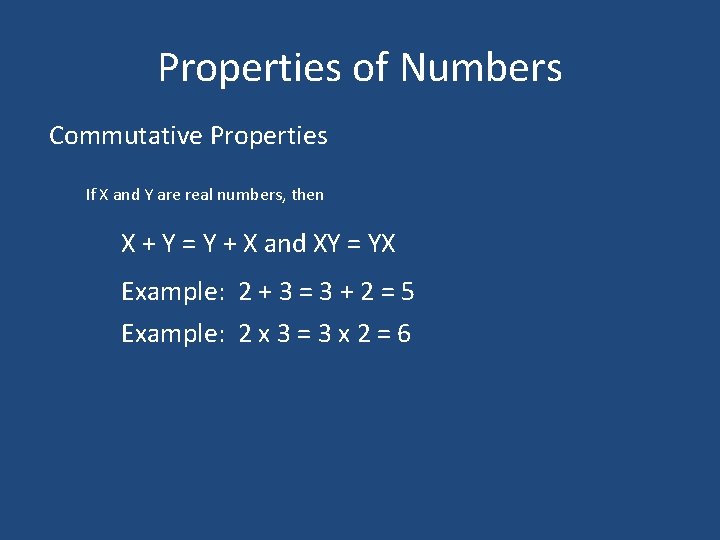
Properties of Numbers Commutative Properties If X and Y are real numbers, then X + Y = Y + X and XY = YX Example: 2 + 3 = 3 + 2 = 5 Example: 2 x 3 = 3 x 2 = 6
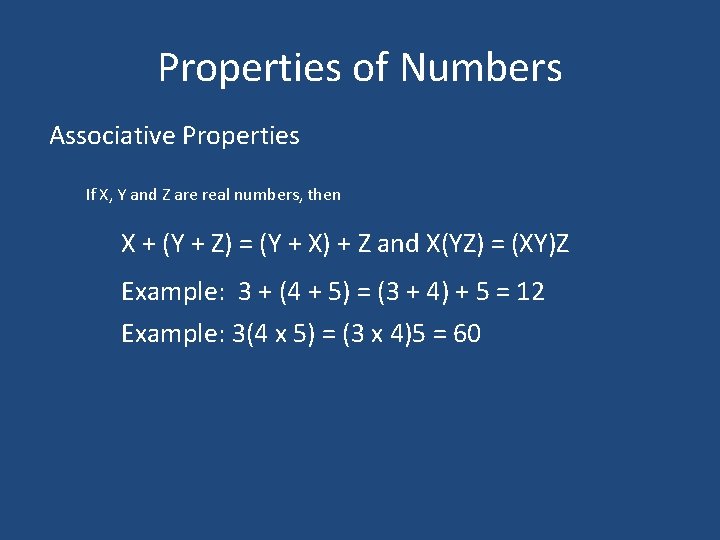
Properties of Numbers Associative Properties If X, Y and Z are real numbers, then X + (Y + Z) = (Y + X) + Z and X(YZ) = (XY)Z Example: 3 + (4 + 5) = (3 + 4) + 5 = 12 Example: 3(4 x 5) = (3 x 4)5 = 60
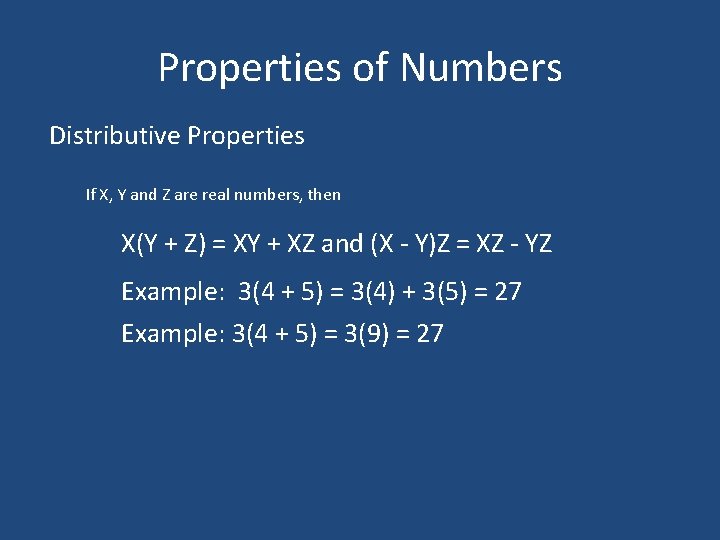
Properties of Numbers Distributive Properties If X, Y and Z are real numbers, then X(Y + Z) = XY + XZ and (X - Y)Z = XZ - YZ Example: 3(4 + 5) = 3(4) + 3(5) = 27 Example: 3(4 + 5) = 3(9) = 27
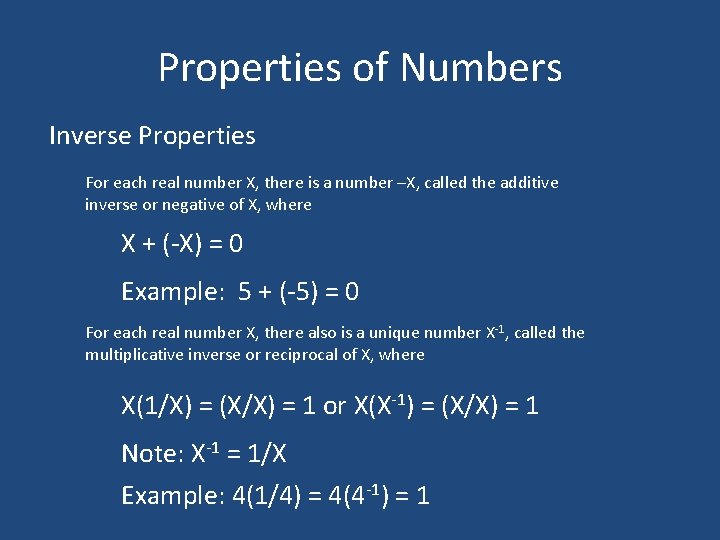
Properties of Numbers Inverse Properties For each real number X, there is a number –X, called the additive inverse or negative of X, where X + (-X) = 0 Example: 5 + (-5) = 0 For each real number X, there also is a unique number X-1, called the multiplicative inverse or reciprocal of X, where X(1/X) = (X/X) = 1 or X(X-1) = (X/X) = 1 Note: X-1 = 1/X Example: 4(1/4) = 4(4 -1) = 1
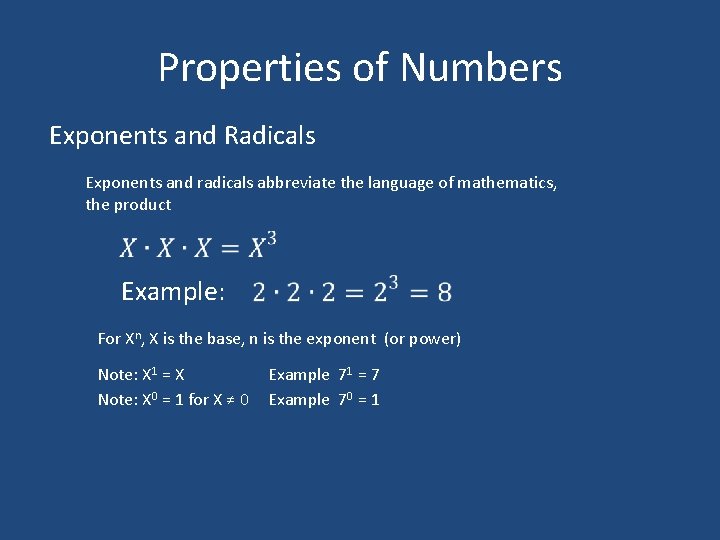
Properties of Numbers Exponents and Radicals Exponents and radicals abbreviate the language of mathematics, the product Example: For Xn, X is the base, n is the exponent (or power) Note: X 1 = X Note: X 0 = 1 for X ≠ 0 Example 71 = 7 Example 70 = 1
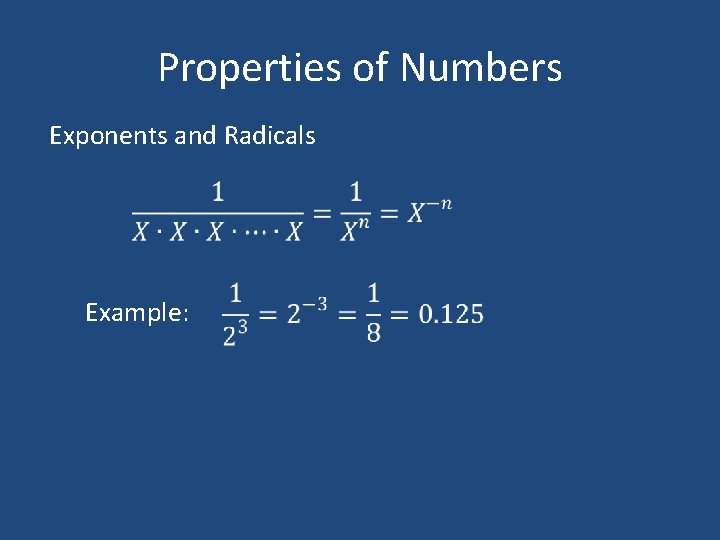
Properties of Numbers Exponents and Radicals Example:
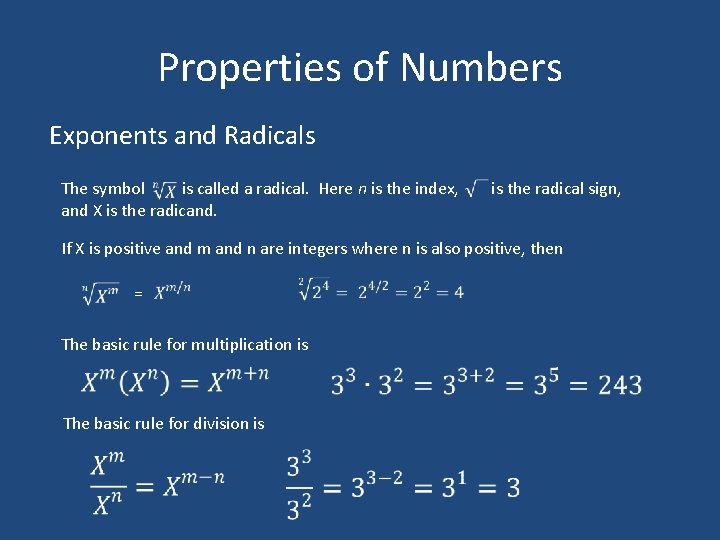
Properties of Numbers Exponents and Radicals The symbol is called a radical. Here n is the index, and X is the radicand. is the radical sign, If X is positive and m and n are integers where n is also positive, then = The basic rule for multiplication is The basic rule for division is
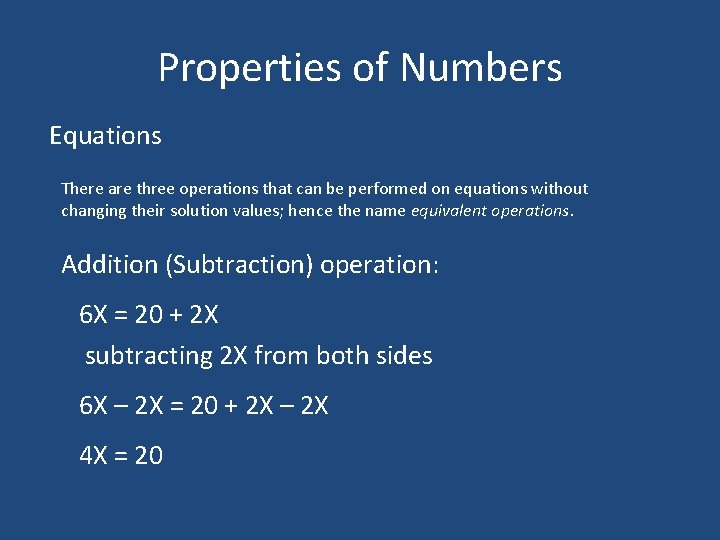
Properties of Numbers Equations There are three operations that can be performed on equations without changing their solution values; hence the name equivalent operations. Addition (Subtraction) operation: 6 X = 20 + 2 X subtracting 2 X from both sides 6 X – 2 X = 20 + 2 X – 2 X 4 X = 20
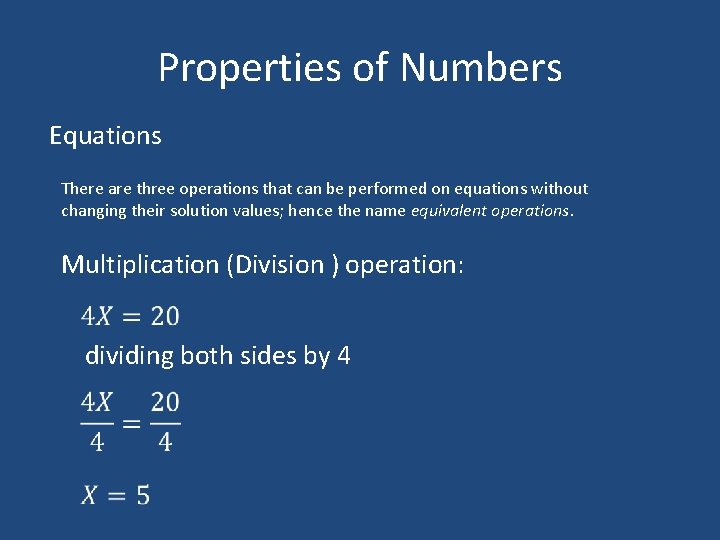
Properties of Numbers Equations There are three operations that can be performed on equations without changing their solution values; hence the name equivalent operations. Multiplication (Division ) operation: dividing both sides by 4
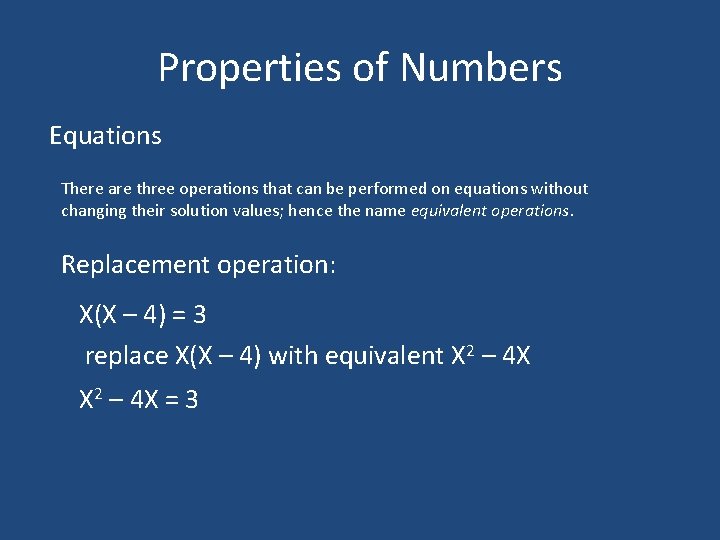
Properties of Numbers Equations There are three operations that can be performed on equations without changing their solution values; hence the name equivalent operations. Replacement operation: X(X – 4) = 3 replace X(X – 4) with equivalent X 2 – 4 X = 3
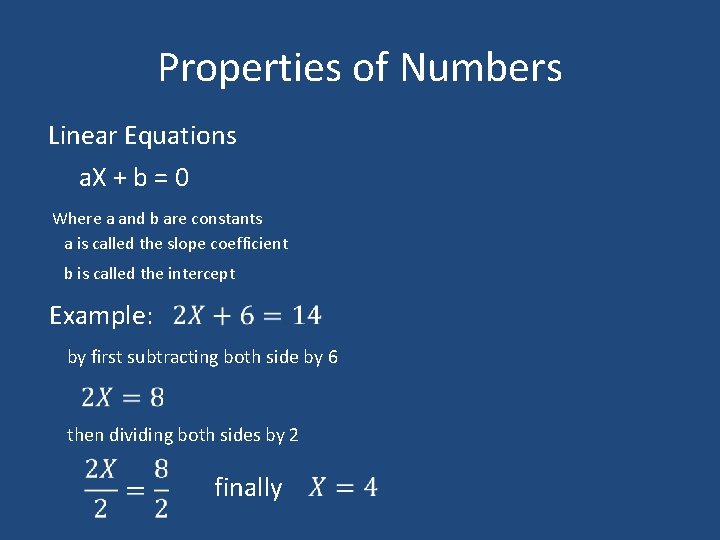
Properties of Numbers Linear Equations a. X + b = 0 Where a and b are constants a is called the slope coefficient b is called the intercept Example: by first subtracting both side by 6 then dividing both sides by 2 finally
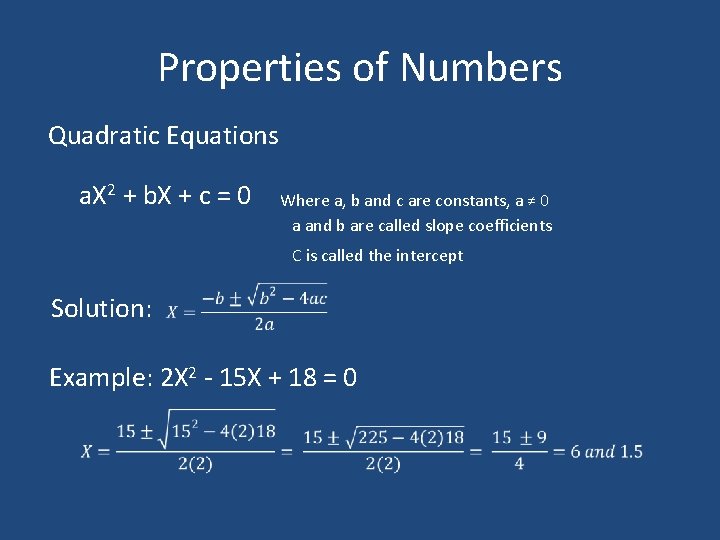
Properties of Numbers Quadratic Equations a. X 2 + b. X + c = 0 Where a, b and c are constants, a ≠ 0 a and b are called slope coefficients C is called the intercept Solution: Example: 2 X 2 - 15 X + 18 = 0
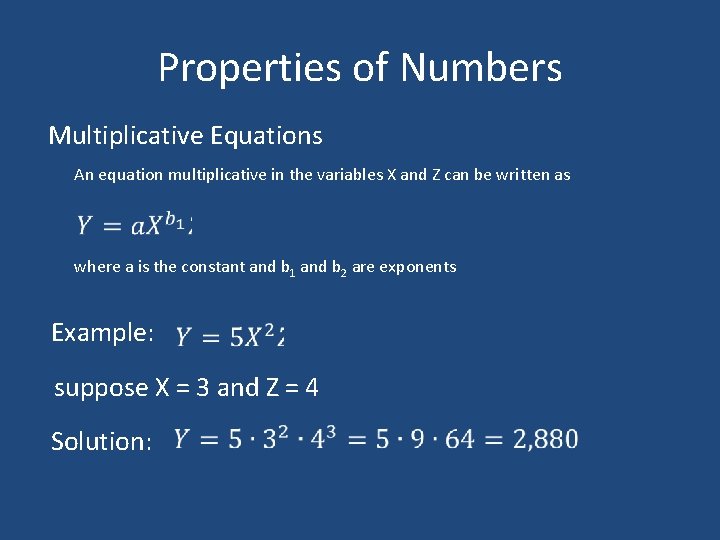
Properties of Numbers Multiplicative Equations An equation multiplicative in the variables X and Z can be written as where a is the constant and b 1 and b 2 are exponents Example: suppose X = 3 and Z = 4 Solution:
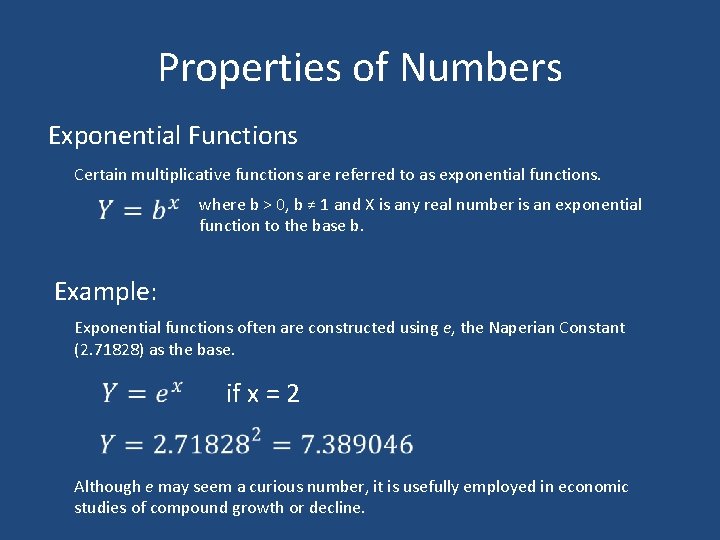
Properties of Numbers Exponential Functions Certain multiplicative functions are referred to as exponential functions. where b > 0, b ≠ 1 and X is any real number is an exponential function to the base b. Example: Exponential functions often are constructed using e, the Naperian Constant (2. 71828) as the base. if x = 2 Although e may seem a curious number, it is usefully employed in economic studies of compound growth or decline.
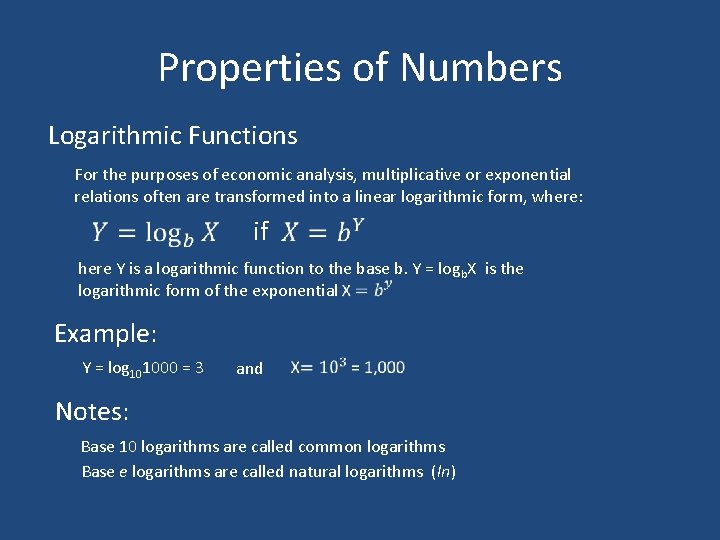
Properties of Numbers Logarithmic Functions For the purposes of economic analysis, multiplicative or exponential relations often are transformed into a linear logarithmic form, where: if here Y is a logarithmic function to the base b. Y = logb. X is the logarithmic form of the exponential Example: Y = log 101000 = 3 and Notes: Base 10 logarithms are called common logarithms Base e logarithms are called natural logarithms (ln)
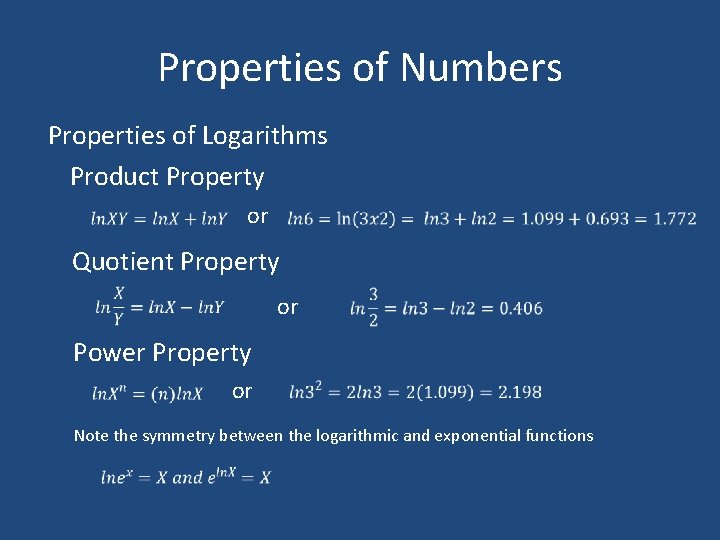
Properties of Numbers Properties of Logarithms Product Property or Quotient Property or Power Property or Note the symmetry between the logarithmic and exponential functions
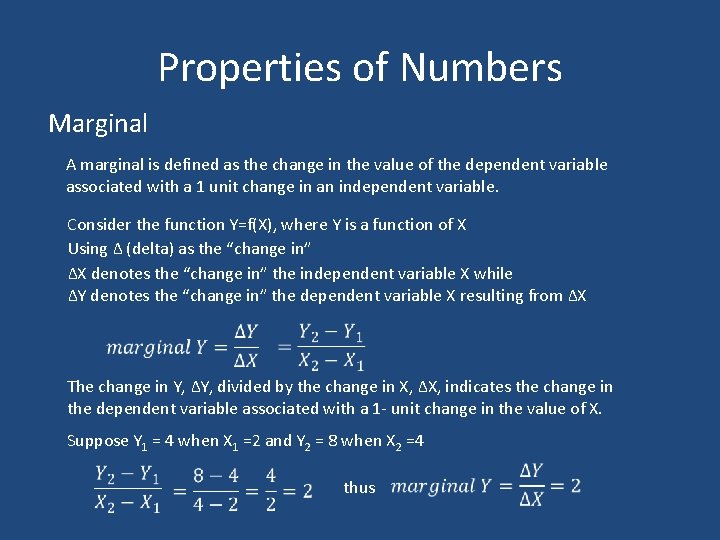
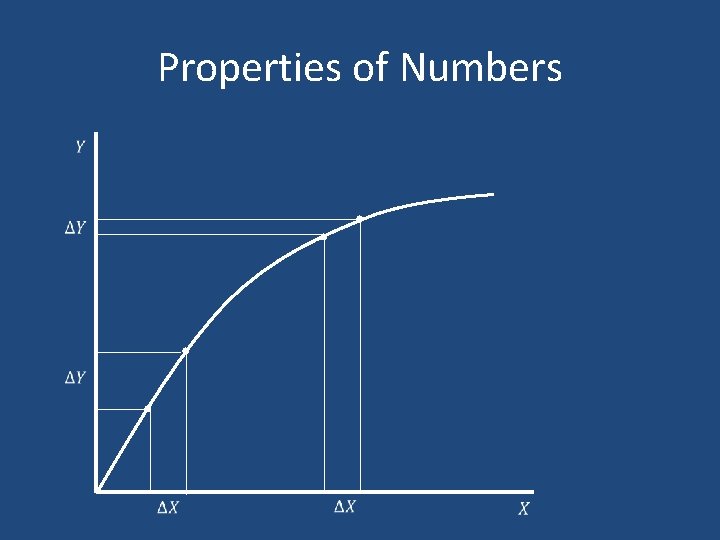
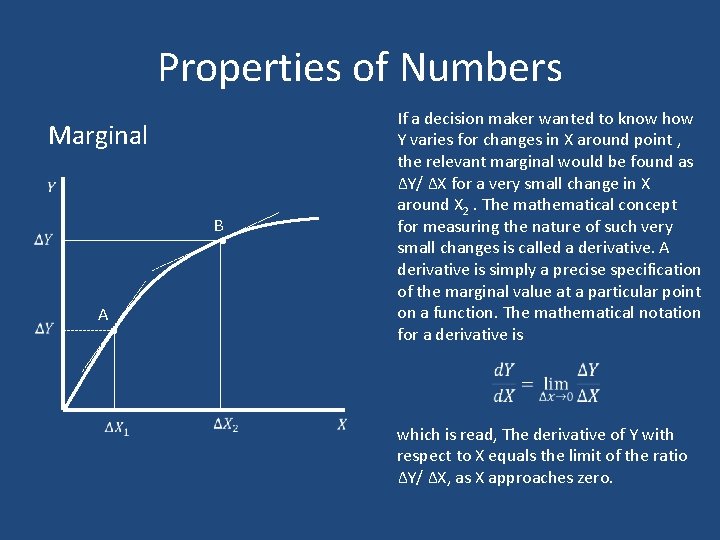
Properties of Numbers Marginal A marginal is defined as the change in the value of the dependent variable associated with a 1 unit change in an independent variable. Consider the function Y=f(X), where Y is a function of X Using ∆ (delta) as the “change in” ∆X denotes the “change in” the independent variable X while ∆Y denotes the “change in” the dependent variable X resulting from ∆X The change in Y, ∆Y, divided by the change in X, ∆X, indicates the change in the dependent variable associated with a 1 - unit change in the value of X. Suppose Y 1 = 4 when X 1 =2 and Y 2 = 8 when X 2 =4 thus
Properties of Numbers . .
Properties of Numbers Marginal . B . A If a decision maker wanted to know how Y varies for changes in X around point , the relevant marginal would be found as ∆Y/ ∆X for a very small change in X around X 2. The mathematical concept for measuring the nature of such very small changes is called a derivative. A derivative is simply a precise specification of the marginal value at a particular point on a function. The mathematical notation for a derivative is which is read, The derivative of Y with respect to X equals the limit of the ratio ∆Y/ ∆X, as X approaches zero.
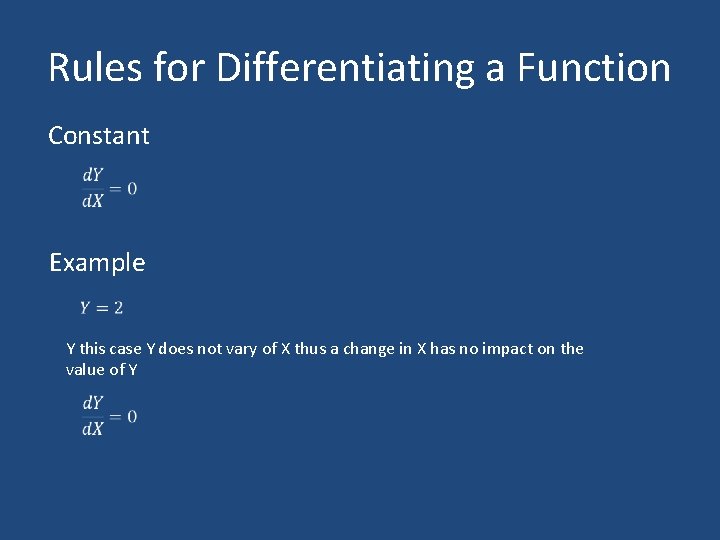
Rules for Differentiating a Function Constant Example Y this case Y does not vary of X thus a change in X has no impact on the value of Y
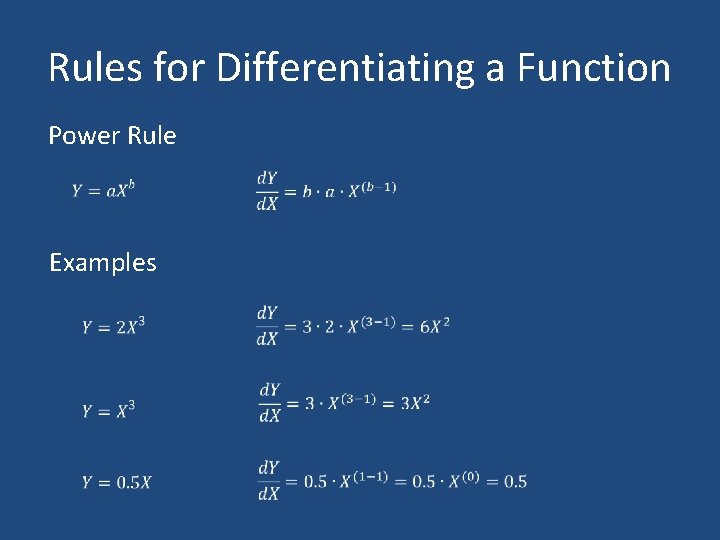
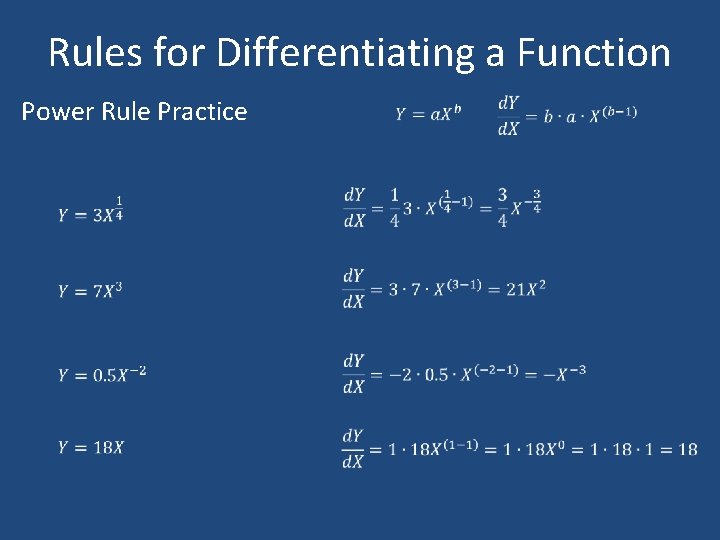
Rules for Differentiating a Function Power Rule Examples
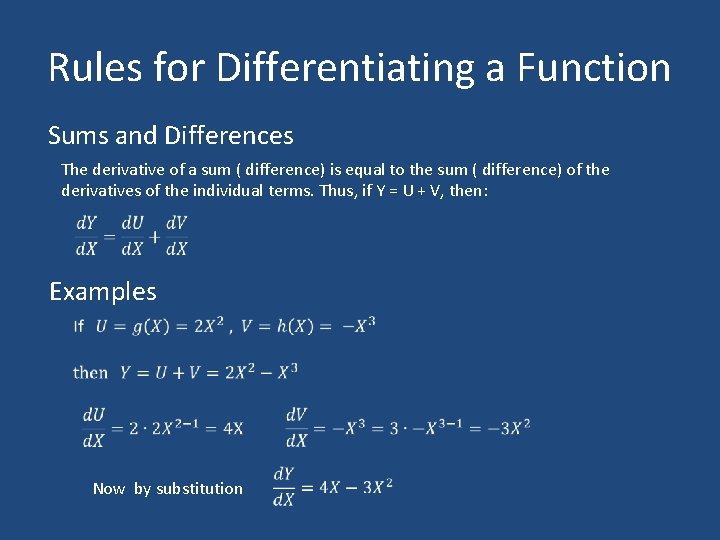
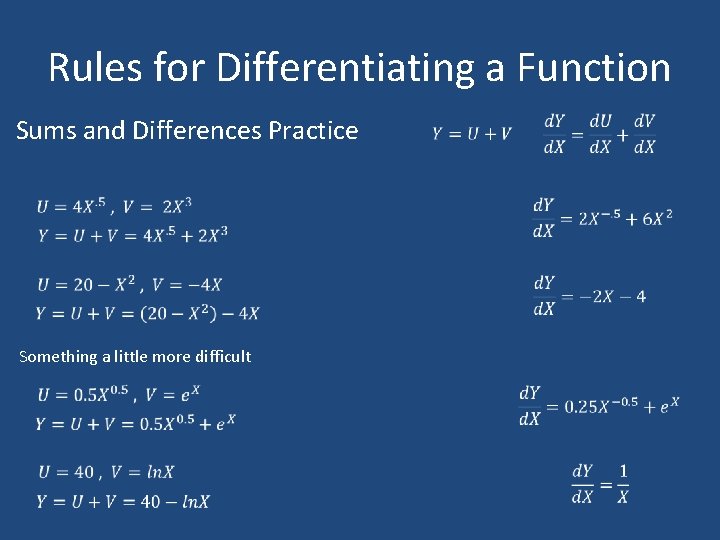
Rules for Differentiating a Function Sums and Differences The derivative of a sum ( difference) is equal to the sum ( difference) of the derivatives of the individual terms. Thus, if Y = U + V, then: Examples Now by substitution
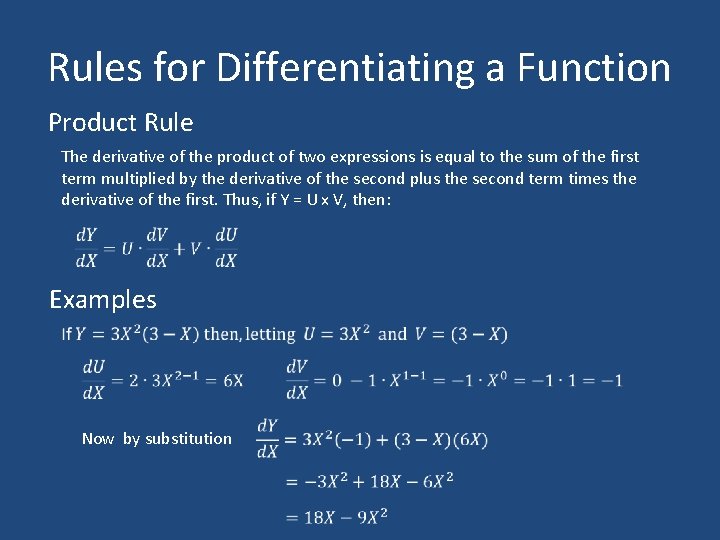
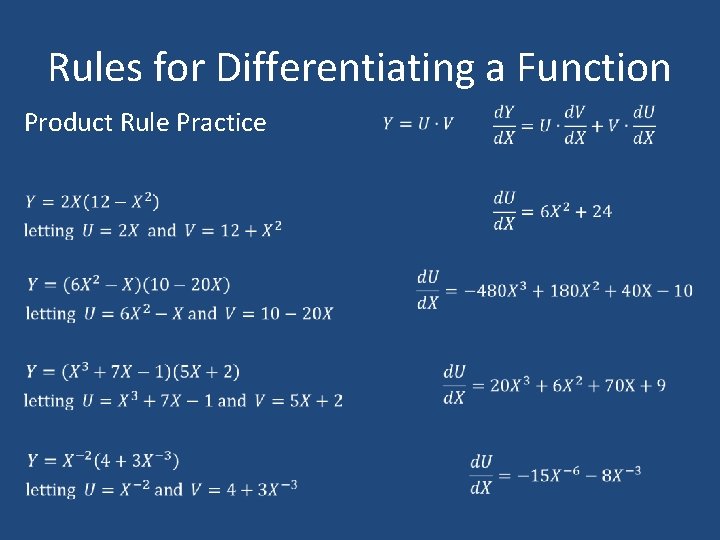
Rules for Differentiating a Function Product Rule The derivative of the product of two expressions is equal to the sum of the first term multiplied by the derivative of the second plus the second term times the derivative of the first. Thus, if Y = U x V, then: Examples Now by substitution
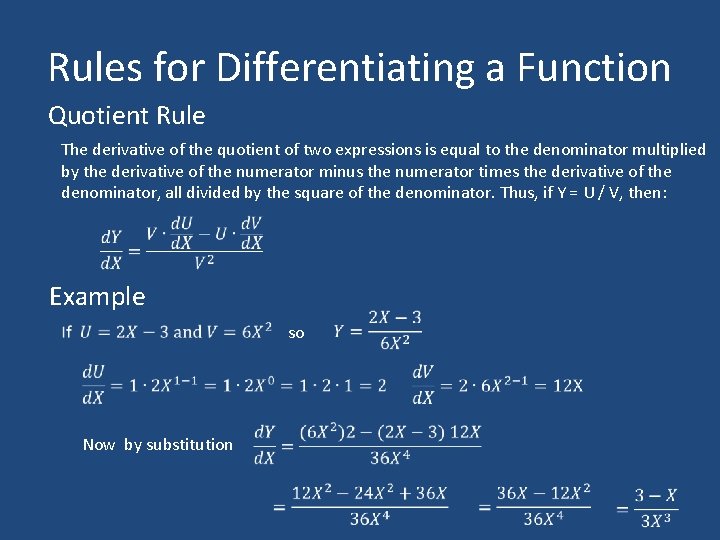
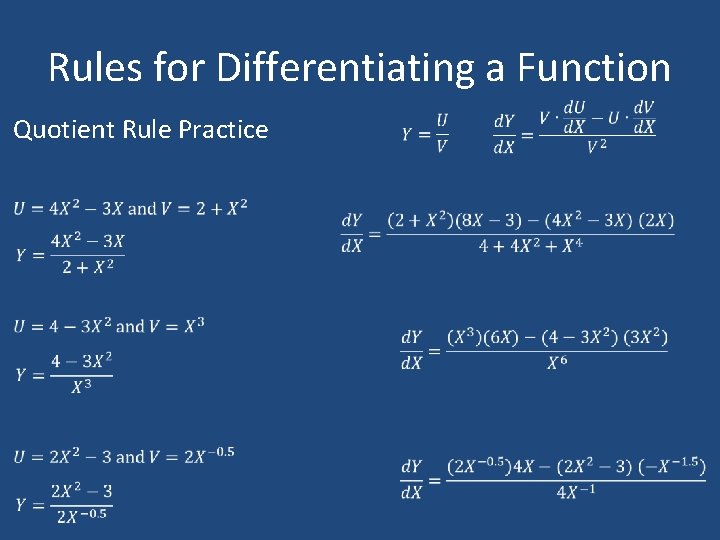
Rules for Differentiating a Function Quotient Rule The derivative of the quotient of two expressions is equal to the denominator multiplied by the derivative of the numerator minus the numerator times the derivative of the denominator, all divided by the square of the denominator. Thus, if Y = U / V, then: Example so Now by substitution
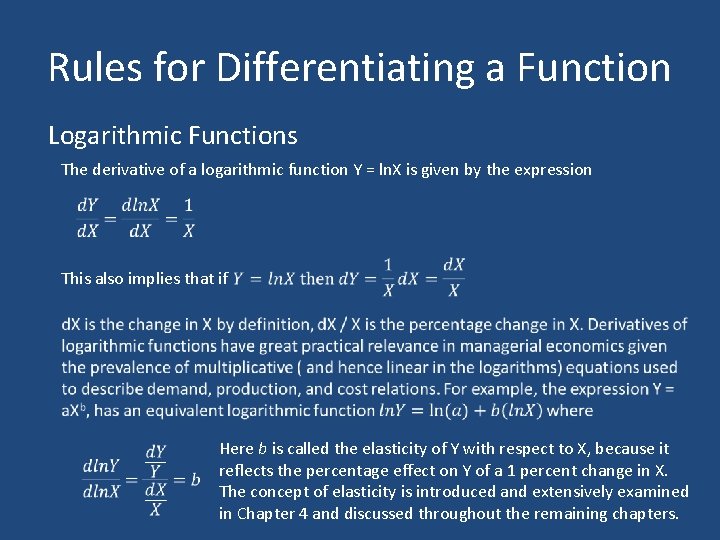
Rules for Differentiating a Function Logarithmic Functions The derivative of a logarithmic function Y = ln. X is given by the expression This also implies that if Here b is called the elasticity of Y with respect to X, because it reflects the percentage effect on Y of a 1 percent change in X. The concept of elasticity is introduced and extensively examined in Chapter 4 and discussed throughout the remaining chapters.
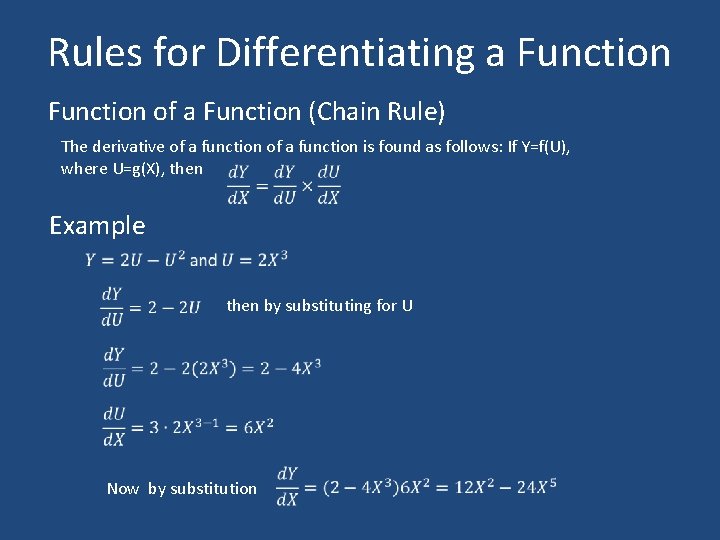
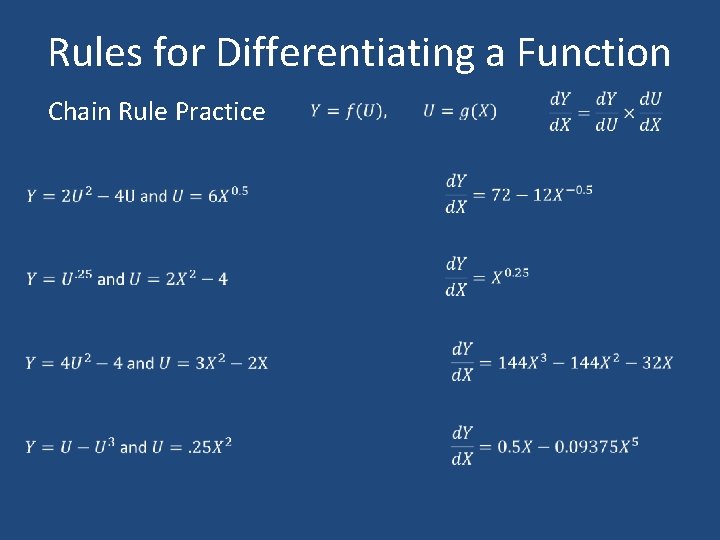
Rules for Differentiating a Function of a Function (Chain Rule) The derivative of a function is found as follows: If Y=f(U), where U=g(X), then Example then by substituting for U Now by substitution
Practice Problems
Rules for Differentiating a Function Power Rule Practice
Rules for Differentiating a Function Sums and Differences Practice Something a little more difficult
Rules for Differentiating a Function Product Rule Practice
Rules for Differentiating a Function Quotient Rule Practice
Rules for Differentiating a Function Chain Rule Practice