
Math 8 H 8 2 Factoring Using the
- Slides: 17
Math 8 H 8 -2 Factoring Using the Distributive Property Algebra 1 Glencoe Mc. Graw-Hill Jo. Ann Evans
Factoring is nothing more than performing the distributive property in reverse. Think of it as “undistributing”. Factoring is a way of looking at a polynomial and then rewriting the polynomial in the form it had before the distributive property was performed.
The simplest form of factoring is pulling out the Greatest Common Monomial Factor. To do this, look at the terms in a polynomial and ask yourself what all of the terms have in common. Once you’ve determined the GCMF, divide it out of each term, putting it outside a set of parentheses. The expression inside the parentheses will be what’s left of each term after the GCMF has been divided out.
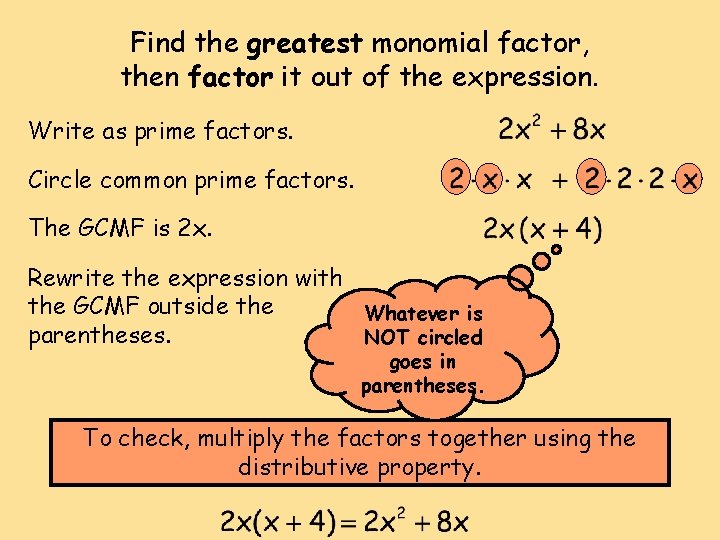
Find the greatest monomial factor, then factor it out of the expression. Write as prime factors. Circle common prime factors. The GCMF is 2 x. Rewrite the expression with the GCMF outside the Whatever is parentheses. NOT circled goes in parentheses. To check, multiply the factors together using the distributive property.
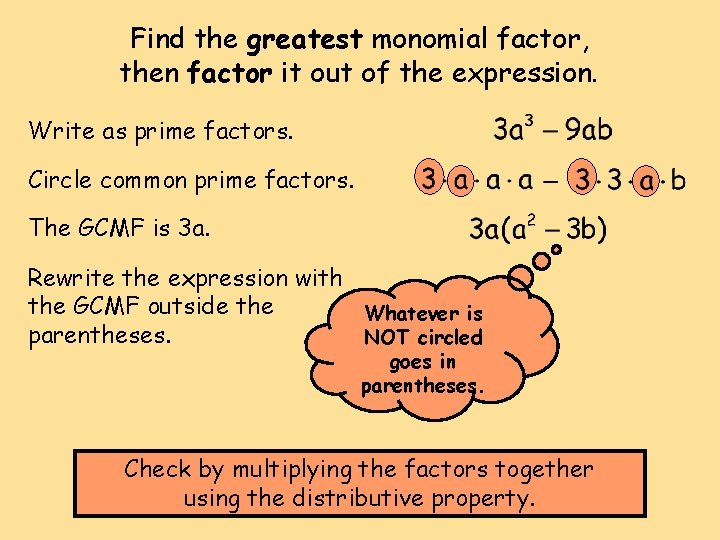
Find the greatest monomial factor, then factor it out of the expression. Write as prime factors. Circle common prime factors. The GCMF is 3 a. Rewrite the expression with the GCMF outside the Whatever is parentheses. NOT circled goes in parentheses. Check by multiplying the factors together using the distributive property.
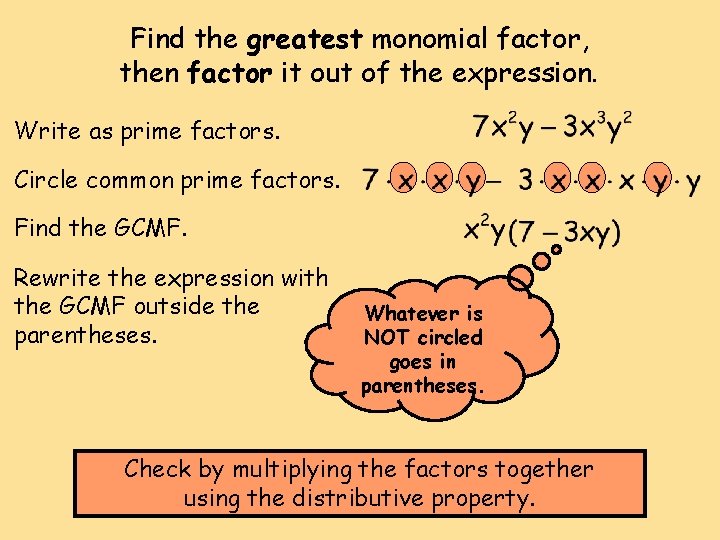
Find the greatest monomial factor, then factor it out of the expression. Write as prime factors. Circle common prime factors. Find the GCMF. Rewrite the expression with the GCMF outside the parentheses. Whatever is NOT circled goes in parentheses. Check by multiplying the factors together using the distributive property.
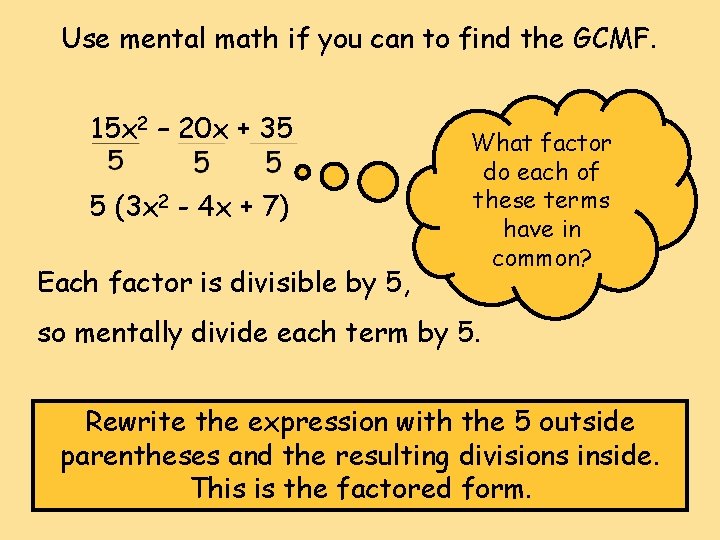
Use mental math if you can to find the GCMF. 15 x 2 – 20 x + 35 5 (3 x 2 - 4 x + 7) Each factor is divisible by 5, What factor do each of these terms have in common? so mentally divide each term by 5. Rewrite the expression with the 5 outside parentheses and the resulting divisions inside. This is the factored form.
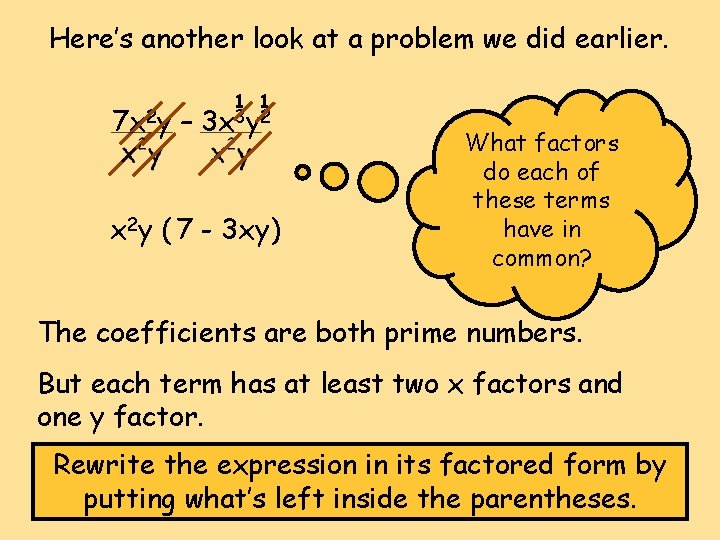
Here’s another look at a problem we did earlier. 7 x 2 y – 1 1 3 x 3 y 2 x 2 y ( 7 - 3 xy ) What factors do each of these terms have in common? The coefficients are both prime numbers. But each term has at least two x factors and one y factor. Rewrite the expression in its factored form by putting what’s left inside the parentheses.
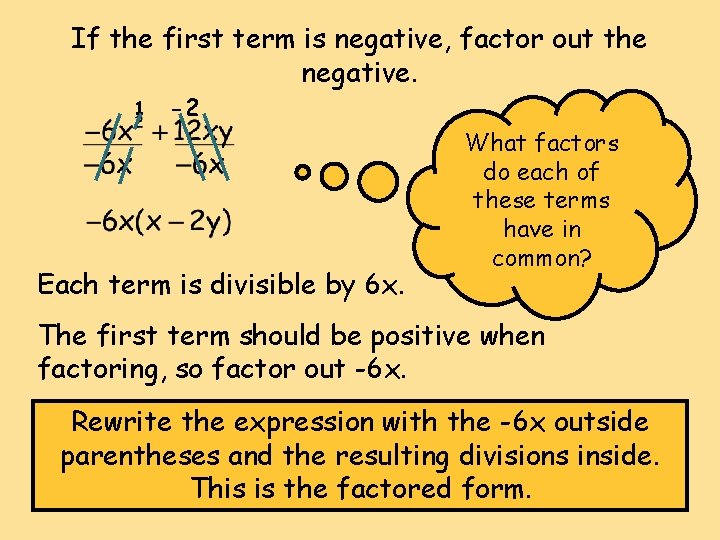
If the first term is negative, factor out the negative. 1 -2 Each term is divisible by 6 x. What factors do each of these terms have in common? The first term should be positive when factoring, so factor out -6 x. Rewrite the expression with the -6 x outside parentheses and the resulting divisions inside. This is the factored form.
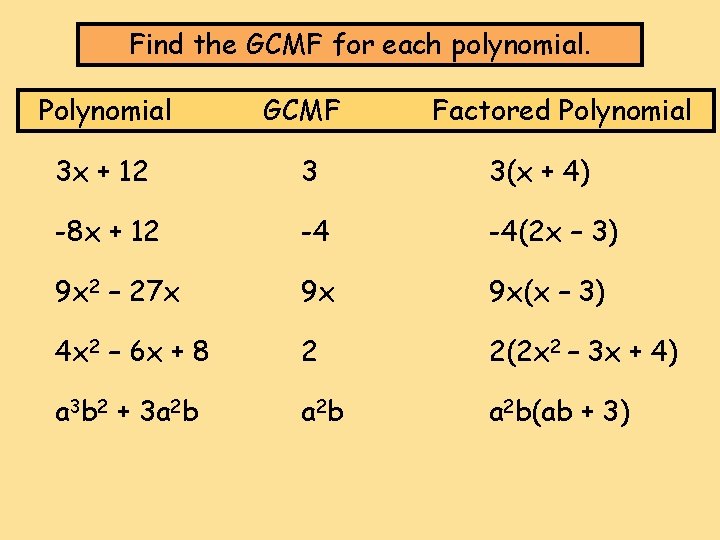
Find the GCMF for each polynomial. Polynomial GCMF Factored Polynomial 3 x + 12 3 3(x + 4) -8 x + 12 -4 -4(2 x – 3) 9 x 2 – 27 x 9 x 9 x(x – 3) 4 x 2 – 6 x + 8 2 2(2 x 2 – 3 x + 4) a 3 b 2 + 3 a 2 b(ab + 3)
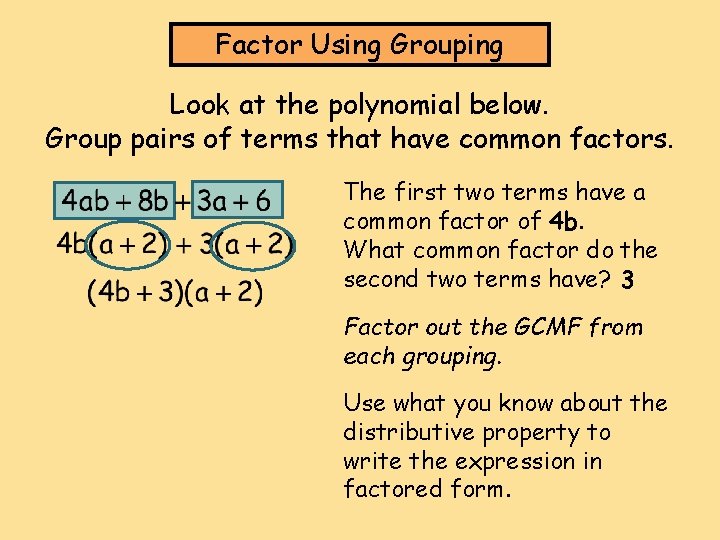
Factor Using Grouping Look at the polynomial below. Group pairs of terms that have common factors. The first two terms have a common factor of 4 b. What common factor do the second two terms have? 3 Factor out the GCMF from each grouping. Use what you know about the distributive property to write the expression in factored form.
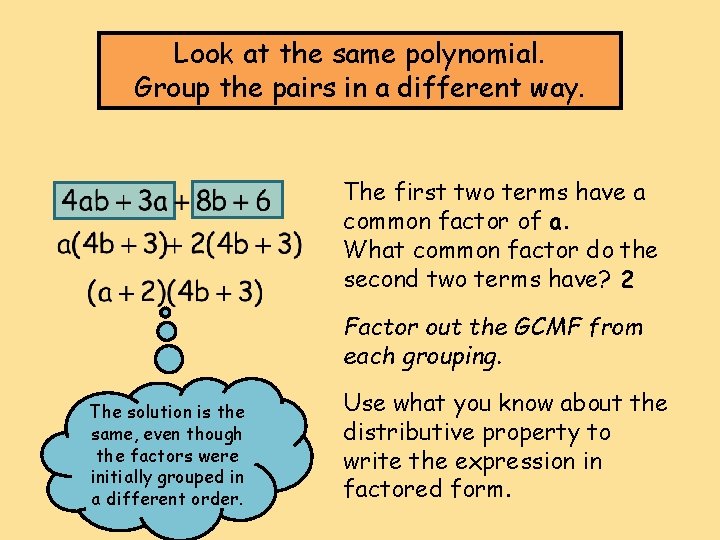
Look at the same polynomial. Group the pairs in a different way. The first two terms have a common factor of a. What common factor do the second two terms have? 2 Factor out the GCMF from each grouping. The solution is the same, even though the factors were initially grouped in a different order. Use what you know about the distributive property to write the expression in factored form.
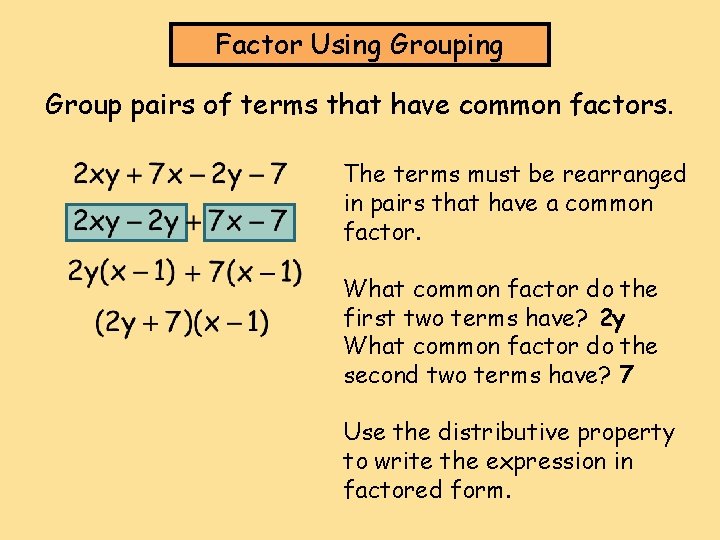
Factor Using Group pairs of terms that have common factors. The terms must be rearranged in pairs that have a common factor. What common factor do the first two terms have? 2 y What common factor do the second two terms have? 7 Use the distributive property to write the expression in factored form.
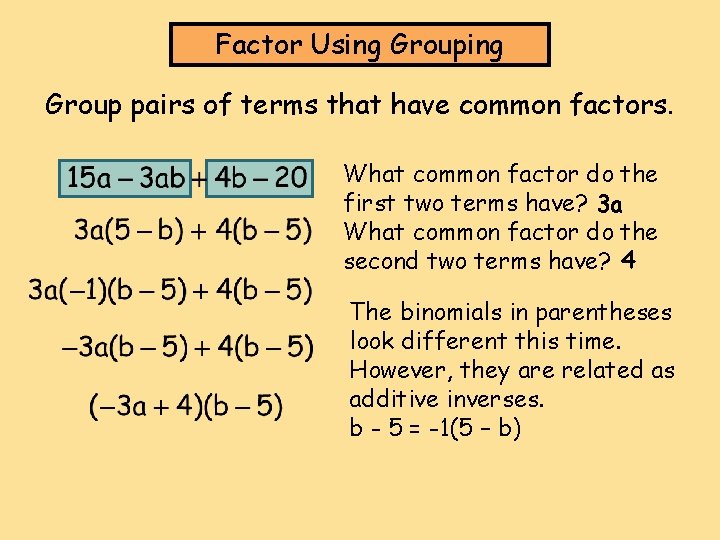
Factor Using Group pairs of terms that have common factors. What common factor do the first two terms have? 3 a What common factor do the second two terms have? 4 The binomials in parentheses look different this time. However, they are related as additive inverses. b - 5 = -1(5 – b)
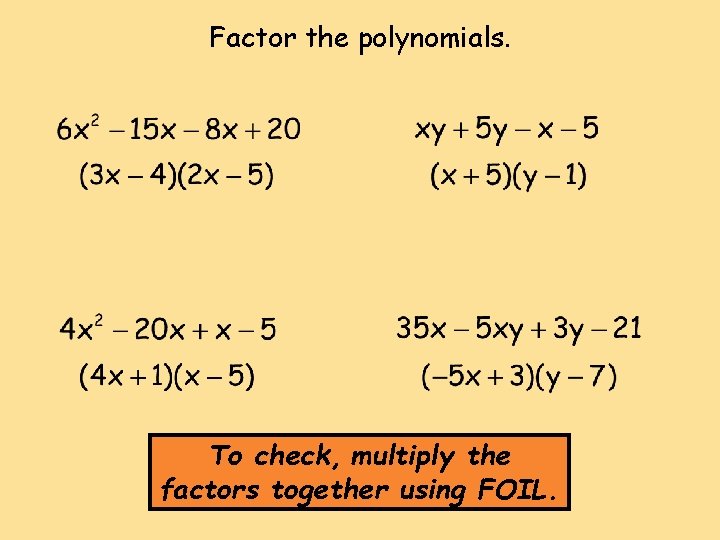
Factor the polynomials. To check, multiply the factors together using FOIL.
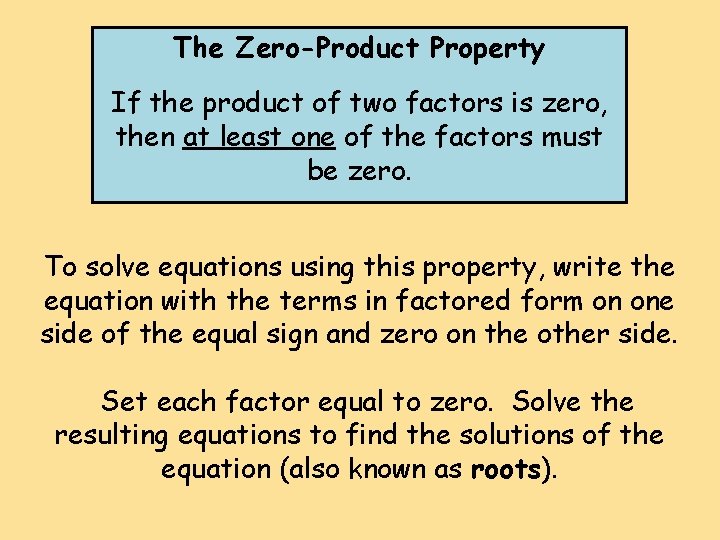
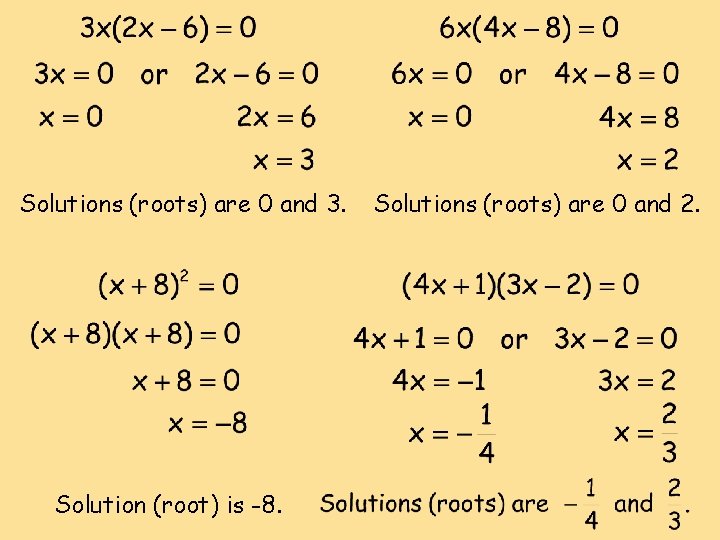
The Zero-Product Property If the product of two factors is zero, then at least one of the factors must be zero. To solve equations using this property, write the equation with the terms in factored form on one side of the equal sign and zero on the other side. Set each factor equal to zero. Solve the resulting equations to find the solutions of the equation (also known as roots).
Solutions (roots) are 0 and 3. Solution (root) is -8. Solutions (roots) are 0 and 2.