
Math 7 Unit 6 Test Review 1 Which

- Slides: 18
Math 7 Unit 6 Test Review
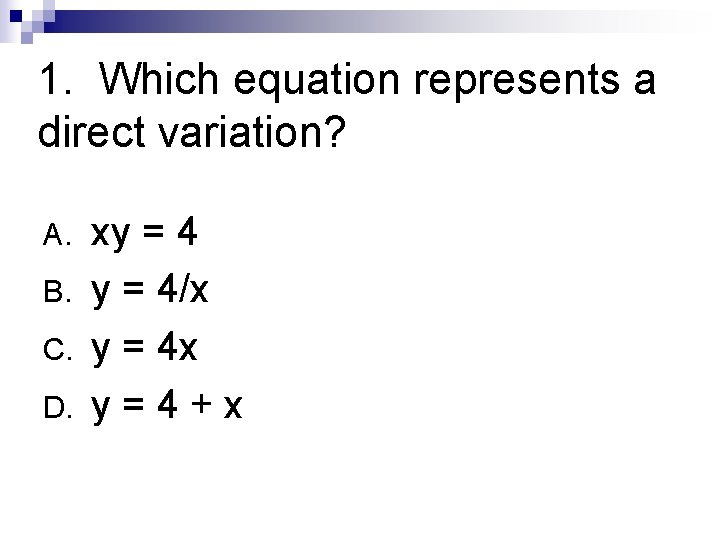
1. Which equation represents a direct variation? A. B. C. D. xy = 4/x y = 4 x y=4+x
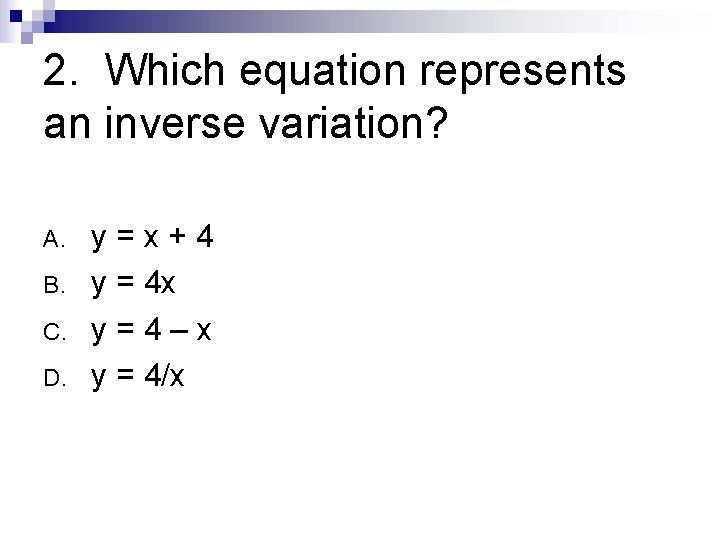
2. Which equation represents an inverse variation? A. B. C. D. y=x+4 y = 4 x y=4–x y = 4/x
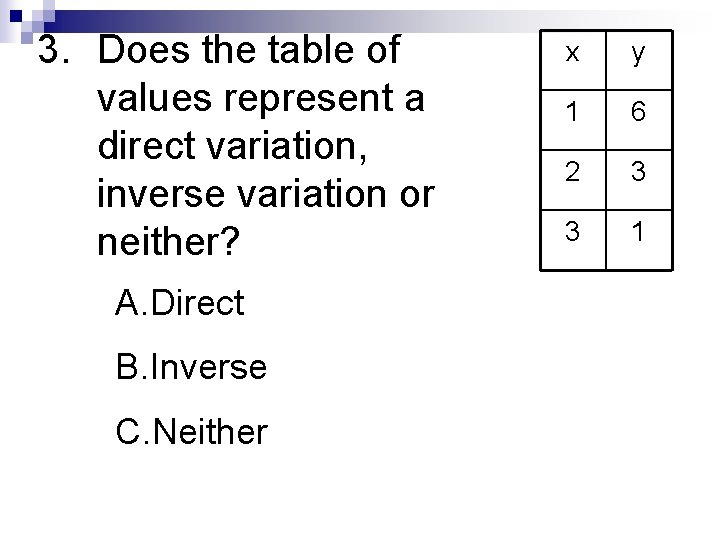
3. Does the table of values represent a direct variation, inverse variation or neither? A. Direct B. Inverse C. Neither x y 1 6 2 3 3 1
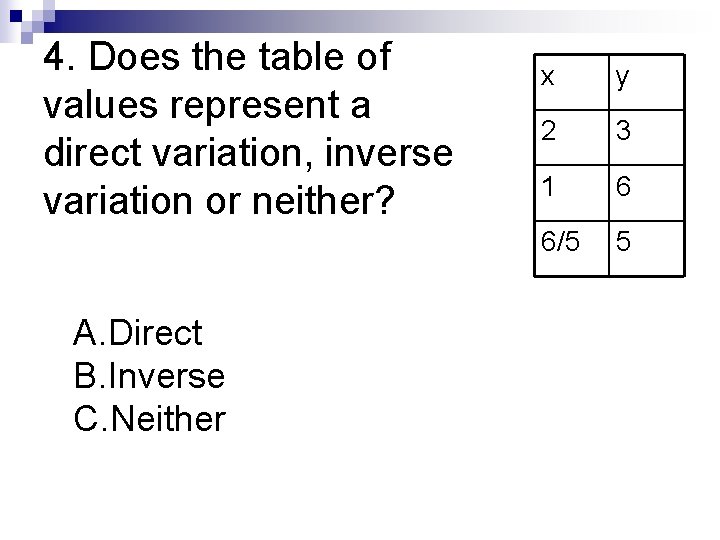
4. Does the table of values represent a direct variation, inverse variation or neither? A. Direct B. Inverse C. Neither x y 2 3 1 6 6/5 5
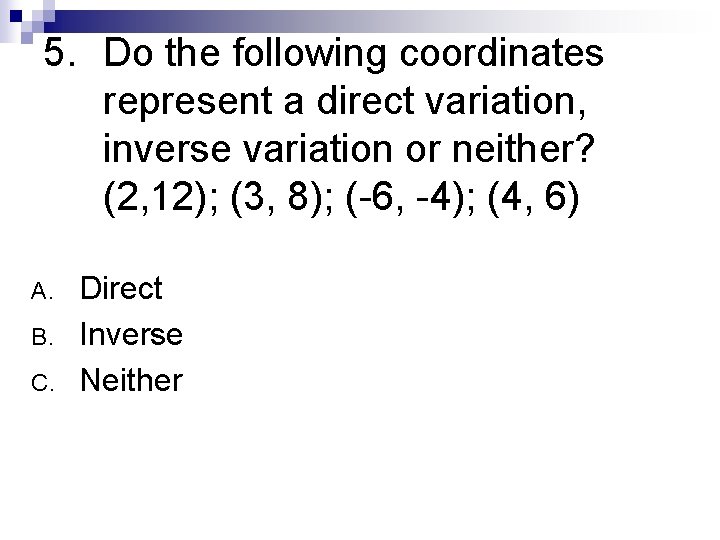
5. Do the following coordinates represent a direct variation, inverse variation or neither? (2, 12); (3, 8); (-6, -4); (4, 6) A. B. C. Direct Inverse Neither
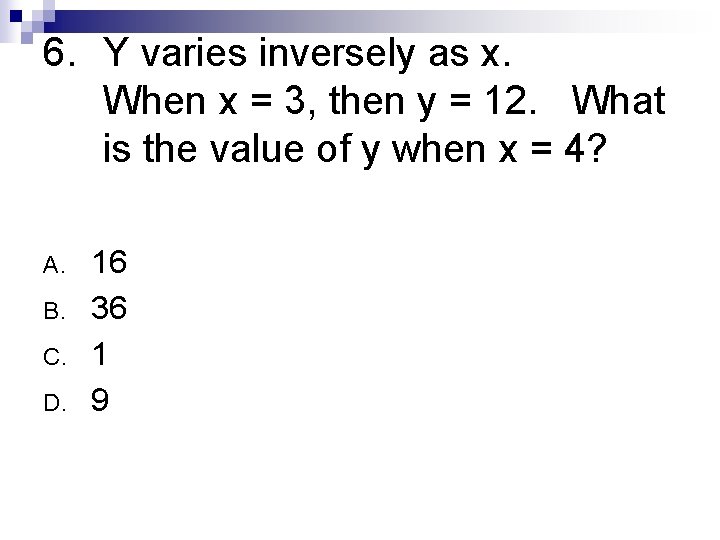
6. Y varies inversely as x. When x = 3, then y = 12. What is the value of y when x = 4? A. B. C. D. 16 36 1 9
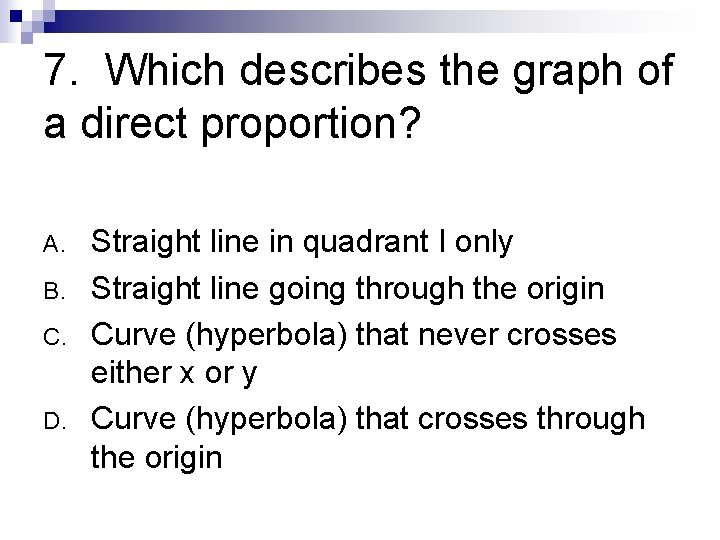
7. Which describes the graph of a direct proportion? A. B. C. D. Straight line in quadrant I only Straight line going through the origin Curve (hyperbola) that never crosses either x or y Curve (hyperbola) that crosses through the origin
8. Which describes the graph of an inverse variation? A. B. C. D. Straight line in quadrant I only Straight line going through the origin Curve (hyperbola) that never crosses either x or y Curve (hyperbola) that crosses through the origin
9. The school board has $2, 000 to use for school supplies. If they give each school an equal amount, how do they decide how much money each school gets? A. B. C. Take $2, 000 and divide it by how many schools there are Take the number of schools and divide that by $2, 000 Take $2, 000 and multiply by the number of schools there are
10. What type of variation does the previous situation represent? A. B. C. Direct Inverse Neither
11. John makes $10 for each lawn he mows. How can you determine how much money he will make? A. B. C. D. Multiply 10 by the number of lawns he mows Divide the number of lawns he mows by 10 Add 10 to the number of lawns he mows Divide 10 by the number of lawns he mows
12. What type of variation does the previous situation represent? A. B. C. Direct Inverse Neither
13. Celina is making a new recipe of dog treats. The recipe calls for 6 cups of whole wheat flour for 125 dog treats. If she only wants to make 50 dog treats, how many cups of flour does she need? A. B. C. D. 15 cups 2 1/6 cups 2. 5 cups 2 cups
14. If x = 4 and y = 12, and x varies directly with y, what is x when y = 18 A. B. C. D. 6 3 2 54
15. y varies inversely with x. When x = 10, then y = 2. What is y when x=4 A. B. C. D. 4/5 5 20 8
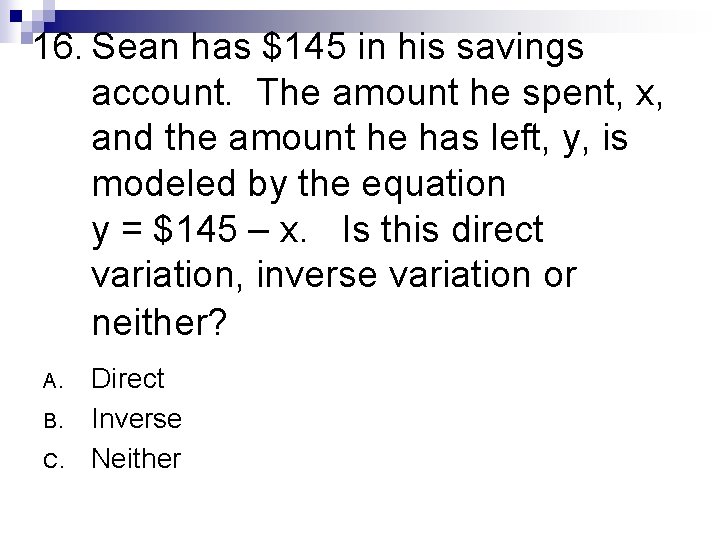
16. Sean has $145 in his savings account. The amount he spent, x, and the amount he has left, y, is modeled by the equation y = $145 – x. Is this direct variation, inverse variation or neither? A. B. C. Direct Inverse Neither