
MATH 310 FALL 2003 Combinatorial Problem Solving Lecture
MATH 310, FALL 2003 (Combinatorial Problem Solving) Lecture 37, Wednesday, December 3
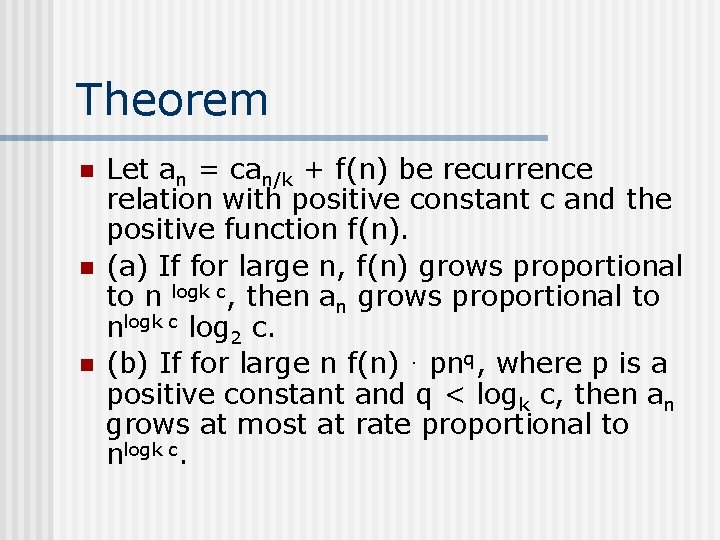
Theorem n n n Let an = can/k + f(n) be recurrence relation with positive constant c and the positive function f(n). (a) If for large n, f(n) grows proportional to n logk c, then an grows proportional to nlogk c log 2 c. (b) If for large n f(n) · pnq, where p is a positive constant and q < logk c, then an grows at most at rate proportional to nlogk c.
7. 3. Solution of Linear Recurrence Relations n Homework (MATH 310#11 W): • Read 7. 4 • Do 7. 3: all odd numbered problems • Turn in 7. 3: 2, 4, 6, 8, 10
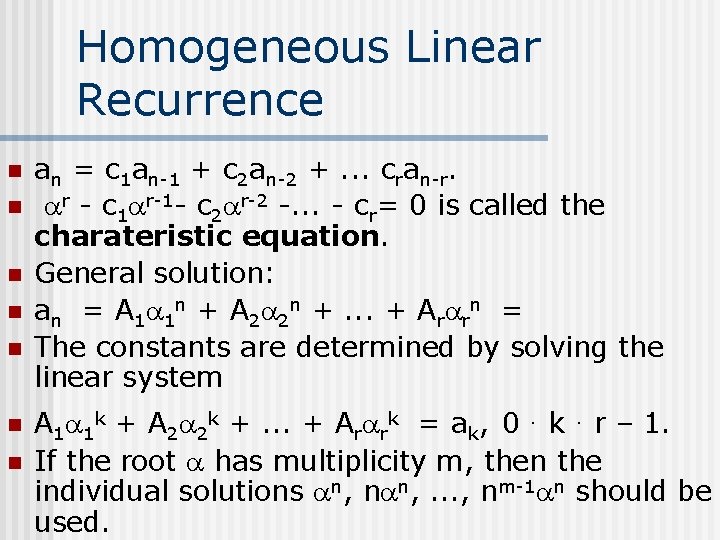
Homogeneous Linear Recurrence n n n n an = c 1 an-1 + c 2 an-2 +. . . cran-r. ar - c 1 ar-1 - c 2 ar-2 -. . . - cr= 0 is called the charateristic equation. General solution: an = A 1 a 1 n + A 2 a 2 n +. . . + Ararn = The constants are determined by solving the linear system A 1 a 1 k + A 2 a 2 k +. . . + Arark = ak, 0 · k · r – 1. If the root a has multiplicity m, then the individual solutions an, nan, . . . , nm-1 an should be used.
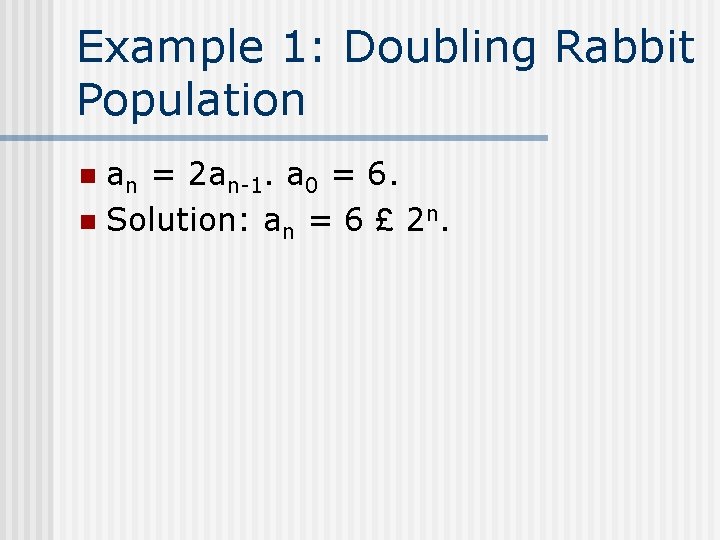
Example 1: Doubling Rabbit Population an = 2 an-1. a 0 = 6. n Solution: an = 6 £ 2 n. n

Example 2: Second-Order Recurrence Relation Solve the recurrence relation an = 2 an-1 + 3 an-2 with a 0 = a 1 = 1. n Solution: n an = A 13 n + A 2(-1)n where A 1 = A 2 = ½. n
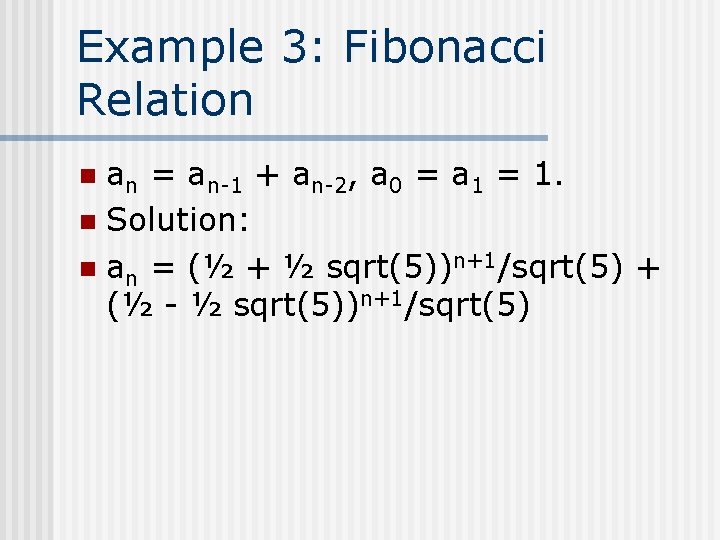
Example 3: Fibonacci Relation an = an-1 + an-2, a 0 = a 1 = 1. n Solution: n an = (½ + ½ sqrt(5))n+1/sqrt(5) + (½ - ½ sqrt(5))n+1/sqrt(5) n
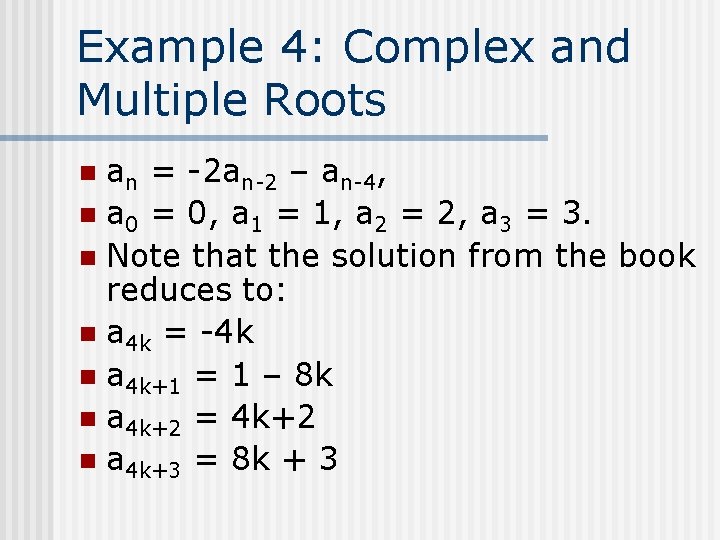
Example 4: Complex and Multiple Roots an = -2 an-2 – an-4, n a 0 = 0, a 1 = 1, a 2 = 2, a 3 = 3. n Note that the solution from the book reduces to: n a 4 k = -4 k n a 4 k+1 = 1 – 8 k n a 4 k+2 = 4 k+2 n a 4 k+3 = 8 k + 3 n
- Slides: 8