
MATH 3 FINAL EXAM REVIEW PART 1 Unit
- Slides: 17
MATH 3 FINAL EXAM REVIEW PART 1 Unit 3: Linear Programming Unit 3. 2: Quadratic Functions Unit 4: Higher-Order Polynomial Functions Unit 7: Exponential & Log Functions
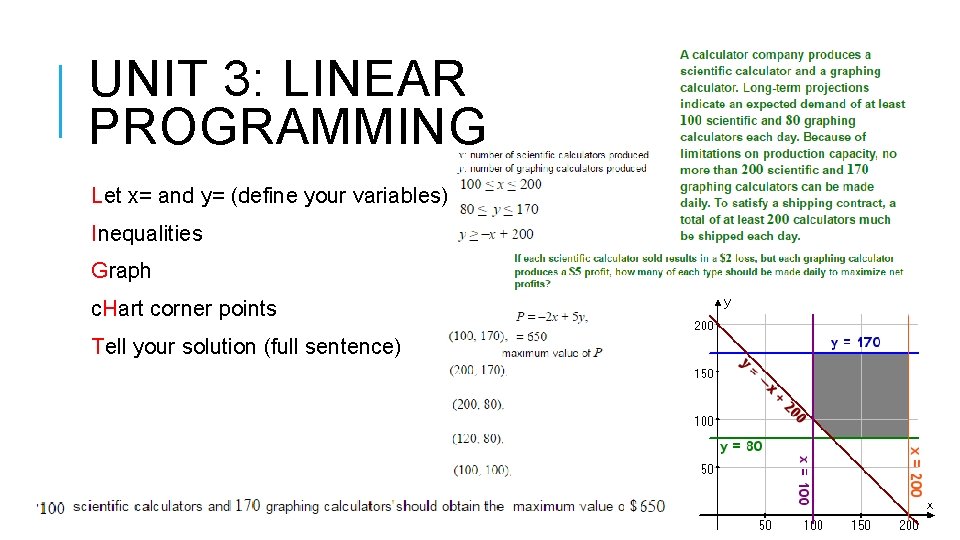
UNIT 3: LINEAR PROGRAMMING Let x= and y= (define your variables) Inequalities Graph c. Hart corner points Tell your solution (full sentence)
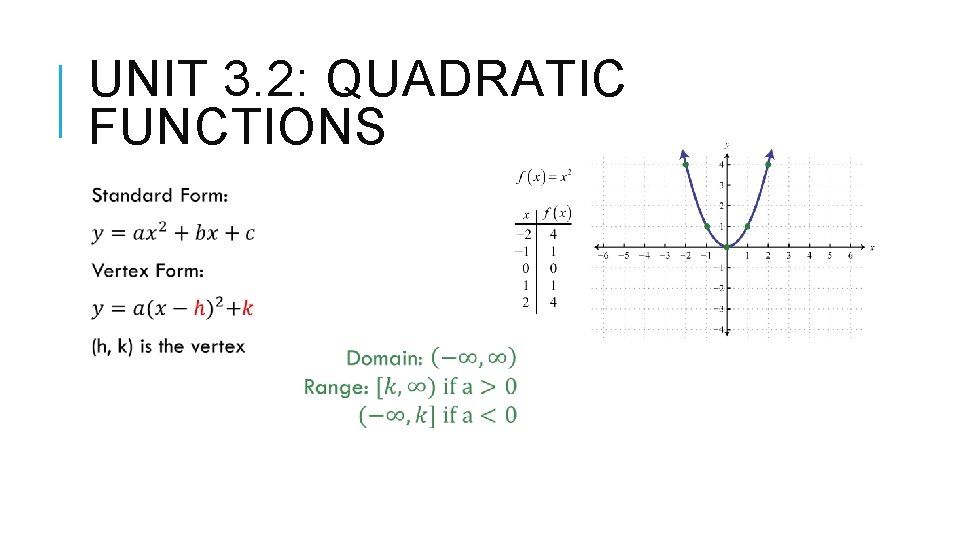
UNIT 3. 2: QUADRATIC FUNCTIONS
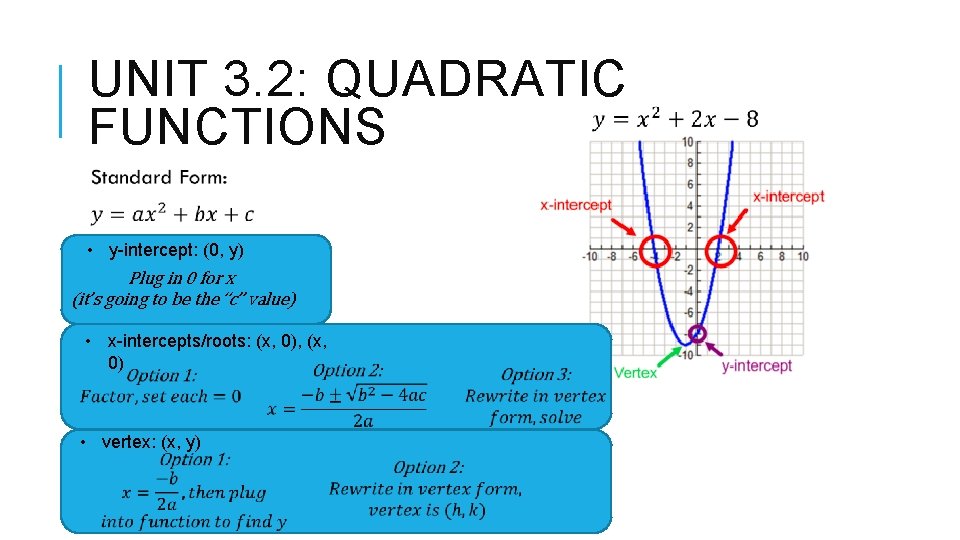
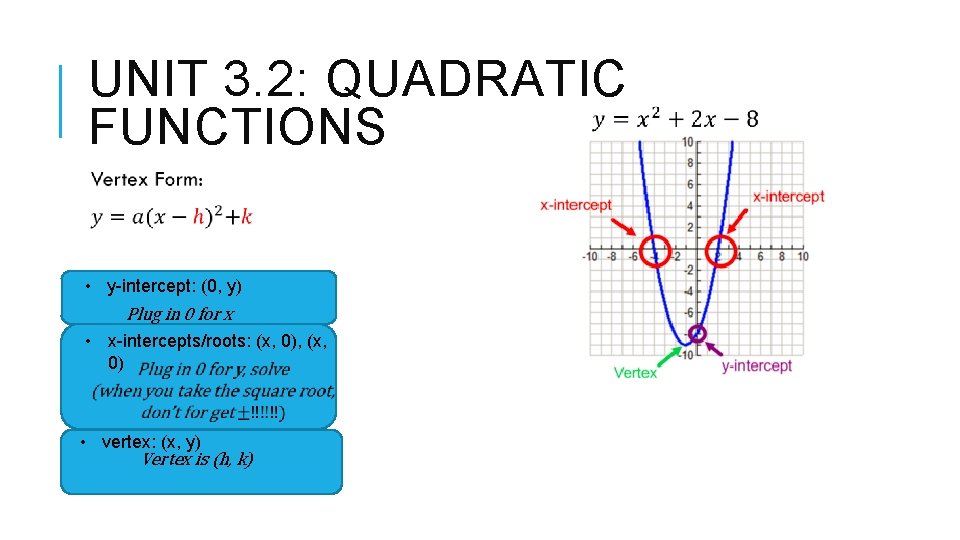
UNIT 3. 2: QUADRATIC FUNCTIONS • y-intercept: (0, y) Plug in 0 for x (it’s going to be the “c” value) • x-intercepts/roots: (x, 0), (x, 0) • vertex: (x, y)
UNIT 3. 2: QUADRATIC FUNCTIONS • y-intercept: (0, y) Plug in 0 for x • x-intercepts/roots: (x, 0), (x, 0) • vertex: (x, y) Vertex is (h, k)
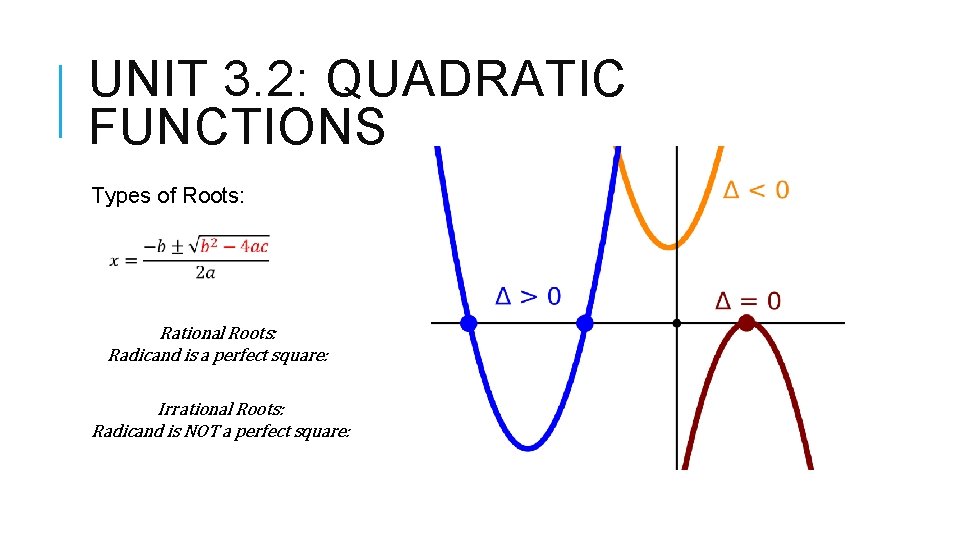
UNIT 3. 2: QUADRATIC FUNCTIONS Types of Roots: Rational Roots: Radicand is a perfect square: Irrational Roots: Radicand is NOT a perfect square:
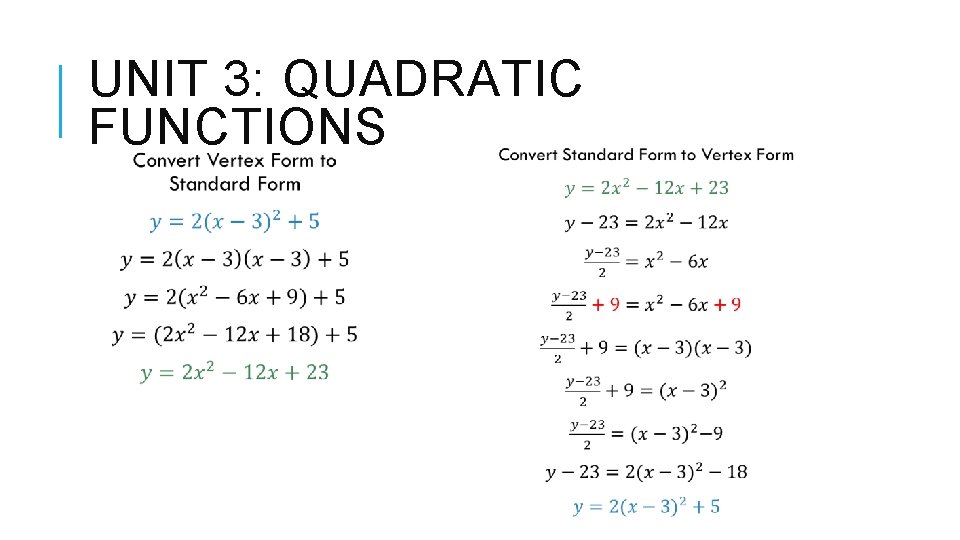
UNIT 3: QUADRATIC FUNCTIONS
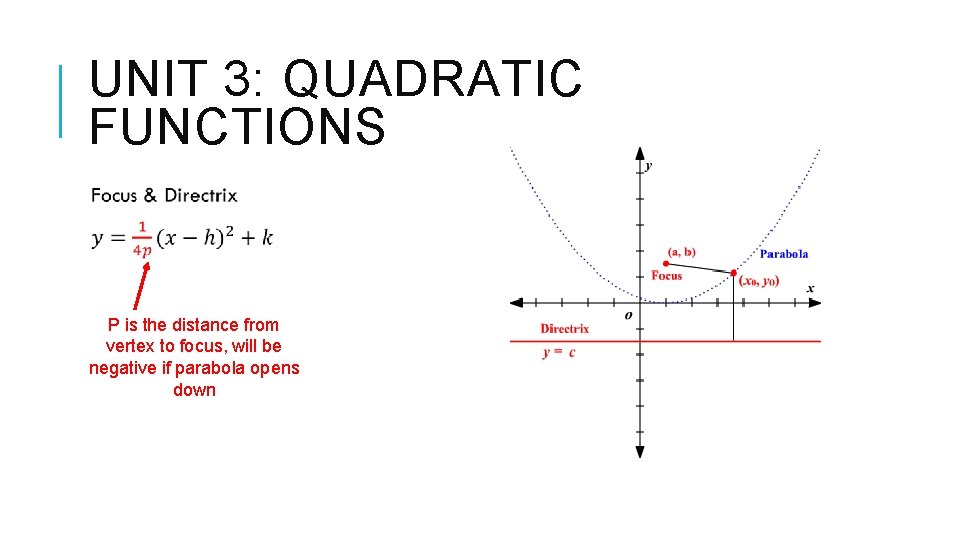
UNIT 3: QUADRATIC FUNCTIONS P is the distance from vertex to focus, will be negative if parabola opens down
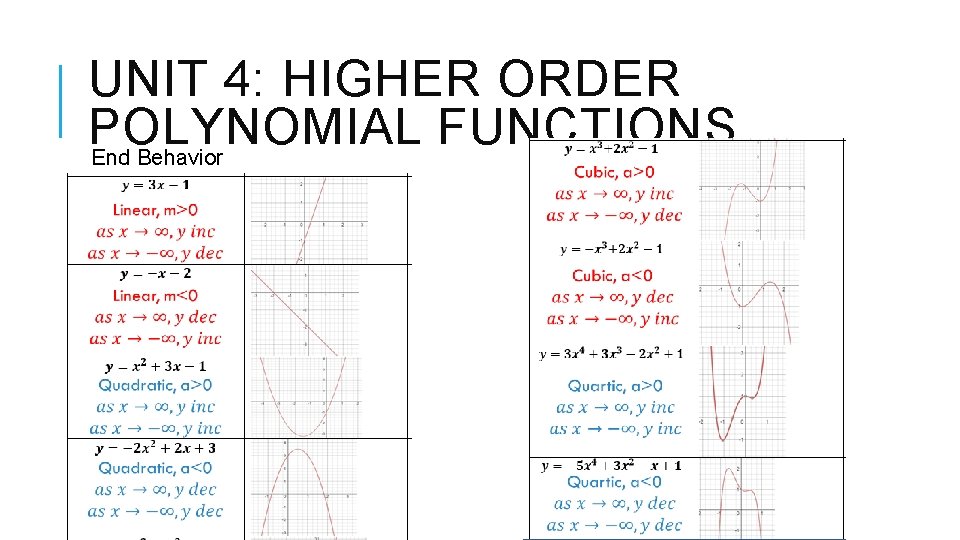
UNIT 4: HIGHER ORDER POLYNOMIAL FUNCTIONS End Behavior
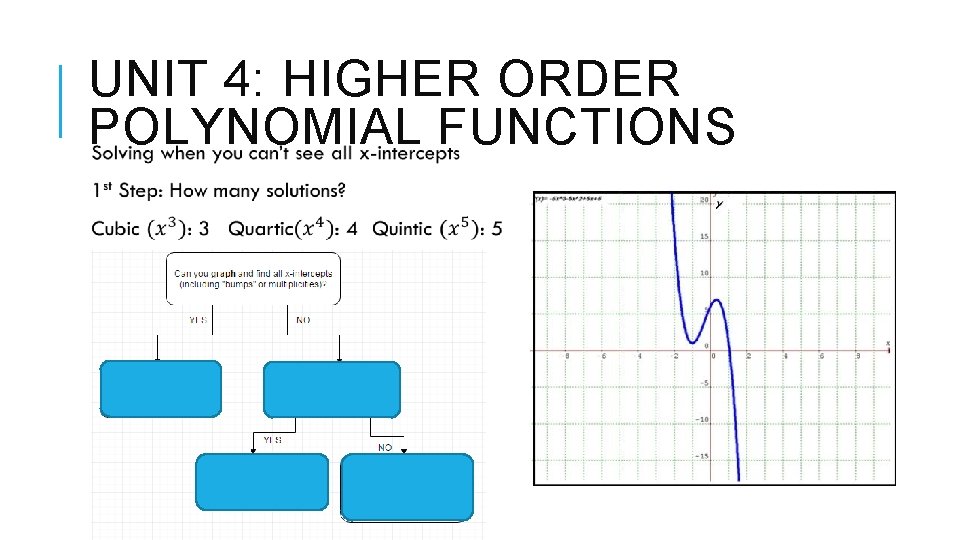
UNIT 4: HIGHER ORDER POLYNOMIAL FUNCTIONS
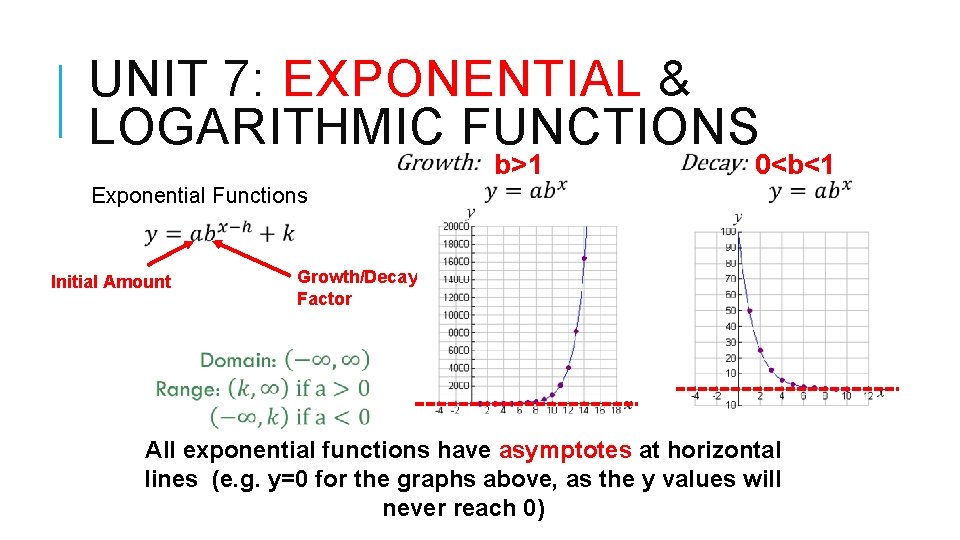
UNIT 7: EXPONENTIAL & LOGARITHMIC FUNCTIONS b>1 0<b<1 Exponential Functions Initial Amount Growth/Decay Factor All exponential functions have asymptotes at horizontal lines (e. g. y=0 for the graphs above, as the y values will never reach 0)
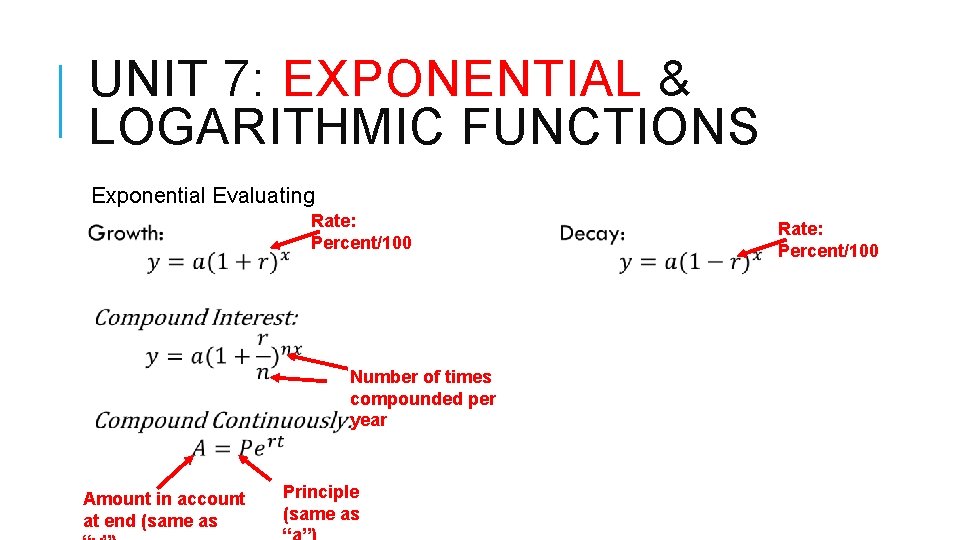
UNIT 7: EXPONENTIAL & LOGARITHMIC FUNCTIONS Exponential Evaluating Rate: Percent/100 Number of times compounded per year Amount in account at end (same as Principle (same as Rate: Percent/100
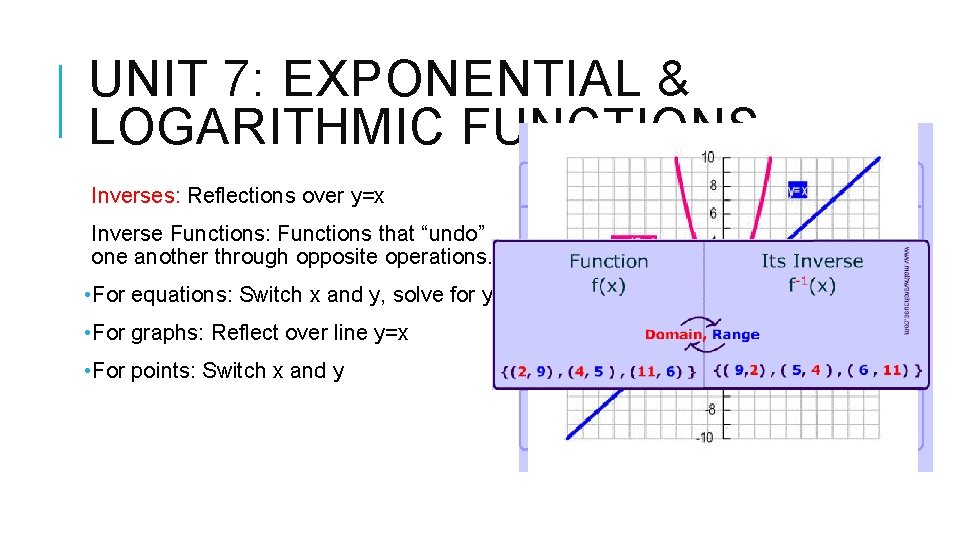
UNIT 7: EXPONENTIAL & LOGARITHMIC FUNCTIONS Inverses: Reflections over y=x Inverse Functions: Functions that “undo” one another through opposite operations. • For equations: Switch x and y, solve for y • For graphs: Reflect over line y=x • For points: Switch x and y
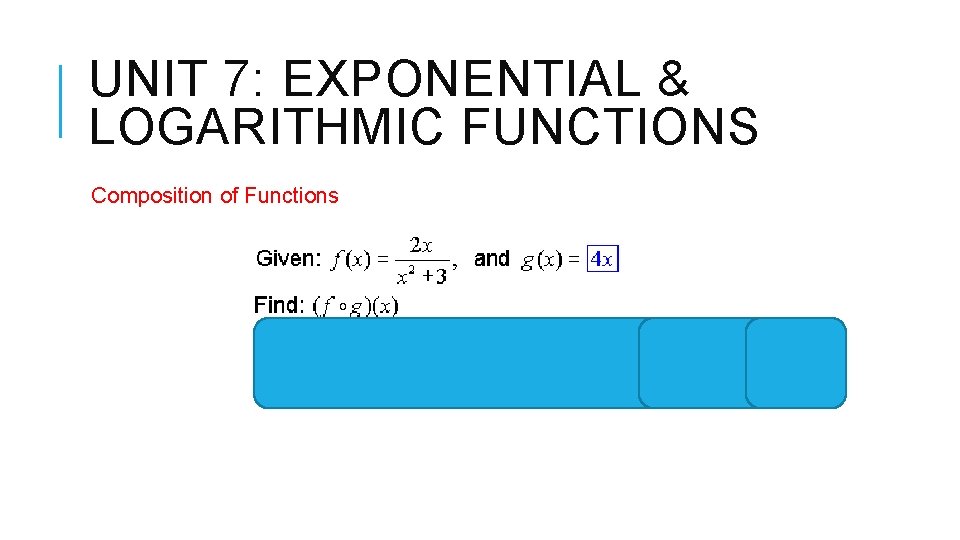
UNIT 7: EXPONENTIAL & LOGARITHMIC FUNCTIONS Composition of Functions
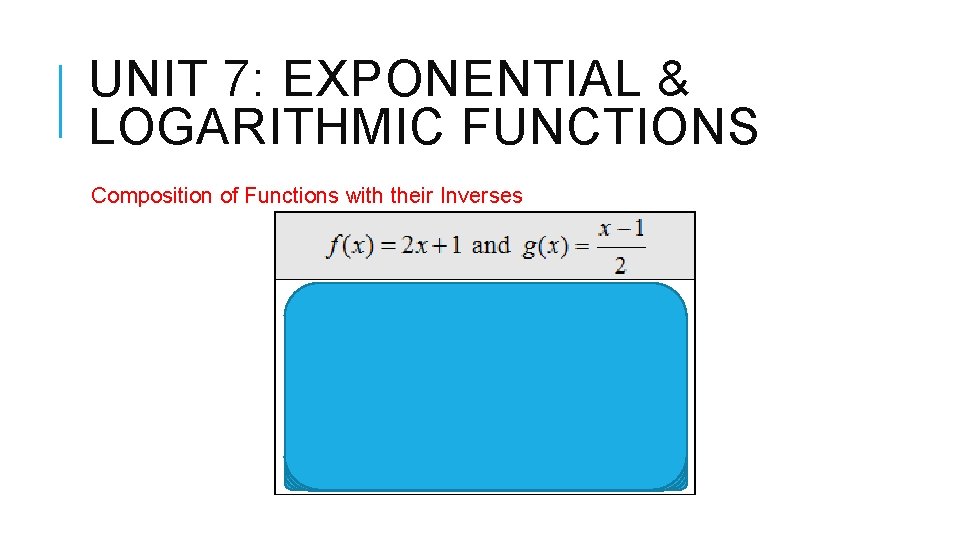
UNIT 7: EXPONENTIAL & LOGARITHMIC FUNCTIONS Composition of Functions with their Inverses
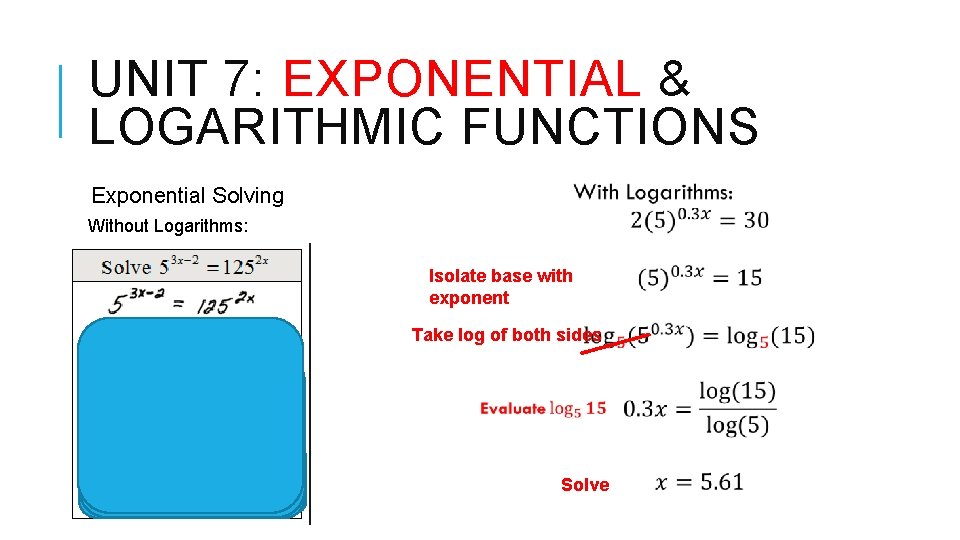
UNIT 7: EXPONENTIAL & LOGARITHMIC FUNCTIONS Exponential Solving Without Logarithms: Isolate base with exponent Take log of both sides Solve
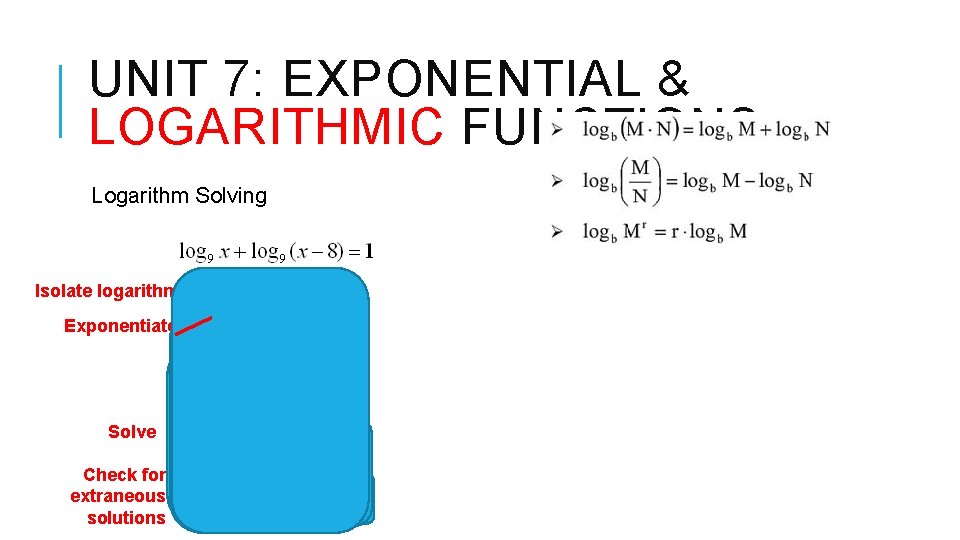
UNIT 7: EXPONENTIAL & LOGARITHMIC FUNCTIONS Logarithm Solving Isolate logarithm Exponentiate Solve Check for extraneous solutions