
MATH 2401 Harrell Curves from the inside Lecture



- Slides: 74
MATH 2401 - Harrell Curves from the inside Lecture 5 Copyright 2007 by Evans M. Harrell II.
Reminder… There’s a test on tomorrow!
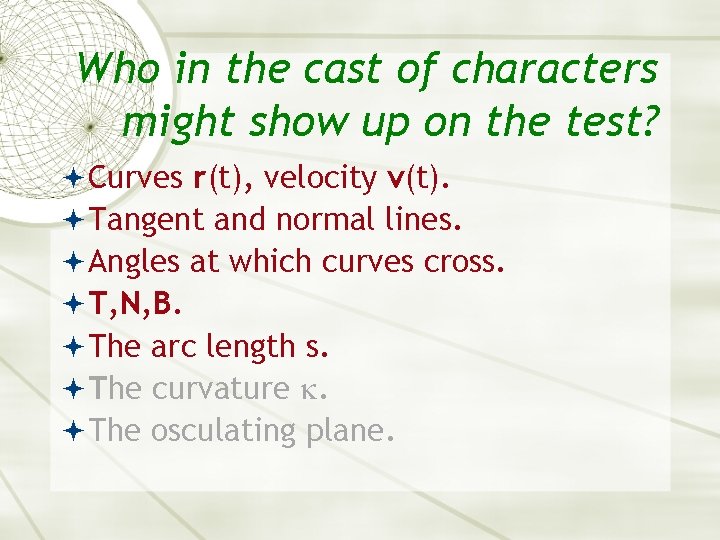
Who in the cast of characters might show up on the test? Curves r(t), velocity v(t). Tangent and normal lines. Angles at which curves cross. T, N, B. The arc length s. The curvature . The osculating plane.
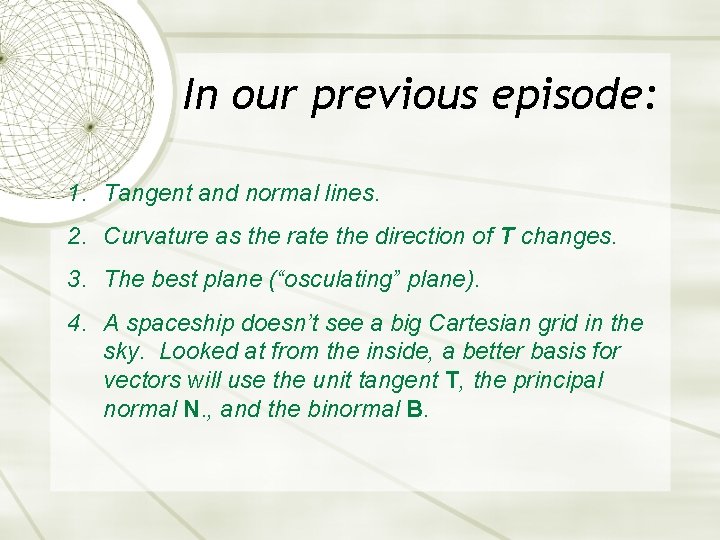
In our previous episode: 1. Tangent and normal lines. 2. Curvature as the rate the direction of T changes. 3. The best plane (“osculating” plane). 4. A spaceship doesn’t see a big Cartesian grid in the sky. Looked at from the inside, a better basis for vectors will use the unit tangent T, the principal normal N. , and the binormal B.
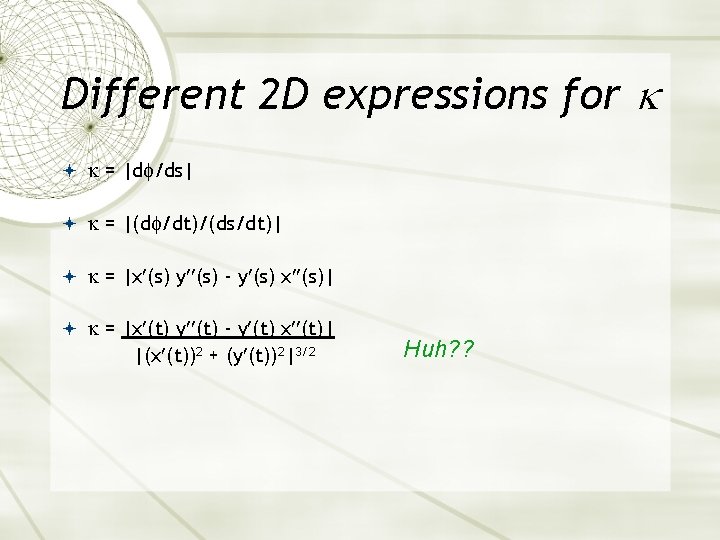
Different 2 D expressions for = |d /ds| = |(d /dt)/(ds/dt)| = |x (s) y (s) - y (s) x (s)| = |x (t) y (t) - y (t) x (t)| |(x (t))2 + (y (t))2|3/2 Huh? ?
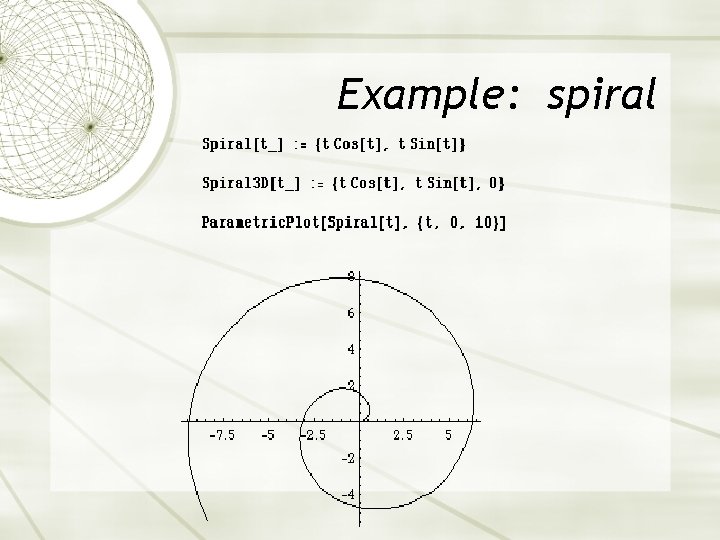
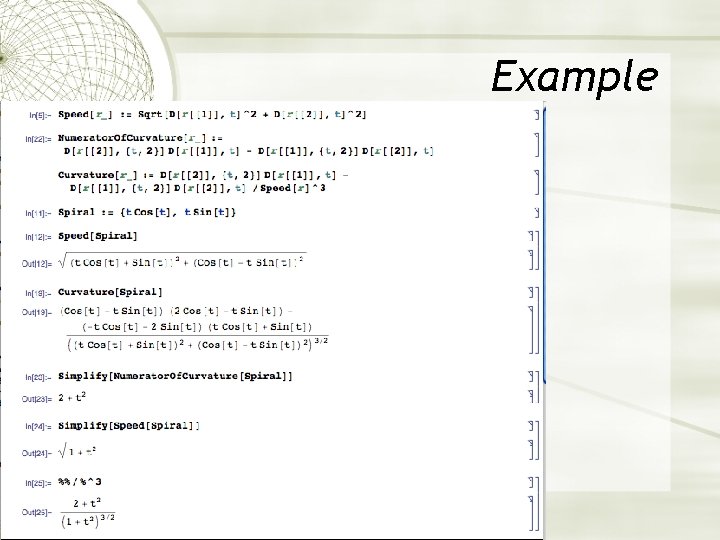
Example Spiral: The formula for curvature is complicated, but the spiral is simple, so the curvature should be simple.
Example Spiral: The formula for curvature is complicated, but the spiral is simple, so the curvature should be simple. Still, we’ll be lazy and use Mathematica:
Example: spiral
Example
Dimensional analysis What units do you use to measure curvature?
Dimensional analysis What units do you use to measure curvature? Hint: angles are considered dimensionless, since radian measure is a ratio of arclength (cm) to radius (also cm)
Dimensional analysis What units do you use to measure curvature? Answer: 1/distance, for instance 1/cm. 1/ is known as the radius of curvature. It’s the radius of the circle that best matches the curve at a given contact point.
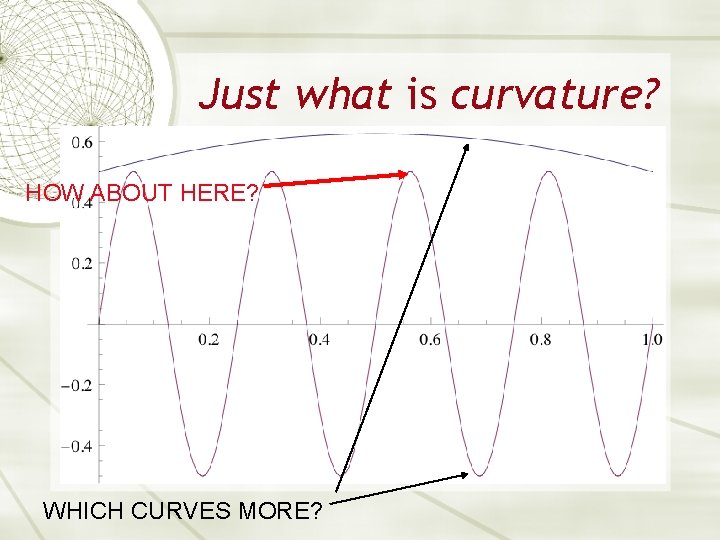
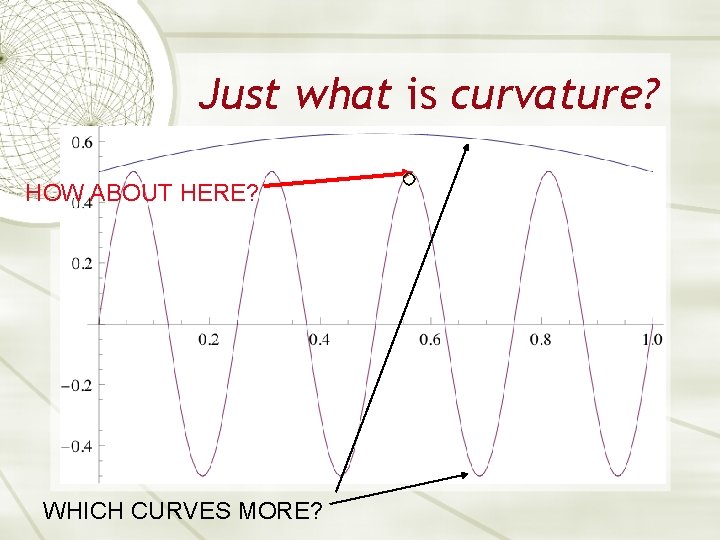
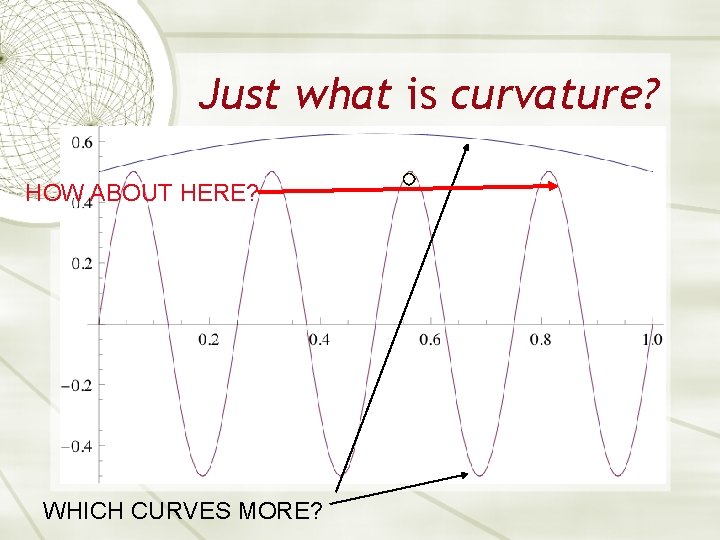
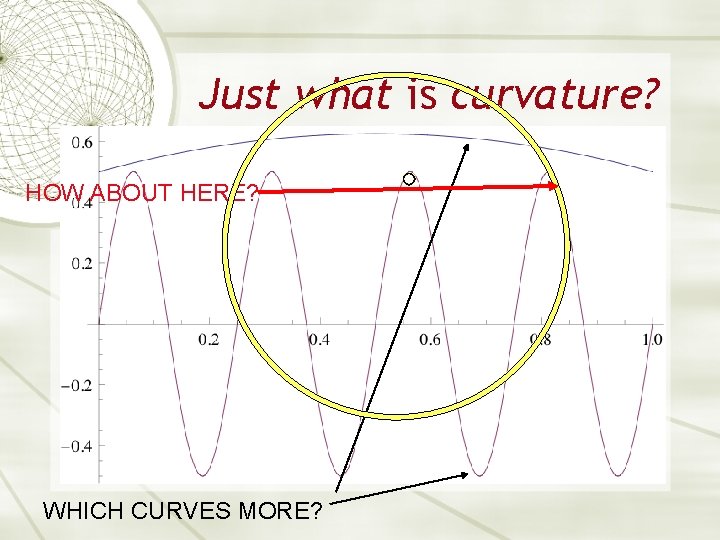
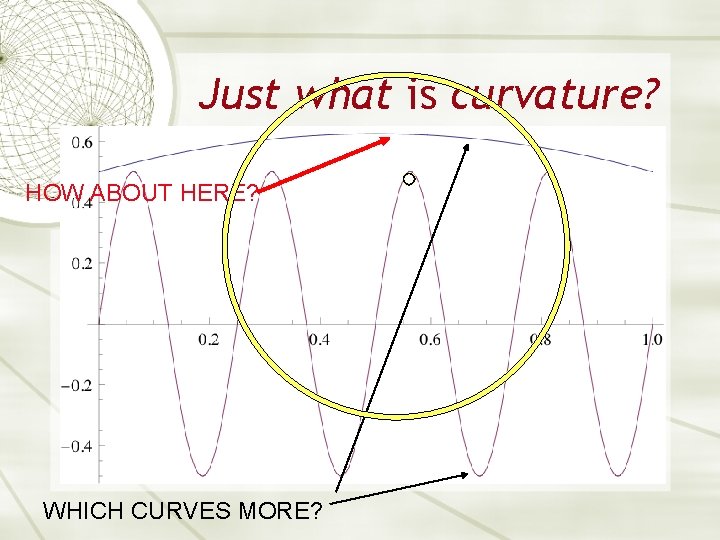
Just what is curvature? HOW ABOUT HERE? WHICH CURVES MORE?
Just what is curvature? HOW ABOUT HERE? WHICH CURVES MORE?
Just what is curvature? HOW ABOUT HERE? WHICH CURVES MORE?
Just what is curvature? HOW ABOUT HERE? WHICH CURVES MORE?
Just what is curvature? HOW ABOUT HERE? WHICH CURVES MORE?
3 D It seems as though 3 D would be more complicated, but there is a sneaky mathematician trick: Write what you know about a special case without referring explicitly to what makes it special.
3 D It seems as though 3 D would be more complicated, but there is a sneaky mathematician trick: Write what you know about a special case without referring explicitly to what makes it special. The angle is special to 2 D. Vectors r, T, N, and the arclength s are not.
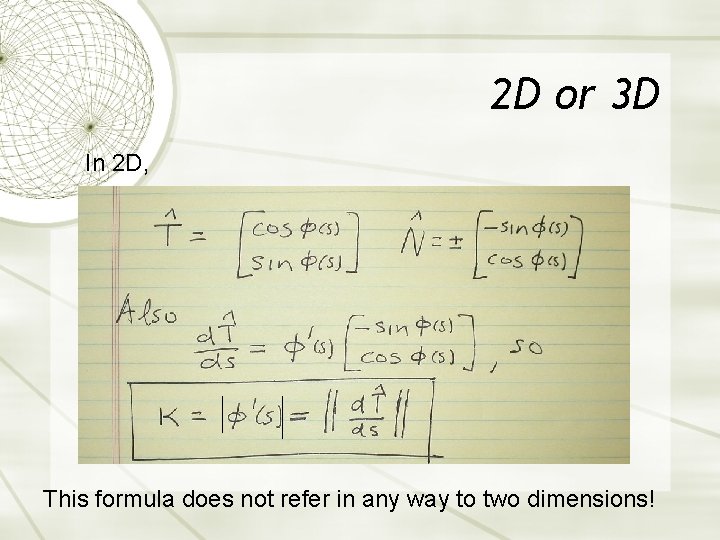
2 D or 3 D In 2 D, This formula does not refer in any way to two dimensions!
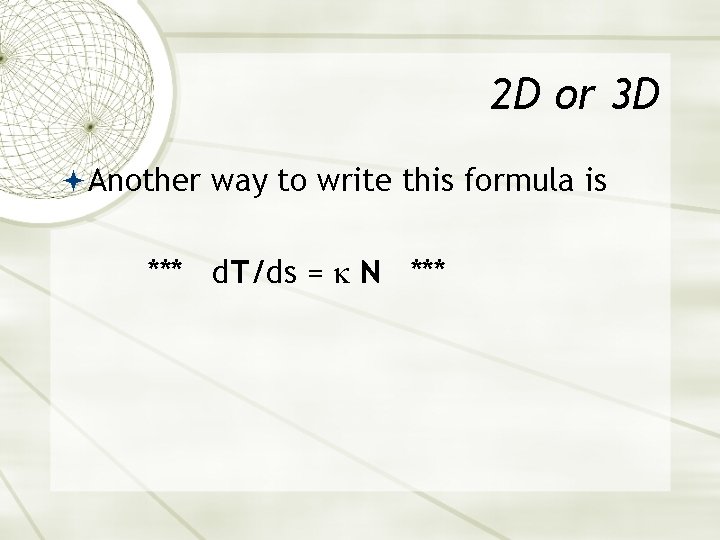
2 D or 3 D Another way to write this formula is *** d. T/ds = N ***
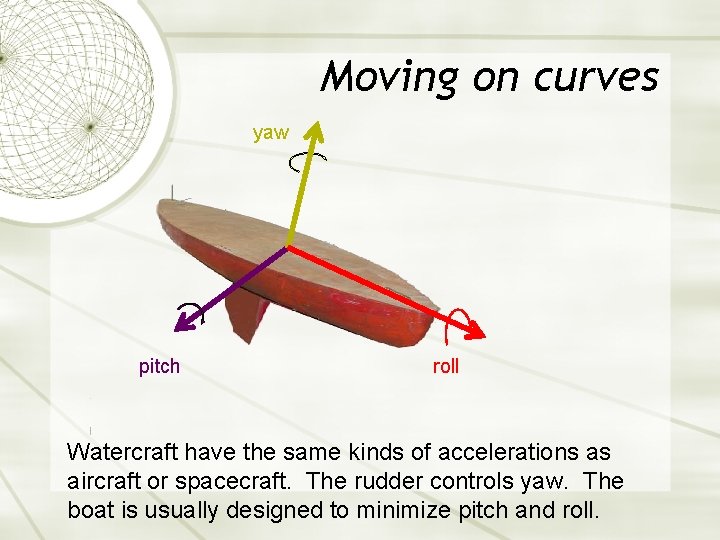
Moving on curves yaw pitch roll Watercraft have the same kinds of accelerations as aircraft or spacecraft. The rudder controls yaw. The boat is usually designed to minimize pitch and roll.
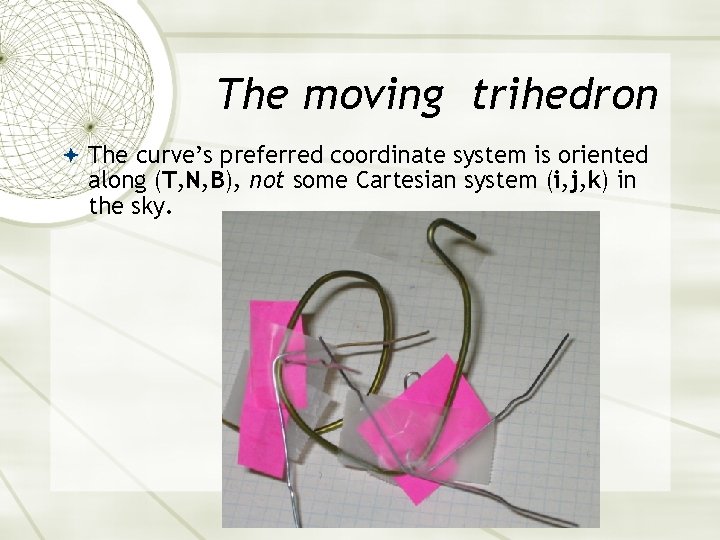
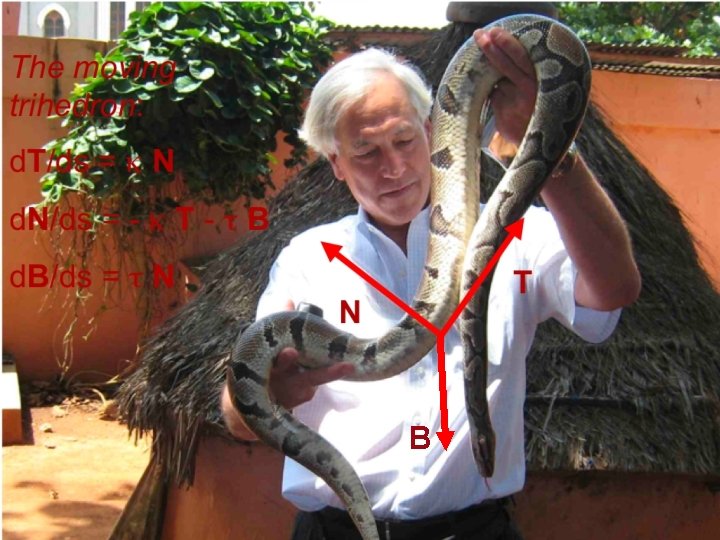
The moving trihedron The curve’s preferred coordinate system is oriented along (T, N, B), not some Cartesian system (i, j, k) in the sky.
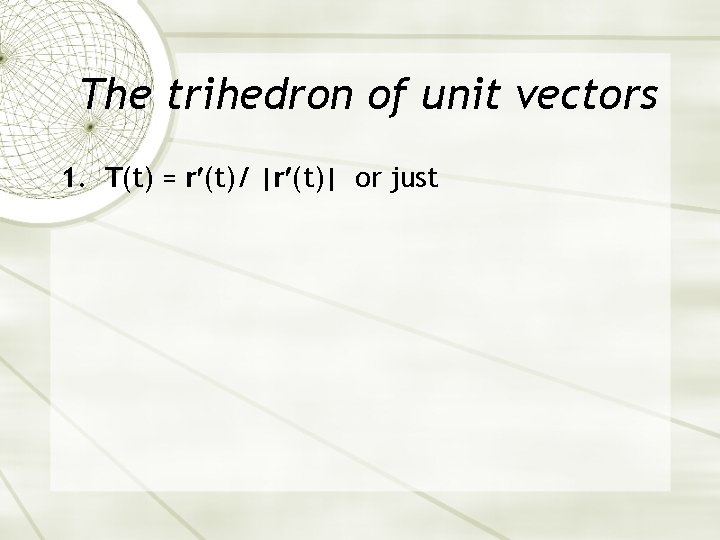
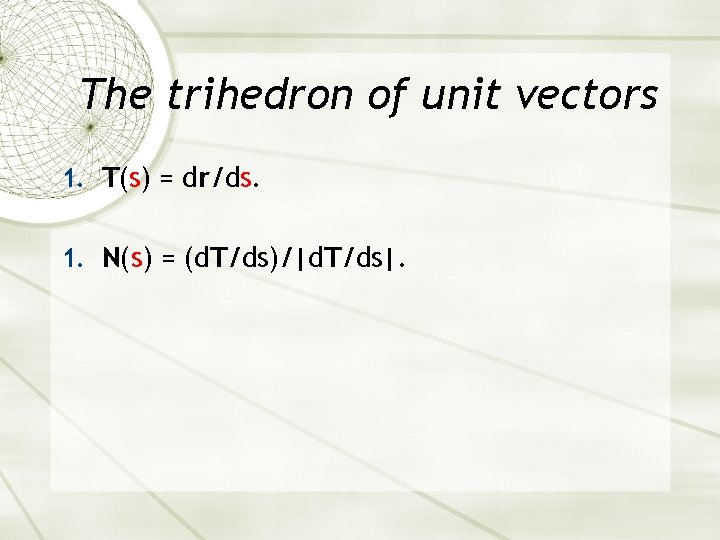
The trihedron of unit vectors 1. T(t) = r (t)/ |r (t)| or just
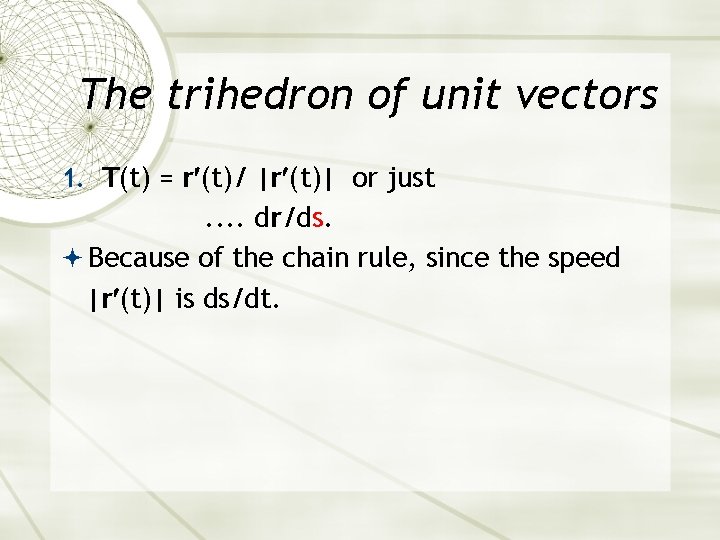
The trihedron of unit vectors 1. T(t) = r (t)/ |r (t)| or just . . dr/ds. Because of the chain rule, since the speed |r (t)| is ds/dt.
The trihedron of unit vectors 1. T(s) = dr/ds. 1. N(s) = (d. T/ds)/|d. T/ds|.
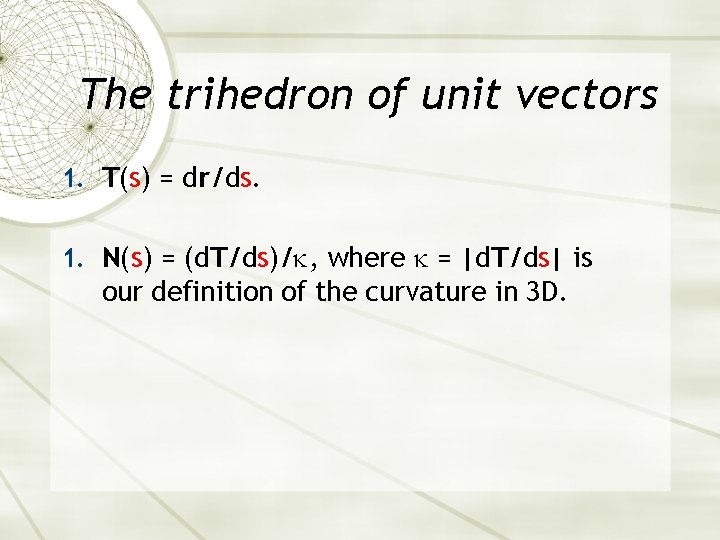
The trihedron of unit vectors 1. T(s) = dr/ds. 1. N(s) = (d. T/ds)/ , where = |d. T/ds| is our definition of the curvature in 3 D.
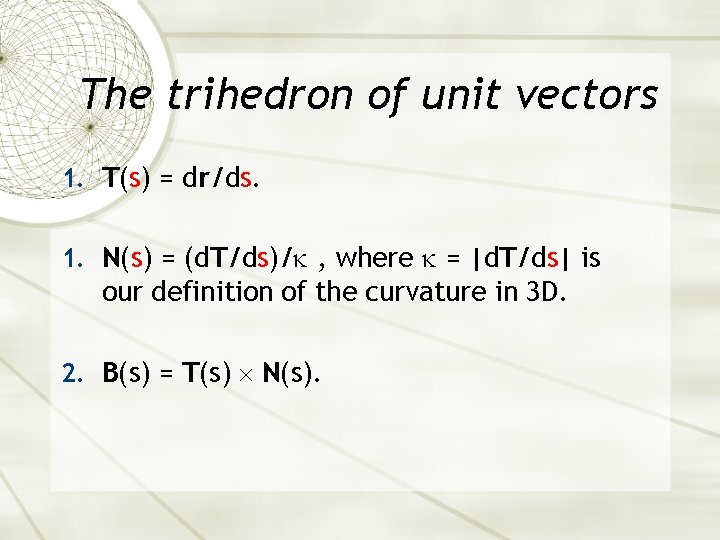
The trihedron of unit vectors 1. T(s) = dr/ds. 1. N(s) = (d. T/ds)/ , where = |d. T/ds| is our definition of the curvature in 3 D. 2. B(s) = T(s) N(s).
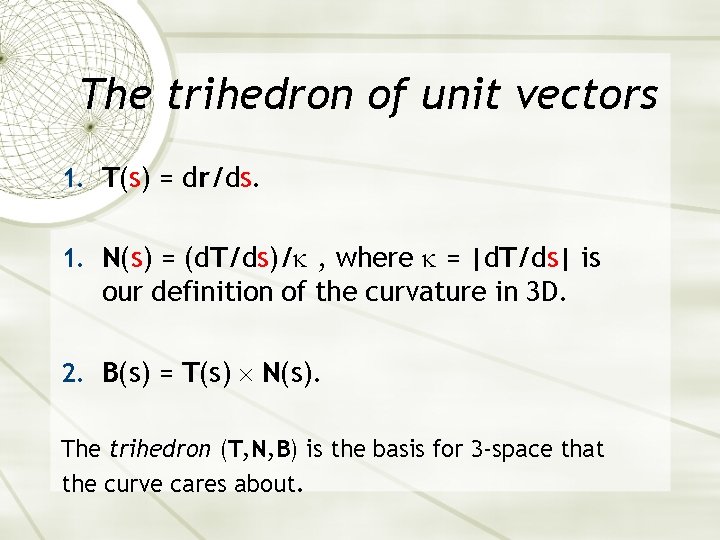
The trihedron of unit vectors 1. T(s) = dr/ds. 1. N(s) = (d. T/ds)/ , where = |d. T/ds| is our definition of the curvature in 3 D. 2. B(s) = T(s) N(s). The trihedron (T, N, B) is the basis for 3 -space that the curve cares about.
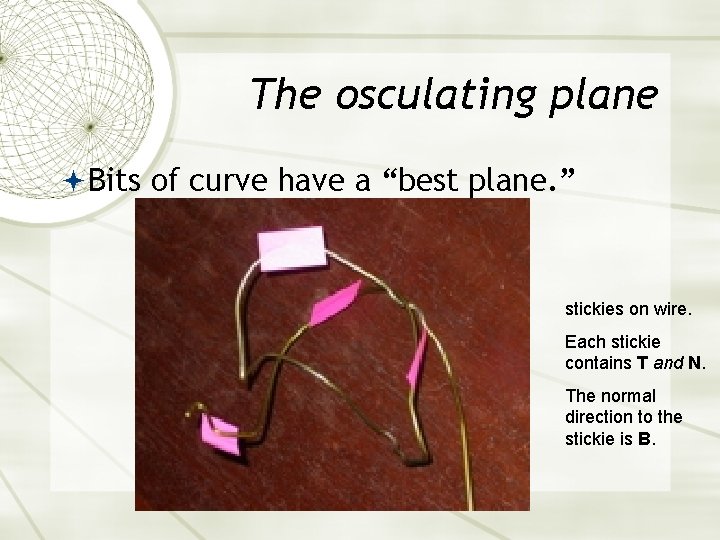
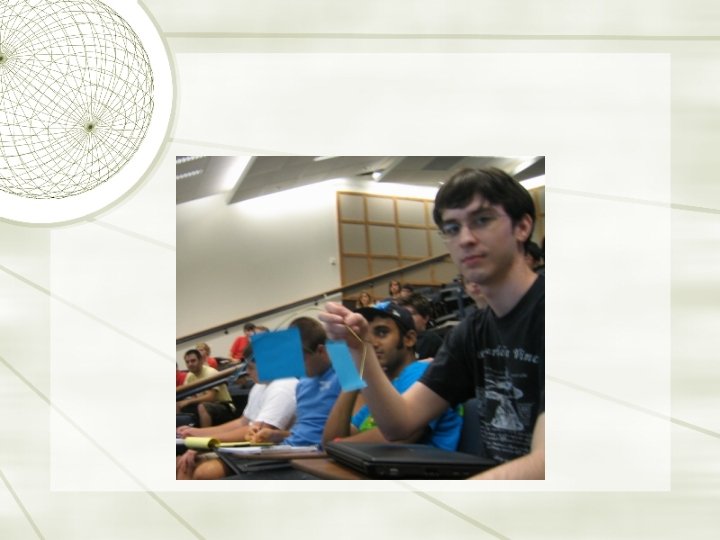
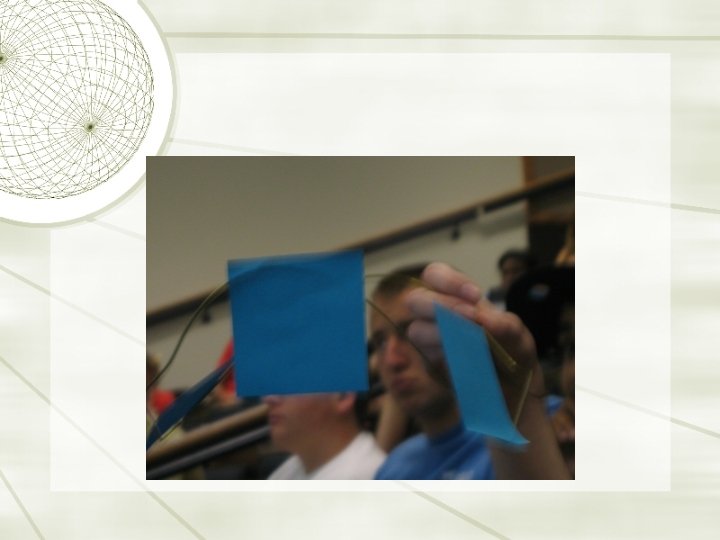
The osculating plane Bits of curve have a “best plane. ” stickies on wire. Each stickie contains T and N. The normal direction to the stickie is B.
The equations for motion on a curve – “from the inside”
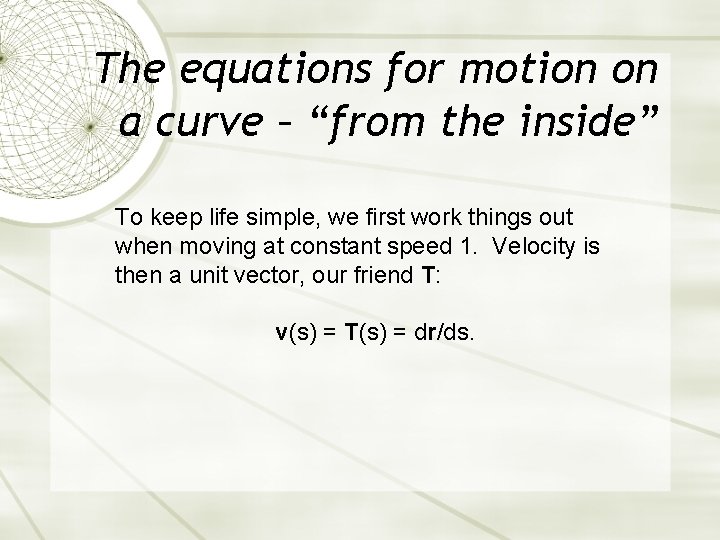
The equations for motion on a curve – “from the inside” To keep life simple, we first work things out when moving at constant speed 1. Velocity is then a unit vector, our friend T: v(s) = T(s) = dr/ds.
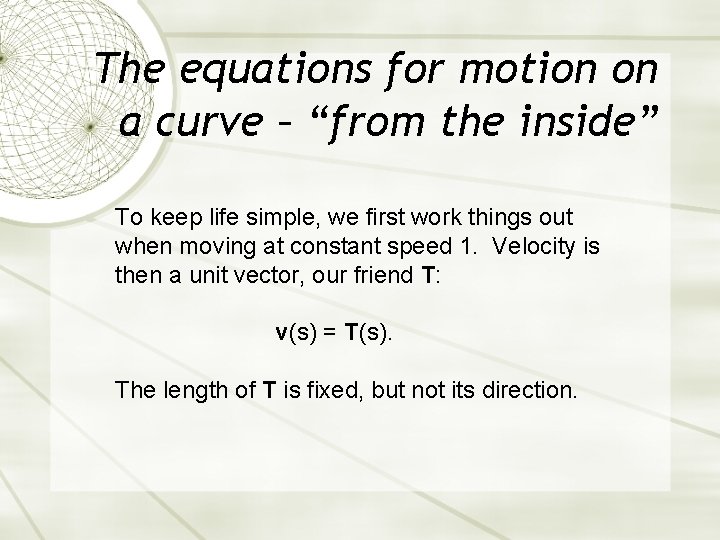
The equations for motion on a curve – “from the inside” To keep life simple, we first work things out when moving at constant speed 1. Velocity is then a unit vector, our friend T: v(s) = T(s). The length of T is fixed, but not its direction.
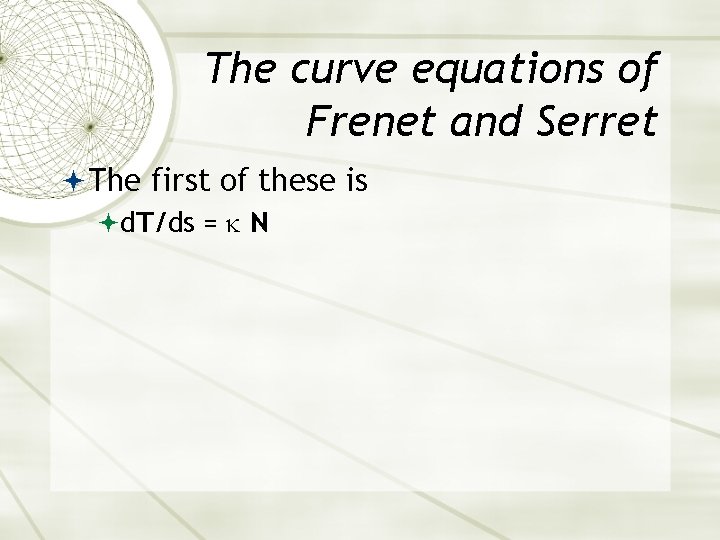
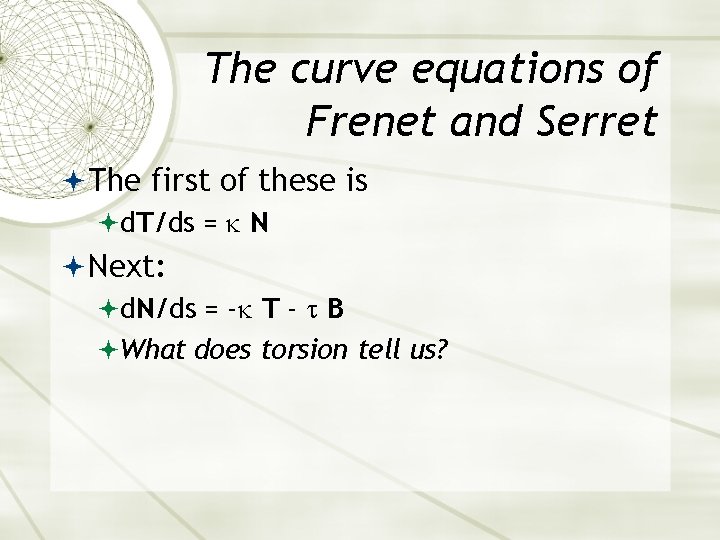
The curve equations of Frenet and Serret The first of these is d. T/ds = N
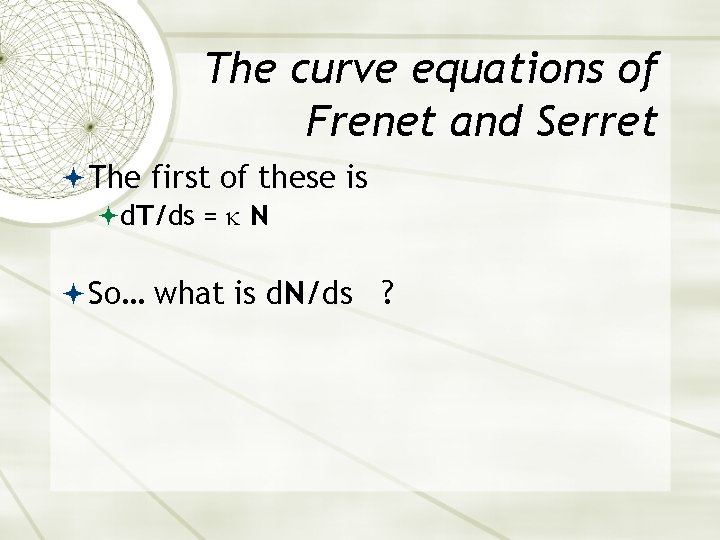
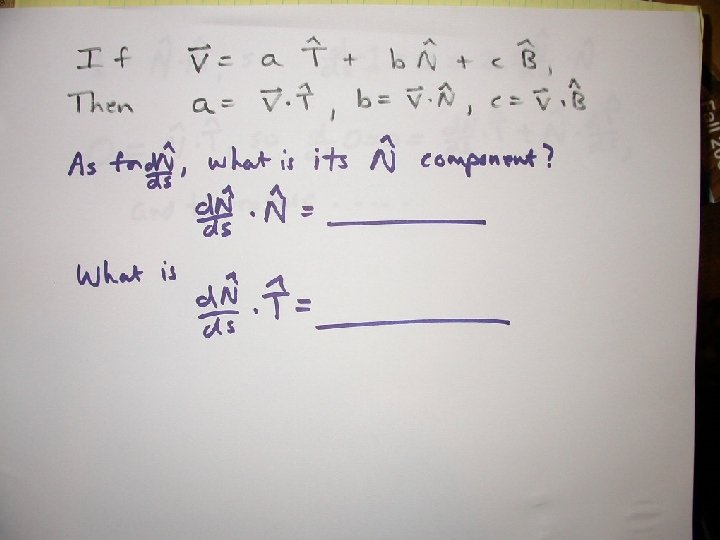
The curve equations of Frenet and Serret The first of these is d. T/ds = N So… what is d. N/ds ?
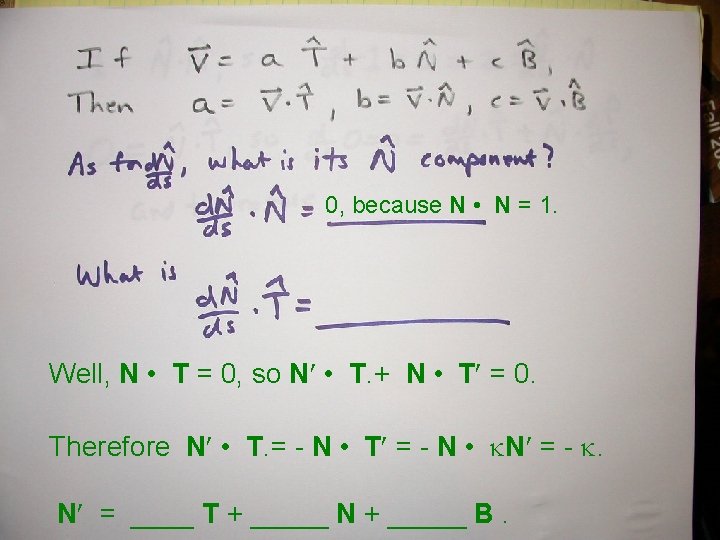
The curve equations of Frenet and Serret The first of these is d. T/ds = N So… what is d. N/ds ? Like all vectors, it must be of the form _____ T + _____ N + _____ B
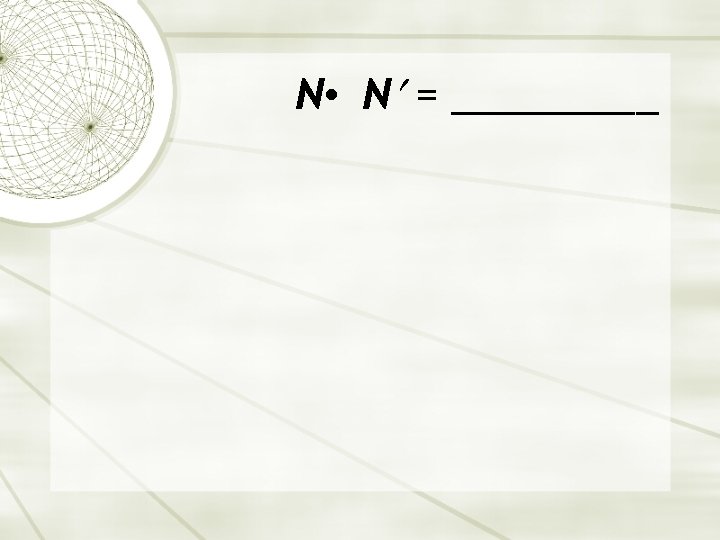
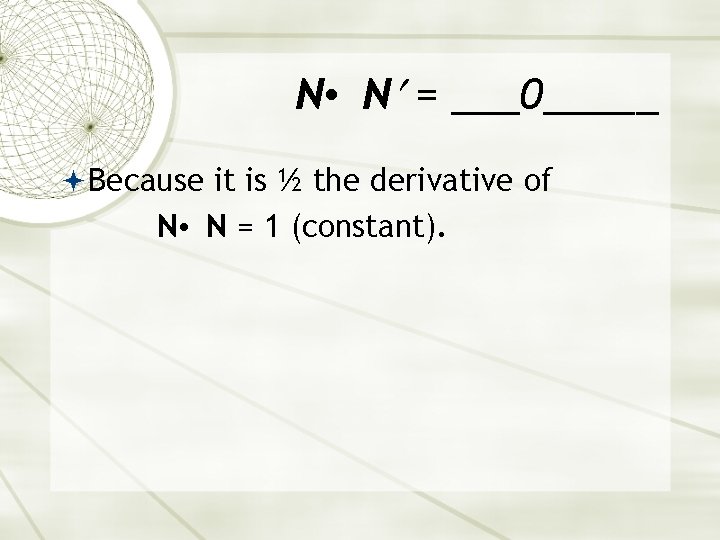
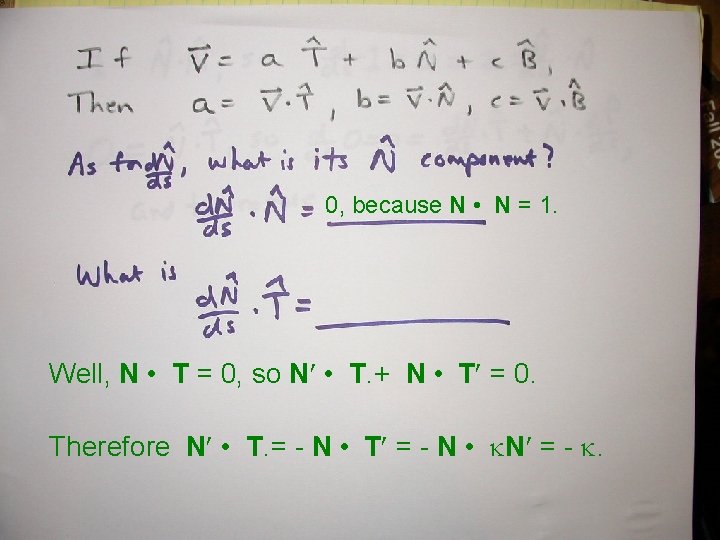
N • N¢ = ___0_____ Because it is ½ the derivative of N • N = 1 (constant).
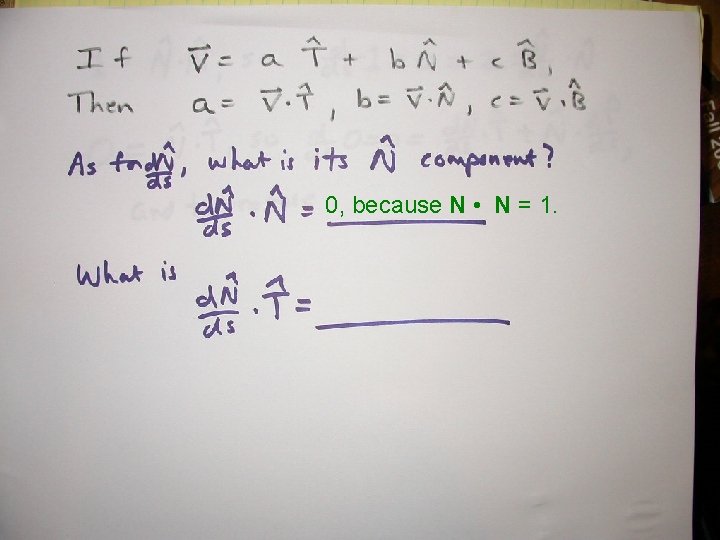
The curve equations of Frenet and Serret The first of these is 0, because N • N = 1. d. T/ds = N So… what is d. N/ds ? Like all vectors, it must be of the form _____ T + _____ N + _____ B
The curve equations of Frenet and Serret The first of these is 0, because N • N = 1. d. T/ds = N So… what is d. N/ds ? Well, N • all T =vectors, 0, so N • it. T. + N • be T of = 0. Like must the form _____ T + _____ N + _____ B Therefore N • T. = - N • T = - N • N = - .
The curve equations of Frenet and Serret The first of these is 0, because N • N = 1. d. T/ds = N So… what is d. N/ds ? Well, N • all T =vectors, 0, so N • it. T. + N • be T of = 0. Like must the form _____ T + _____ N + _____ B Therefore N • T. = - N • T = - N • N = - . N = ____ T + _____ N + _____ B.
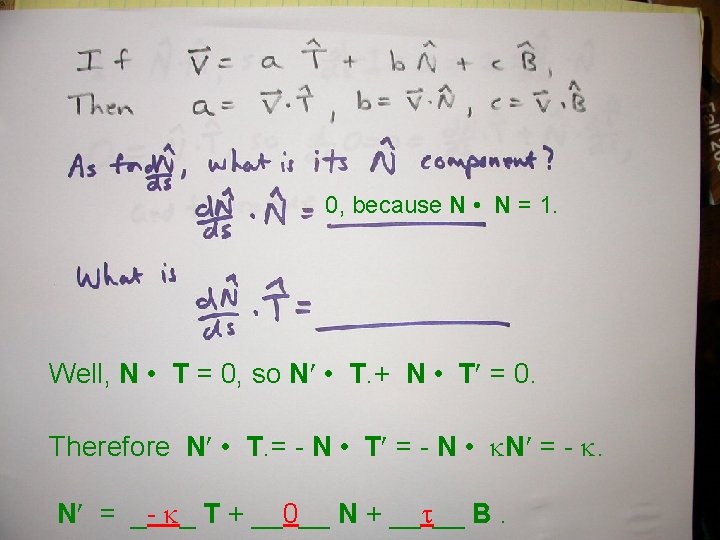
The curve equations of Frenet and Serret The first of these is 0, because N • N = 1. d. T/ds = N So… what is d. N/ds ? Well, N • all T =vectors, 0, so N • it. T. + N • be T of = 0. Like must the form _____ T + _____ N + _____ B Therefore N • T. = - N • T = - N • N = - . N = _- _ T + __0__ N + __? __ B.
The curve equations of Frenet and Serret The first of these is 0, because N • N = 1. d. T/ds = N So… what is d. N/ds ? Well, N • all T =vectors, 0, so N • it. T. + N • be T of = 0. Like must the form _____ T + _____ N + _____ B Therefore N • T. = - N • T = - N • N = - . N = _- _ T + __0__ N + __ __ B.
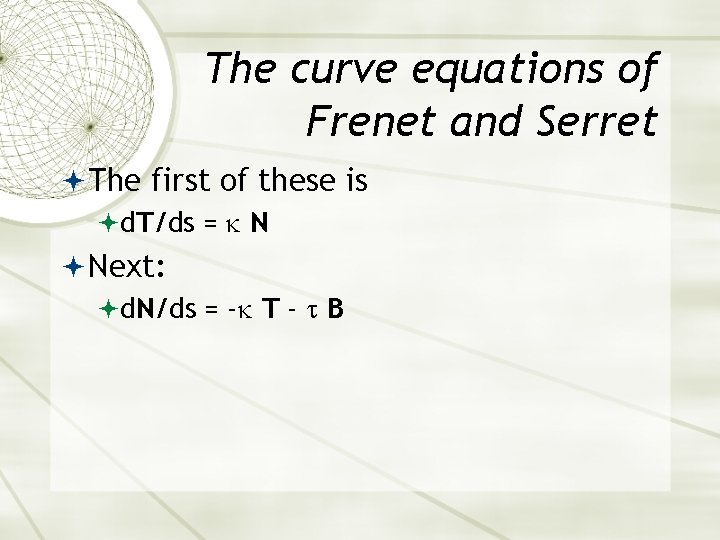
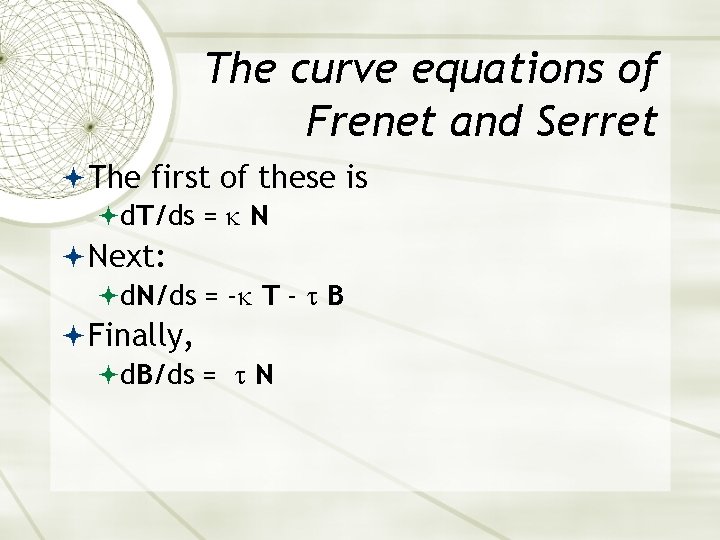
The curve equations of Frenet and Serret The first of these is d. T/ds = N Next: d. N/ds = - T - B
The curve equations of Frenet and Serret The first of these is d. T/ds = N Next: d. N/ds = - T - B What does torsion tell us?
The curve equations of Frenet and Serret The first of these is d. T/ds = N Next: d. N/ds = - T - B Finally, d. B/ds = N
Motion in 3 D Remember that a curve’s favorite coordinate system is based on the moving trihedron (T, N, B).
B
Motion in 3 D Remember that a curve’s favorite coordinate system is based on the moving trihedron (T, N, B). What happens to a moving particle in this moving frame? velocity acceleration
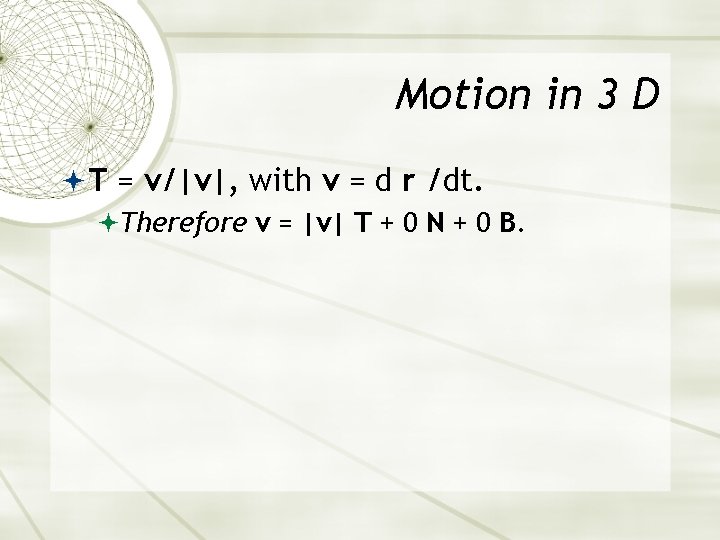
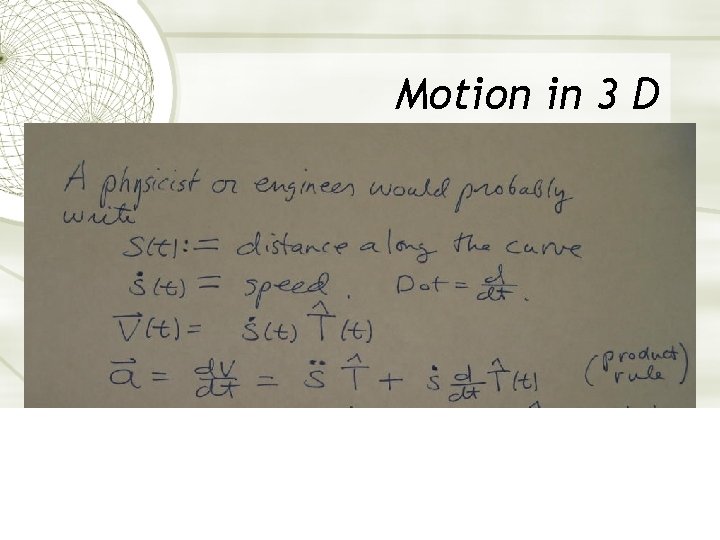
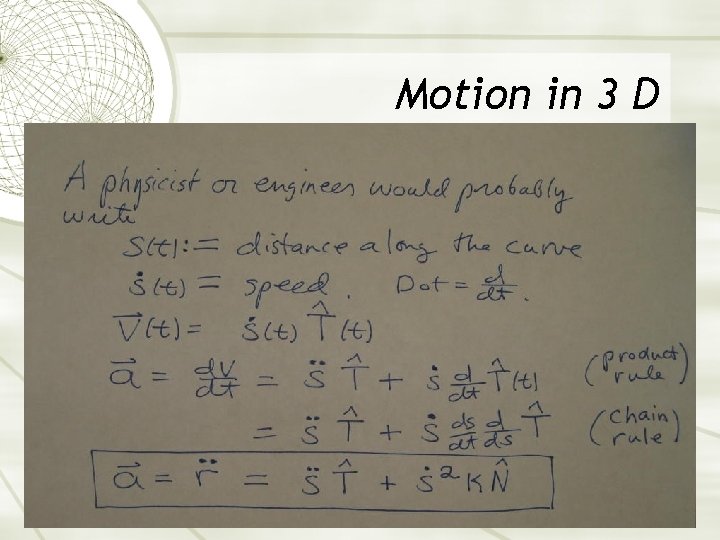
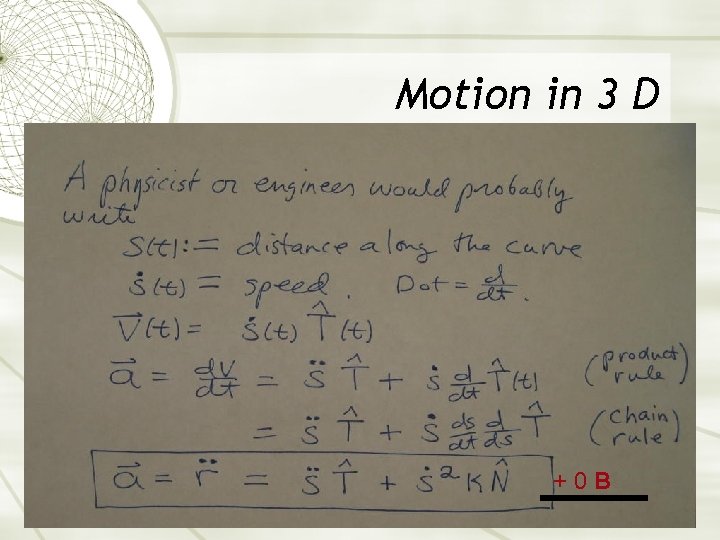
Motion in 3 D T = v/|v|, with v = d r /dt. Therefore v = |v| T + 0 N + 0 B.
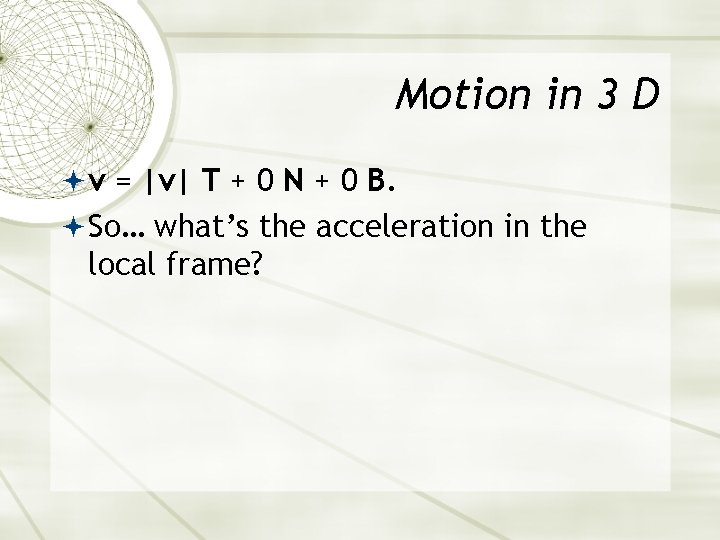
Motion in 3 D v = |v| T + 0 N + 0 B. So… what’s the acceleration in the local frame?
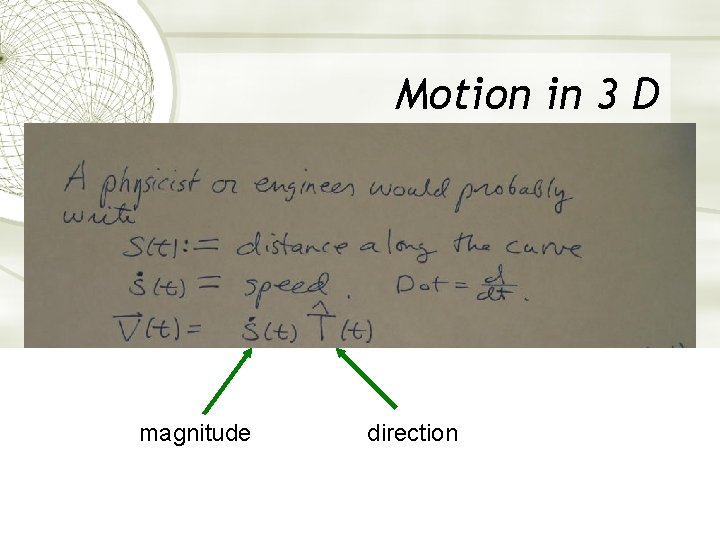
Motion in 3 D magnitude direction
Motion in 3 D
Motion in 3 D
Motion in 3 D +0 B
What does this say about the osculating plane? ?
How about some examples, Prof. H?
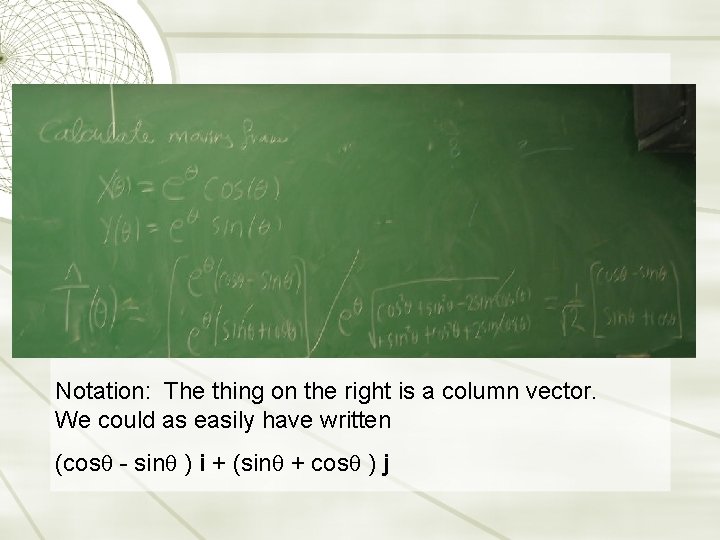
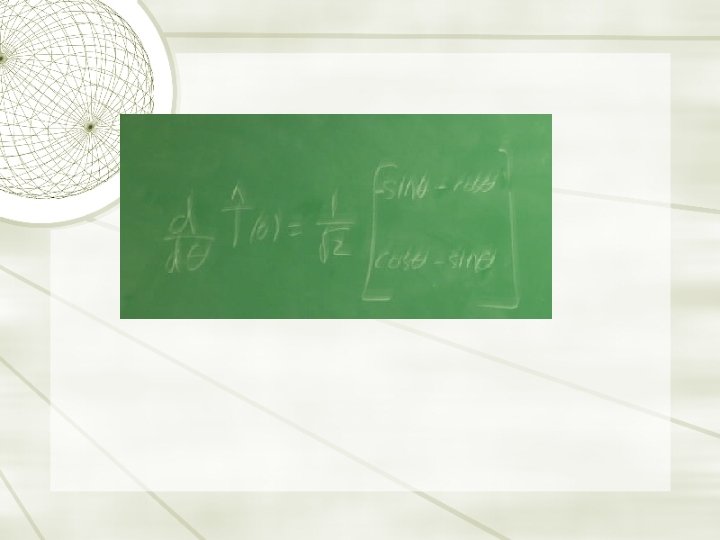
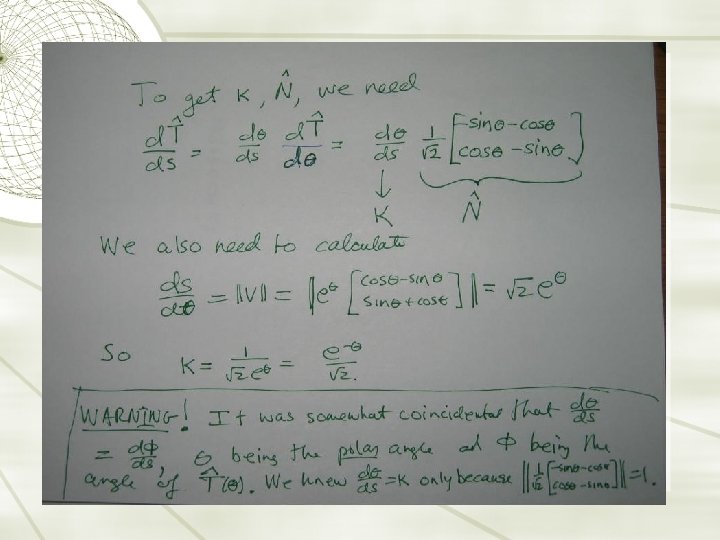
Notation: The thing on the right is a column vector. We could as easily have written (cos - sin ) i + (sin + cos ) j
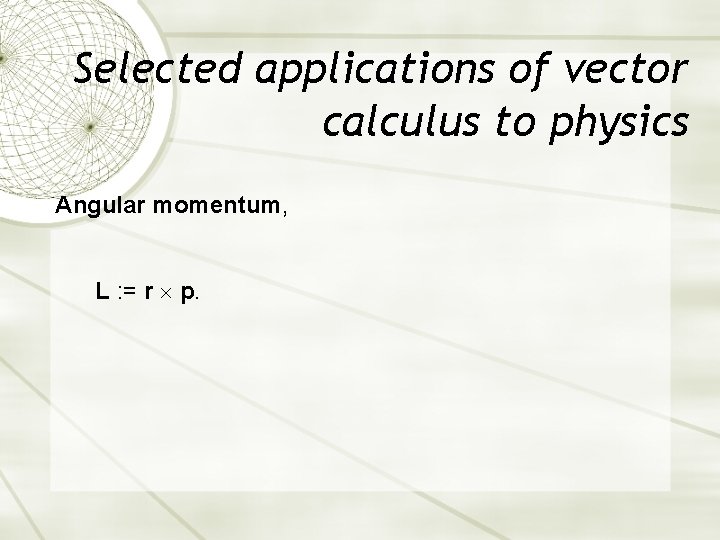
Selected applications of vector calculus to physics Angular momentum, L : = r p.
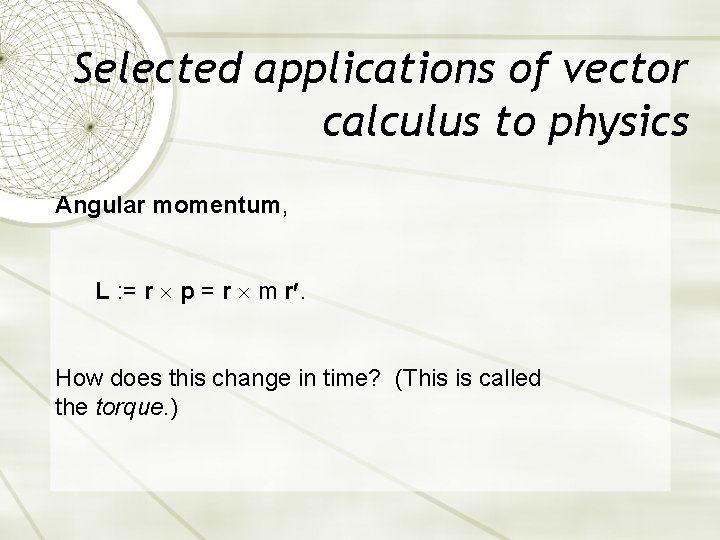
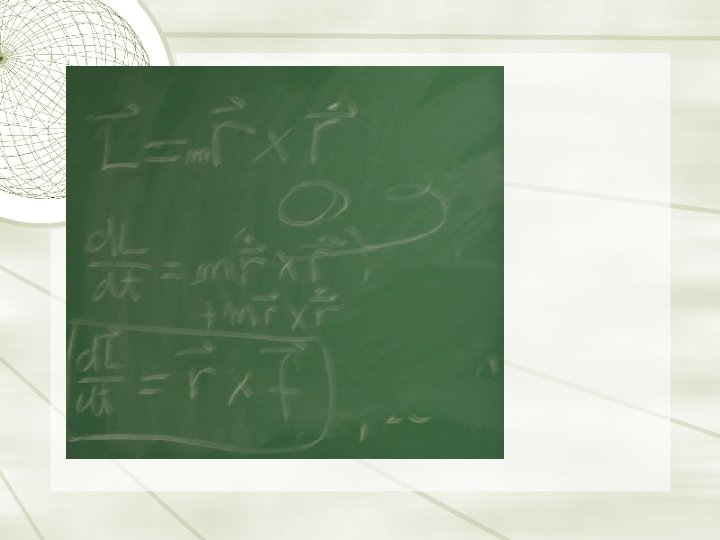
Selected applications of vector calculus to physics Angular momentum, L : = r p = r m r. How does this change in time? (This is called the torque. )
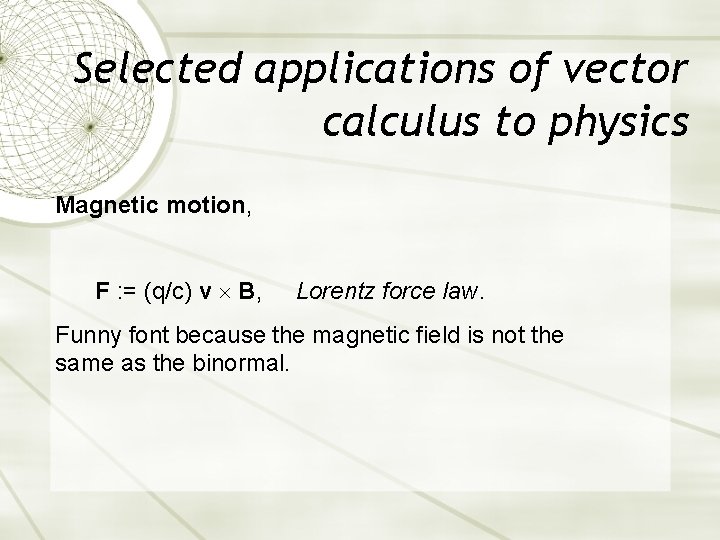
Selected applications of vector calculus to physics Magnetic motion, F : = (q/c) v B, Lorentz force law. Funny font because the magnetic field is not the same as the binormal.
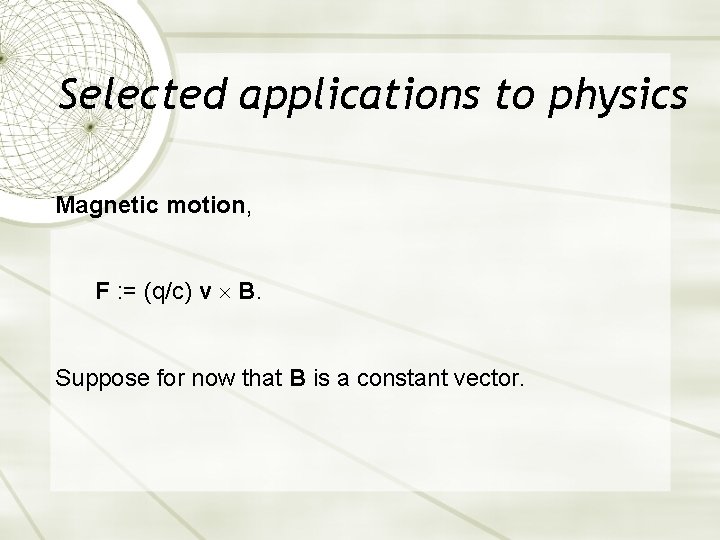
Selected applications to physics Magnetic motion, F : = (q/c) v B. Suppose for now that B is a constant vector.
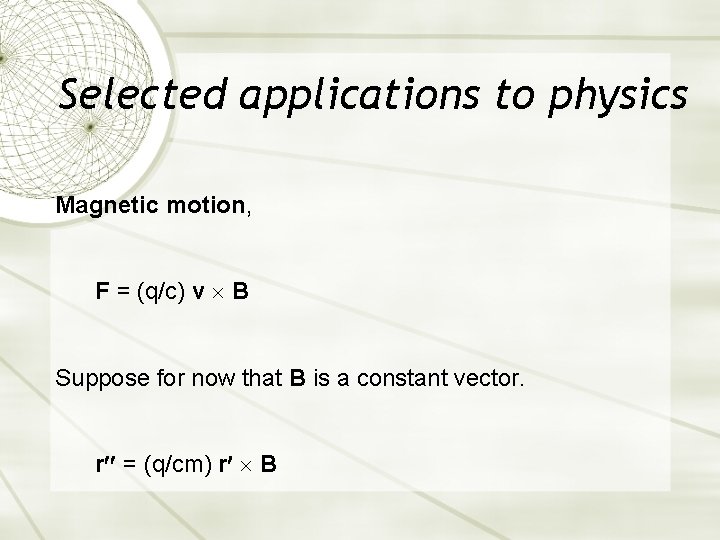
Selected applications to physics Magnetic motion, F = (q/c) v B Suppose for now that B is a constant vector. r = (q/cm) r B
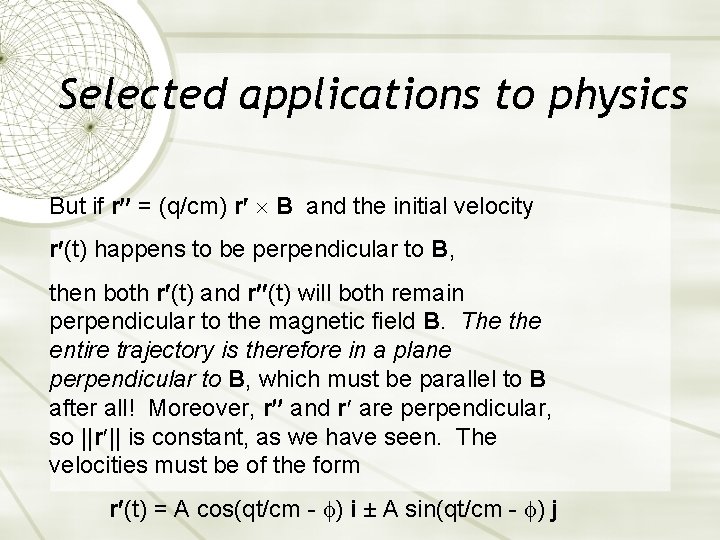
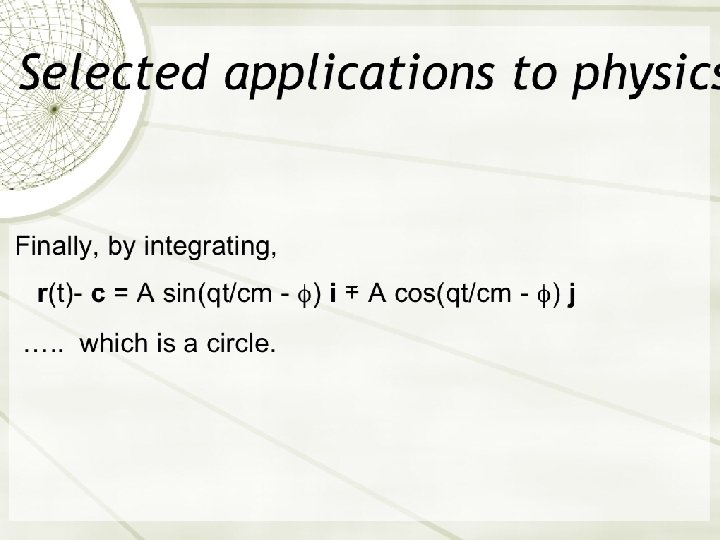
Selected applications to physics But if r = (q/cm) r B and the initial velocity r (t) happens to be perpendicular to B, then both r (t) and r (t) will both remain perpendicular to the magnetic field B. The the entire trajectory is therefore in a plane perpendicular to B, which must be parallel to B after all! Moreover, r and r are perpendicular, so ||r || is constant, as we have seen. The velocities must be of the form r (t) = A cos(qt/cm - ) i ± A sin(qt/cm - ) j
Test tomorrow!! Review time!!