
Math 123 Quantitative Reasoning Sharon Koch Ivy Tech




- Slides: 19
Math 123 Quantitative Reasoning Sharon Koch Ivy Tech Gary skoch 12@ivytech. edu Rebecca Wulf Ivy Tech Lafayette rwulf@ivytech. edu Ben Markham Ivy Tech Bloomington bmarkham@ivytech. edu
Ivy Tech Community College • 30 campuses in 14 regions • Nearly 200, 000 students annually • Accredited by the Higher Learning Commission • Member of the North Central Association of Colleges and Schools
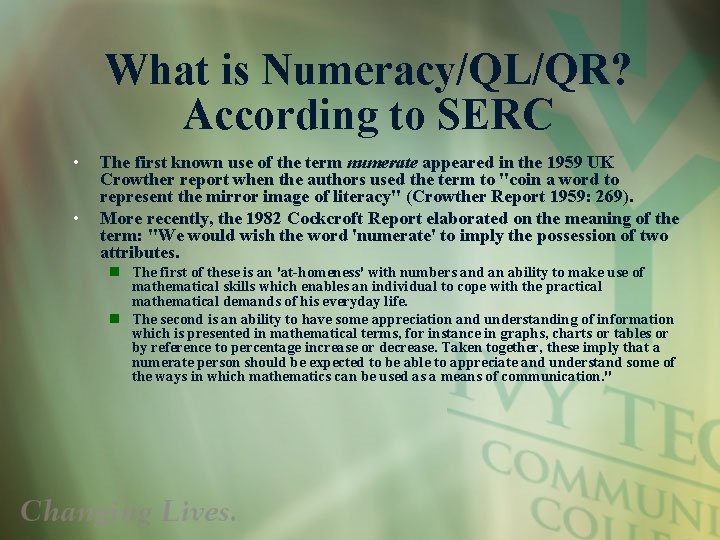
What is Numeracy/QL/QR? According to SERC • • The first known use of the term numerate appeared in the 1959 UK Crowther report when the authors used the term to "coin a word to represent the mirror image of literacy" (Crowther Report 1959: 269). More recently, the 1982 Cockcroft Report elaborated on the meaning of the term: "We would wish the word 'numerate' to imply the possession of two attributes. n The first of these is an 'at-homeness' with numbers and an ability to make use of mathematical skills which enables an individual to cope with the practical mathematical demands of his everyday life. n The second is an ability to have some appreciation and understanding of information which is presented in mathematical terms, for instance in graphs, charts or tables or by reference to percentage increase or decrease. Taken together, these imply that a numerate person should be expected to be able to appreciate and understand some of the ways in which mathematics can be used as a means of communication. "
Course Structure • This course is 3 credit hours and 4 contact hours. • The class structure of the quantitative reasoning course is unique. Class discussion and group work are main staples of the classroom and instructor lecturing is minimal.
Course Consistency • Math 123 has a statewide lead instructor and a regional lead instructor. • Was developed by Ivy Tech Faculty • Has its own ‘textbook’
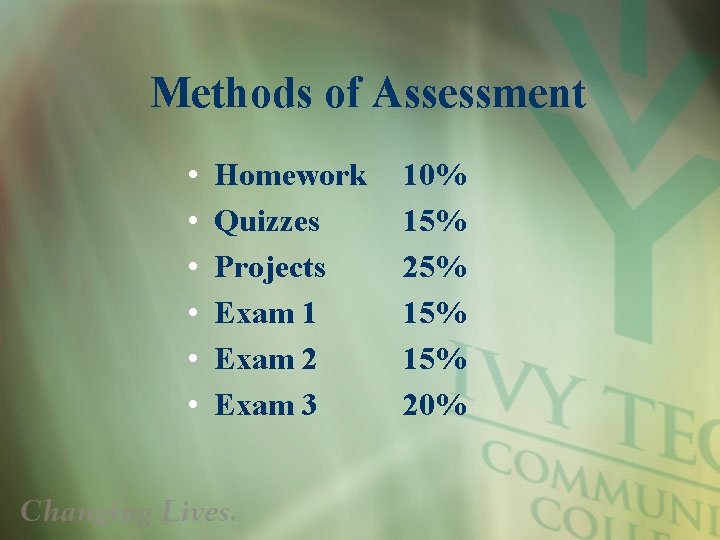
Methods of Assessment • • • Homework Quizzes Projects Exam 1 Exam 2 Exam 3 10% 15% 25% 15% 20%
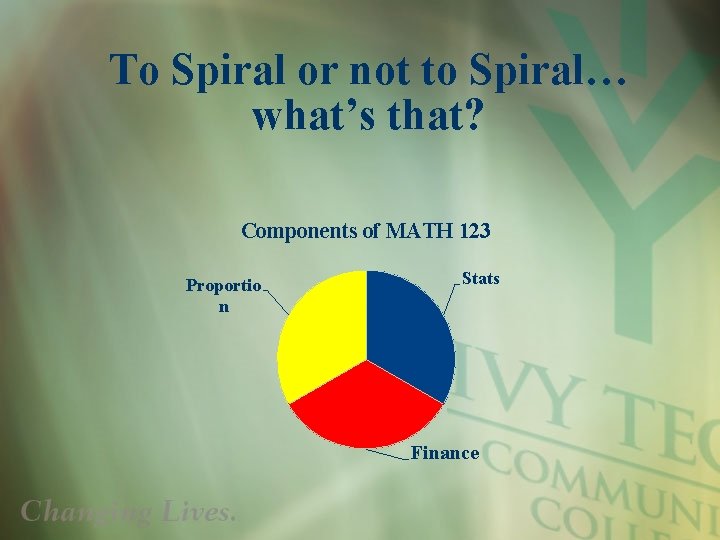
To Spiral or not to Spiral… what’s that? Components of MATH 123 Proportio n Stats Finance
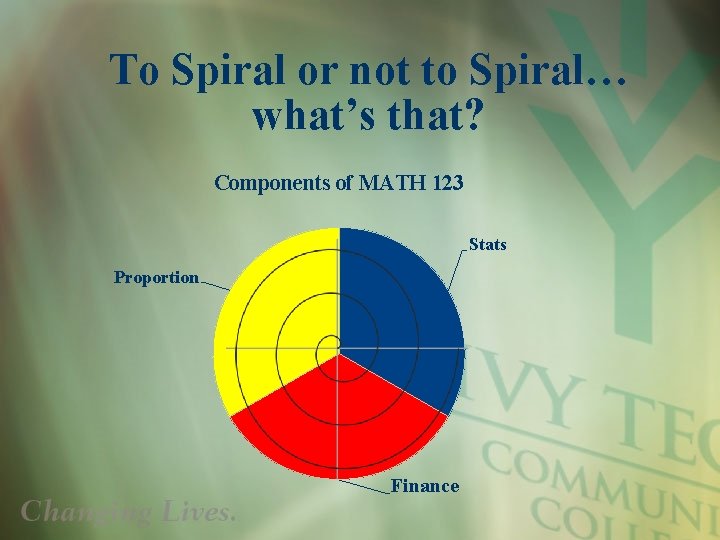
To Spiral or not to Spiral… what’s that? Components of MATH 123 Stats Proportion Finance
Unit 1 topics • • Large and Small Numbers Proportional Reasoning Descriptive Statistics Weighted Averages
Unit 2 Topics • • • Dimensional Analysis Normal Distributions Probability Risk Margins of Error
Unit 3 Topics • • Financial Literacy Absolute and Relative Change Linear Models Exponential Models
Why Use Spreadsheets? • To make cumbersome calculations more accessible • To easily graph data • To focus on quantitative reasoning • To prepare students for the real world
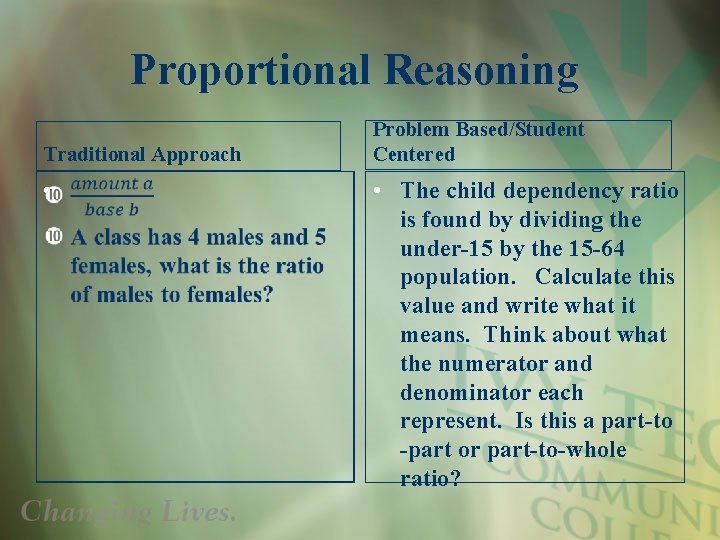
Proportional Reasoning Traditional Approach • Problem Based/Student Centered • The child dependency ratio is found by dividing the under-15 by the 15 -64 population. Calculate this value and write what it means. Think about what the numerator and denominator each represent. Is this a part-to -part or part-to-whole ratio?
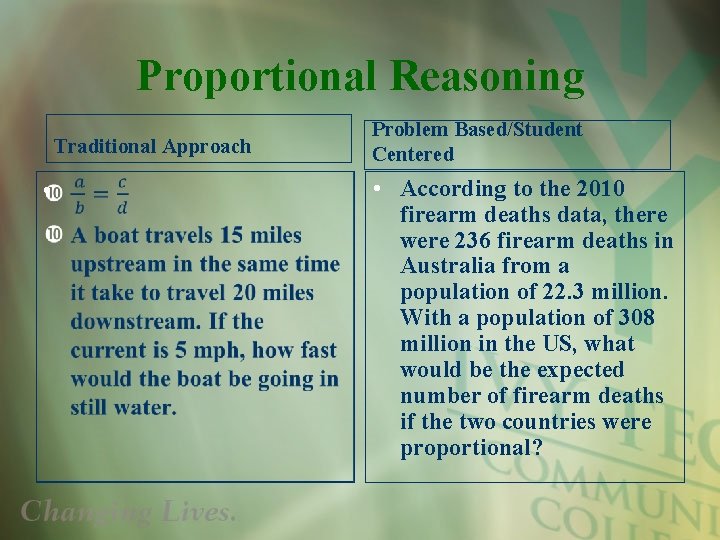
Proportional Reasoning Traditional Approach • Problem Based/Student Centered • According to the 2010 firearm deaths data, there were 236 firearm deaths in Australia from a population of 22. 3 million. With a population of 308 million in the US, what would be the expected number of firearm deaths if the two countries were proportional?
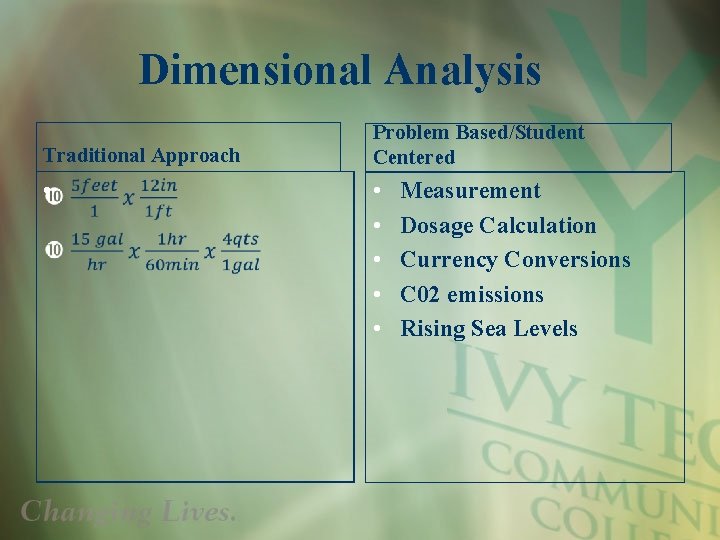
Dimensional Analysis Traditional Approach • Problem Based/Student Centered • • • Measurement Dosage Calculation Currency Conversions C 02 emissions Rising Sea Levels
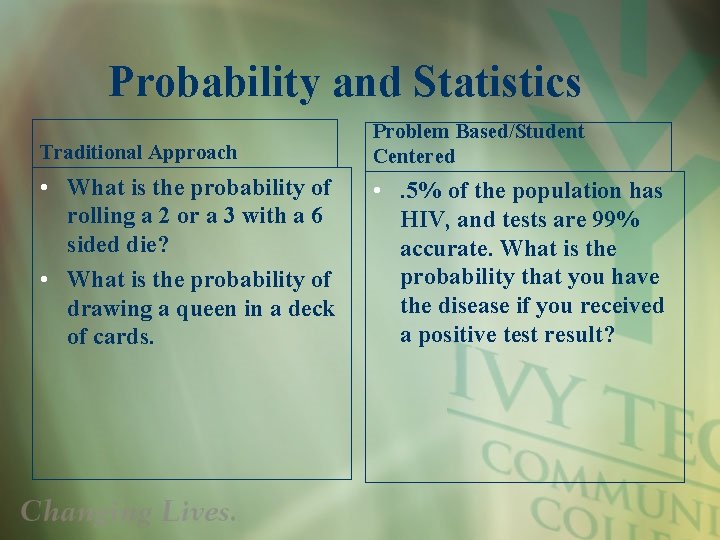
Probability and Statistics Traditional Approach Problem Based/Student Centered • What is the probability of rolling a 2 or a 3 with a 6 sided die? • What is the probability of drawing a queen in a deck of cards. • . 5% of the population has HIV, and tests are 99% accurate. What is the probability that you have the disease if you received a positive test result?
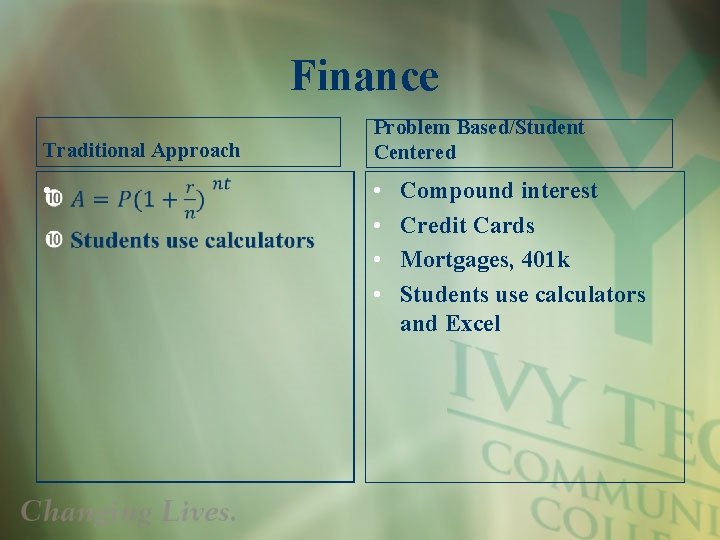
Finance Traditional Approach • Problem Based/Student Centered • • Compound interest Credit Cards Mortgages, 401 k Students use calculators and Excel
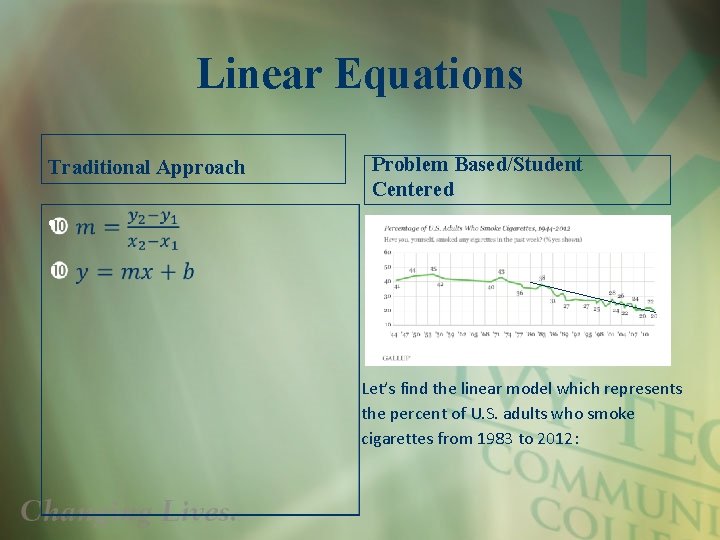
Linear Equations Traditional Approach Problem Based/Student Centered • Let’s find the linear model which represents the percent of U. S. adults who smoke cigarettes from 1983 to 2012: