
Math 11 Lesson 68 Descartes Rule of Signs
- Slides: 20
Math 11: Lesson 68 Descartes’ Rule of Signs Dr. Dave Paulus
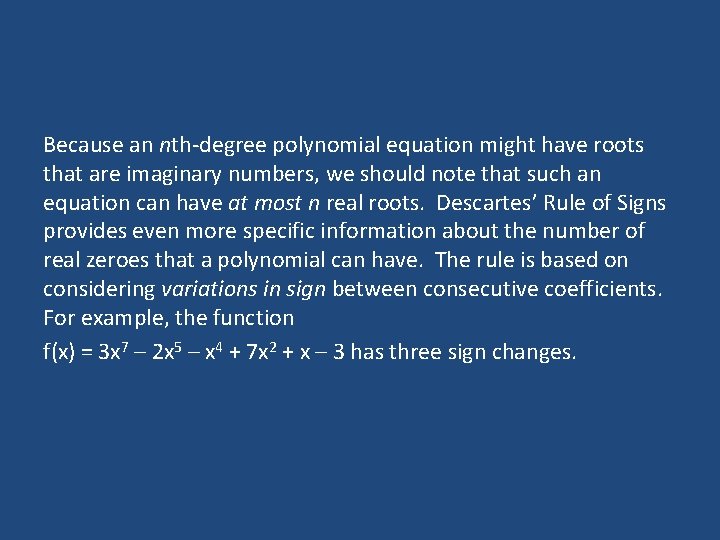
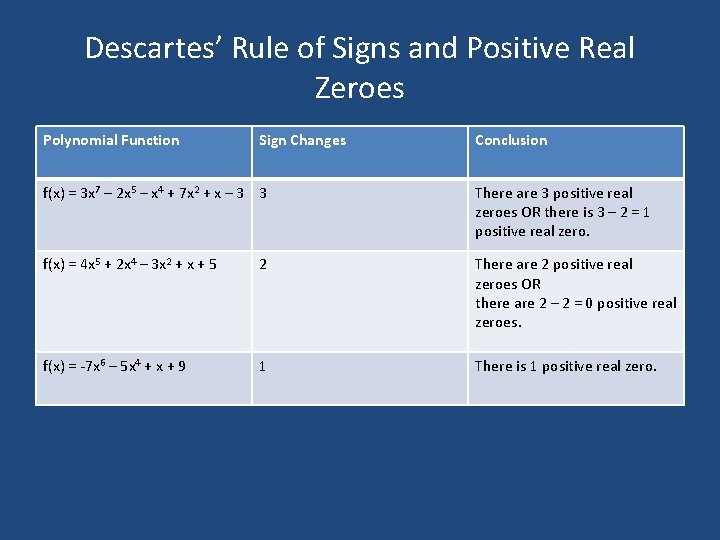
Because an nth-degree polynomial equation might have roots that are imaginary numbers, we should note that such an equation can have at most n real roots. Descartes’ Rule of Signs provides even more specific information about the number of real zeroes that a polynomial can have. The rule is based on considering variations in sign between consecutive coefficients. For example, the function f(x) = 3 x 7 – 2 x 5 – x 4 + 7 x 2 + x – 3 has three sign changes.
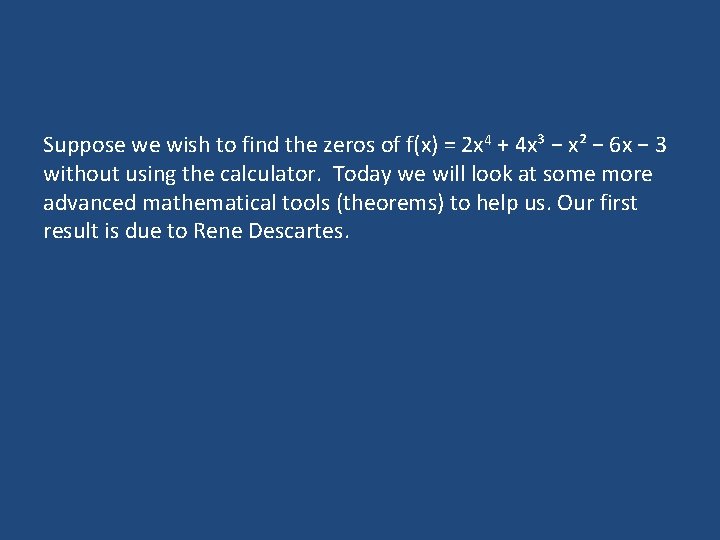
Suppose we wish to find the zeros of f(x) = 2 x 4 + 4 x³ − x² − 6 x − 3 without using the calculator. Today we will look at some more advanced mathematical tools (theorems) to help us. Our first result is due to Rene Descartes.
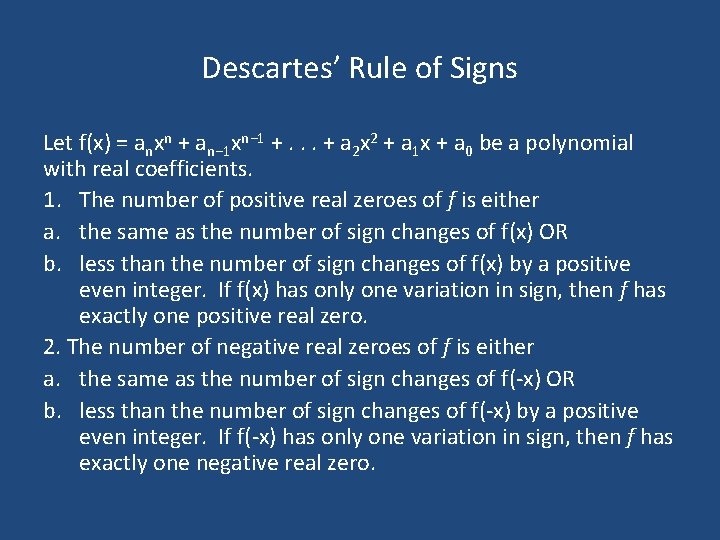
Descartes’ Rule of Signs Let f(x) = anxn + an− 1 xn− 1 +. . . + a 2 x 2 + a 1 x + a 0 be a polynomial with real coefficients. 1. The number of positive real zeroes of f is either a. the same as the number of sign changes of f(x) OR b. less than the number of sign changes of f(x) by a positive even integer. If f(x) has only one variation in sign, then f has exactly one positive real zero. 2. The number of negative real zeroes of f is either a. the same as the number of sign changes of f(-x) OR b. less than the number of sign changes of f(-x) by a positive even integer. If f(-x) has only one variation in sign, then f has exactly one negative real zero.
Descartes’ Rule of Signs and Positive Real Zeroes Polynomial Function Sign Changes Conclusion f(x) = 3 x 7 – 2 x 5 – x 4 + 7 x 2 + x – 3 3 There are 3 positive real zeroes OR there is 3 – 2 = 1 positive real zero. f(x) = 4 x 5 + 2 x 4 – 3 x 2 + x + 5 2 There are 2 positive real zeroes OR there are 2 – 2 = 0 positive real zeroes. f(x) = -7 x 6 – 5 x 4 + x + 9 1 There is 1 positive real zero.
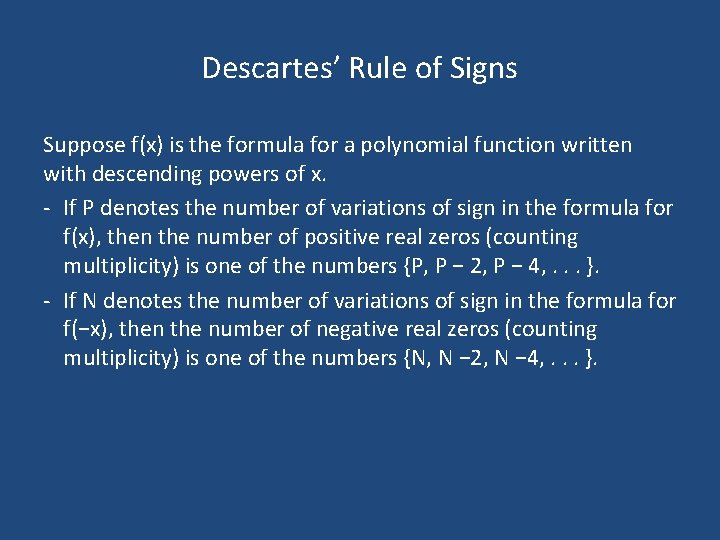
Descartes’ Rule of Signs Suppose f(x) is the formula for a polynomial function written with descending powers of x. - If P denotes the number of variations of sign in the formula for f(x), then the number of positive real zeros (counting multiplicity) is one of the numbers {P, P − 2, P − 4, . . . }. - If N denotes the number of variations of sign in the formula for f(−x), then the number of negative real zeros (counting multiplicity) is one of the numbers {N, N − 2, N − 4, . . . }.
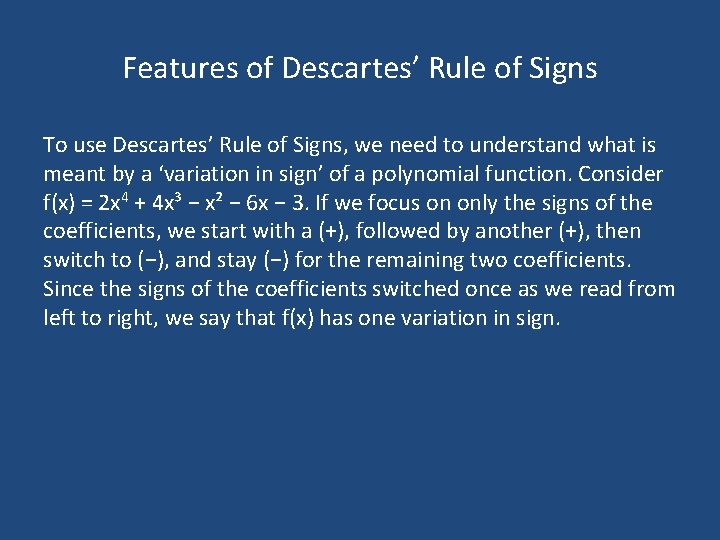
Features of Descartes’ Rule of Signs To use Descartes’ Rule of Signs, we need to understand what is meant by a ‘variation in sign’ of a polynomial function. Consider f(x) = 2 x 4 + 4 x³ − x² − 6 x − 3. If we focus on only the signs of the coefficients, we start with a (+), followed by another (+), then switch to (−), and stay (−) for the remaining two coefficients. Since the signs of the coefficients switched once as we read from left to right, we say that f(x) has one variation in sign.
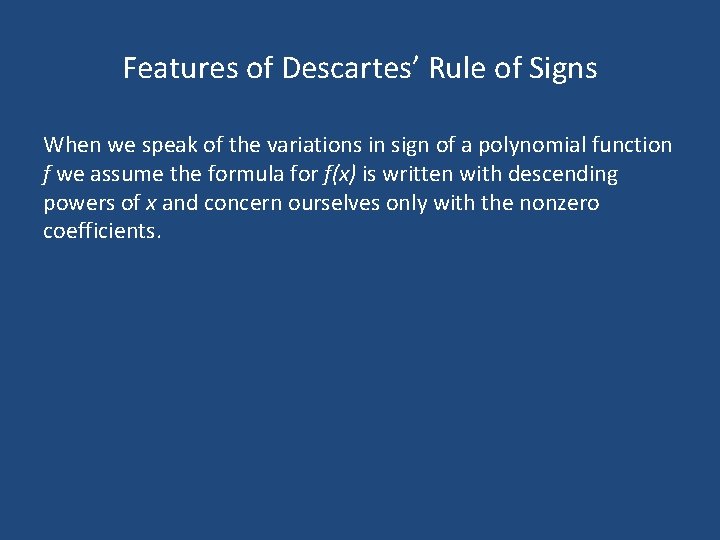
Features of Descartes’ Rule of Signs When we speak of the variations in sign of a polynomial function f we assume the formula for f(x) is written with descending powers of x and concern ourselves only with the nonzero coefficients.
Features of Descartes’ Rule of Signs Unlike the Rational Zeros Theorem, Descartes’ Rule of Signs gives us an estimate to the number of positive and negative real zeros, not the actual value of the zeros.
Features of Descartes’ Rule of Signs counts multiplicities. This means that, for example, if one of the zeros has multiplicity 2, Descsartes’ Rule of Signs would count this as two zeros.
Features of Descartes’ Rule of Signs Note that the number of positive or negative real zeros always starts with the number of sign changes and decreases by an even number. For example, if f(x) has 7 sign changes, then, counting multplicities, f has either 7, 5, 3 or 1 positive real zero. This implies that the graph of y = f(x) crosses the positive x-axis at least once. If f(−x) results in 4 sign changes, then, counting multiplicities, f has 4, 2 or 0 negative real zeros; hence, the graph of y = f(x) may not cross the negative x-axis at all.
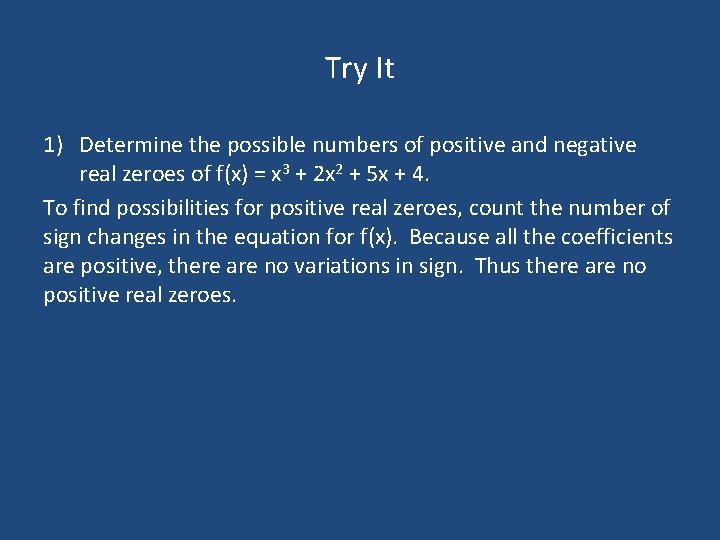
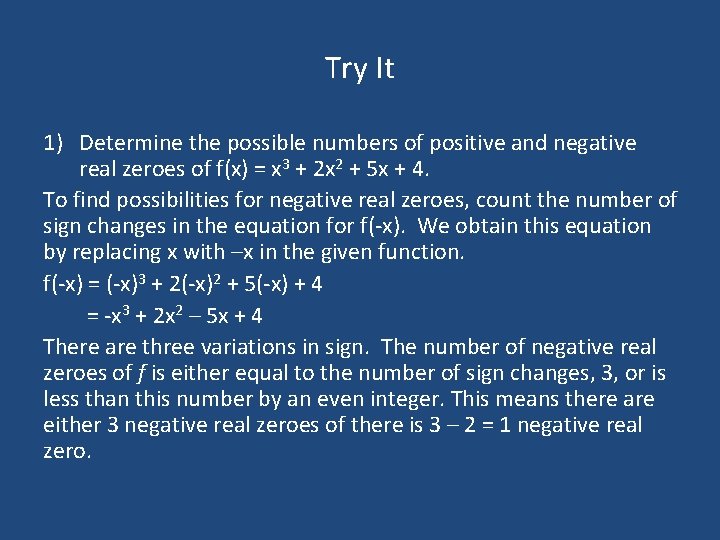
Try It 1) Determine the possible numbers of positive and negative real zeroes of f(x) = x 3 + 2 x 2 + 5 x + 4.
Try It 1) Determine the possible numbers of positive and negative real zeroes of f(x) = x 3 + 2 x 2 + 5 x + 4. To find possibilities for positive real zeroes, count the number of sign changes in the equation for f(x). Because all the coefficients are positive, there are no variations in sign. Thus there are no positive real zeroes.
Try It 1) Determine the possible numbers of positive and negative real zeroes of f(x) = x 3 + 2 x 2 + 5 x + 4. To find possibilities for negative real zeroes, count the number of sign changes in the equation for f(-x). We obtain this equation by replacing x with –x in the given function. f(-x) = (-x)3 + 2(-x)2 + 5(-x) + 4 = -x 3 + 2 x 2 – 5 x + 4 There are three variations in sign. The number of negative real zeroes of f is either equal to the number of sign changes, 3, or is less than this number by an even integer. This means there are either 3 negative real zeroes of there is 3 – 2 = 1 negative real zero.
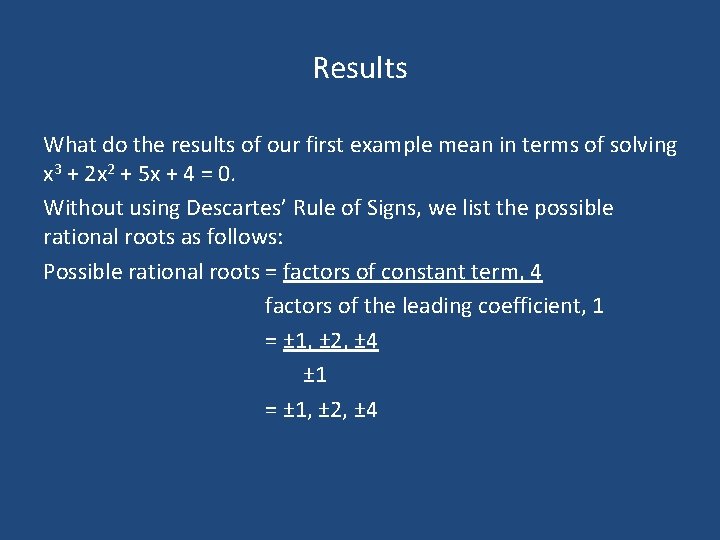
Results What do the results of our first example mean in terms of solving x 3 + 2 x 2 + 5 x + 4 = 0. Without using Descartes’ Rule of Signs, we list the possible rational roots as follows: Possible rational roots = factors of constant term, 4 factors of the leading coefficient, 1 = ± 1, ± 2, ± 4 ± 1 = ± 1, ± 2, ± 4
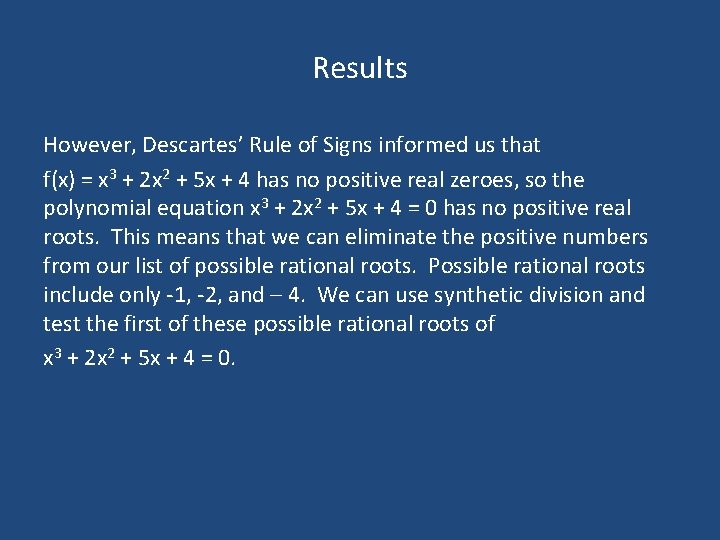
Results However, Descartes’ Rule of Signs informed us that f(x) = x 3 + 2 x 2 + 5 x + 4 has no positive real zeroes, so the polynomial equation x 3 + 2 x 2 + 5 x + 4 = 0 has no positive real roots. This means that we can eliminate the positive numbers from our list of possible rational roots. Possible rational roots include only -1, -2, and – 4. We can use synthetic division and test the first of these possible rational roots of x 3 + 2 x 2 + 5 x + 4 = 0.
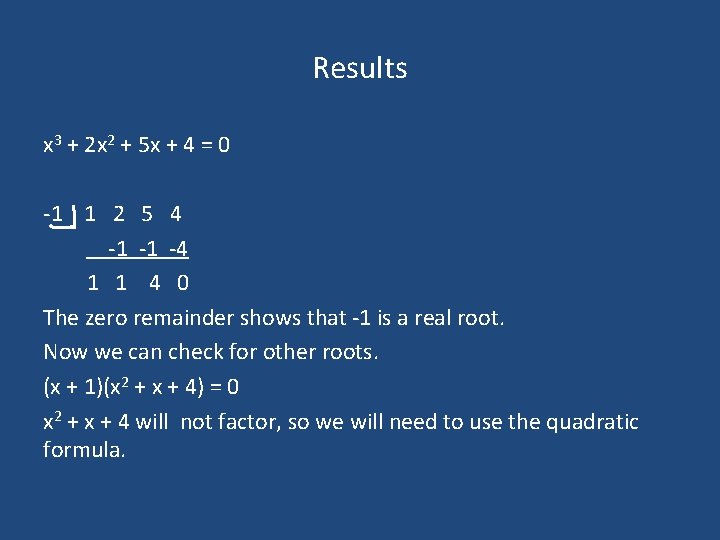
Results x 3 + 2 x 2 + 5 x + 4 = 0 -1 1 2 5 4 -1 -1 -4 1 1 4 0 The zero remainder shows that -1 is a real root. Now we can check for other roots. (x + 1)(x 2 + x + 4) = 0 x 2 + x + 4 will not factor, so we will need to use the quadratic formula.
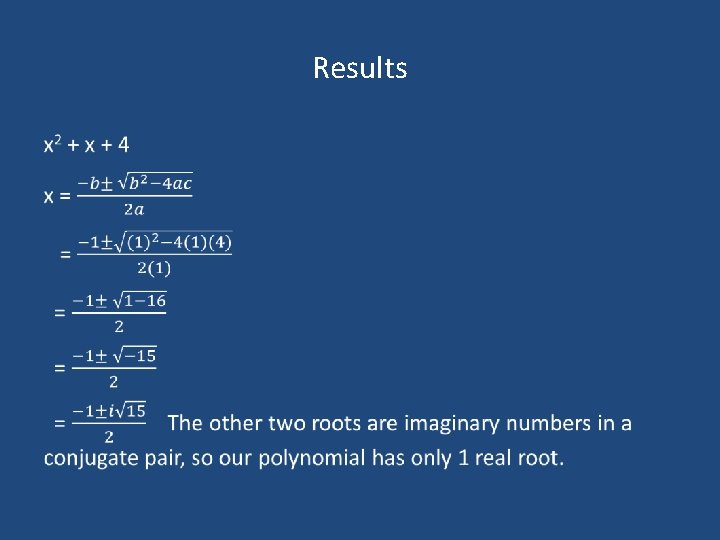
Results •
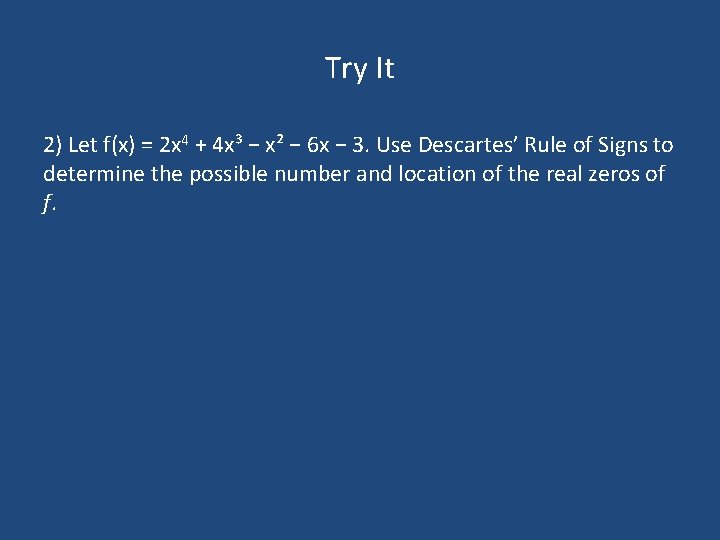
Try It 2) Let f(x) = 2 x 4 + 4 x³ − x² − 6 x − 3. Use Descartes’ Rule of Signs to determine the possible number and location of the real zeros of f.
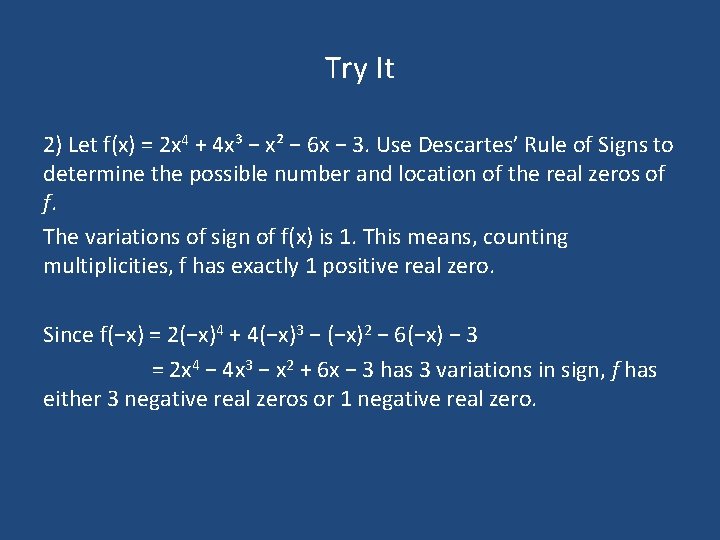
Try It 2) Let f(x) = 2 x 4 + 4 x³ − x² − 6 x − 3. Use Descartes’ Rule of Signs to determine the possible number and location of the real zeros of f. The variations of sign of f(x) is 1. This means, counting multiplicities, f has exactly 1 positive real zero. Since f(−x) = 2(−x)4 + 4(−x)3 − (−x)2 − 6(−x) − 3 = 2 x 4 − 4 x 3 − x 2 + 6 x − 3 has 3 variations in sign, f has either 3 negative real zeros or 1 negative real zero.