
Math 11 Lesson 37 Graphs of Equations Symmetry
- Slides: 28
Math 11: Lesson 37 Graphs of Equations - Symmetry Dr. Dave Paulus
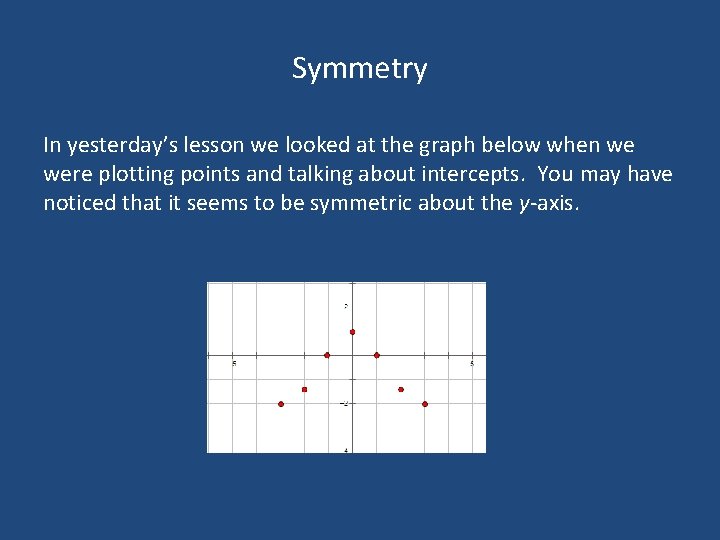
Symmetry In yesterday’s lesson we looked at the graph below when we were plotting points and talking about intercepts. You may have noticed that it seems to be symmetric about the y-axis.
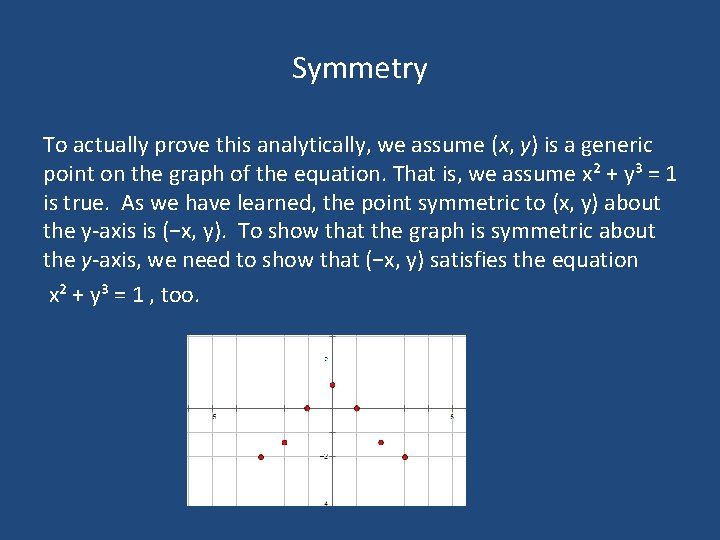
Symmetry To actually prove this analytically, we assume (x, y) is a generic point on the graph of the equation. That is, we assume x² + y³ = 1 is true. As we have learned, the point symmetric to (x, y) about the y-axis is (−x, y). To show that the graph is symmetric about the y-axis, we need to show that (−x, y) satisfies the equation x² + y³ = 1 , too.
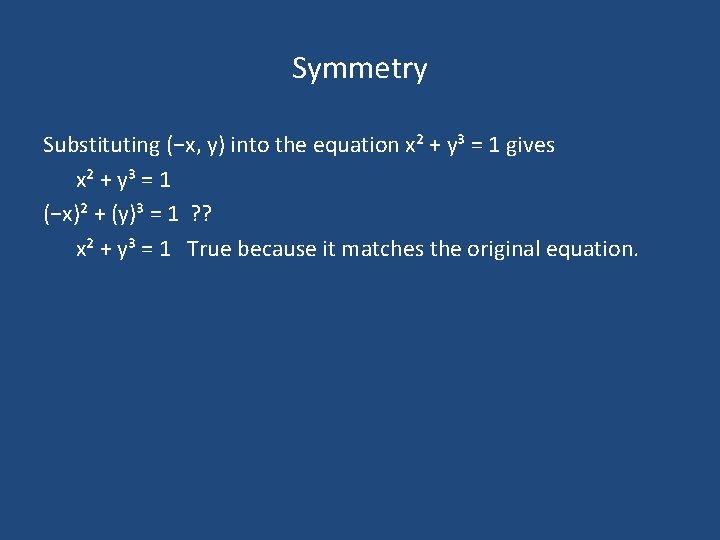
Symmetry Substituting (−x, y) into the equation x² + y³ = 1 gives x² + y³ = 1 (−x)² + (y)³ = 1 ? ? x² + y³ = 1 True because it matches the original equation.
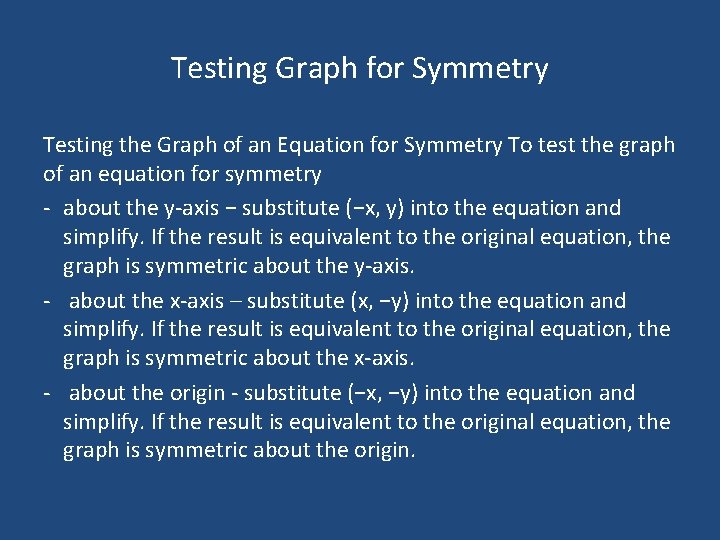
Testing Graph for Symmetry Testing the Graph of an Equation for Symmetry To test the graph of an equation for symmetry - about the y-axis − substitute (−x, y) into the equation and simplify. If the result is equivalent to the original equation, the graph is symmetric about the y-axis. - about the x-axis – substitute (x, −y) into the equation and simplify. If the result is equivalent to the original equation, the graph is symmetric about the x-axis. - about the origin - substitute (−x, −y) into the equation and simplify. If the result is equivalent to the original equation, the graph is symmetric about the origin.
Intercepts and symmetry are two tools which can help us sketch a graph analytically. This is demonstrated in the next example.
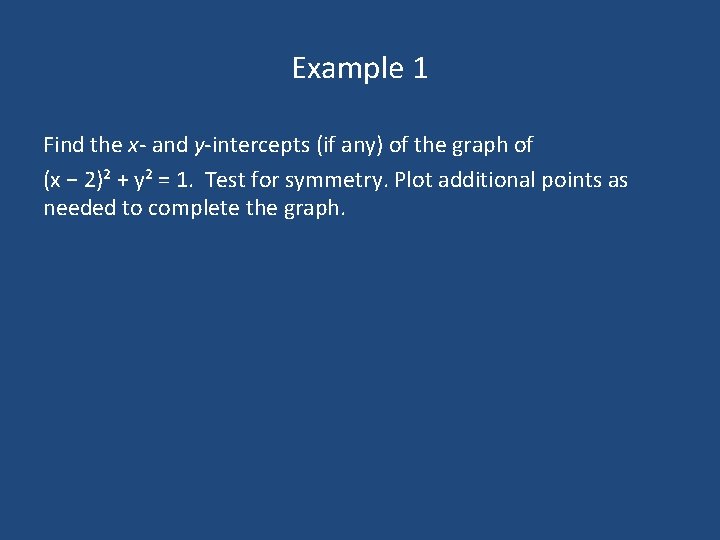
Example 1 Find the x- and y-intercepts (if any) of the graph of (x − 2)² + y² = 1. Test for symmetry. Plot additional points as needed to complete the graph.
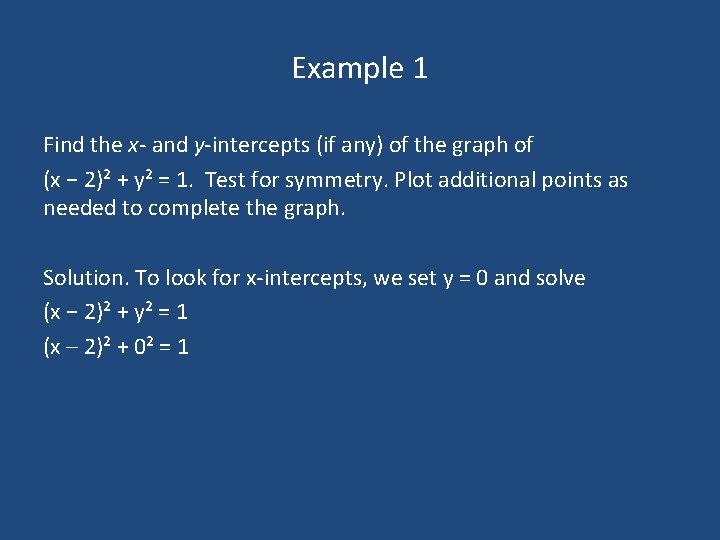
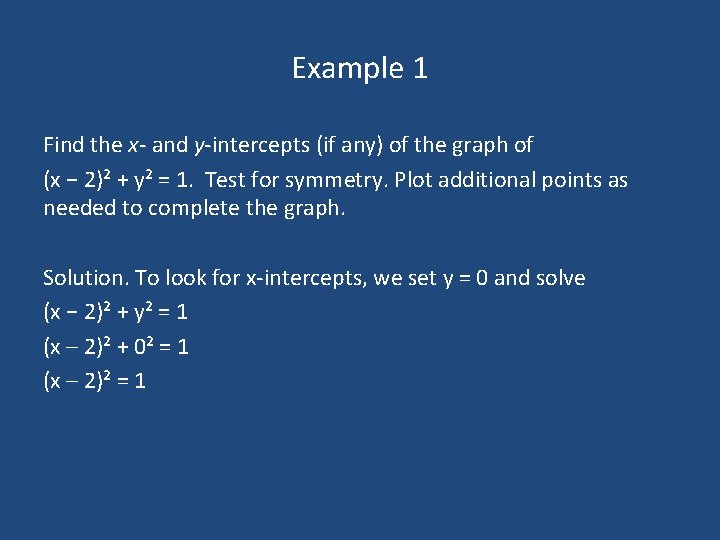
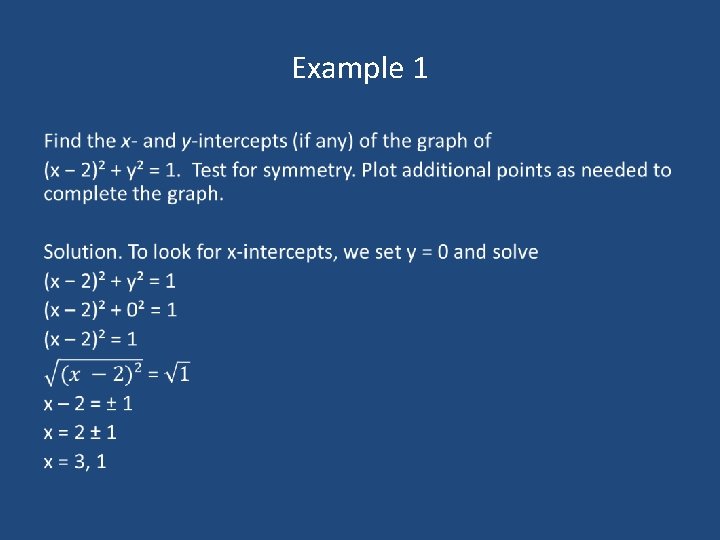
Example 1 Find the x- and y-intercepts (if any) of the graph of (x − 2)² + y² = 1. Test for symmetry. Plot additional points as needed to complete the graph. Solution. To look for x-intercepts, we set y = 0 and solve (x − 2)² + y² = 1 (x – 2)² + 0² = 1
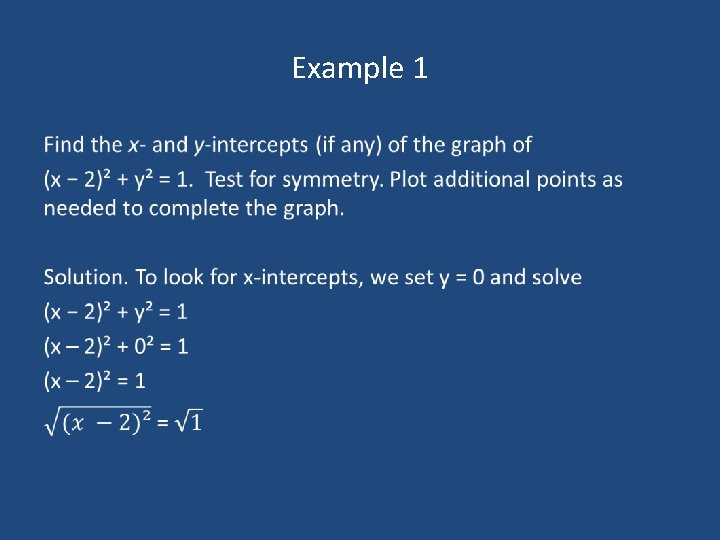
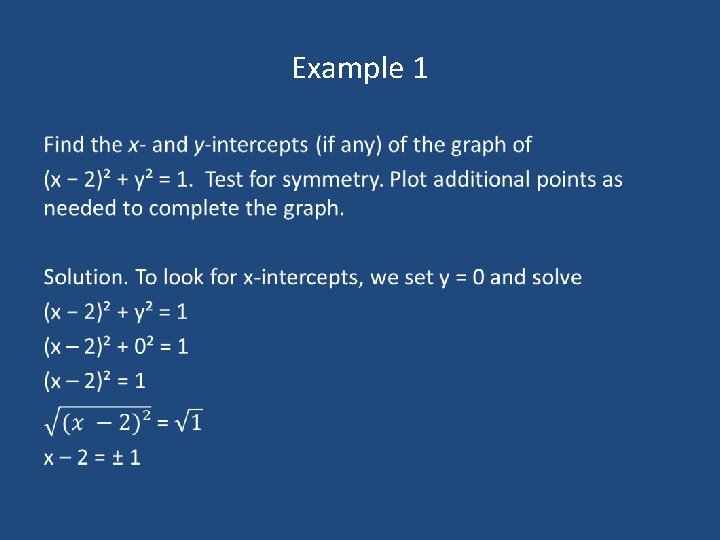
Example 1 Find the x- and y-intercepts (if any) of the graph of (x − 2)² + y² = 1. Test for symmetry. Plot additional points as needed to complete the graph. Solution. To look for x-intercepts, we set y = 0 and solve (x − 2)² + y² = 1 (x – 2)² + 0² = 1 (x – 2)² = 1
Example 1 •
Example 1 •
Example 1 •
Example 1 •
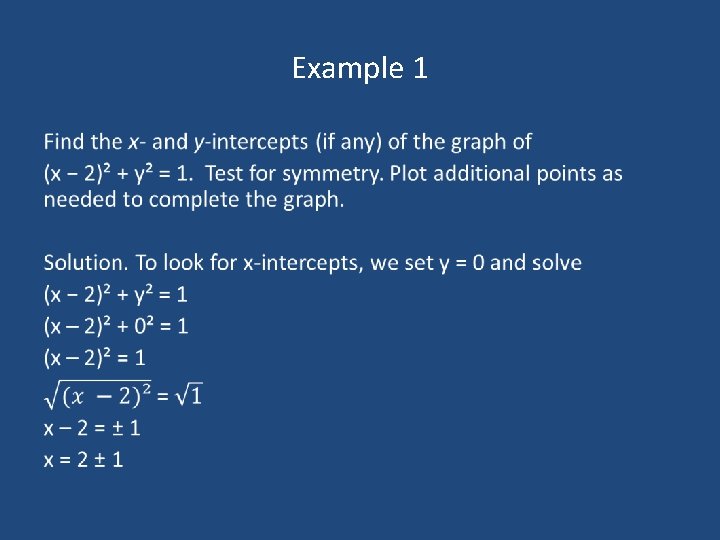
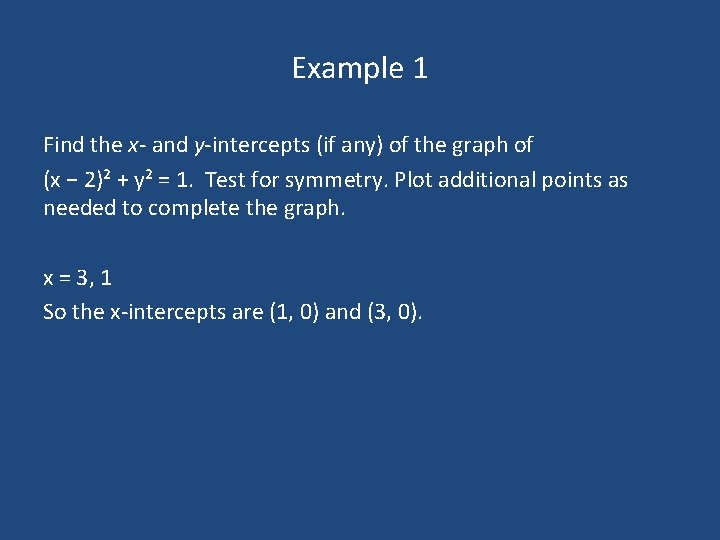
Example 1 Find the x- and y-intercepts (if any) of the graph of (x − 2)² + y² = 1. Test for symmetry. Plot additional points as needed to complete the graph. x = 3, 1 So the x-intercepts are (1, 0) and (3, 0).
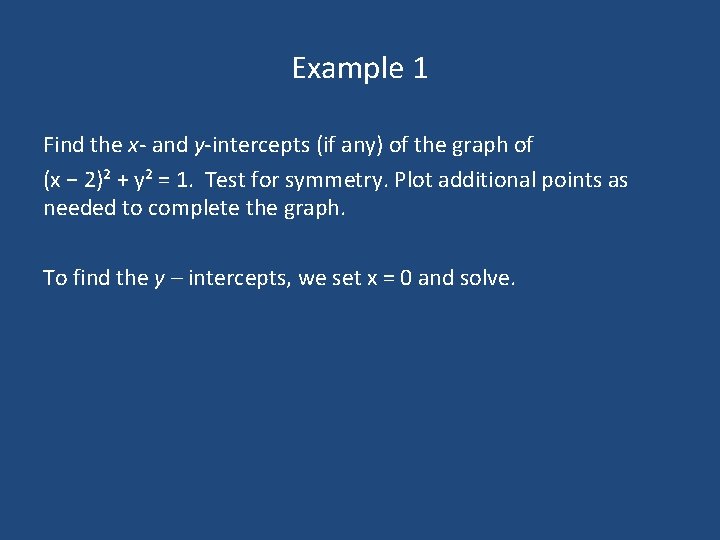
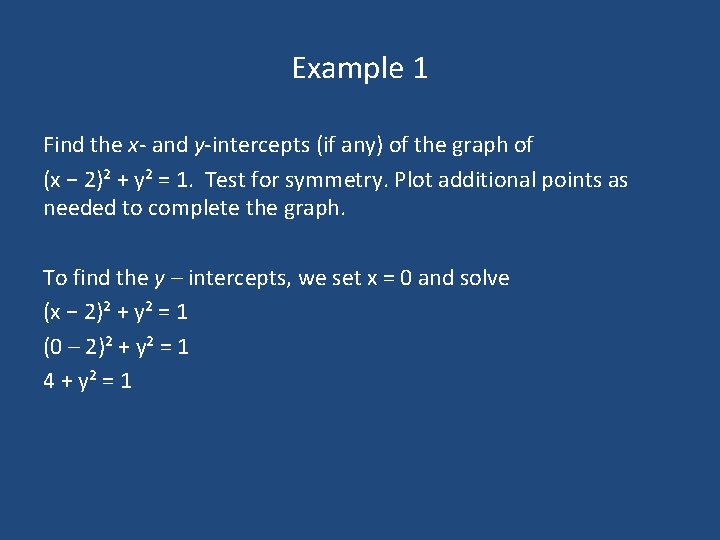
Example 1 Find the x- and y-intercepts (if any) of the graph of (x − 2)² + y² = 1. Test for symmetry. Plot additional points as needed to complete the graph. To find the y – intercepts, we set x = 0 and solve.
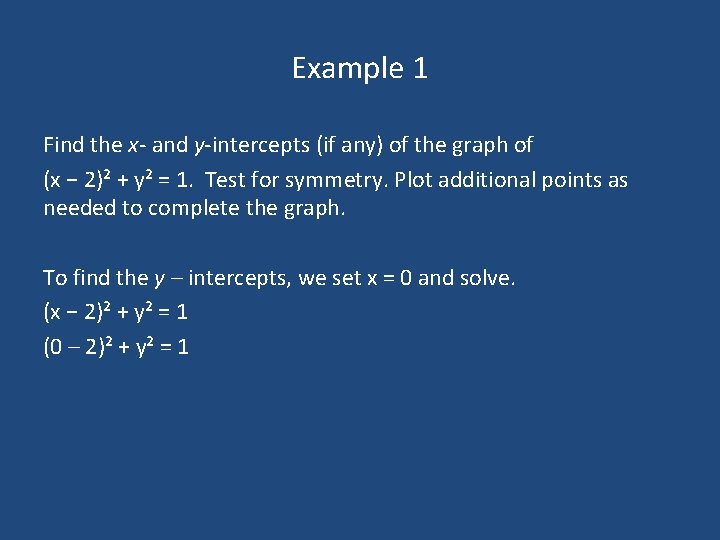
Example 1 Find the x- and y-intercepts (if any) of the graph of (x − 2)² + y² = 1. Test for symmetry. Plot additional points as needed to complete the graph. To find the y – intercepts, we set x = 0 and solve. (x − 2)² + y² = 1 (0 – 2)² + y² = 1
Example 1 Find the x- and y-intercepts (if any) of the graph of (x − 2)² + y² = 1. Test for symmetry. Plot additional points as needed to complete the graph. To find the y – intercepts, we set x = 0 and solve (x − 2)² + y² = 1 (0 – 2)² + y² = 1 4 + y² = 1
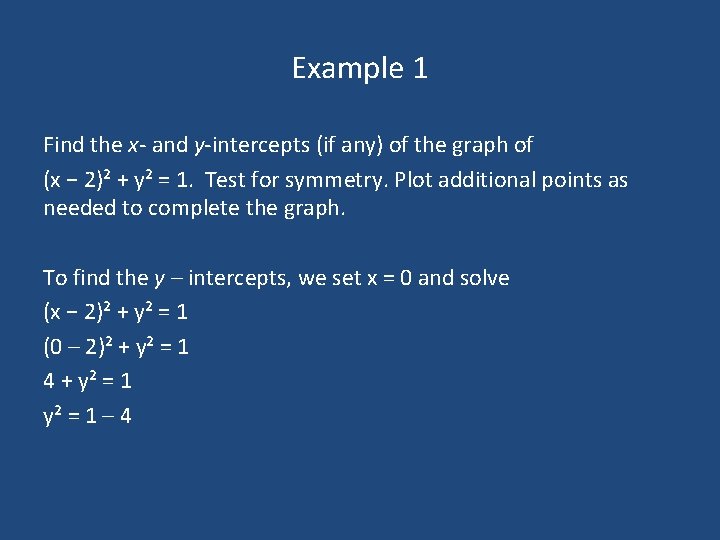
Example 1 Find the x- and y-intercepts (if any) of the graph of (x − 2)² + y² = 1. Test for symmetry. Plot additional points as needed to complete the graph. To find the y – intercepts, we set x = 0 and solve (x − 2)² + y² = 1 (0 – 2)² + y² = 1 4 + y² = 1 – 4
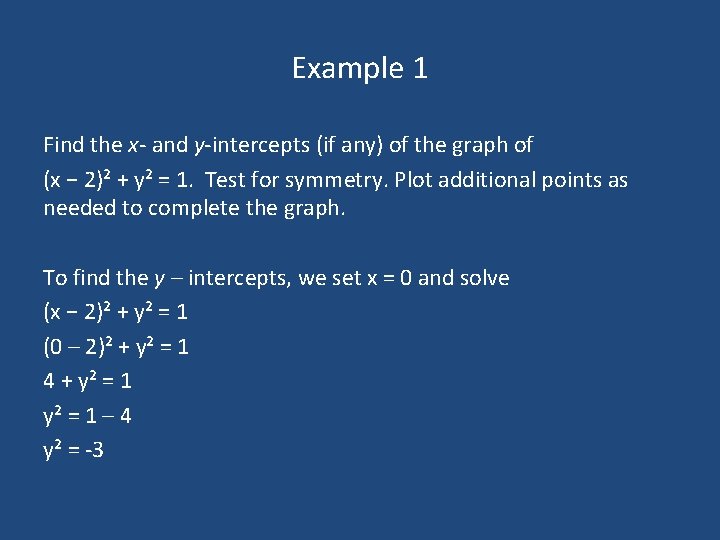
Example 1 Find the x- and y-intercepts (if any) of the graph of (x − 2)² + y² = 1. Test for symmetry. Plot additional points as needed to complete the graph. To find the y – intercepts, we set x = 0 and solve (x − 2)² + y² = 1 (0 – 2)² + y² = 1 4 + y² = 1 – 4 y² = -3
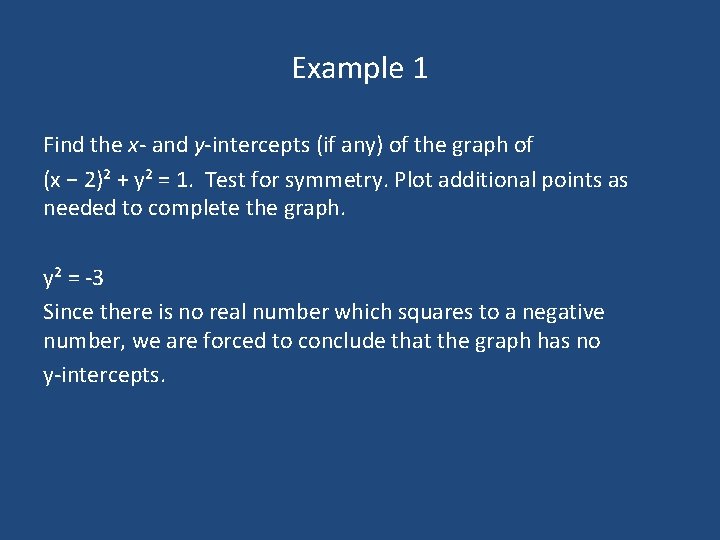
Example 1 Find the x- and y-intercepts (if any) of the graph of (x − 2)² + y² = 1. Test for symmetry. Plot additional points as needed to complete the graph. y² = -3 Since there is no real number which squares to a negative number, we are forced to conclude that the graph has no y-intercepts.
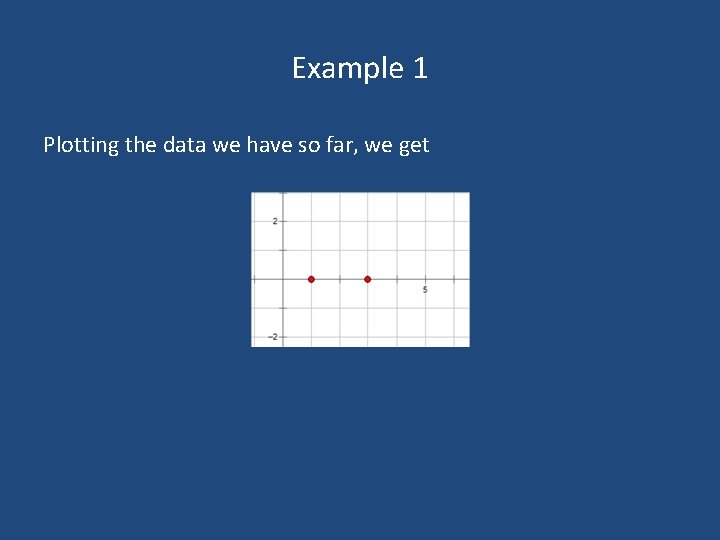
Example 1 Plotting the data we have so far, we get
Example 1 Moving along to symmetry, we can immediately dismiss the possibility that the graph is symmetric about the y-axis or the origin. If the graph possessed either of these symmetries, then the fact that (1, 0) is on the graph would mean (− 1, 0) would have to be on the graph. (Why? ) Since (− 1, 0) would be another x -intercept (and we’ve found all of these), the graph can’t have yaxis or origin symmetry. The only symmetry left to test is symmetry about the x-axis. To that end, we substitute (x, −y) into the equation and simplify.
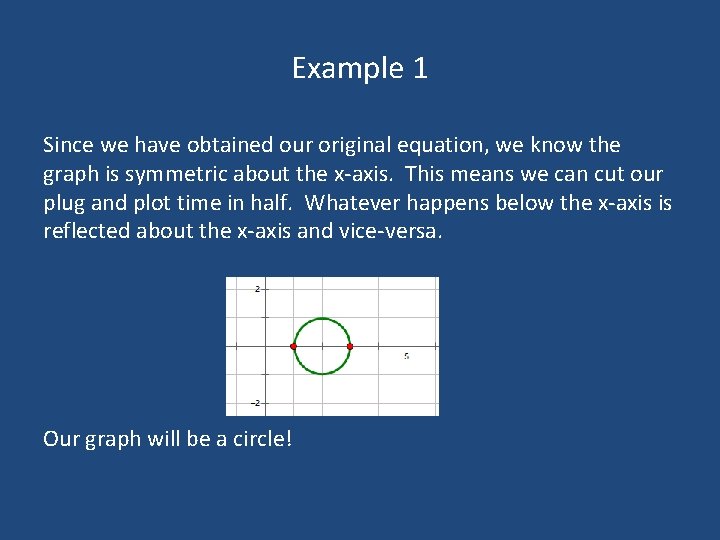
Example 1 (x – 2)² + y² = 1 (x – 2)² + (-y)² = 1 ? (x – 2)² + y² = 1 True Since we have obtained our original equation, we know the graph is symmetric about the x-axis. This means we can cut our ‘plug and plot’ time in half: whatever happens below the x-axis is reflected above the x-axis, and vice-versa. Proceeding as we did in the previous example, we obtain
Example 1 Since we have obtained our original equation, we know the graph is symmetric about the x-axis. This means we can cut our plug and plot time in half. Whatever happens below the x-axis is reflected about the x-axis and vice-versa. Our graph will be a circle!
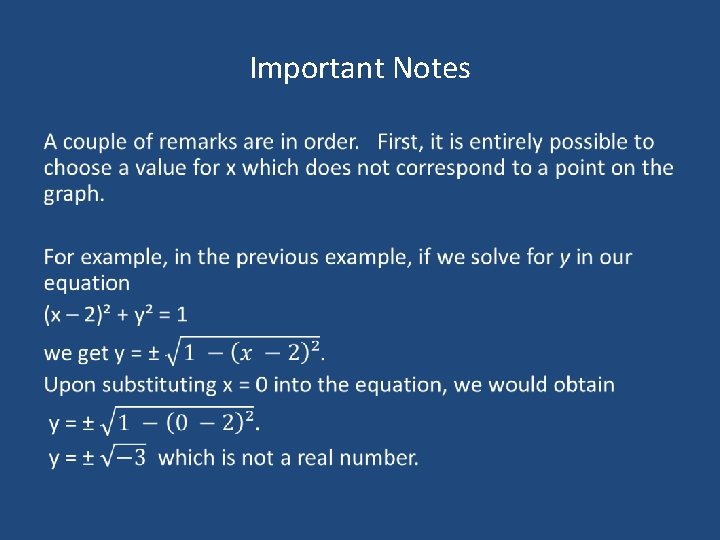
Important Notes •
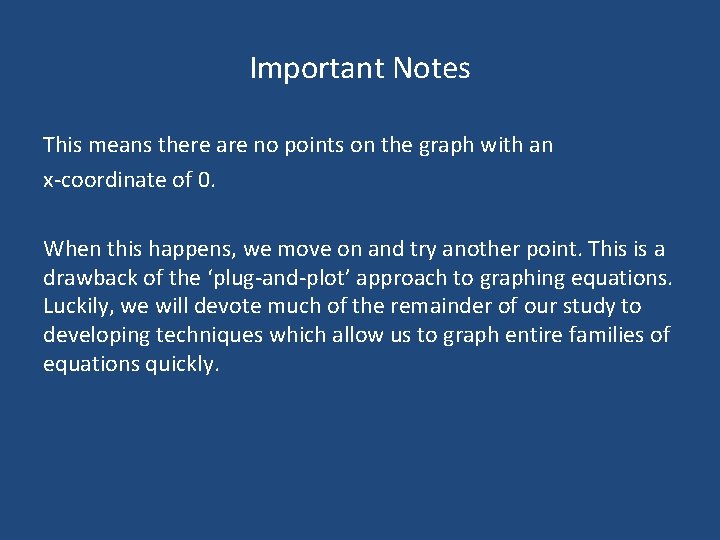
Important Notes This means there are no points on the graph with an x-coordinate of 0. When this happens, we move on and try another point. This is a drawback of the ‘plug-and-plot’ approach to graphing equations. Luckily, we will devote much of the remainder of our study to developing techniques which allow us to graph entire families of equations quickly.
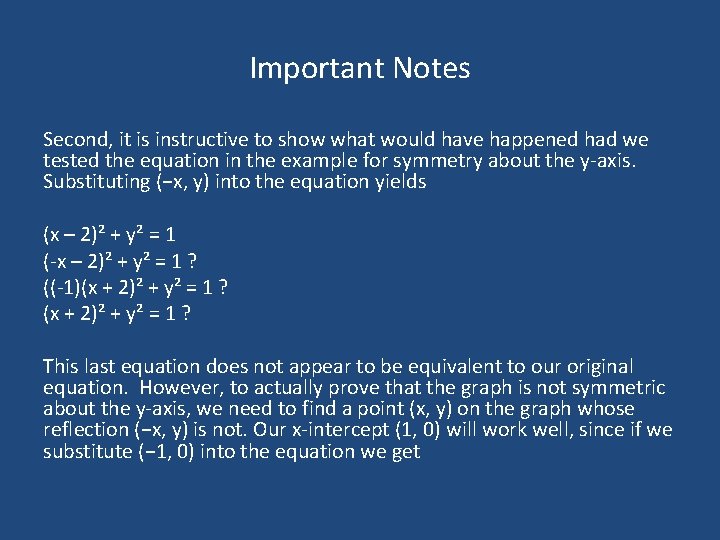
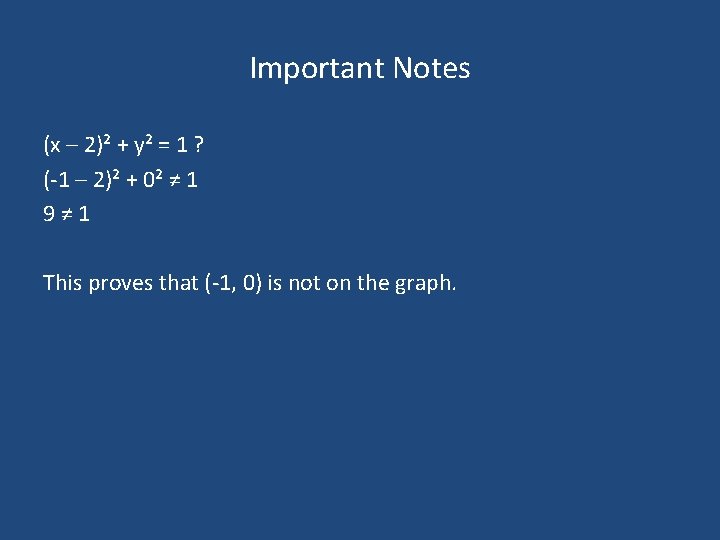
Important Notes Second, it is instructive to show what would have happened had we tested the equation in the example for symmetry about the y-axis. Substituting (−x, y) into the equation yields (x – 2)² + y² = 1 (-x – 2)² + y² = 1 ? ((-1)(x + 2)² + y² = 1 ? This last equation does not appear to be equivalent to our original equation. However, to actually prove that the graph is not symmetric about the y-axis, we need to find a point (x, y) on the graph whose reflection (−x, y) is not. Our x-intercept (1, 0) will work well, since if we substitute (− 1, 0) into the equation we get
Important Notes (x – 2)² + y² = 1 ? (-1 – 2)² + 0² ≠ 1 9≠ 1 This proves that (-1, 0) is not on the graph.