
MATH 092 013 Mathematical Literacy for College Students
- Slides: 8
MATH 092 -013 Mathematical Literacy for College Students I Class 12, October 13, 2015 Lessons 2. 6 & 2. 7
Lesson 2. 6 Objectives � By the end of this lesson, you should understand: ◦ Numerical data can be summarized using measures of central tendency ◦ The mean and median statistics for a set of data can provide different snapshots of the data ◦ Conclusions derived from statistical summaries are prone to error ◦ A spreadsheet can be used to organize data
Lesson 2. 6 Objectives � By to: the end of this lesson, you should be able ◦ Calculate the mean and median for numerical data ◦ Create a data set that meets certain criteria for measures of central tendency
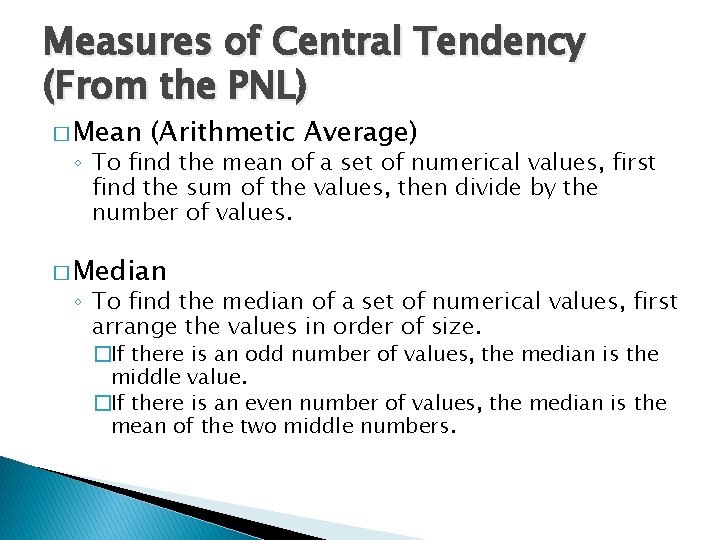
Measures of Central Tendency (From the PNL) � Mean (Arithmetic Average) ◦ To find the mean of a set of numerical values, first find the sum of the values, then divide by the number of values. � Median ◦ To find the median of a set of numerical values, first arrange the values in order of size. �If there is an odd number of values, the median is the middle value. �If there is an even number of values, the median is the mean of the two middle numbers.
Lesson 2. 6 Connections � Main idea: ◦ Measures of central tendency are tools—that have advantages and limitations—for summarizing data �All summaries can help you to understand data, but they can also obscure meaning. You have to understand the type of summary (such as what a mean is) to really make sense of the data. � Main idea: ◦ It is important to ask questions about data
Lesson 2. 7 Objectives � By the end of this lesson, you should understand that: ◦ Each statistic—the mean, median, and mode—is a different summary of numerical data ◦ Conclusions derived from statistical summaries are subject to error ◦ Measures of central tendency can be used to make decisions
Lesson 2. 7 Objectives � By to: the end of this lesson, you should be able ◦ Make good decision using information about data ◦ Interpret the mean, median, or mode in terms of the context of the problem ◦ Match data sets with appropriate statistics
Lesson 2. 7 Connections � Main idea: ◦ It is important to ask questions about quantitative information ◦ Additive change maintains absolute differences. Multiplicative change does not