
Materials Selection and Engineering Design of ITER PFCs



- Slides: 22
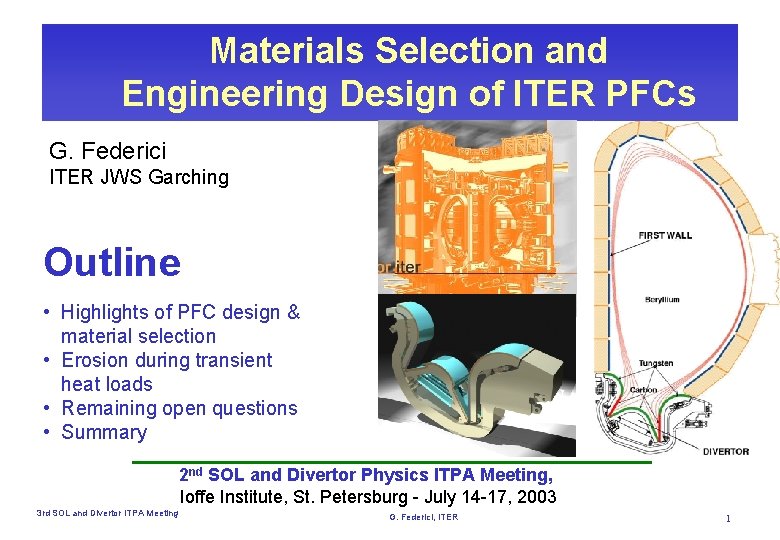
Materials Selection and Engineering Design of ITER PFCs G. Federici ITER JWS Garching Outline • Highlights of PFC design & material selection • Erosion during transient heat loads • Remaining open questions • Summary 2 nd SOL and Divertor Physics ITPA Meeting, Ioffe Institute, St. Petersburg - July 14 -17, 2003 3 rd SOL and Divertor ITPA Meeting G. Federici, ITER 1
Rationale for material selection Present choice: 3 different materials Advantages ITER Drawbacks Be Y Good O 2 gettering capability Y ~ tokamak practice (mainly JET); Y low Z; Y repairability by plasma-spraying; Y established joining technology; Y low tritium inventory. Y Inadequate for the divertor (Tm<1300˚C). Y Be dust on ‘hot’ surfaces -> H production due to reactivity with steam during accidents. Y Compatibility with Type I ELM loads disruptions or ‘mitigated’ disruptions. C Y Good power handling, thermal shock and thermal fatigue resistance; Y Chemical erosion --> erosion lifetime (~few thousand pulses). Y Tritium codeposition --> needs adequate recovery methods. W Y does not melt (but sublimes); Y low radiative power losses with influx to plasma due to low Z; Y well established joining technology; Y broad tokamak operation experience. Y low physical sputtering yield and high sputtering threshold energy; Y no chemical sputtering in H-plasma; Y low tritium inventory; Y repairability by plasma-spraying; Y well established joining technology. 3 rd SOL and Divertor ITPA Meeting Y Plasma compatibility-->favourable operation experience from ASDEXUpgrade, dust radiological hazard. Y Near strike points, its operational lifetime, has still uncertainties due to melt layer loss during disruptions and ‘large’ ELMs. G. Federici, ITER 2
Divertor design loads/lifetime • • Total power Nominal surface heat loads Transient heat load Disruption heat load Ion flux parameters Neutron load Other factors ITER Q 150 MW q = 10 MW/m 2, = 400 -500 sec, N = 3000 cycles (1 st div. ) q = 20 MW/m 2, = 10 sec, N = 300 cycles (i. e. , 10%) Q = 10 -100 MJ/m 2, = 0. 1 10 ms, N = 300 event (i. e. , 10%) J = 1021 -1024 m-2 s-1, E = 10 -100 e. V J(E>0. 1 Me. V) 1018 m-2 s-1, D = ~0. 1 dpa electromagnetic loads (P 4 MPa), H environment, etc. Strike points W/m 2 0. 56 2. 35 1. 34 4. 23 3. 47 Code simulation of surface heat flux on divertor 3 rd SOL and Divertor ITPA Meeting G. Federici, ITER 3
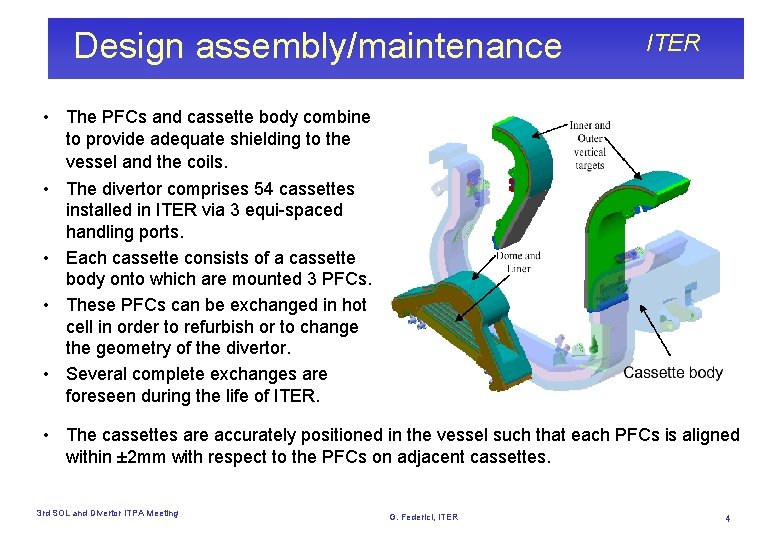
Design assembly/maintenance ITER • The PFCs and cassette body combine to provide adequate shielding to the vessel and the coils. • The divertor comprises 54 cassettes installed in ITER via 3 equi-spaced handling ports. • Each cassette consists of a cassette body onto which are mounted 3 PFCs. • These PFCs can be exchanged in hot cell in order to refurbish or to change the geometry of the divertor. • Several complete exchanges are foreseen during the life of ITER. • The cassettes are accurately positioned in the vessel such that each PFCs is aligned within ± 2 mm with respect to the PFCs on adjacent cassettes. 3 rd SOL and Divertor ITPA Meeting G. Federici, ITER 4
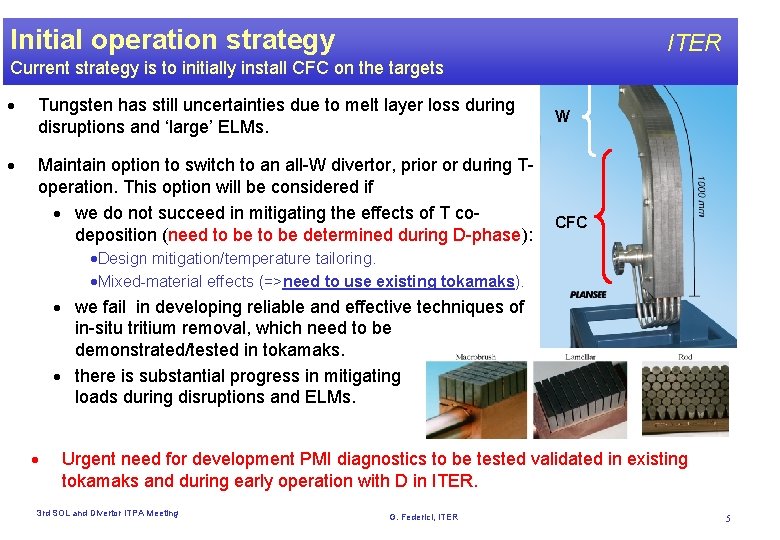
Initial operation strategy ITER Current strategy is to initially install CFC on the targets · Tungsten has still uncertainties due to melt layer loss during disruptions and ‘large’ ELMs. · Maintain option to switch to an all-W divertor, prior or during Toperation. This option will be considered if · we do not succeed in mitigating the effects of T codeposition (need to be determined during D-phase): W CFC ·Design mitigation/temperature tailoring. ·Mixed-material effects (=>need to use existing tokamaks). · we fail in developing reliable and effective techniques of in-situ tritium removal, which need to be demonstrated/tested in tokamaks. · there is substantial progress in mitigating heat loads during disruptions and ELMs. · Urgent need for development PMI diagnostics to be tested validated in existing tokamaks and during early operation with D in ITER. 3 rd SOL and Divertor ITPA Meeting G. Federici, ITER 5
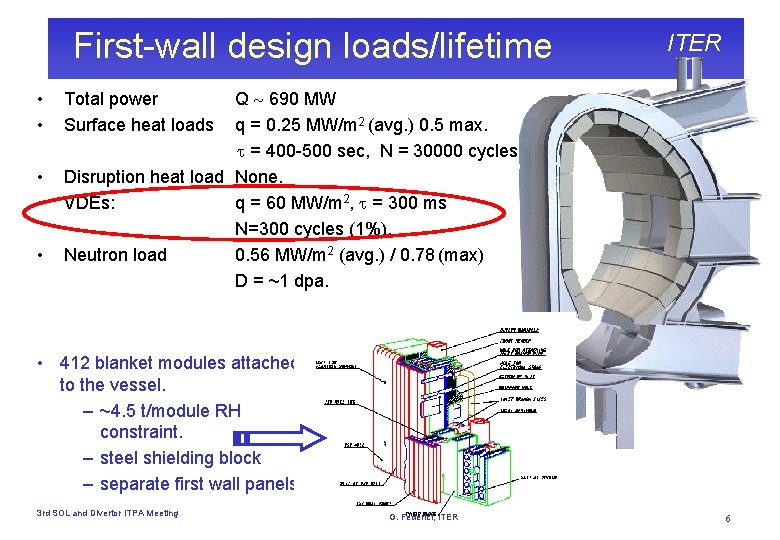
First-wall design loads/lifetime • • • ITER Q 690 MW q = 0. 25 MW/m 2 (avg. ) 0. 5 max. = 400 -500 sec, N = 30000 cycles Disruption heat load None. VDEs: q = 60 MW/m 2, = 300 ms N=300 cycles (1%), Neutron load 0. 56 MW/m 2 (avg. ) / 0. 78 (max) D = ~1 dpa. Total power Surface heat loads • 412 blanket modules attached to the vessel. – ~4. 5 t/module RH constraint. – steel shielding block – separate first wall panels. 3 rd SOL and Divertor ITPA Meeting G. Federici, ITER 6
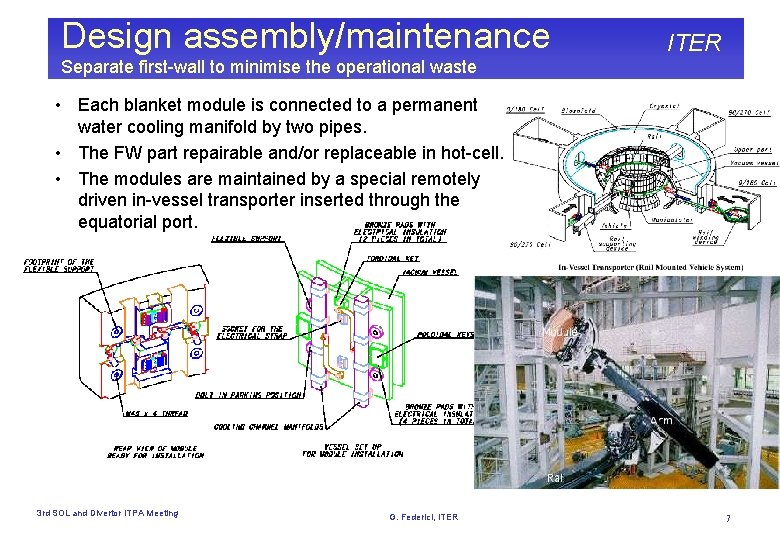
Design assembly/maintenance ITER Separate first-wall to minimise the operational waste • Each blanket module is connected to a permanent water cooling manifold by two pipes. • The FW part repairable and/or replaceable in hot-cell. • The modules are maintained by a special remotely driven in-vessel transporter inserted through the equatorial port. 3 rd SOL and Divertor ITPA Meeting G. Federici, ITER 7
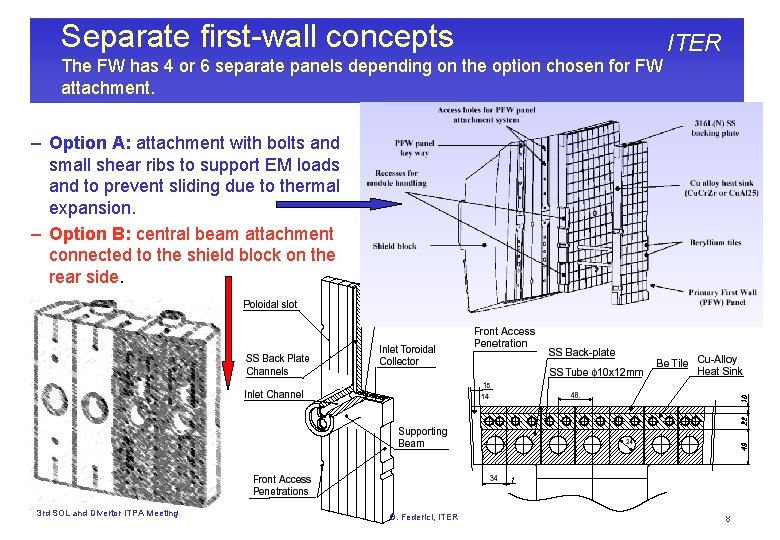
Separate first-wall concepts The FW has 4 or 6 separate panels depending on the option chosen for FW attachment. ITER – Option A: attachment with bolts and small shear ribs to support EM loads and to prevent sliding due to thermal expansion. – Option B: central beam attachment connected to the shield block on the rear side. 3 rd SOL and Divertor ITPA Meeting G. Federici, ITER 8
Remote handling classification ITER based on need for scheduled and unscheduled maintenance and modifications, likelihood for maintenance, and impact on operations and availability Divertor is Class 1: • Requires scheduled maintenance or replacement. • Component design and RH equipment and procedures, optimised to ensure task completion within a minimum time. • Feasibility of maintenance tasks demonstrated with R&D during EDA. • Demonstration using real components during initial assembly prior to active phase of operation is highly desirable. Blanket is Class 2: • Do not require scheduled but likely unscheduled or very infrequent maintenance. • Components are designed for full remote repair or replacement but “minimisation of repair is subordinate to consideration on nuclear performance and reliability”. • Feasibility of maintenance tasks partially demonstrated with R&D during EDA. • Demonstration using real components during initial assembly prior to active phase of operation is desirable. 3 rd SOL and Divertor ITPA Meeting G. Federici, ITER 9
Maintenance time estimates In-vessel components are removed from the VV by 4 equatorial ports, ITER 3 divertor ports and (? ) upper ports (EC and diagnostics). • Divertor cassette refurbishment – 18 cassettes --> 1 RH port =>2 months (7 working day/week, 2 (8 hrs) wk shifts/day, 1 cask transporter (8 hrs/shift/day). – 3 RH ports in series ==> 6 months – Replacement of 1 single faulty cassette ≤ 2 months!! • Blanket maintenance – Replacement of some shield modules is likely due to local damage. – Replacement of the full first wall is presently not anticipated, but should be feasible. – 1 blanket module: 25 days – 1 toroidal row: 32 -151 days * – All blanket modules: 276 -916 days * * Depends on # of deployed IVT. • Current design policy: small number of spare parts. 3 rd SOL and Divertor ITPA Meeting G. Federici, ITER 10
Critical PFC design/operation issues ITER • Heat loads and erosion during type I ELMs Y Ongoing vigorous ITPA effort, EU PWI task force • Heat loads and erosion during thermal quench disruptions and VDEs Y Ongoing vigorous ITPA effort, EU PWI task force • Hydrocarbon transport/T codeposition in remote areas and removal Y Surveys in tokamaks (EU PWI task force) • Identify source and sinks. • Deposition patterns and dependence on operation parameters. • Composition of exhaust. Y Laboratory simulations (EFDA, EU PWI task force) • Sticking of radicals. • Effects of temperature, H/C ratios, etc. • Mixing of materials (C/Be) 3 rd SOL and Divertor ITPA Meeting G. Federici, ITER 11
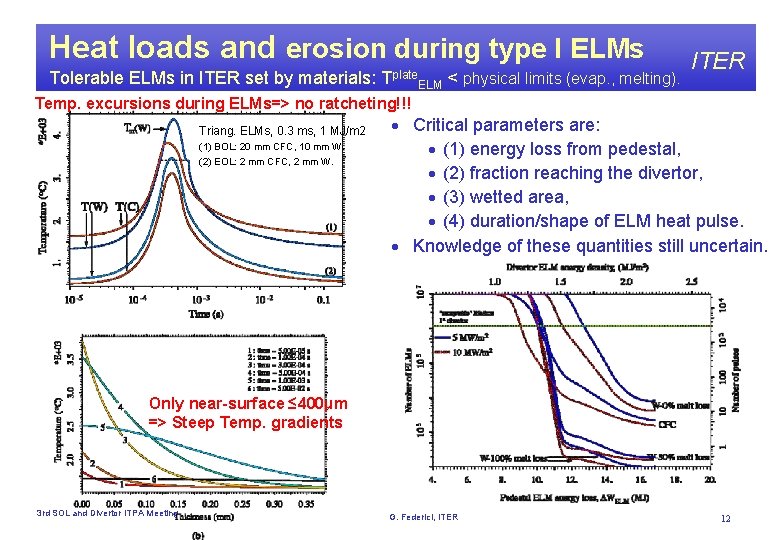
Heat loads and erosion during type I ELMs Tolerable ELMs in ITER set by materials: Tplate ELM < physical limits (evap. , melting). ITER Temp. excursions during ELMs=> no ratcheting!!! Triang. ELMs, 0. 3 ms, 1 MJ/m 2 (1) BOL: 20 mm CFC, 10 mm W. (2) EOL: 2 mm CFC, 2 mm W. · Critical parameters are: · (1) energy loss from pedestal, · (2) fraction reaching the divertor, · (3) wetted area, · (4) duration/shape of ELM heat pulse. · Knowledge of these quantities still uncertain. Only near-surface ≤ 400µm => Steep Temp. gradients 3 rd SOL and Divertor ITPA Meeting G. Federici, ITER 12
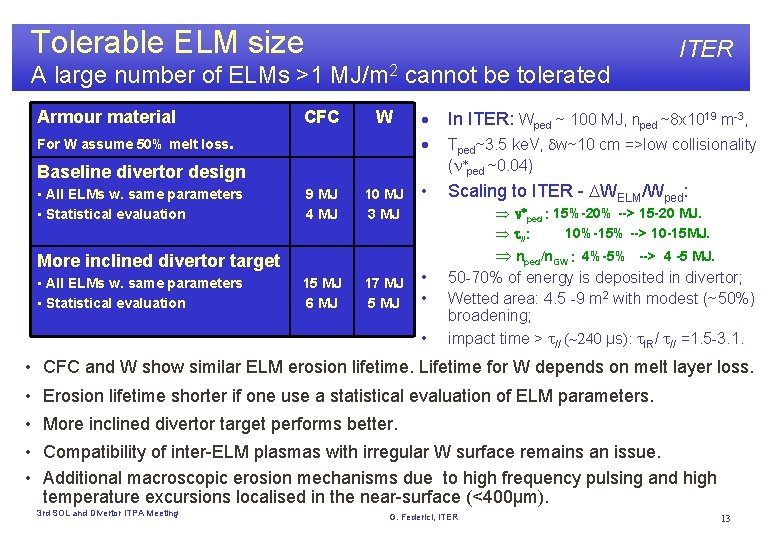
Tolerable ELM size A large number of ELMs >1 MJ/m 2 cannot be tolerated Armour material CFC W For W assume 50% melt loss. Baseline divertor design • All ELMs w. same parameters • Statistical evaluation 9 MJ 4 MJ 10 MJ 3 MJ More inclined divertor target • All ELMs w. same parameters • Statistical evaluation 15 MJ 6 MJ 17 MJ 5 MJ ITER · In ITER: Wped ~ 100 MJ, nped ~8 x 10¹⁹ m-3, · Tped~3. 5 ke. V, dw~10 cm =>low collisionality (n*ped ~0. 04) • Scaling to ITER - DWELM/Wped: Þ n*ped : 15%-20% --> 15 -20 MJ. Þ //: 10%-15% --> 10 -15 MJ. • • • Þ nped/n. GW : 4%-5% --> 4 -5 MJ. 50 -70% of energy is deposited in divertor; Wetted area: 4. 5 -9 m 2 with modest (~50%) broadening; impact time > // ( 240 µs): IR/ // =1. 5 -3. 1. • CFC and W show similar ELM erosion lifetime. Lifetime for W depends on melt layer loss. • Erosion lifetime shorter if one use a statistical evaluation of ELM parameters. • More inclined divertor target performs better. • Compatibility of inter-ELM plasmas with irregular W surface remains an issue. • Additional macroscopic erosion mechanisms due to high frequency pulsing and high temperature excursions localised in the near-surface (<400µm). 3 rd SOL and Divertor ITPA Meeting G. Federici, ITER 13
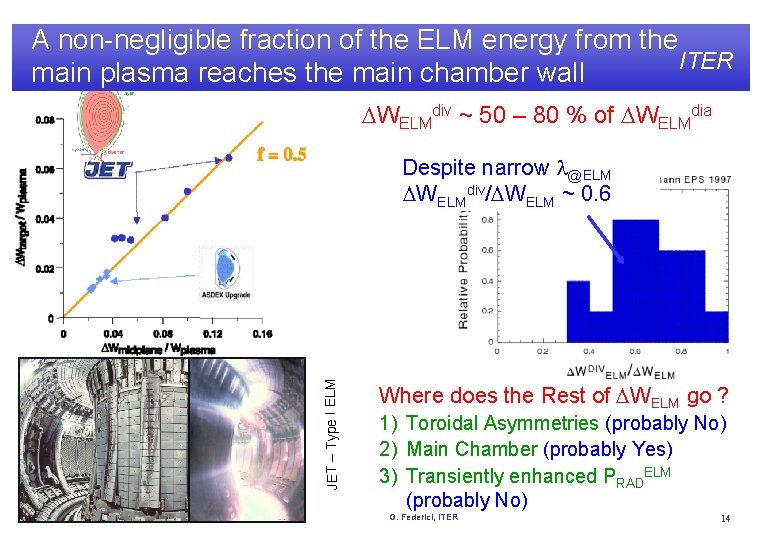
A non-negligible fraction of the ELM energy from the ITER main plasma reaches the main chamber wall DWELMdiv ~ 50 – 80 % of DWELMdia JET – Type I ELM Despite narrow l@ELM DWELMdiv/DWELM ~ 0. 6 3 rd SOL and Divertor ITPA Meeting Where does the Rest of DWELM go ? 1) Toroidal Asymmetries (probably No) 2) Main Chamber (probably Yes) 3) Transiently enhanced PRADELM (probably No) G. Federici, ITER 14
Effects of type I ELMs at the main chamber wall ITER Expect interaction with protruding surfaces (~1 m 2) ==> tolerable only 1 -2 MJ depending on duration (if ≥ 1 ms no melting of W) 3 rd SOL and Divertor ITPA Meeting G. Federici, ITER 15
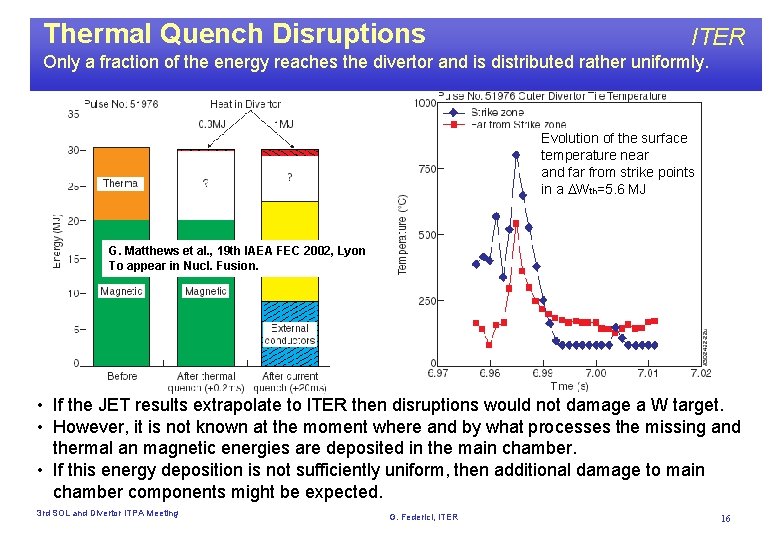
Thermal Quench Disruptions ITER Only a fraction of the energy reaches the divertor and is distributed rather uniformly. Evolution of the surface temperature near and far from strike points in a DWth=5. 6 MJ G. Matthews et al. , 19 th IAEA FEC 2002, Lyon To appear in Nucl. Fusion. • If the JET results extrapolate to ITER then disruptions would not damage a W target. • However, it is not known at the moment where and by what processes the missing and thermal an magnetic energies are deposited in the main chamber. • If this energy deposition is not sufficiently uniform, then additional damage to main chamber components might be expected. 3 rd SOL and Divertor ITPA Meeting G. Federici, ITER 16
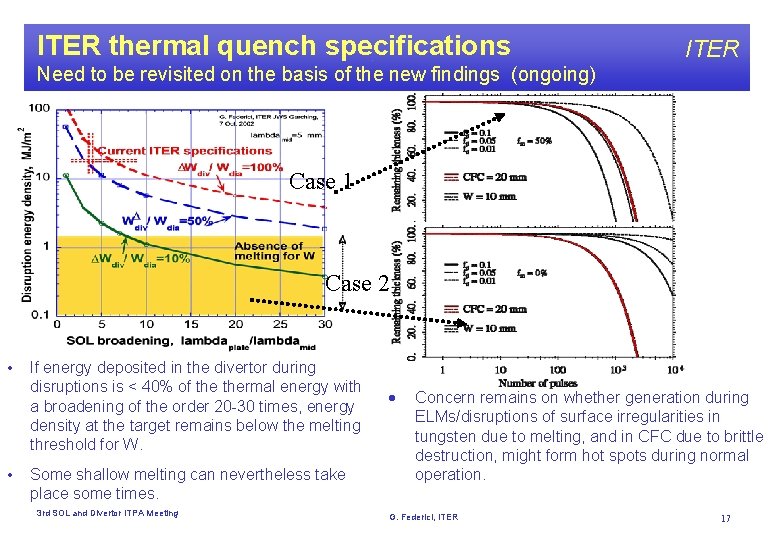
ITER thermal quench specifications ITER Need to be revisited on the basis of the new findings (ongoing) Case 1 Case 2 • • If energy deposited in the divertor during disruptions is < 40% of thermal energy with a broadening of the order 20 -30 times, energy density at the target remains below the melting threshold for W. Some shallow melting can nevertheless take place some times. 3 rd SOL and Divertor ITPA Meeting · Concern remains on whether generation during ELMs/disruptions of surface irregularities in tungsten due to melting, and in CFC due to brittle destruction, might form hot spots during normal operation. G. Federici, ITER 17
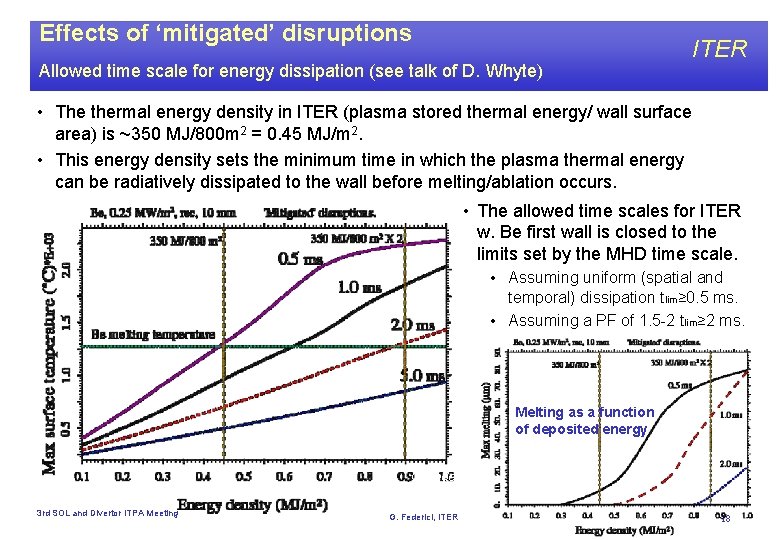
Effects of ‘mitigated’ disruptions Allowed time scale for energy dissipation (see talk of D. Whyte) ITER • The thermal energy density in ITER (plasma stored thermal energy/ wall surface area) is ~350 MJ/800 m 2 = 0. 45 MJ/m 2. • This energy density sets the minimum time in which the plasma thermal energy can be radiatively dissipated to the wall before melting/ablation occurs. • The allowed time scales for ITER w. Be first wall is closed to the limits set by the MHD time scale. • Assuming uniform (spatial and temporal) dissipation tlim≥ 0. 5 ms. • Assuming a PF of 1. 5 -2 tlim≥ 2 ms. Melting as a function of deposited energy G. Federici, G. Strohmayer 3/2003 3 rd SOL and Divertor ITPA Meeting G. Federici, ITER 18
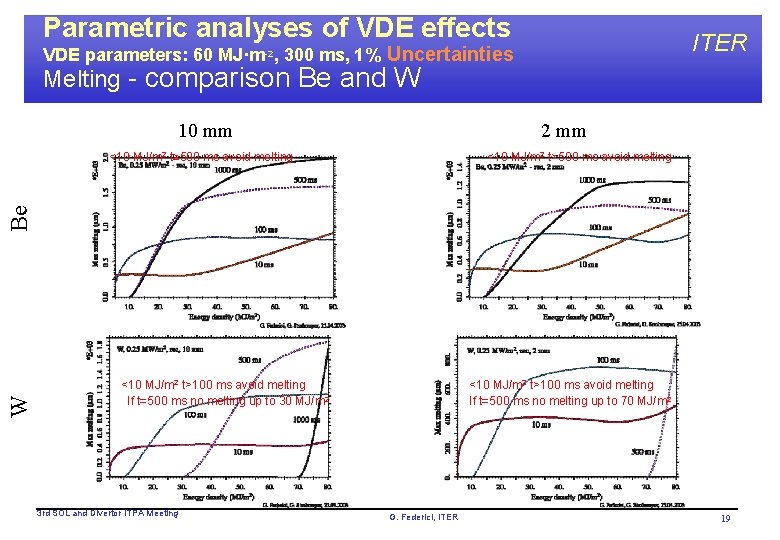
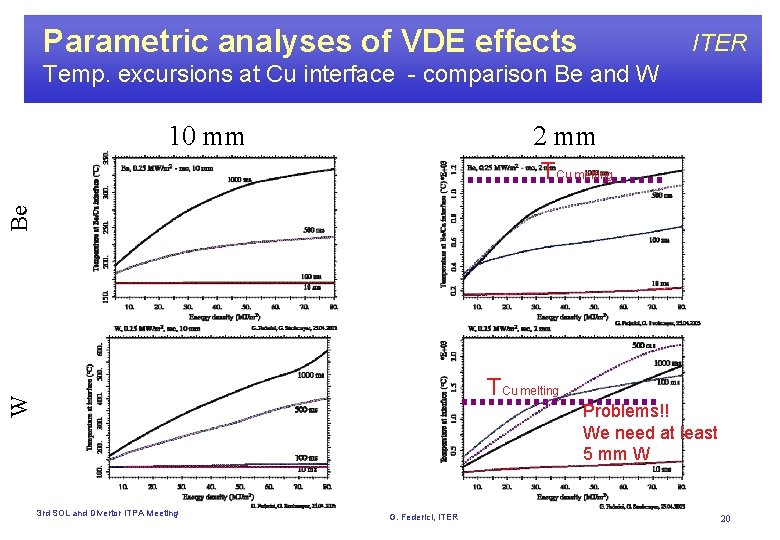
Parametric analyses of VDE effects ITER VDE parameters: 60 MJ·m-2, 300 ms, 1% Uncertainties Melting - comparison Be and W 10 mm 2 mm <10 MJ/m 2 t>500 ms avoid melting W Be <10 MJ/m 2 t≥ 500 ms avoid melting <10 MJ/m 2 t>100 ms avoid melting If t=500 ms no melting up to 30 MJ/m 2 3 rd SOL and Divertor ITPA Meeting <10 MJ/m 2 t>100 ms avoid melting If t=500 ms no melting up to 70 MJ/m 2 G. Federici, ITER 19
Parametric analyses of VDE effects ITER Temp. excursions at Cu interface - comparison Be and W 10 mm 2 mm Be TCu melting W TCu melting Problems!! We need at least 5 mm W 3 rd SOL and Divertor ITPA Meeting G. Federici, ITER 20
Future Work/ Open Questions 3 -5 years before starting PFC material procurement for ITER Current efforts: EU task force on PWI / ITPA work • Type I ELM and disruption heat loads - energy loss, energy to divertor and wall, duration, broadening, impurities, etc. ; (ITPA, JET TF, EU PWI TF) • Mitigation of disruptions (ITPA, JET TF, EU PWI TF); • Effect of mitigated disruptions on Be wall (ITPA); • Material damage due to ELMs/disruptions (Russia, EU PWI TF); • Erosion - mixed material effects (PISCES-B/EFDA) • Explain co-deposition in existing machines (ITPA, JET & EU PWI TFs); • Mitigation of co-deposition (temperature tailoring, reactive species (N 2)); • Monitor Cx. Hy deposits on cryopumps (JET, AUG); • Carbon removal - e. g. baking with oxygen - temperature, hold time (? ? ? ); • Dust generation - volume, location, BET, mobilisation. • Plasma interaction with irregular and/or molten W surfaces. • Measurements/diagnostics 3 rd SOL and Divertor ITPA Meeting G. Federici, ITER 21
Summary ITER Opportunities and challenges • According to current ITER construction plans, 3 -5 years are available for further R&D and physics input to divertor/first-wall design and PFM choice. • We take a big risk if we construct ITER without first testing/validating proposed material mix in an existing tokamak. • We should reduce to a minimum the extent that ITER has to be a PMI experiment and explore all these effects before hand in existing machines. • In case we retain CFC armour and use it during T operation a reliable method to remove the codeposted layers and control T-uptake is required. • Type-I ELMs are still challenging for the ITER divertor and design optimisation is ongoing. Power deposition on the first-wall is still uncertain. • IF JET divertor results extrapolate to ITER, the large majority of disruptions would not lead to melting a W target. Compatibility of plasma with irregular W surfaces and macroscopic C erosion and impact on operation/performance require investigations. • ITER divertor design has enough flexibility. Feasibility of maintenance has been demonstrated. For the first-wall only infrequent maintenance is anticipated and feasibility demonstration is needed. 3 rd SOL and Divertor ITPA Meeting G. Federici, ITER 22