
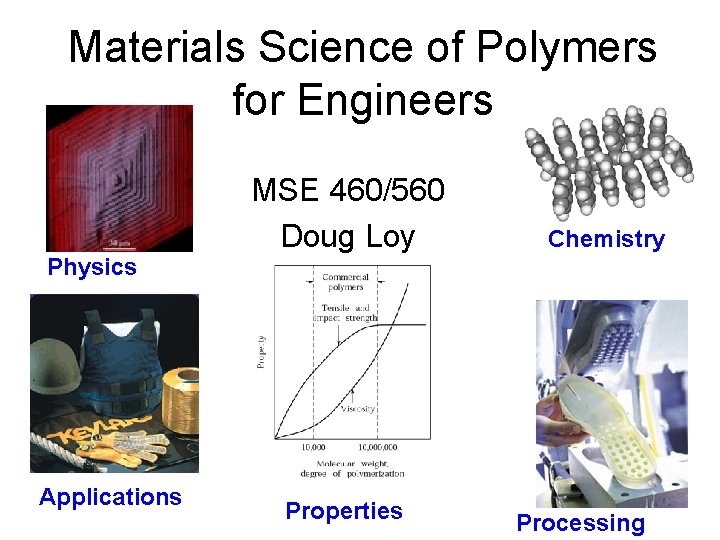
Materials Science of Polymers for Engineers Physics Applications
- Slides: 54
Materials Science of Polymers for Engineers Physics Applications MSE 460/560 Doug Loy Properties Chemistry Processing
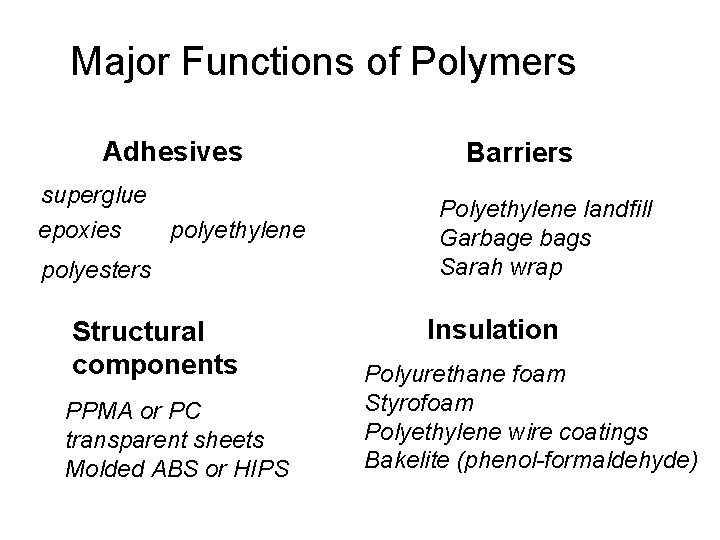
Major Functions of Polymers Adhesives superglue epoxies polyethylene polyesters Structural components PPMA or PC transparent sheets Molded ABS or HIPS Barriers Polyethylene landfill Garbage bags Sarah wrap Insulation Polyurethane foam Styrofoam Polyethylene wire coatings Bakelite (phenol-formaldehyde)
COURSE WEBSITE: Loy group website, courses, MSE 460/560 Spring 2010 http: //www. loyresearchgroup. com/mse-460560 -polymerscience-for-engineers. html
Office Hours • • Old Chemistry 309 Tuesday 1 -3 pm Monday and Wednesday 11 am-noon or by appointment
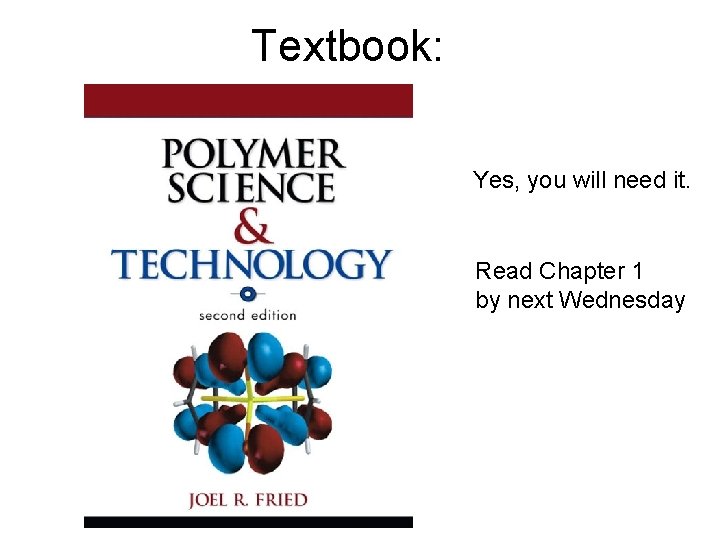
Textbook: Yes, you will need it. Read Chapter 1 by next Wednesday
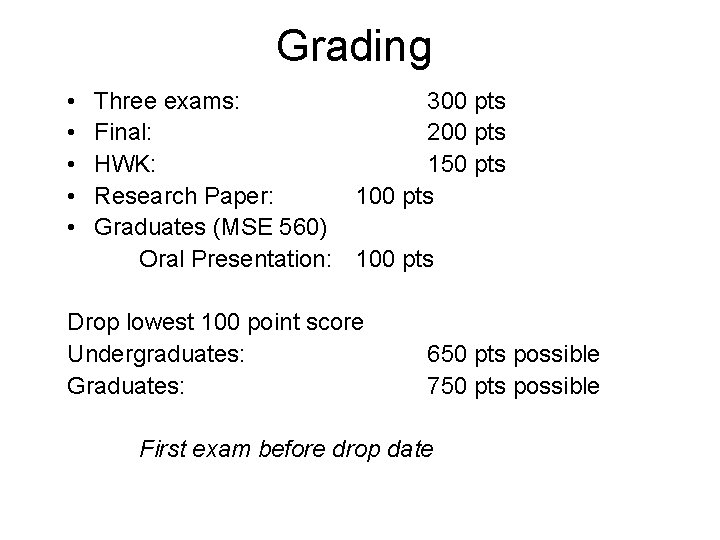
Grading • • • Three exams: 300 pts Final: 200 pts HWK: 150 pts Research Paper: 100 pts Graduates (MSE 560) Oral Presentation: 100 pts Drop lowest 100 point score Undergraduates: Graduates: 650 pts possible 750 pts possible First exam before drop date
Homework • Assignments will be on D 2 L • Not up yet but should be by Monday.
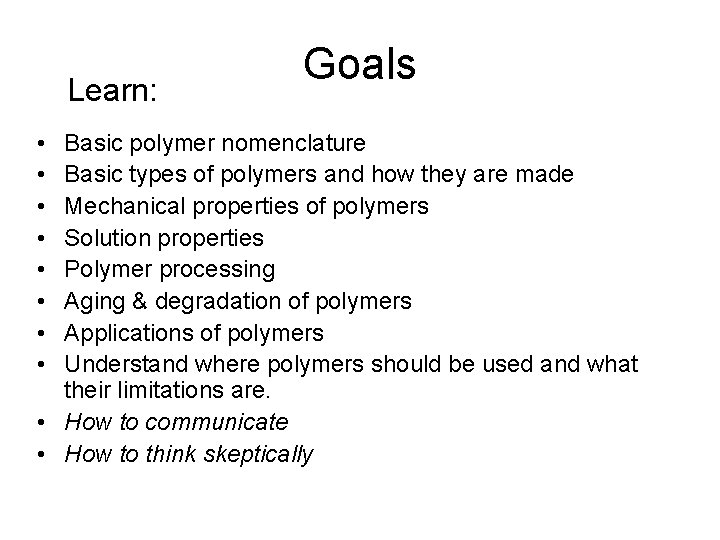
Learn: • • Goals Basic polymer nomenclature Basic types of polymers and how they are made Mechanical properties of polymers Solution properties Polymer processing Aging & degradation of polymers Applications of polymers Understand where polymers should be used and what their limitations are. • How to communicate • How to think skeptically
How to succeed in MSE 460/560 • • • Read the Chapter ahead of lectures Come to class Start paper early Study groups Practice exams (new ones will be written). Don’t cheat, plagiarize, or otherwise participate in unethical behavior • Use office hours • Ask questions • Think skeptically
Thinking skeptically • Don’t trust anyone (particularly anyone over 30) • If it doesn’t make sense, ask questions. • Beware of trusting experts and textbooks • Acquaint yourself with logic and logical fallacies
Research Paper • Review of literature topic I provide • Graduates can petition to present topic relating to research or oral. • > 10 pages, double spaced, times roman font, typed + graphics. • JACS style bibliography • Hard and electronic copy • Must be readable on Mac (your responsibility) • Keyword list due 1/18 • Literature search results due 1/25 • One draft due during semester • You will edit each others drafts (for HWK assign)
Research Paper Topics & Assignments • • • • • • polysilsesquioxane photoresists polysilsesquioxane membranes for separations polysilsesquioxane membranes for fuel cells and batteries polysilsesquioxane anti-corrosion coatings optical application of polysilsesquioxanes polysilsesquioxane particles surfactant templating polysilsesquioxanes (organosilica, PMO's) Composites with polysilsesquioxanes polysilsesquioxane coupling agents in tires polysilsesquioxanes for supported enzymes mechanical properties of polysilsesquioxanes polysilsesquioxane ceramic precursors bridged polysilsesquioxane since 2010 polysilsesquioxane for stone conservation polysilsesquioxanes for shrink-fit plastics polysilsesquioxane ladder polymers Fluorescent polysilsesquioxanes Degradation of polysilsesquioxanes polysilsesquioxane adsorbents for toxic metals polysilsesquioxane adsorbents for volatile organics drug delivery with polysilsesquioxanes polysilsesquioxane low k dielectrics Polysilsesquioxanes in cosmetics
Oral Presentations • Graduate students only • 20 minute presentations (two per day) • Everyone must attend & compose one exam question for each presentation • Last two weeks of class • 100 points
HWK 1 -Due January 20 th • DSL • Some figures will be at website in HWK section as pdfs. • Draft of research paper will count as a homework assignment.
MSE 460/560 Today’s Logic Lesson: Post Hoc, Ergo Propter Hoc "After this, therefore because of this. " Correlation does not equate with causation “I ate sushi yesterday, I became sick today, therefore the sushi made me ill. ”
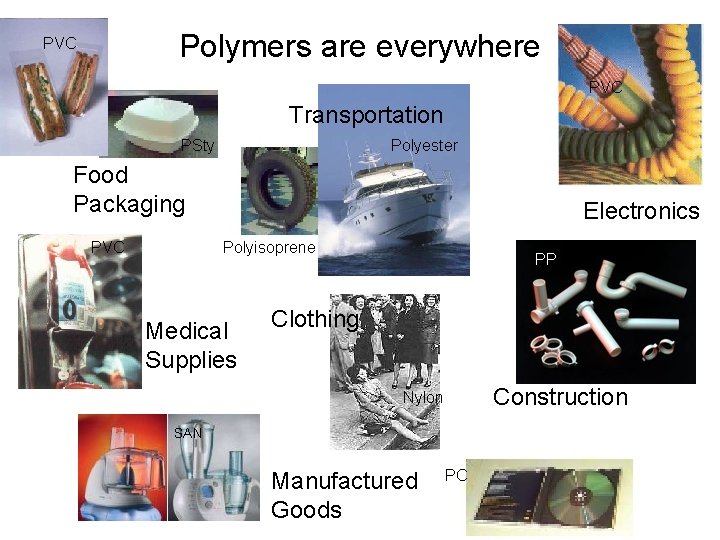
Polymers are everywhere PVC Transportation PSty Polyester PES Food Packaging PVC Electronics Polyisoprene Medical Supplies PP Clothing Construction Nylon SAN Manufactured Goods PC
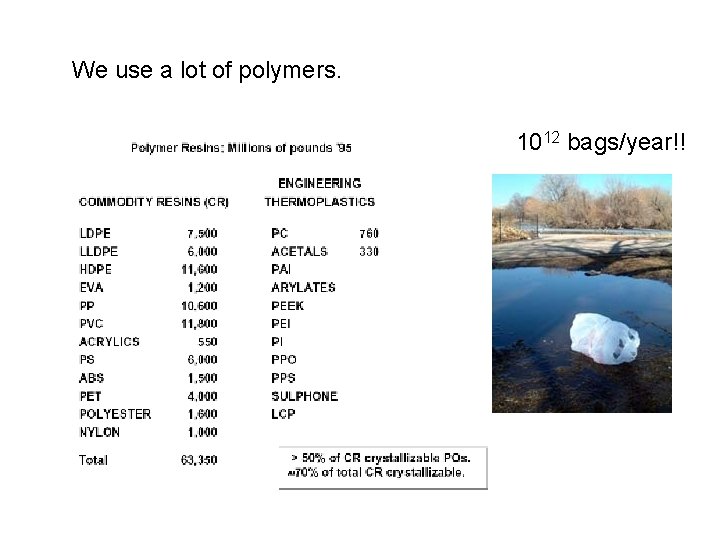
We use a lot of polymers. 1012 bags/year!!
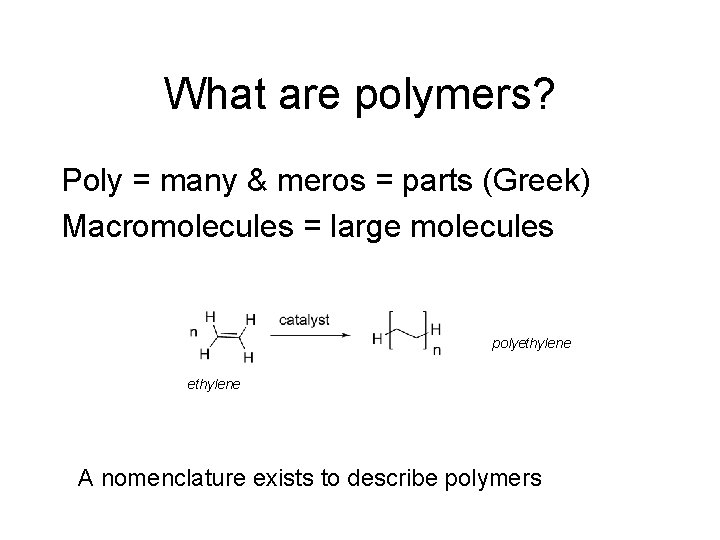
What are polymers? Poly = many & meros = parts (Greek) Macromolecules = large molecules polyethylene A nomenclature exists to describe polymers
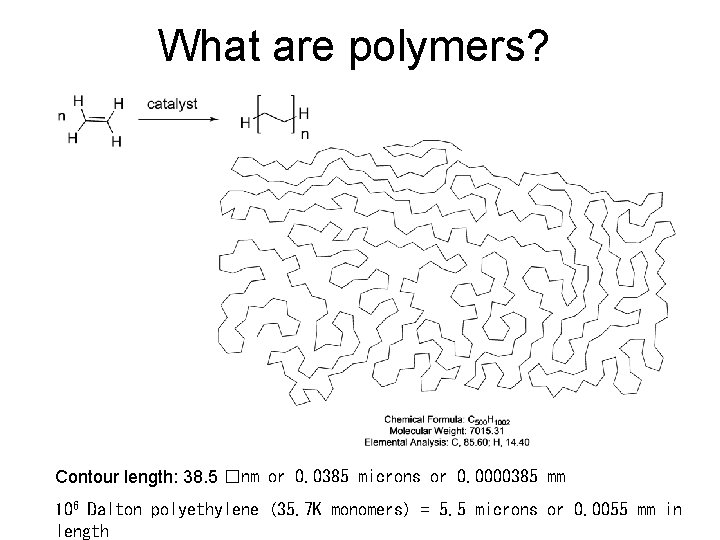
What are polymers? Contour length: 38. 5 �nm or 0. 0385 microns or 0. 0000385 mm 106 Dalton polyethylene (35. 7 K monomers) = 5. 5 microns or 0. 0055 mm in length
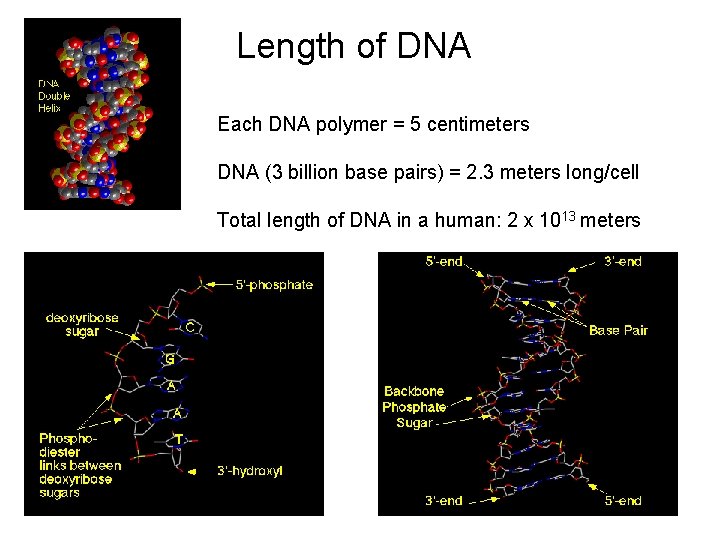
Length of DNA Each DNA polymer = 5 centimeters DNA (3 billion base pairs) = 2. 3 meters long/cell Total length of DNA in a human: 2 x 10¹³ meters
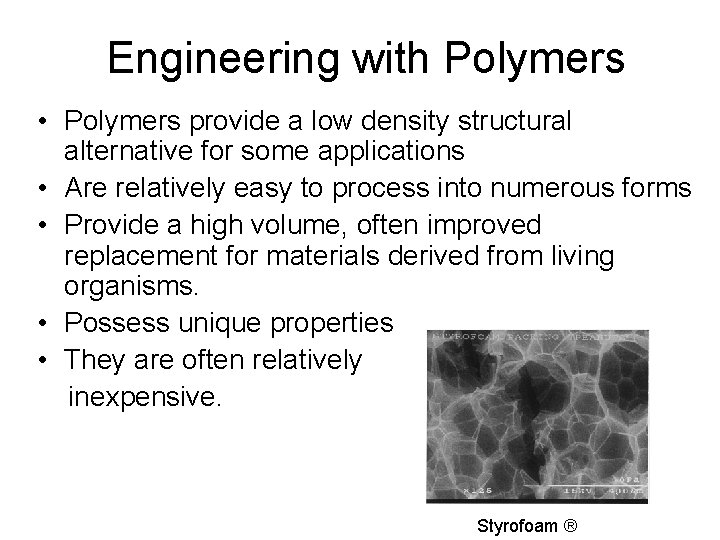
Engineering with Polymers • Polymers provide a low density structural alternative for some applications • Are relatively easy to process into numerous forms • Provide a high volume, often improved replacement for materials derived from living organisms. • Possess unique properties • They are often relatively inexpensive. Styrofoam ®
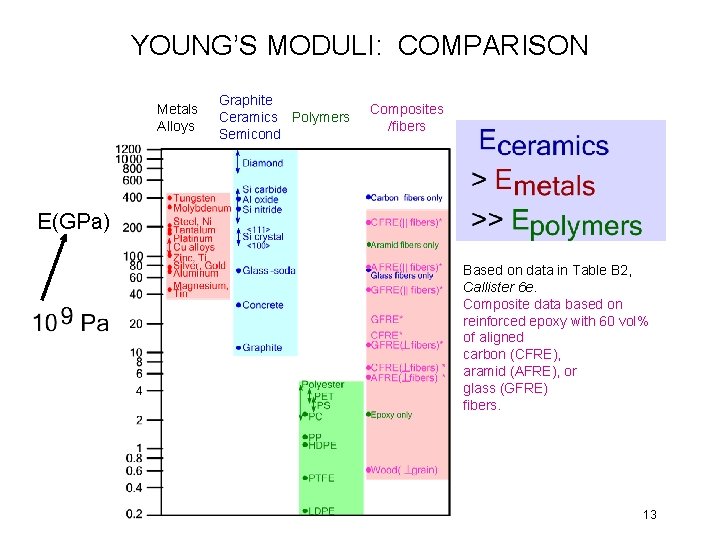
YOUNG’S MODULI: COMPARISON Metals Alloys Graphite Ceramics Polymers Semicond Composites /fibers E(GPa) Based on data in Table B 2, Callister 6 e. Composite data based on reinforced epoxy with 60 vol% of aligned carbon (CFRE), aramid (AFRE), or glass (GFRE) fibers. 13
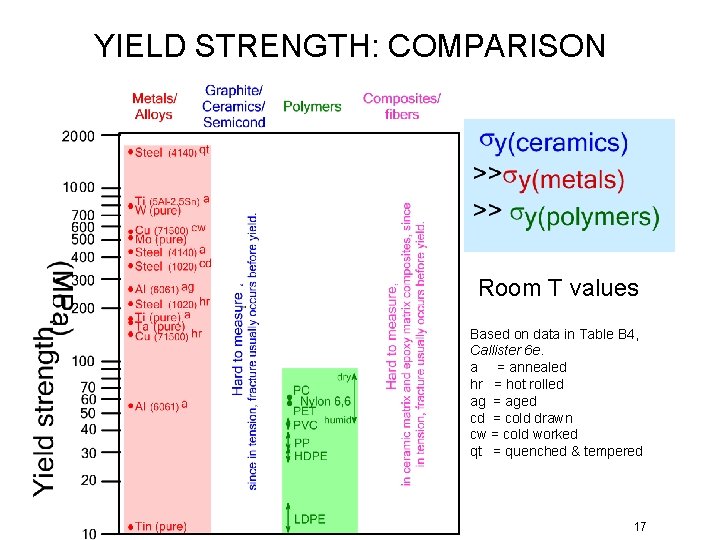
YIELD STRENGTH: COMPARISON Room T values Based on data in Table B 4, Callister 6 e. a = annealed hr = hot rolled ag = aged cd = cold drawn cw = cold worked qt = quenched & tempered 17
Why use polymers • Easy to process – Injection molding (thermoplastics) – Mold or reaction injection molding (thermosets) • • • Cheap Lightweight Tough Flexible Transparent (sometimes) Insulating (generally)
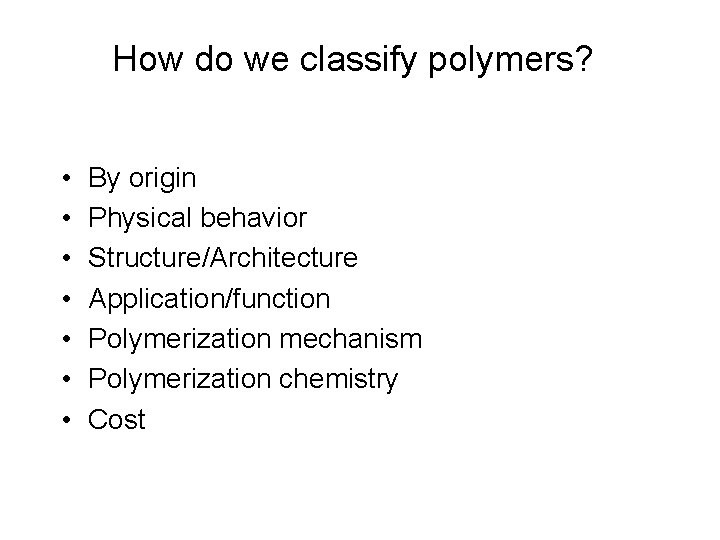
How do we classify polymers? • • By origin Physical behavior Structure/Architecture Application/function Polymerization mechanism Polymerization chemistry Cost
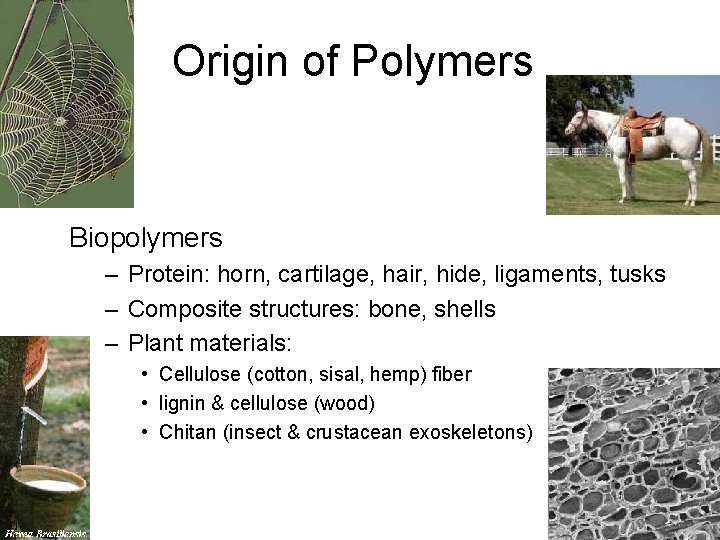
Origin of Polymers Biopolymers – Protein: horn, cartilage, hair, hide, ligaments, tusks – Composite structures: bone, shells – Plant materials: • Cellulose (cotton, sisal, hemp) fiber • lignin & cellulose (wood) • Chitan (insect & crustacean exoskeletons)
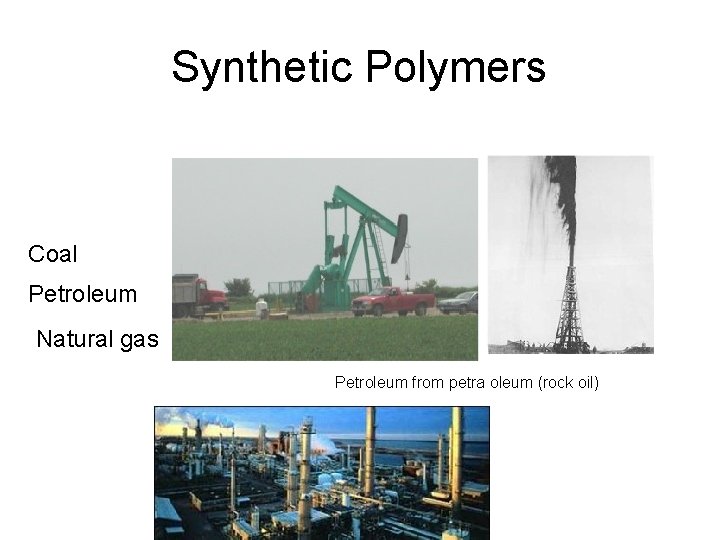
Synthetic Polymers Coal Petroleum Natural gas Petroleum from petra oleum (rock oil)
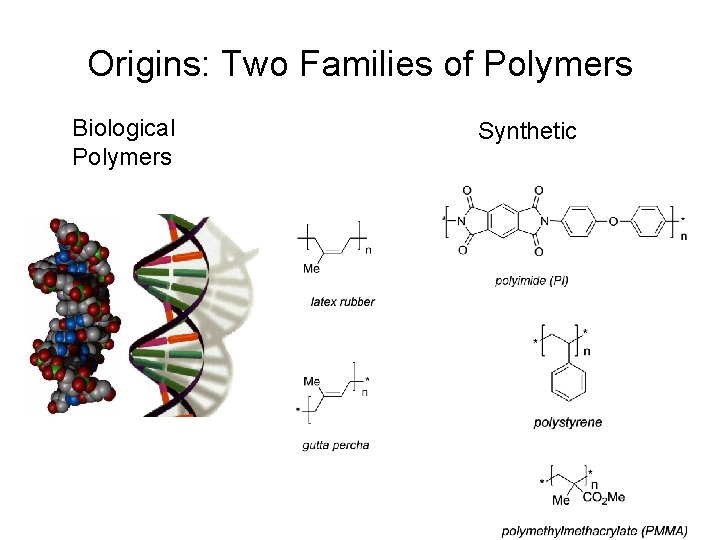
Origins: Two Families of Polymers Biological Polymers Synthetic
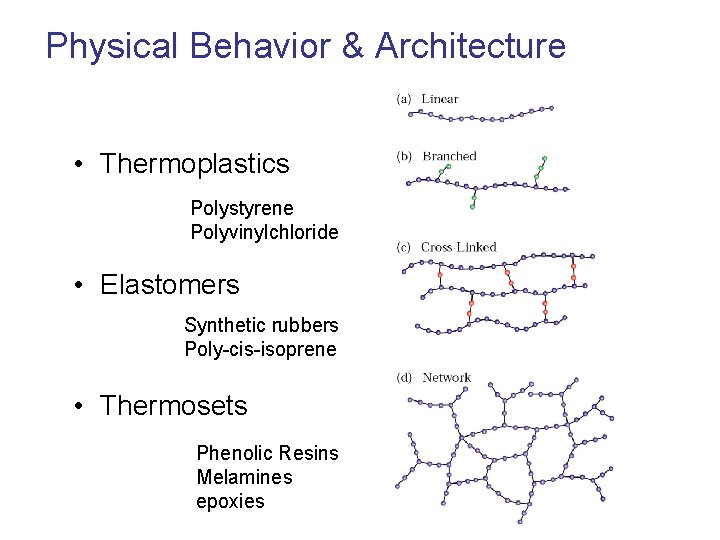
Physical Behavior & Architecture • Thermoplastics Polystyrene Polyvinylchloride • Elastomers Synthetic rubbers Poly-cis-isoprene • Thermosets Phenolic Resins Melamines epoxies
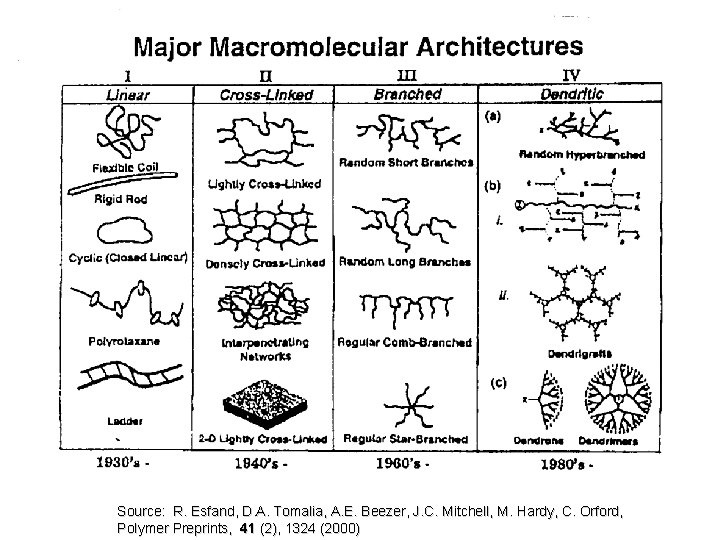
Source: R. Esfand, D. A. Tomalia, A. E. Beezer, J. C. Mitchell, M. Hardy, C. Orford, Polymer Preprints, 41 (2), 1324 (2000)
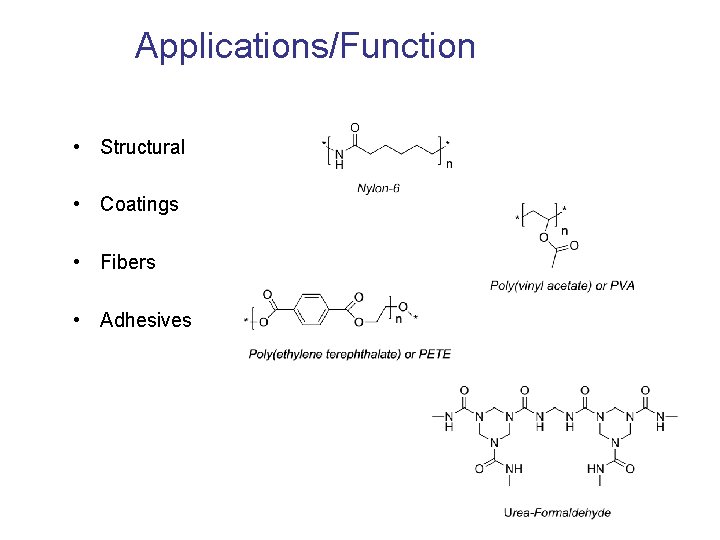
Applications/Function • Structural • Coatings • Fibers • Adhesives
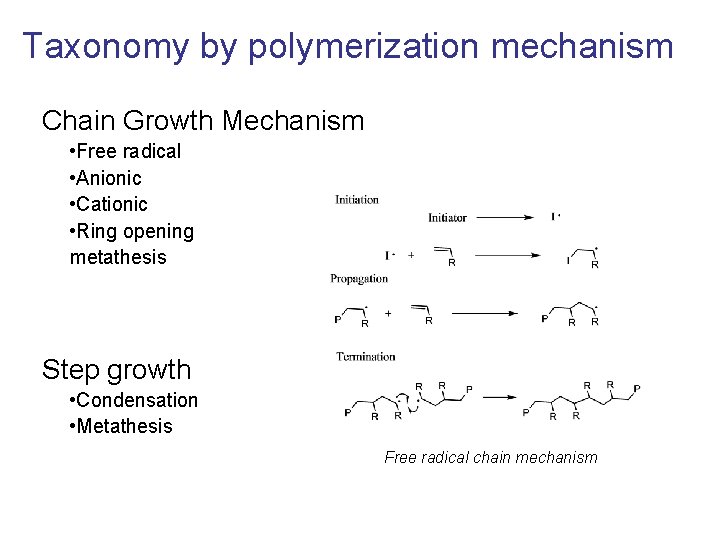
Taxonomy by polymerization mechanism Chain Growth Mechanism • Free radical • Anionic • Cationic • Ring opening metathesis Step growth • Condensation • Metathesis Free radical chain mechanism
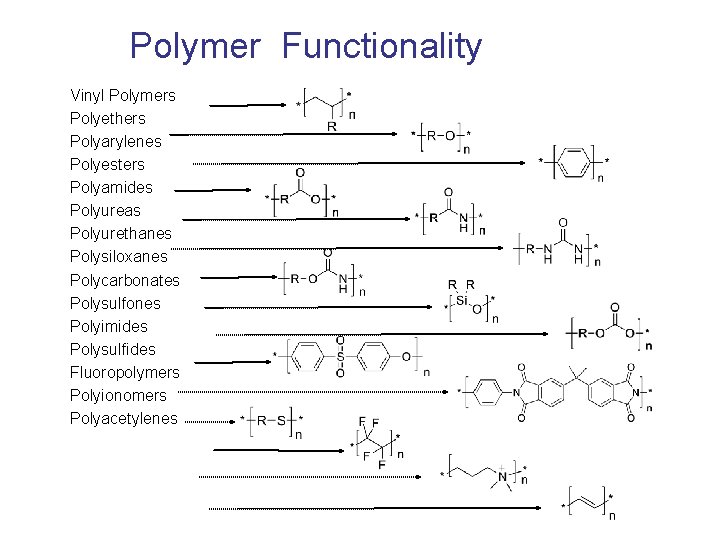
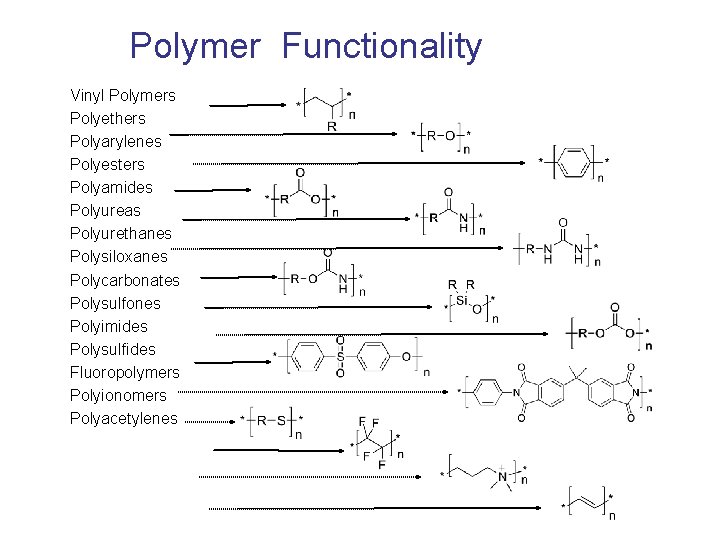
Polymer Functionality Vinyl Polymers Polyethers Polyarylenes Polyesters Polyamides Polyureas Polyurethanes Polysiloxanes Polycarbonates Polysulfones Polyimides Polysulfides Fluoropolymers Polyionomers Polyacetylenes
Polymer Functionality Vinyl Polymers Polyethers Polyarylenes Polyesters Polyamides Polyureas Polyurethanes Polysiloxanes Polycarbonates Polysulfones Polyimides Polysulfides Fluoropolymers Polyionomers Polyacetylenes
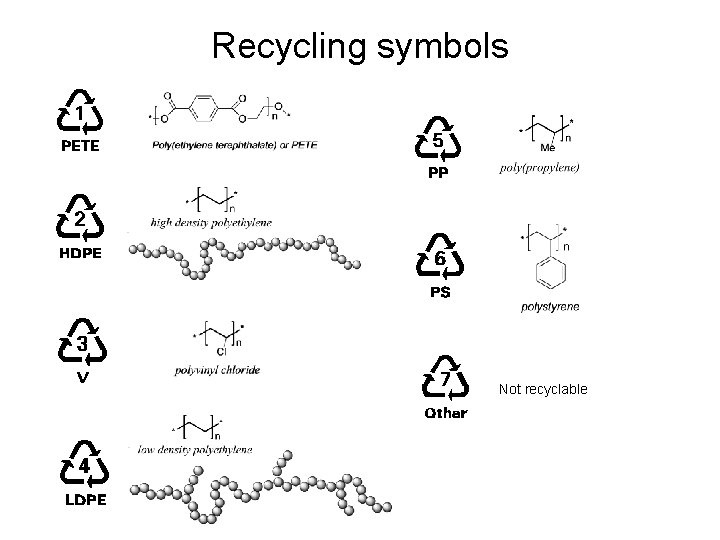
Recycling symbols Not recyclable
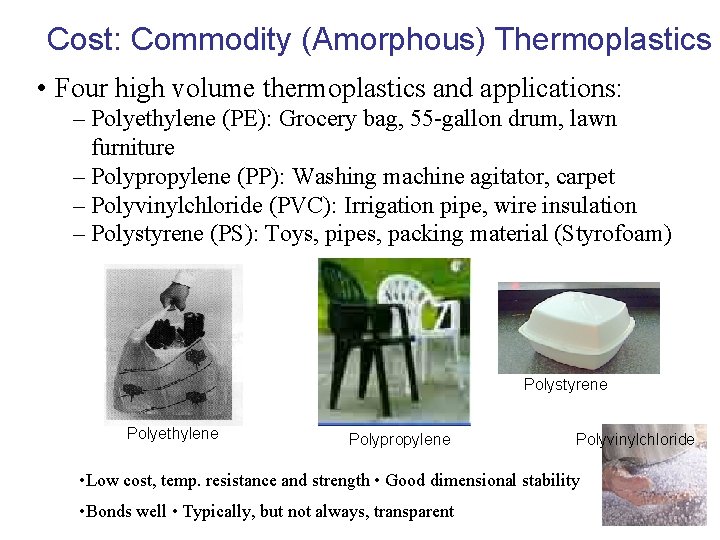
Cost: Commodity (Amorphous) Thermoplastics • Four high volume thermoplastics and applications: – Polyethylene (PE): Grocery bag, 55 -gallon drum, lawn furniture – Polypropylene (PP): Washing machine agitator, carpet – Polyvinylchloride (PVC): Irrigation pipe, wire insulation – Polystyrene (PS): Toys, pipes, packing material (Styrofoam) Polystyrene Polyethylene Polypropylene Polyvinylchloride • Low cost, temp. resistance and strength • Good dimensional stability • Bonds well • Typically, but not always, transparent
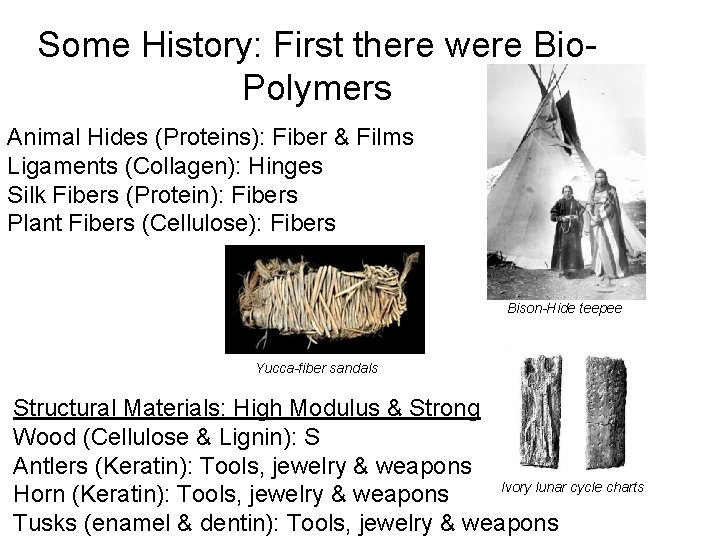
Some History: First there were Bio. Polymers Animal Hides (Proteins): Fiber & Films Ligaments (Collagen): Hinges Silk Fibers (Protein): Fibers Plant Fibers (Cellulose): Fibers Bison-Hide teepee Yucca-fiber sandals Structural Materials: High Modulus & Strong Wood (Cellulose & Lignin): S Antlers (Keratin): Tools, jewelry & weapons Ivory lunar cycle charts Horn (Keratin): Tools, jewelry & weapons Tusks (enamel & dentin): Tools, jewelry & weapons
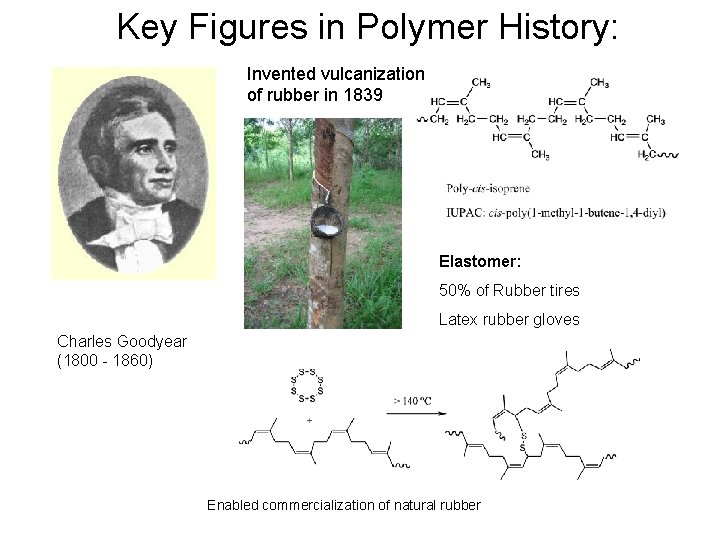
Key Figures in Polymer History: Invented vulcanization of rubber in 1839 Elastomer: 50% of Rubber tires Latex rubber gloves Charles Goodyear (1800 - 1860) Enabled commercialization of natural rubber
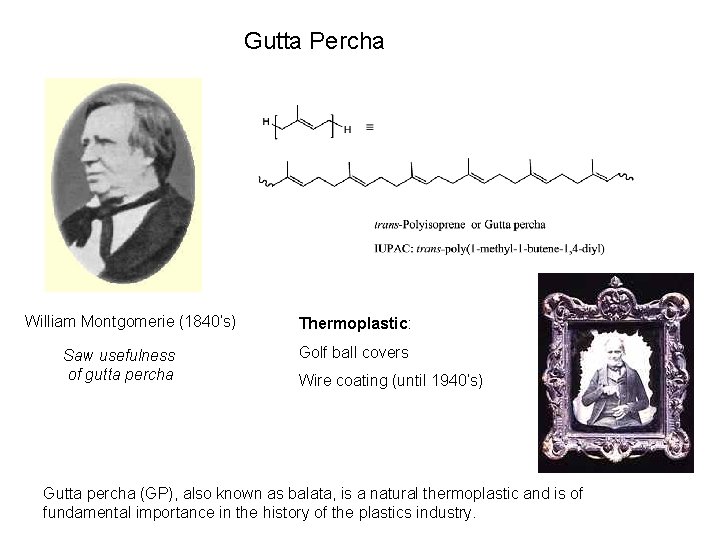
Gutta Percha William Montgomerie (1840’s) Saw usefulness of gutta percha Thermoplastic: Golf ball covers Wire coating (until 1940’s) Gutta percha (GP), also known as balata, is a natural thermoplastic and is of fundamental importance in the history of the plastics industry.
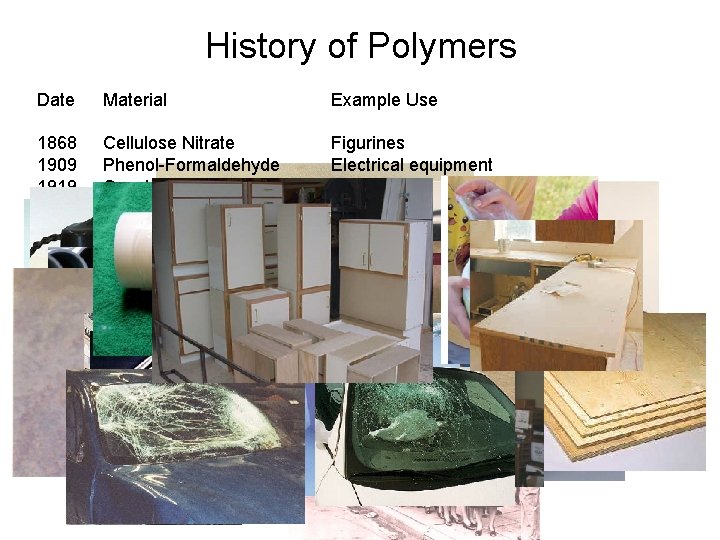
History of Polymers Date Material Example Use 1868 1909 1919 1927 1929 1936 1938 1939 Cellulose Nitrate Phenol-Formaldehyde Casein Cellulose Acetate Polyvinyl Chloride Urea-Formaldehyde Acrylic Polyvinyl Acetate Polystyrene or Styrene Nylon (Polyamide) Polyvinyl Butyrate Polyvinylidene Chloride Melamine-Formaldehyde Figurines Electrical equipment Beauty accessories Cellophane package wrapping Pipe, Synthetic Leather Lighting fixtures, Plywood glue Brush backs, displays Synthetic flooring Disposable utensils Hosiery Safety glass interlayer Saran wrap Countertops, Cabinets
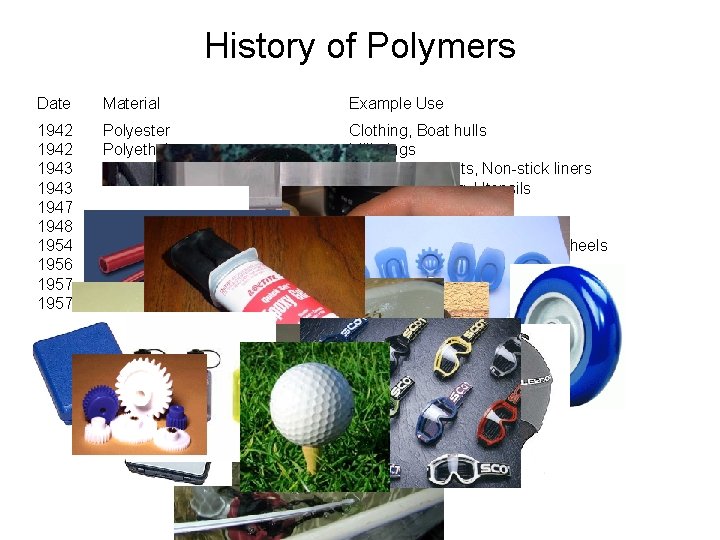
History of Polymers Date Material Example Use 1942 1943 1947 1948 1954 1956 1957 1964 Polyester Polyethylene Fluorocarbon Silicone Epoxy Acrylonitrile-Butadiene-Styrene Polyurethane or Urethane Acetal Polypropylene Polycarbonate Ionomer Polyimide Clothing, Boat hulls Milk Jugs Industrial gaskets, Non-stick liners Gaskets, Tubing, Utensils Glues Luggage Foam cushions, Shoe soles, Wheels Automotive parts, Toilet parts Living hinges, Safety helmets Water bottles, Eye protection Golf balls, Skin packages Gears
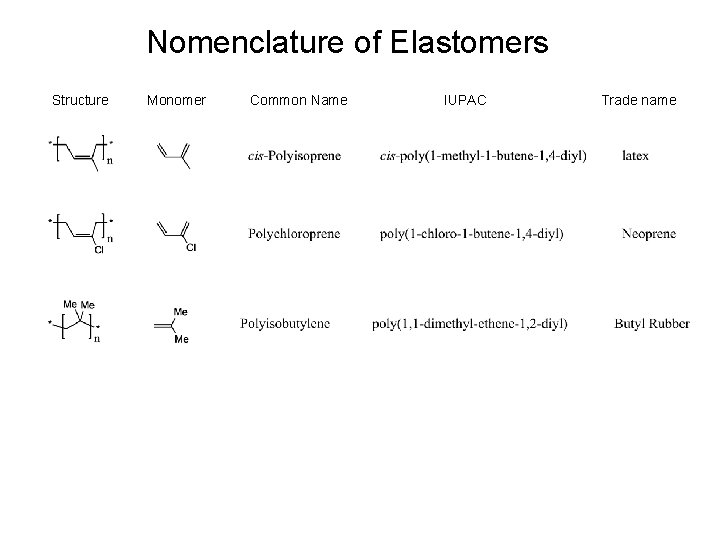
Nomenclature of Elastomers Structure Monomer Common Name IUPAC Trade name
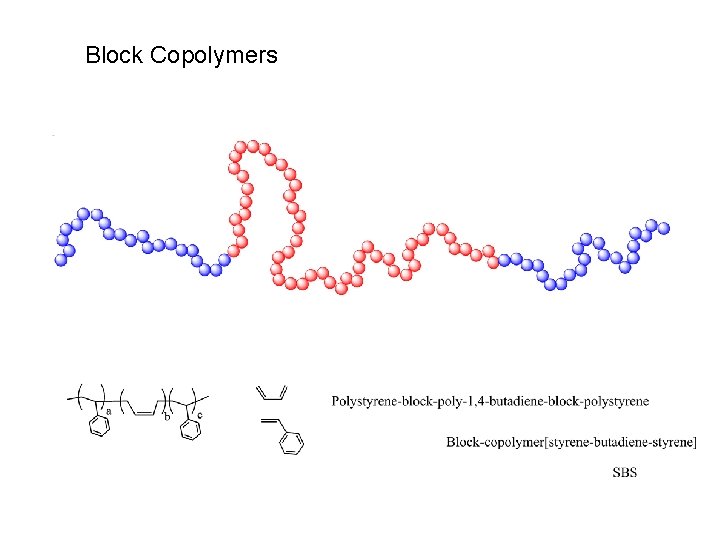
Block Copolymers
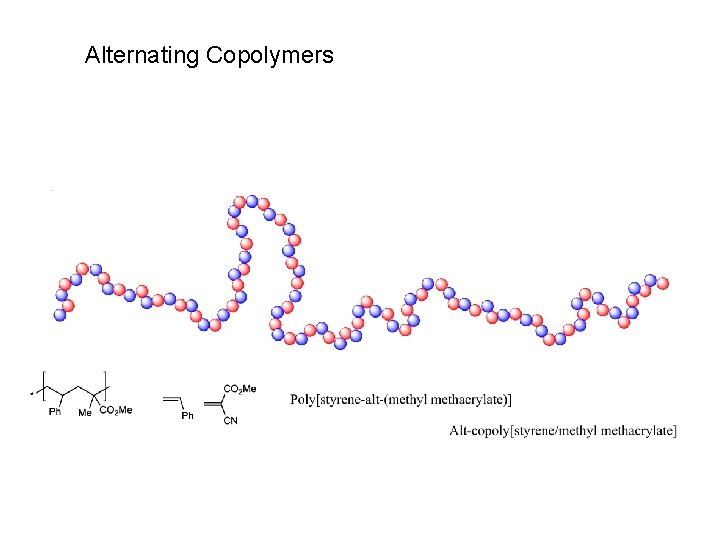
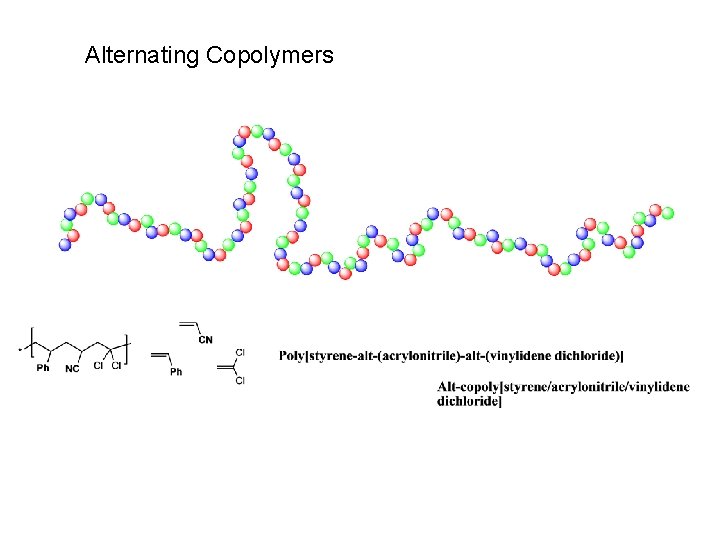
Alternating Copolymers
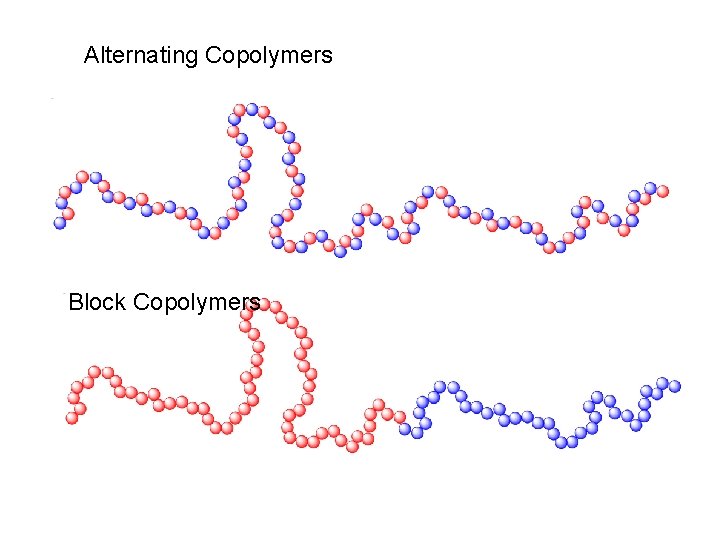
Alternating Copolymers
Alternating Copolymers Block Copolymers
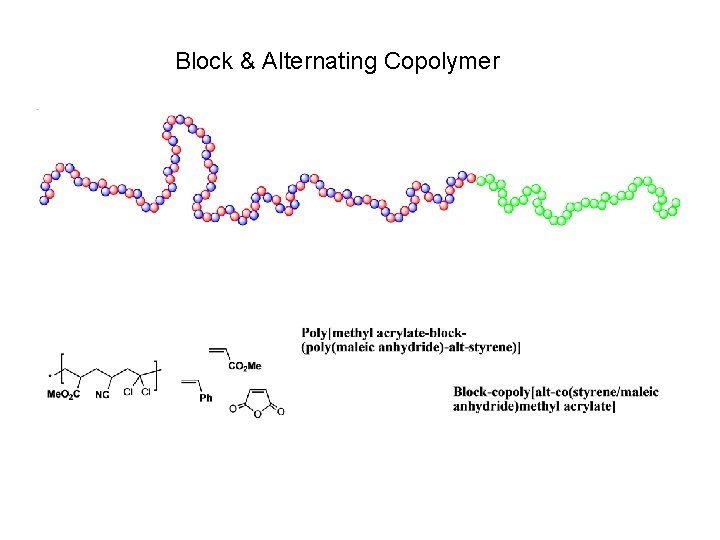
Block & Alternating Copolymer
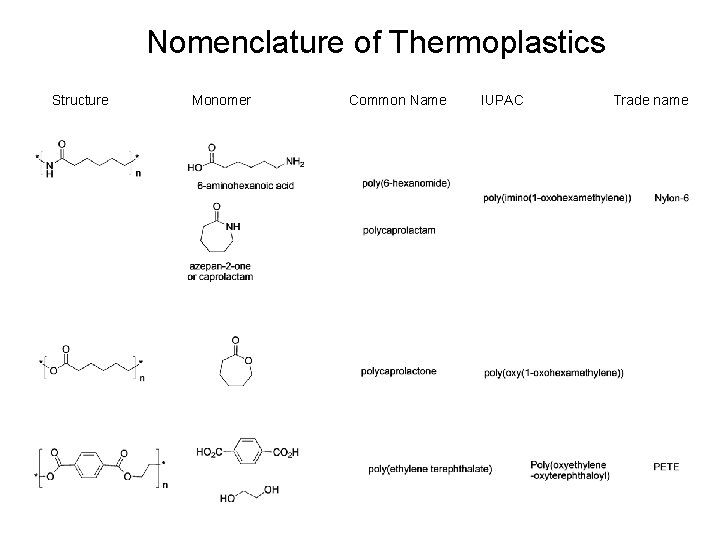
Nomenclature of Thermoplastics Structure Monomer Common Name IUPAC Trade name
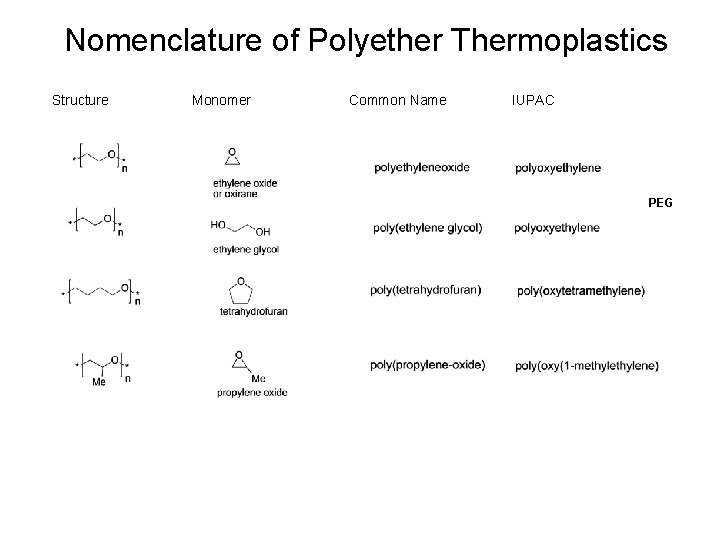
Nomenclature of Polyether Thermoplastics Structure Monomer Common Name IUPAC PEG
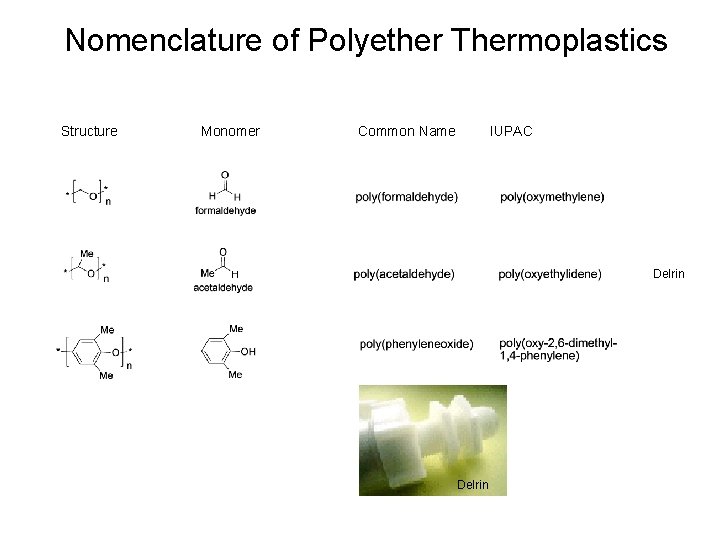
Nomenclature of Polyether Thermoplastics Structure Monomer Common Name IUPAC Delrin
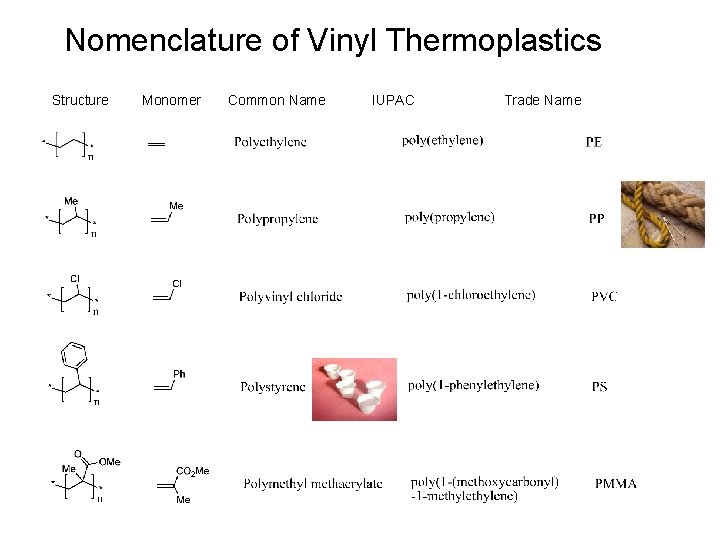
Nomenclature of Vinyl Thermoplastics Structure Monomer Common Name IUPAC Trade Name
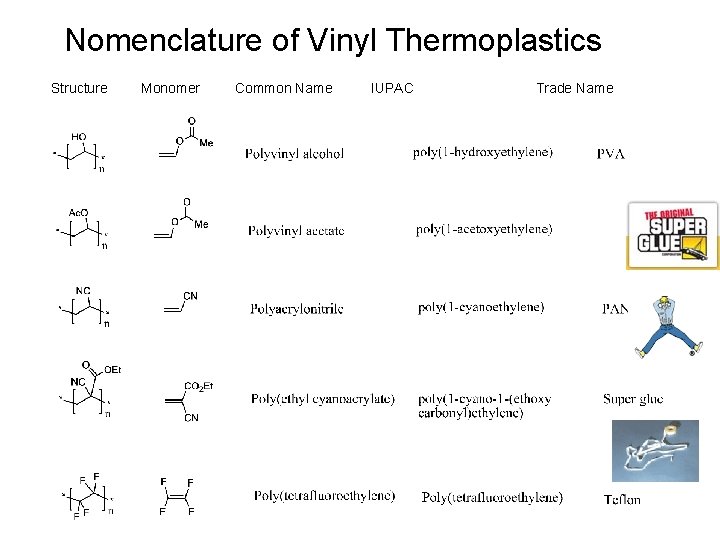
Nomenclature of Vinyl Thermoplastics Structure Monomer Common Name IUPAC Trade Name
Tacticity: How groups are arranged along polymer Isotactic and syndiotactic pack into lattices easier: crystalline
Tacticity: disubstituted monomers