
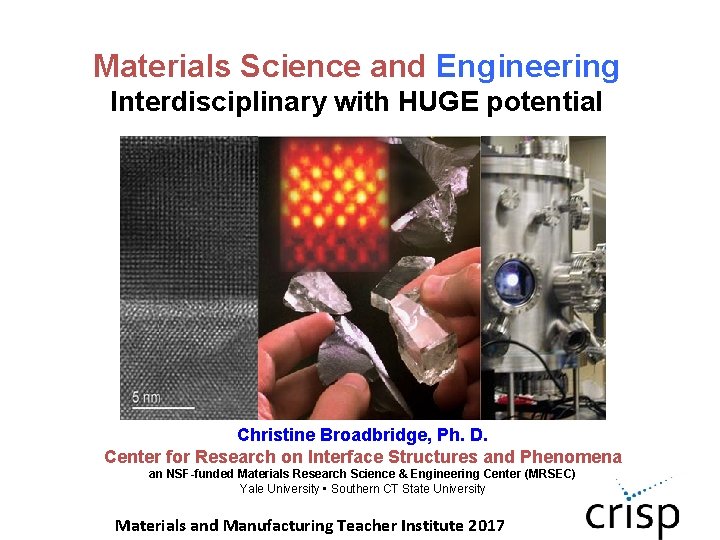
Materials Science and Engineering Interdisciplinary with HUGE potential

![Nanotechnology Control & manipulation of matter [1 -100 nm] Unique phenomenon enable novel applications](https://slidetodoc.com/presentation_image/16e2463e83c3f31ac4eabe35f1f00a76/image-21.jpg "Nanotechnology Control & manipulation of matter [1 -100 nm] Unique phenomenon enable novel applications")

- Slides: 28
Materials Science and Engineering Interdisciplinary with HUGE potential Christine Broadbridge, Ph. D. Center for Research on Interface Structures and Phenomena an NSF-funded Materials Research Science & Engineering Center (MRSEC) Yale University • Southern CT State University Materials and Manufacturing Teacher Institute 2017
March 4, 2017 Resources for Educators crisp. southernct. edu Professional Development For educators, professionals, and practicing scientists Educational Resources Clearing-house for hands-on activities and demos available for loan for local educators Past workshops View materials from past workshops, videos, and pictures Library CRISP has a collection of books and DVDs also available Courses at SCSU See what graduate courses Southern has to offer in the Applied Physics program! SCSU Office for STEM Innovation and Leadership (STEM-IL) https: //www. southernct. edu/stem/about-us. html
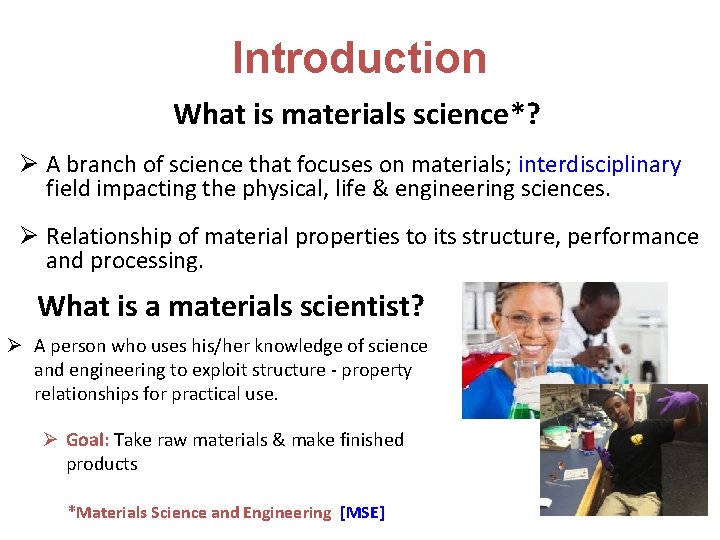
Introduction What is materials science*? Ø A branch of science that focuses on materials; interdisciplinary field impacting the physical, life & engineering sciences. Ø Relationship of material properties to its structure, performance and processing. What is a materials scientist? Ø A person who uses his/her knowledge of science and engineering to exploit structure - property relationships for practical use. Ø Goal: Take raw materials & make finished products *Materials Science and Engineering [MSE]
Materials Science and Engineering Processing Synthesis, fabrication & manufacturing Characterization Materials testing & imaging Performance Reliable & cost-efficient Structure crystal structure, atomic structure (i. e. bonding) Properties Chemical & Physical 5
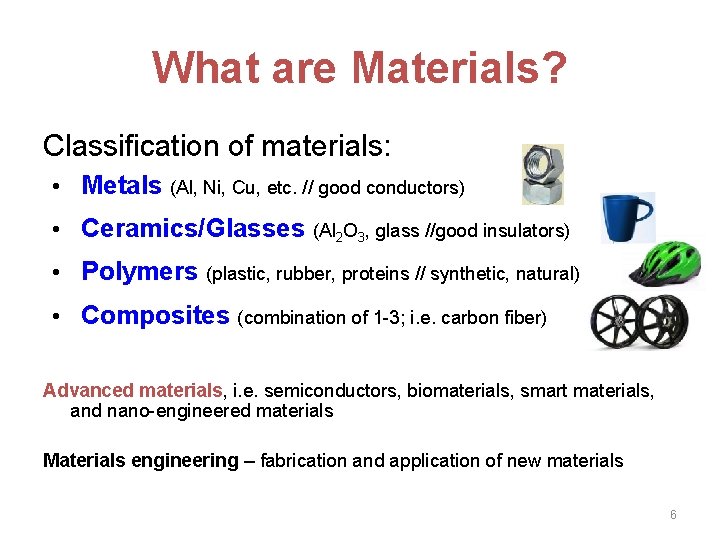
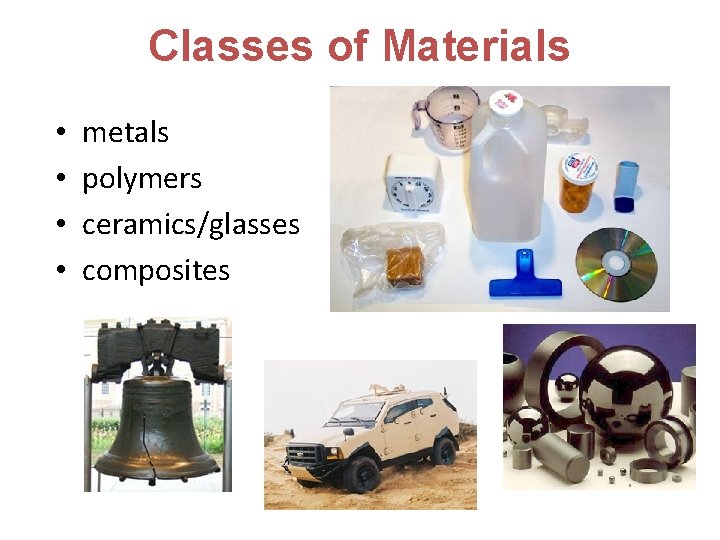
What are Materials? Classification of materials: • Metals (Al, Ni, Cu, etc. // good conductors) • Ceramics/Glasses • Polymers (Al 2 O 3, glass //good insulators) (plastic, rubber, proteins // synthetic, natural) • Composites (combination of 1 -3; i. e. carbon fiber) Advanced materials, i. e. semiconductors, biomaterials, smart materials, and nano-engineered materials Materials engineering – fabrication and application of new materials 6
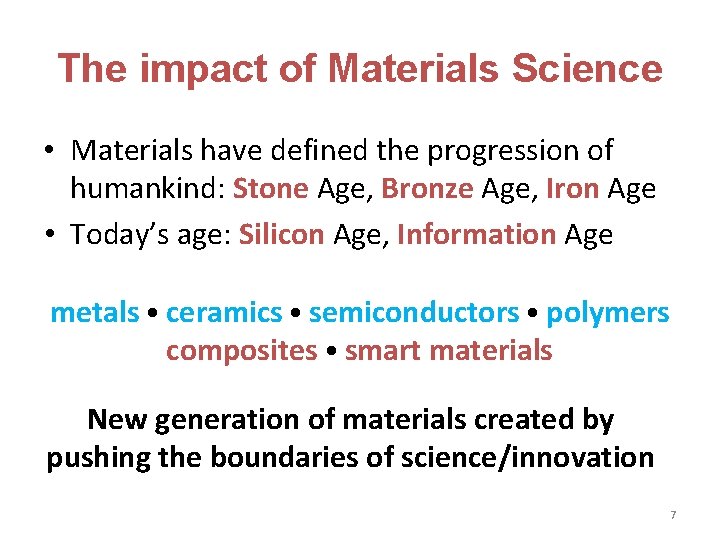
The impact of Materials Science • Materials have defined the progression of humankind: Stone Age, Bronze Age, Iron Age • Today’s age: Silicon Age, Information Age metals • ceramics • semiconductors • polymers composites • smart materials New generation of materials created by pushing the boundaries of science/innovation 7
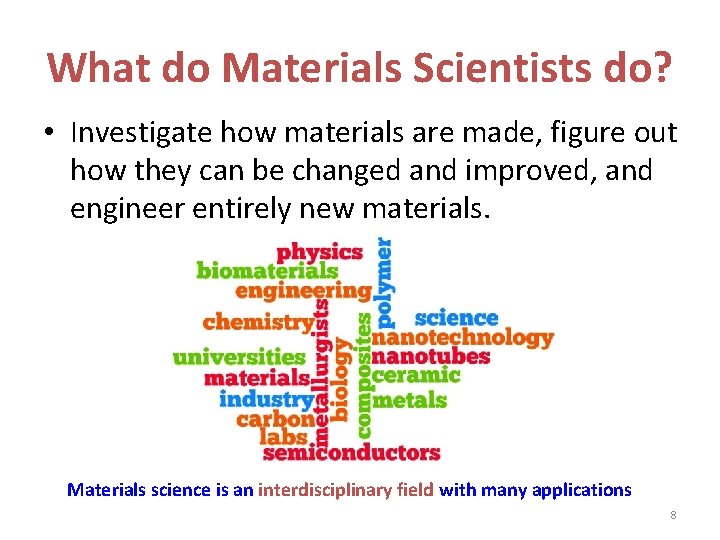
What do Materials Scientists do? • Investigate how materials are made, figure out how they can be changed and improved, and engineer entirely new materials. Materials science is an interdisciplinary field with many applications 8
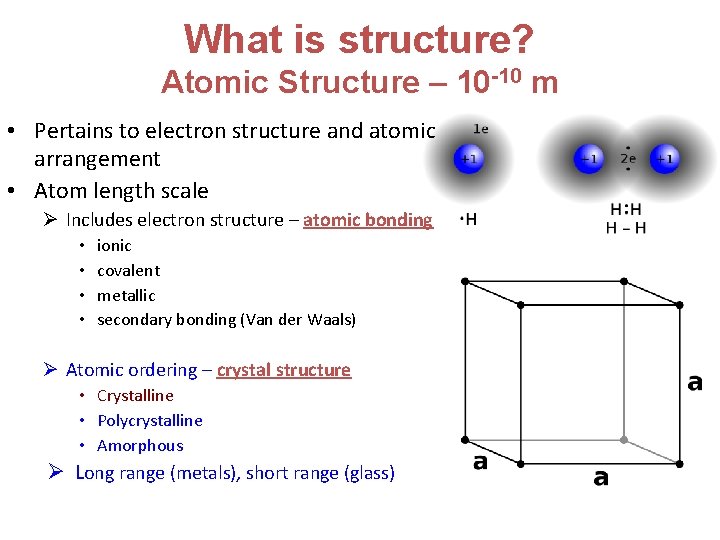
What is structure? Atomic Structure – 10 -10 m • Pertains to electron structure and atomic arrangement • Atom length scale Ø Includes electron structure – atomic bonding • • ionic covalent metallic secondary bonding (Van der Waals) Ø Atomic ordering – crystal structure • Crystalline • Polycrystalline • Amorphous Ø Long range (metals), short range (glass)
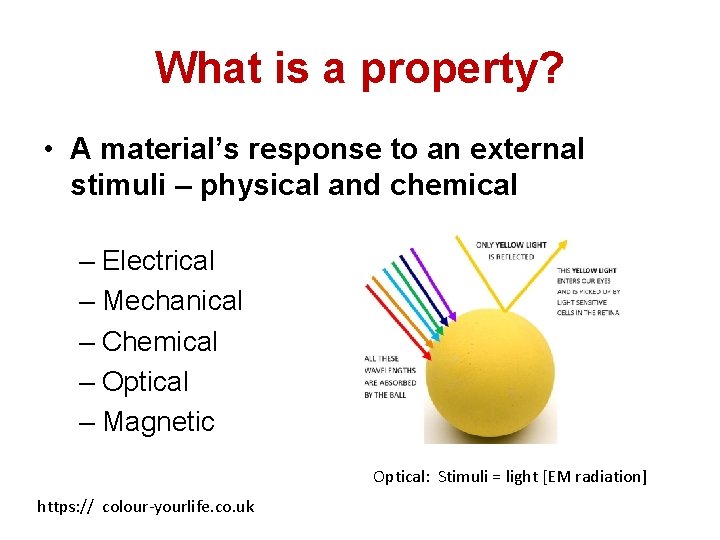
What is a property? • A material’s response to an external stimuli – physical and chemical – Electrical – Mechanical – Chemical – Optical – Magnetic Optical: Stimuli = light [EM radiation] https: // colour-yourlife. co. uk
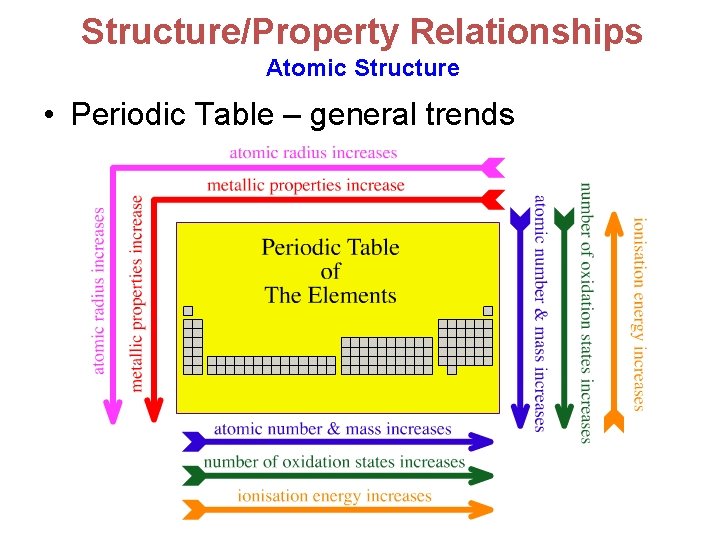
Structure/Property Relationships Atomic Structure • Periodic Table – general trends
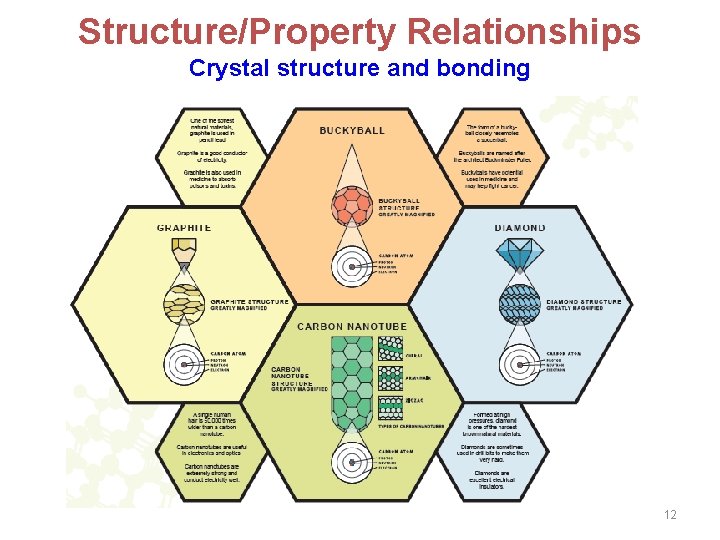
Structure/Property Relationships Crystal structure and bonding 12
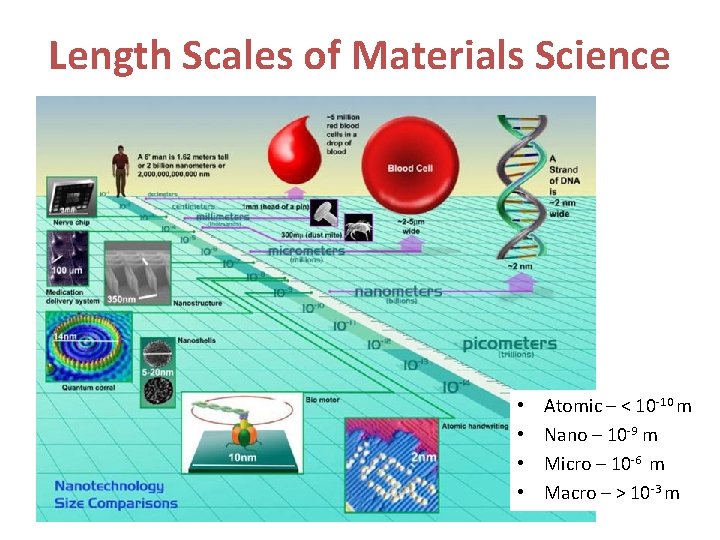
Length Scales of Materials Science • • Atomic – < 10 -10 m Nano – 10 -9 m Micro – 10 -6 m Macro – > 10 -3 m
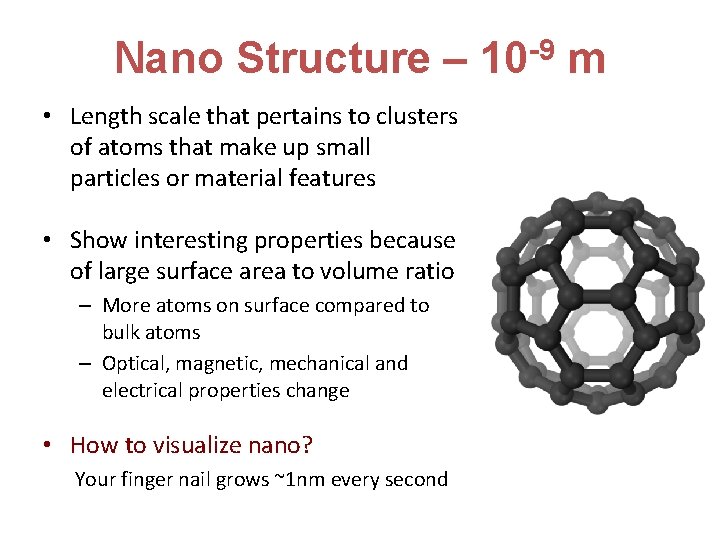
Nano Structure – 10 -9 m • Length scale that pertains to clusters of atoms that make up small particles or material features • Show interesting properties because of large surface area to volume ratio – More atoms on surface compared to bulk atoms – Optical, magnetic, mechanical and electrical properties change • How to visualize nano? Your finger nail grows ~1 nm every second
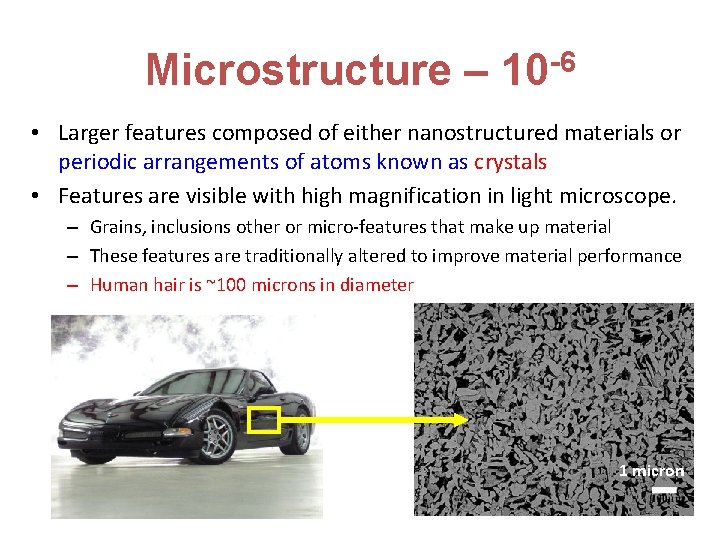
Microstructure – 10 -6 • Larger features composed of either nanostructured materials or periodic arrangements of atoms known as crystals • Features are visible with high magnification in light microscope. – Grains, inclusions other or micro-features that make up material – These features are traditionally altered to improve material performance – Human hair is ~100 microns in diameter 1 micron
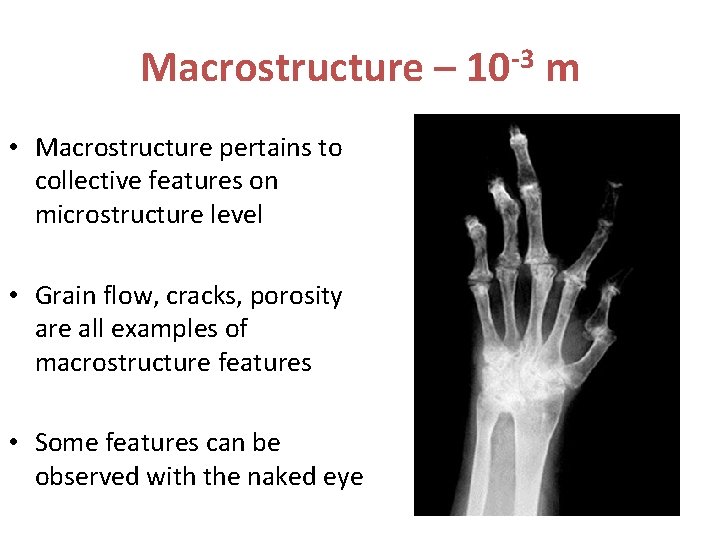
Macrostructure – 10 -3 m • Macrostructure pertains to collective features on microstructure level • Grain flow, cracks, porosity are all examples of macrostructure features • Some features can be observed with the naked eye
Classes of Materials • • metals polymers ceramics/glasses composites
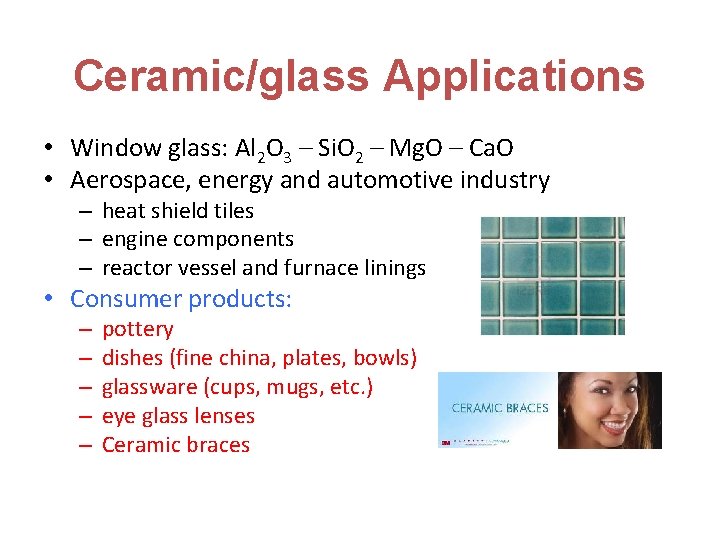
Ceramic/glass Applications • Window glass: Al 2 O 3 – Si. O 2 – Mg. O – Ca. O • Aerospace, energy and automotive industry – heat shield tiles – engine components – reactor vessel and furnace linings • Consumer products: – – – pottery dishes (fine china, plates, bowls) glassware (cups, mugs, etc. ) eye glass lenses Ceramic braces
Other advanced materials • Semiconductors – ceramics – computer chips – memory storage devices – solar cells – image screens • Nanomaterials – ceramics, metals, polymers – gold nanoshells – quantum dots – ferrofluids – medical devices
How do we test materials? Materials Characterization We use mechanical, chemical and imaging methods • Mechanical testing gives strength, ductility and toughness material information – – tensile tests bend tests compressive tests fracture testing • Chemical testing tells us about composition and chemical stability – x-ray diffraction and fluorescence – composition testing – corrosion testing • Microscopy is more of a way to view atomic, nano and microstructures, and gives us insight to structure property relationships – – light optical microscope – microstructure scanning electron microscope – microstructure and nano structure transmission electron microscope – nanostucture and atomic structure scanning probe microscope – atomic structures
Nanotechnology Control & manipulation of matter [1 -100 nm] Unique phenomenon enable novel applications 1 nm C 60 buckyball fullerene Quantum dots C nanotube cylindrical fullerene [photovoltaic, solar cell] Nanosize semiconductors [DVD, video games] 21
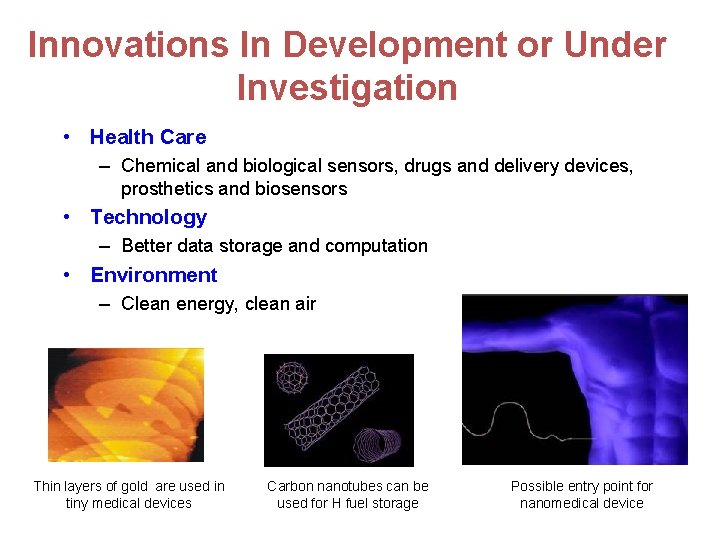
Innovations In Development or Under Investigation • Health Care – Chemical and biological sensors, drugs and delivery devices, prosthetics and biosensors • Technology – Better data storage and computation • Environment – Clean energy, clean air Thin layers of gold are used in tiny medical devices Carbon nanotubes can be used for H fuel storage Possible entry point for nanomedical device
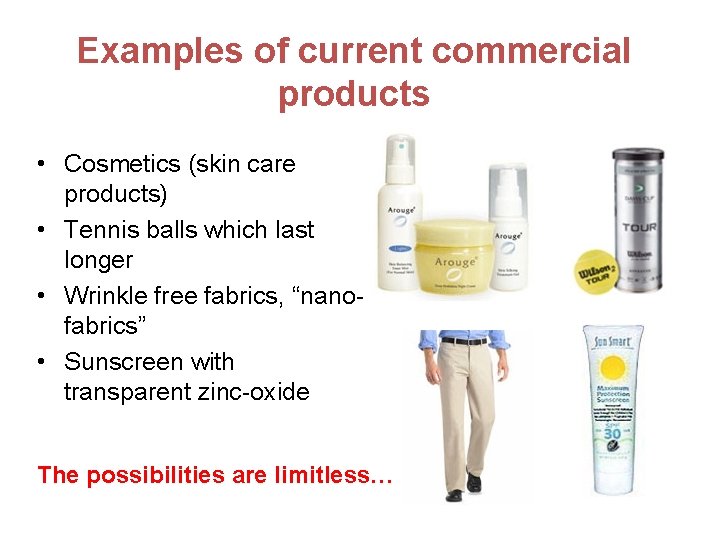
Examples of current commercial products • Cosmetics (skin care products) • Tennis balls which last longer • Wrinkle free fabrics, “nanofabrics” • Sunscreen with transparent zinc-oxide The possibilities are limitless…
Potential Impacts How might Materials Science, Engineering and Manufacturing enhance K-12 education? 24
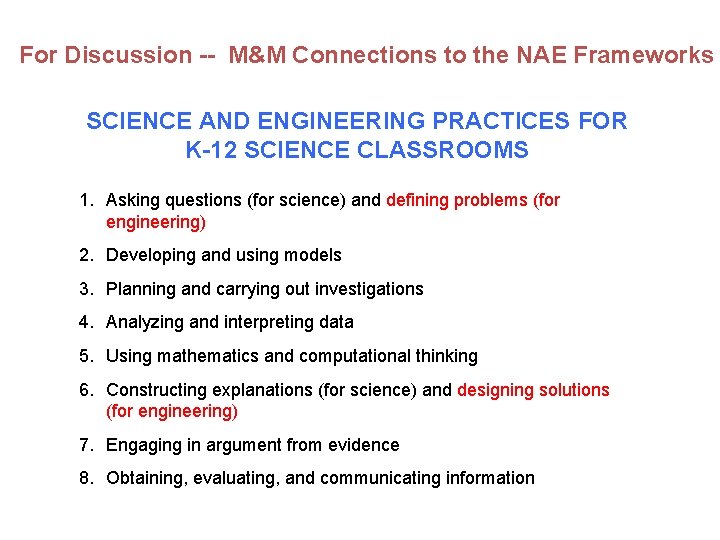
For Discussion -- M&M Connections to the NAE Frameworks SCIENCE AND ENGINEERING PRACTICES FOR K-12 SCIENCE CLASSROOMS 1. Asking questions (for science) and defining problems (for engineering) 2. Developing and using models 3. Planning and carrying out investigations 4. Analyzing and interpreting data 5. Using mathematics and computational thinking 6. Constructing explanations (for science) and designing solutions (for engineering) 7. Engaging in argument from evidence 8. Obtaining, evaluating, and communicating information
CORE AND COMPONENT IDEAS IN THE PHYSICAL SCIENCES Core Idea PS 1: Matter and Its Interactions PS 1. A: Structure and Properties of Matter PS 1. B: Chemical Reactions PS 1. C: Nuclear Processes Core Idea PS 2: Motion and Stability: Forces and Interactions PS 2. A: Forces and Motion PS 2. B: Types of Interactions PS 2. C: Stability and Instability in Physical Systems Core Idea PS 3: Energy PS 3. A: Definitions of Energy PS 3. B: Conservation of Energy and Energy Transfer PS 3. C: Relationship Between Energy and Forces PS 3. D: Energy in Chemical Processes and Everyday Life Core Idea PS 4: Waves and Their Applications in Technologies for Information Transfer PS 4. A: Wave Properties PS 4. B: Electromagnetic Radiation PS 4. C: Information Technologies and Instrumentation
Summary Materials Science & Engineering Ø A branch of science that focuses on materials; interdisciplinary field composed of physical, life and engineering sciences. Ø Relationship of material properties to its structure, performance and processing. Ø Interdisciplinary field with huge potential for synergies with the National Academies Frameworks, Next Generation Science Standards & Common Core. 27
Materials, Manufacturing and the K-12 Curriculum David Tuttle David is the Dept. head for the Precision Manufacturing Program at Platt Technical High School which is part of the Connecticut Technical High School System in which he oversees two instructors, teaches grades 11 & 12 in advanced technologies. He also manages program budgets, purchasing, inventory, shop floor requirements, industrial relations and job placements for Platt Tech. David has many years for relevant industry experience that he will share during his sessions Gregory Am. Ende Greg is currently entering his 4 th year as a manufacturing instructor at Platt Technical High School. He previously worked for 2 years as a manufacturing instructor at Housatonic’s Advanced Manufacturing program. Before teaching Greg worked for EDAC Technologies in the Aero Rotating Components division. At EDAC he worked in multiple departments including VTL operations, Tool Room, Special Processes, Inspection, and Assembly. EDAC specializes in aerospace engine components for the military, commercial airlines, energy companies, and NASA. Curriculum facilitator -- Yvonne Klancko Yvonne is a partner of the consulting firm of Klancko & Klancko, LLC, specializing in the areas of education consulting, new program development, creative teaching techniques, testing and community relations.