
Materials presented are for general informational purposes only






- Slides: 47
Materials presented are for general informational purposes only and do not constitute official University rules, policies or practices or interpretations or summaries of such rules, policies or practices. No warranties or representations are made as to the accuracy of any information presented. Any discrepancy between the information presented here and the official rules and policies of the University of Oregon is not intended to and does not alter or amend the official rules and policies.
Preparing Promotion and Tenure Files Department Heads, Office Managers, and Key Support Staff Ken Doxsee Vice Provost For Academic Affairs February 18, 2016
Overview Timelines Constructing the dossier (guidance on components) The supplementary file Digital dossier submission
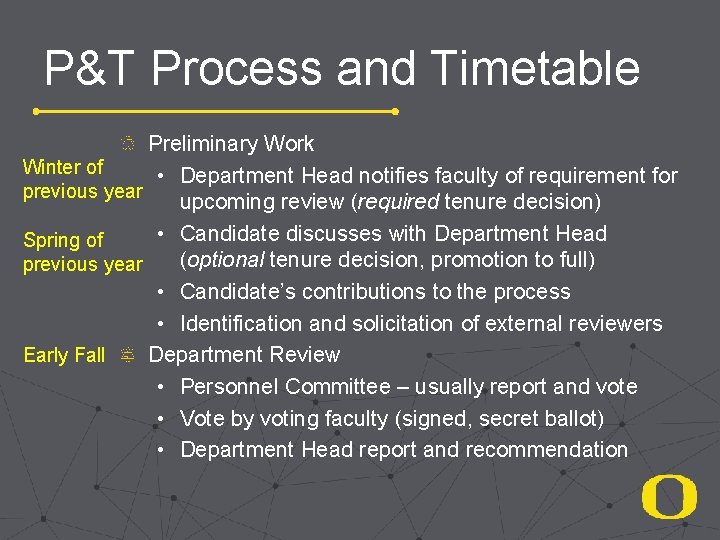
P&T Process and Timetable Preliminary Work Winter of • Department Head notifies faculty of requirement for previous year upcoming review (required tenure decision) • Candidate discusses with Department Head Spring of (optional tenure decision, promotion to full) previous year • Candidate’s contributions to the process • Identification and solicitation of external reviewers Department Review Early Fall • Personnel Committee – usually report and vote • Vote by voting faculty (signed, secret ballot) • Department Head report and recommendation
P&T Process and Timetable (continued) Fall / Winter School/College Review • Personnel or Advisory Committee (elected) – report and vote • Dean – report and recommendation Winter / Spring University Review • Faculty Personnel Committee (elected) – report and vote • Provost – review and decision Decision announcement target date: May 1
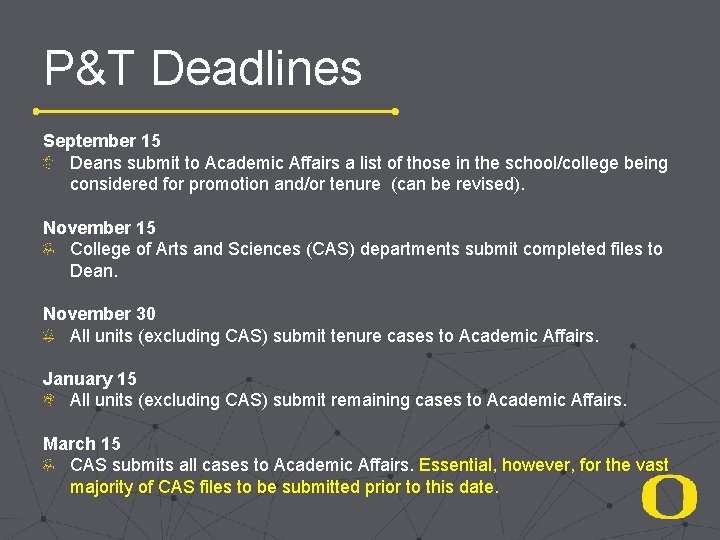
P&T Deadlines September 15 Deans submit to Academic Affairs a list of those in the school/college being considered for promotion and/or tenure (can be revised). November 15 College of Arts and Sciences (CAS) departments submit completed files to Dean. November 30 All units (excluding CAS) submit tenure cases to Academic Affairs. January 15 All units (excluding CAS) submit remaining cases to Academic Affairs. March 15 CAS submits all cases to Academic Affairs. Essential, however, for the vast majority of CAS files to be submitted prior to this date.
Constructing the Dossier {A review in the approximate order of its construction} http: //academicaffairs. uoregon. edu/promotion-tenure
Election of Criteria Pre-tenure candidates: If there has been a change in the written criteria for promotion and/or tenure since the time of hire, the candidate may choose (and should establish in writing) which criteria document will apply. Tenured candidates: The above is limited to the preceding 6 years.
Candidate’s CV Signed and dated Updates permissible – prefer simple list of updates (signed and dated) rather than a full updated CV Always include the CV as seen by the external reviewers as well as any updates Format – disciplinary norm • Full profile (including teaching and service) • Include graduation dates, mentor’s names • Include section for work in progress “The Book” • Signed contract, manuscript complete and accepted, with no further revision (copy edit/galley proof can be pending)
Candidate’s Statement Signed and dated Updates permissible Always include the statement as seen by the external reviewers as well as any updates Accomplishments, current activities, and future plans for research, teaching, and service Statement regarding contributions to institutional equity and inclusion Help the reader understand anything “unusual”
Statement of Waiver File must contain signed and dated statement by candidate • Retaining full access, or • Waiving all rights of access, or • Partial waiver This statement must be completed prior to request for external evaluations Templates available on Academic Affairs web site
Statement of Duties & Responsibilities Objective statement Purely factual Increasingly common practice – provide copy of position description
“Conditions of Appointment” Section Tenure cases – most recent contract Promotion to full professor – nothing required Official letters of understanding • • evaluation procedure for “split” appointments limited range of activities on which promotion will be based credit granted for prior service at other institutions extended time for tenure for reasons such as pregnancy or childbirth
“Teaching Evaluations” Section Courses (large, small, seminar) Curriculum development Student supervision, advising, etc. Hires from other institutions • Recognize that some materials may not be available • Attempt to include as comprehensive a package as possible
Teaching – Department Responsibilities List of courses taught Summary table – quantitative evaluations (including class size, percent response, departmental comparison data) Sample evaluation form Copies of all quantitative summaries Copies of all signed qualitative comments (in supplementary file) Peer evaluations • Pre-tenure: at least one in each of years 3, 4, and 5 • Tenured associate professor: at least one every other year
Teaching – Candidate’s Responsibilities List of teaching awards List of supervised students, sorted by kind and including dates and role (e. g. , chair, advisor, committee member) • Postdoc, doctoral dissertation, masters thesis, honors thesis Teaching portfolio • In supplementary file • Syllabi, innovative materials (including electronic), etc. • Illustrative, not exhaustive
Letters from Students Include both solicited and unsolicited student letters, but only if signed and dated Student letters are not required Inundation is not needed or desirable
Supplemental File Supplemental teaching evaluation data • One set of printouts and signed statements. Unsigned narrative student evaluations are unacceptable and should not be included in the file. It is illegal to quote from unsigned evaluations in summary statements prepared for the file. Scholarship portfolio Teaching portfolio (“typically includes”) Service portfolio (Evidence of contributions to equity and inclusion)
Letters of Evaluation Candidate – list of suggestions Department – independent list If candidate suggests reviewer on department list, that reviewer NOT listed as “suggested by the candidate” Reviewers at or above the rank being sought, at comparable institutions Department selects external reviewers Clear majority of “untainted” reviewers – be proactive and reactive Requested by department head via standard form letter • Templates available on Academic Affairs web site Include example of each letter in the dossier
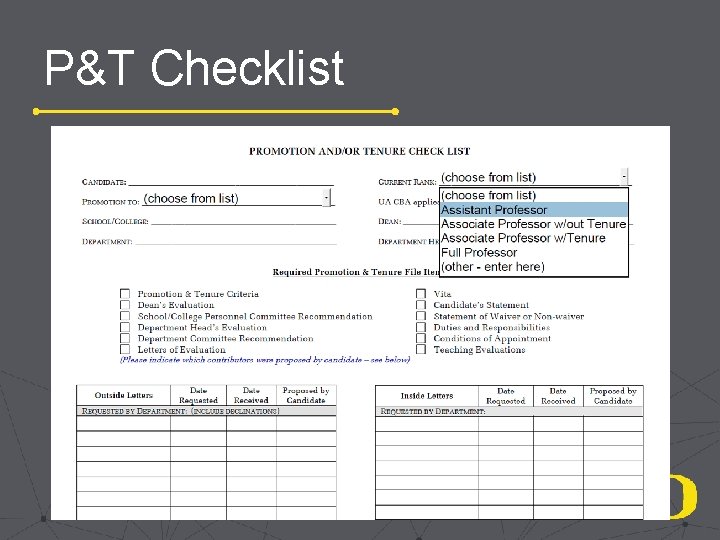
Letters of Evaluation (continued) Reviewers must be notified in advance regarding waiver status Include both solicited and unsolicited letters All letters received must be included in the file Written declinations included at the end of section Reconcile letters received with list of letters solicited on the Promotion and Tenure Checklist Place unsolicited letters AFTER solicited letters Letters from students on teaching and supervision belong in teaching section
List of Materials Sent to Reviewers Candidate’s Statement Candidate’s Vita Published Work (during period under review) – list Selected works in progress may be included – list Unit’s Promotion and Tenure Criteria
Biographical Sketches of External Reviewers Short but complete, with description of the person and their standing in the field, relationship to the candidate, and whether suggested by the candidate or chosen by the Department. Do not include vitas here; provide in supplemental file. Noam Chomsky, Professor of Linguistics, MIT Chomsky is one of the three or four most important scholars of linguistics in the 20 th century. He is the originator (along with his teacher Zellig Hams) of theoretical framework for linguistic analysis known as “generative linguistics. ” Chomsky has no known relationship to the candidate. Selected by the Department
Departmental Committee Recommendation Analysis, not just information from the vita Strengths and weaknesses relative to department and discipline standards Fully present all aspects of the case – analysis, not advocacy Context for scholarship/creative practice • Ranking, status of journals, publishers, venues, etc. • Peer reviewed vs. not • Comments on the stature of the external referees • Other information relevant to appraising the candidate’s work • Research grants, fellowships, etc. , if normal to the field • Not size or number of awards but recognition by rigorous competitive review • Discrepancies in publishing and/or funding record
Departmental Committee Recommendation (cont’d) Analysis of candidate’s record of teaching • Statistical data from student evaluations • Address anomalies • Comparisons with rest of department and/or faculty teaching courses of similar size, character or content • Evaluative summary of signed written students comments • Review and comment on teaching portfolio • Discrepancies between student and peer evaluations Analysis of the candidate’s record of service Report must be signed by all members of the committee
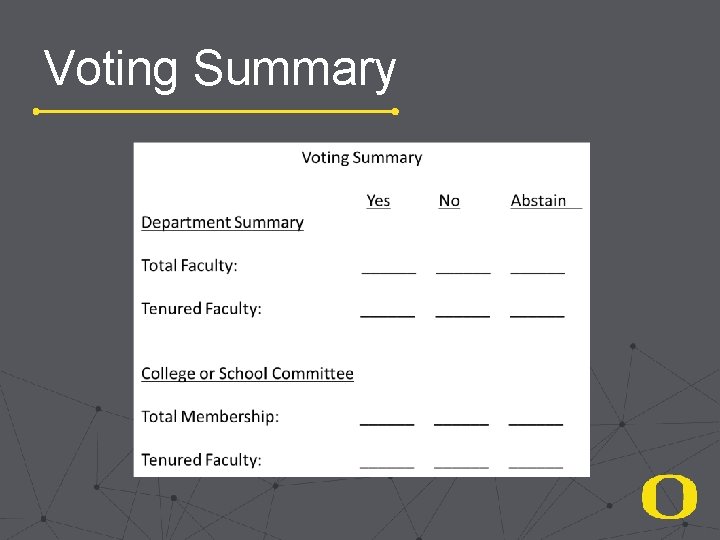
Department Head’s Evaluation Administrative summary of the department’s position on the case • • • Brief explanation of department’s review process Clarification of special conditions, duties or obligations Explanation of who votes Summary of faculty discussion preceding official vote Departmental votes secret; only tally revealed to faculty and recorded on voting summary sheet • Explanation for abstentions or recusals Justification for an earlier-than-usual process Independent review and appraisal of the case Report must be signed
School/College Personnel Committee Report “Secondary reviewers” – in general, lack expertise to review and evaluate the scholarship; focus on overall record, external reviews, and departmental reports Criteria employed are those of the school /college /unit May request additional information, including additional outside letters Committee’s vote recorded and part of the file forwarded to Academic Affairs
Dean’s Evaluation & Recommendation Independent from department level review – analysis of qualifications relative to school/college standards Attempt to address any issues that have been overlooked In early cases, discussion of exceptional merits of case
Dean’s Meeting Dean (or associate dean, if designated) meets with candidate prior to submission of file to Academic Affairs • Information presented in the departmental report • General content of outside letters • Summary of recommendations made to date, including Dean’s • Three days’ notification of meeting required • If member of bargaining unit, candidate may bring nonparticipating observer or non-participating representative from United Academics
Dean’s Meeting (Continued) Candidate may request redacted copy of Dean’s report, redacted in accordance with waiver status (Academic Affairs can assist) Requests for any other materials – consult with Academic Affairs 10 days allowed for candidate to provide written response
Voting Summary
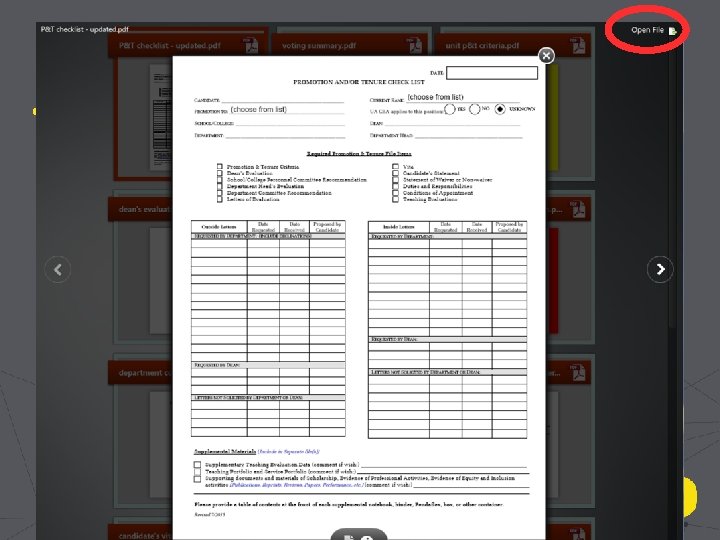
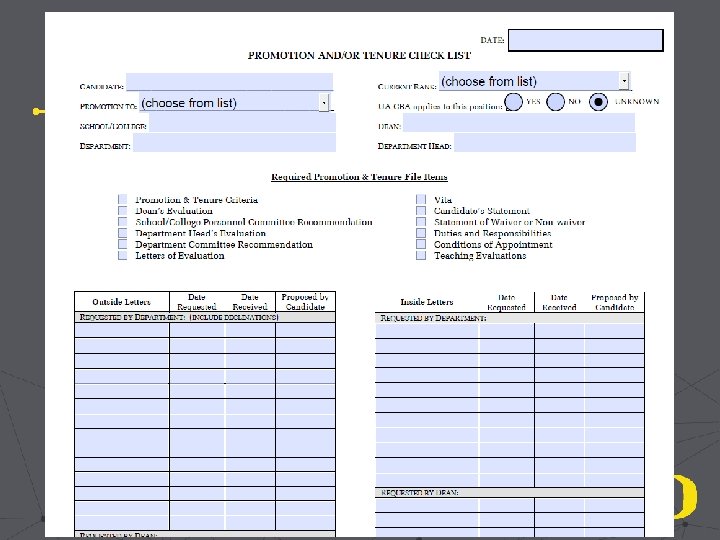
P&T Checklist
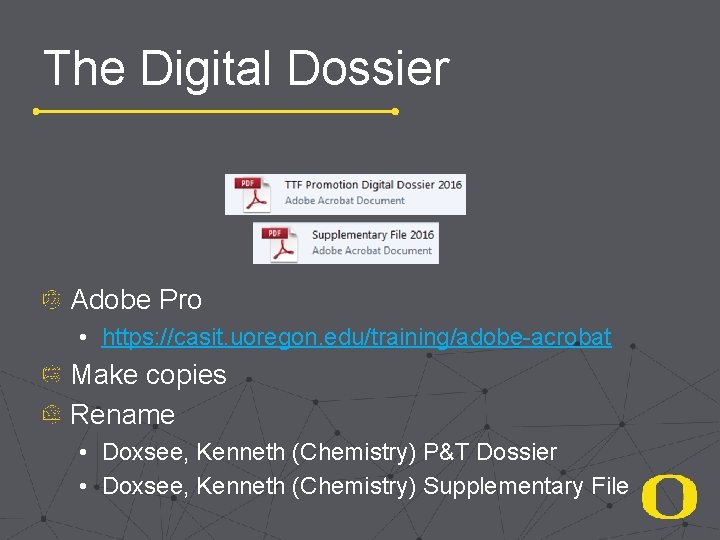
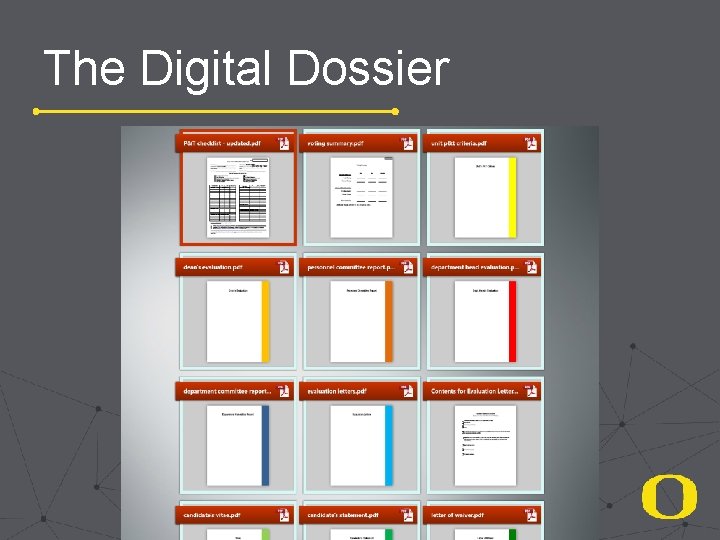
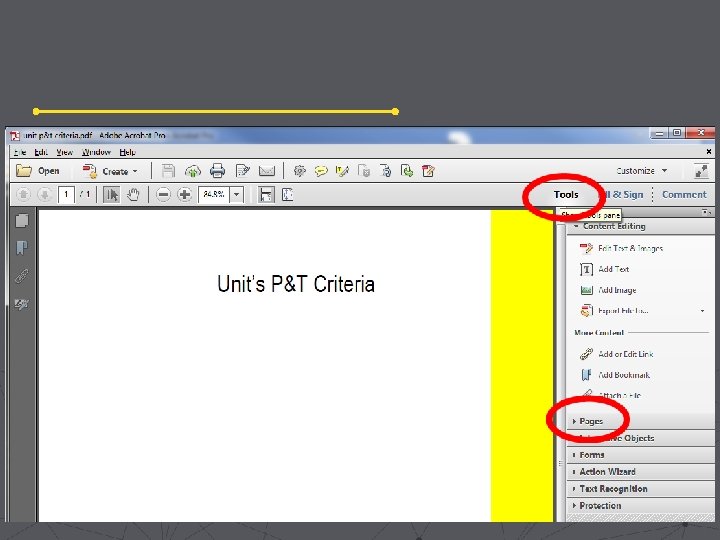
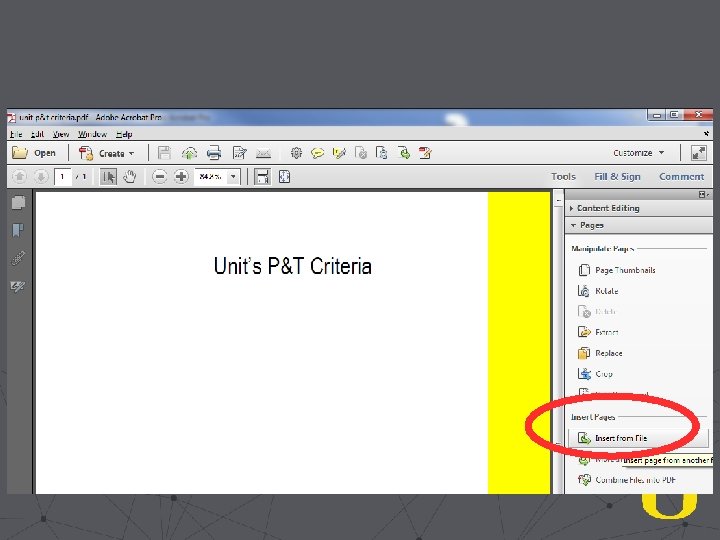
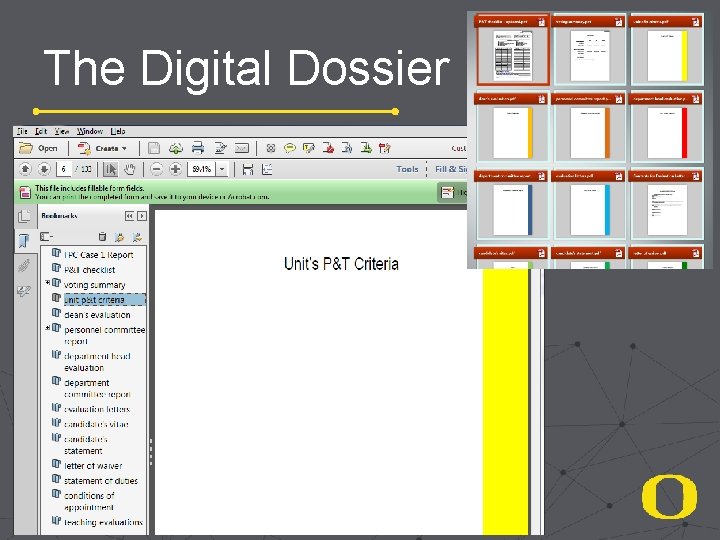
The Digital Dossier Adobe Pro • https: //casit. uoregon. edu/training/adobe-acrobat Make copies Rename • Doxsee, Kenneth (Chemistry) P&T Dossier • Doxsee, Kenneth (Chemistry) Supplementary File
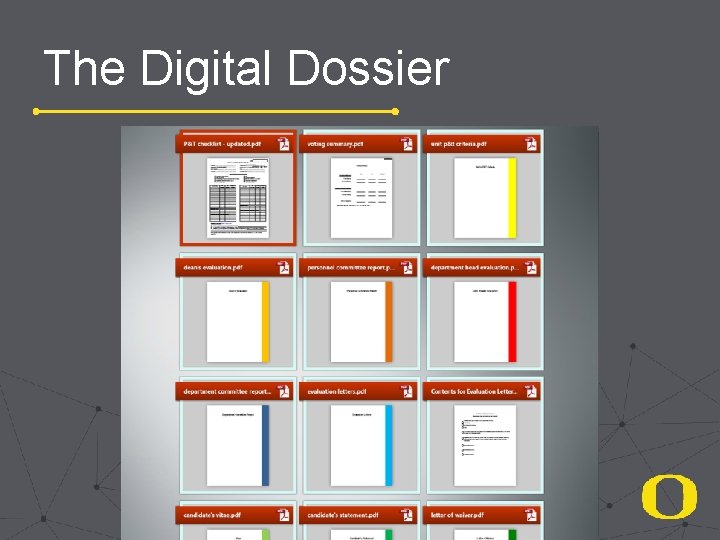
The Digital Dossier
The Digital Dossier
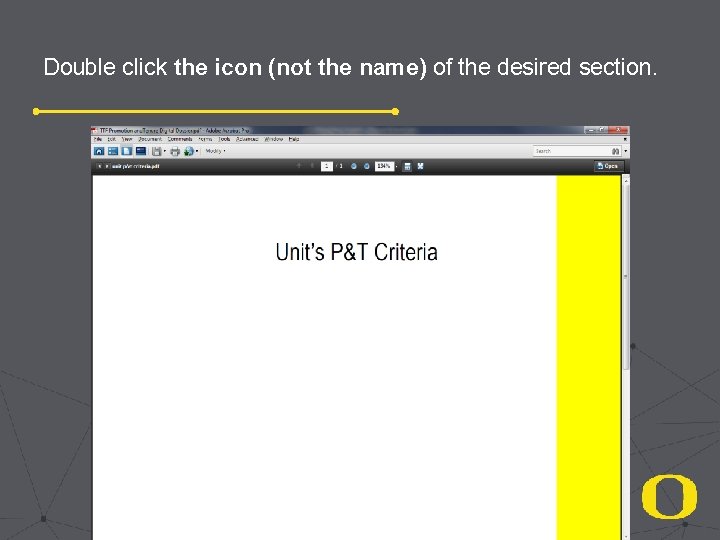
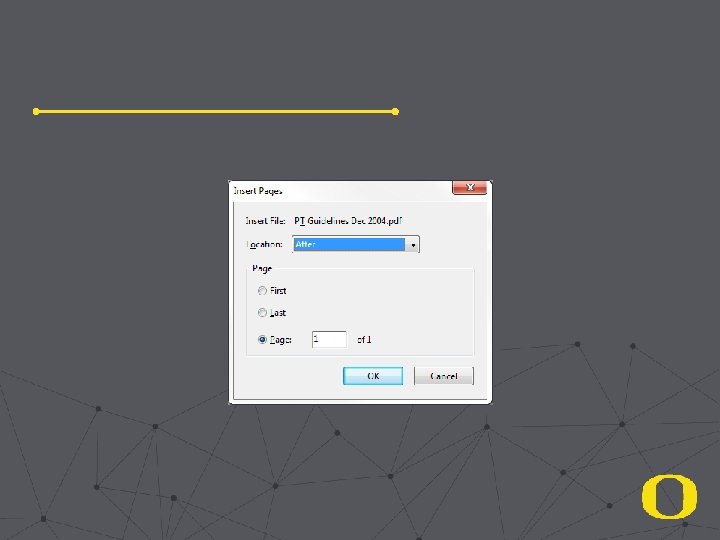
Double click the icon (not the name) of the desired section.
The Digital Dossier
Fillable Forms P&T Checklist Voting Summary Contents for Evaluation Letters Section Teaching Checklist
The Digital Dossier
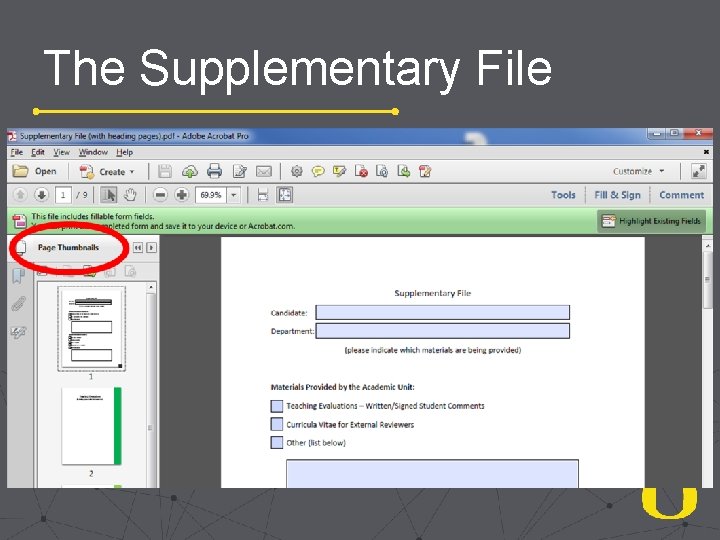
The Supplementary File
The Supplementary File Materials not conveniently provided in digital form Provide in conventional format
Submission of Digital Dossiers Notification of Academic Affairs in advance (as always) Submission of the digital dossier • In-person via USB drive • Plan – secure web site (stay tuned) Archiving • Academic Affairs requires no hard copies • Dean and/or Unit Head may choose to create hard copy
Questions Ken Doxsee Vice Provost for Academic Affairs 346 -2846 doxsee@uoregon. edu