
Materials Plastic Higher Design and Manufacture Plastic Properties
- Slides: 13
Materials - Plastic Higher Design and Manufacture
Plastic Properties Ideal for mass production. Light in weight. Resistant to corrosion. Low in thermal conductivity. Translucent, transparent and opaque. Electrically resistant. Easily formed. Recyclable.
Different Forms of Plastic Profiled sheets, rods, tubes and bars. Moulding compounds. Thin layers of film and sheets. Foam. Casting compounds such as ingots. Paint, varnish and lacquer used for finishing. Filaments and fibres. Composites that contain reinforcing material.
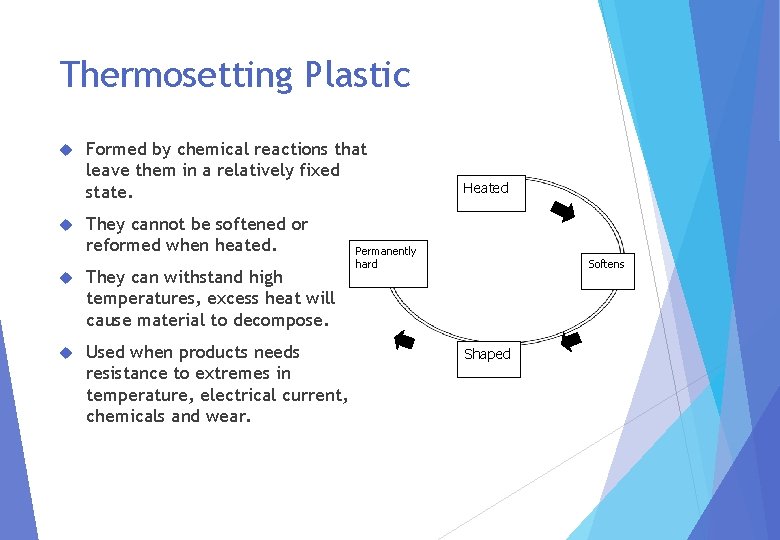
Thermosetting Plastic Formed by chemical reactions that leave them in a relatively fixed state. They cannot be softened or reformed when heated. They can withstand high temperatures, excess heat will cause material to decompose. Used when products needs resistance to extremes in temperature, electrical current, chemicals and wear. Heated Permanently hard Softens Shaped
Thermosetting Plastic Some examples of thermosetting plastics are: Epoxy Resin ER (Araldite) – good adhesive, low shrinkage, strong when reinforced. Used in bonding, laminating, surface coating, printed circuit boards. Polyester Resin PR (Orel Beetle) – stiff, hard, brittle, formed without heat or pressure. Used in panels for car bodies, casting and embedding. Melamine Formaldehyde MF (Formica Melaware) – waterproof, tasteless, odourless, mark and scratch resistant. Used in worktops, tableware, buttons and electrical insulation.
Thermosetting Plastic Urea Formaldehyde UF (Areolyte Cascamite) – good adhesive, stiff, hard, brittle, good electrical insulator. Used in electrical fittings, paper and textile coating, wood adhesive. Phenol Formaldehyde PF (Phenol methanol) – Hard, brittle plastic with dark colour, glossy finish. Resists heat. Used in parts for domestic appliances, bottle tops, kettle/iron/saucepan handles.
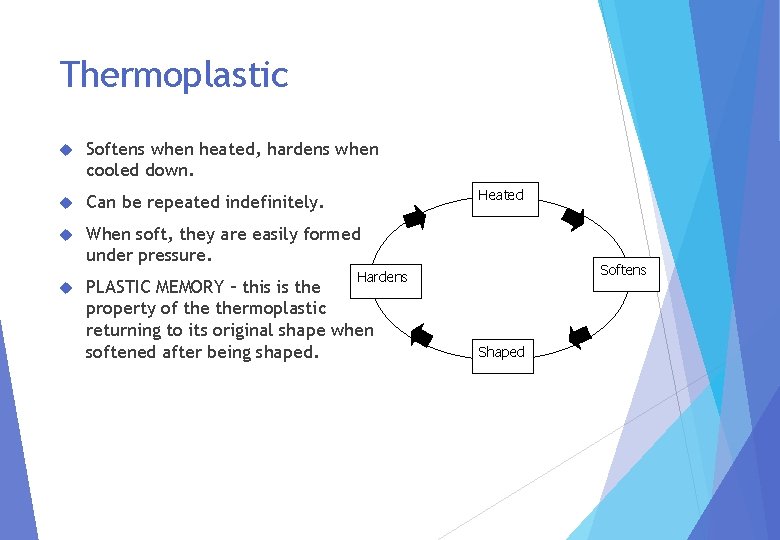
Thermoplastic Softens when heated, hardens when cooled down. Can be repeated indefinitely. When soft, they are easily formed under pressure. Heated Softens Hardens PLASTIC MEMORY – this is the property of thermoplastic returning to its original shape when softened after being shaped. Shaped
Thermoplastic Some examples of thermoplastics are: Polythene HDPE – high density, tough, resists chemicals, feels waxy. Used for rigid objects: buckets, bowls, sterilised containers. Polythene LDPE – low density, soft and pliable, electrical insulator. Used for flexible objects: bags, bottles, cables, toys. Polypropylene PP – rigid, light, good chemical resistance, resistance to fatigue/bending. Used for crates, seats, string, rope, medical equipment, hinges, kitchenware, film. Polystyrene PS – light, stiff, water/weather resistant. Used for packaging, containers, insulation and toys.
Thermoplastic Polyvinyl Chloride UPVC – rigid, abrasive resistance, water/weather resistant. Used for pipes, gutters, bottles, roofing, window frames. Poly-methacrylate PMMA (Acrylic/Perspex) – Stiff, hard, clear, durable, scratches easily, easily machined and polished. Used for signs, lighting, reflectors/lenses cases, jewellery. Nylon – Hard, brittle, good resistance to wear and tear. Solid nylon has flow friction qualities and high melting point. Used in curtain rail fittings, combs and clothes.
Elastomers An elastomer is a natural or synthetic polymer having elastic properties e. g. Rubber It has elastic properties Similar to rubber in how it reacts to pressure and their texture Withstands large amounts of deformation Can be stretched several times to their length Uses: Waterproof seals Flexible handles Sportswear Foam padding
Thermoplastic Elastomers They are a combination of thermoplastics and elastomers. Although classed as polymers, they act like a thermoset rubber. In simple terms, they are a mix of polymers and rubber giving them a combination of the physical properties attributed to thermoplastics and rubber (elastomers). This can include combining flexibility (rubber) with toughness (thermoplastic). They have good strength and tear resistance. They have good properties of flexibility and resistance to compression. After bending, they will return close to their original shape/form. They are widely used in the automotive industry, replacing common elastomers (rubber) because of their ability to resist wear and tear. They are also used in the casings of electronic devices such as TV remote controls. They resist damage when knocked or dropped
Composite Materials Consists of two or more substances. Combines to produce properties that no single substance can achieve. One composite forms the matrix (base) while the other provides reinforcement. Properties are controlled by size and distribution of reinforcing substance.
Composite Materials - Example Using carbon fibres embedded in resin. Carbon-fibre reinforced plastic CFRP Used in aerospace industry and car frameworks. Properties are: Low in density Light in weight High tensile strength Better corrosion resistance and fatigue performance than most metal alloys