
Materials for the Target System Internal Shield Neutrino
- Slides: 5
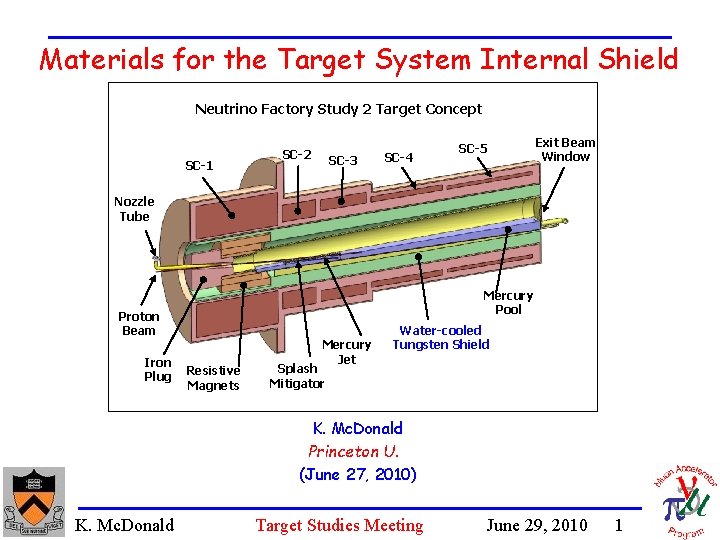
Materials for the Target System Internal Shield Neutrino Factory Study 2 Target Concept SC-1 SC-2 SC-3 SC-4 SC-5 Exit Beam Window Nozzle Tube Mercury Pool Proton Beam Iron Plug Resistive Magnets Mercury Jet Water-cooled Tungsten Shield Splash Mitigator K. Mc. Donald Princeton U. (June 27, 2010) K. Mc. Donald Target Studies Meeting June 29, 2010 1
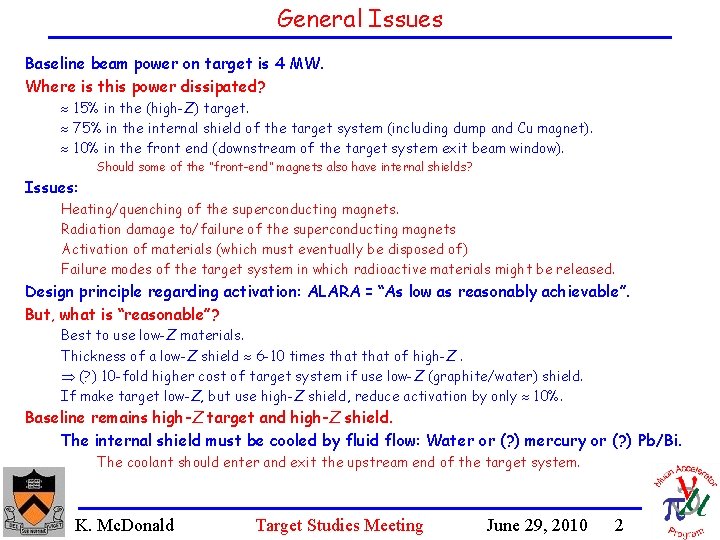
General Issues Baseline beam power on target is 4 MW. Where is this power dissipated? 15% in the (high-Z) target. 75% in the internal shield of the target system (including dump and Cu magnet). 10% in the front end (downstream of the target system exit beam window). Should some of the “front-end” magnets also have internal shields? Issues: Heating/quenching of the superconducting magnets. Radiation damage to/failure of the superconducting magnets Activation of materials (which must eventually be disposed of) Failure modes of the target system in which radioactive materials might be released. Design principle regarding activation: ALARA = “As low as reasonably achievable”. But, what is “reasonable”? Best to use low-Z materials. Thickness of a low-Z shield 6 -10 times that of high-Z. (? ) 10 -fold higher cost of target system if use low-Z (graphite/water) shield. If make target low-Z, but use high-Z shield, reduce activation by only 10%. Baseline remains high-Z target and high-Z shield. The internal shield must be cooled by fluid flow: Water or (? ) mercury or (? ) Pb/Bi. The coolant should enter and exit the upstream end of the target system. K. Mc. Donald Target Studies Meeting June 29, 2010 2
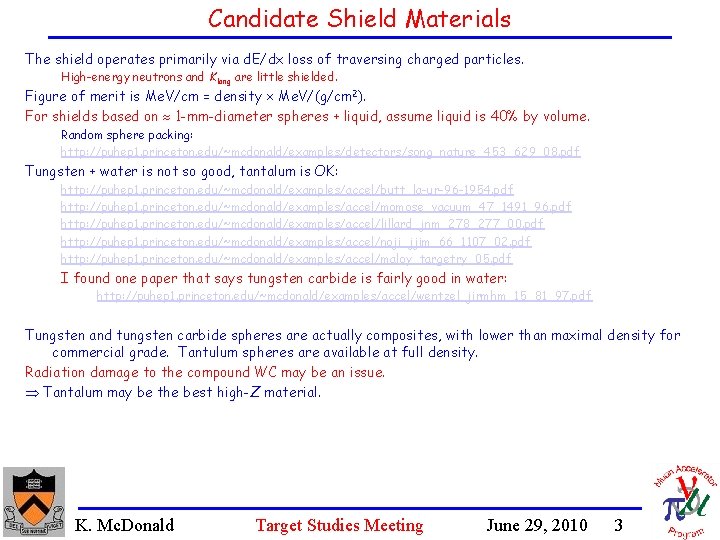
Candidate Shield Materials The shield operates primarily via d. E/dx loss of traversing charged particles. High-energy neutrons and Klong are little shielded. Figure of merit is Me. V/cm = density Me. V/(g/cm 2). For shields based on 1 -mm-diameter spheres + liquid, assume liquid is 40% by volume. Random sphere packing: http: //puhep 1. princeton. edu/~mcdonald/examples/detectors/song_nature_453_629_08. pdf Tungsten + water is not so good, tantalum is OK: http: //puhep 1. princeton. edu/~mcdonald/examples/accel/butt_la-ur-96 -1954. pdf http: //puhep 1. princeton. edu/~mcdonald/examples/accel/momose_vacuum_47_1491_96. pdf http: //puhep 1. princeton. edu/~mcdonald/examples/accel/lillard_jnm_278_277_00. pdf http: //puhep 1. princeton. edu/~mcdonald/examples/accel/noji_jjim_66_1107_02. pdf http: //puhep 1. princeton. edu/~mcdonald/examples/accel/maloy_targetry_05. pdf I found one paper that says tungsten carbide is fairly good in water: http: //puhep 1. princeton. edu/~mcdonald/examples/accel/wentzel_jirmhm_15_81_97. pdf Tungsten and tungsten carbide spheres are actually composites, with lower than maximal density for commercial grade. Tantulum spheres are available at full density. Radiation damage to the compound WC may be an issue. Tantalum may be the best high-Z material. K. Mc. Donald Target Studies Meeting June 29, 2010 3
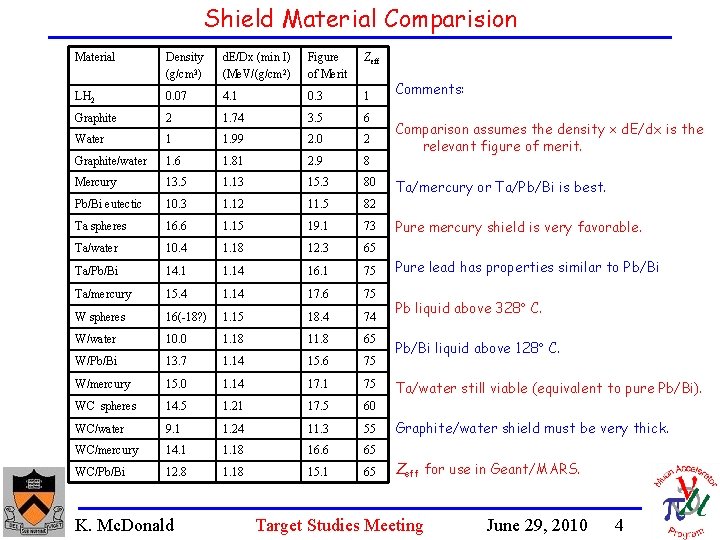
Shield Material Comparision Material Density (g/cm 3) d. E/Dx (min I) (Me. V/(g/cm 2) Figure of Merit Zeff LH 2 0. 07 4. 1 0. 3 1 Graphite 2 1. 74 3. 5 6 Water 1 1. 99 2. 0 2 Graphite/water 1. 6 1. 81 2. 9 8 Mercury 13. 5 1. 13 15. 3 80 Pb/Bi eutectic 10. 3 1. 12 11. 5 82 Ta spheres 16. 6 1. 15 19. 1 73 Ta/water 10. 4 1. 18 12. 3 65 Ta/Pb/Bi 14. 1 1. 14 16. 1 75 Ta/mercury 15. 4 1. 14 17. 6 75 W spheres 16(-18? ) 1. 15 18. 4 74 W/water 10. 0 1. 18 11. 8 65 W/Pb/Bi 13. 7 1. 14 15. 6 75 W/mercury 15. 0 1. 14 17. 1 75 WC spheres 14. 5 1. 21 17. 5 60 WC/water 9. 1 1. 24 11. 3 55 WC/mercury 14. 1 1. 18 16. 6 65 WC/Pb/Bi 12. 8 1. 18 15. 1 65 K. Mc. Donald Comments: Comparison assumes the density d. E/dx is the relevant figure of merit. Ta/mercury or Ta/Pb/Bi is best. Pure mercury shield is very favorable. Pure lead has properties similar to Pb/Bi Pb liquid above 328 C. Pb/Bi liquid above 128 C. Ta/water still viable (equivalent to pure Pb/Bi). Graphite/water shield must be very thick. Zeff for use in Geant/MARS. Target Studies Meeting June 29, 2010 4
Open Issues Shield with high-Z material and liquid coolant is required. Is a liquid-metal coolant acceptable? Pb, Pb/Bi, Hg? If liquid-metal coolant not acceptable, probably must use low-Z solid target (and longer highfield solenoid). If liquid-metal coolant is acceptable, then probably favorable to use liquid-metal target/beam dump. For now, I consider the baseline to be liquid-metal target, beam dump and shield coolant. Should the shield be pure liquid metal, or, say, Ta/liquid metal? I believe that both of these options should be explored. Option for water-cooled shield can be considered without (I think) major extra effort. Solid-target option could be considered as part of water-cooled shield option. Need greater effort on mechanical design of shield/beam dump (and magnets, iron plug, . . . ) Need spec as to maximum allowable head load per meter in superconducting magnet from secondary particles. Need coordinated effort on coolant flow (flow path, stagnant regions, required pressure…) Opportunity exists for collaboration with Peles group at RPI, which studies heat transfer in microchannels: http: //www. rpi. edu/~pelesy/index. htm If water cooling, advantageous to use boiling (2 -phase) flow; can this be controlled in our environment? K. Mc. Donald Target Studies Meeting June 29, 2010 5