
MATERIALS FOR MEMBRANE CONSTRUCTION IN MEMBRANE FILTRATION UNITS
MATERIALS FOR MEMBRANE CONSTRUCTION IN MEMBRANE FILTRATION UNITS Dairy Process Engineering (DTE – 221) Dr. Jahangir Badshah University Professor-cum-Chief Scientist Dairy Engineering Department, SGIDT, Patna (Bihar Animal Sciences University, Patna)

Different materials for membrane construction Ø Cellulose Acetate i. Contains 38 – 40 % by weight of acetyl group. ii. Membranes are strong and flexible. iii. Used for RO, NF and UF applications. Advantages i. ii. Low price Less prone to fouling due to its hydrophilic nature. Disadvantages i. Low resistance to p. H change. ii. Maximum operating temperature is 35°C. iii. Low resistance to chemicals normally used for cleaning and sanitization (e. g. chlorine) iv. Can be eaten by microorganisms.
Synthetic polymers : Poysulphones Aromatic polysulphones are used as they are resistant to oxidation Ø Dimensionally stable and resistant to acids, alkali, salt solutions and detergents even at elevated temperatures or moderate pressure. Ø Used for UF and MF membrane since 1975. Ø Ø Advantages Exceptional temperature and p. H resistance Ø Disadvantages The polysulphone membranes do not tolerate oil, grease, fat and polar solvents.
Other Synthetic polymers Ø § § Polyvinylidene fluoride These are resistant to hydrocarbons and oxidizing environments. These have excellent abrasion resistance These have good resistance against temperature and chemicals. It has extraordinary chemical resistance and can be used in a wide range of temperature.
Other Polymeric membrane materials � Polyether sulphone � Polyphenylsulphone � Polyethylene (PE) � Polypropylene (PP) � Polyamide (PA) � Polycarbonate (PC) � Polymethylmethacrylate (PMMA) � Polyacrylonitrile � Polytetrafluoroethylene � Aliphatic and aromatic polyamides

Ceramic Membrane Materials � Alumina : Alumina membranes are membranes made of high-purity (mostly >97 %) aluminum oxides (alumina). They belong to the categories of ceramic membranes and in most cases, microfiltration and ultrafiltration membranes. � Titania: The synthesis and properties of microporous titania membranes that contain pore sizes <1 nm are reported. The membranes show a molecular weight cut‐offof less than 400 in nanofiltration, and are selective in the pervaporation of water from binary liquid. � Zirconia : Porous ceramic membranes are chiefly used for gas separation and micro- or nanofiltratio. They can be made from both crystalline as well as amorphous solids. � An example of an amorphous membrane is the silica membrane. � An example of a highly porous membrane is the type made of silicon carbide.

Membrane structure Membranes have a tight top layer facing the product to be treated. This layer is also called the skin layer. It is thin, typically <0. 1 micron. Ø The membrane itself is 150 - 250 micron, the bulk of the membrane simply providing structural support for the skin layer. Ø Ø Pore size differs for different types of processes: i. MF – 5 – 0. 1 micron ii. UF – 0. 1 – 0. 01 micron iii. NF & RO – 0. 001 micron (Theoretical)

Composite membranes Ø Ø Ø Ø Made to replace cellulose acetate RO membranes. The main advantage is the combination of relatively high flux and very high salt rejection. They also have good temperature and p. H resistance. They do not tolerate oxidizing environments. Composite membranes are made in two-layer and three-layer designs, the precise composition of which is proprietary. Around 1980, Film Tech. marketed the two-layer design which immediately became the industry standard for water desalination. In the mid-1980 s Desalination Systems, Inc. (DSI) began making composite membranes with a three-layer design. The three-layer design is available for RO and NF, and it is still the best choice for treating a
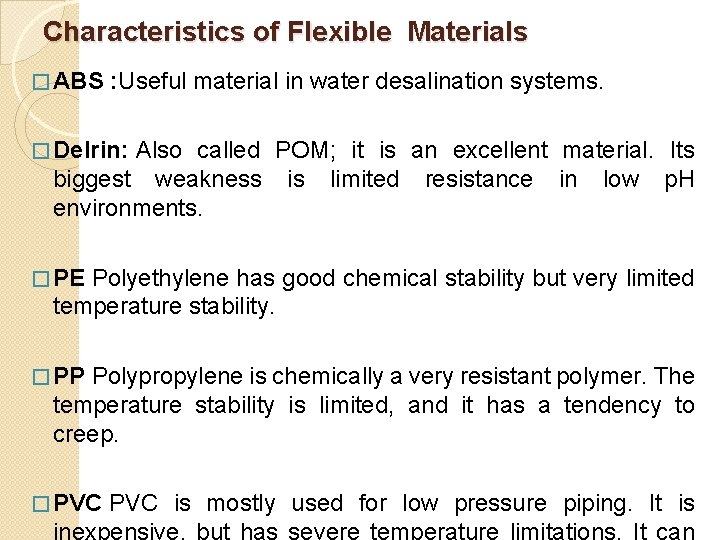
Characteristics of Flexible Materials � ABS : Useful material in water desalination systems. � Delrin: Also called POM; it is an excellent material. Its biggest weakness is limited resistance in low p. H environments. � PE Polyethylene has good chemical stability but very limited temperature stability. � PP Polypropylene is chemically a very resistant polymer. The temperature stability is limited, and it has a tendency to creep. � PVC is mostly used for low pressure piping. It is
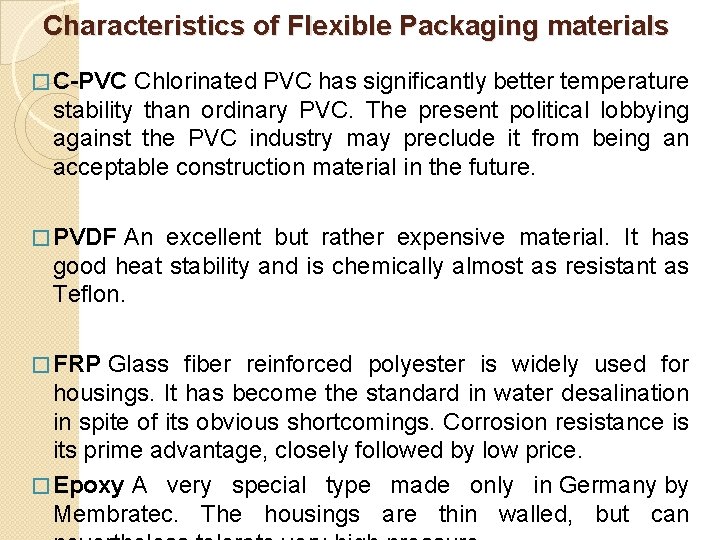
Characteristics of Flexible Packaging materials � C-PVC Chlorinated PVC has significantly better temperature stability than ordinary PVC. The present political lobbying against the PVC industry may preclude it from being an acceptable construction material in the future. � PVDF An excellent but rather expensive material. It has good heat stability and is chemically almost as resistant as Teflon. � FRP Glass fiber reinforced polyester is widely used for housings. It has become the standard in water desalination in spite of its obvious shortcomings. Corrosion resistance is its prime advantage, closely followed by low price. � Epoxy A very special type made only in Germany by Membratec. The housings are thin walled, but can

Thank You ejazbadshah@gmail. com
- Slides: 11