
Materials engineering science processing and design 2 nd

- Slides: 21
Materials: engineering, science, processing and design, 2 nd edition Copyright (c)2010 Michael Ashby, Hugh Shercliff, David Cebon
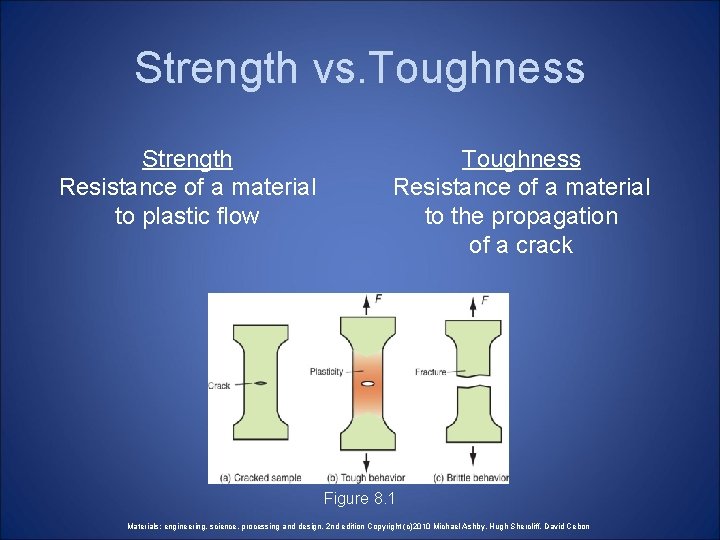
Strength vs. Toughness Strength Resistance of a material to plastic flow Toughness Resistance of a material to the propagation of a crack Figure 8. 1 Materials: engineering, science, processing and design, 2 nd edition Copyright (c)2010 Michael Ashby, Hugh Shercliff, David Cebon
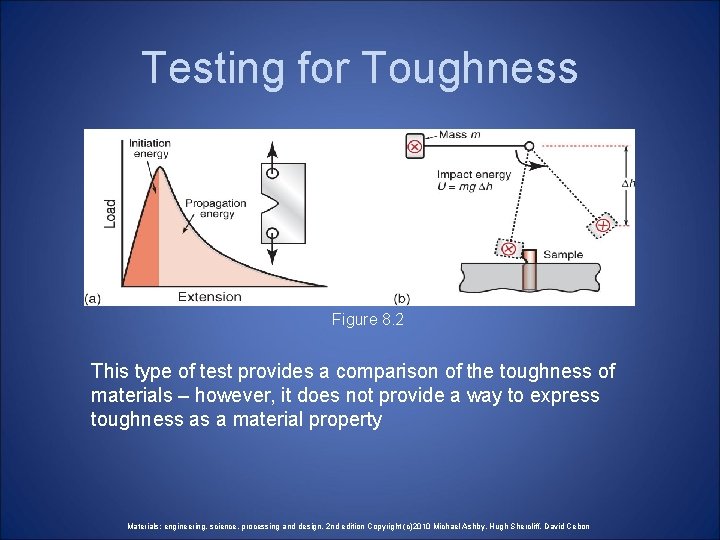
Testing for Toughness Figure 8. 2 This type of test provides a comparison of the toughness of materials – however, it does not provide a way to express toughness as a material property Materials: engineering, science, processing and design, 2 nd edition Copyright (c)2010 Michael Ashby, Hugh Shercliff, David Cebon
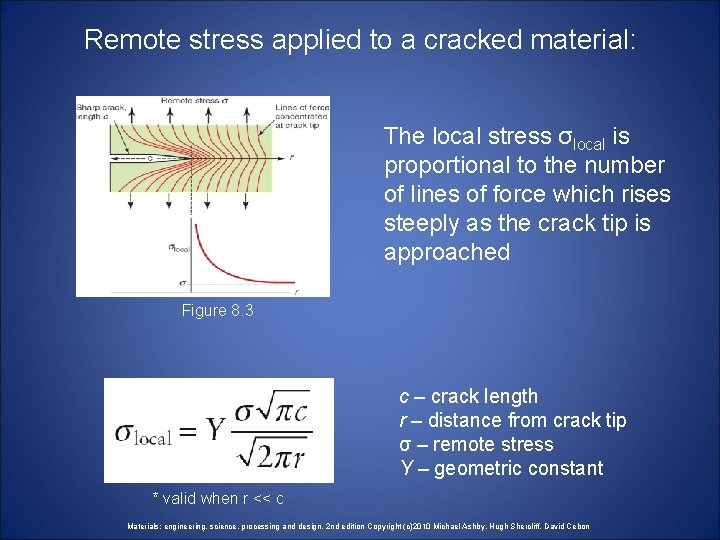
Remote stress applied to a cracked material: The local stress σlocal is proportional to the number of lines of force which rises steeply as the crack tip is approached Figure 8. 3 c – crack length r – distance from crack tip σ – remote stress Y – geometric constant * valid when r << c Materials: engineering, science, processing and design, 2 nd edition Copyright (c)2010 Michael Ashby, Hugh Shercliff, David Cebon
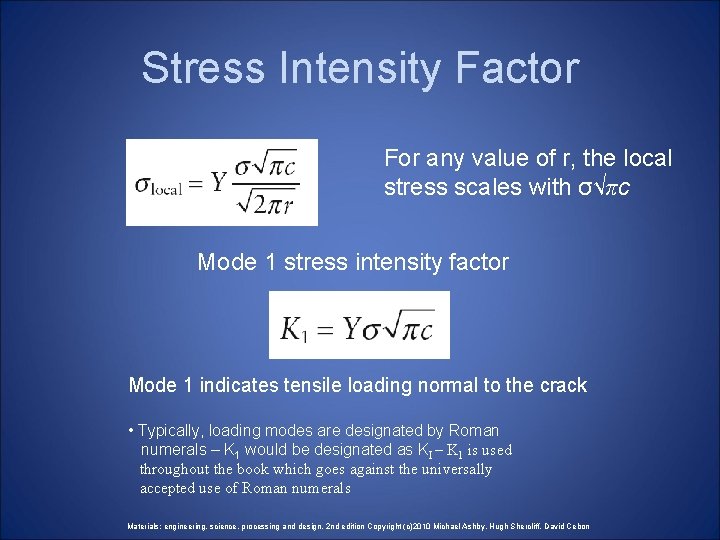
Stress Intensity Factor For any value of r, the local stress scales with σ√πc Mode 1 stress intensity factor Mode 1 indicates tensile loading normal to the crack • Typically, loading modes are designated by Roman numerals – K 1 would be designated as KI – K 1 is used throughout the book which goes against the universally accepted use of Roman numerals Materials: engineering, science, processing and design, 2 nd edition Copyright (c)2010 Michael Ashby, Hugh Shercliff, David Cebon
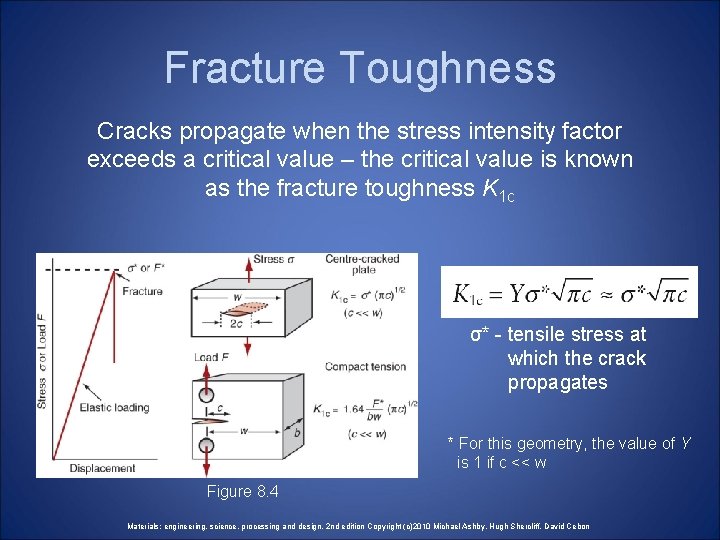
Fracture Toughness Cracks propagate when the stress intensity factor exceeds a critical value – the critical value is known as the fracture toughness K 1 c σ* - tensile stress at which the crack propagates * For this geometry, the value of Y is 1 if c << w Figure 8. 4 Materials: engineering, science, processing and design, 2 nd edition Copyright (c)2010 Michael Ashby, Hugh Shercliff, David Cebon
Energy Release Rate G and Toughness Gc For a crack to grow, sufficient external work must be done which is in the form of released elastic energy γ – surface energy Figure 8. 5 Materials: engineering, science, processing and design, 2 nd edition Copyright (c)2010 Michael Ashby, Hugh Shercliff, David Cebon
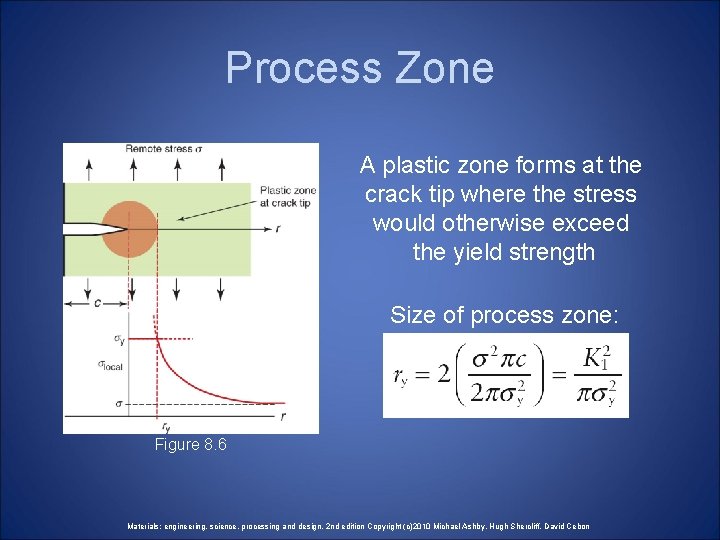
Process Zone A plastic zone forms at the crack tip where the stress would otherwise exceed the yield strength Size of process zone: Figure 8. 6 Materials: engineering, science, processing and design, 2 nd edition Copyright (c)2010 Michael Ashby, Hugh Shercliff, David Cebon
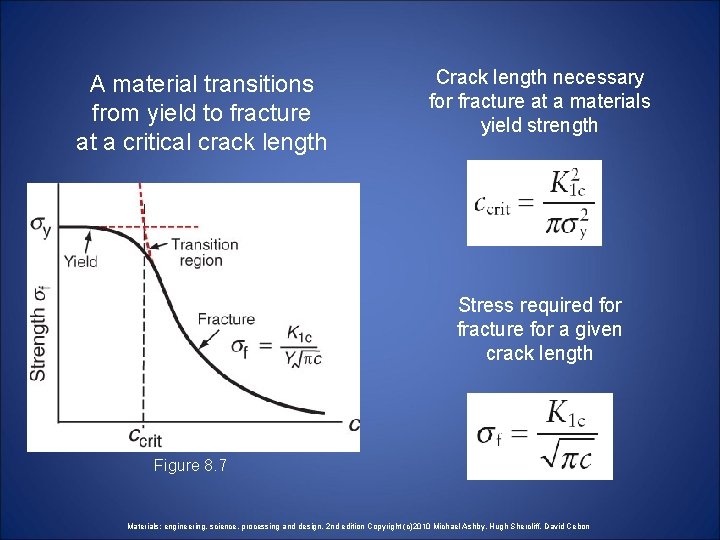
A material transitions from yield to fracture at a critical crack length Crack length necessary for fracture at a materials yield strength Stress required for fracture for a given crack length Figure 8. 7 Materials: engineering, science, processing and design, 2 nd edition Copyright (c)2010 Michael Ashby, Hugh Shercliff, David Cebon
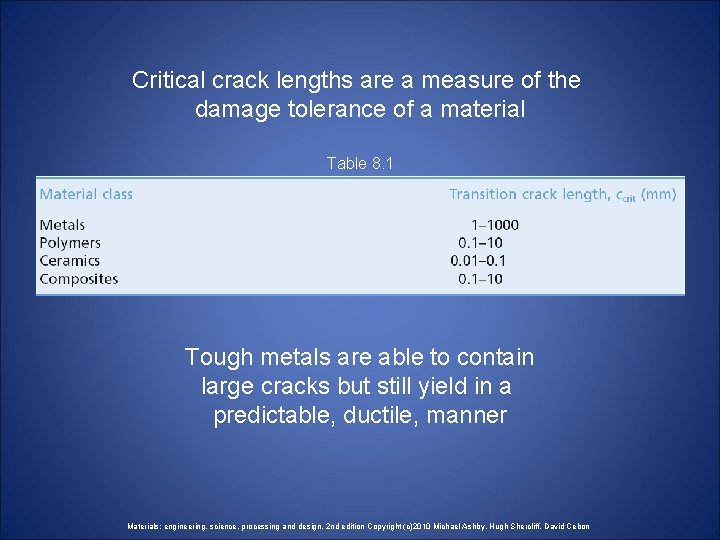
Critical crack lengths are a measure of the damage tolerance of a material Table 8. 1 Tough metals are able to contain large cracks but still yield in a predictable, ductile, manner Materials: engineering, science, processing and design, 2 nd edition Copyright (c)2010 Michael Ashby, Hugh Shercliff, David Cebon
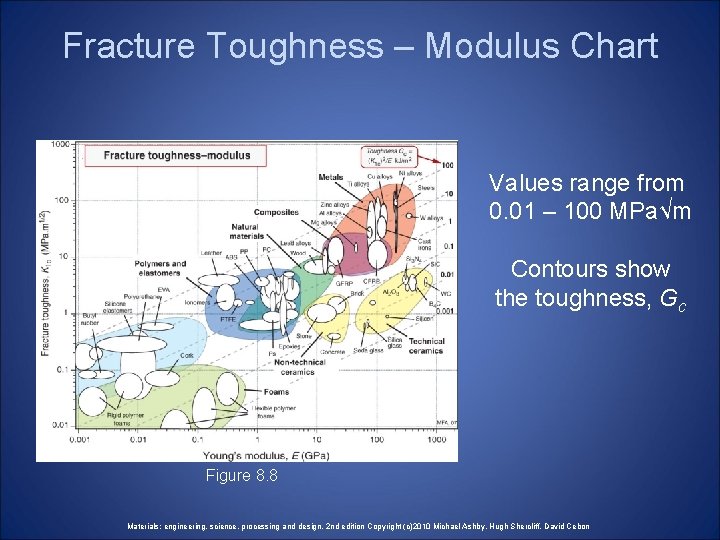
Fracture Toughness – Modulus Chart Values range from 0. 01 – 100 MPa√m Contours show the toughness, Gc Figure 8. 8 Materials: engineering, science, processing and design, 2 nd edition Copyright (c)2010 Michael Ashby, Hugh Shercliff, David Cebon
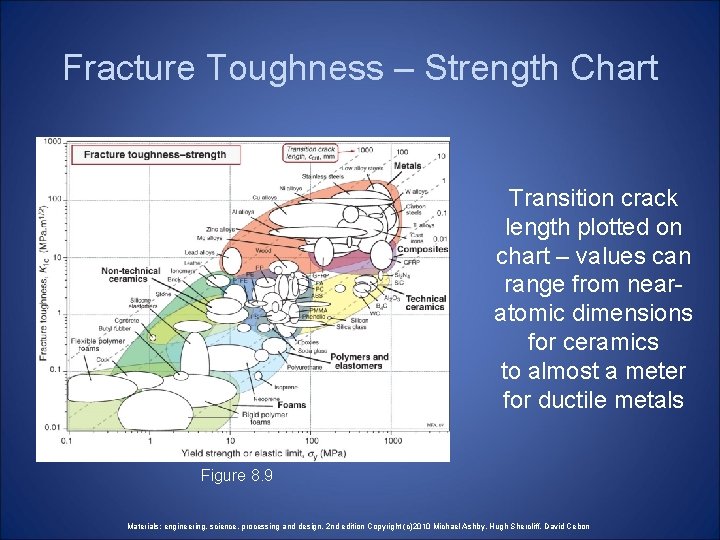
Fracture Toughness – Strength Chart Transition crack length plotted on chart – values can range from nearatomic dimensions for ceramics to almost a meter for ductile metals Figure 8. 9 Materials: engineering, science, processing and design, 2 nd edition Copyright (c)2010 Michael Ashby, Hugh Shercliff, David Cebon
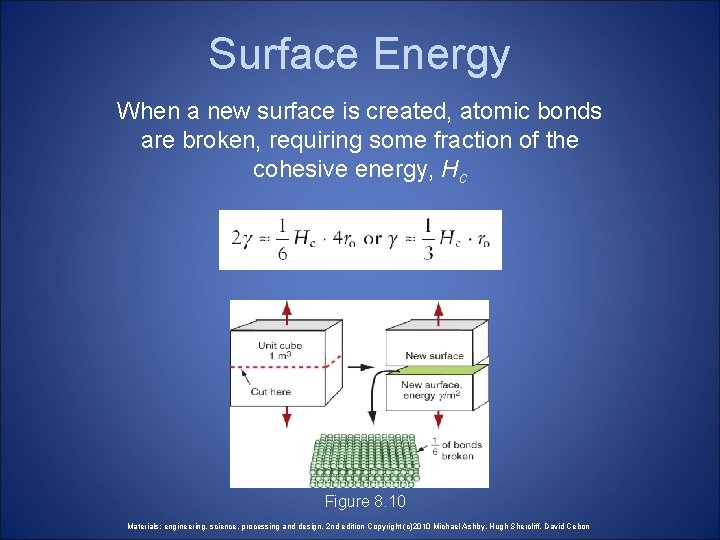
Surface Energy When a new surface is created, atomic bonds are broken, requiring some fraction of the cohesive energy, Hc Figure 8. 10 Materials: engineering, science, processing and design, 2 nd edition Copyright (c)2010 Michael Ashby, Hugh Shercliff, David Cebon
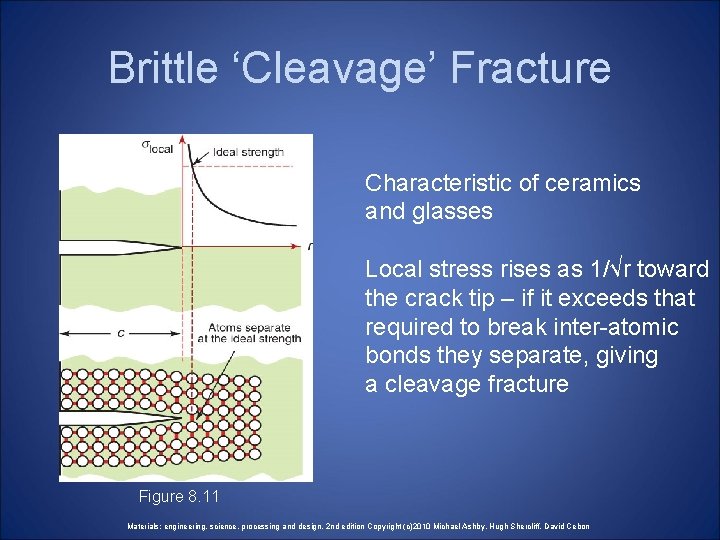
Brittle ‘Cleavage’ Fracture Characteristic of ceramics and glasses Local stress rises as 1/√r toward the crack tip – if it exceeds that required to break inter-atomic bonds they separate, giving a cleavage fracture Figure 8. 11 Materials: engineering, science, processing and design, 2 nd edition Copyright (c)2010 Michael Ashby, Hugh Shercliff, David Cebon
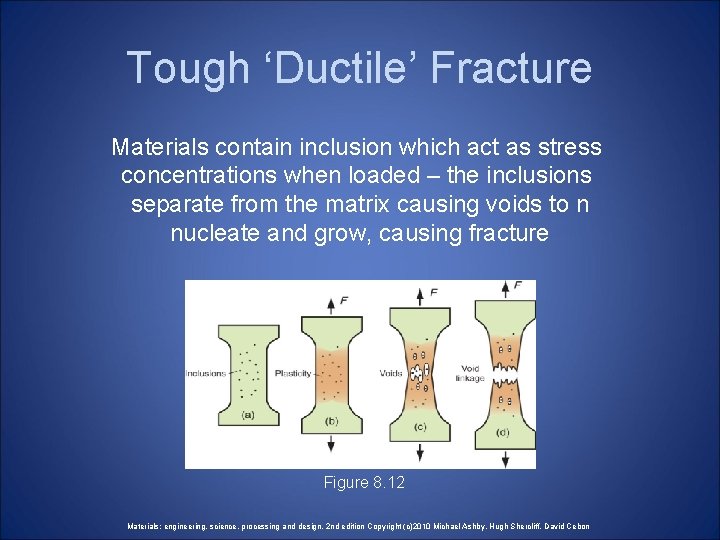
Tough ‘Ductile’ Fracture Materials contain inclusion which act as stress concentrations when loaded – the inclusions separate from the matrix causing voids to n nucleate and grow, causing fracture Figure 8. 12 Materials: engineering, science, processing and design, 2 nd edition Copyright (c)2010 Michael Ashby, Hugh Shercliff, David Cebon
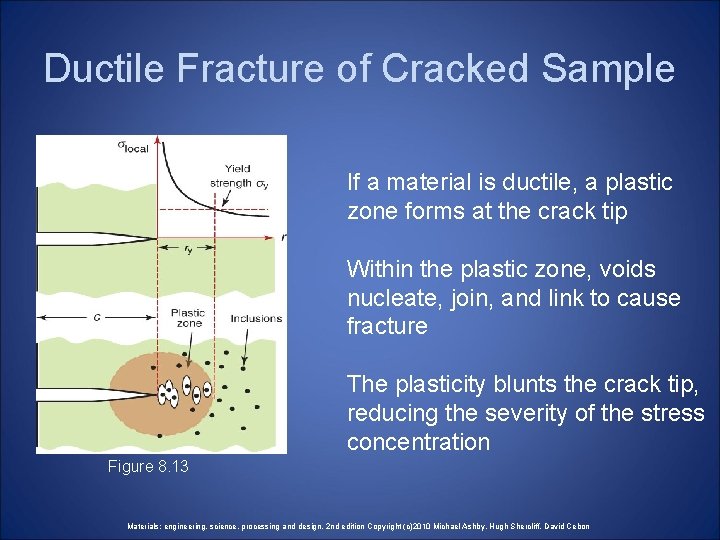
Ductile Fracture of Cracked Sample If a material is ductile, a plastic zone forms at the crack tip Within the plastic zone, voids nucleate, join, and link to cause fracture The plasticity blunts the crack tip, reducing the severity of the stress concentration Figure 8. 13 Materials: engineering, science, processing and design, 2 nd edition Copyright (c)2010 Michael Ashby, Hugh Shercliff, David Cebon
Ductile-to-Brittle Transition At low temperatures some metals and all polymers become brittle As temperatures decrease, yield strengths of most materials increase leading to a reduction in the plastic zone size Only metals with an FCC structure remain ductile at the lowest temperatures Materials: engineering, science, processing and design, 2 nd edition Copyright (c)2010 Michael Ashby, Hugh Shercliff, David Cebon
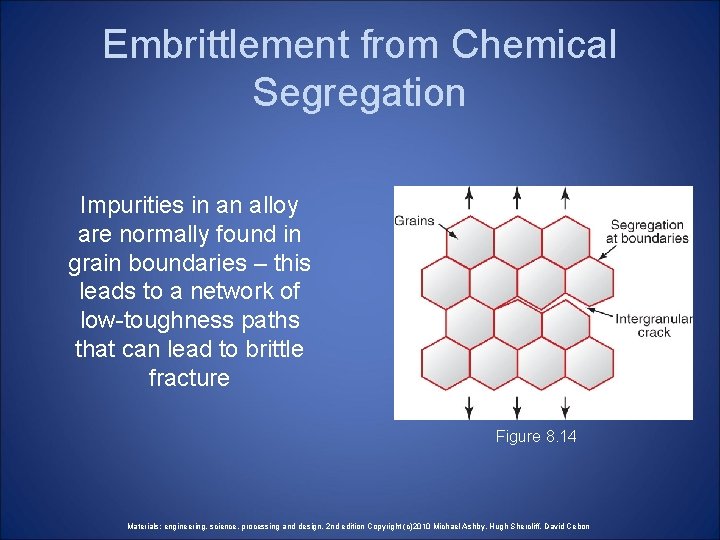
Embrittlement from Chemical Segregation Impurities in an alloy are normally found in grain boundaries – this leads to a network of low-toughness paths that can lead to brittle fracture Figure 8. 14 Materials: engineering, science, processing and design, 2 nd edition Copyright (c)2010 Michael Ashby, Hugh Shercliff, David Cebon
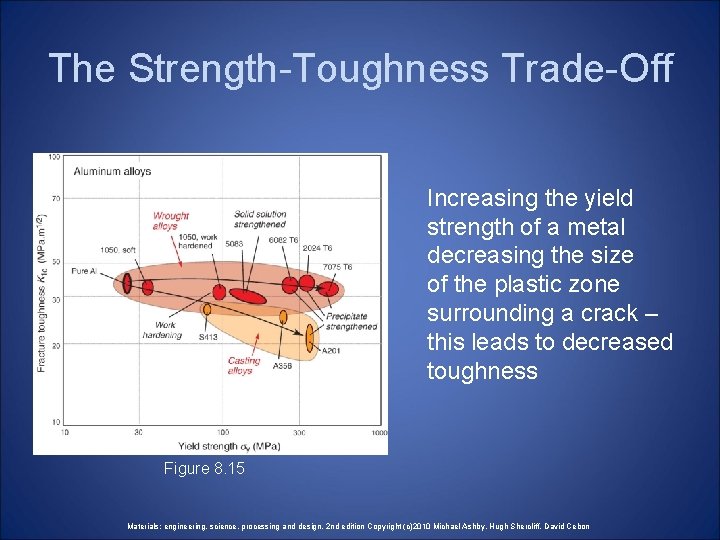
The Strength-Toughness Trade-Off Increasing the yield strength of a metal decreasing the size of the plastic zone surrounding a crack – this leads to decreased toughness Figure 8. 15 Materials: engineering, science, processing and design, 2 nd edition Copyright (c)2010 Michael Ashby, Hugh Shercliff, David Cebon
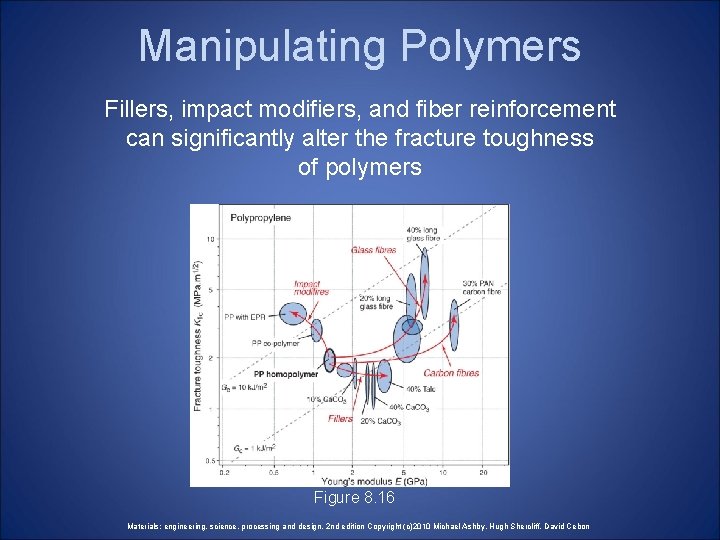
Manipulating Polymers Fillers, impact modifiers, and fiber reinforcement can significantly alter the fracture toughness of polymers Figure 8. 16 Materials: engineering, science, processing and design, 2 nd edition Copyright (c)2010 Michael Ashby, Hugh Shercliff, David Cebon
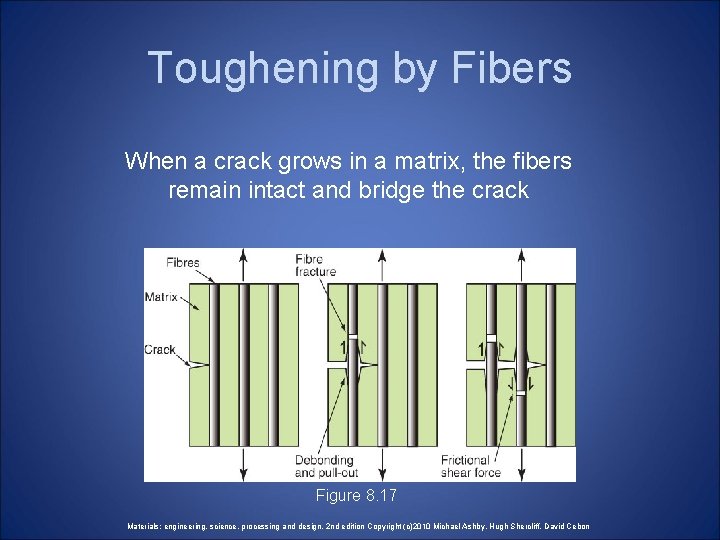
Toughening by Fibers When a crack grows in a matrix, the fibers remain intact and bridge the crack Figure 8. 17 Materials: engineering, science, processing and design, 2 nd edition Copyright (c)2010 Michael Ashby, Hugh Shercliff, David Cebon