
Materials engineering science processing and design 2 nd

- Slides: 24
Materials: engineering, science, processing and design, 2 nd edition Copyright (c)2010 Michael Ashby, Hugh Shercliff, David Cebon
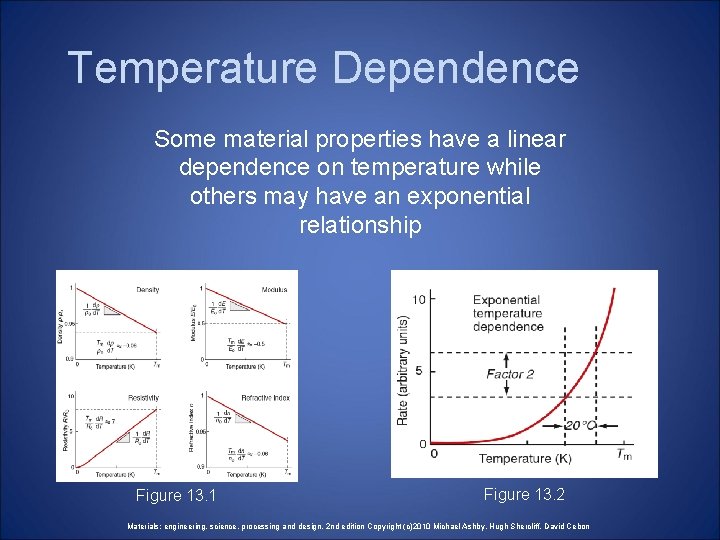
Temperature Dependence Some material properties have a linear dependence on temperature while others may have an exponential relationship Figure 13. 1 Figure 13. 2 Materials: engineering, science, processing and design, 2 nd edition Copyright (c)2010 Michael Ashby, Hugh Shercliff, David Cebon
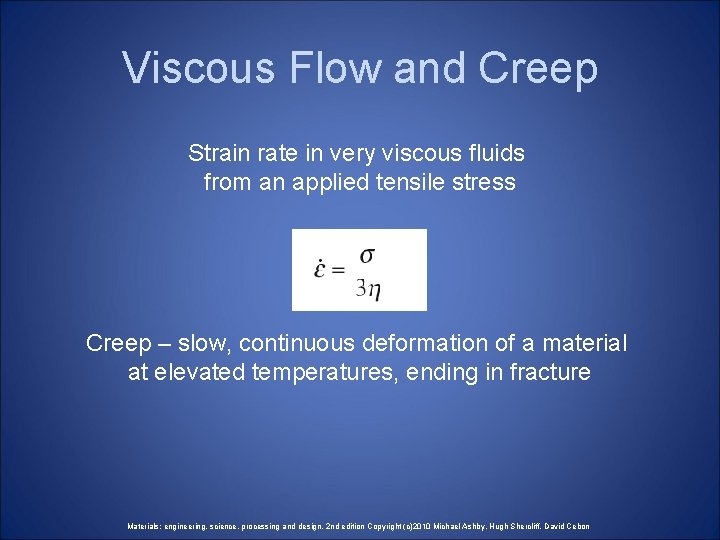
Viscous Flow and Creep Strain rate in very viscous fluids from an applied tensile stress Creep – slow, continuous deformation of a material at elevated temperatures, ending in fracture Materials: engineering, science, processing and design, 2 nd edition Copyright (c)2010 Michael Ashby, Hugh Shercliff, David Cebon
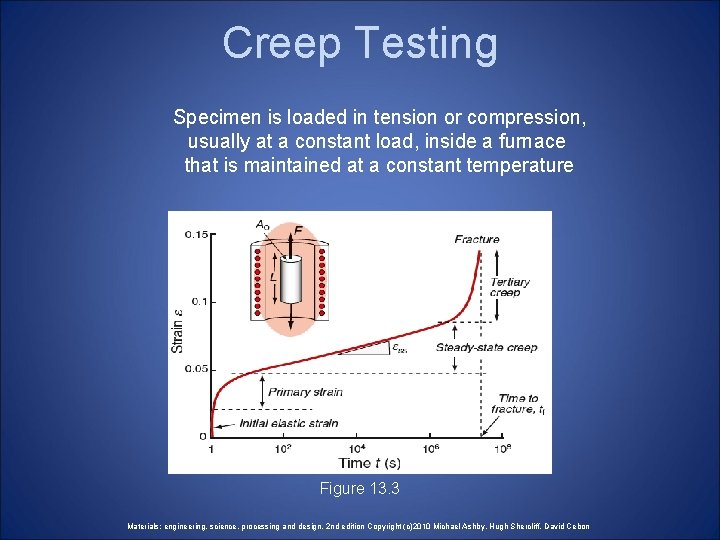
Creep Testing Specimen is loaded in tension or compression, usually at a constant load, inside a furnace that is maintained at a constant temperature Figure 13. 3 Materials: engineering, science, processing and design, 2 nd edition Copyright (c)2010 Michael Ashby, Hugh Shercliff, David Cebon
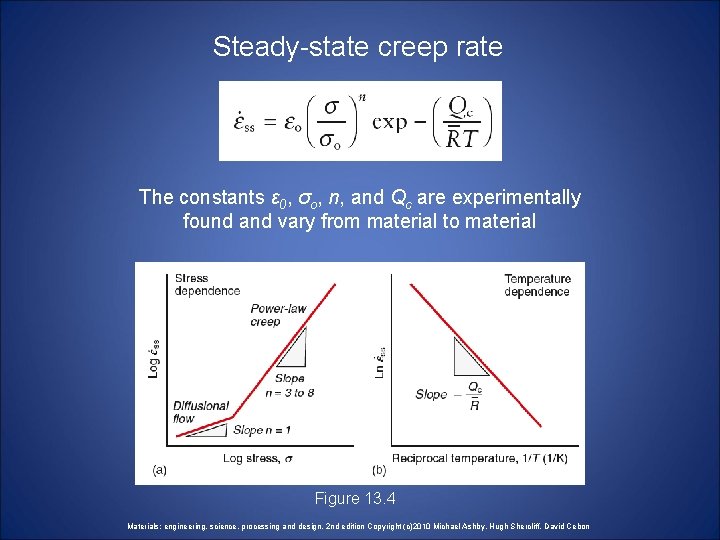
Steady-state creep rate The constants ε 0, σo, n, and Qc are experimentally found and vary from material to material Figure 13. 4 Materials: engineering, science, processing and design, 2 nd edition Copyright (c)2010 Michael Ashby, Hugh Shercliff, David Cebon
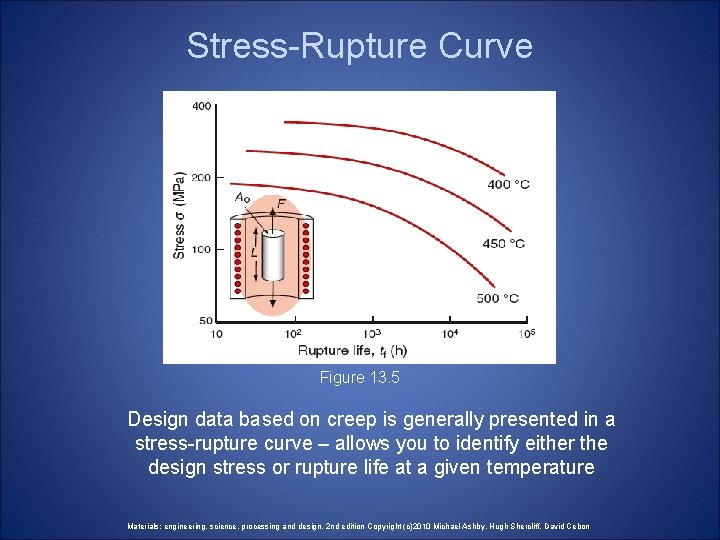
Stress-Rupture Curve Figure 13. 5 Design data based on creep is generally presented in a stress-rupture curve – allows you to identify either the design stress or rupture life at a given temperature Materials: engineering, science, processing and design, 2 nd edition Copyright (c)2010 Michael Ashby, Hugh Shercliff, David Cebon
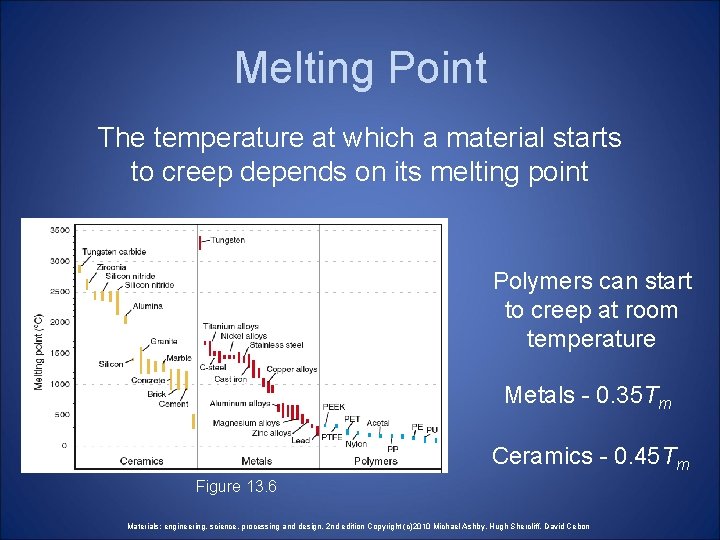
Melting Point The temperature at which a material starts to creep depends on its melting point Polymers can start to creep at room temperature Metals - 0. 35 Tm Ceramics - 0. 45 Tm Figure 13. 6 Materials: engineering, science, processing and design, 2 nd edition Copyright (c)2010 Michael Ashby, Hugh Shercliff, David Cebon
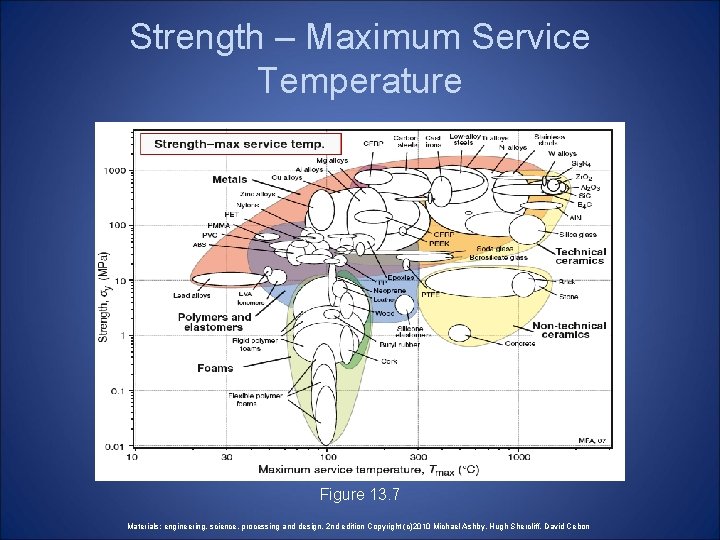
Strength – Maximum Service Temperature Figure 13. 7 Materials: engineering, science, processing and design, 2 nd edition Copyright (c)2010 Michael Ashby, Hugh Shercliff, David Cebon
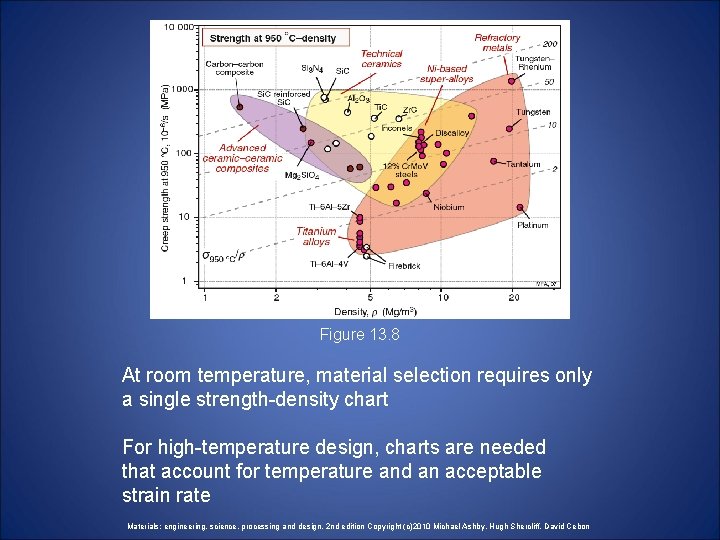
Figure 13. 8 At room temperature, material selection requires only a single strength-density chart For high-temperature design, charts are needed that account for temperature and an acceptable strain rate Materials: engineering, science, processing and design, 2 nd edition Copyright (c)2010 Michael Ashby, Hugh Shercliff, David Cebon
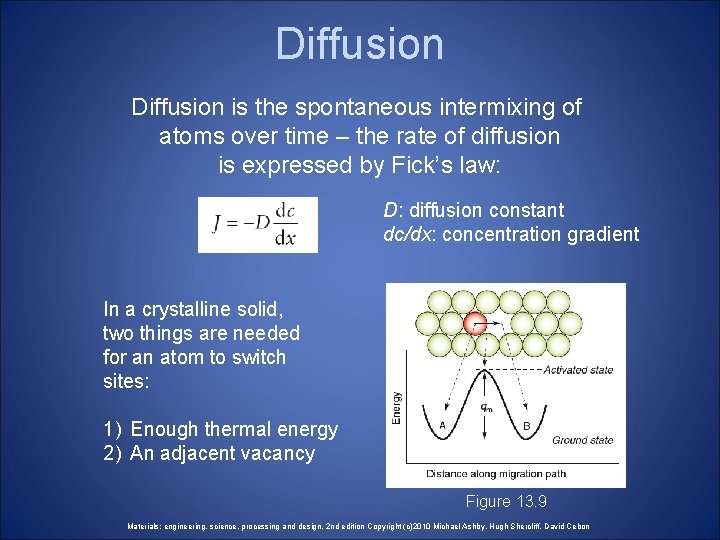
Diffusion is the spontaneous intermixing of atoms over time – the rate of diffusion is expressed by Fick’s law: D: diffusion constant dc/dx: concentration gradient In a crystalline solid, two things are needed for an atom to switch sites: 1) Enough thermal energy 2) An adjacent vacancy Figure 13. 9 Materials: engineering, science, processing and design, 2 nd edition Copyright (c)2010 Michael Ashby, Hugh Shercliff, David Cebon
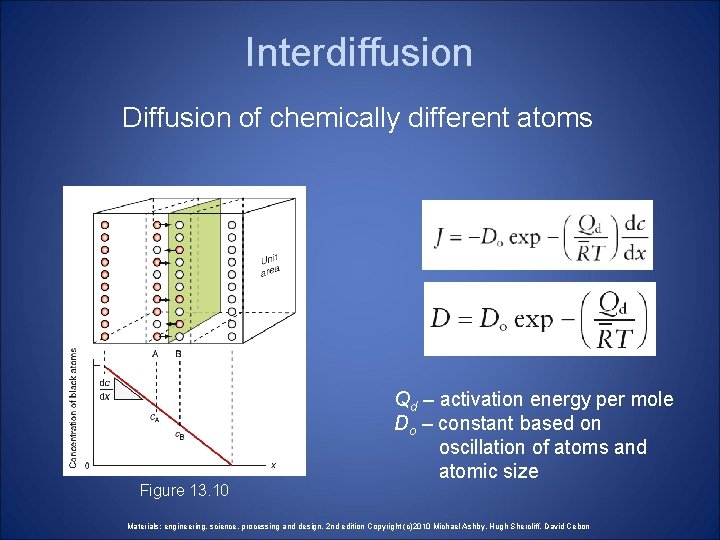
Interdiffusion Diffusion of chemically different atoms Figure 13. 10 Qd – activation energy per mole Do – constant based on oscillation of atoms and atomic size Materials: engineering, science, processing and design, 2 nd edition Copyright (c)2010 Michael Ashby, Hugh Shercliff, David Cebon
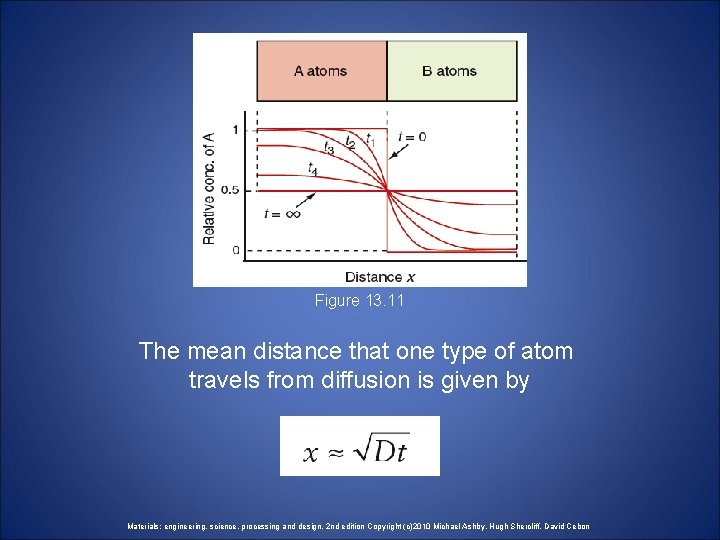
Figure 13. 11 The mean distance that one type of atom travels from diffusion is given by Materials: engineering, science, processing and design, 2 nd edition Copyright (c)2010 Michael Ashby, Hugh Shercliff, David Cebon
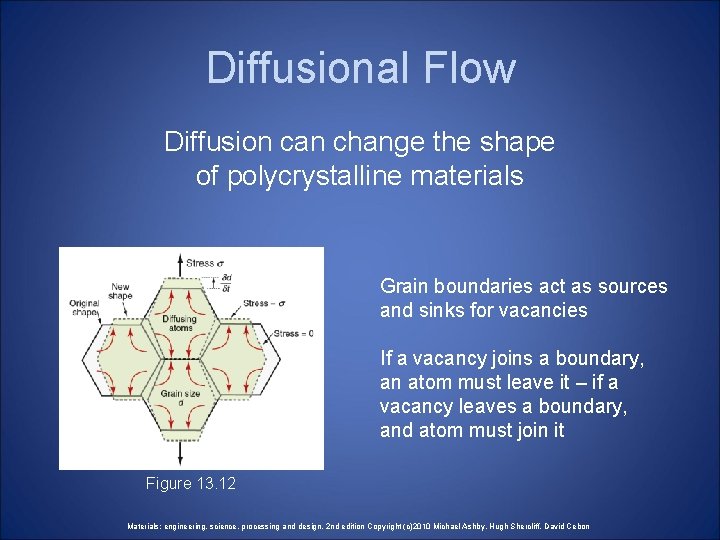
Diffusional Flow Diffusion can change the shape of polycrystalline materials Grain boundaries act as sources and sinks for vacancies If a vacancy joins a boundary, an atom must leave it – if a vacancy leaves a boundary, and atom must join it Figure 13. 12 Materials: engineering, science, processing and design, 2 nd edition Copyright (c)2010 Michael Ashby, Hugh Shercliff, David Cebon
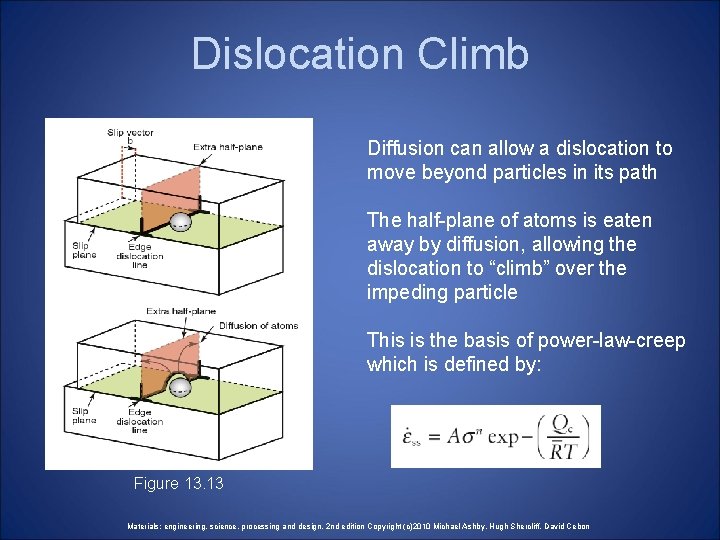
Dislocation Climb Diffusion can allow a dislocation to move beyond particles in its path The half-plane of atoms is eaten away by diffusion, allowing the dislocation to “climb” over the impeding particle This is the basis of power-law-creep which is defined by: Figure 13. 13 Materials: engineering, science, processing and design, 2 nd edition Copyright (c)2010 Michael Ashby, Hugh Shercliff, David Cebon
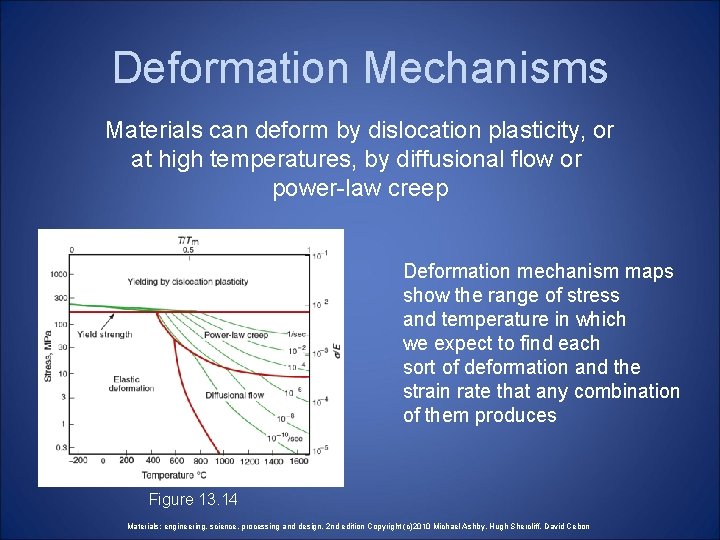
Deformation Mechanisms Materials can deform by dislocation plasticity, or at high temperatures, by diffusional flow or power-law creep Deformation mechanism maps show the range of stress and temperature in which we expect to find each sort of deformation and the strain rate that any combination of them produces Figure 13. 14 Materials: engineering, science, processing and design, 2 nd edition Copyright (c)2010 Michael Ashby, Hugh Shercliff, David Cebon
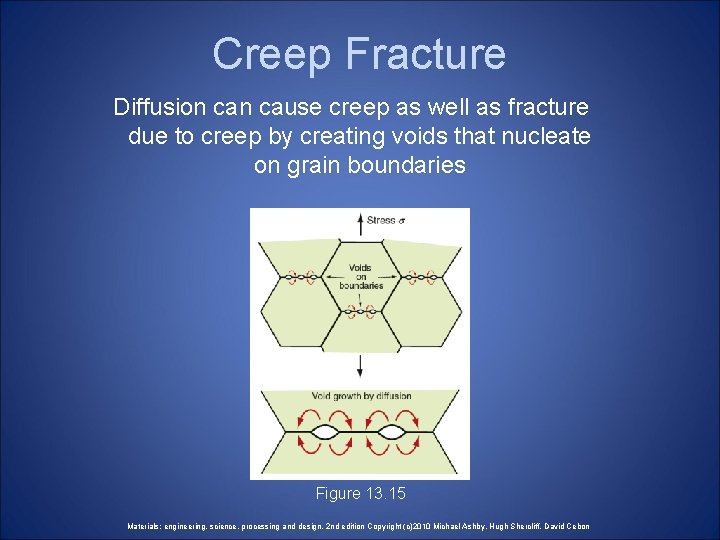
Creep Fracture Diffusion cause creep as well as fracture due to creep by creating voids that nucleate on grain boundaries Figure 13. 15 Materials: engineering, science, processing and design, 2 nd edition Copyright (c)2010 Michael Ashby, Hugh Shercliff, David Cebon
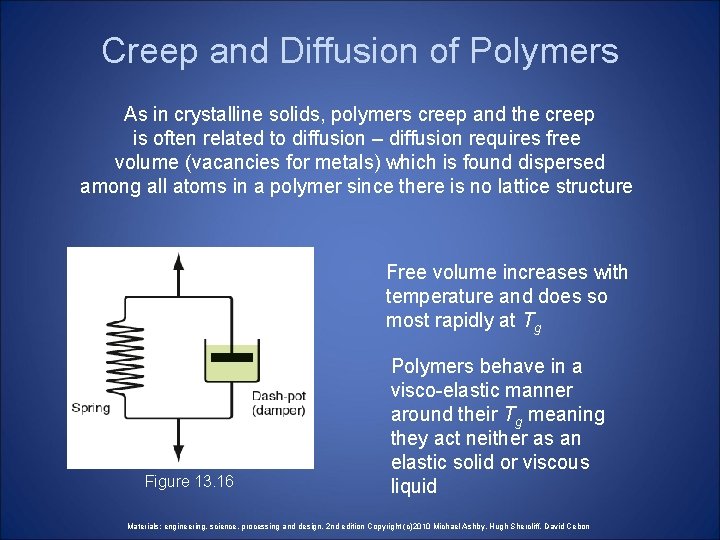
Creep and Diffusion of Polymers As in crystalline solids, polymers creep and the creep is often related to diffusion – diffusion requires free volume (vacancies for metals) which is found dispersed among all atoms in a polymer since there is no lattice structure Free volume increases with temperature and does so most rapidly at Tg Figure 13. 16 Polymers behave in a visco-elastic manner around their Tg meaning they act neither as an elastic solid or viscous liquid Materials: engineering, science, processing and design, 2 nd edition Copyright (c)2010 Michael Ashby, Hugh Shercliff, David Cebon
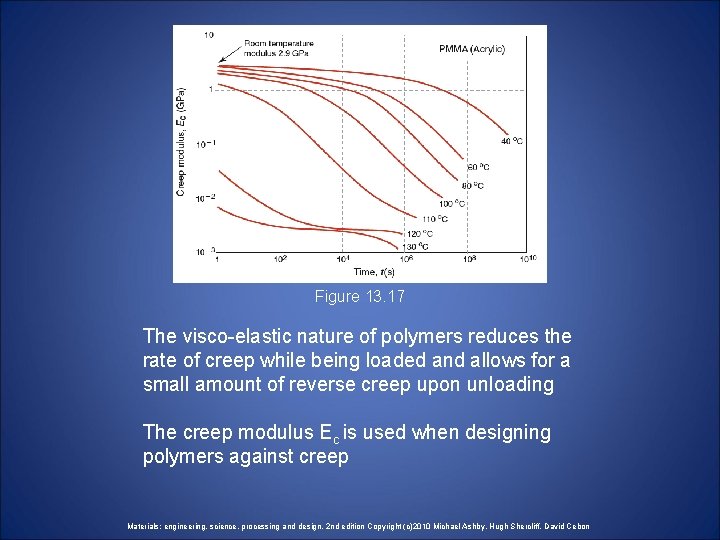
Figure 13. 17 The visco-elastic nature of polymers reduces the rate of creep while being loaded and allows for a small amount of reverse creep upon unloading The creep modulus Ec is used when designing polymers against creep Materials: engineering, science, processing and design, 2 nd edition Copyright (c)2010 Michael Ashby, Hugh Shercliff, David Cebon
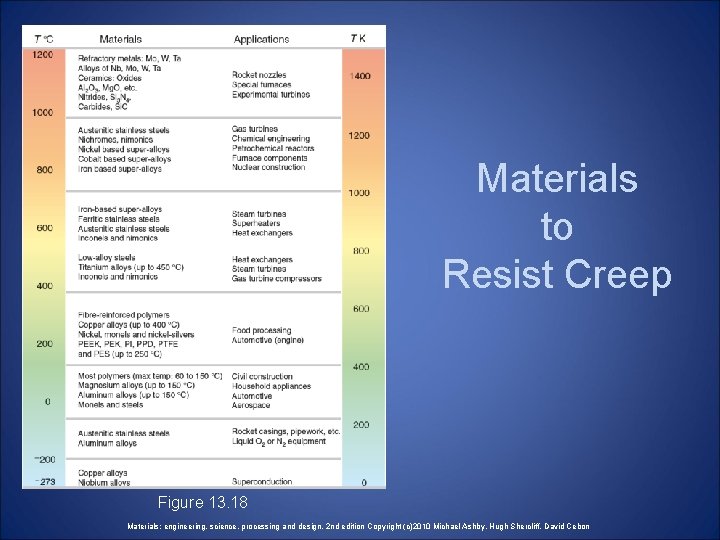
Materials to Resist Creep Figure 13. 18 Materials: engineering, science, processing and design, 2 nd edition Copyright (c)2010 Michael Ashby, Hugh Shercliff, David Cebon
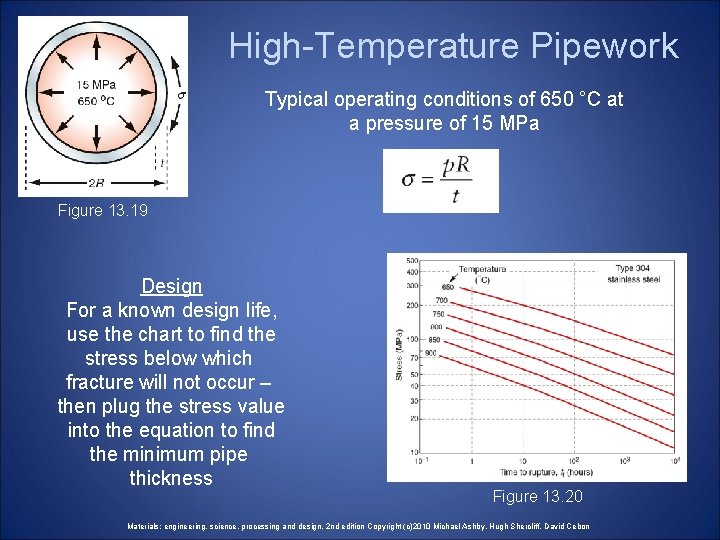
High-Temperature Pipework Typical operating conditions of 650 °C at a pressure of 15 MPa Figure 13. 19 Design For a known design life, use the chart to find the stress below which fracture will not occur – then plug the stress value into the equation to find the minimum pipe thickness Figure 13. 20 Materials: engineering, science, processing and design, 2 nd edition Copyright (c)2010 Michael Ashby, Hugh Shercliff, David Cebon
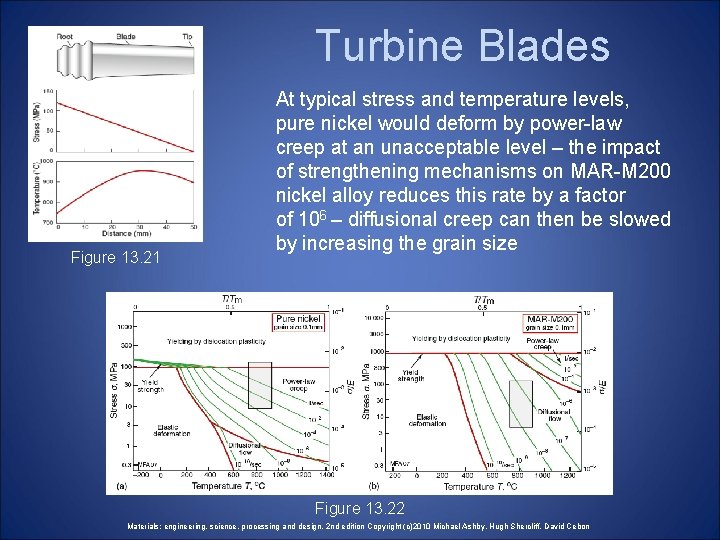
Turbine Blades Figure 13. 21 At typical stress and temperature levels, pure nickel would deform by power-law creep at an unacceptable level – the impact of strengthening mechanisms on MAR-M 200 nickel alloy reduces this rate by a factor of 106 – diffusional creep can then be slowed by increasing the grain size Figure 13. 22 Materials: engineering, science, processing and design, 2 nd edition Copyright (c)2010 Michael Ashby, Hugh Shercliff, David Cebon
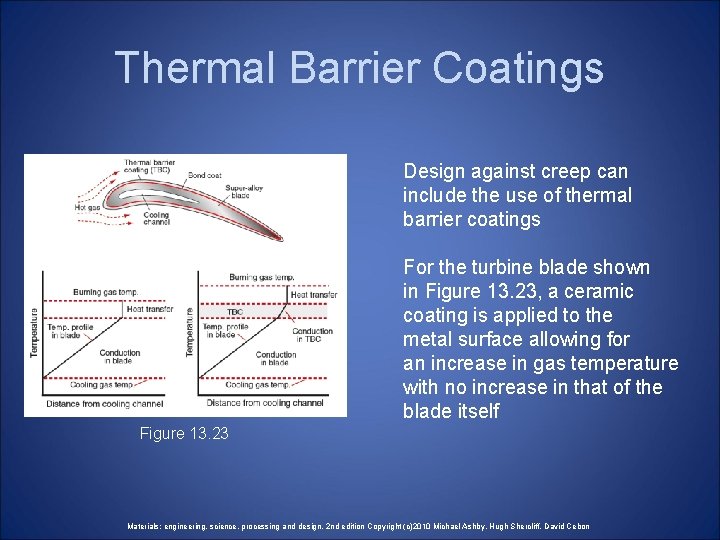
Thermal Barrier Coatings Design against creep can include the use of thermal barrier coatings For the turbine blade shown in Figure 13. 23, a ceramic coating is applied to the metal surface allowing for an increase in gas temperature with no increase in that of the blade itself Figure 13. 23 Materials: engineering, science, processing and design, 2 nd edition Copyright (c)2010 Michael Ashby, Hugh Shercliff, David Cebon
Airframes Aircraft flying above speeds of Mach 1 are subject to creep due to high temperatures and thermal expansion caused by the ΔT of the jet and the atmosphere Figure 13. 24 Material selection for this application has several potential limiting factors – a combination of tensile strength and high temperature performance is required, but weight often forces a material with lower than desired values to achieve optimal speed Figure 13. 25 Materials: engineering, science, processing and design, 2 nd edition Copyright (c)2010 Michael Ashby, Hugh Shercliff, David Cebon
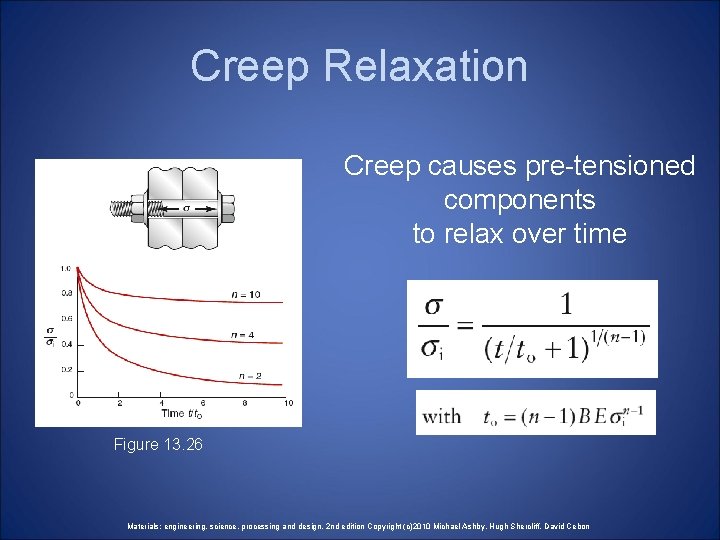
Creep Relaxation Creep causes pre-tensioned components to relax over time Figure 13. 26 Materials: engineering, science, processing and design, 2 nd edition Copyright (c)2010 Michael Ashby, Hugh Shercliff, David Cebon