
Materials Characterization Learning Objectives Identify compressive and tensile
Materials Characterization
Learning Objectives • Identify compressive and tensile forces • Identify brittle and ductile characteristics • Calculate the moment of inertia • Calculate the modulus of elasticity
Elasticity • When a material returns to its original shape after removing a stress • Example: rubber bands
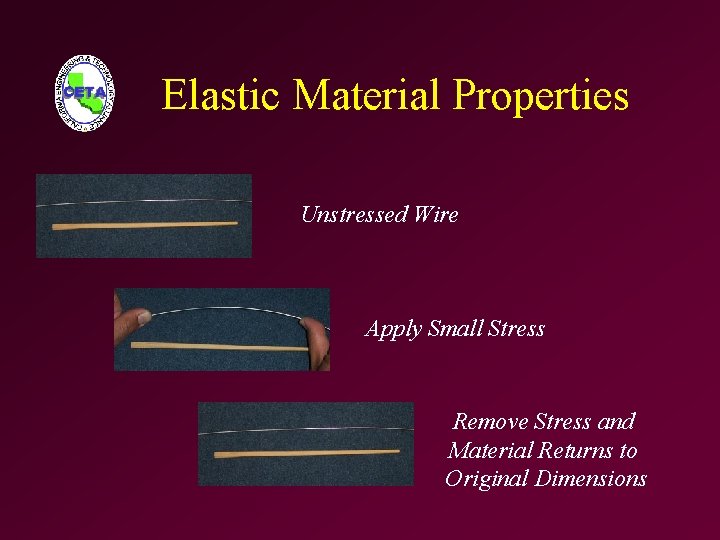
Elastic Material Properties Unstressed Wire Apply Small Stress Remove Stress and Material Returns to Original Dimensions
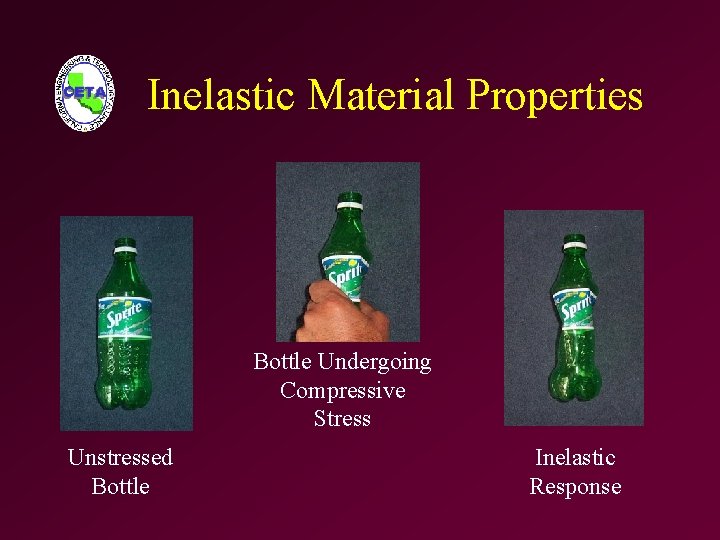
Inelastic Material Properties Bottle Undergoing Compressive Stress Unstressed Bottle Inelastic Response
Compression • Applied stress that squeezes the material • Example: compressive stresses can crush an aluminum can
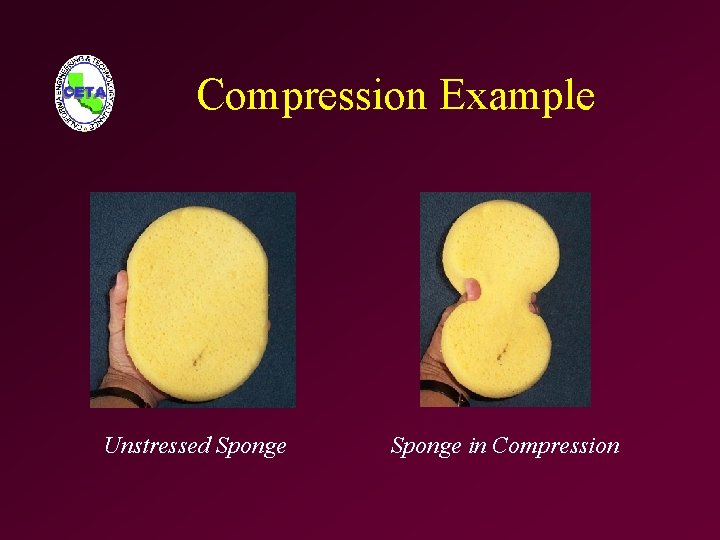
Compression Example Unstressed Sponge in Compression
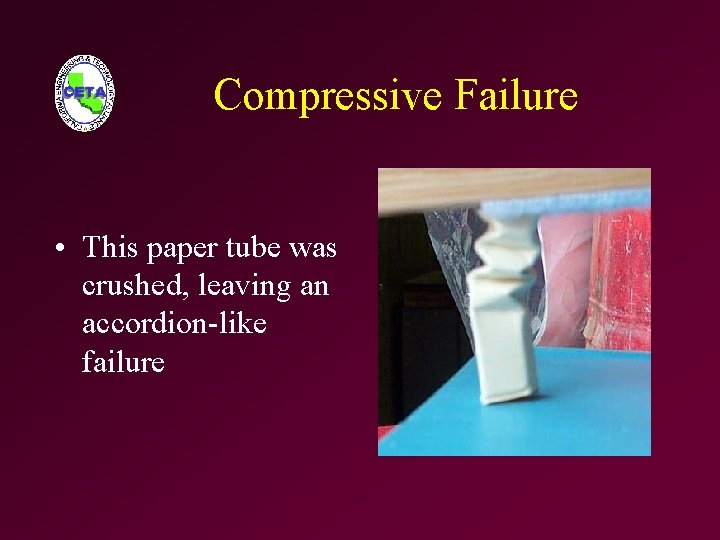
Compressive Failure • This paper tube was crushed, leaving an accordion-like failure
Tension • Applied stress that stretches a material • Example: tensile stresses will cause a rubber band to stretch
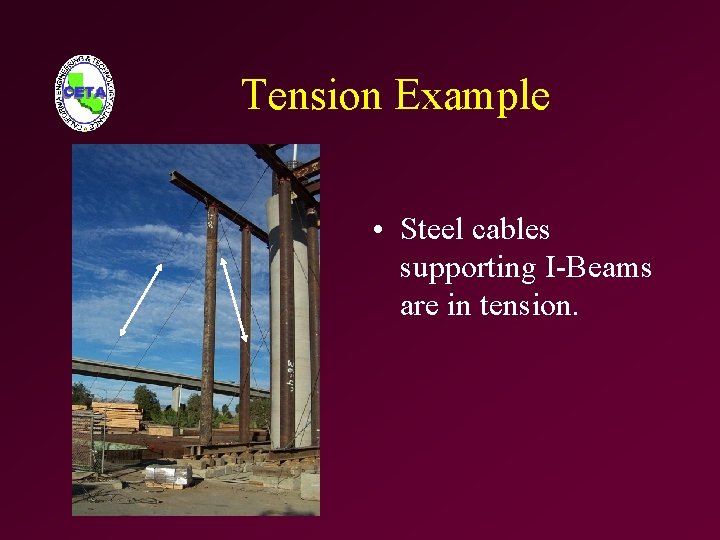
Tension Example • Steel cables supporting I-Beams are in tension.
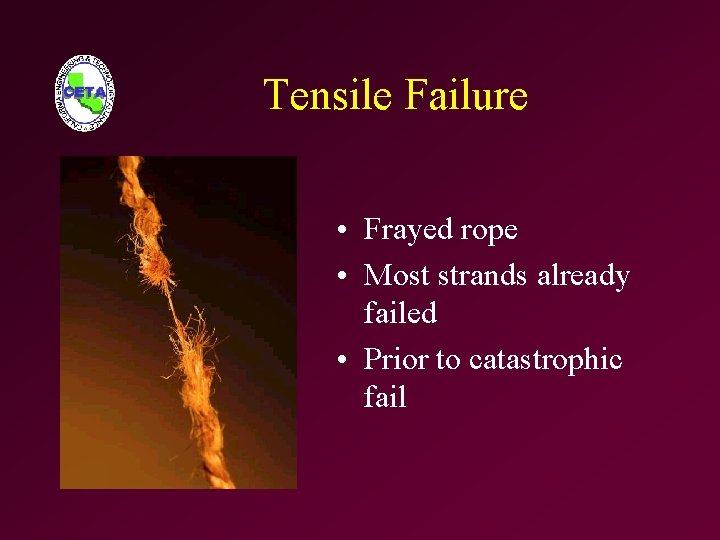
Tensile Failure • Frayed rope • Most strands already failed • Prior to catastrophic fail
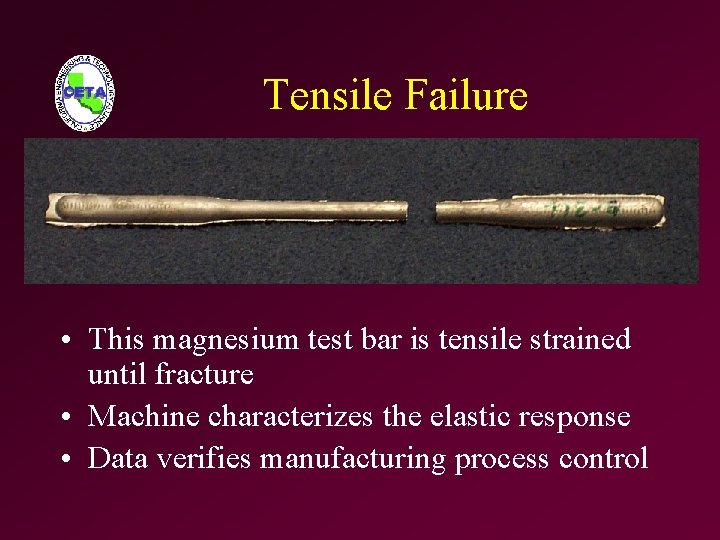
Tensile Failure • This magnesium test bar is tensile strained until fracture • Machine characterizes the elastic response • Data verifies manufacturing process control
Force Directions • AXIAL: an applied force along the length or axis of a material • TRANSVERSE: an applied force that causes bending or deflection
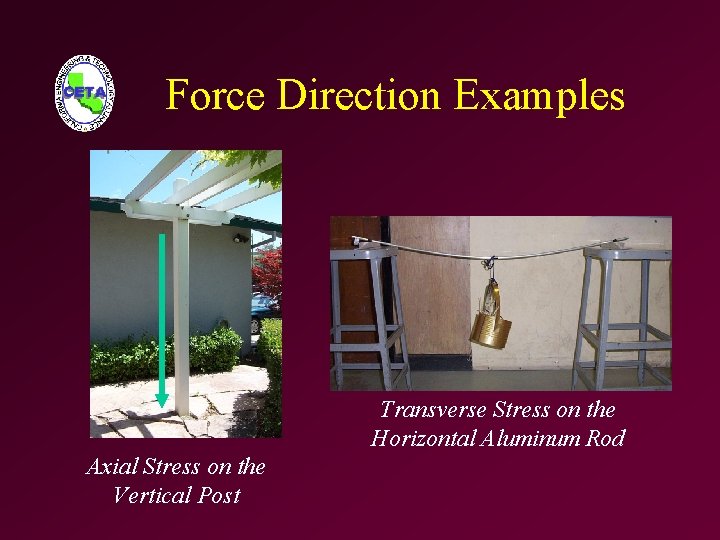
Force Direction Examples Transverse Stress on the Horizontal Aluminum Rod Axial Stress on the Vertical Post
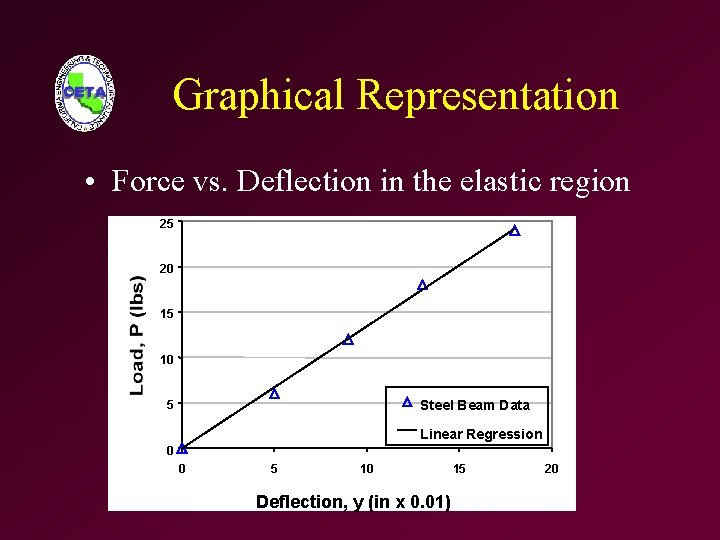
Graphical Representation • Force vs. Deflection in the elastic region 25 20 15 10 Steel Beam Data 5 Linear Regression 0 0 5 10 Deflection, y (in x 0. 01) 15 20
Yield Stress • The stress point where a member cannot take any more loading without failure or large amounts of deformation.
Ductile Response • Beyond the yield stress point, the material responds in a non-linear fashion with lots of deformation with little applied force • Example: metal beams
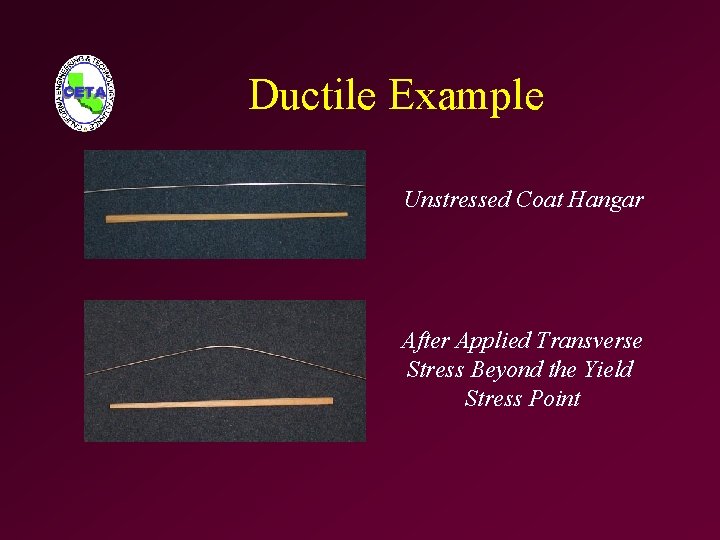
Ductile Example Unstressed Coat Hangar After Applied Transverse Stress Beyond the Yield Stress Point
Brittle Response • Just beyond the yield stress point, the material immediately fails • Example: plastics and wood
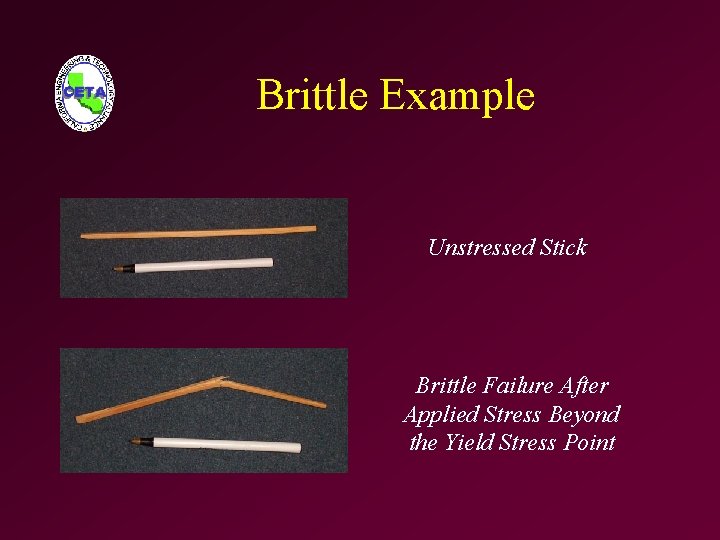
Brittle Example Unstressed Stick Brittle Failure After Applied Stress Beyond the Yield Stress Point
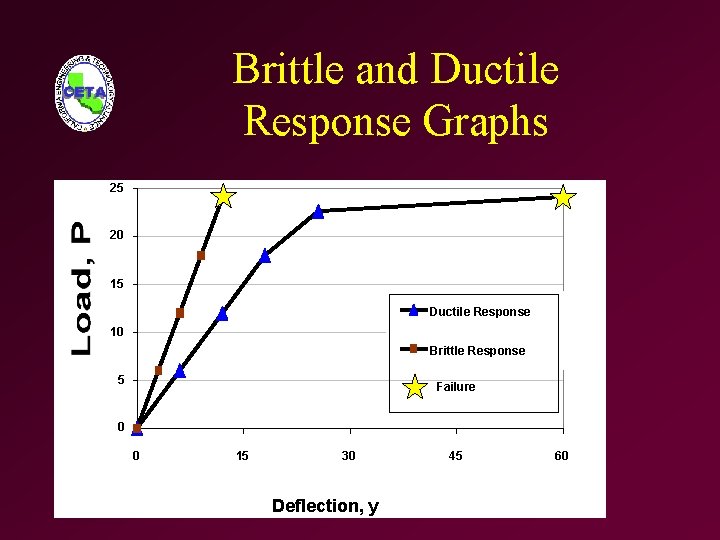
Brittle and Ductile Response Graphs 25 20 15 Ductile Response 10 Brittle Response 5 Failure 0 0 15 30 Deflection, y 45 60
Moment of Inertia • Quantifies the resistance to bending or buckling • Function of the cross-sectional area • Formulas can be found in literature • Units are in length 4 (in 4 or mm 4) • Symbol: I
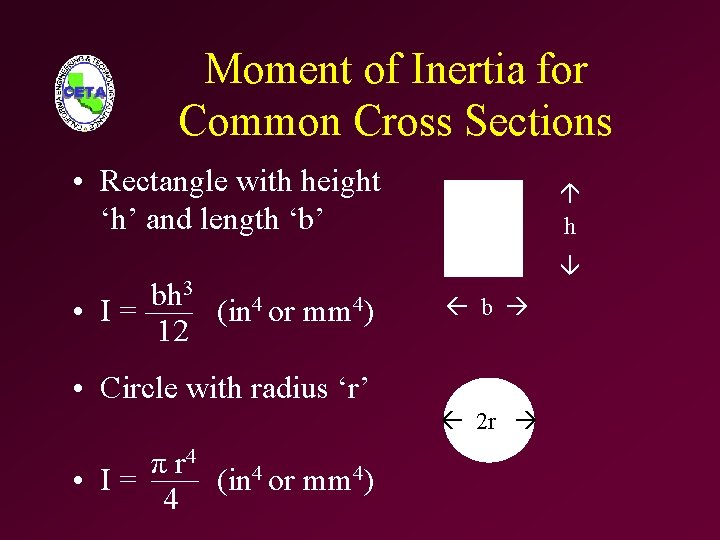
Moment of Inertia for Common Cross Sections h 3 bh • I = ____ (in 4 or mm 4) 12 • Rectangle with height ‘h’ and length ‘b’ b • Circle with radius ‘r’ 2 r 4 π r • I = ____ (in 4 or mm 4) 4
Modulus of Elasticity • Quantifies a material’s resistance to deformation • Constant for a material, independent of the material’s shape. • Units are in force / area. (PSI or N/m 2) • Symbol: E

Flexural Rigidity • Quantifies the stiffness of a material • Higher flexural rigidity = stiffer material • Product of the Modulus of Elasticity times the Moment of Inertia (E*I)
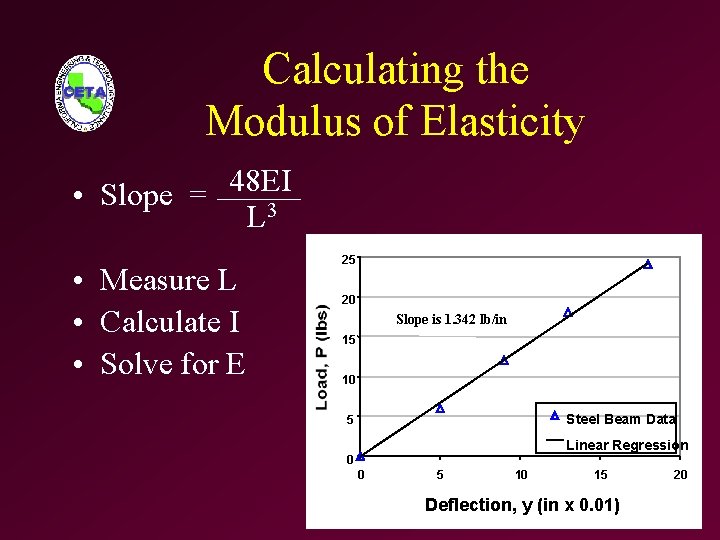
Calculating the Modulus of Elasticity • Slope = 48 EI _______ • Measure L • Calculate I • Solve for E L 3 25 20 Slope is 1. 342 lb/in 15 10 Steel Beam Data 5 Linear Regression 0 0 5 10 15 Deflection, y (in x 0. 01) 20
Acknowledgements • Many terms and the laboratory are based a paper titled A Simple Beam Test: Motivating High School Teachers to Develop Pre-Engineering Curricula, by Eric E. Matsumoto, John R. Johnson, Edward E. Dammel, and S. K. Ramesh of California State University, Sacramento.
- Slides: 27