
Material Science and Manufacturing ENGR 01283 PHYSICAL PROPERTIES
- Slides: 25
Material Science and Manufacturing ENGR 01283 PHYSICAL PROPERTIES OF MATERIALS 1. Volumetric and Melting Properties 2. Thermal Properties 3. Mass Diffusion 4. Electrical Properties 5. Electrochemical Properties
What are materials’ properties? Its (a) Mechanical properties and (b) Physical properties The properties are defined by material structure. Physical Properties are Properties that define the behavior of materials in response to physical forces other than mechanical. e. g. Volumetric, thermal, electrical, and electrochemical properties Electrical and magnetic properties - response to electrical and magnetic fields, conductivity, etc. Thermal properties are related to transmission of heat and heat capacity. Optical properties include absorption, transmission and scattering of light. Chemical properties how a material interacts with another material.
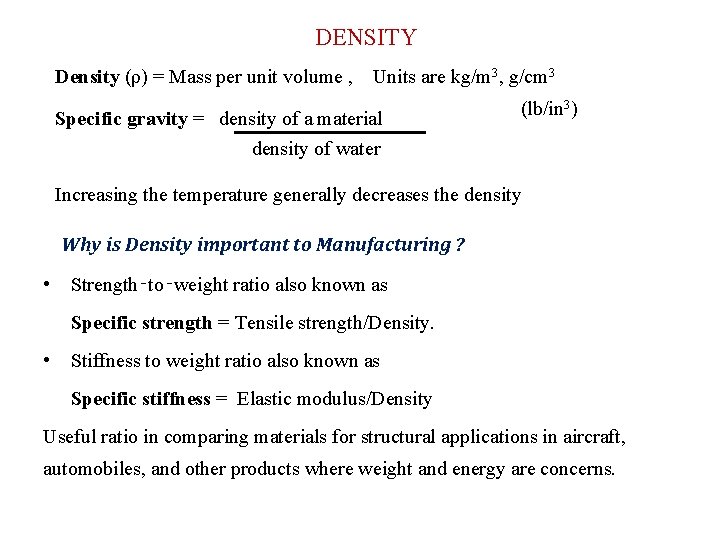
Can materials have same composition but possess different properties? Answer: Yes !!! • Examples: C – carbon can be in different modifications, e. g. graphite, diamond, Bucky ball. Components in a product must conduct electricity (or prevent conduction), allow heat to transfer (or allow its escape), transmit light (or block transmission), and satisfy many other functions
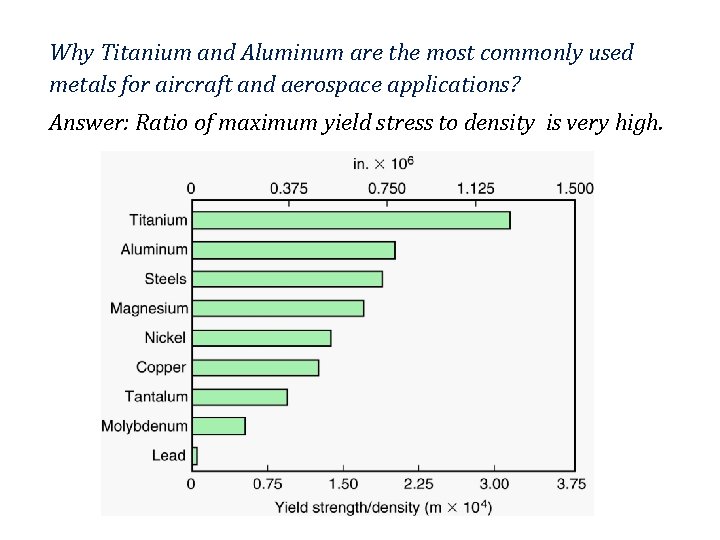
DENSITY Density (ρ) = Mass per unit volume , Units are kg/m 3, g/cm 3 Specific gravity = density of a material (lb/in 3) density of water Increasing the temperature generally decreases the density Why is Density important to Manufacturing ? • Strength‑to‑weight ratio also known as Specific strength = Tensile strength/Density. • Stiffness to weight ratio also known as Specific stiffness = Elastic modulus/Density Useful ratio in comparing materials for structural applications in aircraft, automobiles, and other products where weight and energy are concerns.
Why Titanium and Aluminum are the most commonly used metals for aircraft and aerospace applications? Answer: Ratio of maximum yield stress to density is very high.
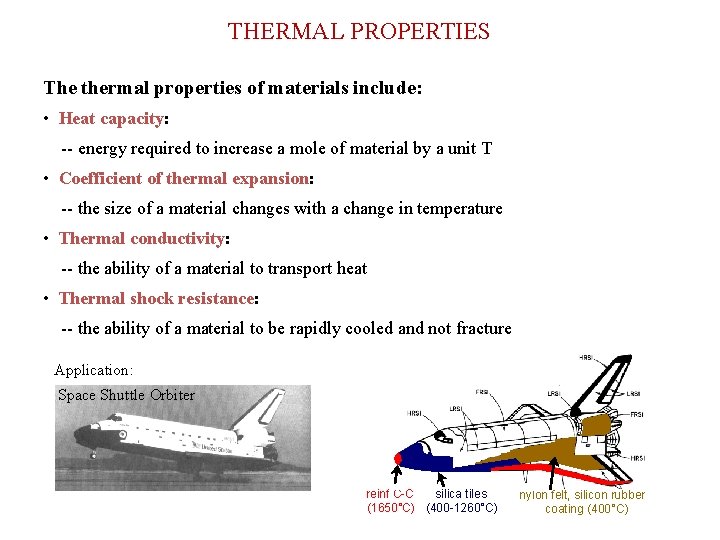
THERMAL PROPERTIES The thermal properties of materials include: • Heat capacity: -- energy required to increase a mole of material by a unit T • Coefficient of thermal expansion: -- the size of a material changes with a change in temperature • Thermal conductivity: -- the ability of a material to transport heat • Thermal shock resistance: -- the ability of a material to be rapidly cooled and not fracture Application: Space Shuttle Orbiter Re-entry T Distribution reinf C-C silica tiles (1650°C) (400 -1260°C) nylon felt, silicon rubber coating (400°C)
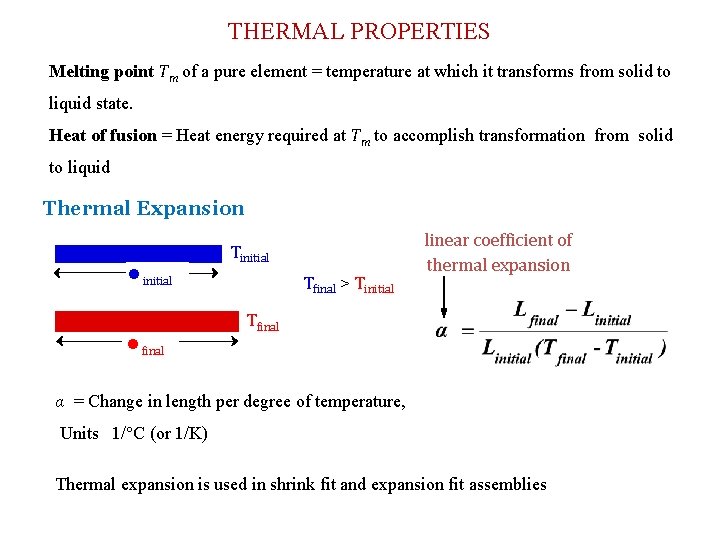
THERMAL PROPERTIES Melting point Tm of a pure element = temperature at which it transforms from solid to liquid state. Heat of fusion = Heat energy required at Tm to accomplish transformation from solid to liquid Thermal Expansion initial Tfinal > Tinitial linear coefficient of thermal expansion Tfinal α = Change in length per degree of temperature, Units 1/ C (or 1/K) Thermal expansion is used in shrink fit and expansion fit assemblies
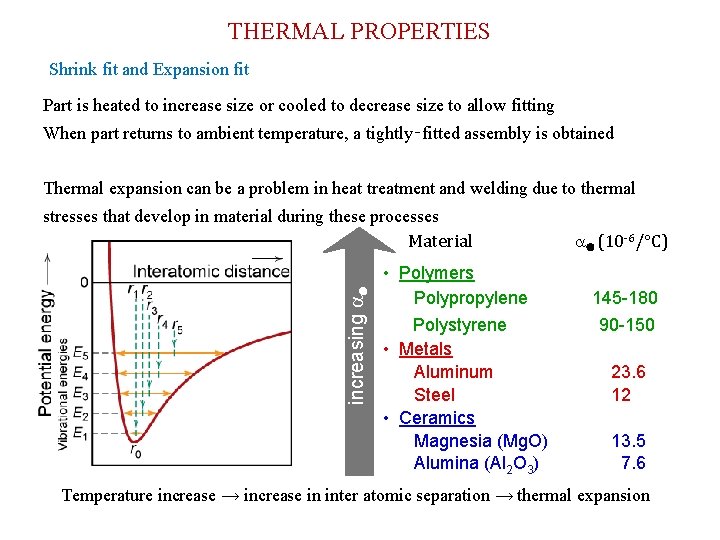
THERMAL PROPERTIES Shrink fit and Expansion fit Part is heated to increase size or cooled to decrease size to allow fitting When part returns to ambient temperature, a tightly‑fitted assembly is obtained Thermal expansion can be a problem in heat treatment and welding due to thermal increasing stresses that develop in material during these processes Material • Polymers Polypropylene Polystyrene • Metals Aluminum Steel • Ceramics Magnesia (Mg. O) Alumina (Al 2 O 3) (10 -6/ C) 145 -180 90 -150 23. 6 12 13. 5 7. 6 Temperature increase → increase in inter atomic separation → thermal expansion
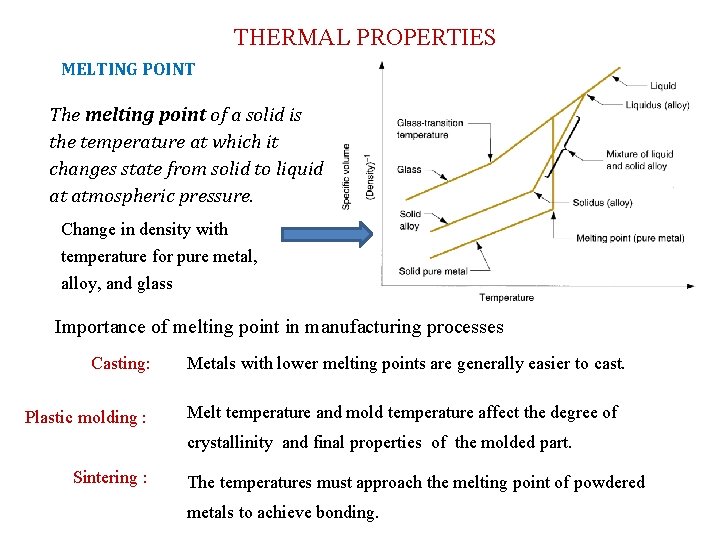
THERMAL PROPERTIES MELTING POINT The melting point of a solid is the temperature at which it changes state from solid to liquid at atmospheric pressure. Change in density with temperature for pure metal, alloy, and glass Importance of melting point in manufacturing processes Casting: Plastic molding : Metals with lower melting points are generally easier to cast. Melt temperature and mold temperature affect the degree of crystallinity and final properties of the molded part. Sintering : The temperatures must approach the melting point of powdered metals to achieve bonding.
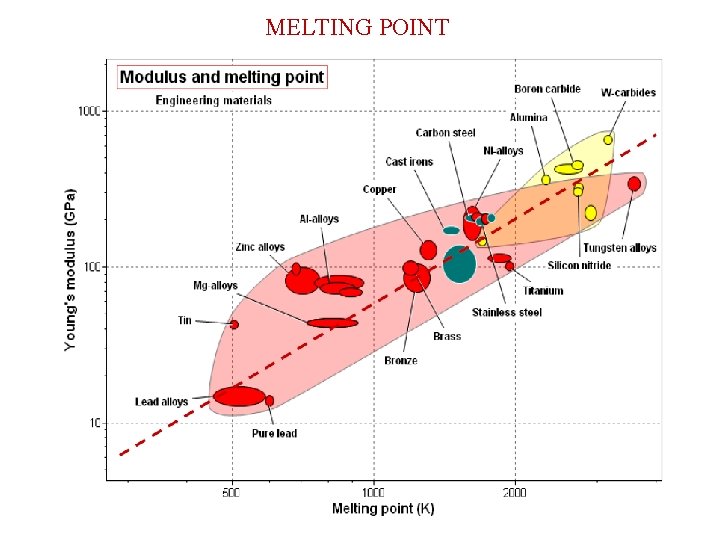
MELTING POINT
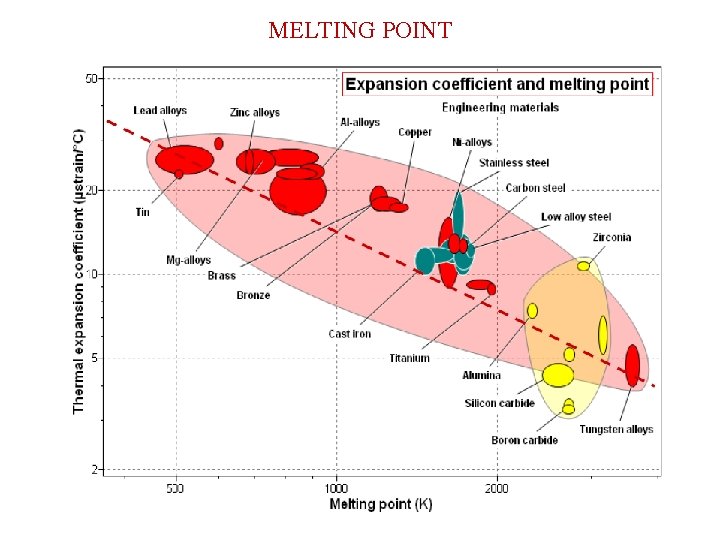
MELTING POINT
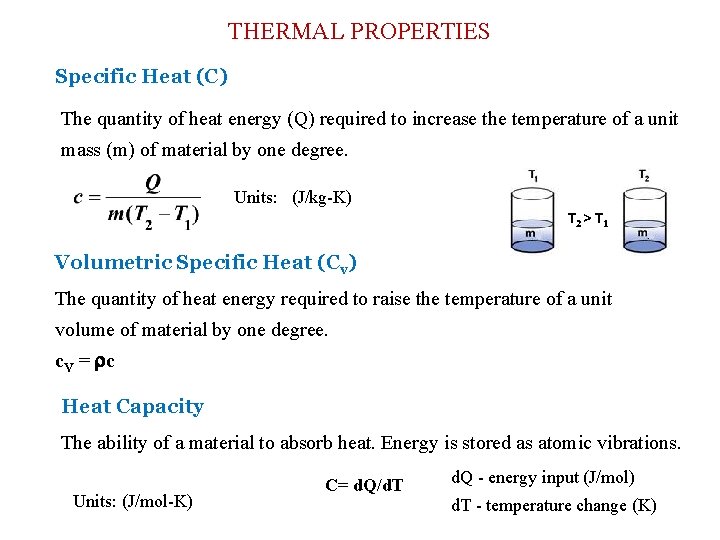
THERMAL PROPERTIES Specific Heat (C) The quantity of heat energy (Q) required to increase the temperature of a unit mass (m) of material by one degree. Units: (J/kg-K) T 2 > T 1 Volumetric Specific Heat (Cv) The quantity of heat energy required to raise the temperature of a unit volume of material by one degree. c. V = c Heat Capacity The ability of a material to absorb heat. Energy is stored as atomic vibrations. Units: (J/mol-K) C= d. Q/d. T d. Q - energy input (J/mol) d. T - temperature change (K)
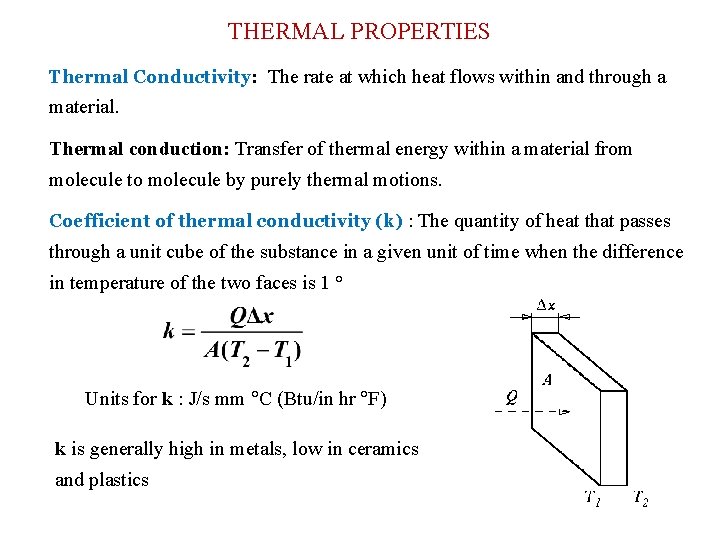
THERMAL PROPERTIES Thermal Conductivity: The rate at which heat flows within and through a material. Thermal conduction: Transfer of thermal energy within a material from molecule to molecule by purely thermal motions. Coefficient of thermal conductivity (k) : The quantity of heat that passes through a unit cube of the substance in a given unit of time when the difference in temperature of the two faces is 1 ° Units for k : J/s mm C (Btu/in hr F) k is generally high in metals, low in ceramics and plastics
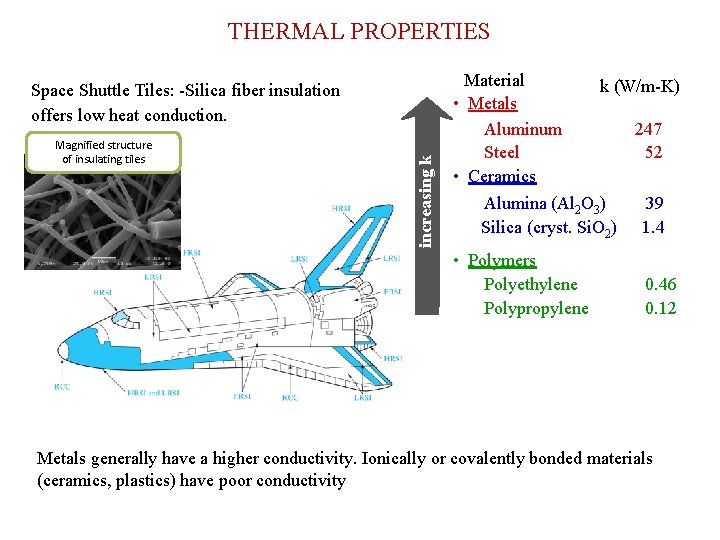
THERMAL PROPERTIES Magnified structure of insulating tiles increasing k Space Shuttle Tiles: -Silica fiber insulation offers low heat conduction. Material • Metals Aluminum Steel • Ceramics k (W/m-K) Alumina (Al 2 O 3) Silica (cryst. Si. O 2) • Polymers Polyethylene Polypropylene 247 52 39 1. 4 0. 46 0. 12 Metals generally have a higher conductivity. Ionically or covalently bonded materials (ceramics, plastics) have poor conductivity
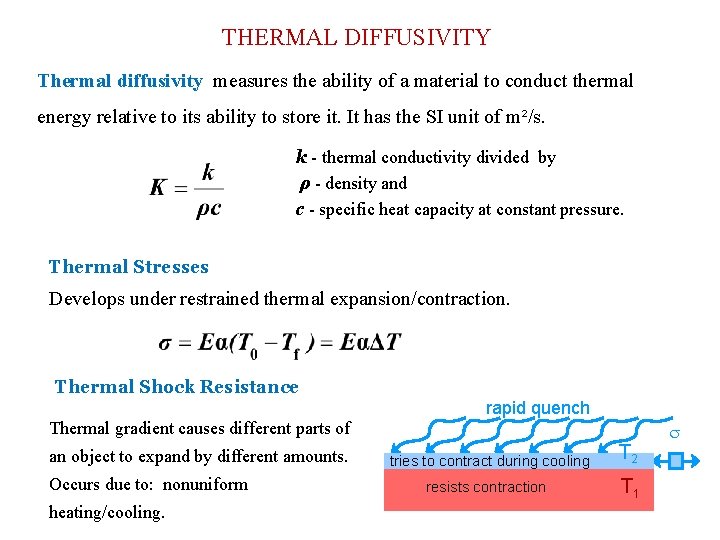
THERMAL DIFFUSIVITY Thermal diffusivity measures the ability of a material to conduct thermal energy relative to its ability to store it. It has the SI unit of m²/s. k - thermal conductivity divided by ρ - density and c - specific heat capacity at constant pressure. Thermal Stresses Develops under restrained thermal expansion/contraction. Thermal Shock Resistance rapid quench Thermal gradient causes different parts of an object to expand by different amounts. Occurs due to: nonuniform heating/cooling. tries to contract during cooling T 2 resists contraction T 1 s
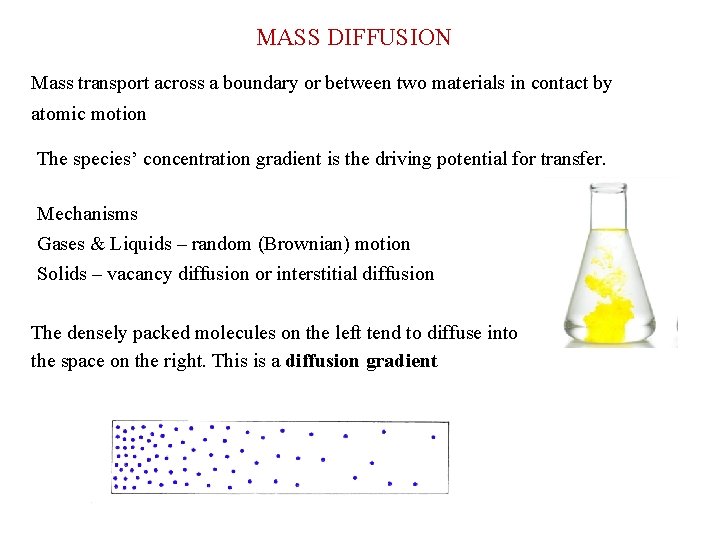
MASS DIFFUSION Mass transport across a boundary or between two materials in contact by atomic motion The species’ concentration gradient is the driving potential for transfer. Mechanisms Gases & Liquids – random (Brownian) motion Solids – vacancy diffusion or interstitial diffusion The densely packed molecules on the left tend to diffuse into the space on the right. This is a diffusion gradient
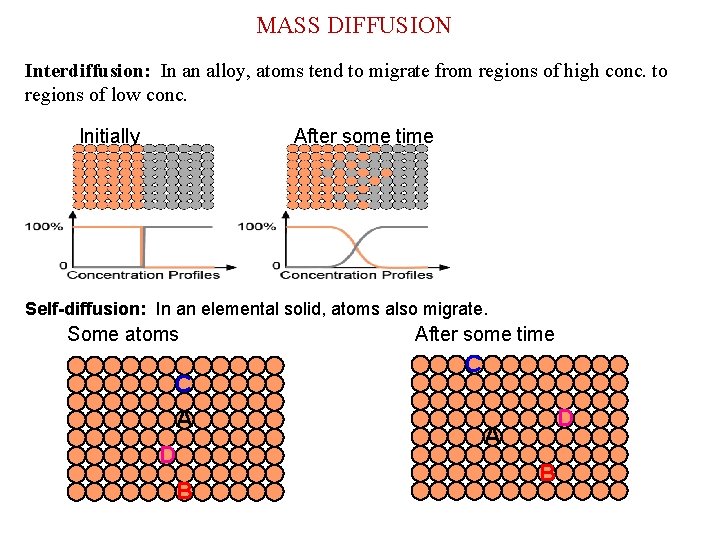
MASS DIFFUSION Interdiffusion: In an alloy, atoms tend to migrate from regions of high conc. to regions of low conc. Initially After some time Self-diffusion: In an elemental solid, atoms also migrate. Some atoms C A D B After some time C D A B
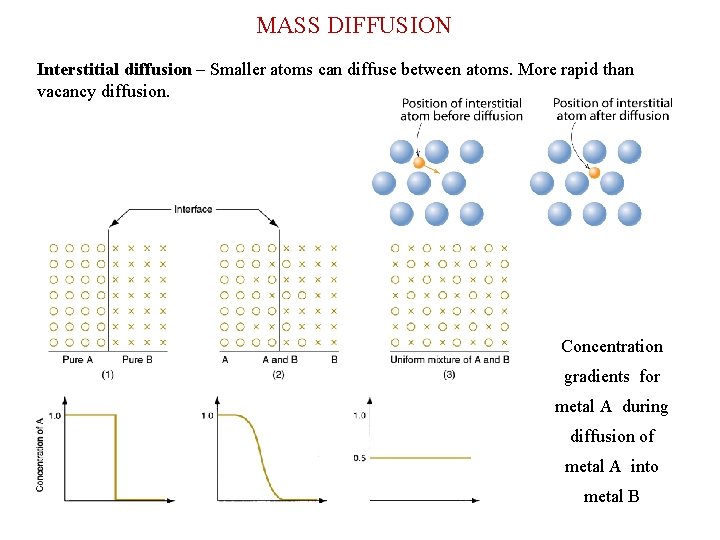
MASS DIFFUSION Interstitial diffusion – Smaller atoms can diffuse between atoms. More rapid than vacancy diffusion. Concentration gradients for metal A during diffusion of metal A into metal B
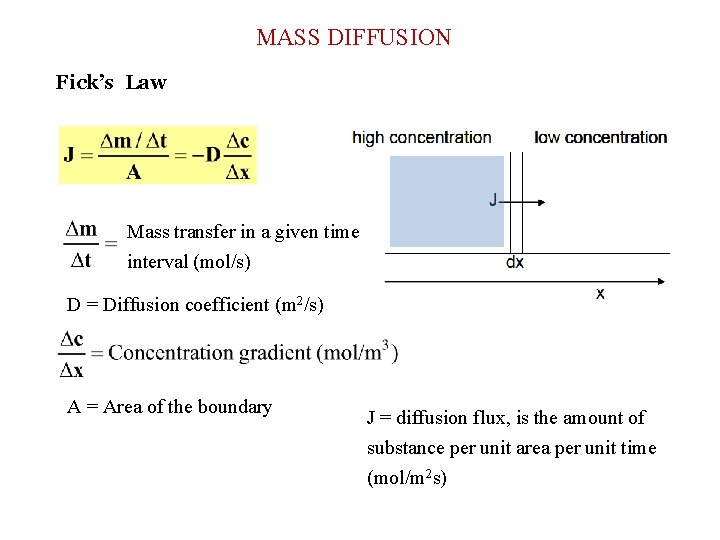
MASS DIFFUSION Fick’s Law Mass transfer in a given time interval (mol/s) D = Diffusion coefficient (m 2/s) A = Area of the boundary J = diffusion flux, is the amount of substance per unit area per unit time (mol/m 2 s)
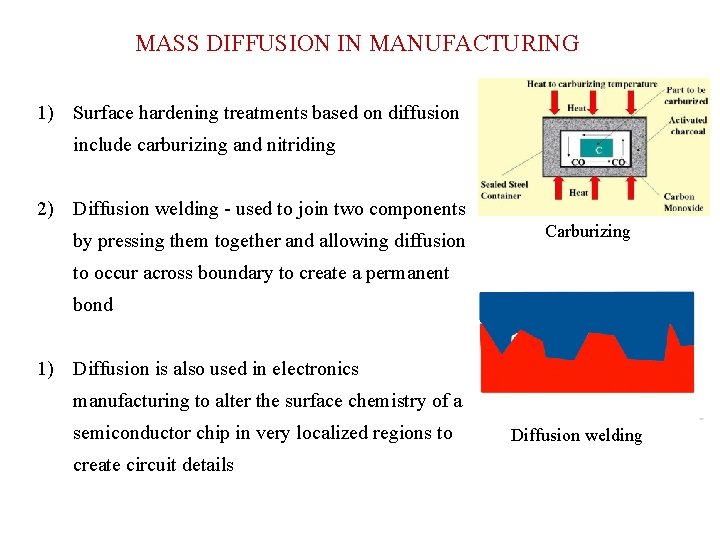
MASS DIFFUSION IN MANUFACTURING 1) Surface hardening treatments based on diffusion include carburizing and nitriding 2) Diffusion welding - used to join two components by pressing them together and allowing diffusion Carburizing to occur across boundary to create a permanent bond 1) Diffusion is also used in electronics manufacturing to alter the surface chemistry of a semiconductor chip in very localized regions to create circuit details Diffusion welding
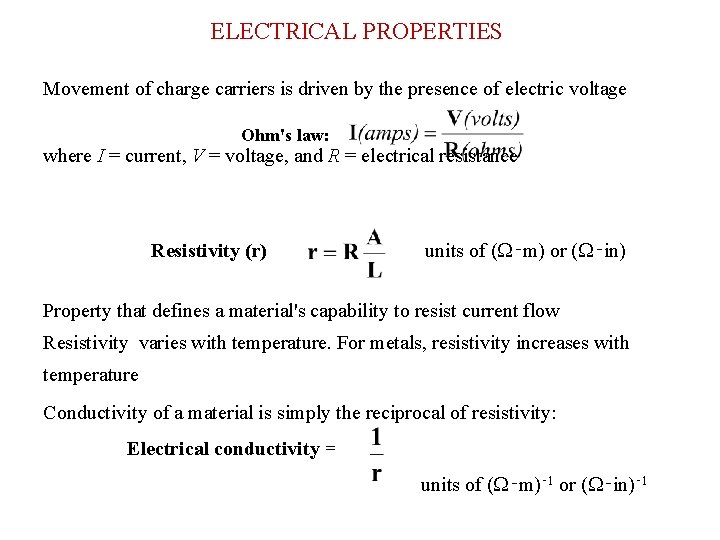
ELECTRICAL PROPERTIES Movement of charge carriers is driven by the presence of electric voltage Ohm's law: where I = current, V = voltage, and R = electrical resistance Resistivity (r) units of ( ‑m) or ( ‑in) Property that defines a material's capability to resist current flow Resistivity varies with temperature. For metals, resistivity increases with temperature Conductivity of a material is simply the reciprocal of resistivity: Electrical conductivity = units of ( ‑m)‑ 1 or ( ‑in)‑ 1
ELECTRICAL PROPERTIES Metals are the best conductors of electricity , because of their metallic bonding Metallic bonds are made from a lattice of ions in a 'cloud' of free electrons. Ceramics and Polymers are poor conductors, whose electrons are tightly bound by covalent and/or ionic bonding. Some of them with high resistivities are used as insulators. Semiconductors are material whose resistivity lies between insulators and conductors Electric discharge machining (EDM)- Uses electrical energy in the form of sparks to remove material from metals. Arc welding and Resistance spot welding, use electrical energy to melt the joint metal.
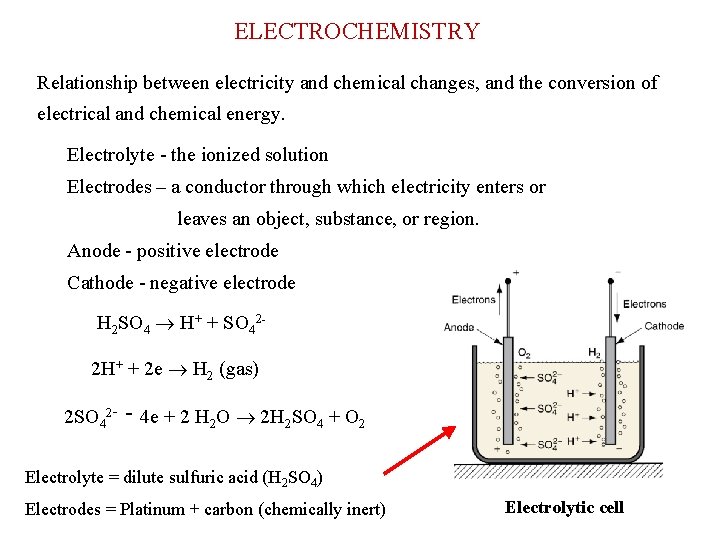
ELECTROCHEMISTRY Relationship between electricity and chemical changes, and the conversion of electrical and chemical energy. Electrolyte - the ionized solution Electrodes – a conductor through which electricity enters or leaves an object, substance, or region. Anode - positive electrode Cathode - negative electrode H 2 SO 4 H+ + SO 422 H+ + 2 e H 2 (gas) 2 SO 42 - ‑ 4 e + 2 H 2 O 2 H 2 SO 4 + O 2 Electrolyte = dilute sulfuric acid (H 2 SO 4) Electrodes = Platinum + carbon (chemically inert) Electrolytic cell
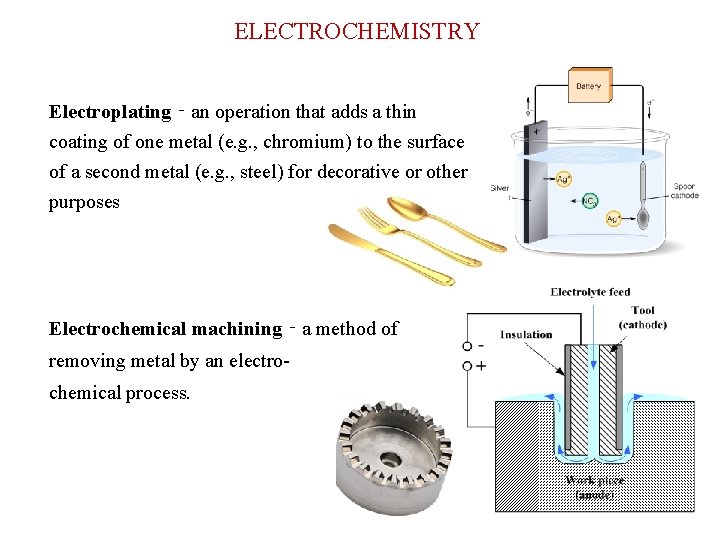
ELECTROCHEMISTRY Electroplating ‑ an operation that adds a thin coating of one metal (e. g. , chromium) to the surface of a second metal (e. g. , steel) for decorative or other purposes Electrochemical machining ‑ a method of removing metal by an electrochemical process.
The properties are defined by material structure! Material structure describes the arrangement of atoms or ions in material and profoundly influences the material properties. Which factor in machining affects tool life ? Thermal properties of the work material - Cutting Temperature Do most alloys have a single melting point like pure metals No Melting begins at a temperature called the solidus and continues until a temperature called the liquidus.