
Material Properties Atomic Structure determines n n Physical
- Slides: 35
Material Properties Atomic Structure determines: n n Physical Properties Chemical Properties Biological Properties Electromagnetic Properties CE 336
Physical Properties Density Permeability Mass Moisture content susceptibility Structure CE 336
Physical Properties Specific gravity Color Texture Shape CE 336
Chemical Properties Resistance to deterioration n Oxidation n Solubility CE 336
Biological Properties Bacterial growth Hazard/exposure consideration Resistance to infestation Biodegradability CE 336
Electromagnetic Properties Conductance Galvanic potential CE 336
Material Selection Strength Serviceability Deflections Adaptability to future Durability CE 336
Material and Testing Standards ASTM /ASME Standards AASHTO, State Highway, EPA, HUD, US-Army BOCA, ICBO, ICC, ISO AISC/ACI/AITC n n n minimum quality standards, minimum application standards Some may be performance standards CE 336
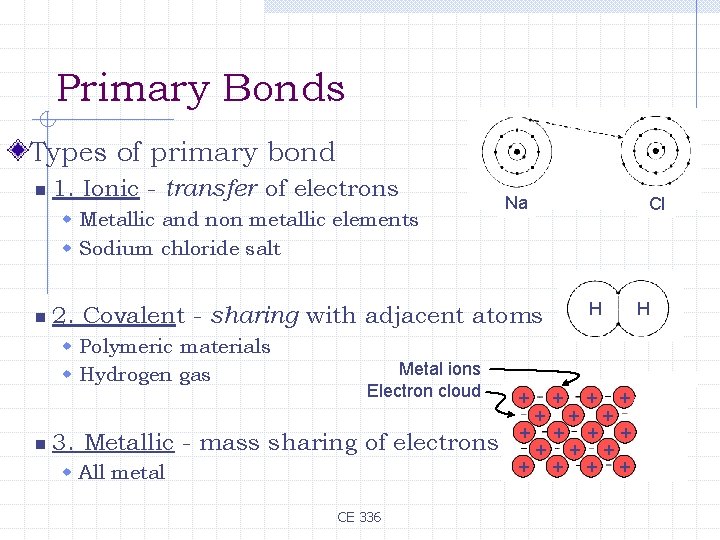
Primary Bonds Types of primary bond n 1. Ionic - transfer of electrons w Metallic and non metallic elements w Sodium chloride salt n Cl H 2. Covalent - sharing with adjacent atoms w Polymeric materials w Hydrogen gas n Na Metal ions Electron cloud 3. Metallic - mass sharing of electrons + + + w All metal CE 336 + + + + + H + + +
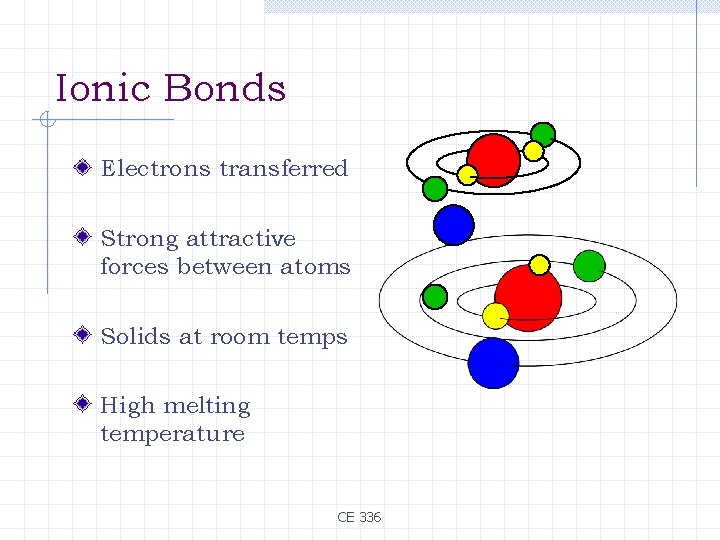
Ionic Bonds Electrons transferred Strong attractive forces between atoms Solids at room temps High melting temperature CE 336
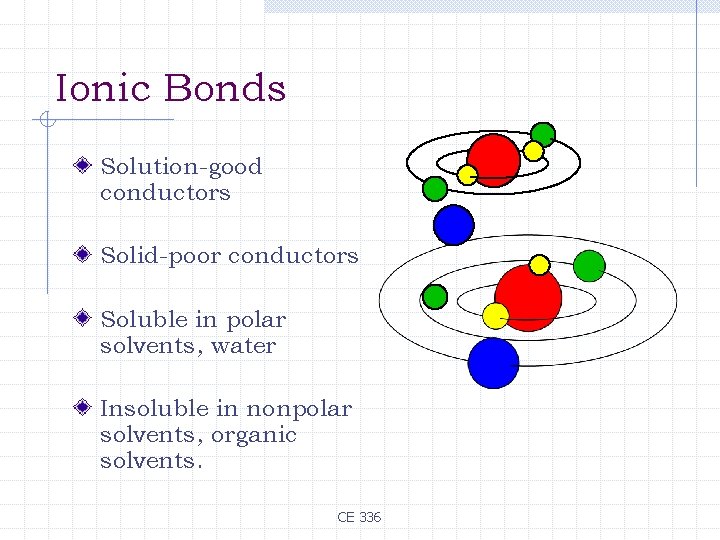
Ionic Bonds Solution-good conductors Solid-poor conductors Soluble in polar solvents, water Insoluble in nonpolar solvents, organic solvents. CE 336
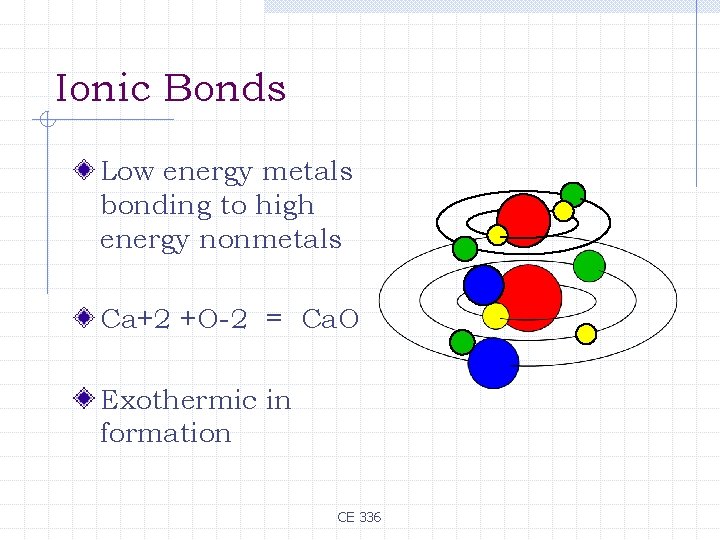
Ionic Bonds Low energy metals bonding to high energy nonmetals Ca+2 +O-2 = Ca. O Exothermic in formation CE 336
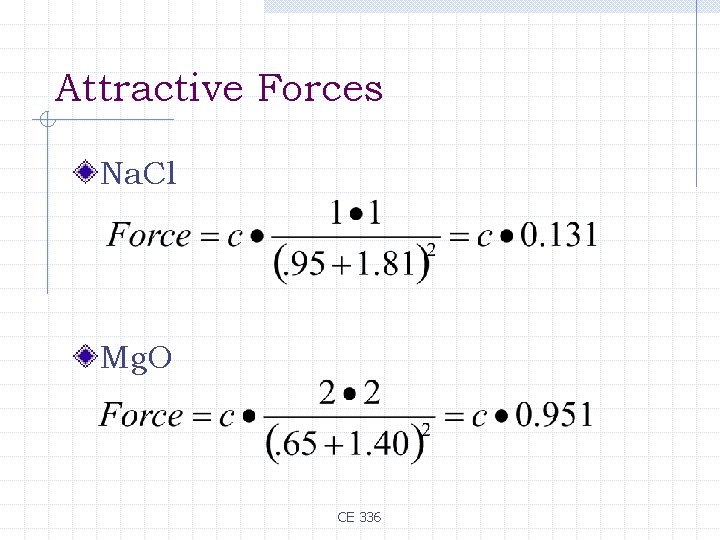
Attractive Forces Na. Cl Mg. O CE 336
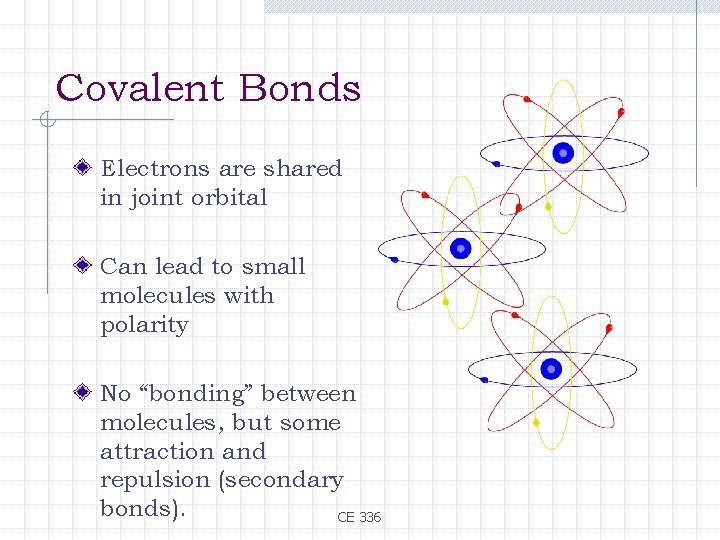
Covalent Bonds Electrons are shared in joint orbital Can lead to small molecules with polarity No “bonding” between molecules, but some attraction and repulsion (secondary bonds). CE 336
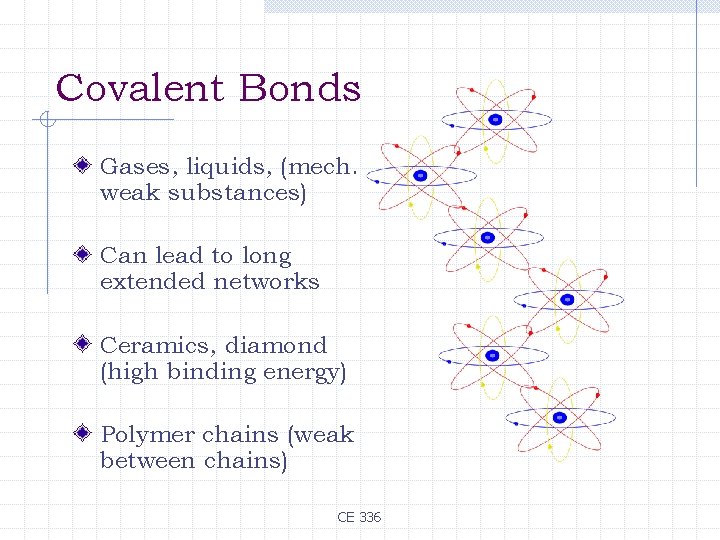
Covalent Bonds Gases, liquids, (mech. weak substances) Can lead to long extended networks Ceramics, diamond (high binding energy) Polymer chains (weak between chains) CE 336
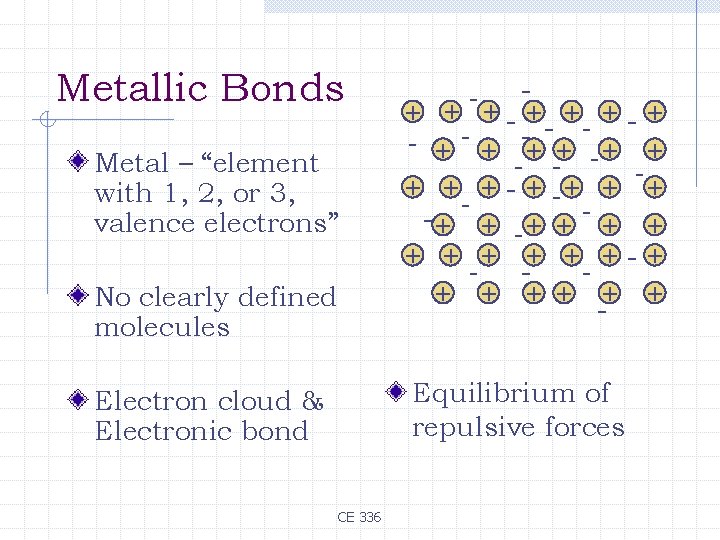
Metallic Bonds Metal – “element with 1, 2, or 3, valence electrons” + + + + + + + + + No clearly defined molecules + + + Equilibrium of repulsive forces Electron cloud & Electronic bond CE 336
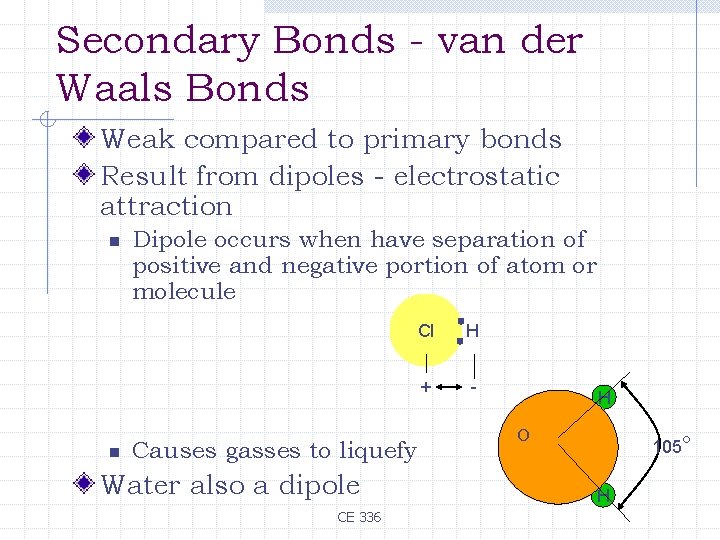
Secondary Bonds - van der Waals Bonds Weak compared to primary bonds Result from dipoles - electrostatic attraction n n Dipole occurs when have separation of positive and negative portion of atom or molecule Causes gasses to liquefy Water also a dipole CE 336 Cl H + - H O 105° H
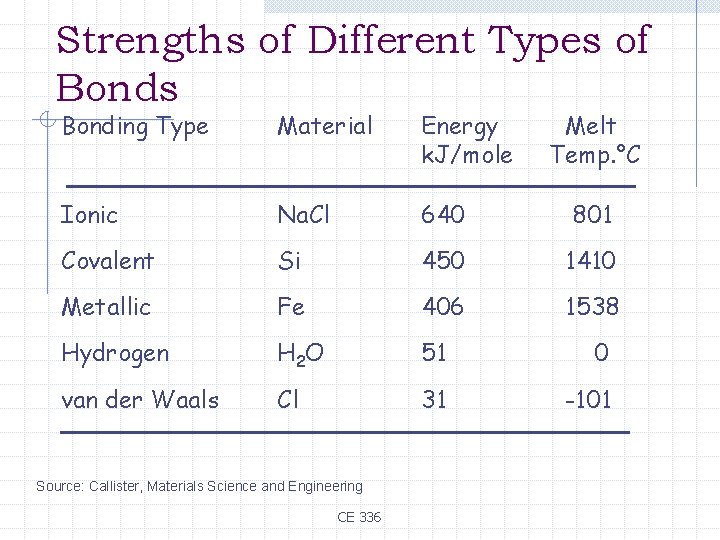
Strengths of Different Types of Bonds Bonding Type Material Energy k. J/mole Ionic Na. Cl 640 801 Covalent Si 450 1410 Metallic Fe 406 1538 Hydrogen H 2 O 51 0 van der Waals Cl 31 -101 Source: Callister, Materials Science and Engineering CE 336 Melt Temp. °C
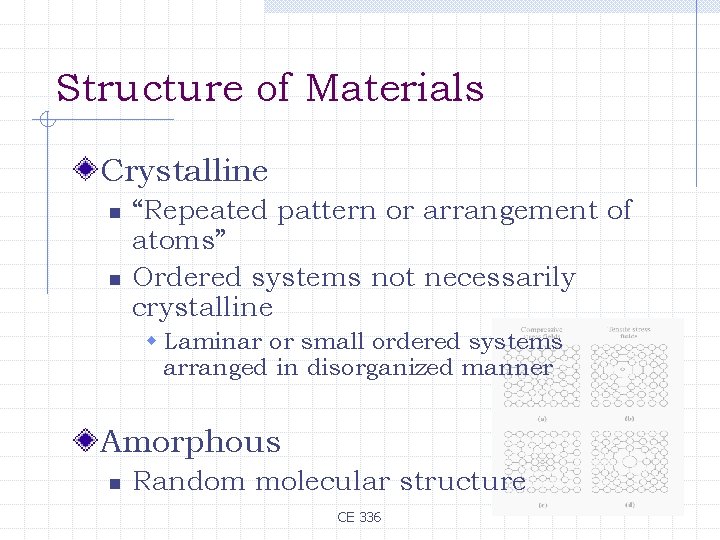
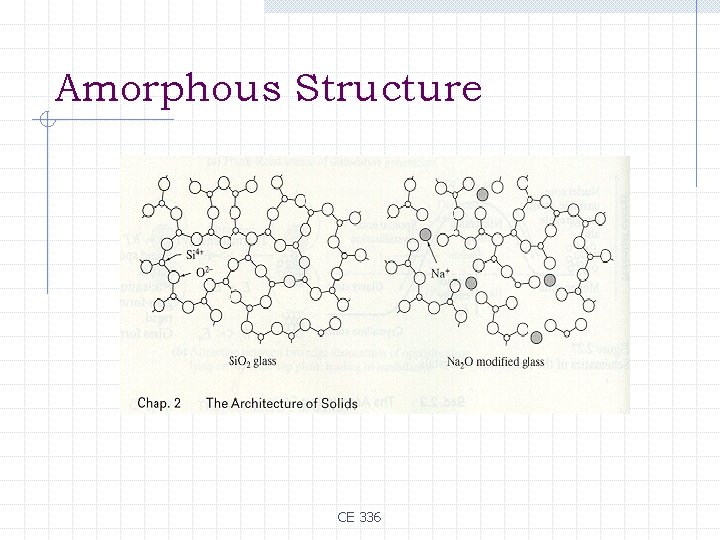
Structure of Materials Crystalline n n “Repeated pattern or arrangement of atoms” Ordered systems not necessarily crystalline w Laminar or small ordered systems arranged in disorganized manner Amorphous n Random molecular structure CE 336
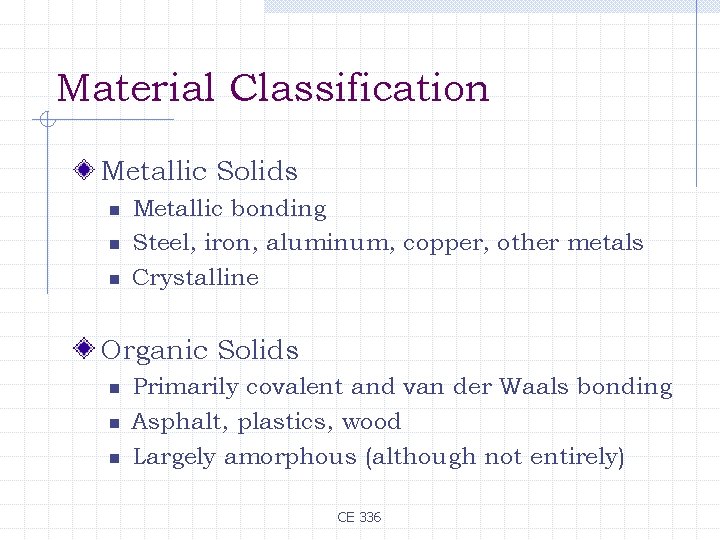
Material Classification Metallic Solids n n n Metallic bonding Steel, iron, aluminum, copper, other metals Crystalline Organic Solids n n n Primarily covalent and van der Waals bonding Asphalt, plastics, wood Largely amorphous (although not entirely) CE 336
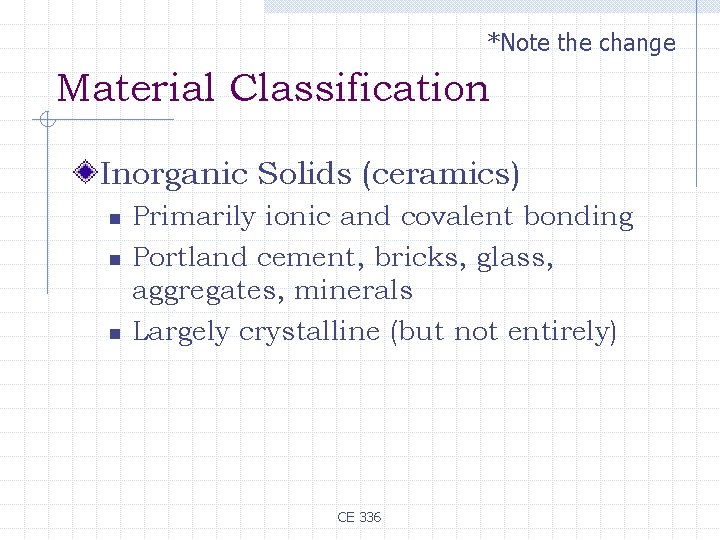
*Note the change Material Classification Inorganic Solids (ceramics) n n n Primarily ionic and covalent bonding Portland cement, bricks, glass, aggregates, minerals Largely crystalline (but not entirely) CE 336
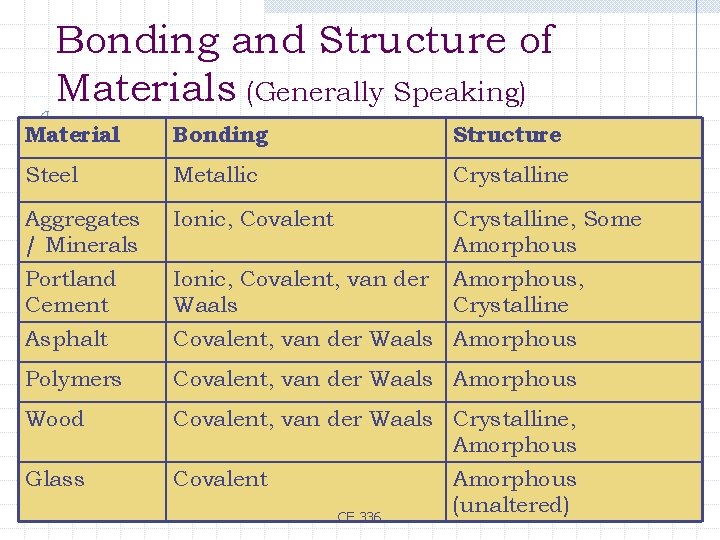
Bonding and Structure of Materials (Generally Speaking) Material Bonding Structure Steel Metallic Crystalline Aggregates / Minerals Ionic, Covalent Crystalline, Some Amorphous Portland Cement Ionic, Covalent, van der Waals Amorphous, Crystalline Asphalt Covalent, van der Waals Amorphous Polymers Covalent, van der Waals Amorphous Wood Covalent, van der Waals Crystalline, Amorphous Glass Covalent CE 336 Amorphous (unaltered)
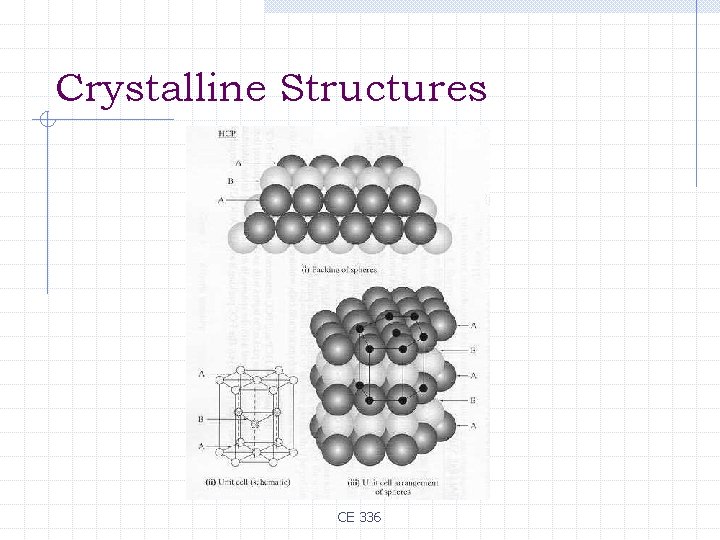
Crystalline Structures CE 336
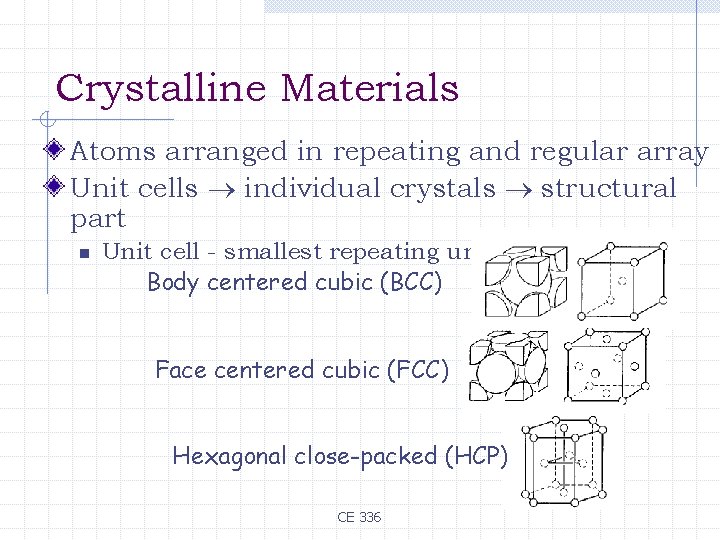
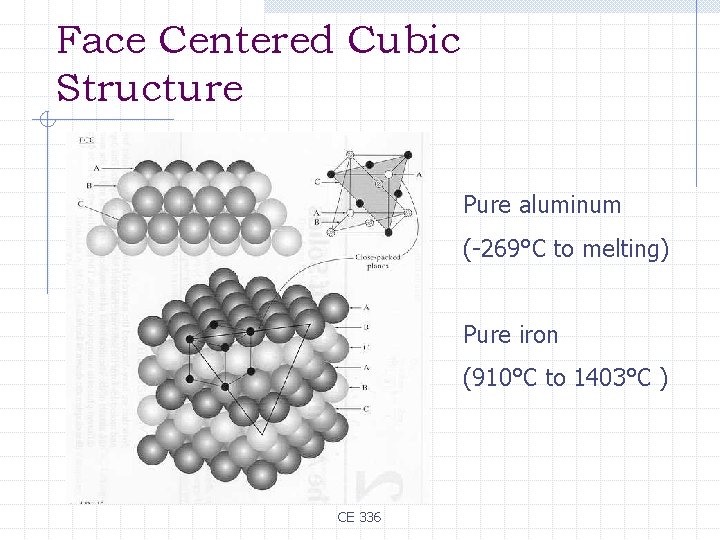
Crystalline Materials Atoms arranged in repeating and regular array Unit cells ® individual crystals ® structural part n Unit cell - smallest repeating unit Body centered cubic (BCC) Face centered cubic (FCC) Hexagonal close-packed (HCP) CE 336
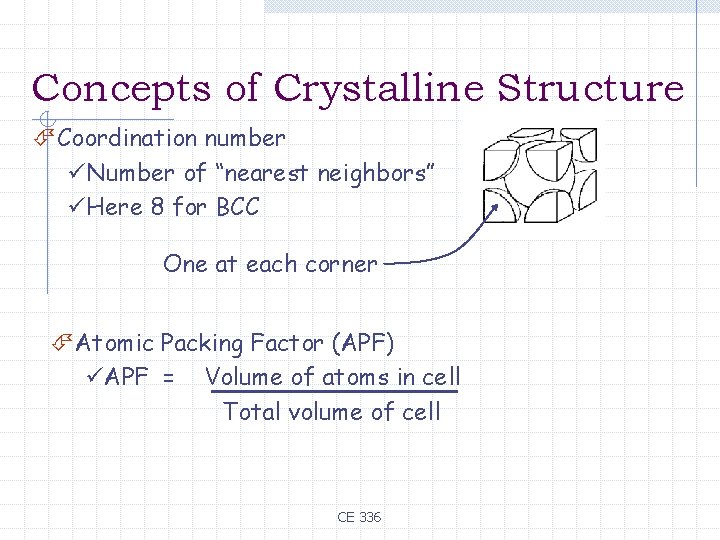
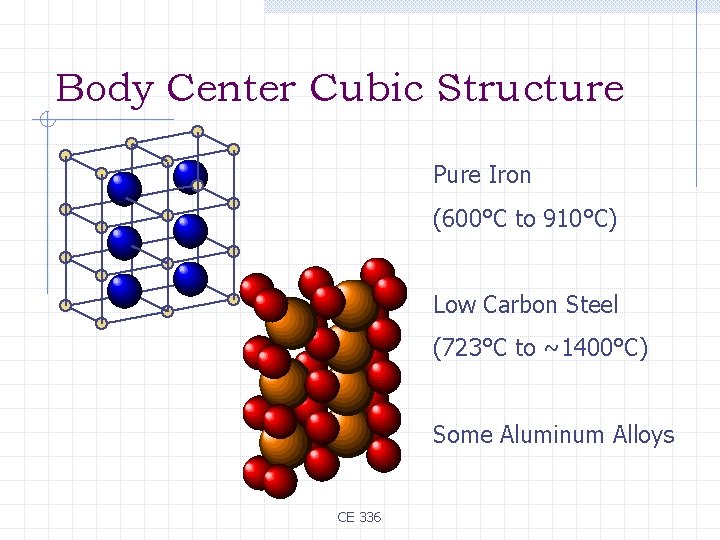
Concepts of Crystalline Structure ÉCoordination number üNumber of “nearest neighbors” üHere 8 for BCC One at each corner ÉAtomic Packing Factor (APF) üAPF = Volume of atoms in cell Total volume of cell CE 336
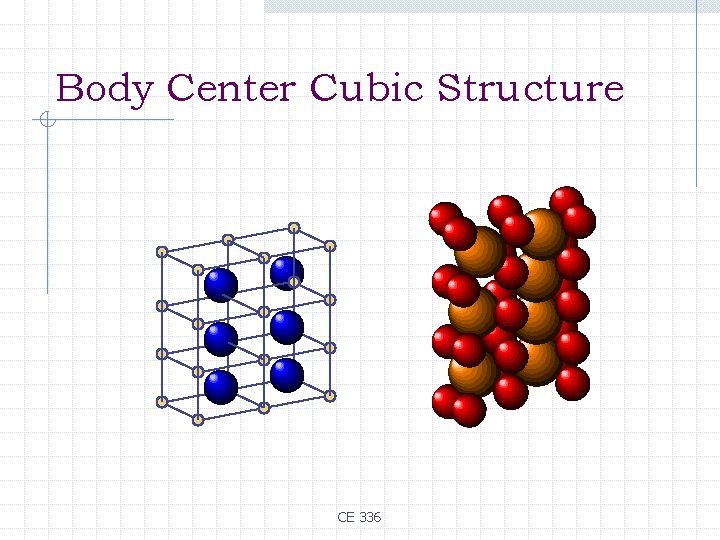
Body Center Cubic Structure CE 336
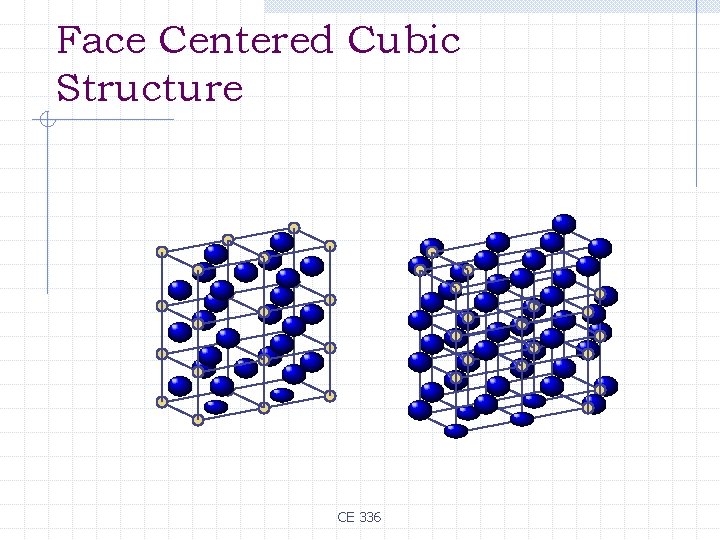
Face Centered Cubic Structure CE 336
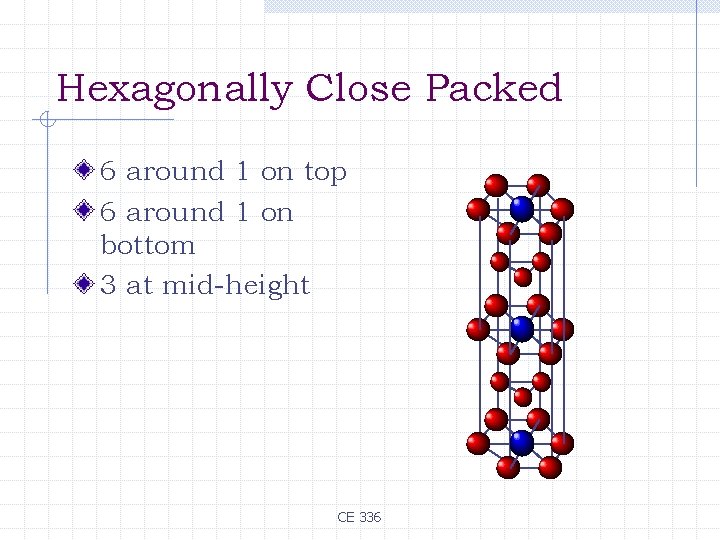
Hexagonally Close Packed 6 around 1 on top 6 around 1 on bottom 3 at mid-height CE 336
Body Center Cubic Structure Pure Iron (600°C to 910°C) Low Carbon Steel (723°C to ~1400°C) Some Aluminum Alloys CE 336
Face Centered Cubic Structure Pure aluminum (-269°C to melting) Pure iron (910°C to 1403°C ) CE 336
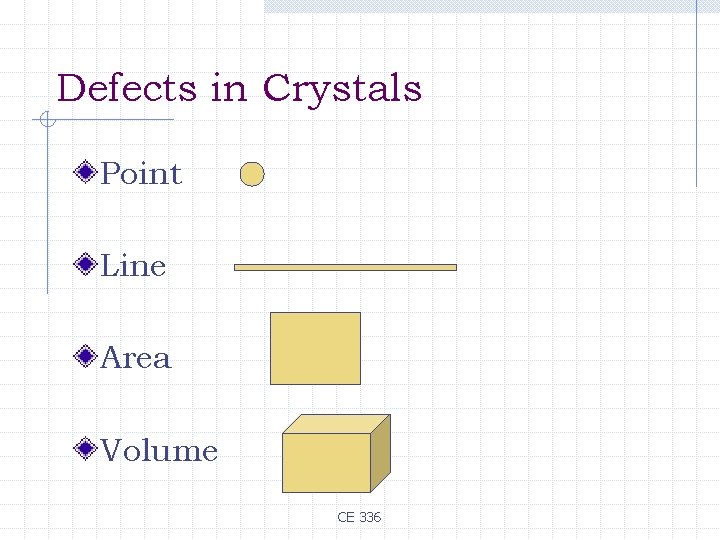
Defects in Crystals Point Line Area Volume CE 336
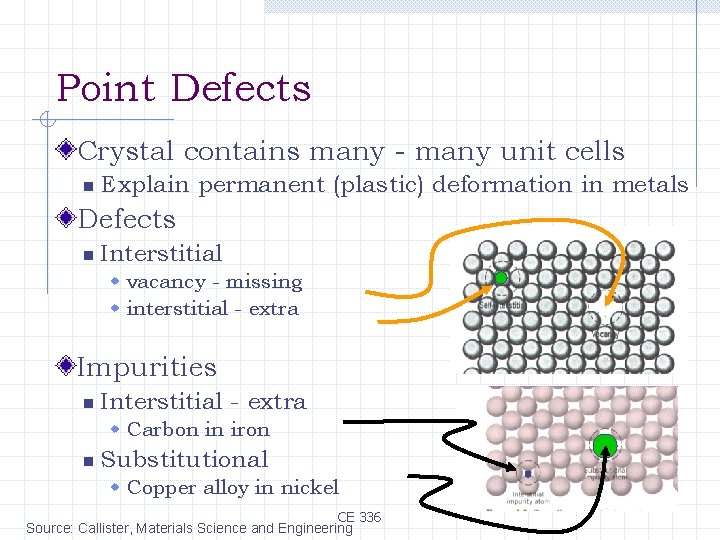
Point Defects Crystal contains many - many unit cells n Explain permanent (plastic) deformation in metals Defects n Interstitial w vacancy - missing w interstitial - extra Impurities n Interstitial - extra w Carbon in iron n Substitutional w Copper alloy in nickel CE 336 Source: Callister, Materials Science and Engineering
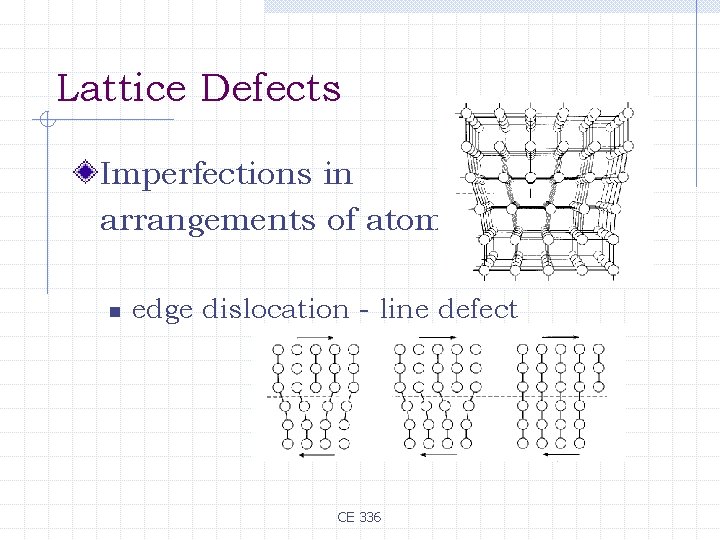
Lattice Defects Imperfections in arrangements of atoms n edge dislocation - line defect CE 336
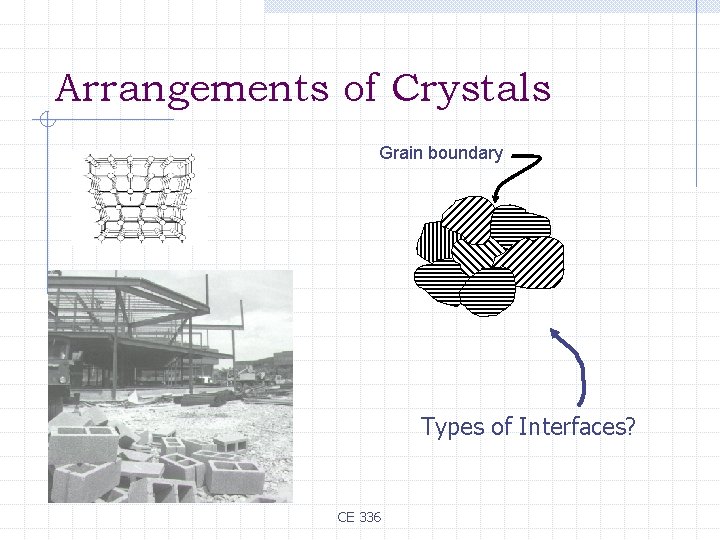
Arrangements of Crystals Grain boundary Types of Interfaces? CE 336
Amorphous Structure CE 336