
Material Management Accounting System Presented By Operations EA
Material Management & Accounting System Presented By: Operations E&A Manufacturing & Production Team Rev 1, May 2014
What is MMAS? • MMAS is the contractor’s business system for planning, controlling, and accounting for the acquisition, use and disposition of material • MMAS law is governed by 10 U. S. C. § 2410 b and the specific regulations are set forth in DFARS 242. 72 • DFARS 252. 242 -7004 prescribes 10 control standards which are based on prudent and reasonable business practices • Larger suppliers must demonstrate how they plan, control, and account for material 2
Origins of MMAS · Incentives to minimize material costs are different in commercial and government environments · Major fraud case at Bell Helicopter in the 1980’s spurred Government to focus on contractor MMAS practices · Early MMAS reviews disclosed many common problems · Do. D/Industry Task Force agreed on 10 key elements/standards · Commercial MRP software systems were modified to comply with 10 standards 3
Do. D MMAS Policy Where applicable, contractors shall have an MMAS that: ü Reasonably forecasts material requirements ü Ensures costs of purchased and fabricated material charged or allocated to a contract are based on valid, time-phased requirements ü Maintains a consistent, equitable, and unbiased logic for costing of material transactions ü Conforms to the 10 control standards Note: MMAS may be manual or automated and they may be stand-alone systems or they may be integrated with planning, engineering, estimating, purchasing, inventory, accounting, or other systems 4
Do. D MMAS Policy Also where applicable, a contractor shall: ü Have policies, procedures, and operating instructions that adequately describe its MMAS ü Assess its MMAS and take reasonable action to comply with the MMAS standards ü Provide to the ACO, upon request, the results of internal reviews that it has conducted to ensure compliance with established MMAS policies, procedures, and operating instructions ü Disclose significant changes in its MMAS to the ACO at least 30 days prior to implementation 5
Common Deficiencies Ø Lack of Internal Controls Ø Lack of Documentation Ø Inaccurate Requirements and Time Phasing Ø Inaccurate Accounting for, or Failure to Identify Excess and Residual Inventory Ø Lack of Audit Trails Ø Inaccurate Inventory Records Ø Inadequate Tracking and Costing of Transfers Ø Improper Use of Loan/Payback Ø Material Allocated without Contractual Requirements 6
What is the Risk? A poor MMAS puts the Government at risk of: Ø Being billed/paying for material prematurely or in excess of actual requirements Ø Financing poor contractor business processes and cost of poor quality • Inadequate production planning • Inadequate shop floor control • Inadequate material handling and inventory management Ø Incorrectly allocated costs Ø Inadvertently financing a contractor’s non-contractual (commercial) ventures or FFP government work Ø Outright FRAUD 7
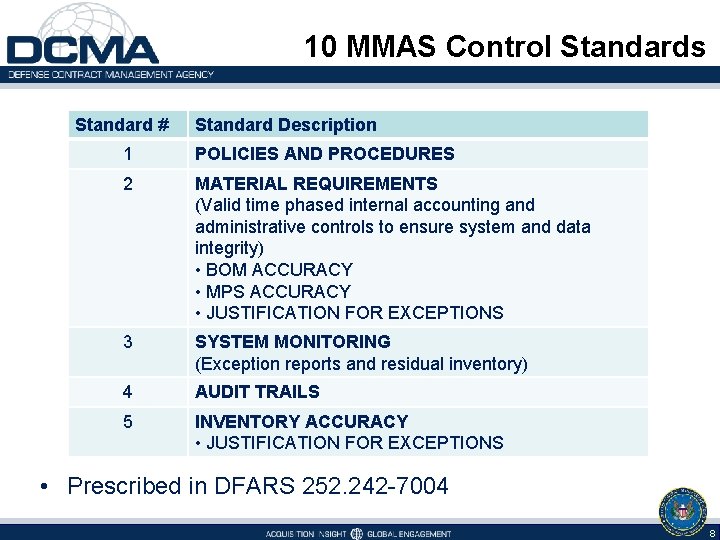
10 MMAS Control Standards Standard # Standard Description 1 POLICIES AND PROCEDURES 2 MATERIAL REQUIREMENTS (Valid time phased internal accounting and administrative controls to ensure system and data integrity) • BOM ACCURACY • MPS ACCURACY • JUSTIFICATION FOR EXCEPTIONS 3 SYSTEM MONITORING (Exception reports and residual inventory) 4 AUDIT TRAILS 5 INVENTORY ACCURACY • JUSTIFICATION FOR EXCEPTIONS • Prescribed in DFARS 252. 242 -7004 8
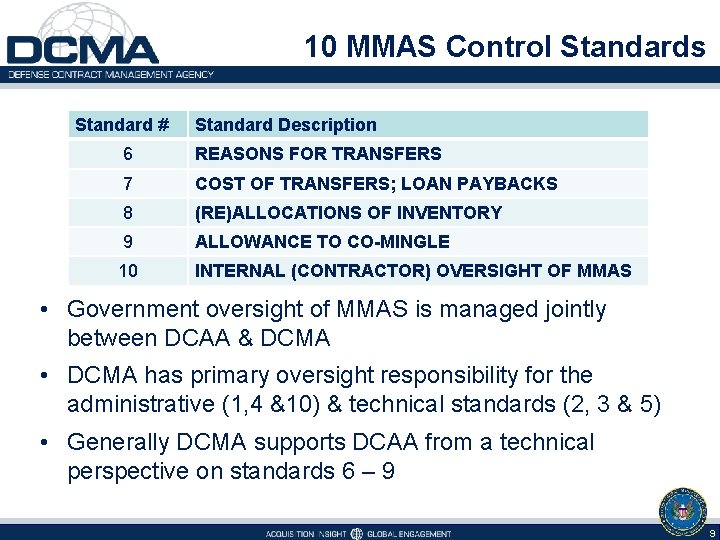
10 MMAS Control Standards Standard # Standard Description 6 REASONS FOR TRANSFERS 7 COST OF TRANSFERS; LOAN PAYBACKS 8 (RE)ALLOCATIONS OF INVENTORY 9 ALLOWANCE TO CO-MINGLE 10 INTERNAL (CONTRACTOR) OVERSIGHT OF MMAS • Government oversight of MMAS is managed jointly between DCAA & DCMA • DCMA has primary oversight responsibility for the administrative (1, 4 &10) & technical standards (2, 3 & 5) • Generally DCMA supports DCAA from a technical perspective on standards 6 – 9 9
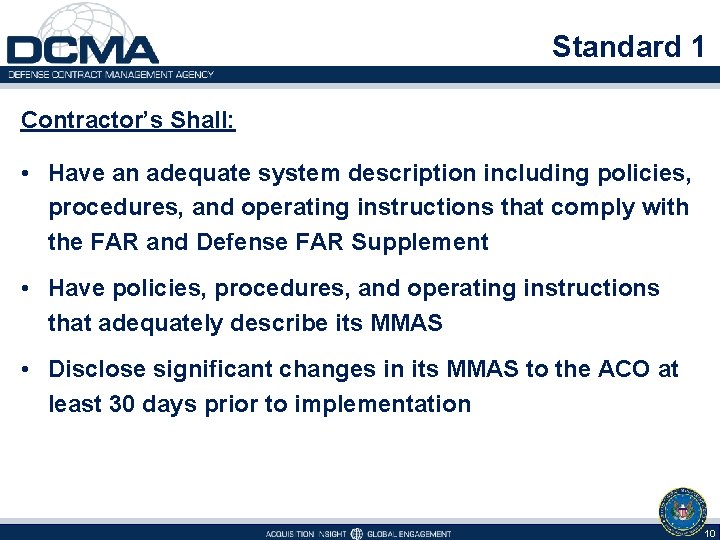
Standard 1 Contractor’s Shall: • Have an adequate system description including policies, procedures, and operating instructions that comply with the FAR and Defense FAR Supplement • Have policies, procedures, and operating instructions that adequately describe its MMAS • Disclose significant changes in its MMAS to the ACO at least 30 days prior to implementation 10
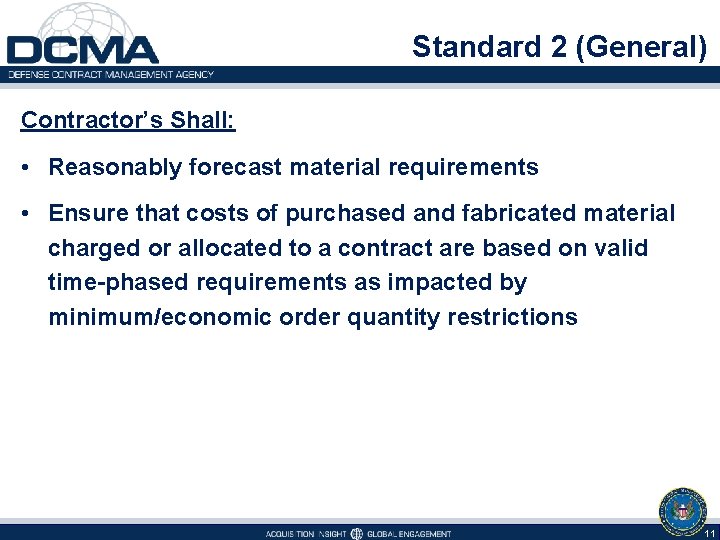
Standard 2 (General) Contractor’s Shall: • Reasonably forecast material requirements • Ensure that costs of purchased and fabricated material charged or allocated to a contract are based on valid time-phased requirements as impacted by minimum/economic order quantity restrictions 11
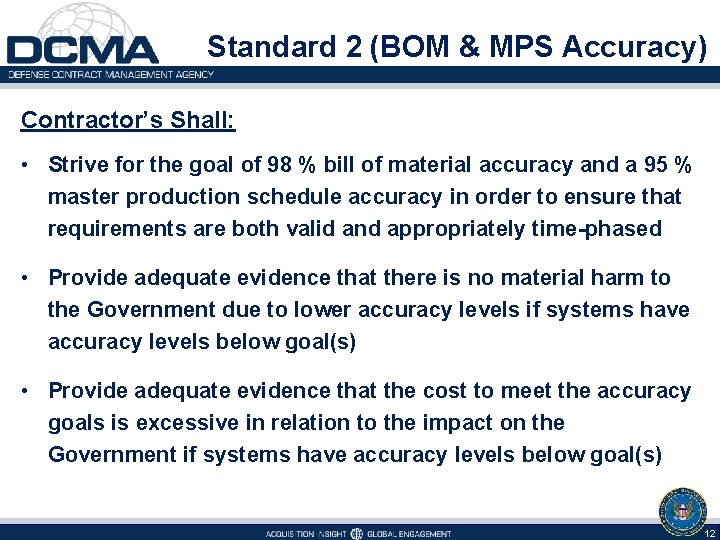
Standard 2 (BOM & MPS Accuracy) Contractor’s Shall: • Strive for the goal of 98 % bill of material accuracy and a 95 % master production schedule accuracy in order to ensure that requirements are both valid and appropriately time-phased • Provide adequate evidence that there is no material harm to the Government due to lower accuracy levels if systems have accuracy levels below goal(s) • Provide adequate evidence that the cost to meet the accuracy goals is excessive in relation to the impact on the Government if systems have accuracy levels below goal(s) 12
Standard 3 Contractor’s Shall: • Provide a mechanism to identify, report, and resolve system control weaknesses and manual override. Systems should identify operational exceptions, such as excess/residual inventory, as soon as known 13
Standard 4 Contractor’s Shall: • Provide audit trails and maintain records (manual and those in machine- readable form) necessary to evaluate system logic and to verify through transaction testing that the system is operating as desired 14
Standard 5 Contractor’s Shall: • Establish and maintain adequate levels of record accuracy, and include reconciliation of recorded inventory quantities to physical inventory by part number on a periodic basis. Strive for the of 95 % inventory accuracy level • Provide adequate evidence that there is no material harm to the Government due to lower accuracy levels if systems have accuracy levels below a 95 % • Provide adequate evidence that the cost to meet the accuracy goals is excessive in relation to the impact on the Government if systems have accuracy levels below a 95 % 15
Standard 6 Contractor’s Shall: • Provide detailed descriptions of circumstances that will result in manual or system generated transfers of parts 16
Standard 7 Contractor’s Shall: • Maintain a consistent, equitable, and unbiased logic for costing of material transactions • Maintain and disclose written policies describing the transfer methodology and the loan/pay-back technique • Maintain consistency across all contract and customer types, and from accounting period to accounting period for initial charging and transfer charging. • The costing methodology may be standard or actual cost, or any of the inventory costing methods in 48 CFR 9904. 411 -50(b)}. 17
Standard 7 Ø The system should transfer parts and associated costs within the same billing period. Ø In the few instances where this may not be appropriate, the Contractor may accomplish the material transaction using a loan/pay-back technique. Ø The “loan/pay-back technique” means that the physical part is moved temporarily from the contract, but the cost of the part remains on the contract. Ø The procedures for the loan/pay-back technique must be approved by the ACO. 18
Standard 7 Contractor’s Shall: • Have controls to ensure parts are paid back expeditiously if the “loan / pay-back technique” is used • Have controls to ensure procedures and controls are in place to correct any overbilling that might occur if the “loan / payback technique” is used • Have controls to ensure monthly identification (at a minimum) of the borrowing contract and the date the part was borrowed if the “loan / pay-back technique” is used • Have controls to ensure the cost of the replacement part is charged to the borrowing contract if the “loan / pay-back technique” is used 19
Standard 8 Contractor’s Shall: • Where allocations from common inventory accounts are used, have controls to ensure that: • Reallocations and any credit due are processed no less frequently than the routine billing cycle • Inventories retained for requirements that are not under contract are not allocated to contracts • Algorithms are maintained based on valid and current data 20
Standard 9 Contractor’s Shall: • Have adequate controls to ensure that physically commingled inventories that may include material for which costs are charged or allocated to fixed-price, costreimbursement, and commercial contracts do not compromise requirements of any of the other MMAS standard requirements • Ensure Government-furnished material shall not be physically commingled with other material • Ensure Government-furnished material shall not be used on commercial work 21
Standard 10 Contractor’s Shall: • Assess its MMAS and take reasonable action to comply with the MMAS standards • Have adequate internal controls to ensure system and data integrity • Provide to the Administrative Contracting Officer (ACO), upon request, the results of internal reviews that it has conducted to ensure compliance with established MMAS policies, procedures, and operating instructions 22
MMAS Compliance DFARS 252. 242 -7004 shall be utilized by PCOs in all solicitations and resulting contracts which: • Exceed simplified acquisition limitation • Are not for acquisition of commercial items • Are Cost-reimbursement contracts • Are Fixed-price contracts with progress payments made on the basis of costs incurred by the contractor as work progresses under the contract (i. e. Government financing) • Are not awarded to small businesses, educational institutions, or nonprofit organizations 23
Compliance Reviews An MMAS review shall be conducted on a contractor when: • A contractor has $40 million of qualifying sales to the Government during the contractor's preceding fiscal year • The ACO, with advice from an auditor or technical specialist determines an MMAS review is needed based on a risk assessment of the contractor's past experience and current vulnerability MMAS reviews should be done every 3 years depending on the level of risk 24
Qualifying Sales • Qualifying sales are sales for which certified cost or pricing data were required under 10 U. S. C. 2306 a, as implemented in FAR 15. 403, or that are contracts priced on other than a firm-fixed-price or fixed-price with economic price adjustment basis. • Qualifying sales include prime contracts, subcontracts, and modifications to such contracts and subcontracts. 25
Performing a Technical Review • Can be in support of full MMAS Audit by DCAA • Can be in support of ACO determination on the adequacy of the MMAS • Should be part of ongoing Manufacturing & Production risk assessment and surveillance • Standards 1 and 10 should always be the starting point • Contractor should present their MMAS policies, procedures, and operating instructions to comply with all standards for review • Contractor should demonstrate how their system works (including MRP, ERP, SAP etc. ) • Contractor’s should present their MMAS internal controls and audit results for review 26
Focus Areas for Technical Review (S: 1) Ø Does the Contractor have written policies, procedures, and operating instructions for its MMAS? Ø Do they provide sufficient information to allow one to obtain a thorough understanding of the way the system is intended to operate? Ø Does the Contractor communicate significant changes to the ACO as per DFARS policy? Ø Are BOM, MPS and Inventory accuracy thresholds in Contractor’s polices already set below the goals set forth in Standards 2 & 5? 27
Focus Areas for Technical Review (S: 2) Ø Effectiveness of lead time projections, purchase order release schedules, and actual performance. Ø Accuracy and consistency of material time phased forecasting methods, including allowances for scrap and shrinkage. Ø Reasonableness and consistency of scrap, shrinkage, rework, and yield projections against historical data, and trends. Ø Material receipt dates and quantities versus schedules. Ø Effectiveness of supplier material cost reduction actions, including evaluations of vendor performance. 28
Focus Areas for Technical Review (S: 2) Ø Manufacturing bill of material accuracy, error rates, and causes. Ø Accuracy of the master production schedules for developing material need dates against actual need dates. Ø Accuracy of work orders, work instructions and process/routing sheets. Ø Contractor’s tracking system for BOM & MPS accuracy analysis. Ø Contractor justifications if 98% BOM & 95% MPS accuracy goals are not met. 29
Focus Areas for Technical Review (S: 3) Ø Timeliness and effectiveness in identifying exceptions like excess/residual inventory, no cost transfers, lost/found parts, etc. Ø Sufficiency of the contractor’s analysis of MMAS related exception reports. Ø Reports that track manufacturing process performance pertaining to the contractor’s material system. Ø Access/authority to enter data into the system, resolve exceptions, and manually override the system logic. 30
Focus Areas for Technical Review (S: 5) Ø Reasonableness of current inventory levels against requirements and historical data. Ø Current inventory-turn ratio against recent trends. Ø Contractor’s tracking system for inventory accuracy analysis. Ø Contractor’s procedures and internal controls for verifying the quantities of physical inventory. Ø Contractor justification (s) if 95% Inventory accuracy goals are not met. 31
Focus Areas for Technical Review (S: 5) Ø Adequacy of policies and procedures for the receipt, inspection and storage of material. Ø Material wait times between receiving and inventory. Ø Only material meeting agreed-to quantity and quality specifications are accepted. Ø Material returns are properly controlled and accounted for. Ø Contractor’s actual material issuance to the floor practices. 32
Focus Areas for Technical Review (S: 8) Ø Adequacy of policies and procedures governing the inventory allocation process. (MRP ‘Soft Pegging’) Ø Magnitude of contractor cost allocations from common inventories. Ø Determine that common materials that have been allocated benefit the contracts charged. Ø Evidence that allocation methods are compliant with valid time-phased requirements. Ø Evidence that common inventory costs were properly calculated and costed on a current basis. 33
Focus Areas for Technical Review (S: 9) Ø Determine if the contractor comingles inventory of different contract types (Fixed price, cost, commercial) Ø Determine if comingled inventories compromise any other MMAS standard Ø Ensure that GFP is not comingled with other inventory Ø Ensure that GFP is not used in commercial work 34
Summary • DCMA has a responsibility to ensure contractors are compliant to the 10 MMAS standards • ACO’s are supposed to review MMAS compliance at least every 3 years on contractors that meet the threshold, regardless of DCAA support or not • A full DCAA Audit is not necessarily required to make a determination on a contractor’s MMAS • It is DCMA policy that the technical elements of MMAS be an ongoing part of Manufacturing and Production surveillance 35
Summary • Reviewing and understanding the contractor's policies, procedures, and internal controls is the foundation of good surveillance • The level of risk a contractor’s MMAS poses to the government depends on how good the contractor's policies, procedures, and internal controls are and how well they are followed by the contractor’s employees • The level of risk determined through ongoing surveillance drives the scope of review or audit required to make a determination on a contractor’s MMAS 36
- Slides: 36