
Material Flow Control CONWIP and Theory of Constraints
- Slides: 54
Material Flow Control, CONWIP and Theory of Constraints 35 E 00100 Service Operations and Strategy 7 Fall 2015
Contents CONWIP (Part 1) n Principles n Mean value analysis model n Comparison with MRP and kanban Shop floor control n Design and control aspects n Production activity control n CONWIP and other pull mechanisms Key points Theory of Constraints (Part 2) Useful material in the textbook: Hopp, W. & Spearman, M. (2000), Factory Physics, Ch. 10. 4 -10. 6 and 14 35 E 00100 Service Operations and Strategy #7 2 Aalto/BIZ Logistics
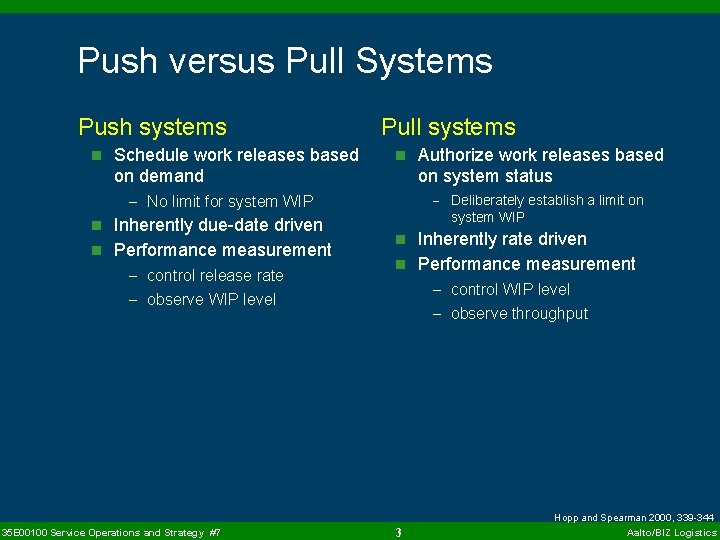
Push versus Pull Systems Push systems n Schedule work releases based Pull systems n Authorize work releases based on demand on system status - Deliberately establish a limit on system WIP - No limit for system WIP n Inherently due-date driven n Performance measurement - control release rate - observe WIP level 35 E 00100 Service Operations and Strategy #7 n Inherently rate driven n Performance measurement - control WIP level - observe throughput 3 Hopp and Spearman 2000, 339 -344 Aalto/BIZ Logistics
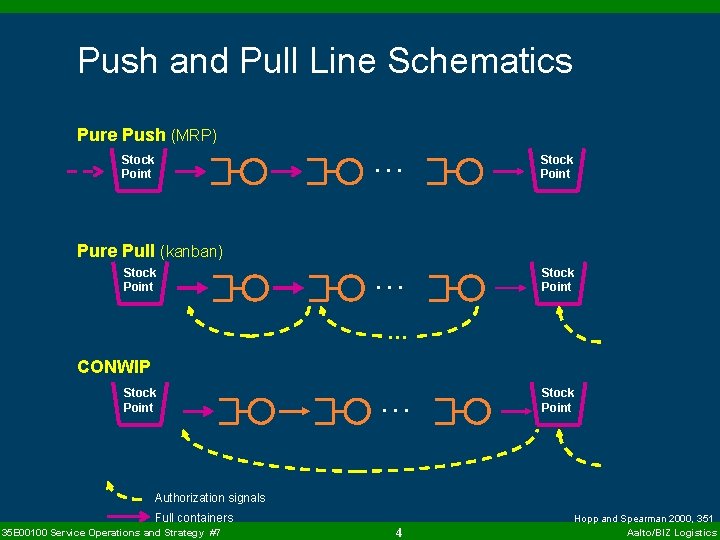
Push and Pull Line Schematics Pure Push (MRP) Stock Point . . . Stock Point Pure Pull (kanban) Stock Point … CONWIP Stock Point . . . Stock Point Authorization signals Full containers 35 E 00100 Service Operations and Strategy #7 4 Hopp and Spearman 2000, 351 Aalto/BIZ Logistics
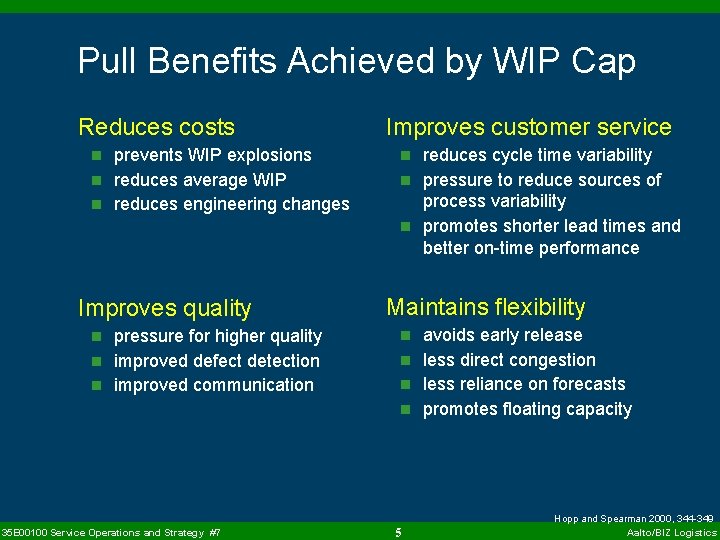
Pull Benefits Achieved by WIP Cap Reduces costs Improves customer service n prevents WIP explosions n reduces cycle time variability n reduces average WIP n pressure to reduce sources of n reduces engineering changes process variability n promotes shorter lead times and better on-time performance Improves quality Maintains flexibility n pressure for higher quality n avoids early release n improved defect detection n less direct congestion n improved communication n less reliance on forecasts n promotes floating capacity 35 E 00100 Service Operations and Strategy #7 5 Hopp and Spearman 2000, 344 -349 Aalto/BIZ Logistics
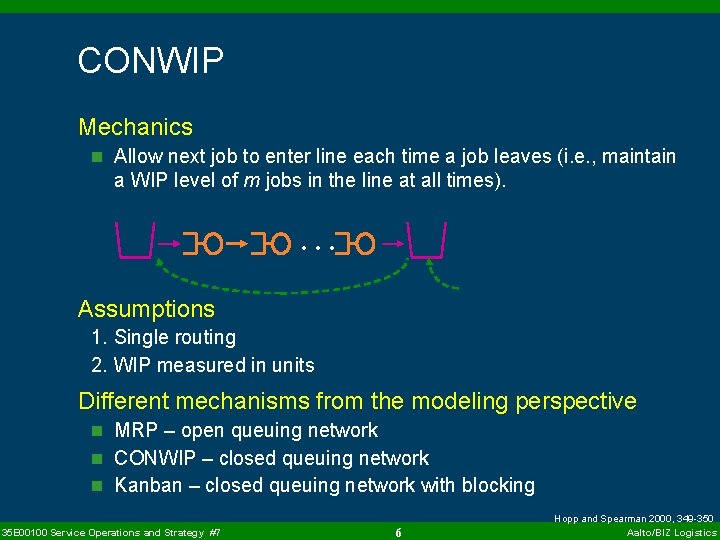
CONWIP Mechanics n Allow next job to enter line each time a job leaves (i. e. , maintain a WIP level of m jobs in the line at all times). . Assumptions 1. Single routing 2. WIP measured in units Different mechanisms from the modeling perspective n MRP – open queuing network n CONWIP – closed queuing network n Kanban – closed queuing network with blocking 35 E 00100 Service Operations and Strategy #7 6 Hopp and Spearman 2000, 349 -350 Aalto/BIZ Logistics
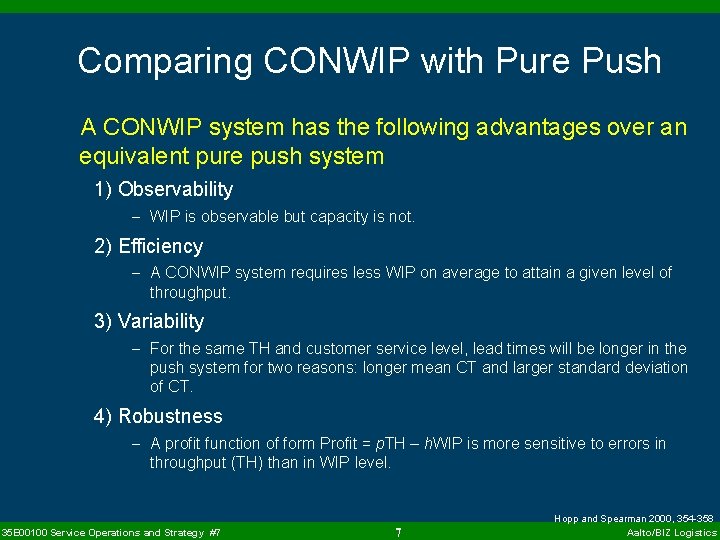
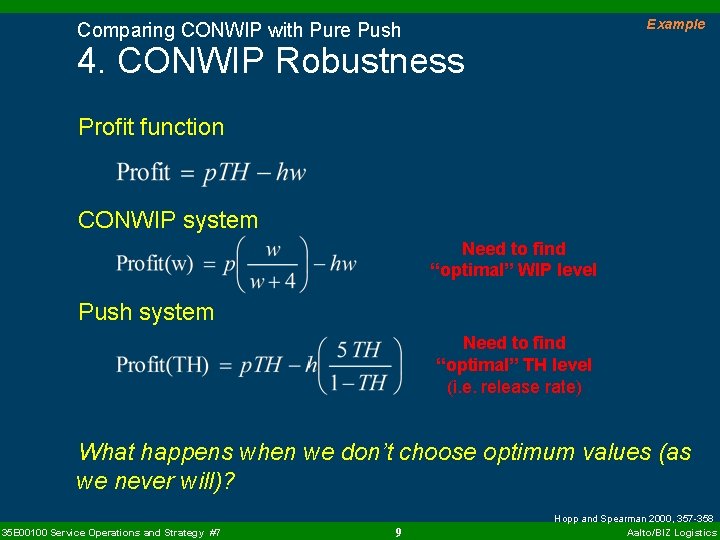
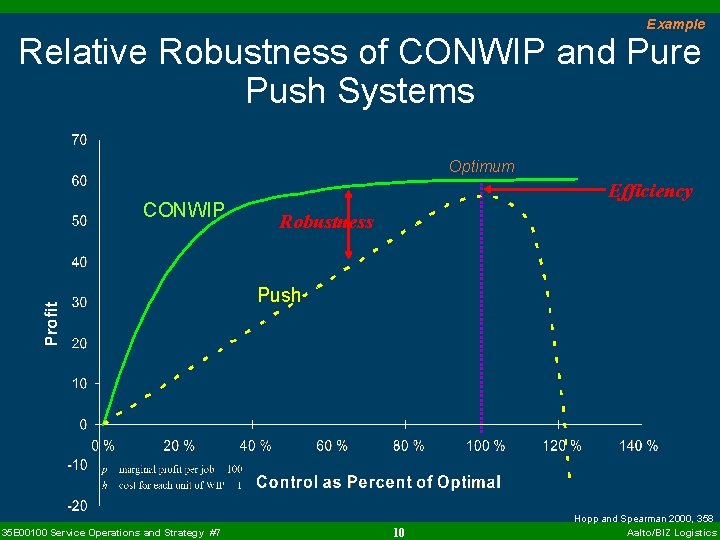
Comparing CONWIP with Pure Push A CONWIP system has the following advantages over an equivalent pure push system 1) Observability - WIP is observable but capacity is not. 2) Efficiency - A CONWIP system requires less WIP on average to attain a given level of throughput. 3) Variability - For the same TH and customer service level, lead times will be longer in the push system for two reasons: longer mean CT and larger standard deviation of CT. 4) Robustness - A profit function of form Profit = p. TH – h. WIP is more sensitive to errors in throughput (TH) than in WIP level. 35 E 00100 Service Operations and Strategy #7 7 Hopp and Spearman 2000, 354 -358 Aalto/BIZ Logistics
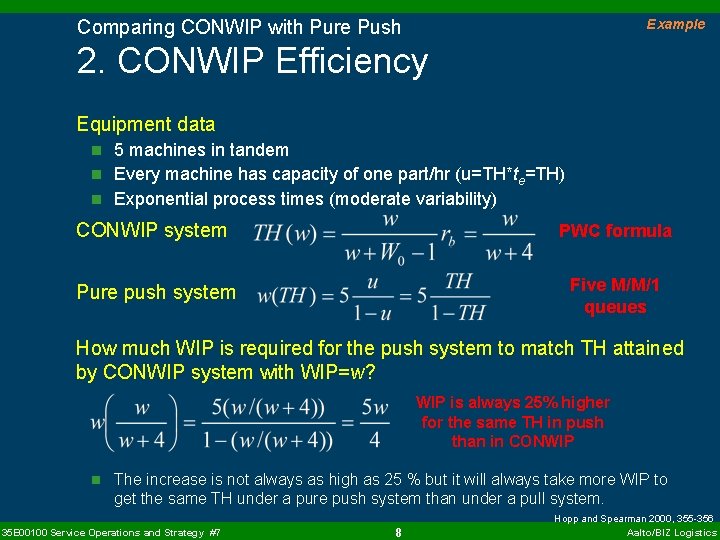
Comparing CONWIP with Pure Push Example 2. CONWIP Efficiency Equipment data n 5 machines in tandem n Every machine has capacity of one part/hr (u=TH*te=TH) n Exponential process times (moderate variability) CONWIP system PWC formula Pure push system Five M/M/1 queues How much WIP is required for the push system to match TH attained by CONWIP system with WIP=w? WIP is always 25% higher for the same TH in push than in CONWIP n The increase is not always as high as 25 % but it will always take more WIP to get the same TH under a pure push system than under a pull system. 35 E 00100 Service Operations and Strategy #7 8 Hopp and Spearman 2000, 355 -356 Aalto/BIZ Logistics
Example Comparing CONWIP with Pure Push 4. CONWIP Robustness Profit function CONWIP system Need to find “optimal” WIP level Push system Need to find “optimal” TH level (i. e. release rate) What happens when we don’t choose optimum values (as we never will)? 35 E 00100 Service Operations and Strategy #7 9 Hopp and Spearman 2000, 357 -358 Aalto/BIZ Logistics
Example Relative Robustness of CONWIP and Pure Push Systems Optimum CONWIP Efficiency Robustness Push 35 E 00100 Service Operations and Strategy #7 10 Hopp and Spearman 2000, 358 Aalto/BIZ Logistics
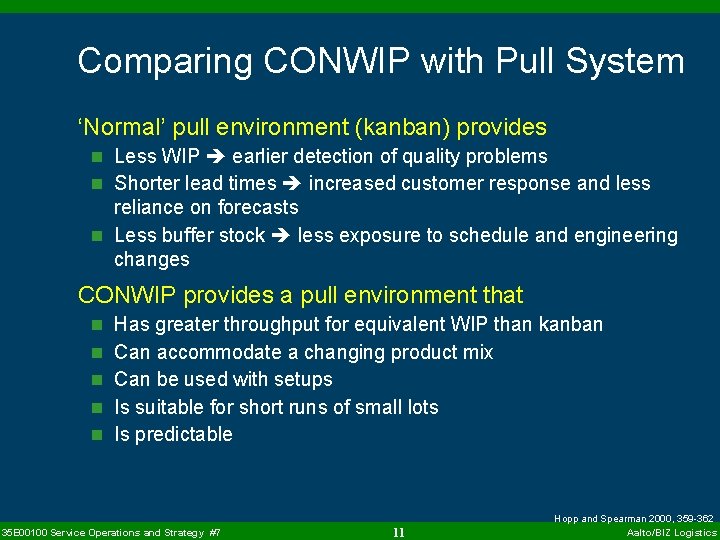
Comparing CONWIP with Pull System ‘Normal’ pull environment (kanban) provides n Less WIP earlier detection of quality problems n Shorter lead times increased customer response and less reliance on forecasts n Less buffer stock less exposure to schedule and engineering changes CONWIP provides a pull environment that n Has greater throughput for equivalent WIP than kanban n Can accommodate a changing product mix n Can be used with setups n Is suitable for short runs of small lots n Is predictable 35 E 00100 Service Operations and Strategy #7 11 Hopp and Spearman 2000, 359 -362 Aalto/BIZ Logistics
Shop Floor Control Basic problem n To control the flow of work through plant and coordinate with other activities, e. g. , quality control and preventive maintenance. Key issues n Customization - SFC is often the most highly customized activity in a plant. n Information collection - SFC represents the interface with the actual production processes and is therefore a good place to collect data. n Simplicity - Departures from simple mechanisms must be carefully justified. We think in generalities, we live in detail. 35 E 00100 Service Operations and Strategy #7 12 Hopp and Spearman 2000, 453 -456 Aalto/BIZ Logistics
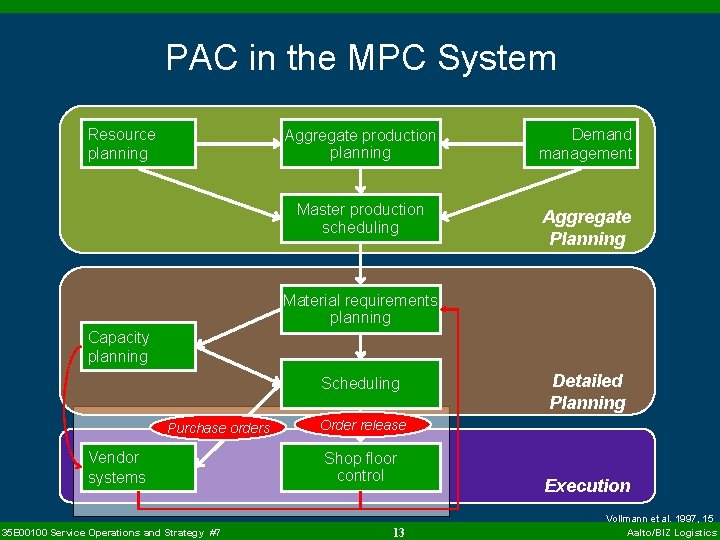
PAC in the MPC System Resource planning Aggregate production planning Demand management Master production scheduling Aggregate Planning Material requirements planning Capacity planning Scheduling Purchase orders Vendor systems 35 E 00100 Service Operations and Strategy #7 Detailed Planning Order release Shop floor control 13 Execution Vollmann et al. 1997, 15 Aalto/BIZ Logistics
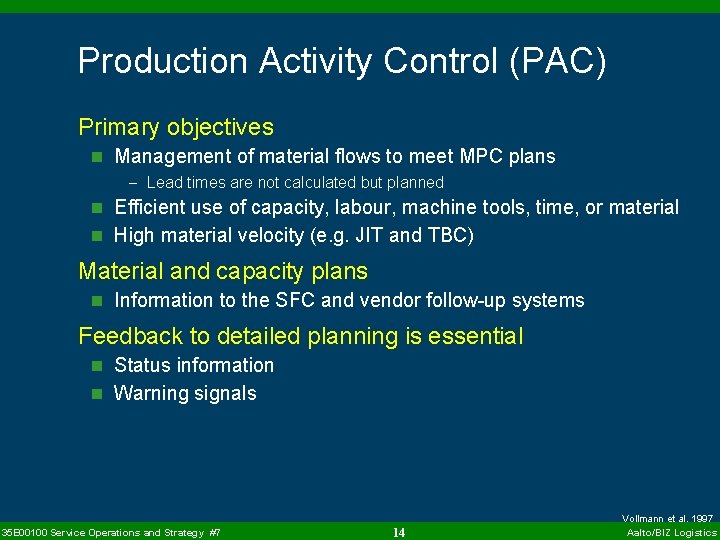
Production Activity Control (PAC) Primary objectives n Management of material flows to meet MPC plans - Lead times are not calculated but planned n Efficient use of capacity, labour, machine tools, time, or material n High material velocity (e. g. JIT and TBC) Material and capacity plans n Information to the SFC and vendor follow-up systems Feedback to detailed planning is essential n Status information n Warning signals 35 E 00100 Service Operations and Strategy #7 14 Vollmann et al. 1997 Aalto/BIZ Logistics
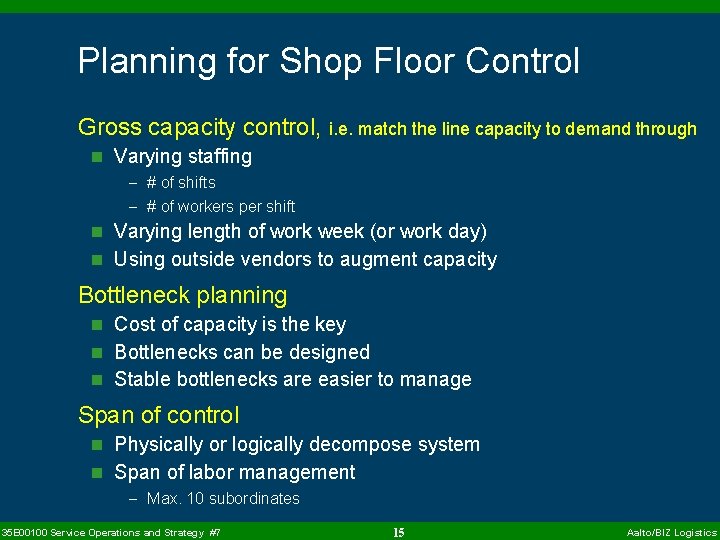
Planning for Shop Floor Control Gross capacity control, i. e. match the line capacity to demand through n Varying staffing - # of shifts - # of workers per shift n Varying length of work week (or work day) n Using outside vendors to augment capacity Bottleneck planning n Cost of capacity is the key n Bottlenecks can be designed n Stable bottlenecks are easier to manage Span of control n Physically or logically decompose system n Span of labor management - Max. 10 subordinates 35 E 00100 Service Operations and Strategy #7 15 Aalto/BIZ Logistics
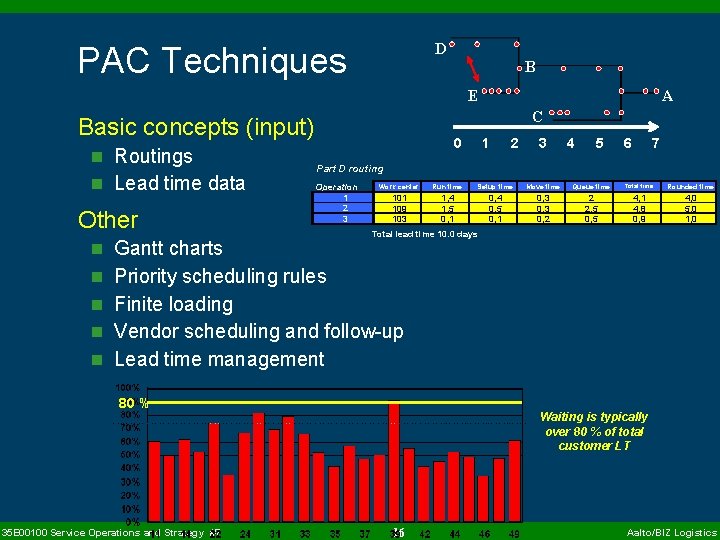
D PAC Techniques B A E C Basic concepts (input) n Routings n Lead time data Other 0 1 2 3 4 5 6 7 Part D routing Operation 1 2 3 n Gantt charts Work center Run time Setup time Move time Queue time Total time Rounded time 101 109 103 1, 4 1, 5 0, 1 0, 4 0, 5 0, 1 0, 3 0, 2 2 2, 5 0, 5 4, 1 4, 8 0, 9 4, 0 5, 0 1, 0 Total lead time 10. 0 days n Priority scheduling rules n Finite loading n Vendor scheduling and follow-up n Lead time management 80 % 35 E 00100 Service Operations and Strategy #7 Waiting is typically over 80 % of total customer LT 16 Aalto/BIZ Logistics
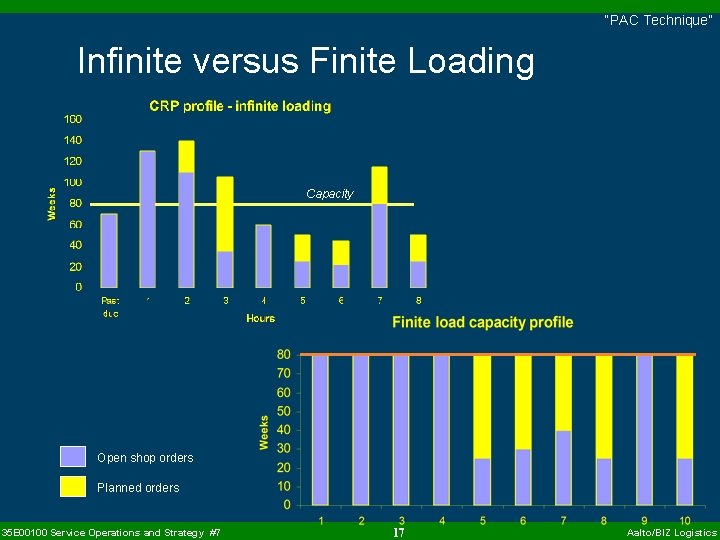
“PAC Technique” Infinite versus Finite Loading Capacity Open shop orders Planned orders 35 E 00100 Service Operations and Strategy #7 17 Aalto/BIZ Logistics
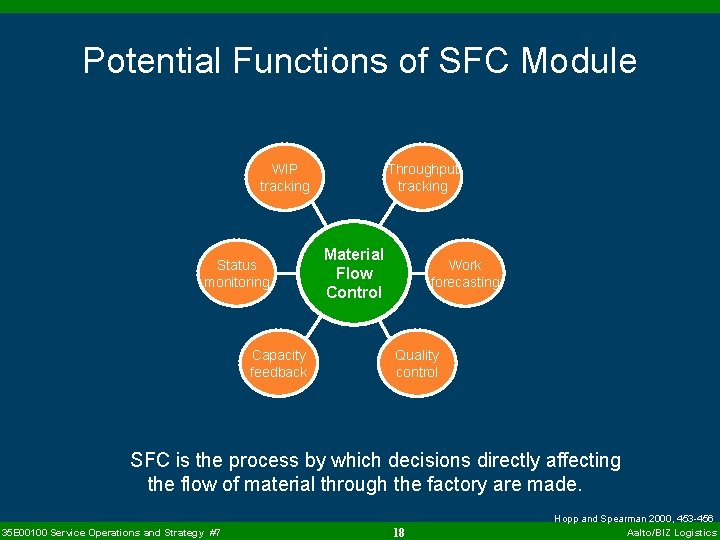
Potential Functions of SFC Module WIP tracking Status monitoring Capacity feedback Throughput tracking Material Flow Control Work forecasting Quality control SFC is the process by which decisions directly affecting the flow of material through the factory are made. 35 E 00100 Service Operations and Strategy #7 18 Hopp and Spearman 2000, 453 -456 Aalto/BIZ Logistics
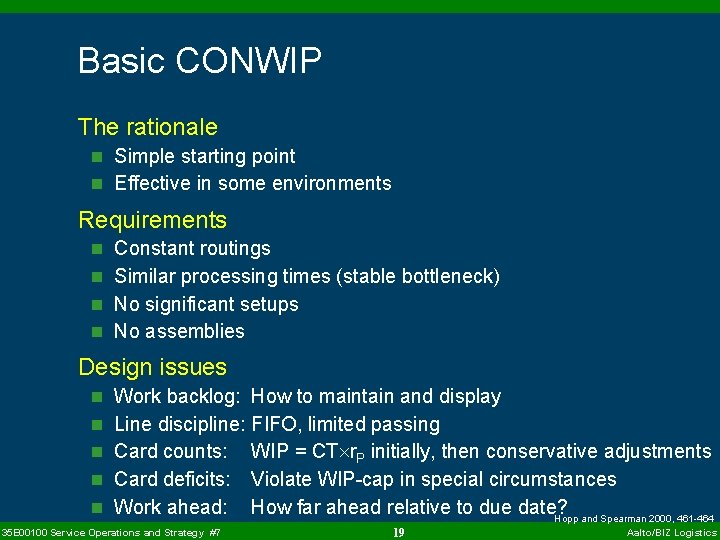
Basic CONWIP The rationale n Simple starting point n Effective in some environments Requirements n Constant routings n Similar processing times (stable bottleneck) n No significant setups n No assemblies Design issues n Work backlog: How to maintain and display n Line discipline: FIFO, limited passing n Card counts: n Card deficits: n Work ahead: 35 E 00100 Service Operations and Strategy #7 WIP = CT r. P initially, then conservative adjustments Violate WIP-cap in special circumstances How far ahead relative to due date? Hopp and Spearman 2000, 461 -464 19 Aalto/BIZ Logistics
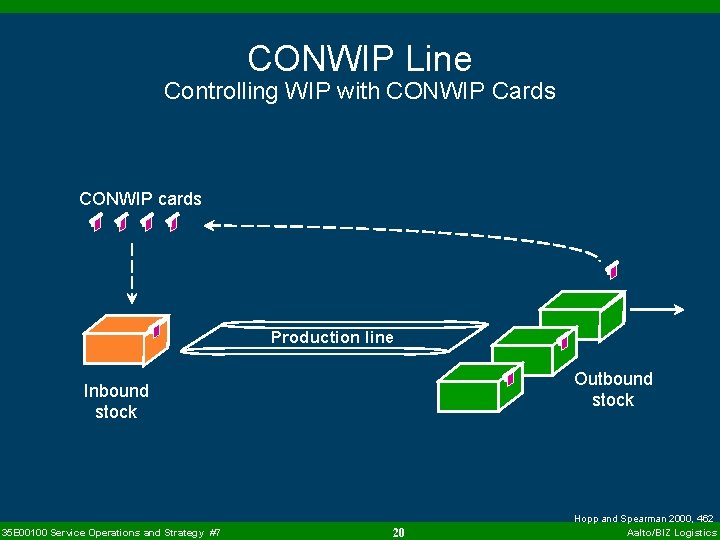
CONWIP Line Controlling WIP with CONWIP Cards CONWIP cards Production line Outbound stock Inbound stock 35 E 00100 Service Operations and Strategy #7 20 Hopp and Spearman 2000, 462 Aalto/BIZ Logistics
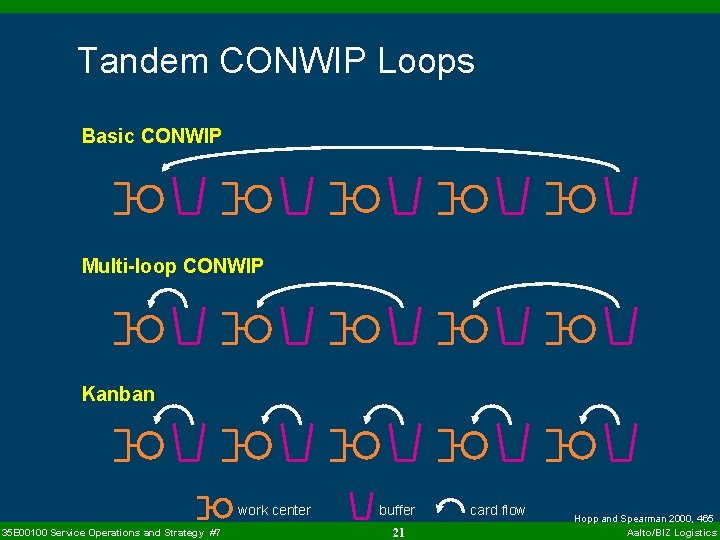
Tandem CONWIP Loops Basic CONWIP Multi-loop CONWIP Kanban work center 35 E 00100 Service Operations and Strategy #7 buffer 21 card flow Hopp and Spearman 2000, 465 Aalto/BIZ Logistics
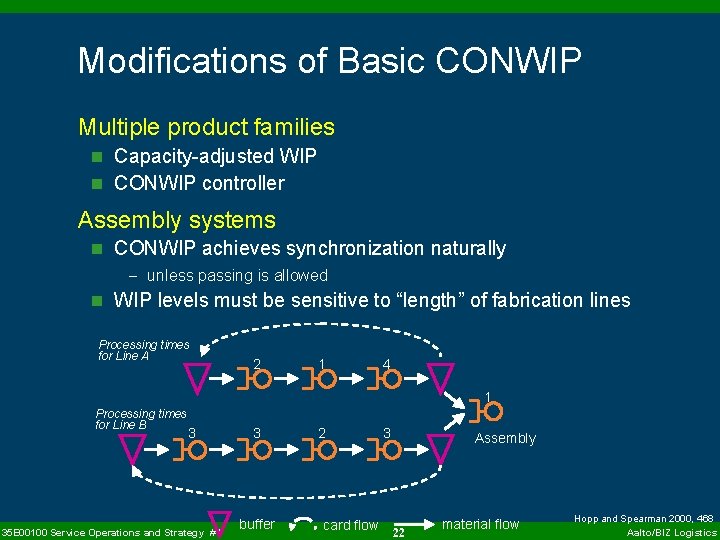
Modifications of Basic CONWIP Multiple product families n Capacity-adjusted WIP n CONWIP controller Assembly systems n CONWIP achieves synchronization naturally - unless passing is allowed n WIP levels must be sensitive to “length” of fabrication lines Processing times for Line A 2 1 4 1 Processing times for Line B 3 35 E 00100 Service Operations and Strategy #7 3 buffer 2 card flow 3 Assembly 22 material flow Hopp and Spearman 2000, 468 Aalto/BIZ Logistics
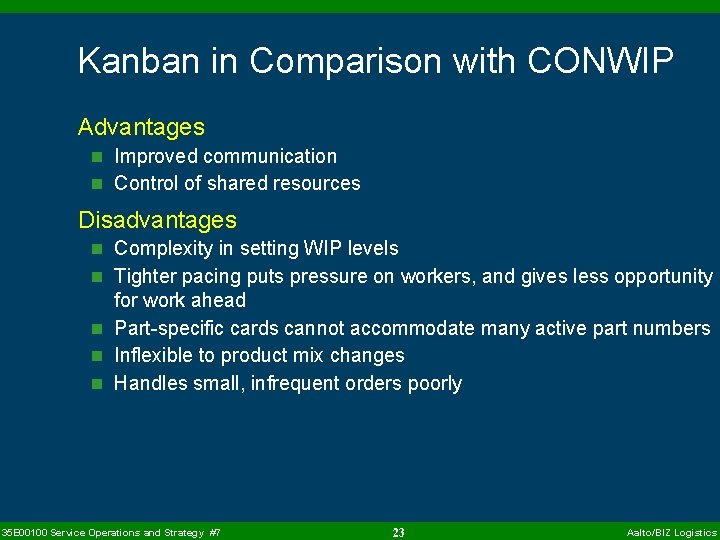
Kanban in Comparison with CONWIP Advantages n Improved communication n Control of shared resources Disadvantages n Complexity in setting WIP levels n Tighter pacing puts pressure on workers, and gives less opportunity for work ahead n Part-specific cards cannot accommodate many active part numbers n Inflexible to product mix changes n Handles small, infrequent orders poorly 35 E 00100 Service Operations and Strategy #7 23 Aalto/BIZ Logistics
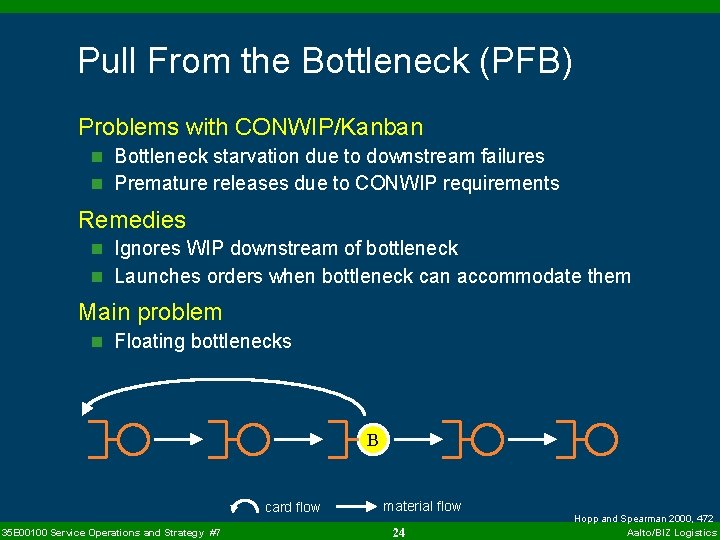
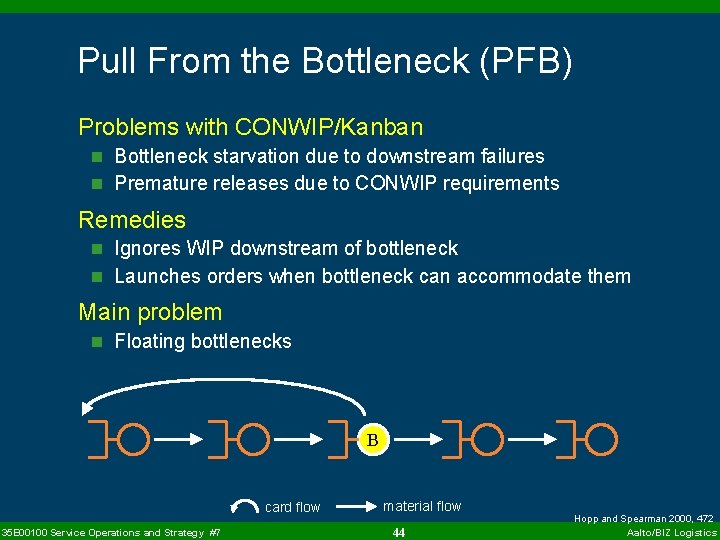
Pull From the Bottleneck (PFB) Problems with CONWIP/Kanban n Bottleneck starvation due to downstream failures n Premature releases due to CONWIP requirements Remedies n Ignores WIP downstream of bottleneck n Launches orders when bottleneck can accommodate them Main problem n Floating bottlenecks B card flow 35 E 00100 Service Operations and Strategy #7 material flow 24 Hopp and Spearman 2000, 472 Aalto/BIZ Logistics
Production Tracking and Feedback Basic problems n Signal quota shortfall n Update capacity data n Quote delivery dates Short term n Statistical Throughput Control (STC) n Progress toward quota n Overtime decisions Long term n Capacity feedback n Synchronize planning models to reality 35 E 00100 Service Operations and Strategy #7 25 Hopp and Spearman 2000, 475 -482 Aalto/BIZ Logistics
Key Points Shop floor control n SFC is more than material flow control n Good SFC requires planning (workforce policies, bottlenecks, management, etc) CONWIP n Simple starting point for advanced pull mechanisms n Reduces variability due to lower WIP fluctuations n Many modifications possible (kanban, pull-from-bottleneck) Benefits of pull mechanisms n Observability, efficiency and robustness Statistical throughput control n Intuitive graphical display n Tool for overtime planning/prediction 35 E 00100 Service Operations and Strategy #7 26 Aalto/BIZ Logistics
Abbreviations Used CONWIP = constant WIP MVA = mean value analysis PAC = production activity control PFB = pull from the bottleneck SFC = shop floor control STC = statistical throughput control 35 E 00100 Service Operations and Strategy #7 27 Aalto/BIZ Logistics
Part 2: Theory of Constraints Contents Theory of constraints (TOC) n Principles n Drum-buffer- rope system n Thinking processes n Product mix planning A comparison of TOC, MRP and JIT Useful material in textbook and in course package: Hopp, W. & Spearman, M. (2000), Factory Physics, Chapter 16. 3 Goldratt, E. (1990) “Appendix: Two Selected Readings from The Goal” Theory of Constraints, pp. 129 -160 35 E 00100 Service Operations and Strategy #7 28 Aalto/BIZ Logistics
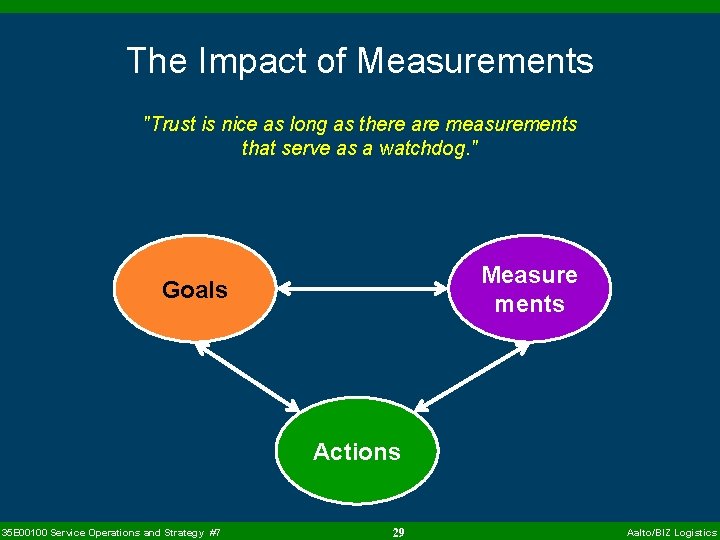
The Impact of Measurements "Trust is nice as long as there are measurements that serve as a watchdog. " Measure ments Goals Actions 35 E 00100 Service Operations and Strategy #7 29 Aalto/BIZ Logistics
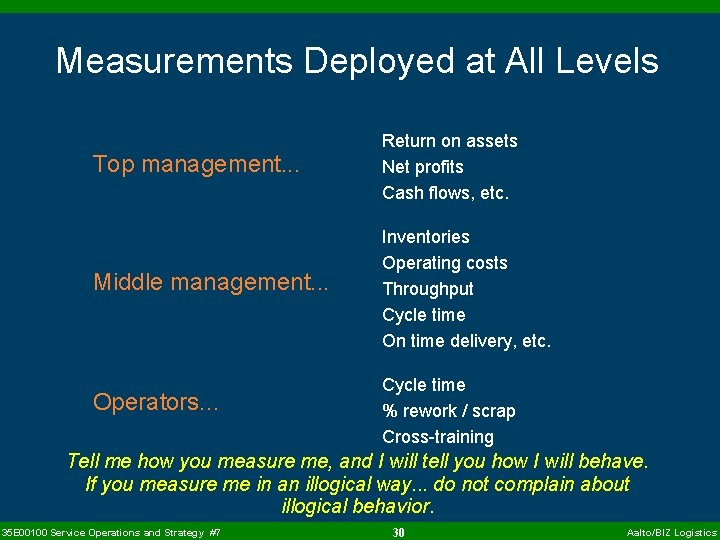
Measurements Deployed at All Levels Top management. . . Return on assets Net profits Cash flows, etc. Middle management. . . Inventories Operating costs Throughput Cycle time On time delivery, etc. Operators. . . Cycle time % rework / scrap Cross-training Tell me how you measure me, and I will tell you how I will behave. If you measure me in an illogical way. . . do not complain about illogical behavior. 35 E 00100 Service Operations and Strategy #7 30 Aalto/BIZ Logistics
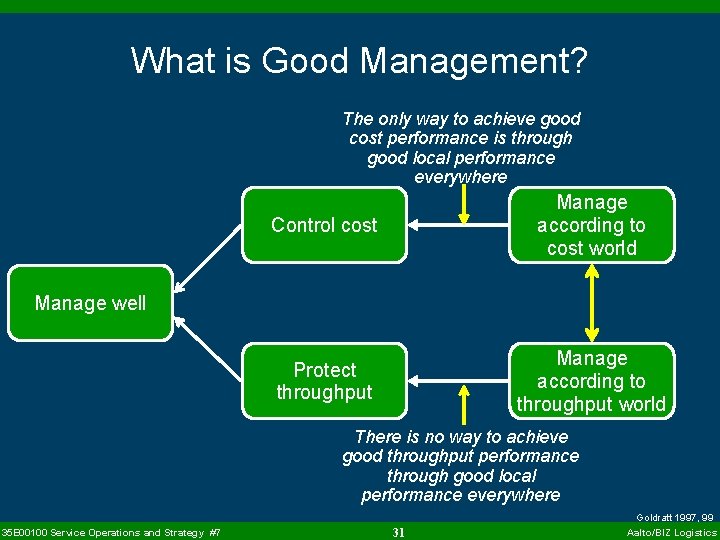
What is Good Management? The only way to achieve good cost performance is through good local performance everywhere Control cost Manage according to cost world Protect throughput Manage according to throughput world Manage well There is no way to achieve good throughput performance through good local performance everywhere 35 E 00100 Service Operations and Strategy #7 31 Goldratt 1997, 99 Aalto/BIZ Logistics
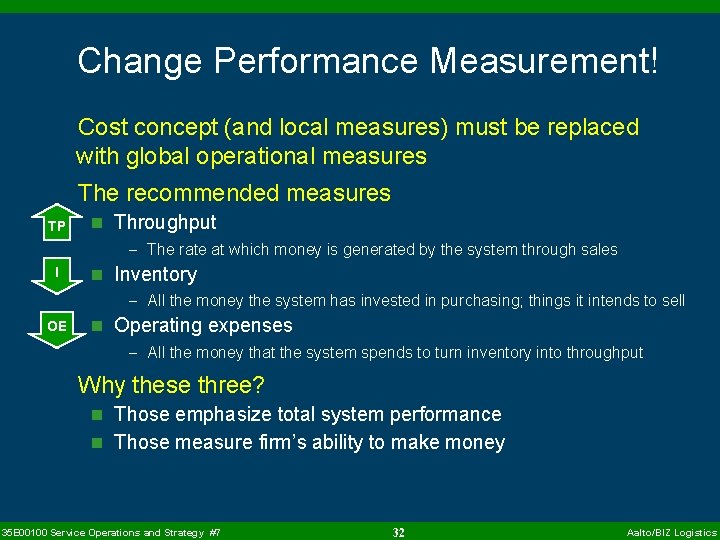
Change Performance Measurement! Cost concept (and local measures) must be replaced with global operational measures The recommended measures TP n Throughput - The rate at which money is generated by the system through sales n Inventory I - All the money the system has invested in purchasing; things it intends to sell OE n Operating expenses - All the money that the system spends to turn inventory into throughput Why these three? n Those emphasize total system performance n Those measure firm’s ability to make money 35 E 00100 Service Operations and Strategy #7 32 Aalto/BIZ Logistics
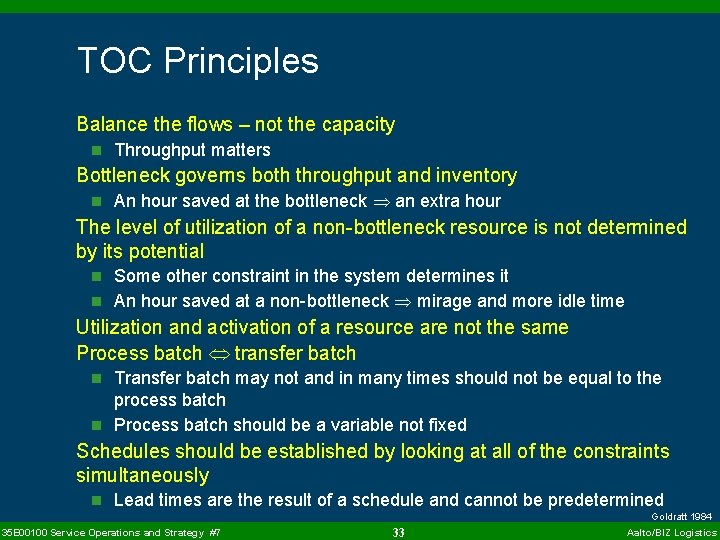
TOC Principles Balance the flows – not the capacity n Throughput matters Bottleneck governs both throughput and inventory n An hour saved at the bottleneck an extra hour The level of utilization of a non- bottleneck resource is not determined by its potential n Some other constraint in the system determines it n An hour saved at a non- bottleneck mirage and more idle time Utilization and activation of a resource are not the same Process batch transfer batch n Transfer batch may not and in many times should not be equal to the process batch n Process batch should be a variable not fixed Schedules should be established by looking at all of the constraints simultaneously n Lead times are the result of a schedule and cannot be predetermined Goldratt 1984 35 E 00100 Service Operations and Strategy #7 33 Aalto/BIZ Logistics
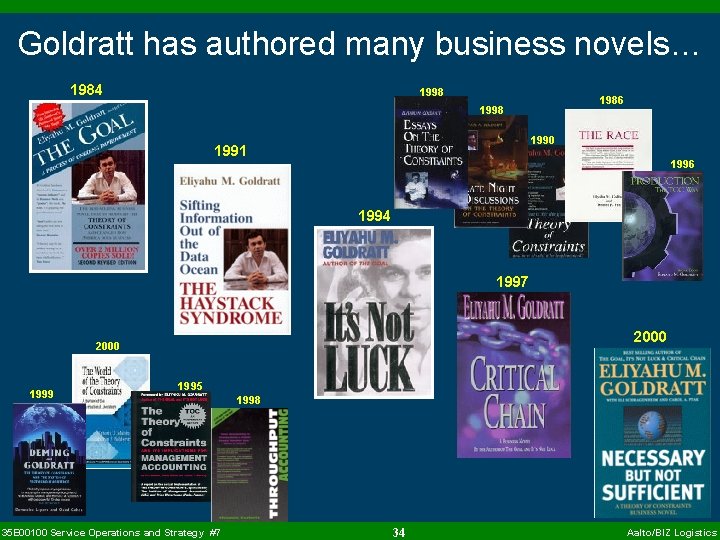
Goldratt has authored many business novels… 1984 1998 1986 1998 1990 1991 1996 1994 1997 2000 1999 1995 35 E 00100 Service Operations and Strategy #7 1998 34 Aalto/BIZ Logistics
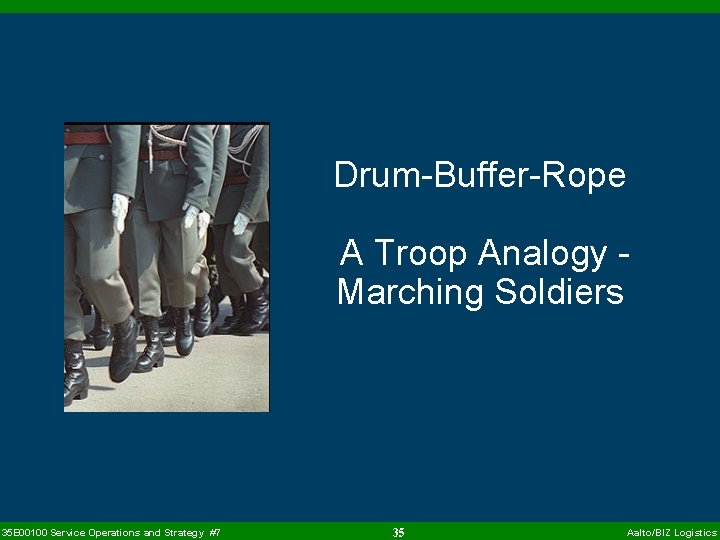
Drum-Buffer-Rope A Troop Analogy Marching Soldiers 35 E 00100 Service Operations and Strategy #7 35 Aalto/BIZ Logistics
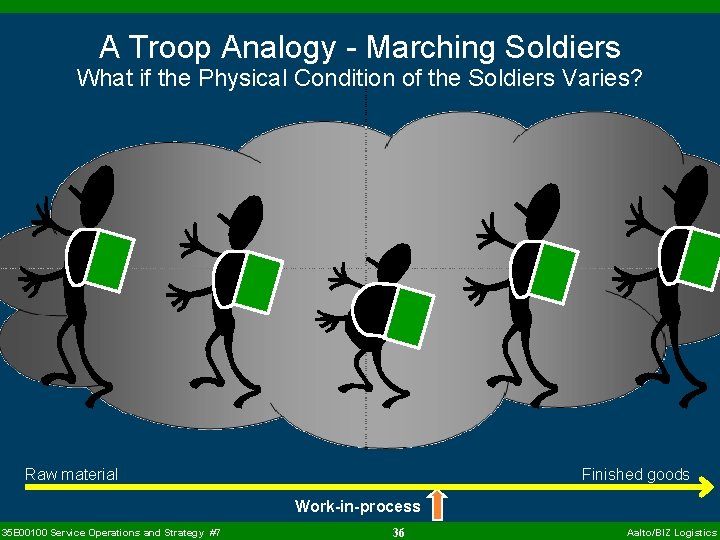
A Troop Analogy - Marching Soldiers What if the Physical Condition of the Soldiers Varies? Raw material Finished goods Work-in-process 35 E 00100 Service Operations and Strategy #7 36 Aalto/BIZ Logistics
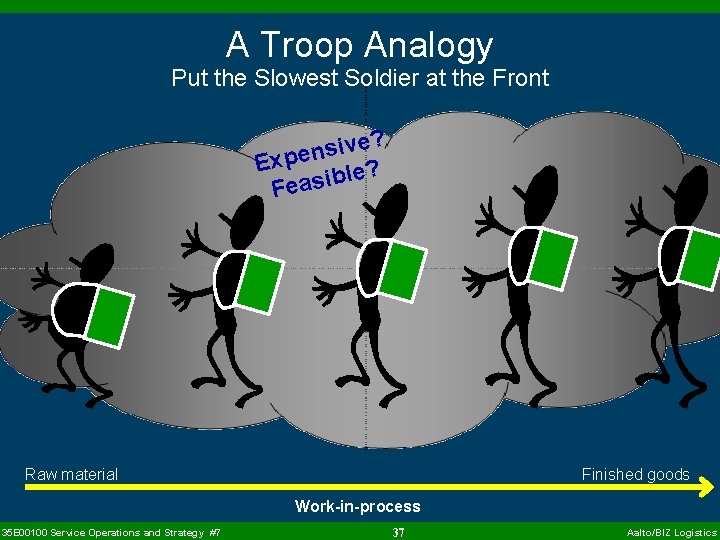
A Troop Analogy Put the Slowest Soldier at the Front ? e v i s Expen le? b Feasi Raw material Finished goods Work-in-process 35 E 00100 Service Operations and Strategy #7 37 Aalto/BIZ Logistics
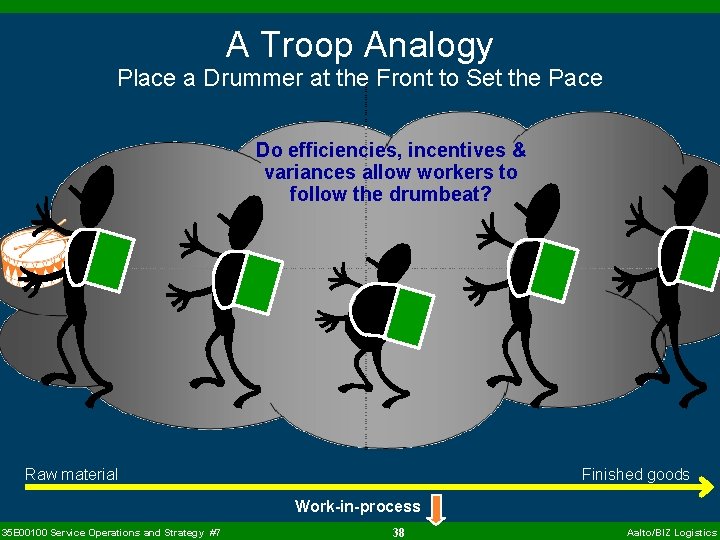
A Troop Analogy Place a Drummer at the Front to Set the Pace Do efficiencies, incentives & variances allow workers to follow the drumbeat? Raw material Finished goods Work-in-process 35 E 00100 Service Operations and Strategy #7 38 Aalto/BIZ Logistics
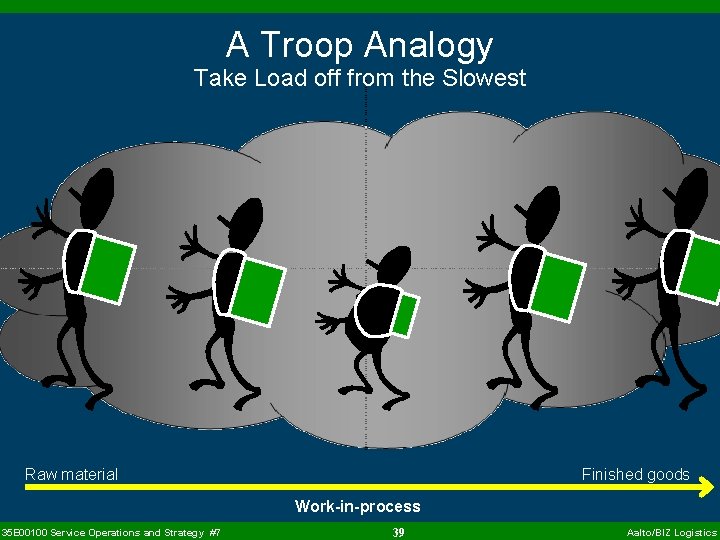
A Troop Analogy Take Load off from the Slowest Raw material Finished goods Work-in-process 35 E 00100 Service Operations and Strategy #7 39 Aalto/BIZ Logistics
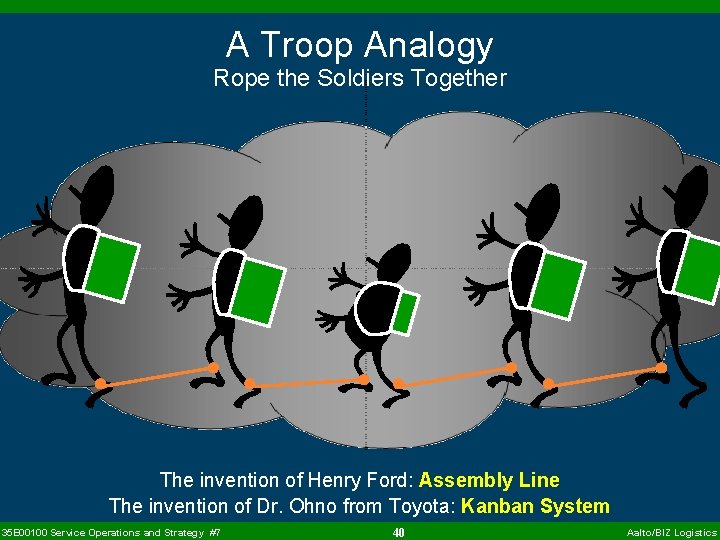
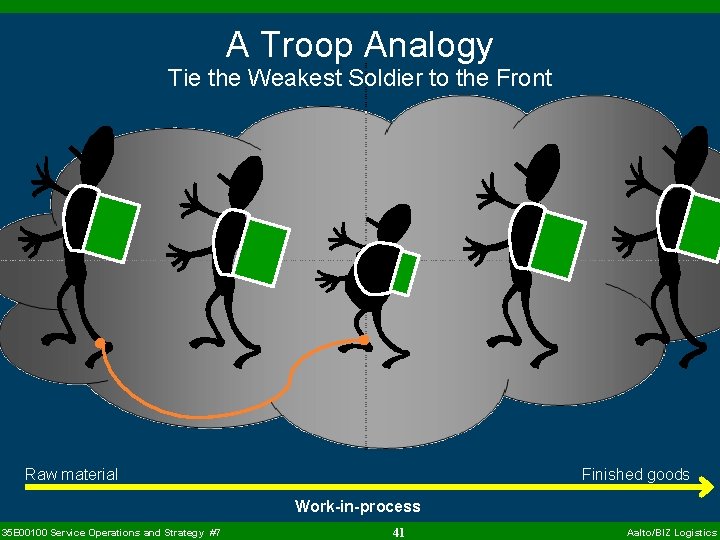
A Troop Analogy Rope the Soldiers Together The invention of Henry Ford: Assembly Line The invention of Dr. Ohno from Toyota: Kanban System 35 E 00100 Service Operations and Strategy #7 40 Aalto/BIZ Logistics
A Troop Analogy Tie the Weakest Soldier to the Front Raw material Finished goods Work-in-process 35 E 00100 Service Operations and Strategy #7 41 Aalto/BIZ Logistics
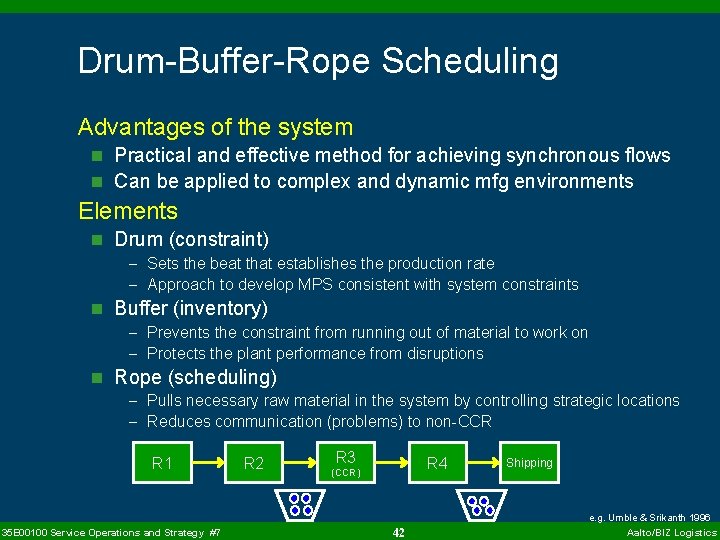
Drum-Buffer-Rope Scheduling Advantages of the system n Practical and effective method for achieving synchronous flows n Can be applied to complex and dynamic mfg environments Elements n Drum (constraint) - Sets the beat that establishes the production rate - Approach to develop MPS consistent with system constraints n Buffer (inventory) - Prevents the constraint from running out of material to work on - Protects the plant performance from disruptions n Rope (scheduling) - Pulls necessary raw material in the system by controlling strategic locations - Reduces communication (problems) to non-CCR R 1 35 E 00100 Service Operations and Strategy #7 R 2 R 3 R 4 (CCR) 42 Shipping e. g. Umble & Srikanth 1996 Aalto/BIZ Logistics
Pull From the Bottleneck (PFB) Problems with CONWIP/Kanban n Bottleneck starvation due to downstream failures n Premature releases due to CONWIP requirements Remedies n Ignores WIP downstream of bottleneck n Launches orders when bottleneck can accommodate them Main problem n Floating bottlenecks B card flow 35 E 00100 Service Operations and Strategy #7 material flow 44 Hopp and Spearman 2000, 472 Aalto/BIZ Logistics
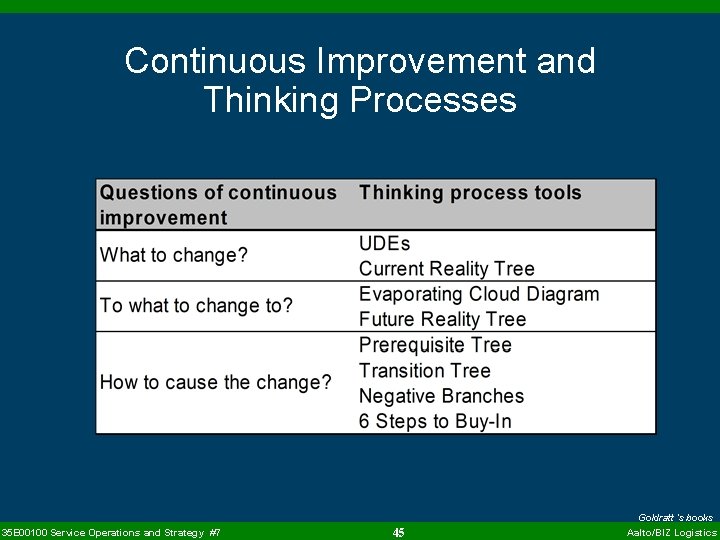
Continuous Improvement and Thinking Processes 35 E 00100 Service Operations and Strategy #7 45 Goldratt ’s books Aalto/BIZ Logistics
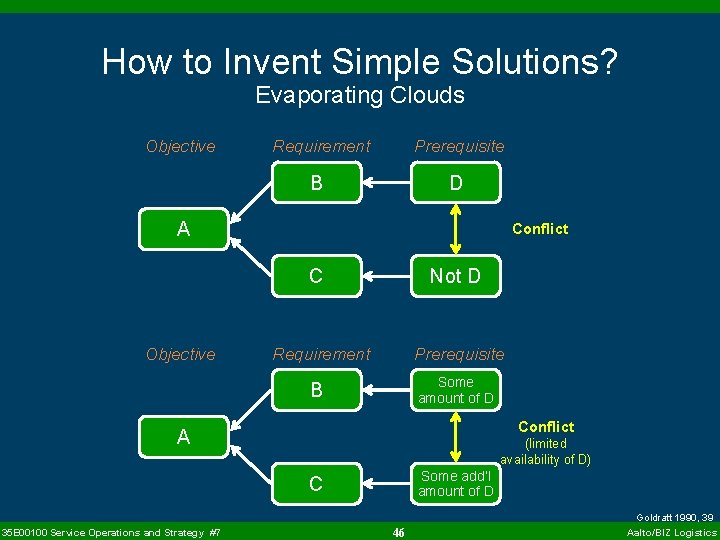
How to Invent Simple Solutions? Evaporating Clouds Objective Requirement Prerequisite B D A Objective Conflict C Not D Requirement Prerequisite Some amount of D B Conflict A (limited availability of D) Some add’l amount of D C 35 E 00100 Service Operations and Strategy #7 46 Goldratt 1990, 39 Aalto/BIZ Logistics
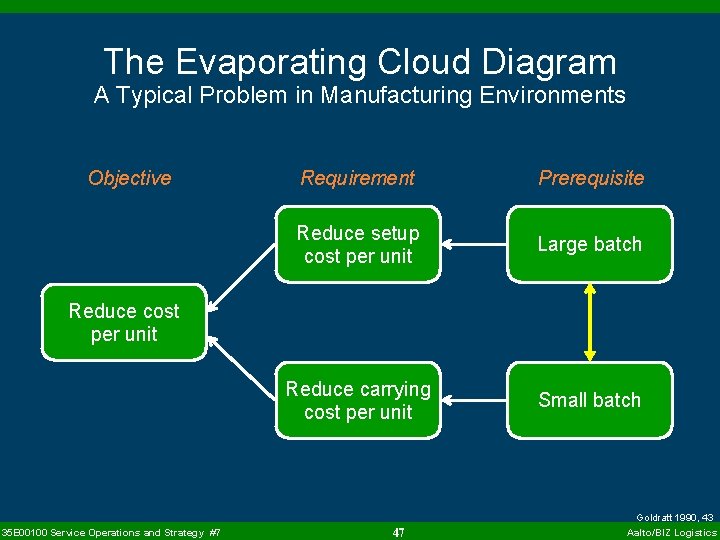
The Evaporating Cloud Diagram A Typical Problem in Manufacturing Environments Objective Requirement Prerequisite Reduce setup cost per unit Large batch Reduce carrying cost per unit Small batch Reduce cost per unit 35 E 00100 Service Operations and Strategy #7 47 Goldratt 1990, 43 Aalto/BIZ Logistics
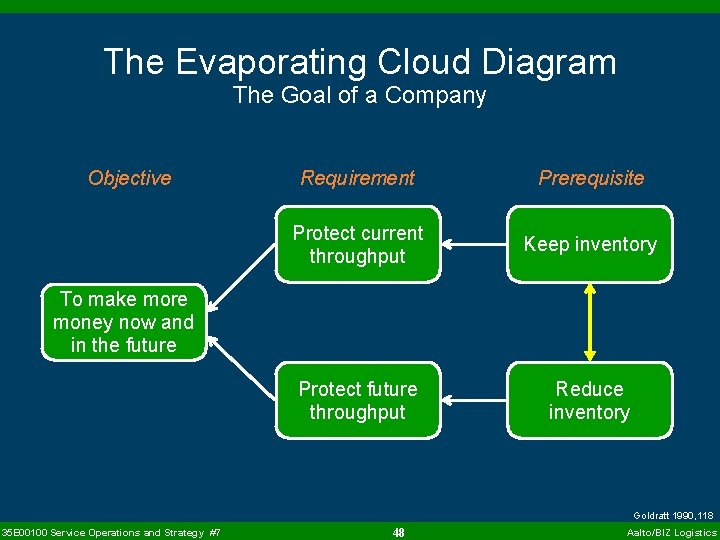
The Evaporating Cloud Diagram The Goal of a Company Objective Requirement Prerequisite Protect current throughput Keep inventory Protect future throughput Reduce inventory To make more money now and in the future Goldratt 1990, 118 35 E 00100 Service Operations and Strategy #7 48 Aalto/BIZ Logistics
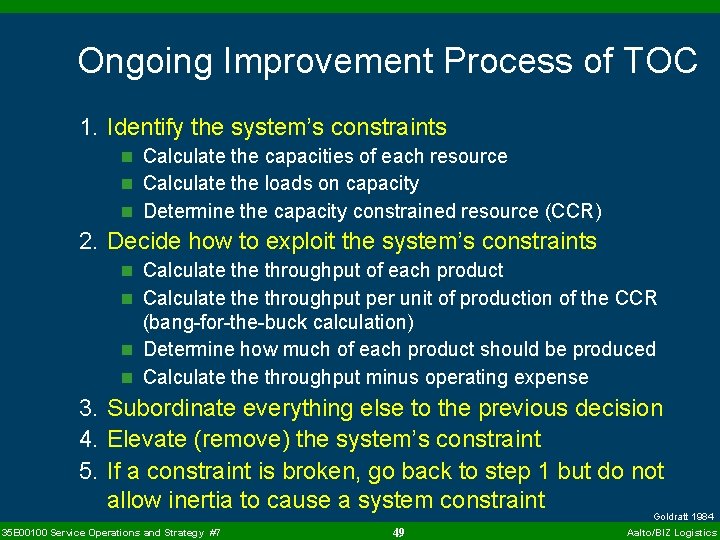
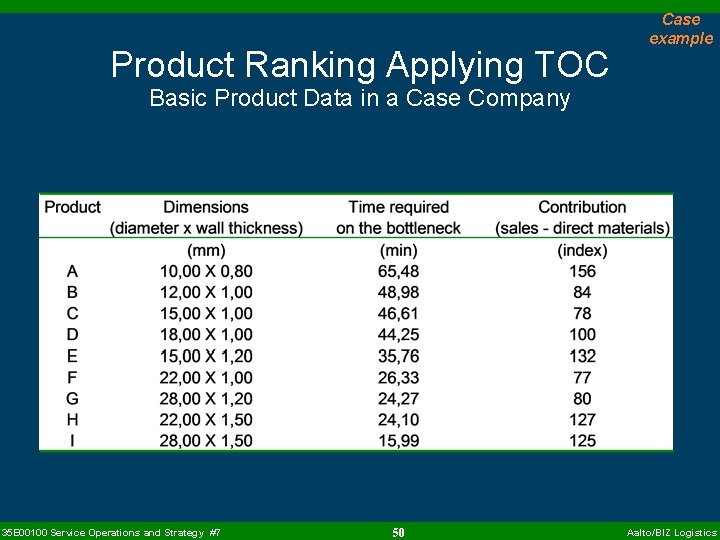
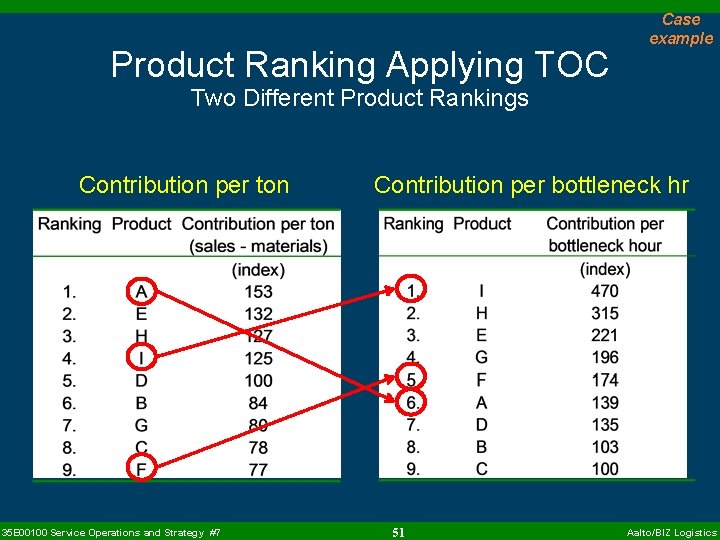
Ongoing Improvement Process of TOC 1. Identify the system’s constraints n Calculate the capacities of each resource n Calculate the loads on capacity n Determine the capacity constrained resource (CCR) 2. Decide how to exploit the system’s constraints n Calculate throughput of each product n Calculate throughput per unit of production of the CCR (bang-for-the-buck calculation) n Determine how much of each product should be produced n Calculate throughput minus operating expense 3. Subordinate everything else to the previous decision 4. Elevate (remove) the system’s constraint 5. If a constraint is broken, go back to step 1 but do not allow inertia to cause a system constraint Goldratt 1984 35 E 00100 Service Operations and Strategy #7 49 Aalto/BIZ Logistics
Product Ranking Applying TOC Case example Basic Product Data in a Case Company 35 E 00100 Service Operations and Strategy #7 50 Aalto/BIZ Logistics
Product Ranking Applying TOC Case example Two Different Product Rankings Contribution per ton 35 E 00100 Service Operations and Strategy #7 Contribution per bottleneck hr 51 Aalto/BIZ Logistics
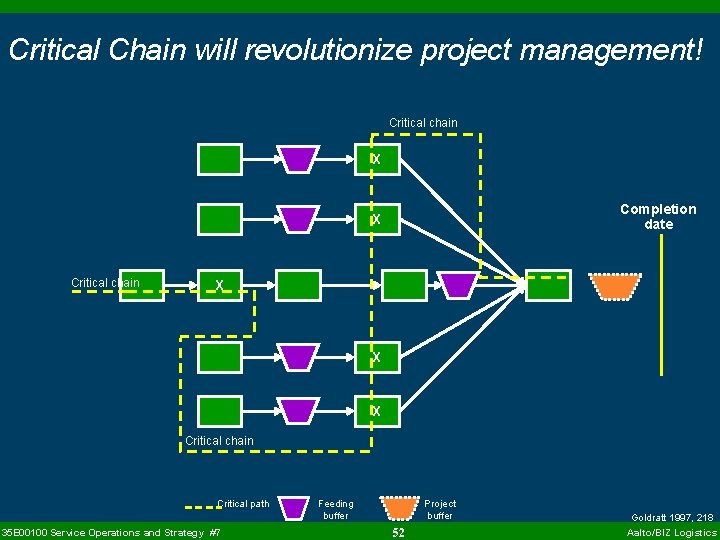
Critical Chain will revolutionize project management! Critical chain X Completion date X Critical chain X X X Critical chain Critical path 35 E 00100 Service Operations and Strategy #7 Feeding buffer Project buffer 52 Goldratt 1997, 218 Aalto/BIZ Logistics
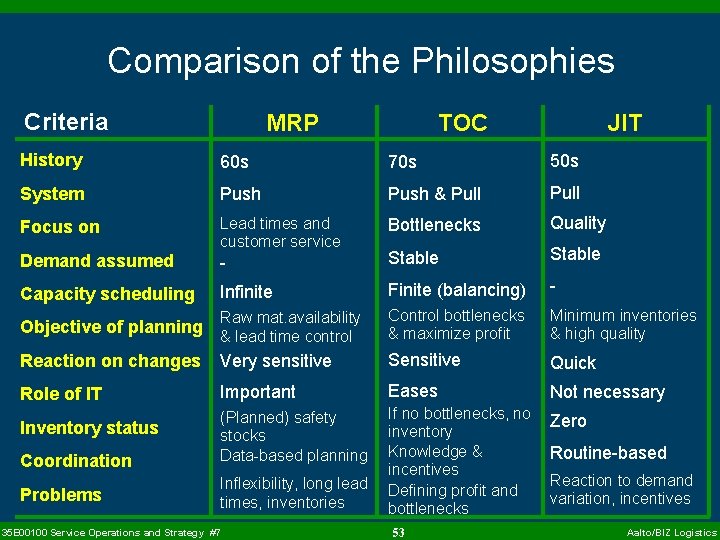
Comparison of the Philosophies Criteria MRP TOC JIT History 60 s 70 s 50 s System Push & Pull Focus on Lead times and customer service Bottlenecks Quality - Stable Infinite Finite (balancing) - Raw mat. availability Control bottlenecks & maximize profit Minimum inventories & high quality Sensitive Quick Important Eases Not necessary Problems Inflexibility, long lead times, inventories If no bottlenecks, no inventory Knowledge & incentives Defining profit and bottlenecks Zero Coordination (Planned) safety stocks Data-based planning Demand assumed Capacity scheduling Objective of planning & lead time control Reaction on changes Very sensitive Role of IT Inventory status 35 E 00100 Service Operations and Strategy #7 53 Routine-based Reaction to demand variation, incentives Aalto/BIZ Logistics
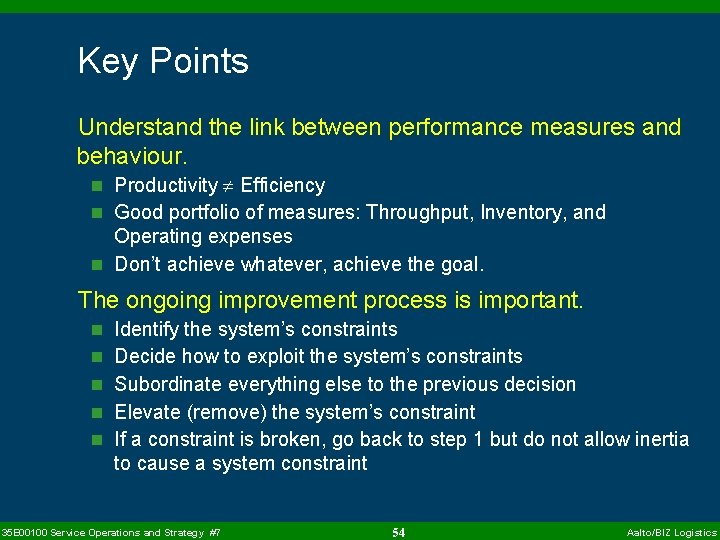
Key Points Understand the link between performance measures and behaviour. n Productivity Efficiency n Good portfolio of measures: Throughput, Inventory, and Operating expenses n Don’t achieve whatever, achieve the goal. The ongoing improvement process is important. n Identify the system’s constraints n Decide how to exploit the system’s constraints n Subordinate everything else to the previous decision n Elevate (remove) the system’s constraint n If a constraint is broken, go back to step 1 but do not allow inertia to cause a system constraint 35 E 00100 Service Operations and Strategy #7 54 Aalto/BIZ Logistics
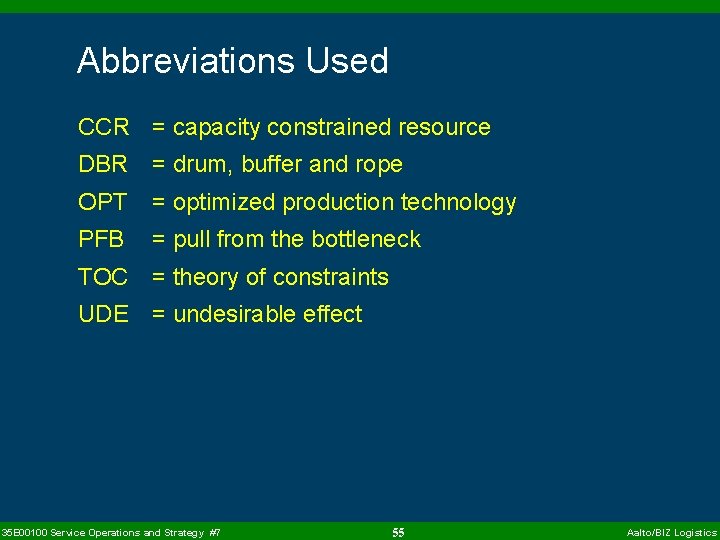
Abbreviations Used CCR = capacity constrained resource DBR = drum, buffer and rope OPT = optimized production technology PFB = pull from the bottleneck TOC = theory of constraints UDE = undesirable effect 35 E 00100 Service Operations and Strategy #7 55 Aalto/BIZ Logistics