
Material Design Development Week 4 Class A B
Material Design & Development Week 4 Class A & B Sample Lesson 1 Processing Bicycle Metaphor EIF & Scaffolding
Housekeeping: Name Cards Name: _________ English Nickname: _____ Email address: _______ Phone #: _________ Something about your self: ____________________ Your Picture
Homework for Next Week • Read answer the questions to Tomlinson’s “Introduction to Materials Development” p. 195 (Qs) 197 -209 (reading). Reflection on Homework • Discuss in small groups or with a partner: – What is the productive skills framework and what happens in each stage?

Processing The Lesson • What are the productive skills? What are the receptive skills? What skill was taught in this lesson? • Look at the lesson plan on pages…and fill in the missing stages – E (encounter) – E/I (encounter & internalize) – I (internalize) – F (fluency)
Processing The Lesson • How was Ss prior knowledge assessed? • What were the materials I used in this lesson? Make a list?

Materials Used in Sample Lesson 1 • Pictures (laminated ones on walls, on desk) • Power. Point (visuals for activities, patterns for guided practice, scaffolding & support language) • Word Cards • The monkey • worksheets (picture puzzle & sample sentences, graphic organizer, survey) • WB (especially for listing Ss prior knowledge, modeling graphic organizer and listing famous people) • Students • Teacher Re-grouping at end of lesson
Your First Lesson Plan • Draw an triangle on a piece of paper. • What steps are there to teach someone to ride a bike? • List the steps on your paper. • Put the first step at the top of the triangle and the last step at the bottom Last First
Your First Lesson Plan • Read through your lesson plan and label the stages E-I-F. • Look at your last step: Did you give your learner a clear task to let them demonstrate their SLO? • Write an SLO of this lesson plan using the formula you learned in this lesson. • Did you miss any steps? Add them in. Last First
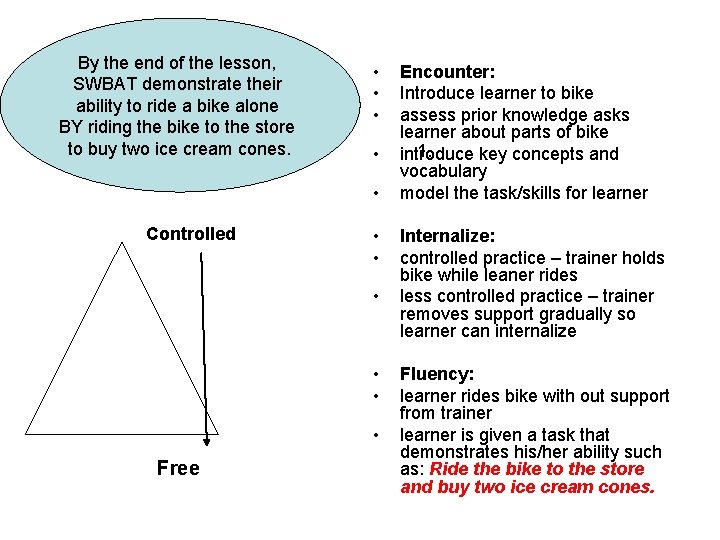
By the end of the lesson, SWBAT demonstrate their ability to ride a bike alone BY riding the bike to the store to buy two ice cream cones. • • • Controlled • • • Free Encounter: Introduce learner to bike assess prior knowledge asks learner about parts of bike 1. introduce key concepts and vocabulary model the task/skills for learner Internalize: controlled practice – trainer holds bike while leaner rides less controlled practice – trainer removes support gradually so learner can internalize Fluency: learner rides bike with out support from trainer learner is given a task that demonstrates his/her ability such as: Ride the bike to the store and buy two ice cream cones.

Scaffolding • SLA Definition: – scaffolding explains how learning occurs as a result of “support coming from a more knowledgeable other that leads the learner to internalize what is being learned. ” (Ko, Schallert and Walters (2003). • Materials Development Definition – scaffolding denotes the language support that the teacher or material developer builds into the productive skill lesson to facilitate the successful learning of the target language

By the end of the lesson, SWBAT demonstrate their ability to ride a bike alone BY riding the bike to the store to buy two ice cream cones. • • • Controlled • • • Free Encounter: Introduce learner to bike assess prior knowledge asks learner about parts of bike 1. introduce key concepts and vocabulary model the task/skills for learner Internalize: controlled practice – trainer holds bike while leaner rides less controlled practice – trainer removes support gradually so learner can internalize Fluency: learner rides bike with out support from trainer learner is given a task that demonstrates his/her ability such as: Ride the bike to the store and buy two ice cream cones.

Visual Support on the box under the box next to the box in the box

EIF E = Encounter Students “encounter” the target language through an activity of some kind (rather than teacher “presenting” the target language) I = Internalize Students “internalize” the target language through practice (controlled practice activities free practice activities) F = Fluency Students “USE” the target language on their own they become fluent in using the target language
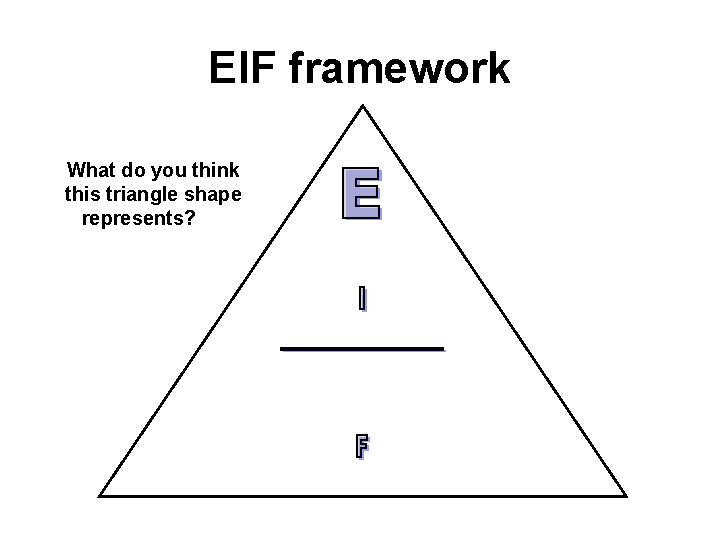
EIF framework What do you think this triangle shape represents?
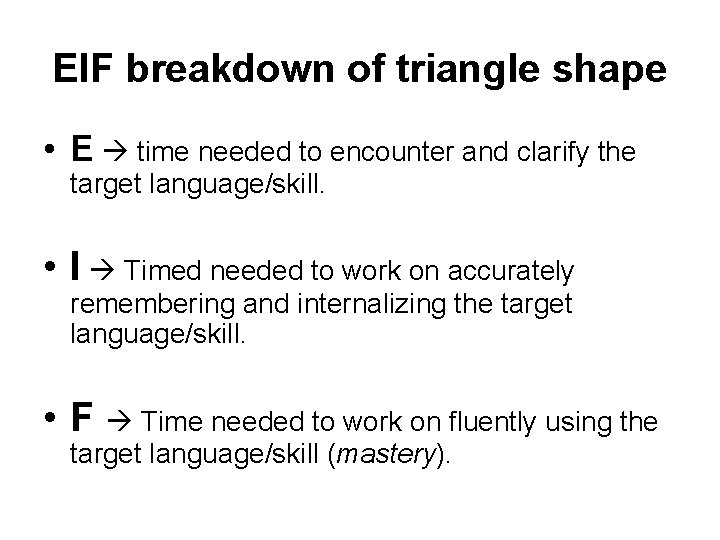
EIF breakdown of triangle shape • E time needed to encounter and clarify the target language/skill. • I Timed needed to work on accurately remembering and internalizing the target language/skill. • F Time needed to work on fluently using the target language/skill (mastery).

• Sometimes the shape of this framework can look similar to a Christmas tree rather than a triangle. • Why do you think this is so?
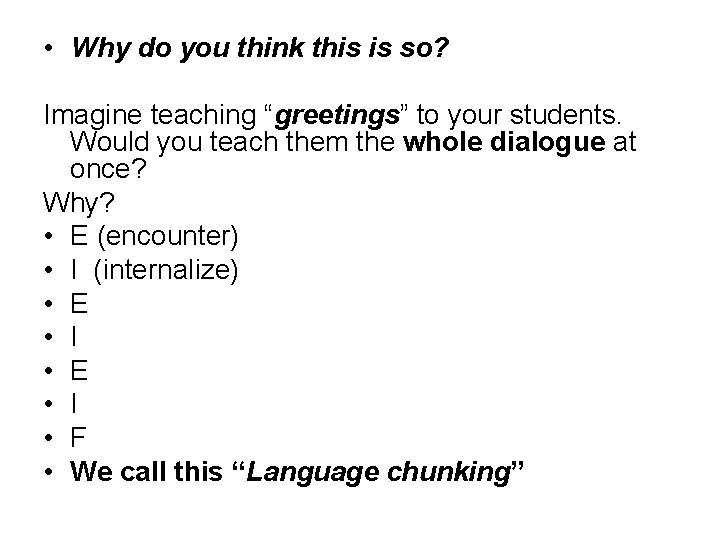
• Why do you think this is so? Imagine teaching “greetings” to your students. Would you teach them the whole dialogue at once? Why? • E (encounter) • I (internalize) • E • I • F • We call this “Language chunking”
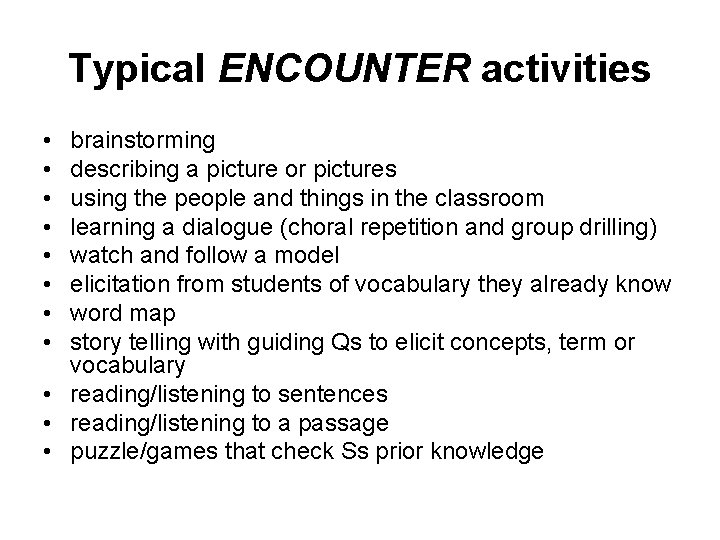
Typical ENCOUNTER activities • • brainstorming describing a picture or pictures using the people and things in the classroom learning a dialogue (choral repetition and group drilling) watch and follow a model elicitation from students of vocabulary they already know word map story telling with guiding Qs to elicit concepts, term or vocabulary • reading/listening to sentences • reading/listening to a passage • puzzle/games that check Ss prior knowledge
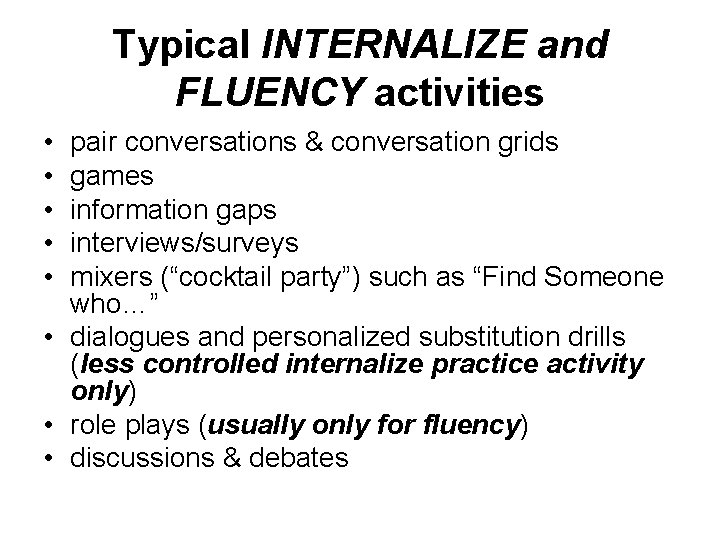
Typical INTERNALIZE and FLUENCY activities • • • pair conversations & conversation grids games information gaps interviews/surveys mixers (“cocktail party”) such as “Find Someone who…” • dialogues and personalized substitution drills (less controlled internalize practice activity only) • role plays (usually only for fluency) • discussions & debates

Is there a difference between dialogues and role-plays? • Dialogue = the script is provided and students read it. (*Substitution of language points in the dialogue is also common “dialogue” activity). • Role-play = the script is not provided. Students use the language they have learned on their own in a situation provided by the teacher.
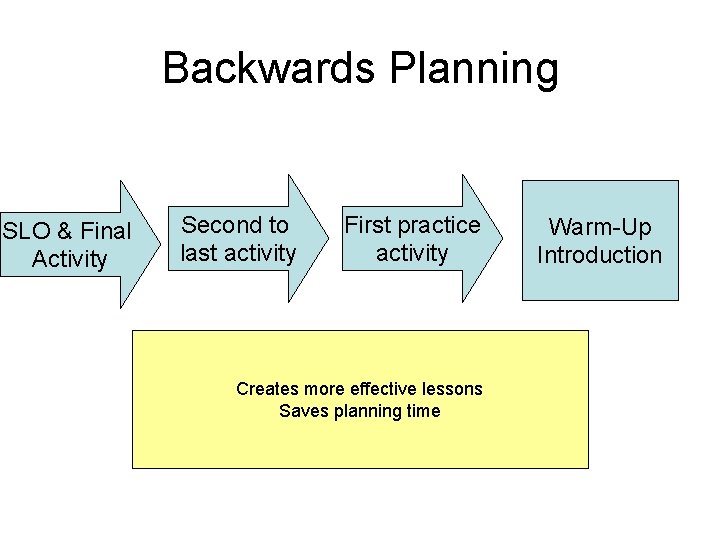
Backwards Planning SLO & Final Activity Second to last activity First practice activity Creates more effective lessons Saves planning time Warm-Up Introduction
- Slides: 22