
MATERIAL BALANCE ON NONREACTIVE MULTIPLE UNIT PROCESS MOHD
MATERIAL BALANCE ON NONREACTIVE MULTIPLE UNIT PROCESS MOHD SHARIZAN MD SARIP, PHD
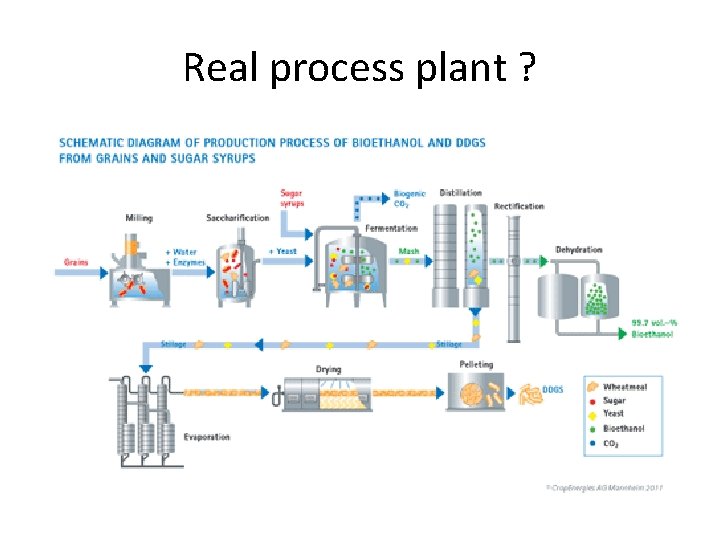
Real process plant ?
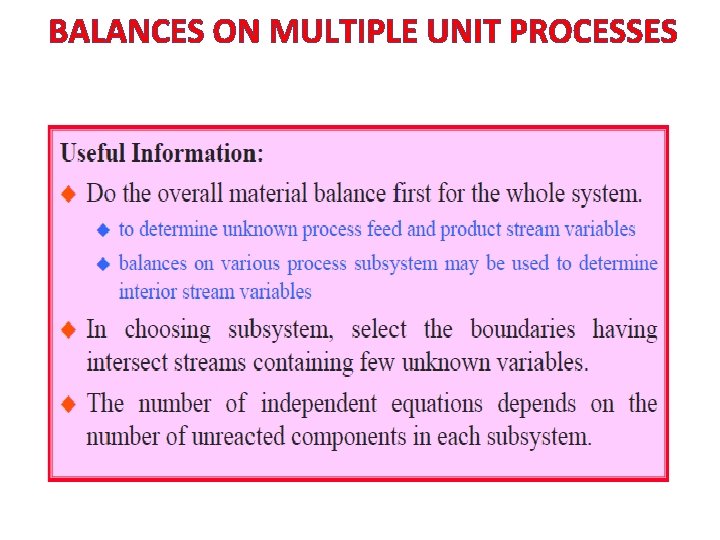
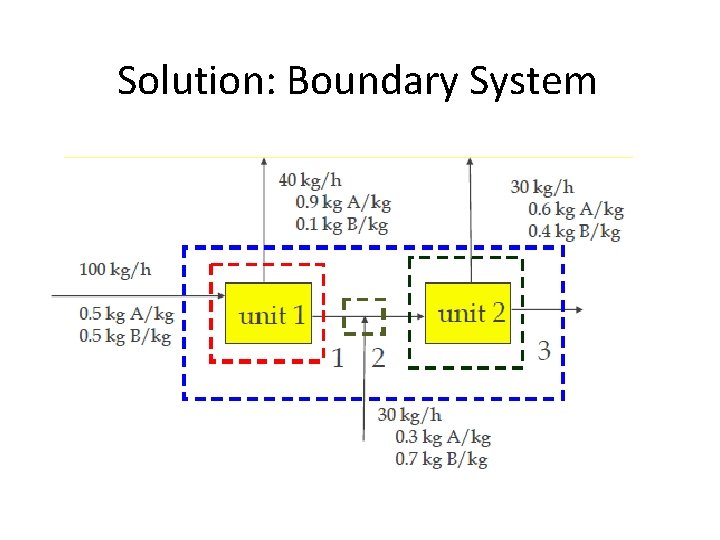
BALANCES ON MULTIPLE UNIT PROCESSES • In real chemical industries, generally, more than one unit processes exist (e. g products produced from reactor are separated using separator) • In order to solve material balance problem, BOUNDARY SYSTEM is introduced. • BOUNDARY SYSTEM: – Any portion of process that can be enclosed within a boundary (hypothetical box) – It can be the : • Entire process, • An interconnected of process unit, • A single unit, • A point which two or more stream come together into one stream or one stream splits into two or more stream. – The inputs and outputs to a system are the process streams that are intersect to the system boundary
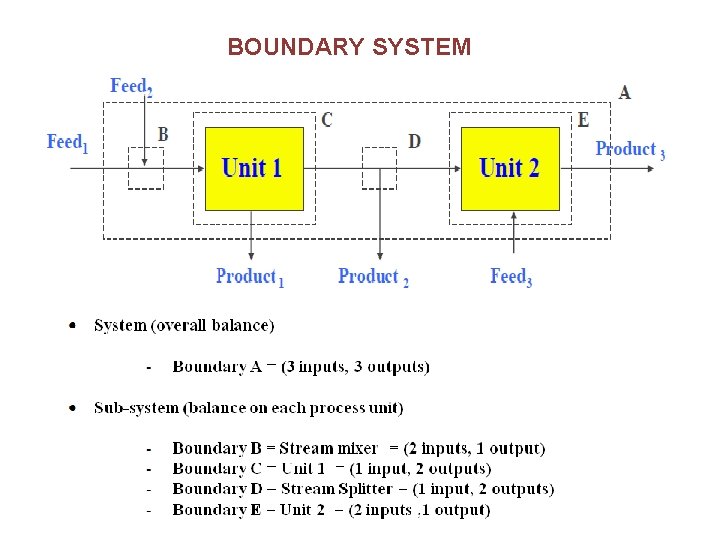
BOUNDARY SYSTEM
BALANCES ON MULTIPLE UNIT PROCESSES
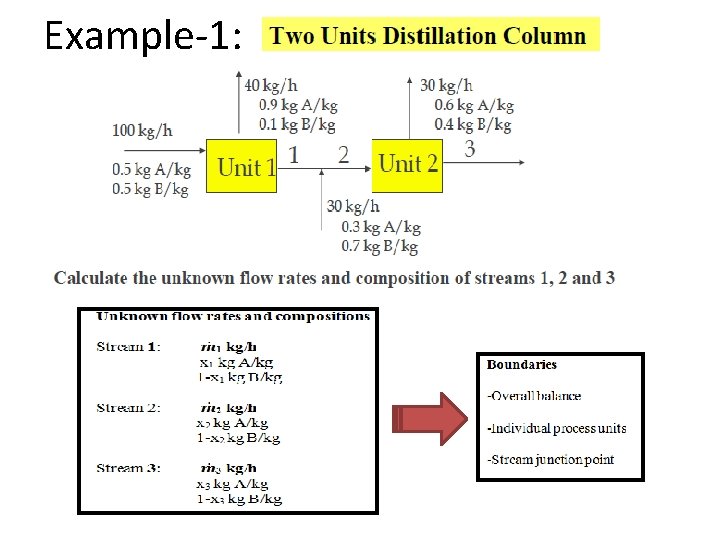
Example-1:
Solution: Boundary System
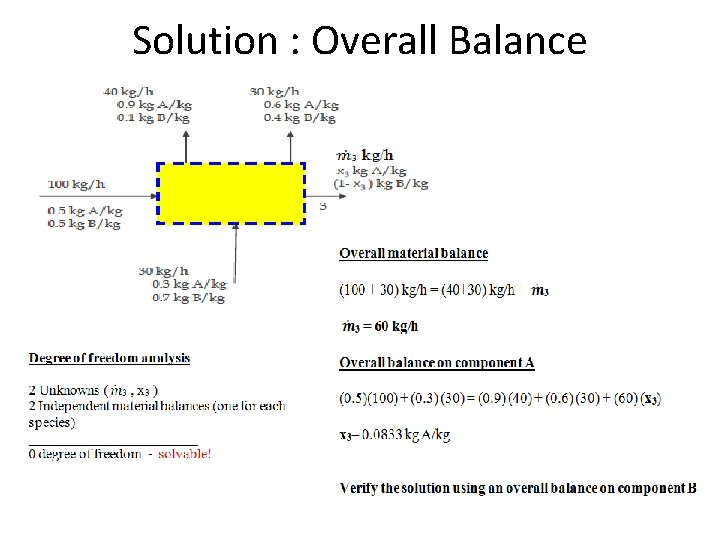
Solution : Overall Balance
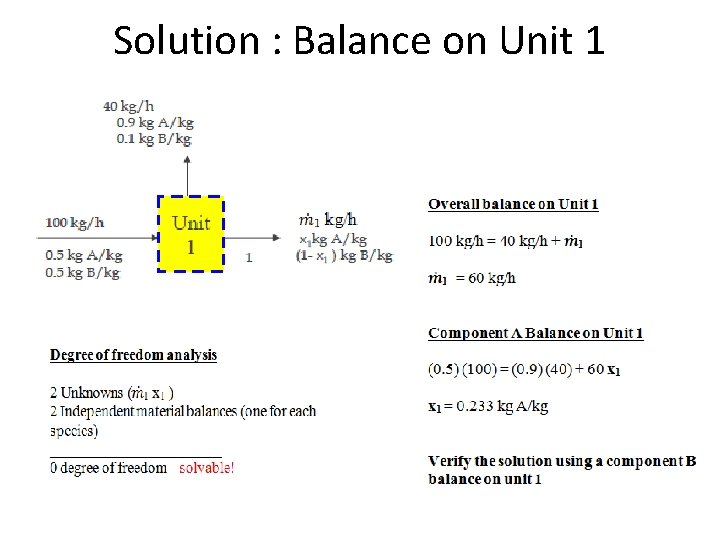
Solution : Balance on Unit 1
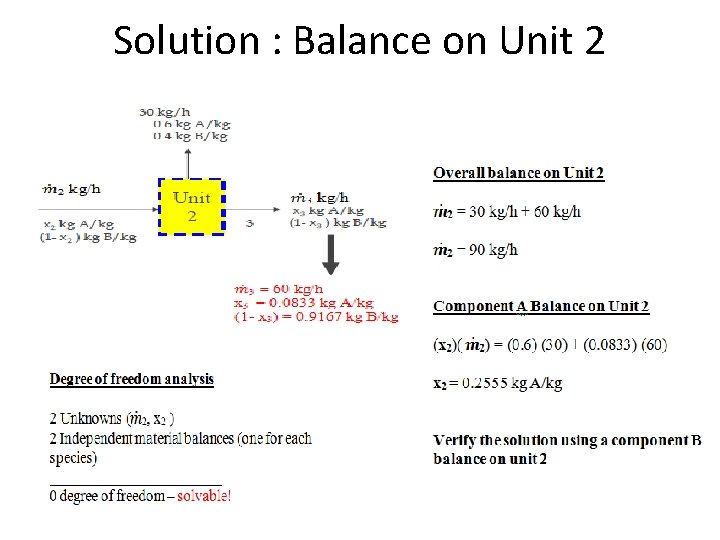
Solution : Balance on Unit 2
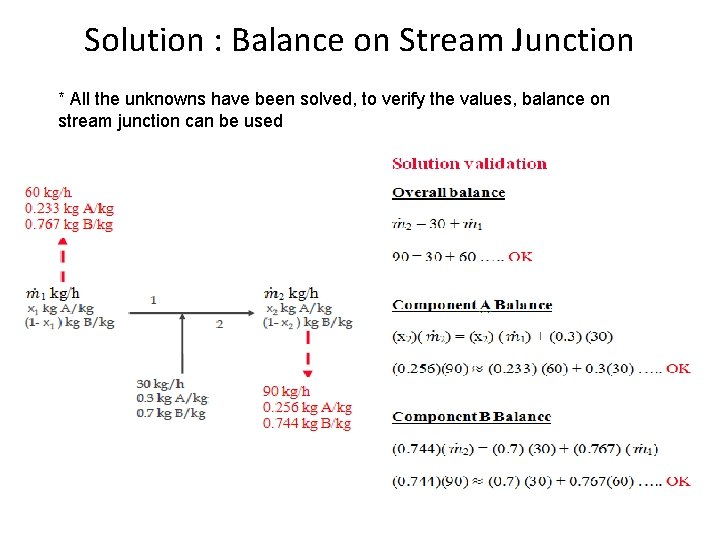
Solution : Balance on Stream Junction * All the unknowns have been solved, to verify the values, balance on stream junction can be used
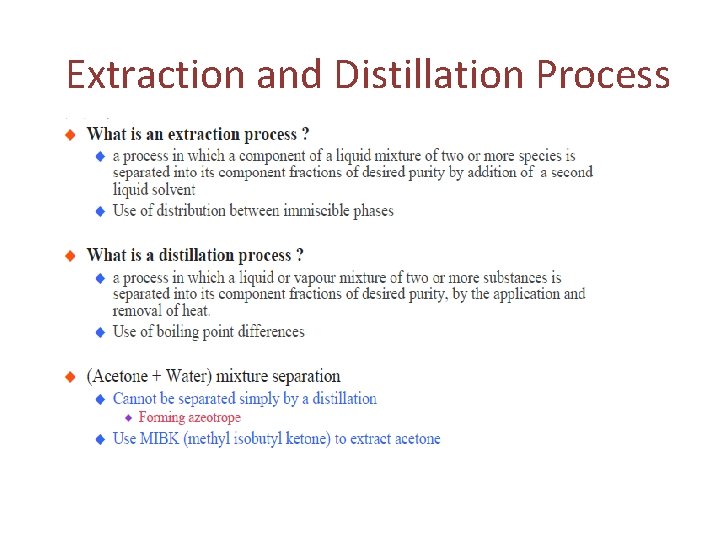
Extraction and Distillation Process
Evaporator and crystallization • An evaporator is a device in a process used to turn the liquid form of a chemical substance such as water into its gaseous-form/vapor. The liquid is evaporated, or vaporized, into a gas form of the targeted substance in that process. • Crystallization is the (natural or artificial) process by which a solid forms, where the atoms or molecules are highly organized into a structure known as a crystal.
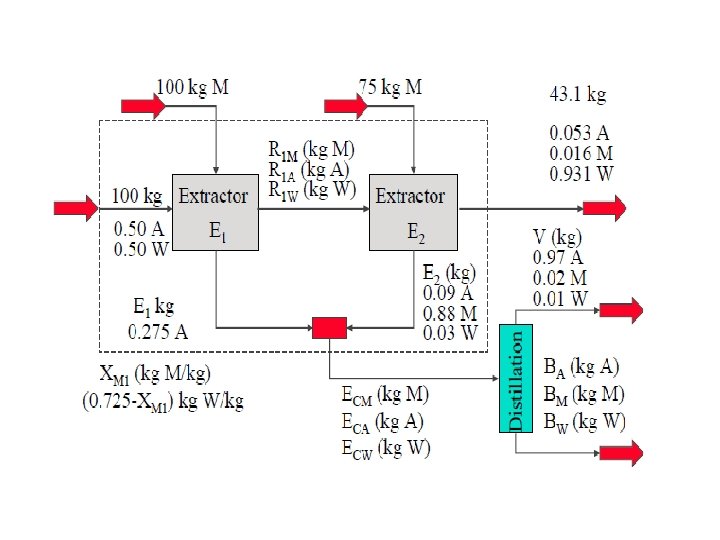
Problem Example In a pilot plant study, for every 100 kg acetone-water fed to the first extractor, 100 kg MIBK are fed to the first extractor and 75 kg MIBK are fed to the second extractor. The extract from the first stage is found to contain 27. 5% acetone. The second-stage raffinate has a mass of 43. 1 kg, and consists of 5. 3 % acetone, 1. 3% MIBK and 93. 1% water and the second stage extract contains 9. 0% acetone, 88% MIBK and 3% water. The overhead product from the distillation column contains 2. 0% MIBK, 1% water, and the balance acetone. For an assumed basis 100 kg acetone-water feed, calculate the masses and compositions (component percentages by mass) of the stage 1 raffinate and extract, the stage 2 extract, the combined extract, and the distillation overhead and bottoms products.
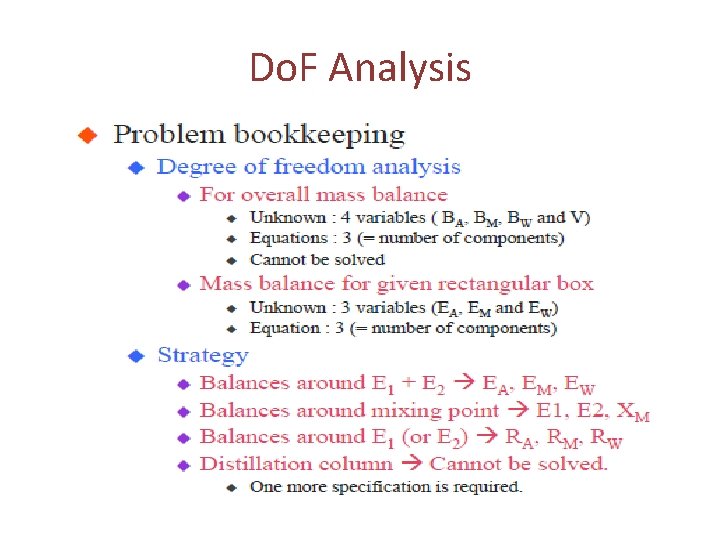
Do. F Analysis
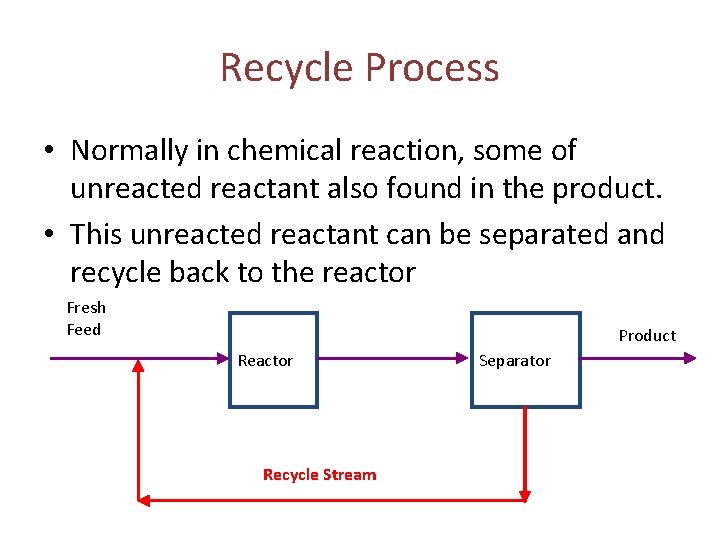
Recycle Process • Normally in chemical reaction, some of unreacted reactant also found in the product. • This unreacted reactant can be separated and recycle back to the reactor Fresh Feed Product Reactor Recycle Stream Separator
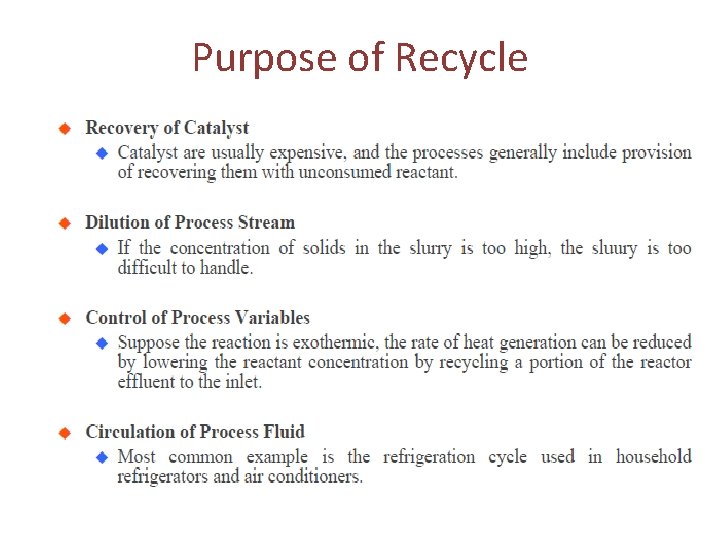
Purpose of Recycle
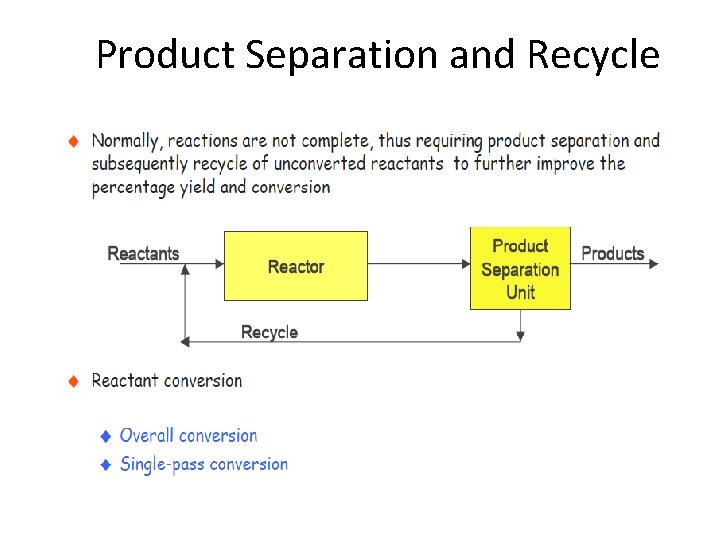
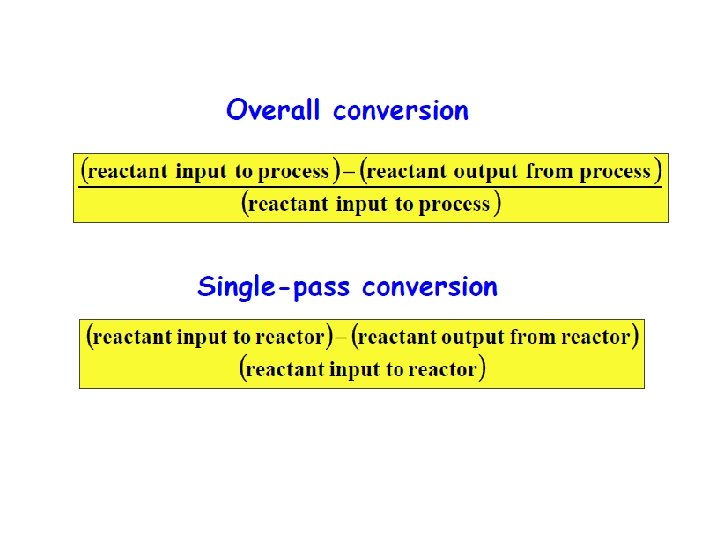
Product Separation and Recycle
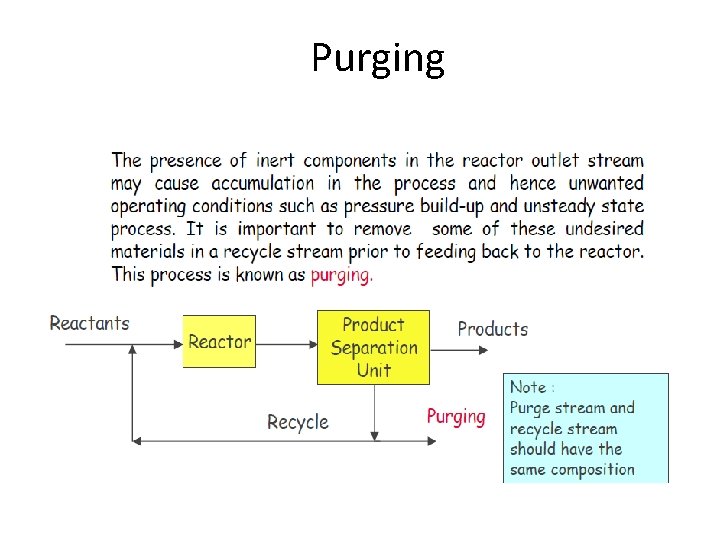
Purging
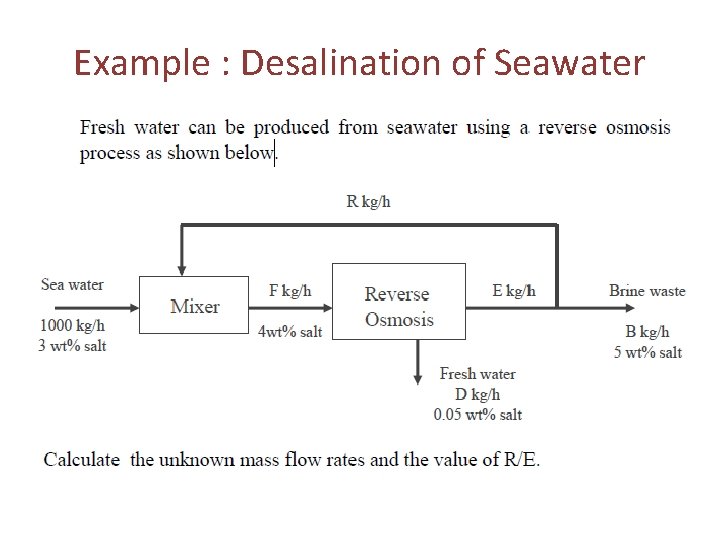
Example : Desalination of Seawater
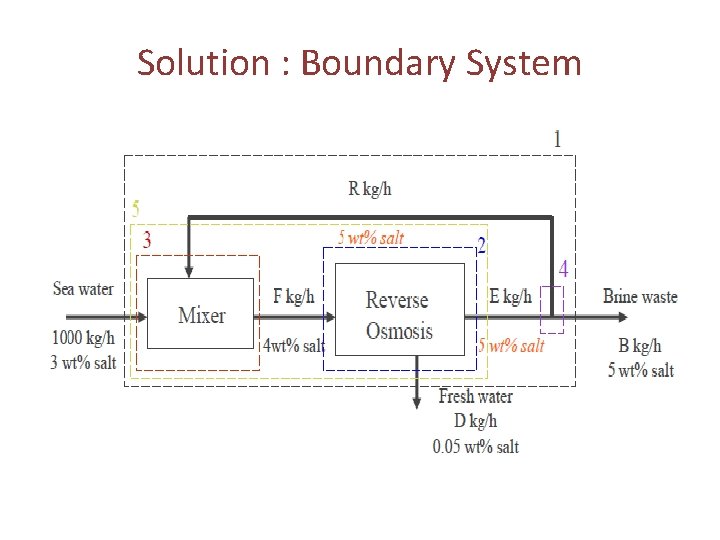
Solution : Boundary System
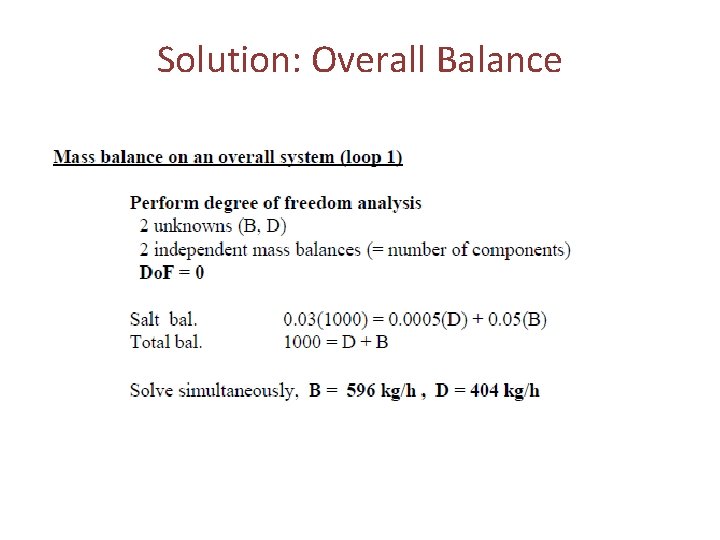
Solution: Overall Balance
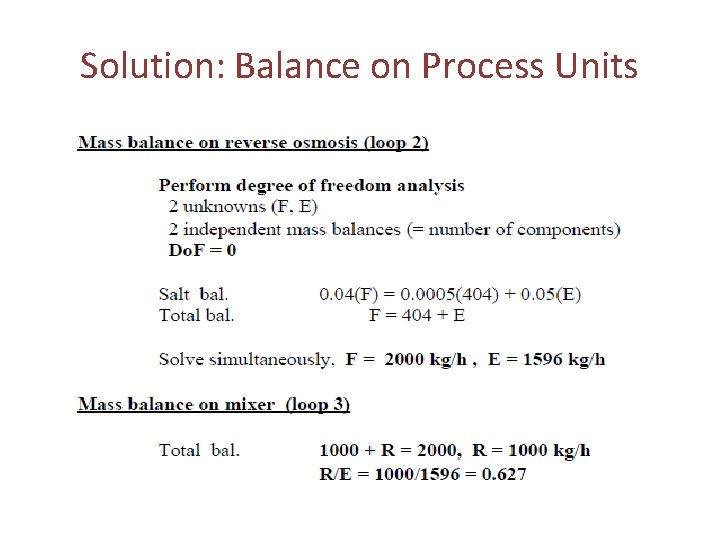
Solution: Balance on Process Units
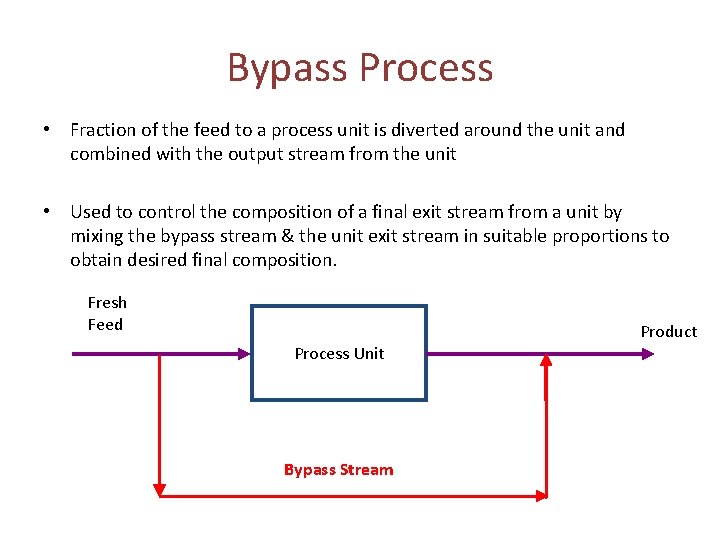
Bypass Process • Fraction of the feed to a process unit is diverted around the unit and combined with the output stream from the unit • Used to control the composition of a final exit stream from a unit by mixing the bypass stream & the unit exit stream in suitable proportions to obtain desired final composition. Fresh Feed Product Process Unit Bypass Stream
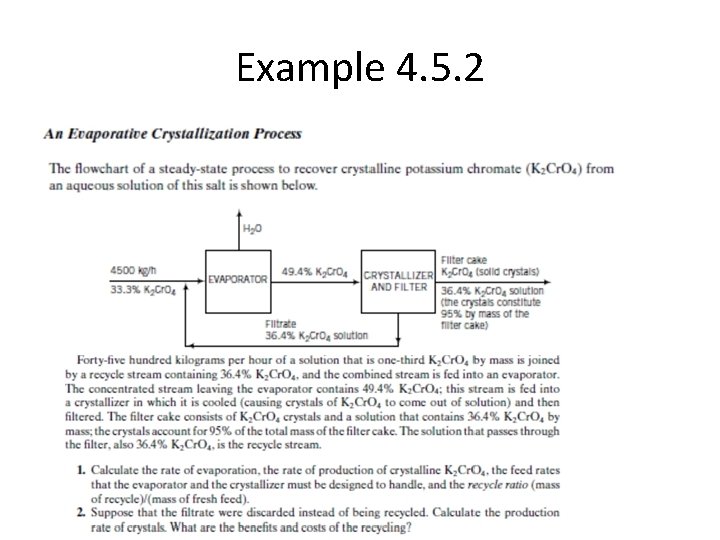
Example 4. 5. 2
Question 4. 32 Fresh orange juice contains 12. 0 wt% solids and the balance water, and concentrated orange juice contains 42. 0 wt% solids. Initially a single evaporation process was used for the concentration, but volatile constituents of the juice escaped with the water, leaving the concentrate with a flat taste. The current process overcomes this problem by bypassing the evaporator with a fraction of the fresh juice. The juice that enters the evaporator is concentrated to 58 wt% solids, and the evaporator product stream is mixed with the bypassed fresh juice to achieve the desired final concentration. a. Draw and label a flowchart of this process, neglecting the vaporization of everything in the juice but water. First prove that the subsystem containing the point where the bypass stream splits off from the evaporator feed has one degree of freedom. (If you think it has zero degrees, try determining the unknown variables associated with this system. ) Then perform the degree-off reedom analysis for the overall system, the evaporator, and the bypass– evaporator product mixing point, and write in order the equations you would solve to determine all unknown stream variables. In each equation, circle the variable for which you would solve, but don’t do any calculations. b. Calculate the amount of product (42% concentrate) produced per 100 kg fresh juice fed to the process and the fraction of the feed that bypasses the evaporator. c. Most of the volatile ingredients that provide the taste of the concentrate are contained in the fresh juice that bypasses the evaporator. You could get more of these ingredients in the final product by evaporating to (say) 90% solids instead of 58%; you could then bypass greater fraction of the fresh juice and hereby obtain an even better tasting product. Suggest possible drawbacks to this proposal.
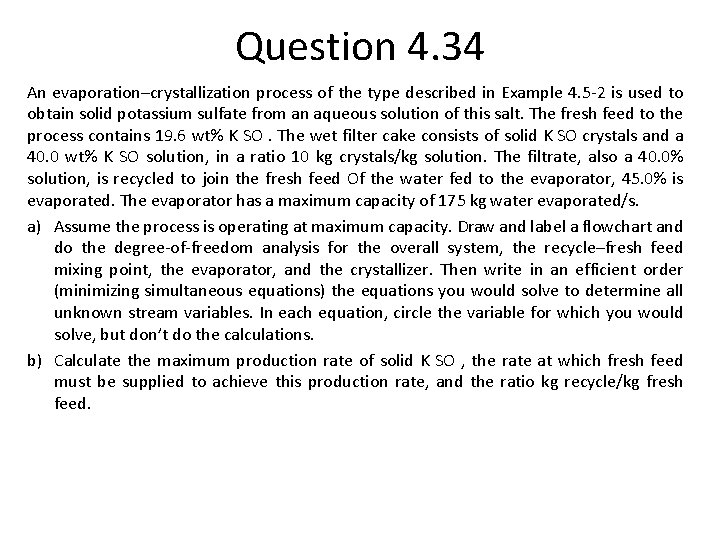
Question 4. 34 An evaporation–crystallization process of the type described in Example 4. 5 -2 is used to obtain solid potassium sulfate from an aqueous solution of this salt. The fresh feed to the process contains 19. 6 wt% K SO. The wet filter cake consists of solid K SO crystals and a 40. 0 wt% K SO solution, in a ratio 10 kg crystals/kg solution. The filtrate, also a 40. 0% solution, is recycled to join the fresh feed Of the water fed to the evaporator, 45. 0% is evaporated. The evaporator has a maximum capacity of 175 kg water evaporated/s. a) Assume the process is operating at maximum capacity. Draw and label a flowchart and do the degree-of-freedom analysis for the overall system, the recycle–fresh feed mixing point, the evaporator, and the crystallizer. Then write in an efficient order (minimizing simultaneous equations) the equations you would solve to determine all unknown stream variables. In each equation, circle the variable for which you would solve, but don’t do the calculations. b) Calculate the maximum production rate of solid K SO , the rate at which fresh feed must be supplied to achieve this production rate, and the ratio kg recycle/kg fresh feed.
Assignment 2 • Question 4. 34 • Question 4. 35 Submit on 10 April 2018
- Slides: 30