
Matching Algorithms and Networks This lecture Matching problem

Matching Algorithms and Networks

This lecture • Matching: problem statement and applications • Bipartite matching (recap) • Matching in arbitrary undirected graphs: Edmonds algorithm • Diversion: generalized tic-tac-toe 2 Algorithms and Networks: Matching

1 Problem and applications

Matching • 4 Algorithms and Networks: Matching

Matching Not a maximal matching, Not a maximum matching Not a perfect matching 5 Algorithms and Networks: Matching
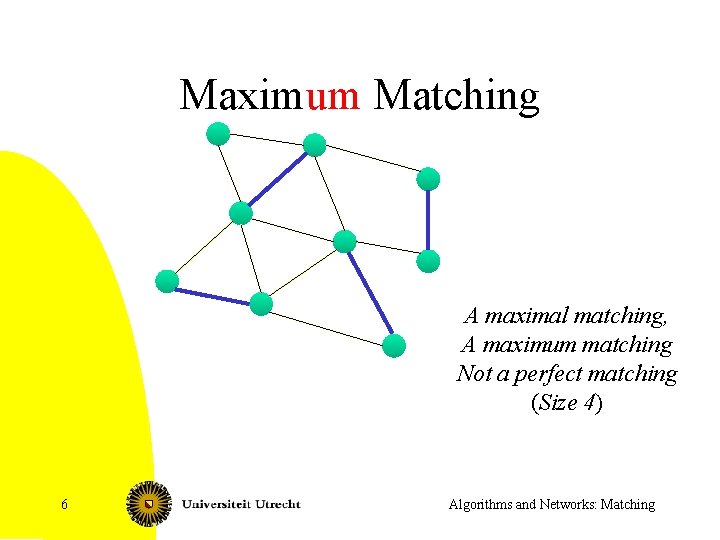
Maximum Matching A maximal matching, A maximum matching Not a perfect matching (Size 4) 6 Algorithms and Networks: Matching

Maximal Matching A maximal matching, Not a maximum matching Not a perfect matching (Size: 3) 7 Algorithms and Networks: Matching
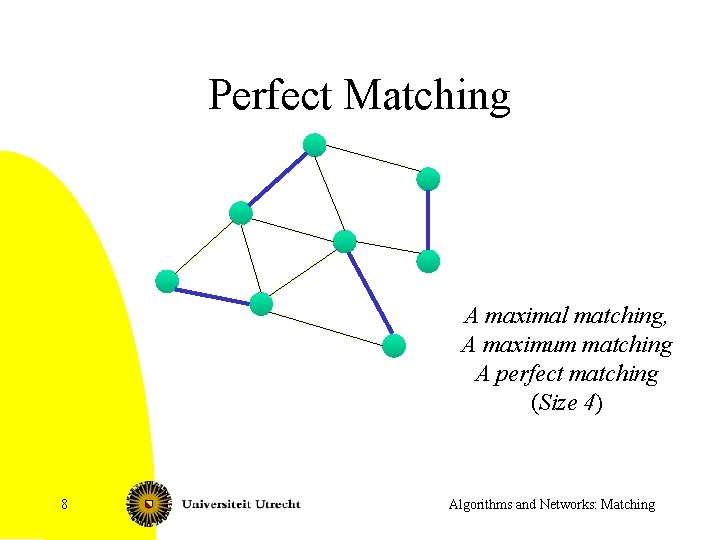
Perfect Matching A maximal matching, A maximum matching A perfect matching (Size 4) 8 Algorithms and Networks: Matching

Cost versions • Each edge has cost; look for perfect matching with minimum cost • Also polynomial time solvable, but harder 9 Algorithms and Networks: Matching

Problems • 10 Algorithms and Networks: Matching

Applications (1) • Classroom assignment • Scheduling • Opponents selection for sport competitions – In a chess (or tennis, or …) club, we have n players, that must be paired to play a match, each week. Some players have played already to each other, and we have rating differences. 11 Algorithms and Networks: Matching

Applications (2) • Personnel assignment (bipartite graphs): – We have n employees and n jobs. Each employee i has a proficiency index u(i, j) for job j. What assignment maximizes the total proficiency? – Our company is international. We have a number of jobs abroad, and a number of employees. For each combination of a job and employee, we have: • The information: can this employee do this job? • The cost of moving the employee with his family to the new location –… 12 Algorithms and Networks: Matching
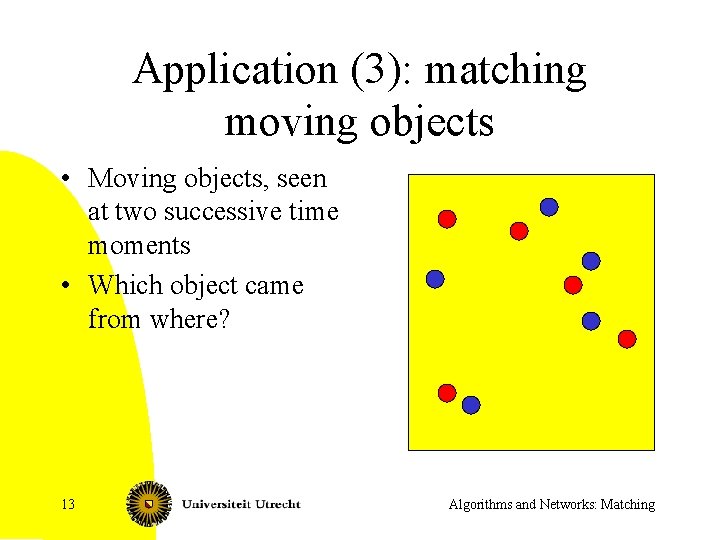
Application (3): matching moving objects • Moving objects, seen at two successive time moments • Which object came from where? 13 Algorithms and Networks: Matching

Application (3): matching moving objects • Moving objects, seen at two successive time moments • Which object came from where? 14 Maybe… Algorithms and Networks: Matching
2 Bipartite matching (recap)

Bipartite graphs: using maximum flow algorithms • Finding maximum matching in bipartite graphs: – Model as flow problem, and solve it: make sure algorithm finds integral flow. Capacities 1 s 16 t Algorithms and Networks: Matching

Technique works for variants too • 17 Algorithms and Networks: Matching
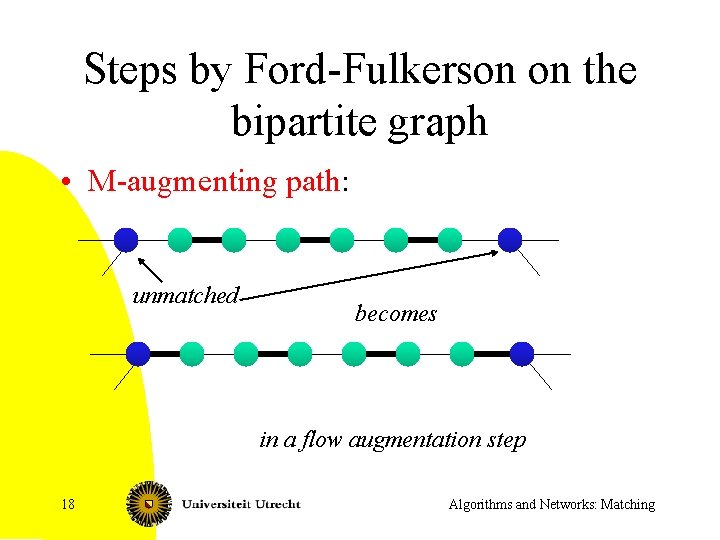
Steps by Ford-Fulkerson on the bipartite graph • M-augmenting path: unmatched becomes in a flow augmentation step 18 Algorithms and Networks: Matching

A simple non-constructive proof of a well known theorem Theorem. Each regular bipartite graph has a perfect matching. Proof: – Construct flow model of G. Set flow of edges from s, or to t to 1, and other edges flow to 1/d. – This flow has value n/2, which is optimal. – Ford-Fulkerson will find integral flow of value n/2; which corresponds to perfect matching. 19 Algorithms and Networks: Matching

3 Edmonds algorithm: matching in (possibly non-bipartite) undirected graphs

A theorem that also works when the graph is not bipartite • 21 Algorithms and Networks: Matching

Algorithm of Edmonds • Finds maximum matching in a graph in polynomial time 22 Algorithms and Networks: Matching
Jack Edmonds 23 Algorithms and Networks: Matching

Jack Edmonds 24 Algorithms and Networks: Matching
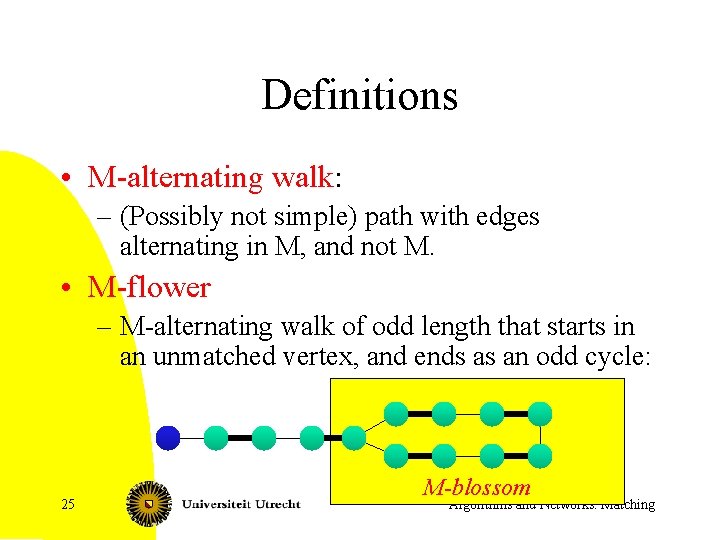
Definitions • M-alternating walk: – (Possibly not simple) path with edges alternating in M, and not M. • M-flower – M-alternating walk of odd length that starts in an unmatched vertex, and ends as an odd cycle: 25 M-blossom Algorithms and Networks: Matching
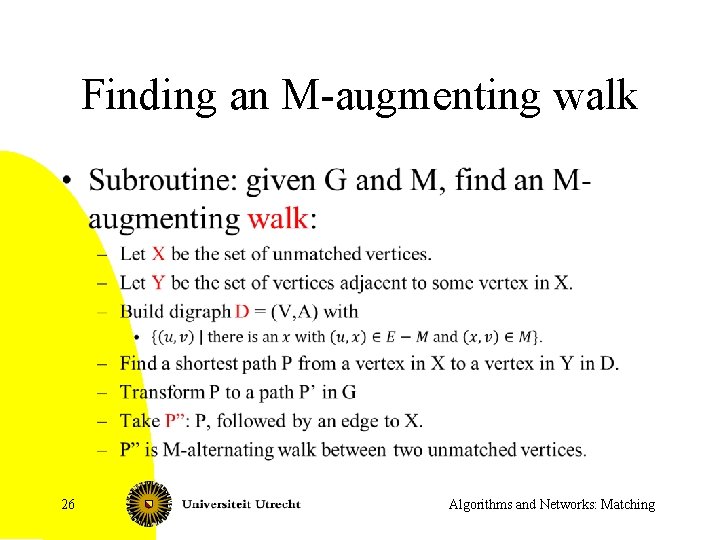
Finding an M-augmenting walk • 26 Algorithms and Networks: Matching

Finding M-augmenting path or M -flower Look at the path P” we just found. Two cases: • P” is a simple path: it is an M-augmenting path • P” is not simple. Look to start of P” until the first time a vertex is visited for the second time. – This is an M-flower: • Cycle-part of walk cannot be of even size, as it then can be removed and we have a shorter walk in D. 27 Algorithms and Networks: Matching
Algorithmic idea • Start with some matching M, and find either M-augmenting path or M-blossom. • If we find an M-augmenting path: – Augment M, and obtain matching of one larger size; repeat. • If we find an M-blossom, we shrink it, and obtain an equivalent smaller problem; recurs. 28 Algorithms and Networks: Matching
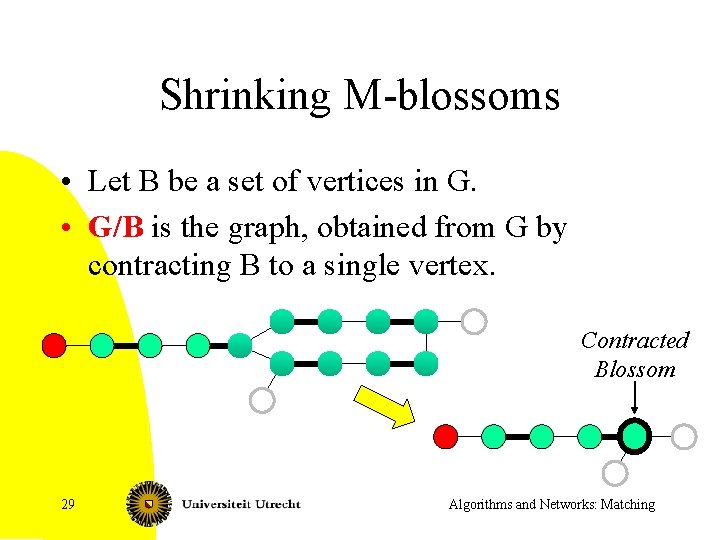
Shrinking M-blossoms • Let B be a set of vertices in G. • G/B is the graph, obtained from G by contracting B to a single vertex. Contracted Blossom 29 Algorithms and Networks: Matching

Theorem • Theorem: Let B be an M-blossom. Then M has an augmenting path iff M/B has an augmenting path in G/B. – Suppose G/B has an M/B-augmenting path P. • P does not traverse the vertex representing B: P also M-augmenting path in G. • P traverses B: lift to M-augmenting path in G (case analysis). 30 Algorithms and Networks: Matching

Case 1 a: P passes through B M/B-Augmenting Path in G/B M-Augmenting Path in G 31 Algorithms and Networks: Matching
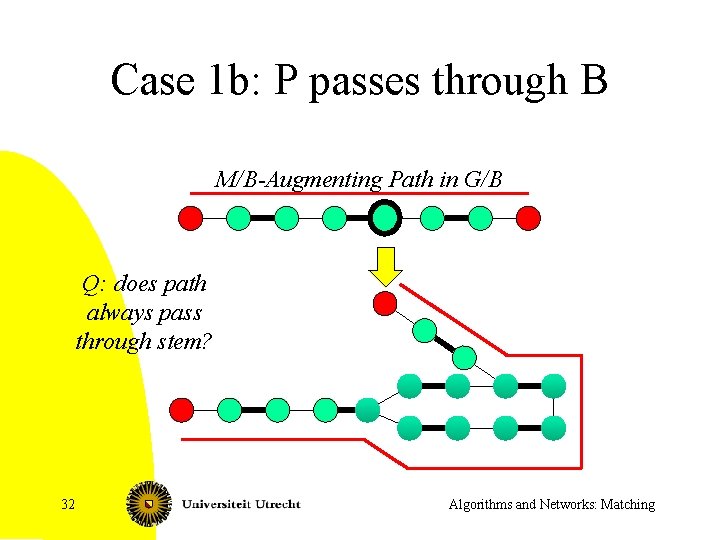
Case 1 b: P passes through B M/B-Augmenting Path in G/B Q: does path always pass through stem? 32 Algorithms and Networks: Matching

Case 2 a: P has B as endpoint Q: when does this case occur? 33 Algorithms and Networks: Matching

Case 2 b: P has B as endpoint 34 Algorithms and Networks: Matching

Converse • Flip stem so that B is unmatched to obtain M’. • Suppose G has M’-augmenting path P. • If P does not intersect B then P also M’/B-augmenting path in G/B. • Otherwise, assume P does not start in B, if not reverse P. – Since B is free, the part of P until B is an M’/Baugmenting path. 35 Algorithms and Networks: Matching

Subroutine • Given: Graph G, matching M • Question: Find M-augmenting path if it exists. – Let X be the vertices not endpoint of edge in M. – Build D, and test if there is an M-alternating walk P from X to X of positive length. (Using Y, etc. ) – If no such walk exists: M is maximum matching. – If P is a path: output P. – If P is not a path: • Find M-blossom B on P. • Shrink B, and recurse on G/B and M/B. • If G/B has no M/B-augmenting path, then M is maximum matching. • Otherwise, expand M/B-augmenting path to an M-augmenting path. 36 Algorithms and Networks: Matching

Edmonds algorithm • A maximum matching can be found in O(n 2 m) time. – Start with empty (or any) matching, and repeat improving it with M-augmenting paths until this stops. – O(n) iterations. Recursion depth is O(n); work per recursive call O(m). • A perfect matching in a graph can be found in O(n 2 m) time, if it exists. 37 Algorithms and Networks: Matching

Improvements • Better analysis and data structures gives O(n 3) algorithm. • Faster is possible: O(n 1/2 m) time. • Minimum cost matchings with more complicated structural ideas. 38 Algorithms and Networks: Matching

5 Diversion: multidimensional tic-tactoe

Trivial drawing strategies in multidimensional tic-tac-toe • Tic-tac-toe • Generalizations – More dimensions – Larger board size • Who has a winning strategy? – Either first player has winning strategy, or second player has drawing strategy 40 Algorithms and Networks: Matching

Trivial drawing strategy • If lines are long enough: pairing of squares such that each line has a pair • If player 1 plays in a pair, then player 2 plays to other square in pair 41 v j c d j i b i u e a h h e a u g d g f b c f v Algorithms and Networks: Matching

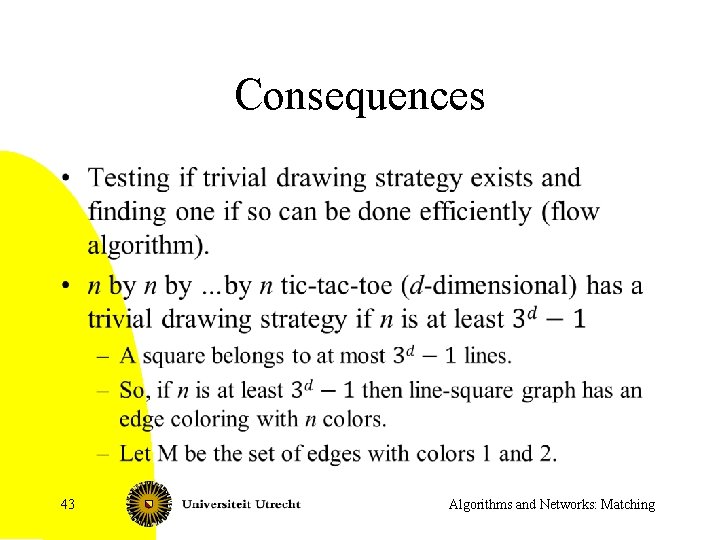
Trivial drawing strategies and generalized matchings • Bipartite graph: line-vertices and square-vertices; edge when square is part of line • Look for set of edges M, such that: – Each line-vertex is incident to two edges in M – Each square-vertex is incident to at most one edge in M • There exists such a set of edges M, if and only if there is a trivial drawing strategy (of the described type). 42 Algorithms and Networks: Matching
Consequences • 43 Algorithms and Networks: Matching

6 Conclusions

Conclusion • Many applications of matching! Often bipartite… • Algorithms for finding matchings: – Bipartite: flow models Bipartite, regular: Schrijver (See course Algorithms for decision support) – General: with M-augmenting paths and blossomshrinking • Minimum cost matching can also be solved in polynomial time: more complex algorithm – Min cost matching on bipartite graphs is solved using min cost flow 45 Algorithms and Networks: Matching
- Slides: 45