
MAT 360 Lecture 4 Projective and affine planes


- Slides: 22
MAT 360 Lecture 4 Projective and affine planes
Undefined terms ¡ ¡ ¡ Point Line Incidence
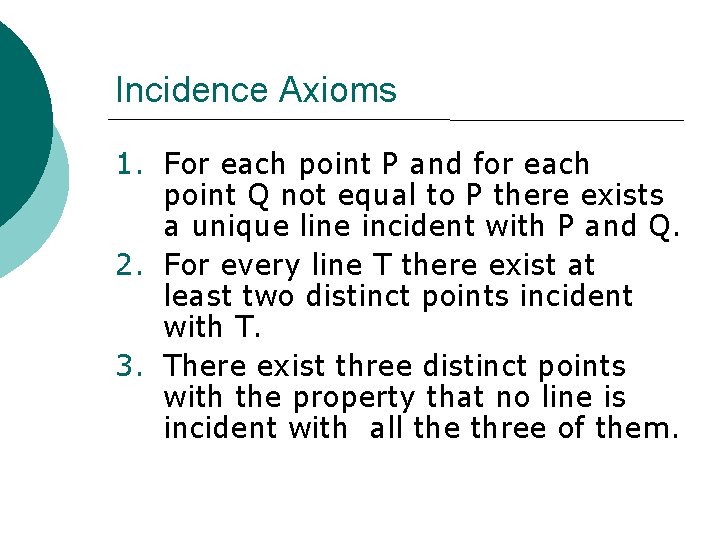
Incidence Axioms 1. For each point P and for each point Q not equal to P there exists a unique line incident with P and Q. 2. For every line T there exist at least two distinct points incident with T. 3. There exist three distinct points with the property that no line is incident with all the three of them.
Recall ¡ Two lines l and m are parallel if no point lies on both or them.
Definition ¡ Euclidean Parallel Property: For every line l and for every point P not in l there exists exactly one line parallel to l passing through P.
Affine Plane Axioms (Incidence+ Euclidean Parallel Property, (EPP)) 1. For each point P and for each point Q not equal to P there exists a unique line incident with P and Q. 2. For every line l there exist at least two distinct points incident with l. 3. There exist three distinct points with the property that no line is incident with all the three of them. 4. For every line l and for every point P not in l there exists exactly one line parallel to l passing through P. (EPP)
EXERCISE ¡ Can you give a model for the Affine Plane Axioms?
EXERCISE: Is the following a model for the Affine Plane Axioms? ¡ ¡ ¡ Points : A, B, C Lines {A, B}, {B, C}, {A, C}, Incidence: Set membership.
EXERCISE: Is the following a model for the Affine Plane Axioms? ¡ ¡ ¡ Points : A, B, C, D Lines {A, B}, {B, C}, {C, D}, {A, C}, {A, D}, {B, D} Incidence: Set membership.
EXERCISE: Is the following a model for the Affine Plane Axioms? ¡ ¡ ¡ Points : A, B, C, D, E, F, G Lines {A, B, D}, {A, C, G}, {G, E, D}, {G, F, B}, {C, F, D}, {E, F, A}, {C, B, E} Incidence: Set membership.
Definition ¡ Elliptic Parallel Property: For every pair of lines l and m there exist a point P incident with both of them.
Is at least one of these two statements valid in every model of Incidence Geometry? ¡ ¡ Elliptic Parallel Property: For every pair of lines l and m there exist a point P incident with both of them. Euclidean Parallel Property: For every line l and for every point P not in l there exists exactly one line parallel to l passing through P.
Parallel properties ¡ ¡ ¡ Elliptic Parallel Property Euclidean Parallel Property Hyperbolic Parallel Property: For every line l and for every point P not in l there at least two lines incident with P and parallel to l.
Projective Plane Axioms 1. For each point P and for each point Q not equal to P there exists a unique line incident with P and Q. 2. For every line l there exists at least three distinct points incident with l. 3. There exist three distinct points with the property that no line is incident with all the three of them. 4. For every pair of lines l and m there exist a point P incident with both of them.
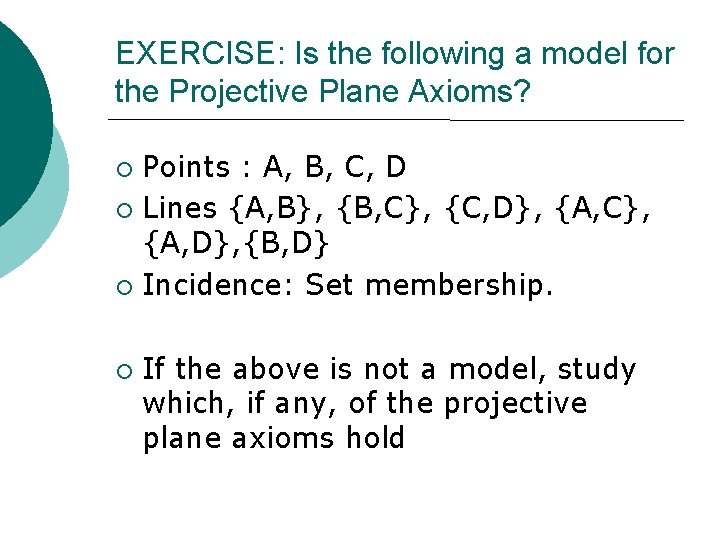
EXERCISE: Is the following a model for the Projective Plane Axioms? ¡ ¡ Points : A, B, C, D Lines {A, B}, {B, C}, {C, D}, {A, C}, {A, D}, {B, D} Incidence: Set membership. If the above is not a model, study which, if any, of the projective plane axioms hold
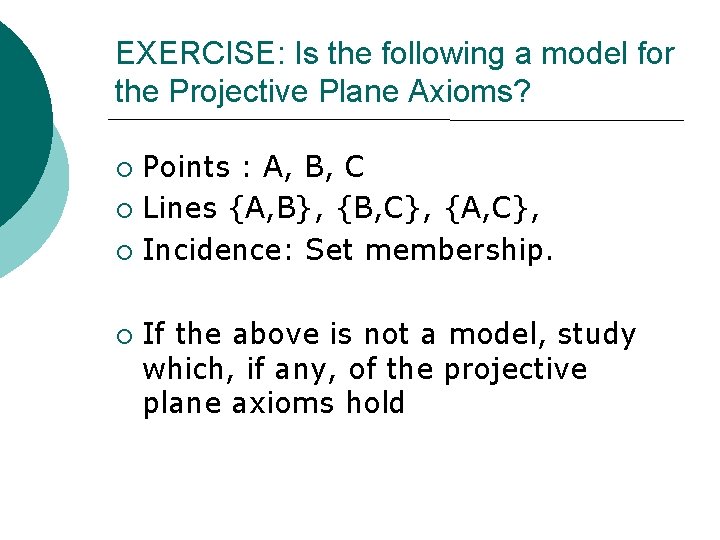
EXERCISE: Is the following a model for the Projective Plane Axioms? ¡ ¡ Points : A, B, C Lines {A, B}, {B, C}, {A, C}, Incidence: Set membership. If the above is not a model, study which, if any, of the projective plane axioms hold
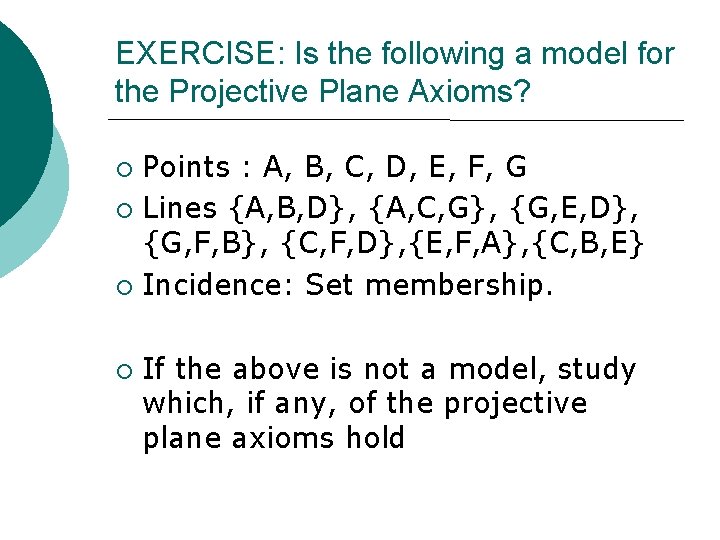
EXERCISE: Is the following a model for the Projective Plane Axioms? ¡ ¡ Points : A, B, C, D, E, F, G Lines {A, B, D}, {A, C, G}, {G, E, D}, {G, F, B}, {C, F, D}, {E, F, A}, {C, B, E} Incidence: Set membership. If the above is not a model, study which, if any, of the projective plane axioms hold
Definition ¡ A projective plane is model of the Projective Plane Axioms
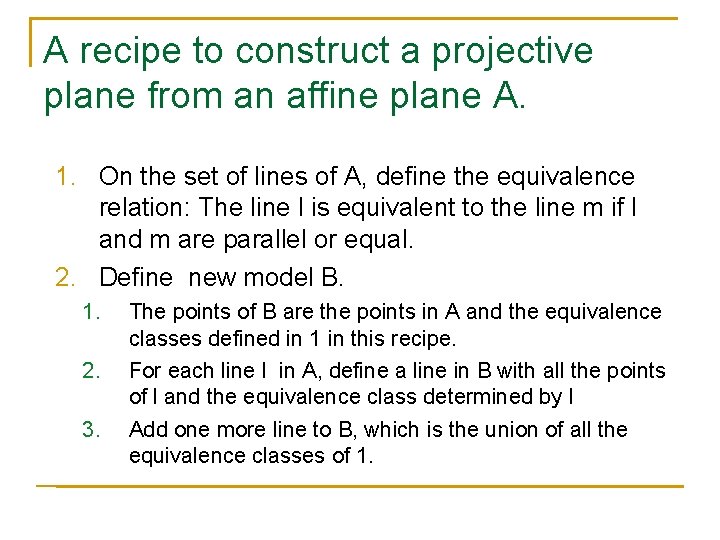
A recipe to construct a projective plane from an affine plane A. 1. On the set of lines of A, define the equivalence relation: The line l is equivalent to the line m if l and m are parallel or equal. 2. Define new model B. 1. 2. 3. The points of B are the points in A and the equivalence classes defined in 1 in this recipe. For each line l in A, define a line in B with all the points of l and the equivalence class determined by l Add one more line to B, which is the union of all the equivalence classes of 1.
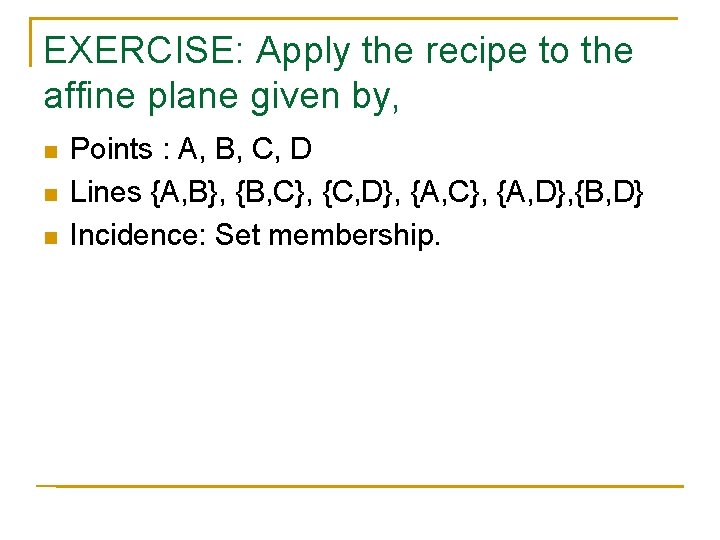
EXERCISE: Apply the recipe to the affine plane given by, n n n Points : A, B, C, D Lines {A, B}, {B, C}, {C, D}, {A, C}, {A, D}, {B, D} Incidence: Set membership.
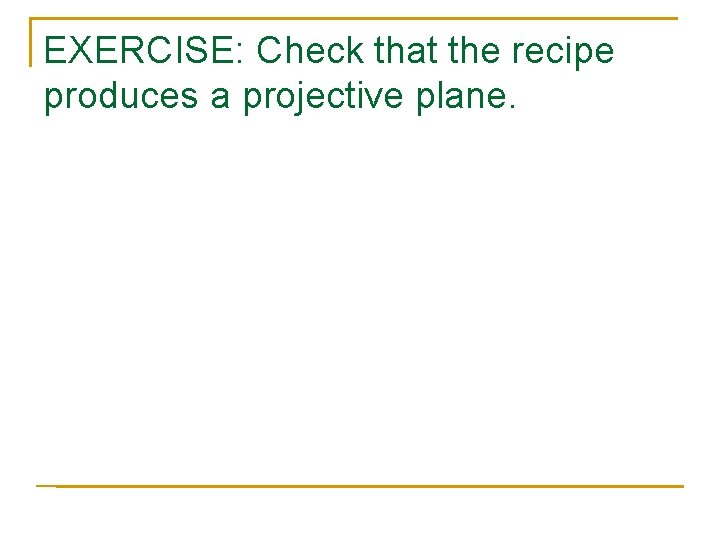
EXERCISE: Check that the recipe produces a projective plane.
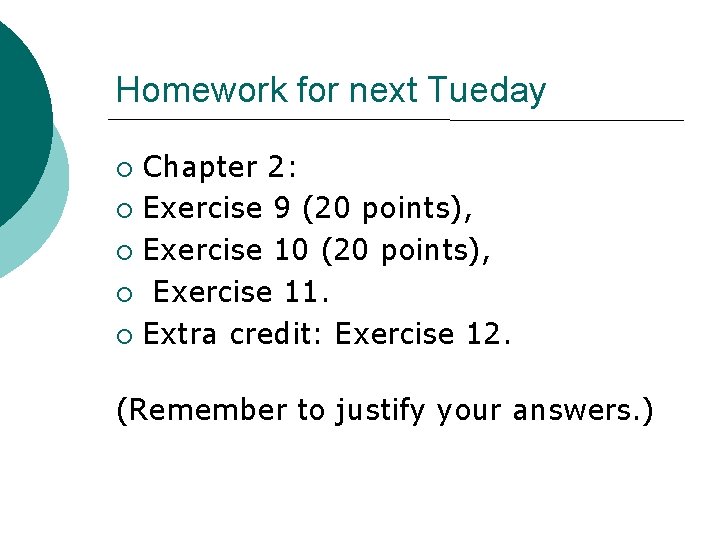
Homework for next Tueday ¡ ¡ ¡ Chapter 2: Exercise 9 (20 points), Exercise 10 (20 points), Exercise 11. Extra credit: Exercise 12. (Remember to justify your answers. )