
MAT 302 Algebraic Cryptography LECTURE 1 Jan 2
MAT 302: Algebraic Cryptography LECTURE 1 Jan 2, 2012
MAT 302: Cryptography from Euclid to Zero-Knowledge Proofs LECTURE 1 Jan 2, 2012
Administrivia (see course info sheet) Instructor Vinod Vaikuntanathan 3073 CCT Building first. last@utoronto. ca Location & Hours M 1 -2 pm, IB 370 W 1 -3 pm, IB 379 (Office hours: W 3 -4 pm) Teaching Asst Ali Mousavidehshikh (Tut: F 10 -11 am, IB 360)
Administrivia (see course info sheet) Website: http: //www. cs. toronto. edu/~vinodv/COURSES/MAT 302 -S 12 (Check often!) Textbook Recommended: Christof Paar and Jan Pelzl, Understanding Cryptography: A Textbook for Students and Practitioners, Springer-Verlag. available online from Uof. T libraries Pre-Requisites MAT 223 Linear Algebra I MAT 224 Linear Algebra II MAT 301 Groups and Symmetries
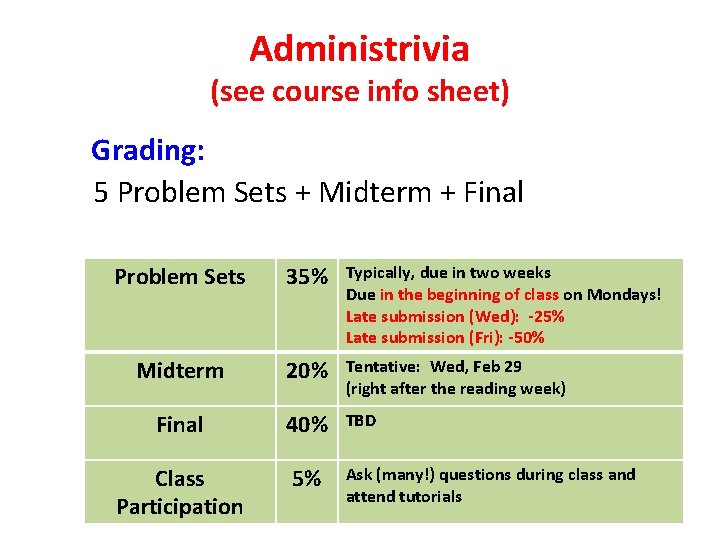
Administrivia (see course info sheet) Grading: 5 Problem Sets + Midterm + Final Problem Sets 35% Typically, due in two weeks Due in the beginning of class on Mondays! Late submission (Wed): -25% Late submission (Fri): -50% Midterm 20% Tentative: Wed, Feb 29 (right after the reading week) Final 40% TBD Class Participation 5% Ask (many!) questions during class and attend tutorials
… now, on to the course …
I) Historical Ciphers
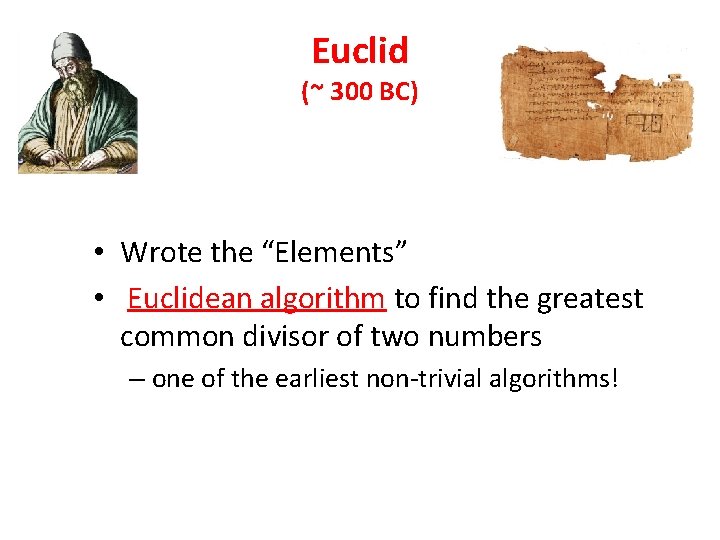
Euclid (~ 300 BC) • Wrote the “Elements” • Euclidean algorithm to find the greatest common divisor of two numbers – one of the earliest non-trivial algorithms!
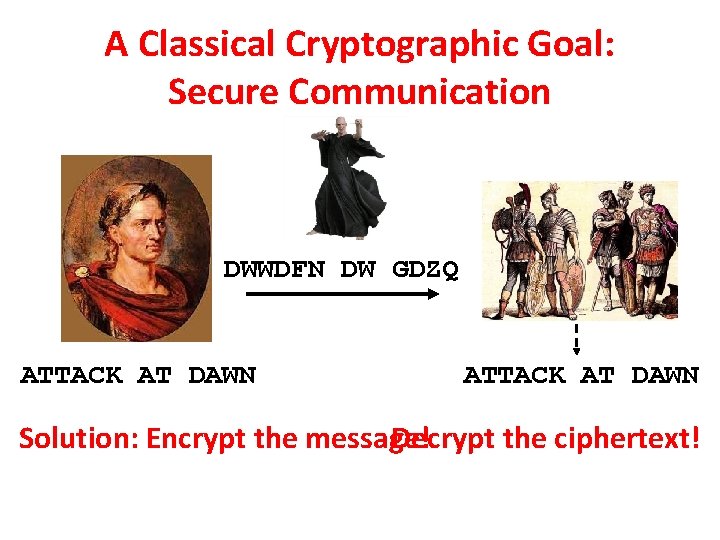
A Classical Cryptographic Goal: Secure Communication DWWDFN DW GDZQ ATTACK AT DAWN Solution: Encrypt the message! Decrypt the ciphertext!
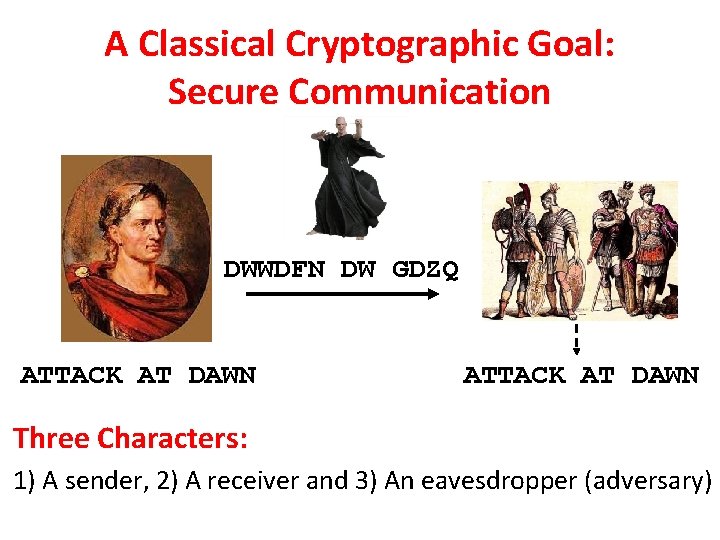
A Classical Cryptographic Goal: Secure Communication DWWDFN DW GDZQ ATTACK AT DAWN Three Characters: 1) A sender, 2) A receiver and 3) An eavesdropper (adversary)
Lesson 1: Asymmetry of Information • The sender and receiver must know something that the adversary doesn’t. • This is called a cryptographic key
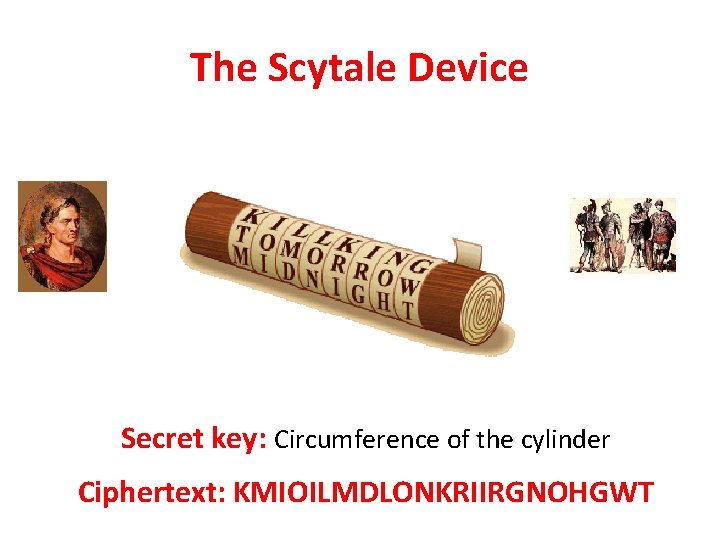
The Scytale Device Secret key: Circumference of the cylinder Ciphertext: KMIOILMDLONKRIIRGNOHGWT
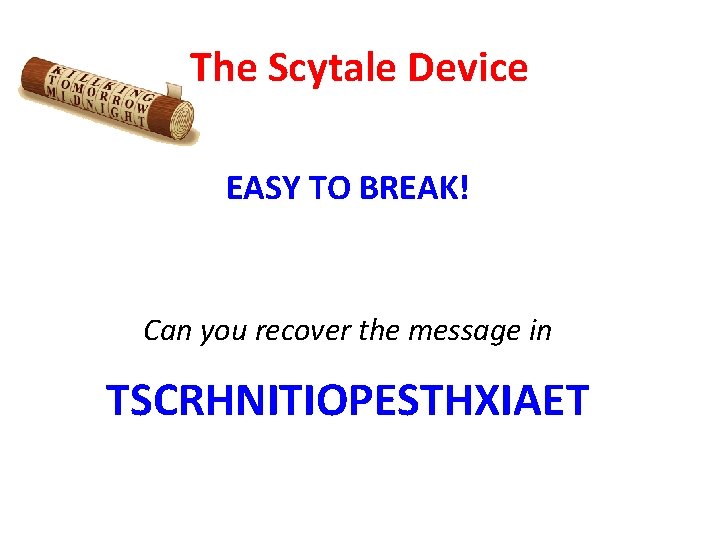
The Scytale Device EASY TO BREAK! Can you recover the message in TSCRHNITIOPESTHXIAET
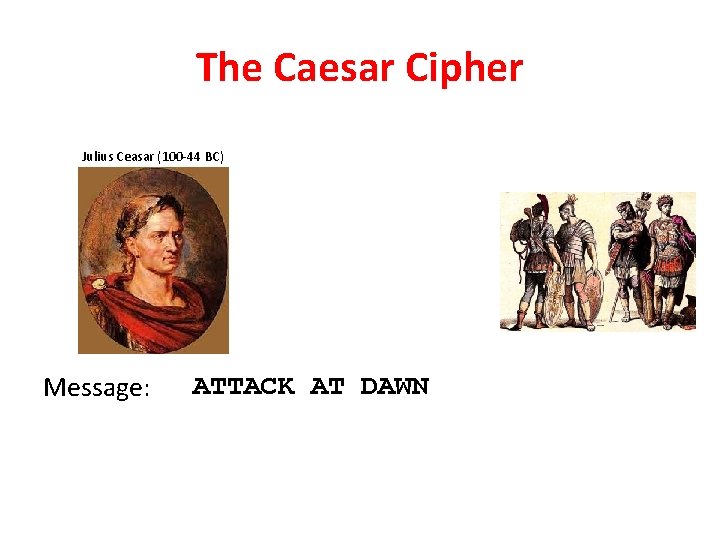
The Caesar Cipher Julius Ceasar (100 -44 BC) Message: ATTACK AT DAWN
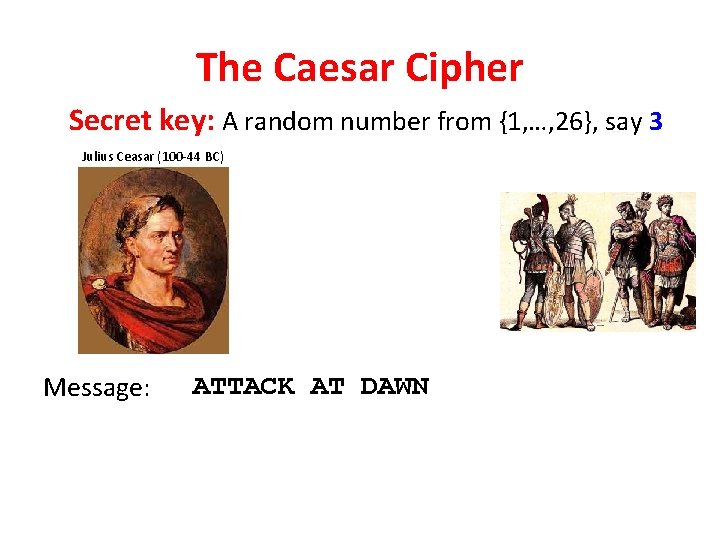
The Caesar Cipher Secret key: A random number from {1, …, 26}, say 3 Julius Ceasar (100 -44 BC) Message: ATTACK AT DAWN
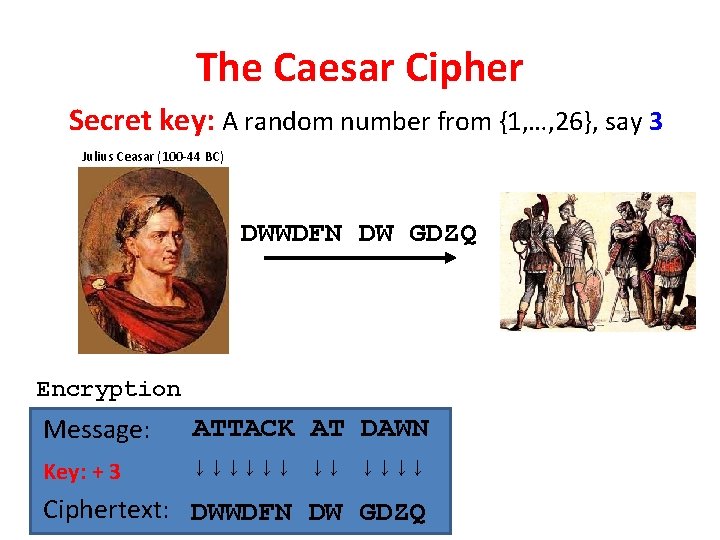
The Caesar Cipher Secret key: A random number from {1, …, 26}, say 3 Julius Ceasar (100 -44 BC) DWWDFN DW GDZQ Encryption Message: ATTACK AT DAWN ↓↓↓↓↓↓ ↓↓ ↓↓↓↓ Key: + 3 Ciphertext: DWWDFN DW GDZQ
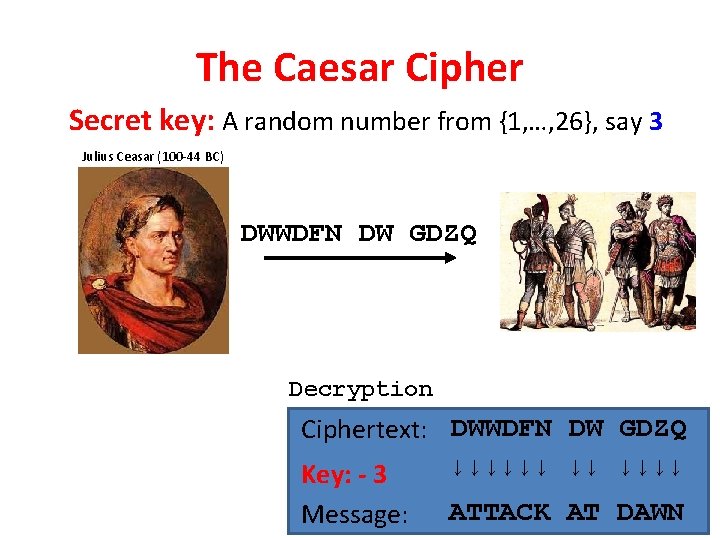
The Caesar Cipher Secret key: A random number from {1, …, 26}, say 3 Julius Ceasar (100 -44 BC) DWWDFN DW GDZQ Decryption Ciphertext: DWWDFN DW GDZQ ↓↓↓↓↓↓ ↓↓ ↓↓↓↓ Key: - 3 Message: ATTACK AT DAWN
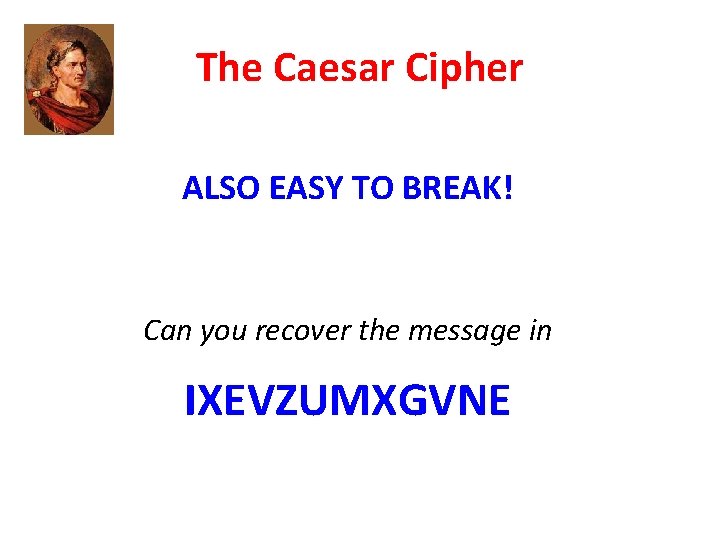
The Caesar Cipher ALSO EASY TO BREAK! Can you recover the message in IXEVZUMXGVNE
Symmetric Encryption Scheme • All these are examples of symmetric (also called secret-key) encryption • Sender and Receiver use the same key • Problem: How did they come up with the shared key to begin with? !
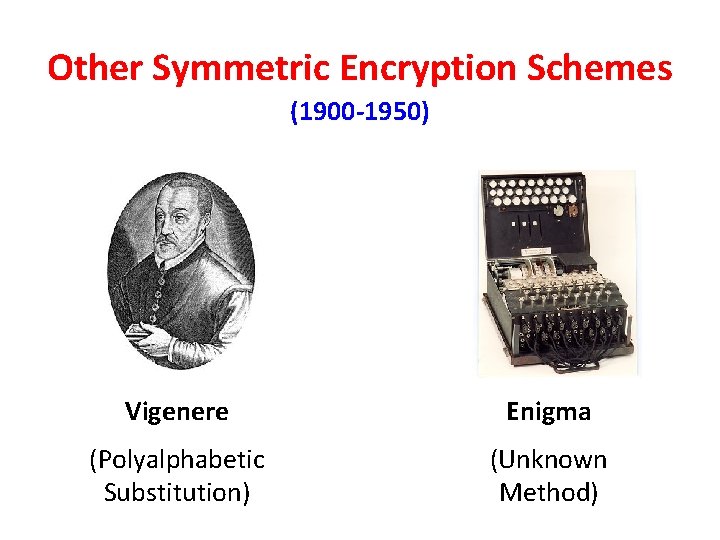
Other Symmetric Encryption Schemes (1900 -1950) Vigenere Enigma (Polyalphabetic Substitution) (Unknown Method)
Lesson 2: Kerckhoff’s Principle Security of a Cryptographic Algorithm should rely ONLY on the secrecy of the KEYS, and NOT on the secrecy of the METHOD used. “Do not rely on security through obscurity”
A Mathematical Theory of Secrecy Claude Shannon (late 1940 s) Perfect Secrecy and the One-time Pad THE GOOD: Unbreakable regardless of the power of the adv. THE BAD: Impractical! Needs very, very long shared keys. THE UGLY: length of key ≥ total length of all messages you ever want to send
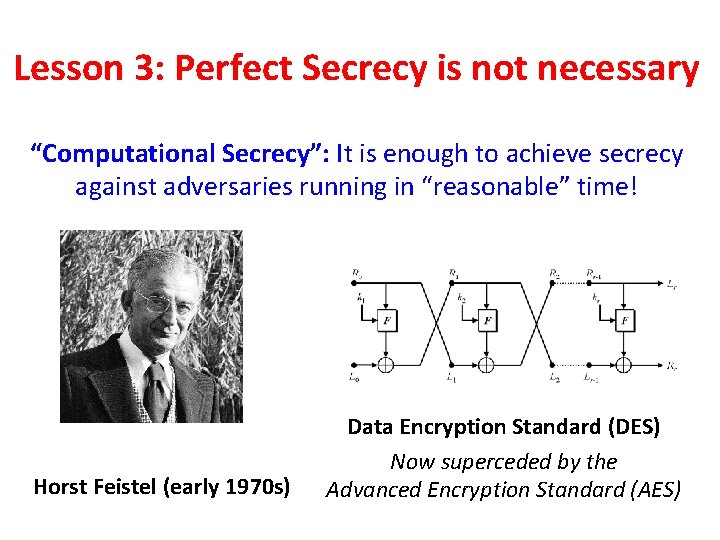
Lesson 3: Perfect Secrecy is not necessary “Computational Secrecy”: It is enough to achieve secrecy against adversaries running in “reasonable” time! Horst Feistel (early 1970 s) Data Encryption Standard (DES) Now superceded by the Advanced Encryption Standard (AES)
II) Modern Cryptography
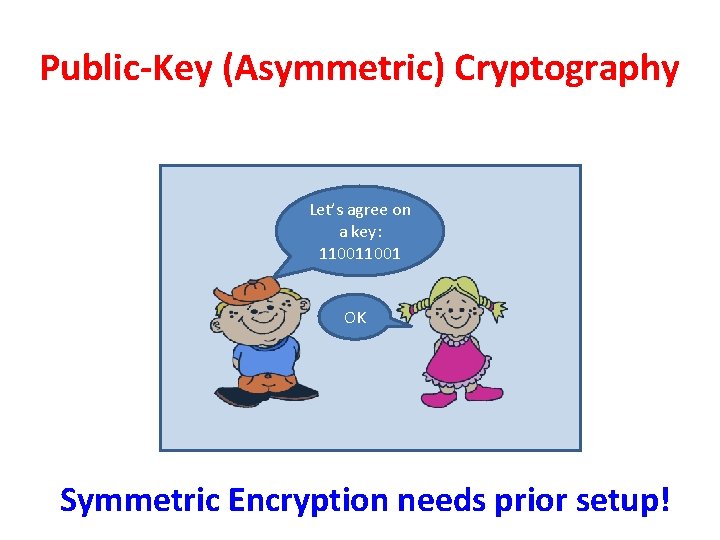
Public-Key (Asymmetric) Cryptography Let’s agree on a key: 11001 OK Symmetric Encryption needs prior setup!
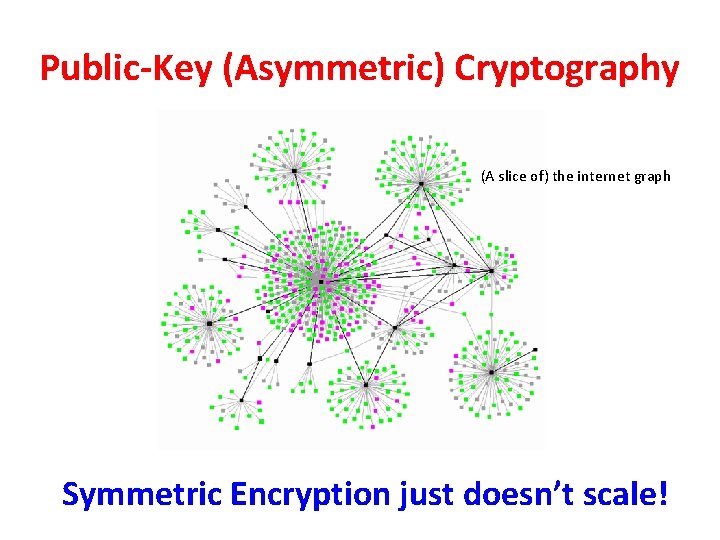
Public-Key (Asymmetric) Cryptography (A slice of) the internet graph Symmetric Encryption just doesn’t scale!
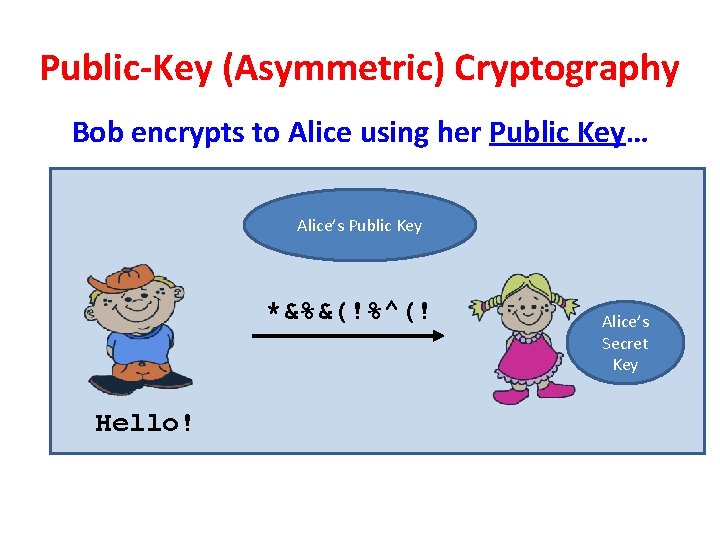
Public-Key (Asymmetric) Cryptography Bob encrypts to Alice using her Public Key… Alice’s Public Key *&%&(!%^(! Hello! Alice’s Secret Key
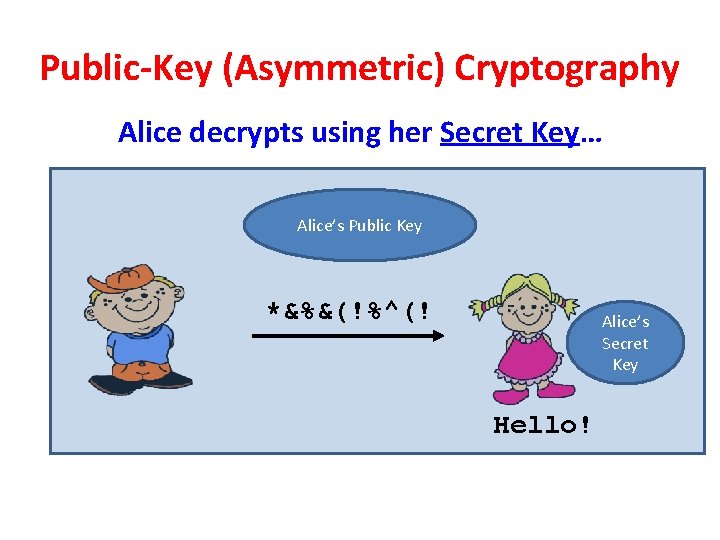
Public-Key (Asymmetric) Cryptography Alice decrypts using her Secret Key… Alice’s Public Key *&%&(!%^(! Alice’s Secret Key Hello!
Two Potent Ingredients Complexity Theory (the hardness of computational problems) + Number Theory
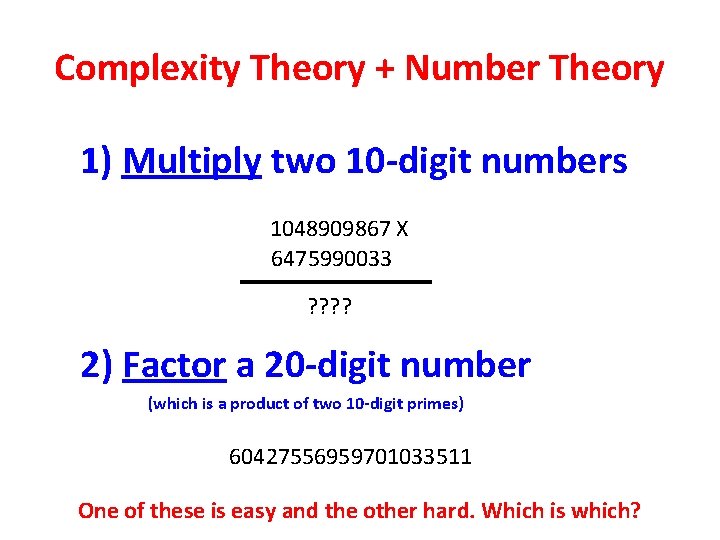
Complexity Theory + Number Theory 1) Multiply two 10 -digit numbers 1048909867 X 6475990033 ? ? 2) Factor a 20 -digit number (which is a product of two 10 -digit primes) 60427556959701033511 One of these is easy and the other hard. Which is which?
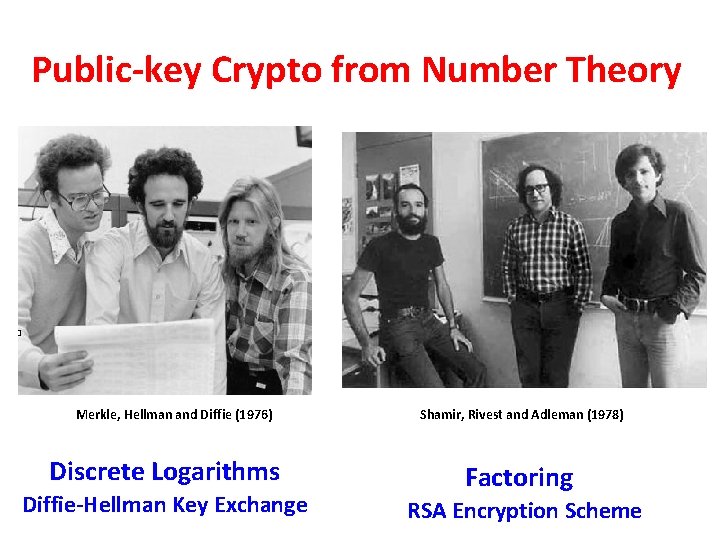
Public-key Crypto from Number Theory Merkle, Hellman and Diffie (1976) Discrete Logarithms Diffie-Hellman Key Exchange Shamir, Rivest and Adleman (1978) Factoring RSA Encryption Scheme
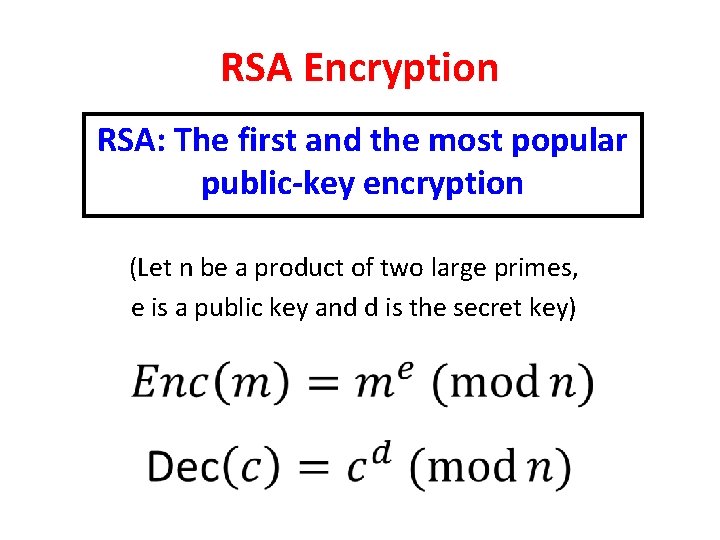
RSA Encryption RSA: The first and the most popular public-key encryption (Let n be a product of two large primes, e is a public key and d is the secret key)
Number Theory Fermat’s Little Theorem Chinese Remainder Theorem Quadratic Reciprocity
Number Theoretic Algorithms Euclid’s GCD algorithm: Efficient Algorithms for Exponentiation: Algorithms to Compute Discrete Logarithms:
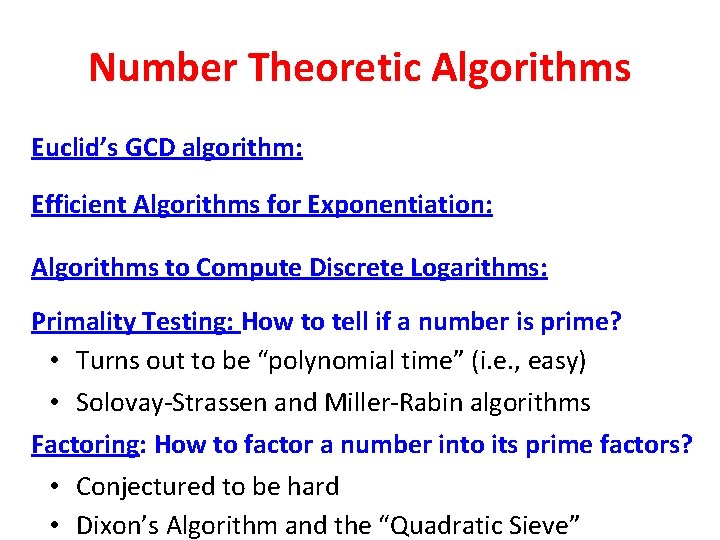
Number Theoretic Algorithms Euclid’s GCD algorithm: Efficient Algorithms for Exponentiation: Algorithms to Compute Discrete Logarithms: Primality Testing: How to tell if a number is prime? • Turns out to be “polynomial time” (i. e. , easy) • Solovay-Strassen and Miller-Rabin algorithms Factoring: How to factor a number into its prime factors? • Conjectured to be hard • Dixon’s Algorithm and the “Quadratic Sieve”
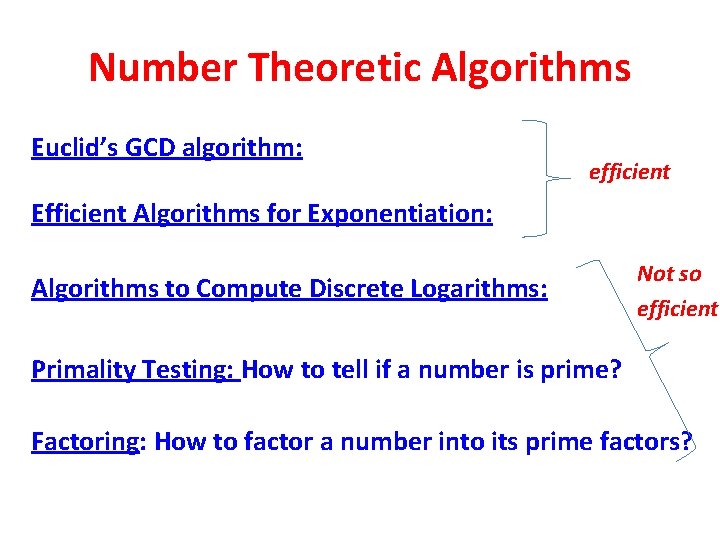
Number Theoretic Algorithms Euclid’s GCD algorithm: efficient Efficient Algorithms for Exponentiation: Algorithms to Compute Discrete Logarithms: Not so efficient Primality Testing: How to tell if a number is prime? Factoring: How to factor a number into its prime factors?
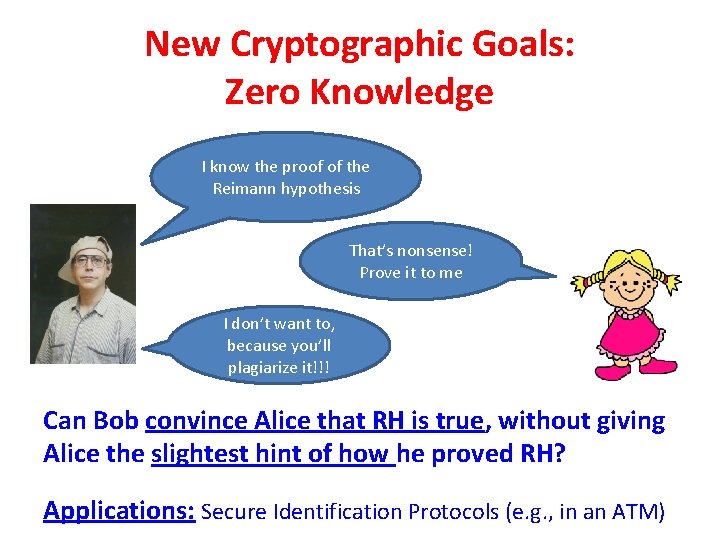
New Cryptographic Goals: Zero Knowledge I know the proof of the Reimann hypothesis That’s nonsense! Prove it to me I don’t want to, because you’ll plagiarize it!!! Can Bob convince Alice that RH is true, without giving Alice the slightest hint of how he proved RH? Applications: Secure Identification Protocols (e. g. , in an ATM)
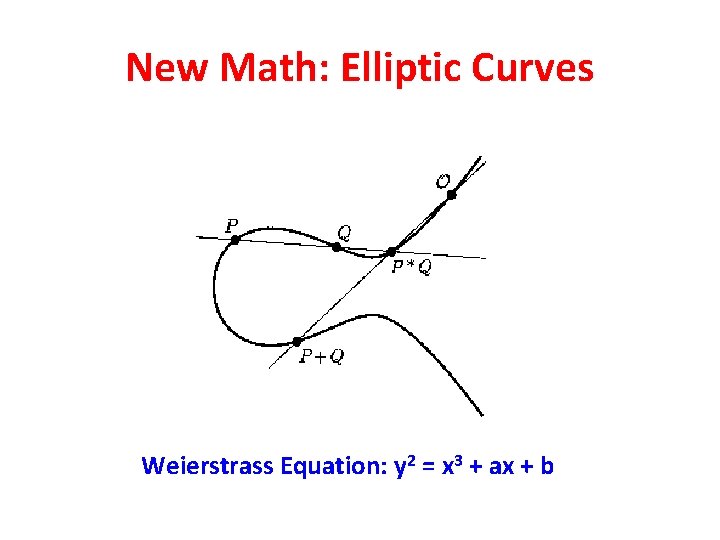
New Math: Elliptic Curves Weierstrass Equation: y 2 = x 3 + ax + b
Exercise for this week: Watch Prof. Ronald Rivest’s lecture on “The Growth of Cryptography” (see the course webpage for the link)
Welcome to MAT 302! Looking forward to an exciting semester!
- Slides: 40