
Mastery Grading Kara Colley PCC How many points

- Slides: 16
Mastery Grading Kara Colley - PCC
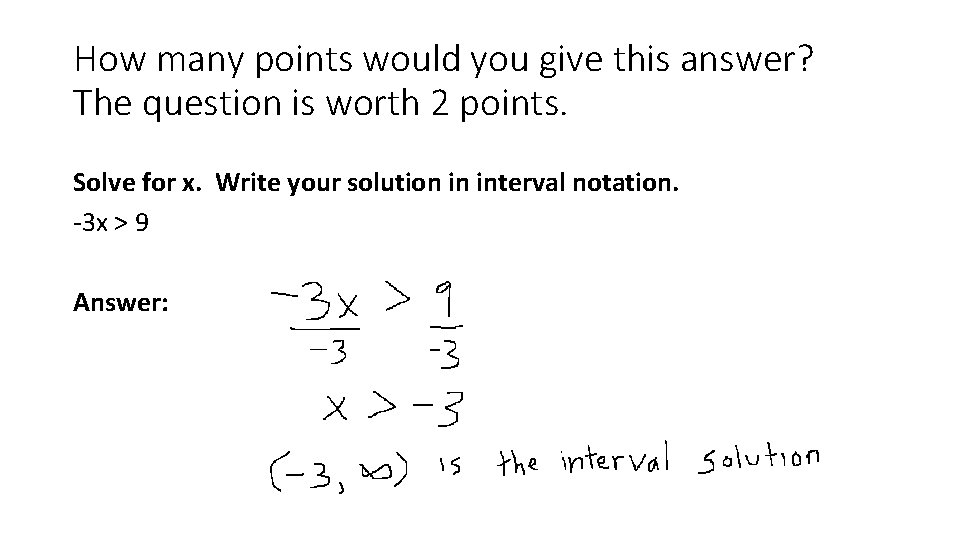
How many points would you give this answer? The question is worth 2 points. Solve for x. Write your solution in interval notation. -3 x > 9 Answer:
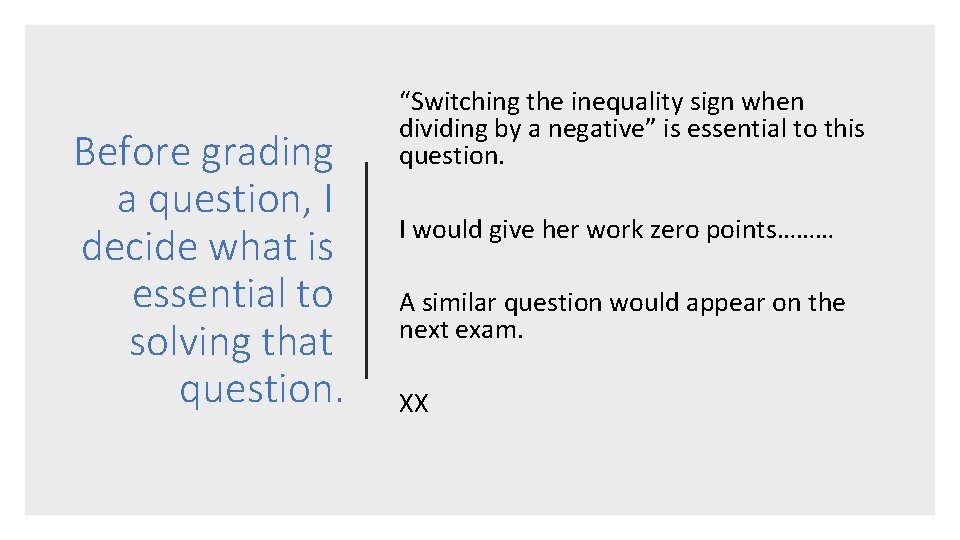
Before grading a question, I decide what is essential to solving that question. “Switching the inequality sign when dividing by a negative” is essential to this question. I would give her work zero points……… A similar question would appear on the next exam. XX
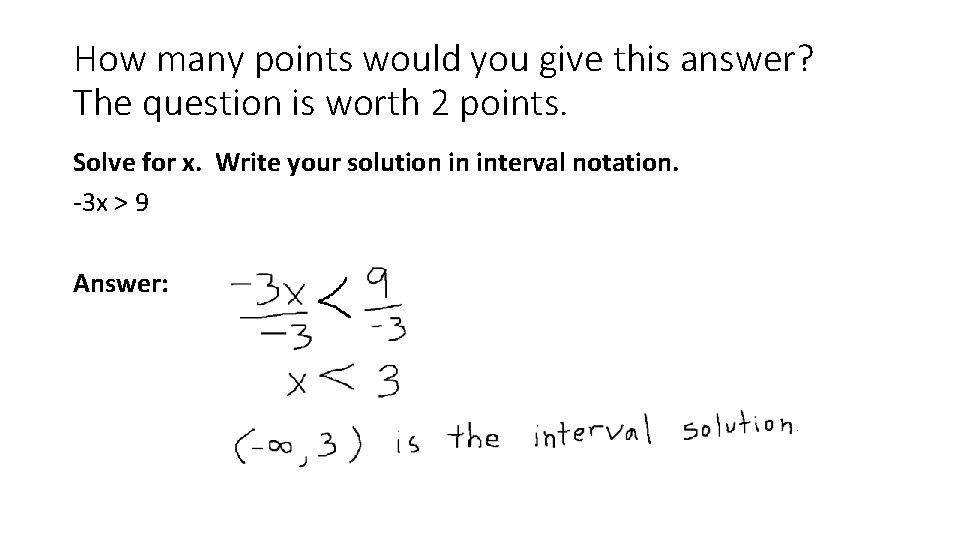
How many points would you give this answer? The question is worth 2 points. Solve for x. Write your solution in interval notation. -3 x > 9 Answer:
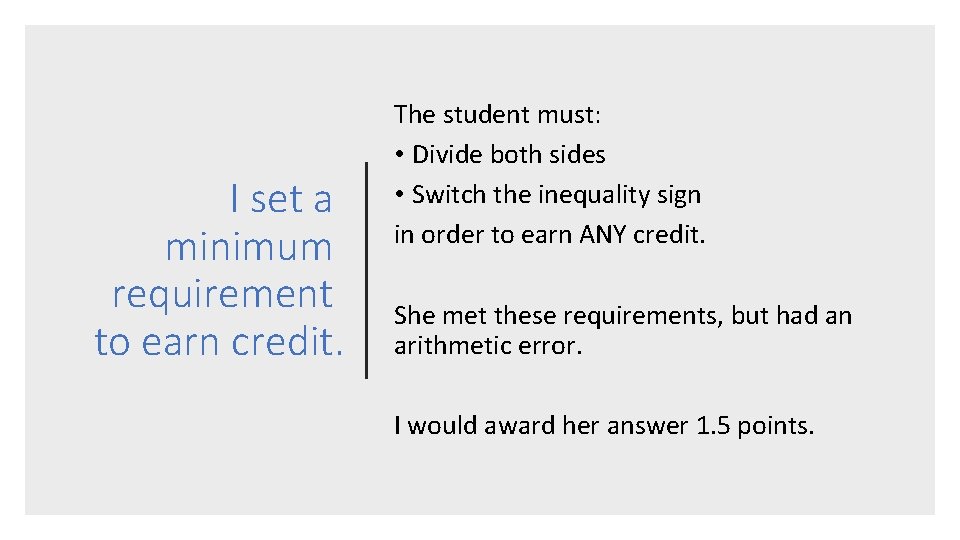
I set a minimum requirement to earn credit. The student must: • Divide both sides • Switch the inequality sign in order to earn ANY credit. She met these requirements, but had an arithmetic error. I would award her answer 1. 5 points.
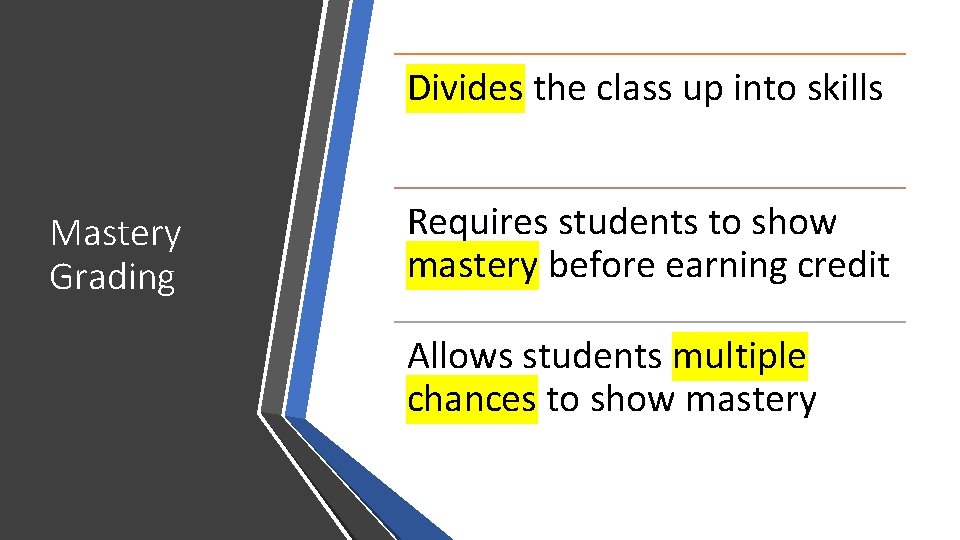
Divides the class up into skills Mastery Grading Requires students to show mastery before earning credit Allows students multiple chances to show mastery
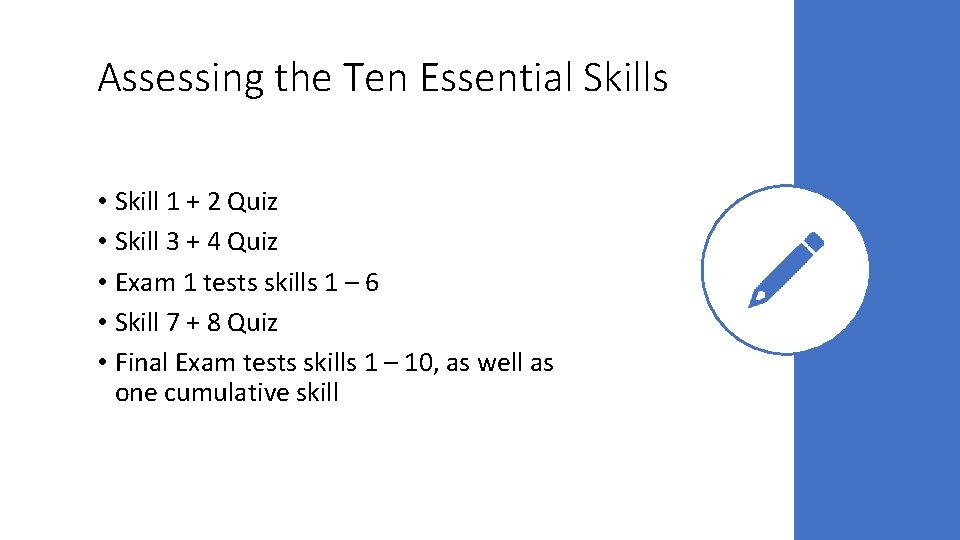
Assessing the Ten Essential Skills • Skill 1 + 2 Quiz • Skill 3 + 4 Quiz • Exam 1 tests skills 1 – 6 • Skill 7 + 8 Quiz • Final Exam tests skills 1 – 10, as well as one cumulative skill
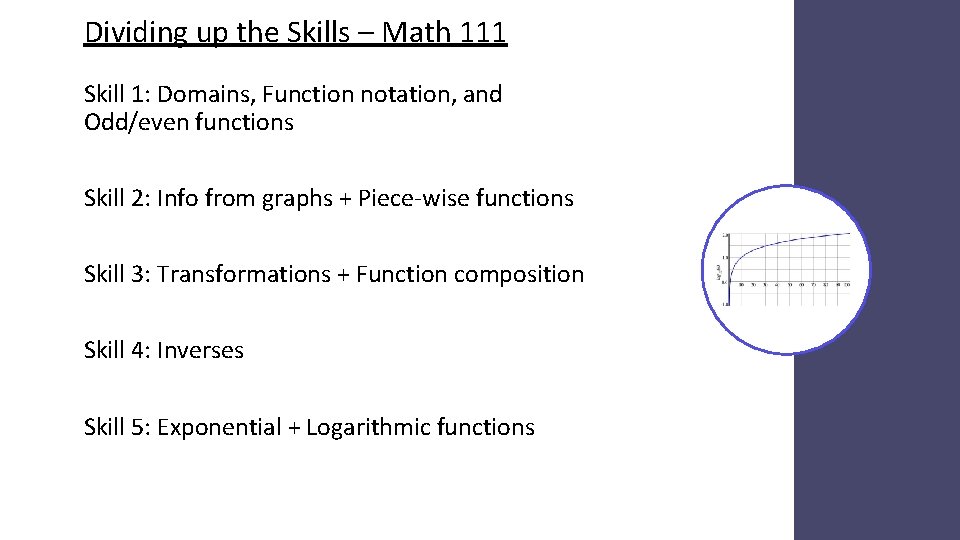
Dividing up the Skills – Math 111 Skill 1: Domains, Function notation, and Odd/even functions Skill 2: Info from graphs + Piece-wise functions Skill 3: Transformations + Function composition Skill 4: Inverses Skill 5: Exponential + Logarithmic functions
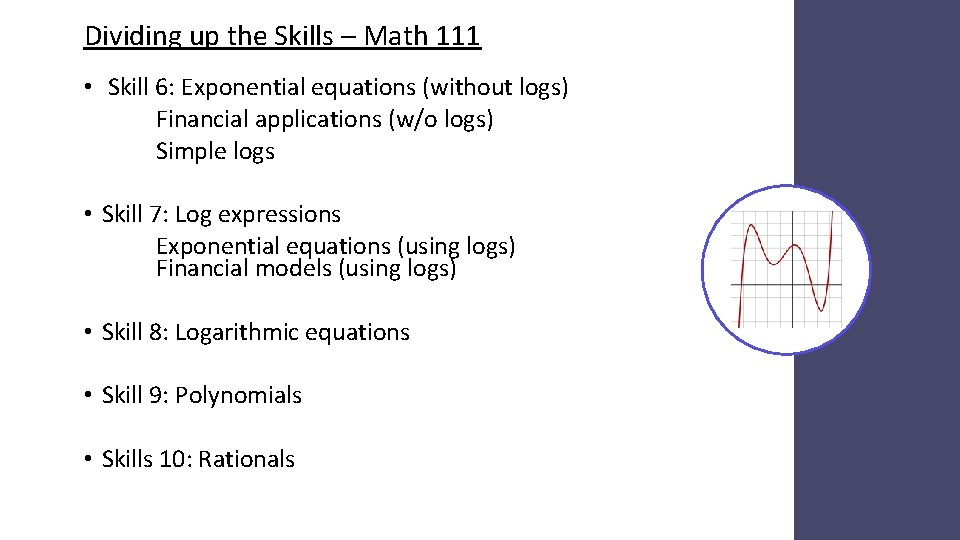
Dividing up the Skills – Math 111 • Skill 6: Exponential equations (without logs) Financial applications (w/o logs) Simple logs • Skill 7: Log expressions Exponential equations (using logs) Financial models (using logs) • Skill 8: Logarithmic equations • Skill 9: Polynomials • Skills 10: Rationals
What is a skill? • Each skill consists of three to five problems • Pass out Final Exams (Math 60 and Math 111) • Each skill is worth 12 points • Earn points on a problem when show mastery • Answering it correctly with a minor error • Reaching a certain minimum requirement
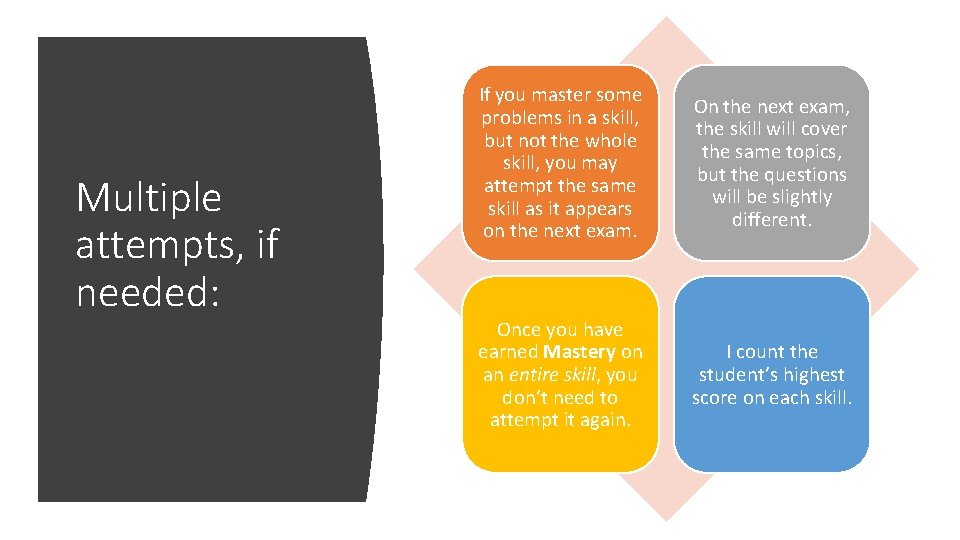
Multiple attempts, if needed: If you master some problems in a skill, but not the whole skill, you may attempt the same skill as it appears on the next exam. On the next exam, the skill will cover the same topics, but the questions will be slightly different. Once you have earned Mastery on an entire skill, you don’t need to attempt it again. I count the student’s highest score on each skill.
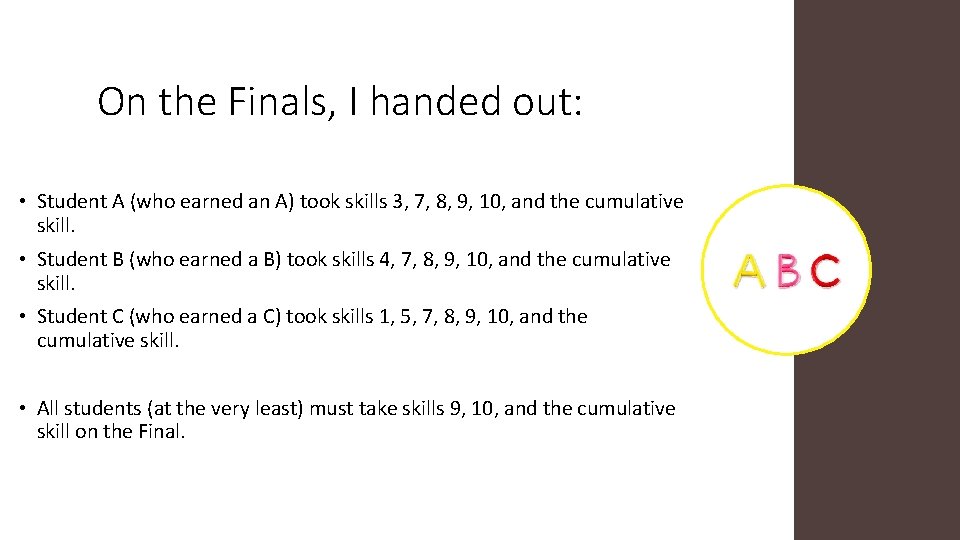
On the Finals, I handed out: • Student A (who earned an A) took skills 3, 7, 8, 9, 10, and the cumulative skill. • Student B (who earned a B) took skills 4, 7, 8, 9, 10, and the cumulative skill. • Student C (who earned a C) took skills 1, 5, 7, 8, 9, 10, and the cumulative skill. • All students (at the very least) must take skills 9, 10, and the cumulative skill on the Final.
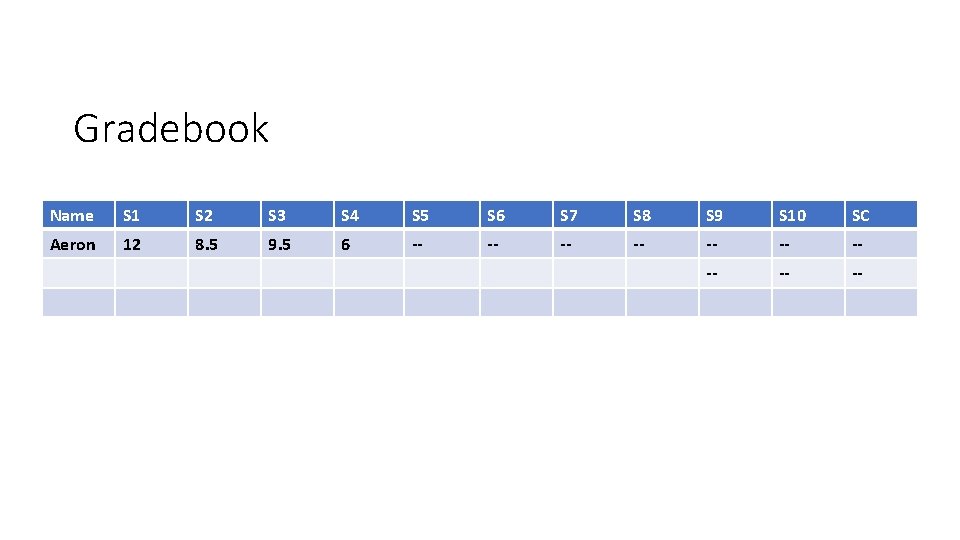
Gradebook Name S 1 S 2 S 3 S 4 S 5 S 6 S 7 S 8 S 9 S 10 SC Aeron 12 8. 5 9. 5 6 -- -- --
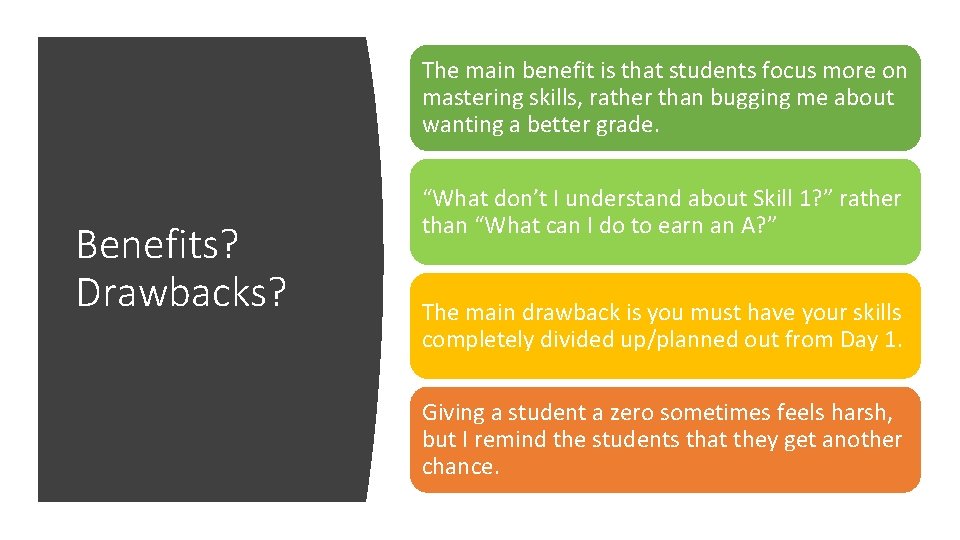
The main benefit is that students focus more on mastering skills, rather than bugging me about wanting a better grade. Benefits? Drawbacks? “What don’t I understand about Skill 1? ” rather than “What can I do to earn an A? ” The main drawback is you must have your skills completely divided up/planned out from Day 1. Giving a student a zero sometimes feels harsh, but I remind the students that they get another chance.
Any questions? For more info, check out: https: //mbtmath. wordpress. com/ This is where I first learned about Mastery Grading. This site addresses Mastery Grading at 4 -year colleges. Feel free to email me with any questions: kara. colley@pcc. edu
Want to be productive? Let’s spend some time dividing up your class into skills.