
Masters of European Formalist Cinema Art Films of

- Slides: 27
Masters of European Formalist Cinema: Art Films of Michelangelo Antonioni and Alain Resnais
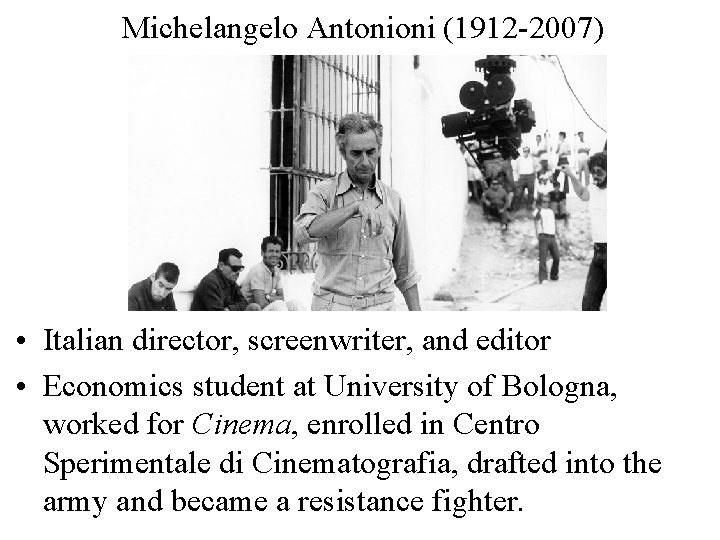
Michelangelo Antonioni (1912 -2007) • Italian director, screenwriter, and editor • Economics student at University of Bologna, worked for Cinema, enrolled in Centro Sperimentale di Cinematografia, drafted into the army and became a resistance fighter.
• Worked first with Roberto Rossellini and other filmmakers for propaganda films during the war years. In France he assisted Marcel Carné for his Les visiteurs du soir and worked also in Republic of Salò. • Early years – influence of neorealismo still noticeable, but in subject matters he shifted between the middle class
Michelangelo Antonioni (1912 -2007)
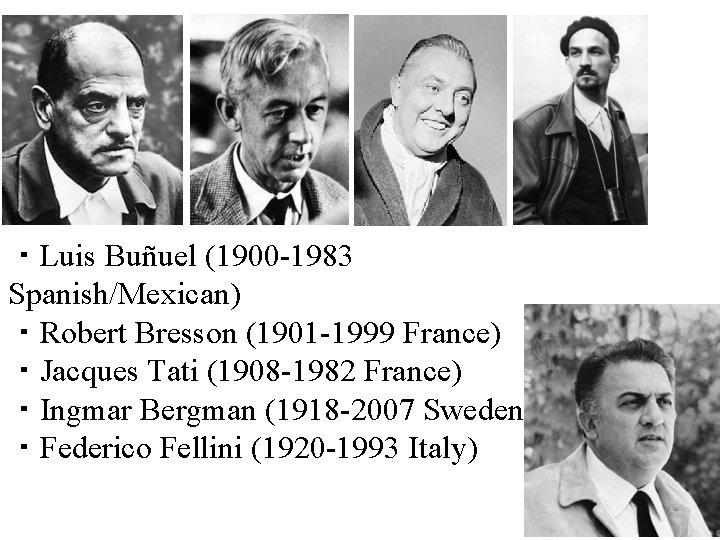
・Luis Buñuel (1900 -1983 Spanish/Mexican) ・Robert Bresson (1901 -1999 France) ・Jacques Tati (1908 -1982 France) ・Ingmar Bergman (1918 -2007 Sweden) ・Federico Fellini (1920 -1993 Italy)
European Art Cinema • European film less commercial and more personal reflecting personal concerns to the almost obsessive level. • Being personal (less commercial) means more unconventional filmmaking. • European film as art film. Bold formal experiment and artistic formal attempt. • Innovations in narrative and visual styles. • Distinguished personal styles. • Auteurs
• Auteur (author) • Auteur theory – theory of filmmaking in which the director is viewed as the major creative force, that’s why auteur (atuhor). • The director oversees all audio and visual element of the motion picture. • Not only that, auteur is the film director who has developed distinctive film styles – film forms. • Auteur is the film director who has stamped signature film styles – film forms.
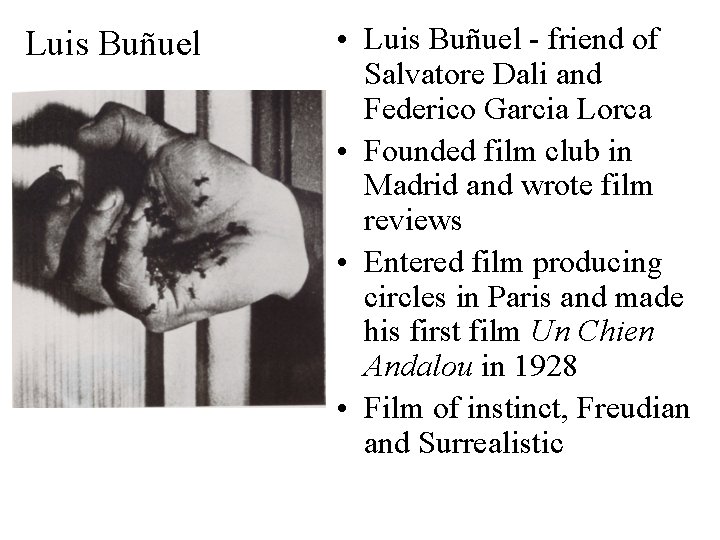
Luis Buñuel • Luis Buñuel - friend of Salvatore Dali and Federico Garcia Lorca • Founded film club in Madrid and wrote film reviews • Entered film producing circles in Paris and made his first film Un Chien Andalou in 1928 • Film of instinct, Freudian and Surrealistic
Luis Buñuel • Dream, the subconscious, and the unconscious – the actual way to know who the person really is. • The person is different in appearance than in one’s actual kind. • The context shapes him to be like that. • The gap between the appearance and the reality revealed through surrealistic images. • Collage rather than montage Blind Priest
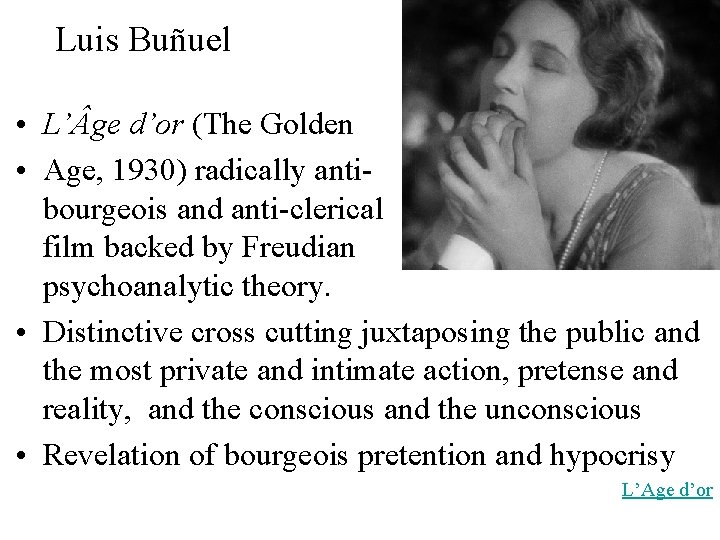
Luis Buñuel • L’ ge d’or (The Golden • Age, 1930) radically antibourgeois and anti-clerical film backed by Freudian psychoanalytic theory. • Distinctive cross cutting juxtaposing the public and the most private and intimate action, pretense and reality, and the conscious and the unconscious • Revelation of bourgeois pretention and hypocrisy L’Age d’or
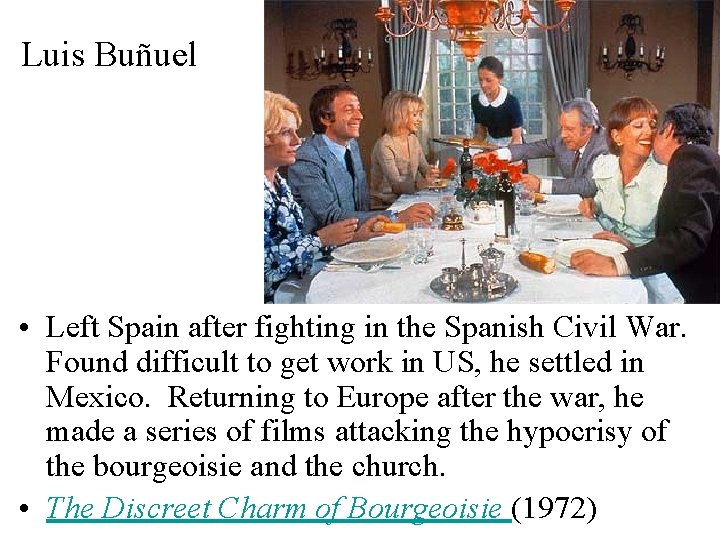
Luis Buñuel • Left Spain after fighting in the Spanish Civil War. Found difficult to get work in US, he settled in Mexico. Returning to Europe after the war, he made a series of films attacking the hypocrisy of the bourgeoisie and the church. • The Discreet Charm of Bourgeoisie (1972)
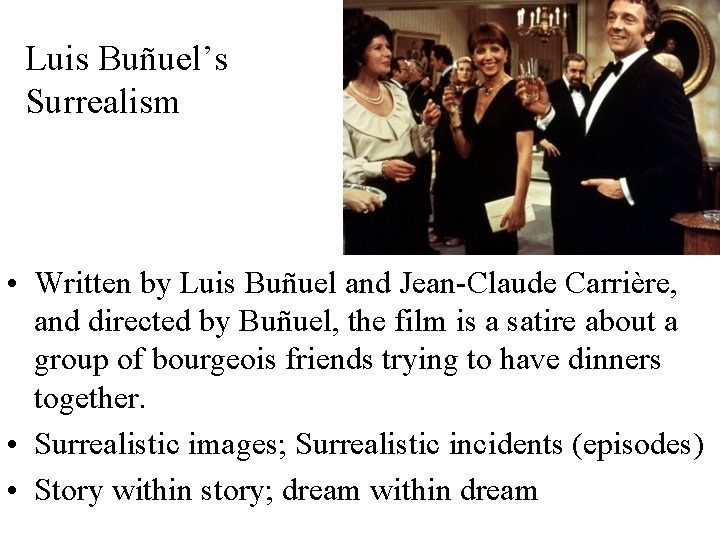
Luis Buñuel’s Surrealism • Written by Luis Buñuel and Jean-Claude Carrière, and directed by Buñuel, the film is a satire about a group of bourgeois friends trying to have dinners together. • Surrealistic images; Surrealistic incidents (episodes) • Story within story; dream within dream
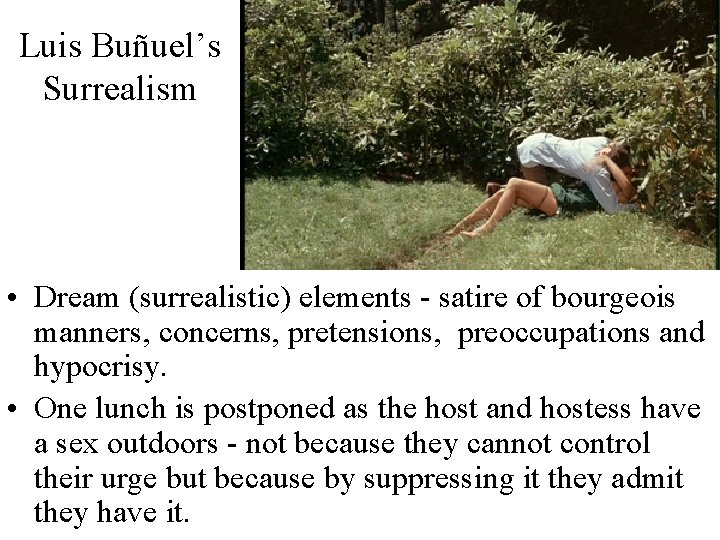
Luis Buñuel’s Surrealism • Dream (surrealistic) elements - satire of bourgeois manners, concerns, pretensions, preoccupations and hypocrisy. • One lunch is postponed as the host and hostess have a sex outdoors - not because they cannot control their urge but because by suppressing it they admit they have it.
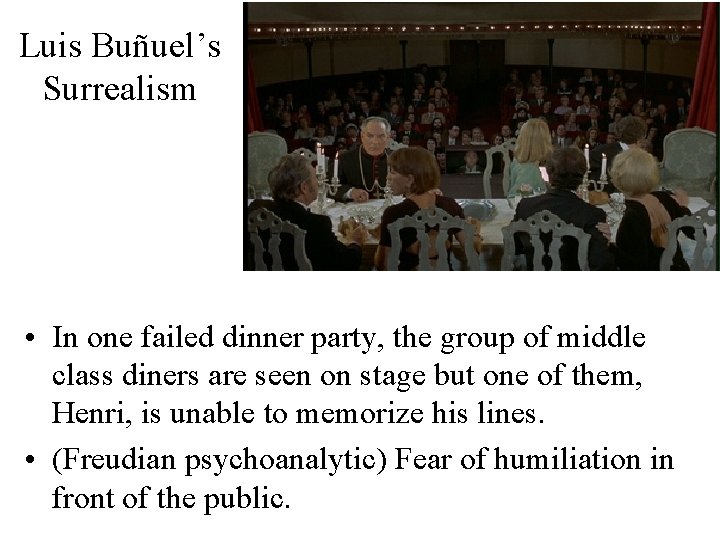
Luis Buñuel’s Surrealism • In one failed dinner party, the group of middle class diners are seen on stage but one of them, Henri, is unable to memorize his lines. • (Freudian psychoanalytic) Fear of humiliation in front of the public.
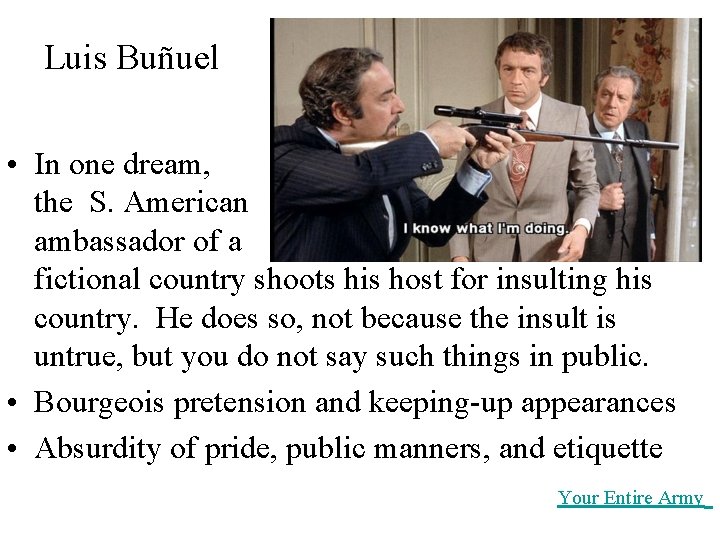
Luis Buñuel • In one dream, the S. American ambassador of a fictional country shoots his host for insulting his country. He does so, not because the insult is untrue, but you do not say such things in public. • Bourgeois pretension and keeping-up appearances • Absurdity of pride, public manners, and etiquette Your Entire Army
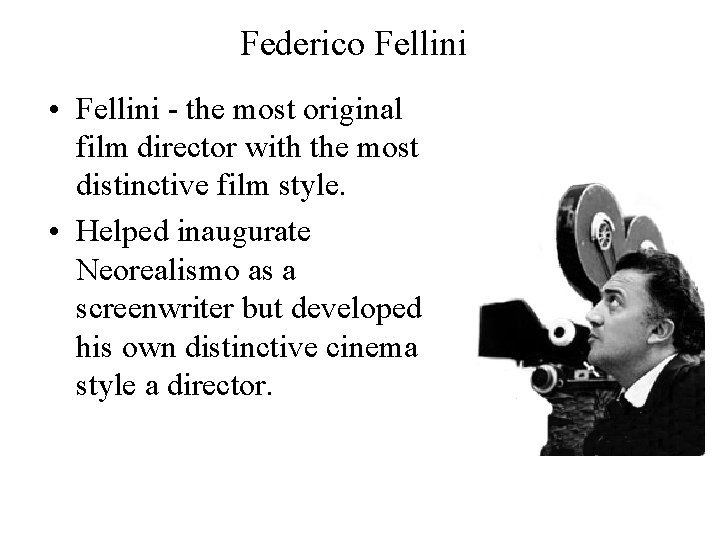
Federico Fellini • Fellini - the most original film director with the most distinctive film style. • Helped inaugurate Neorealismo as a screenwriter but developed his own distinctive cinema style a director.
Fellini’s Films • The normal and the rational seem to have bore him. Through mise-en-scène and montage • Fellini “defamiliarize” our world and have us see it afresh through mise-en-scène and montage. • Challenge our conventional expectation.
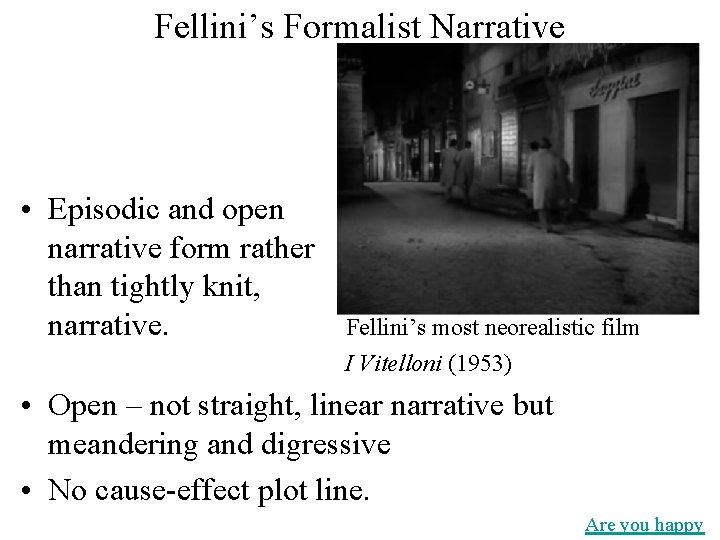
Fellini’s Formalist Narrative • Episodic and open narrative form rather than tightly knit, narrative. closed linear Fellini’s most neorealistic film I Vitelloni (1953) • Open – not straight, linear narrative but meandering and digressive • No cause-effect plot line. Are you happy
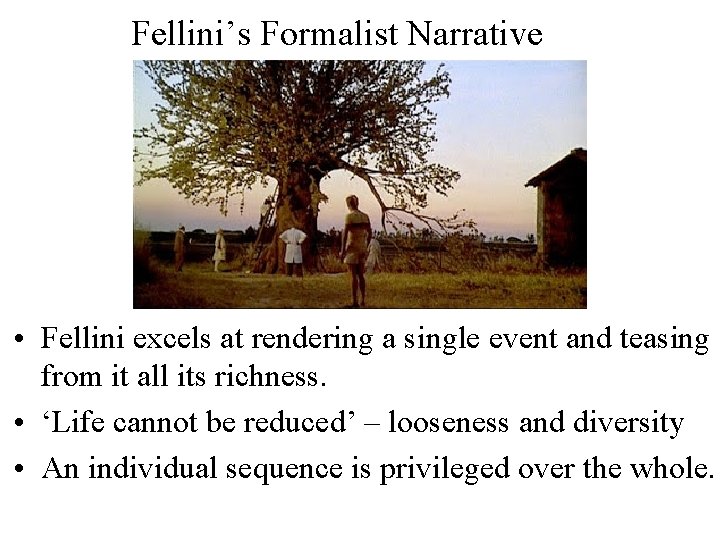
Fellini’s Formalist Narrative • Fellini excels at rendering a single event and teasing from it all its richness. • ‘Life cannot be reduced’ – looseness and diversity • An individual sequence is privileged over the whole.
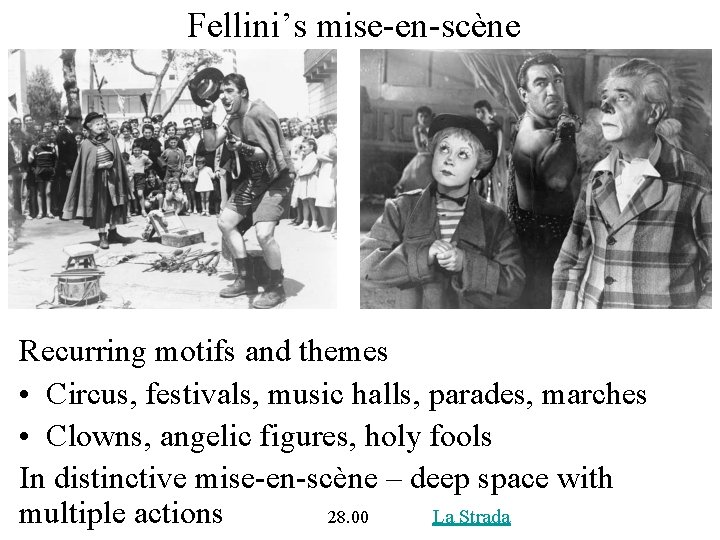
Fellini’s mise-en-scène Recurring motifs and themes • Circus, festivals, music halls, parades, marches • Clowns, angelic figures, holy fools In distinctive mise-en-scène – deep space with multiple actions 28. 00 La Strada
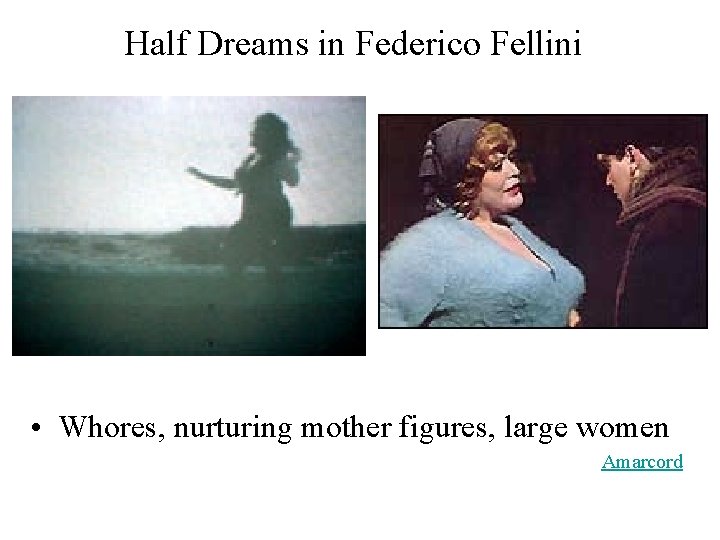
Half Dreams in Federico Fellini • Whores, nurturing mother figures, large women Amarcord
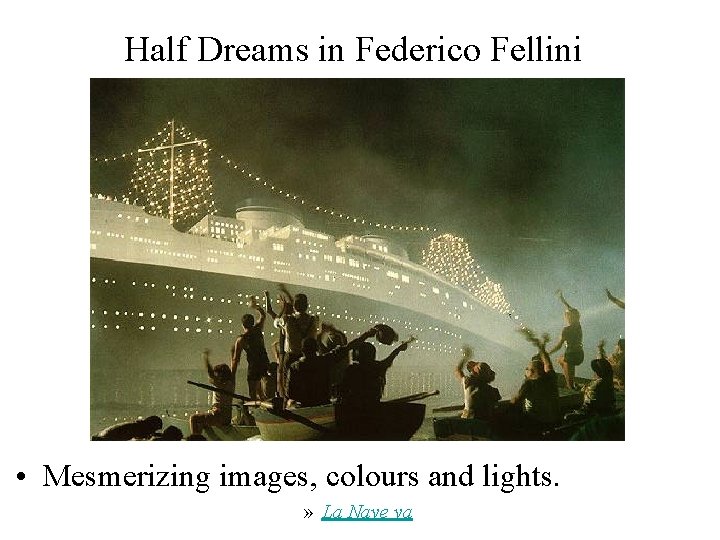
Half Dreams in Federico Fellini • Mesmerizing images, colours and lights. » La Nave va
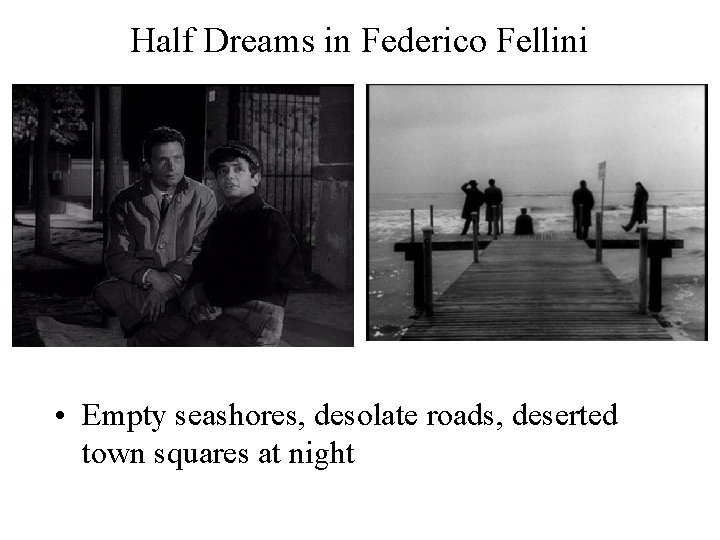
Half Dreams in Federico Fellini • Empty seashores, desolate roads, deserted town squares at night
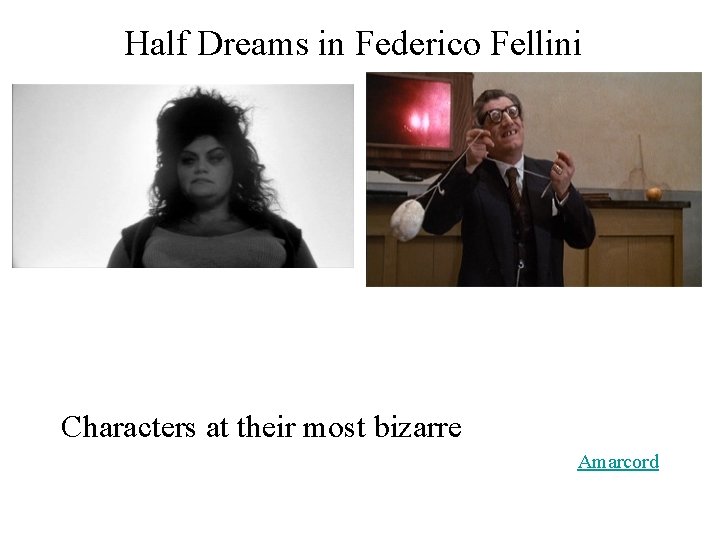
Half Dreams in Federico Fellini Characters at their most bizarre Amarcord
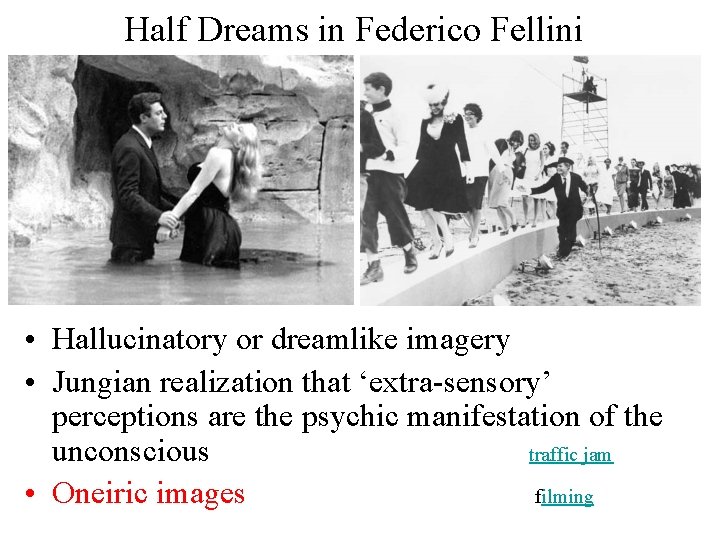
Half Dreams in Federico Fellini • Hallucinatory or dreamlike imagery • Jungian realization that ‘extra-sensory’ perceptions are the psychic manifestation of the unconscious traffic jam • Oneiric images filming
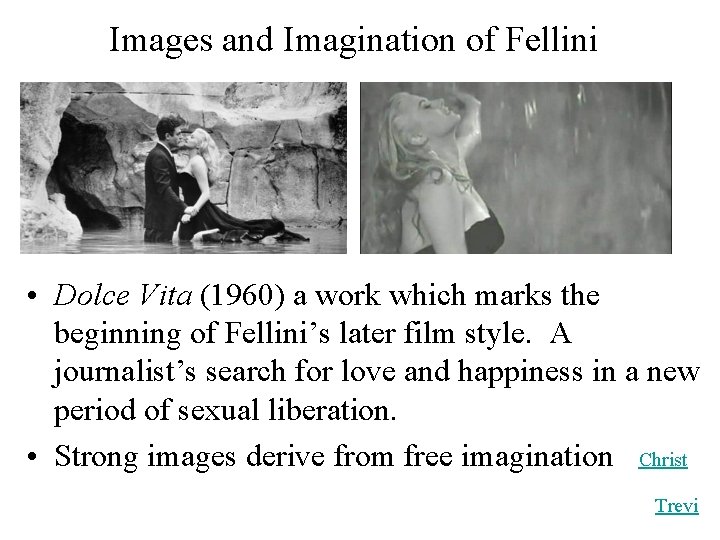
Images and Imagination of Fellini • Dolce Vita (1960) a work which marks the beginning of Fellini’s later film style. A journalist’s search for love and happiness in a new period of sexual liberation. • Strong images derive from free imagination Christ Trevi
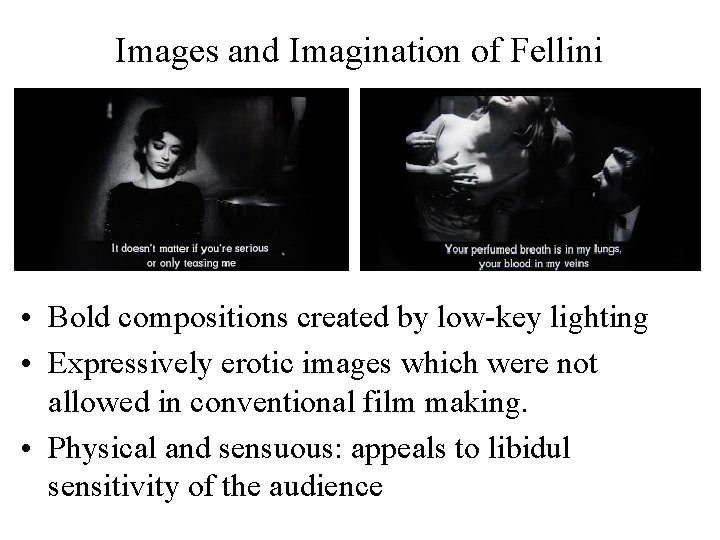
Images and Imagination of Fellini • Bold compositions created by low-key lighting • Expressively erotic images which were not allowed in conventional film making. • Physical and sensuous: appeals to libidul sensitivity of the audience