
Masters in Environmental Studies 2020 21 Masaryk University


- Slides: 26
Masters in Environmental Studies, 2020 -21 Masaryk University, Brno, Czech Republic Class 3: Environmental subjects Christos Zografos, Ph. D Department of Political and Social Sciences, Universitat Pompeu Fabra, Barcelona, Spain christos. zografos@upf. edu
Admin note: the Final Essay 70% of your final mark Can do individual one or group (two students max) v Topic: Klein, N. 2016. Let Them Drown. The Violence of Othering in a Warming World. q You can read the text or you can watch her presenting her text • Performance criteria: 1. Explain in your own words (i. e. without copy-pasting Klein’s text) (i) what Klein means by “othering” as a source of clim change vulnerability that is violent, and (ii) what she suggests as a way of dealing with climate change risks and hazards 2. Evaluate Klein’s argument: do you agree/ disagree with Klein, and why? • State your opinion and support it with arguments and evidence from other studies (e. g. from our course) or data/ examples (e. g. info from media) 3. Using class bibliography to support your answers 1
Introduction • • Answers to question Subjects approach Premises on other theories Classroom activities 2
Today’s reading Class question • “According to Robbins and his study, lawn managers who are more aware of the environmental impacts of chemicals, and are more socially involved and concerned about their communities, are those who apply more intensively chemicals on their lawns • “How do Robbins’ middle-class lawn mainteners (“lawn people”) end up using chemicals which they know that are harmful not only for the environment but also to their own health? • “Why do they do this to themselves and the environment? ” 3
Why do they do it? Three reasons: 1. Hectic lives: no free time 2. Economic/ instrumental logics 3. The good citizen: moral responsibility to the community 4
Hectic lifestyles • “When I first moved here I was traveling a lot so I didn’t have time to do much in my yard. I thought, my lawn must need something, so I was treating it. . . I think of yard work as a fun activity. . . But I just don’t have the time anymore. ” • Residents stated, with some degree of pride, how busy they and their families are with careers, hobbies, sports, and travel • This often translated into a feeling that they did not have time to worry about lawn chemicals 5
Economic/ instrumental logics • Association of chemicals inputs with housing values suggests instrumental motivations • Conserving well the lawn = relatively inexpensive investment for maintaining property values – Note: this is a socio-ecological system where homeowners are rewarded for environmentally detrimental behaviour! • Still: instrumental thinking only a small part of lawn managerhome owner logic 6
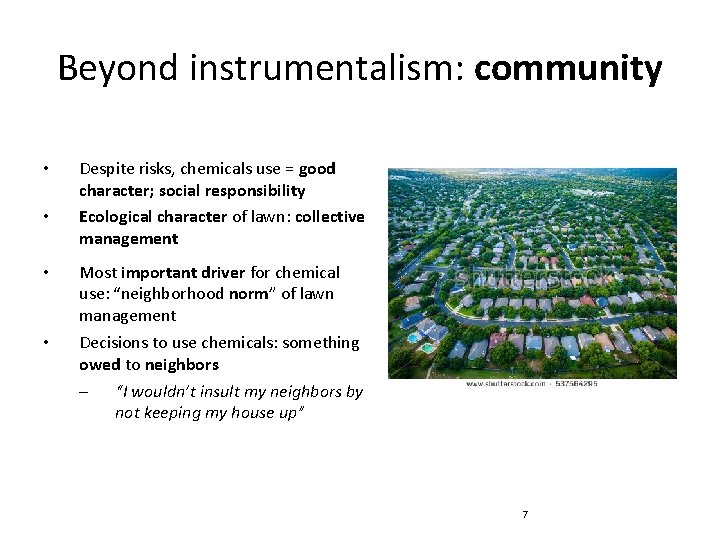
Beyond instrumentalism: community • • Despite risks, chemicals use = good character; social responsibility Ecological character of lawn: collective management • Most important driver for chemical use: “neighborhood norm” of lawn management • Decisions to use chemicals: something owed to neighbors – “I wouldn’t insult my neighbors by not keeping my house up” 7
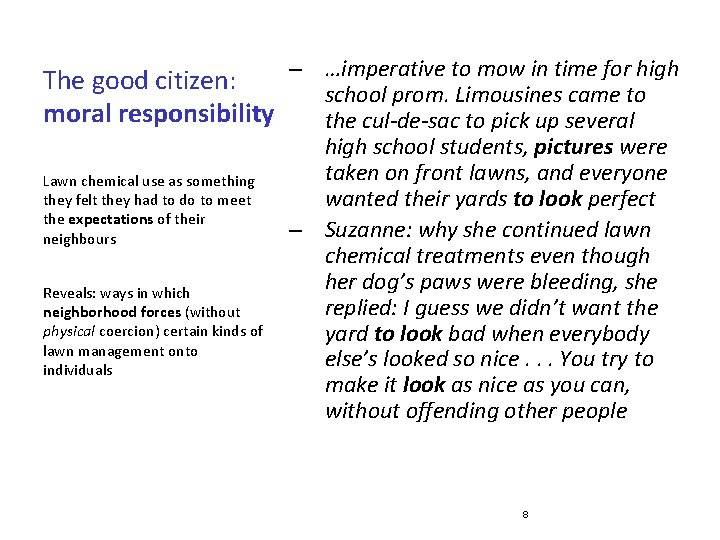
– …imperative to mow in time for high The good citizen: school prom. Limousines came to moral responsibility the cul-de-sac to pick up several Lawn chemical use as something they felt they had to do to meet the expectations of their neighbours Reveals: ways in which neighborhood forces (without physical coercion) certain kinds of lawn management onto individuals high school students, pictures were taken on front lawns, and everyone wanted their yards to look perfect – Suzanne: why she continued lawn chemical treatments even though her dog’s paws were bleeding, she replied: I guess we didn’t want the yard to look bad when everybody else’s looked so nice. . . You try to make it look as nice as you can, without offending other people 8
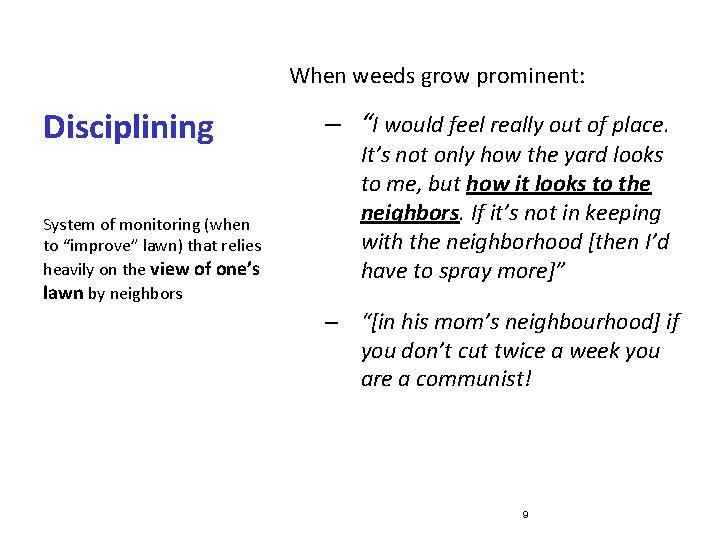
When weeds grow prominent: Disciplining System of monitoring (when to “improve” lawn) that relies heavily on the view of one’s lawn by neighbors – “I would feel really out of place. It’s not only how the yard looks to me, but how it looks to the neighbors. If it’s not in keeping with the neighborhood [then I’d have to spray more]” – “[in his mom’s neighbourhood] if you don’t cut twice a week you are a communist! 9
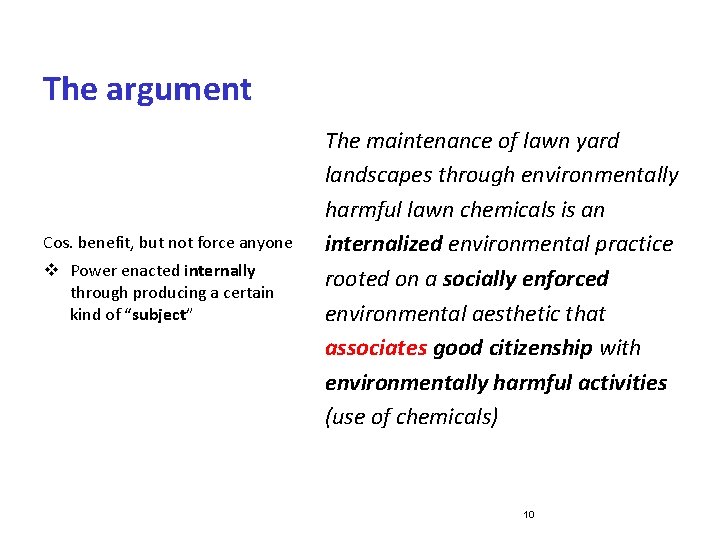
The argument Cos. benefit, but not force anyone v Power enacted internally through producing a certain kind of “subject” The maintenance of lawn yard landscapes through environmentally harmful lawn chemicals is an internalized environmental practice rooted on a socially enforced environmental aesthetic that associates good citizenship with environmentally harmful activities (use of chemicals) 10
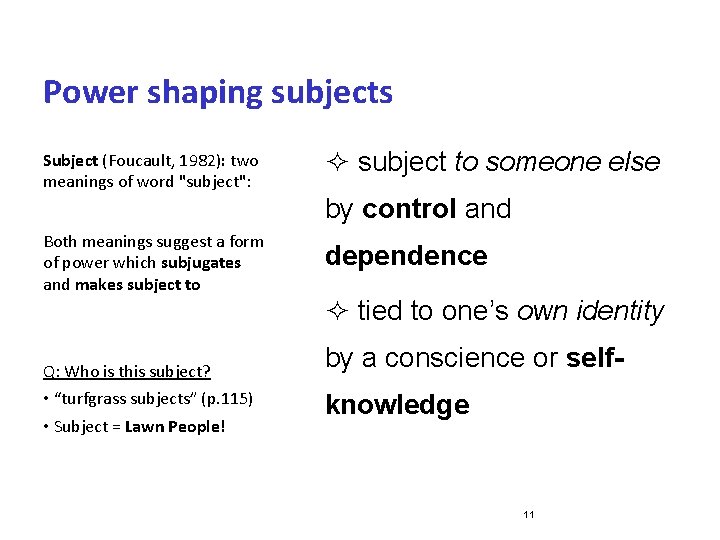
Power shaping subjects Subject (Foucault, 1982): two meanings of word "subject": ² subject to someone else by control and Both meanings suggest a form of power which subjugates and makes subject to Q: Who is this subject? • “turfgrass subjects” (p. 115) • Subject = Lawn People! dependence ² tied to one’s own identity by a conscience or selfknowledge 11
Subjects and subject-making BACKGROUND TO THE APPROACH 12
Foucault, power and liberalism Foucault’s interest: • Of how power operates • Emergence of ‘technologies of power’ in modern (roughly 17 th century onwards) period (Europe) • An interest on liberalism: key, modern political doctrine and practice of government Liberalism (Britannica) • Protecting and enhancing freedom of the individual = the central problem of politics • Government is necessary to protect individuals from being harmed by others • But government itself can pose a threat to liberty • Laws, judges, and police are needed to secure the individual’s life and liberty, but their coercive power may also be turned against him • Problem: how to avoid (as much as possible) coercion/ authority abusing power but also secure individual liberty (do as one wants – more or less)? 13
Central problem of modern government Iverson and Painter, 2005: • Foucault identified the ‘conduct of conduct’ as the central problem of modern government • To deal with the central paradox of liberal government: ‒ liberalism asserts sovereignty of free individual, … ‒ …yet government requires that individual behaviour be (externally) regulated – undesirable for liberalism 14
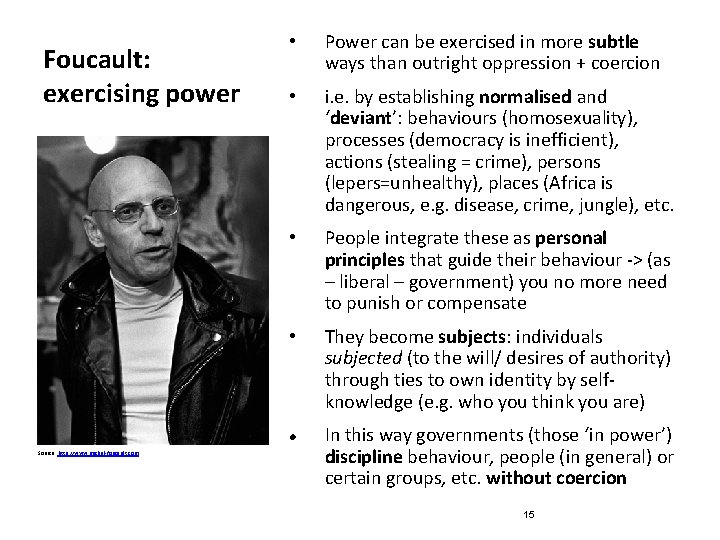
Foucault: exercising power • Power can be exercised in more subtle ways than outright oppression + coercion • i. e. by establishing normalised and ‘deviant’: behaviours (homosexuality), processes (democracy is inefficient), actions (stealing = crime), persons (lepers=unhealthy), places (Africa is dangerous, e. g. disease, crime, jungle), etc. • People integrate these as personal principles that guide their behaviour -> (as – liberal – government) you no more need to punish or compensate • They become subjects: individuals subjected (to the will/ desires of authority) through ties to own identity by selfknowledge (e. g. who you think you are) Source: http: //www. michel-foucault. com In this way governments (those ‘in power’) discipline behaviour, people (in general) or certain groups, etc. without coercion 15
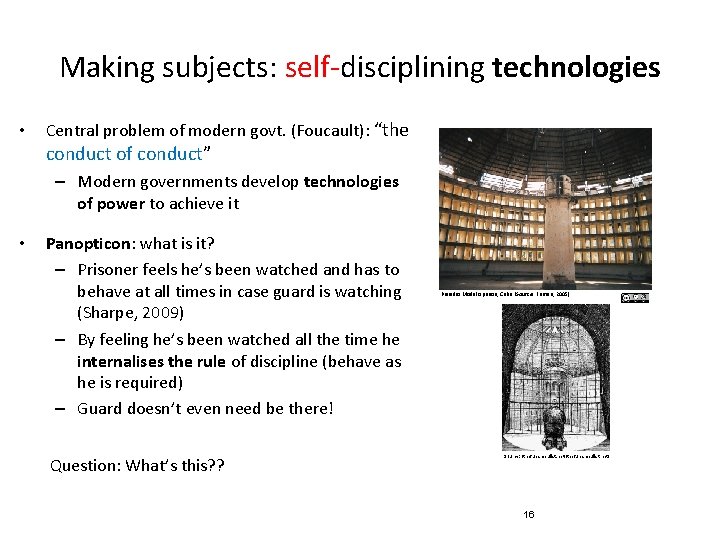
Making subjects: self-disciplining technologies • Central problem of modern govt. (Foucault): “the conduct of conduct” – Modern governments develop technologies of power to achieve it • Panopticon: what is it? – Prisoner feels he’s been watched and has to behave at all times in case guard is watching (Sharpe, 2009) – By feeling he’s been watched all the time he internalises the rule of discipline (behave as he is required) – Guard doesn’t even need be there! Question: What’s this? ? Presidio Modelo prison, Cuba (Source: Friman, 2005) Source: /thefunambulist. net/ 16
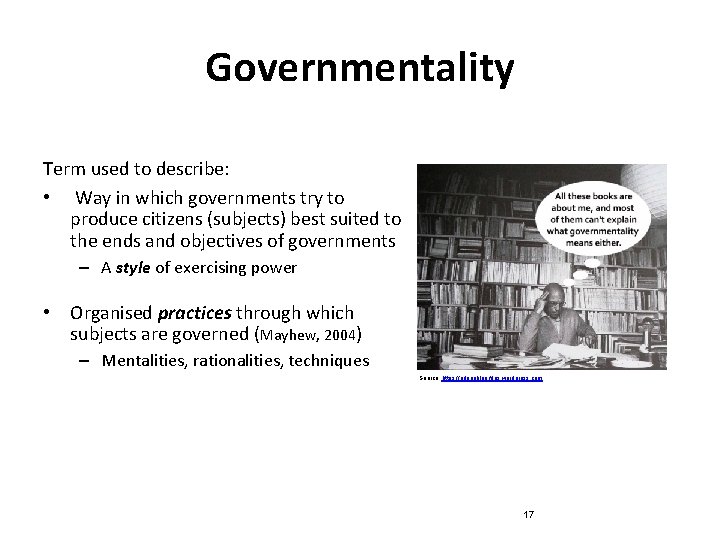
Governmentality Term used to describe: • Way in which governments try to produce citizens (subjects) best suited to the ends and objectives of governments – A style of exercising power • Organised practices through which subjects are governed (Mayhew, 2004) – Mentalities, rationalities, techniques Source: https: //adrianblau. files. wordpress. com 17
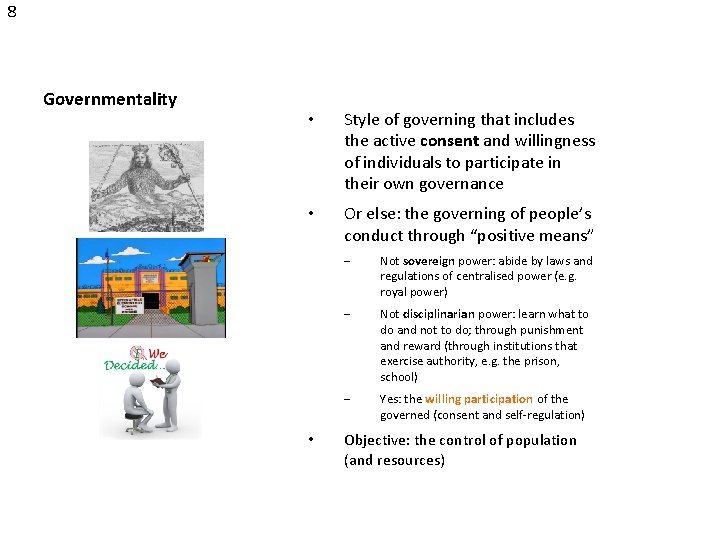
8 Governmentality • Style of governing that includes the active consent and willingness of individuals to participate in their own governance • Or else: the governing of people’s conduct through “positive means” • ‒ Not sovereign power: abide by laws and regulations of centralised power (e. g. royal power) ‒ Not disciplinarian power: learn what to do and not to do; through punishment and reward (through institutions that exercise authority, e. g. the prison, school) ‒ Yes: the willing participation of the governed (consent and self-regulation) Objective: the control of population (and resources)
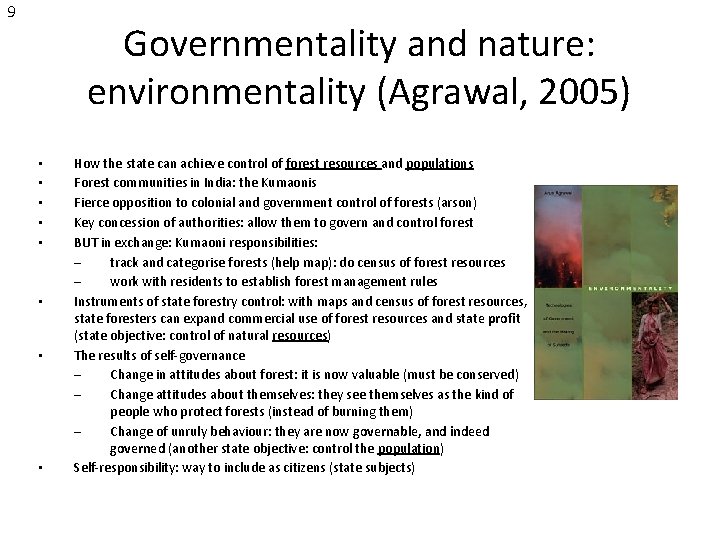
9 Governmentality and nature: environmentality (Agrawal, 2005) • • How the state can achieve control of forest resources and populations Forest communities in India: the Kumaonis Fierce opposition to colonial and government control of forests (arson) Key concession of authorities: allow them to govern and control forest BUT in exchange: Kumaoni responsibilities: ‒ track and categorise forests (help map): do census of forest resources ‒ work with residents to establish forest management rules Instruments of state forestry control: with maps and census of forest resources, state foresters can expand commercial use of forest resources and state profit (state objective: control of natural resources) The results of self-governance ‒ Change in attitudes about forest: it is now valuable (must be conserved) ‒ Change attitudes about themselves: they see themselves as the kind of people who protect forests (instead of burning them) ‒ Change of unruly behaviour: they are now governable, and indeed governed (another state objective: control the population) Self-responsibility: way to include as citizens (state subjects)
The argument (Robbins, 2012) • Increased participation in environmental regulation and enforcement produces environmental subjectivities, … • i. e. environmental subjects: people who facilitate the policing of nature for extraction or conservation, capitalist profit or colonial wealth-creation 20
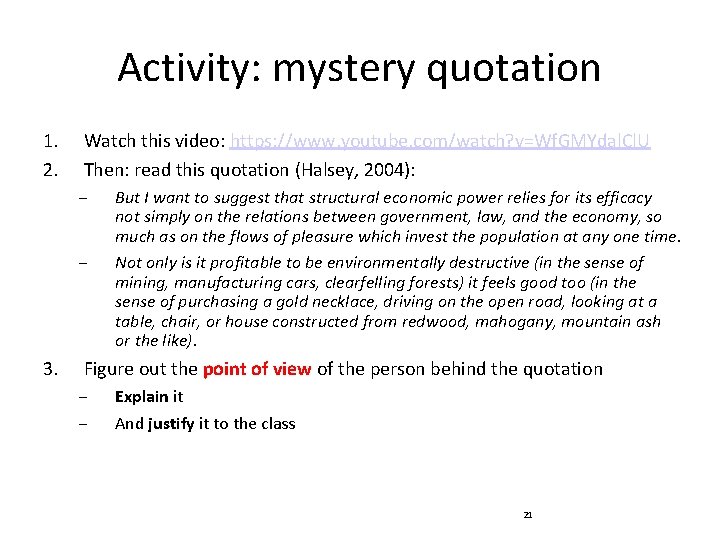
Activity: mystery quotation 1. 2. Watch this video: https: //www. youtube. com/watch? v=Wf. GMYdal. Cl. U Then: read this quotation (Halsey, 2004): ‒ ‒ 3. But I want to suggest that structural economic power relies for its efficacy not simply on the relations between government, law, and the economy, so much as on the flows of pleasure which invest the population at any one time. Not only is it profitable to be environmentally destructive (in the sense of mining, manufacturing cars, clearfelling forests) it feels good too (in the sense of purchasing a gold necklace, driving on the open road, looking at a table, chair, or house constructed from redwood, mahogany, mountain ash or the like). Figure out the point of view of the person behind the quotation ‒ ‒ Explain it And justify it to the class 21
In closing TAKE AWAY POINTS 22
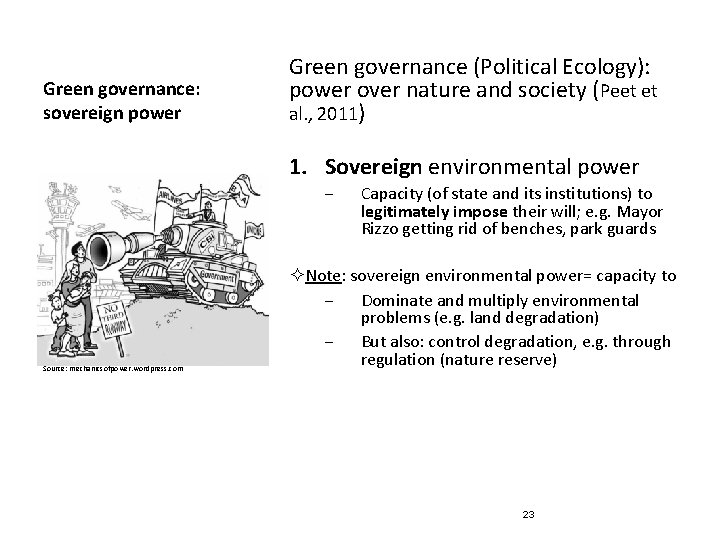
Green governance: sovereign power Green governance (Political Ecology): power over nature and society (Peet et al. , 2011) 1. Sovereign environmental power ‒ Source: mechanicsofpower. wordpress. com Capacity (of state and its institutions) to legitimately impose their will; e. g. Mayor Rizzo getting rid of benches, park guards ²Note: sovereign environmental power= capacity to ‒ Dominate and multiply environmental problems (e. g. land degradation) ‒ But also: control degradation, e. g. through regulation (nature reserve) 23
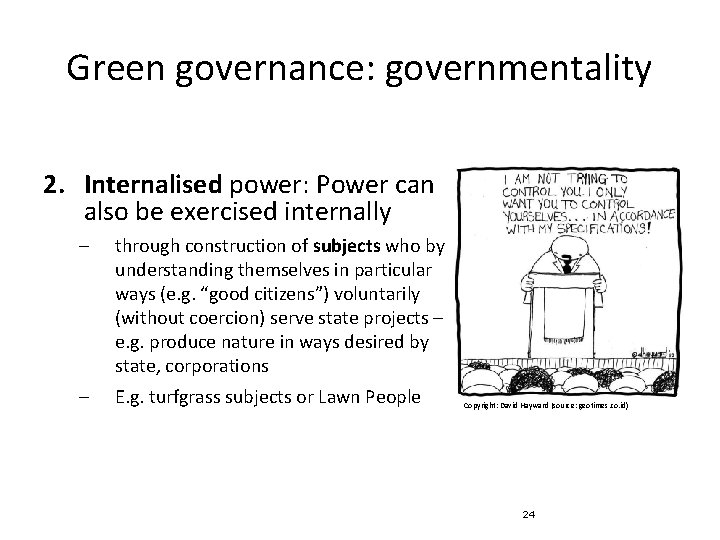
Green governance: governmentality 2. Internalised power: Power can also be exercised internally ‒ through construction of subjects who by understanding themselves in particular ways (e. g. “good citizens”) voluntarily (without coercion) serve state projects – e. g. produce nature in ways desired by state, corporations ‒ E. g. turfgrass subjects or Lawn People Copyright: David Hayward (source: geotimes. co. id) 24
Course overview: what did I learn? Activity: Sketchnoting 1. Breakout room: groups of 3 persons (8 groups) 2. Sketch a picture that represents what you have learned/ or one thing you have learned with this course (20 min) ‒ Use this freeware: https: //awwapp. com/b/ubngq 7 qzuxkca/# ‒ One of you access it, and then invite the other two via the green ”Invite” button and link on the top of the screen ‒ Start sketching! ‒ Finally, save your sketch via “Export board” 3. Then, present your sketch in class with zoom’s “Share screen” – each group will have 3 min to present 25