
Masters and Masters Qualifier in Electronic Systems and
- Slides: 25
Masters and Masters Qualifier in Electronic Systems and Telecommunications Engineering School of Electronic Engineering http: //www. dcu. ie/electronic_engineering/index. shtml
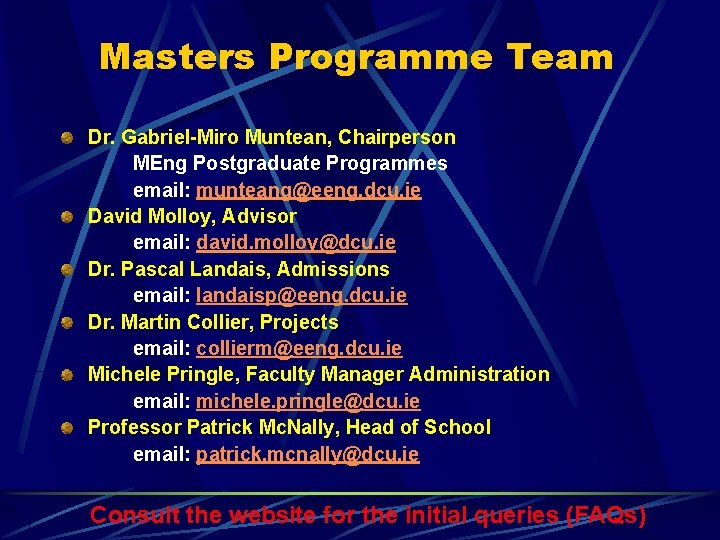
Masters Programme Team Dr. Gabriel-Miro Muntean, Chairperson MEng Postgraduate Programmes email: munteang@eeng. dcu. ie David Molloy, Advisor email: david. molloy@dcu. ie Dr. Pascal Landais, Admissions email: landaisp@eeng. dcu. ie Dr. Martin Collier, Projects email: collierm@eeng. dcu. ie Michele Pringle, Faculty Manager Administration email: michele. pringle@dcu. ie Professor Patrick Mc. Nally, Head of School email: patrick. mcnally@dcu. ie Consult the website for the initial queries (FAQs)
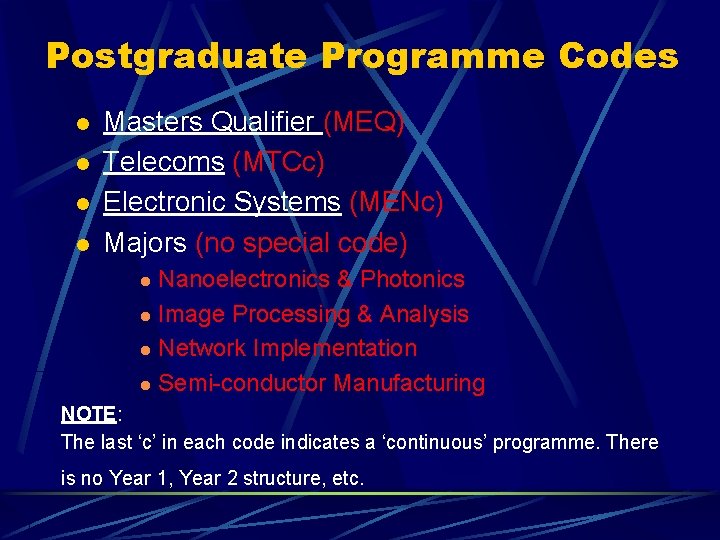
Postgraduate Programme Codes l l Masters Qualifier (MEQ) Telecoms (MTCc) Electronic Systems (MENc) Majors (no special code) Nanoelectronics & Photonics l Image Processing & Analysis l Network Implementation l Semi-conductor Manufacturing l NOTE: The last ‘c’ in each code indicates a ‘continuous’ programme. There is no Year 1, Year 2 structure, etc.
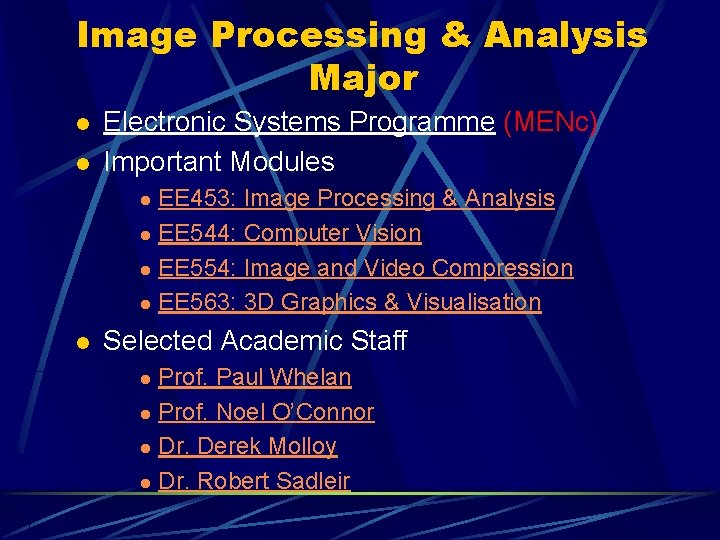
Image Processing & Analysis Major l l Electronic Systems Programme (MENc) Important Modules EE 453: Image Processing & Analysis l EE 544: Computer Vision l EE 554: Image and Video Compression l EE 563: 3 D Graphics & Visualisation l l Selected Academic Staff Prof. Paul Whelan l Prof. Noel O’Connor l Dr. Derek Molloy l Dr. Robert Sadleir l
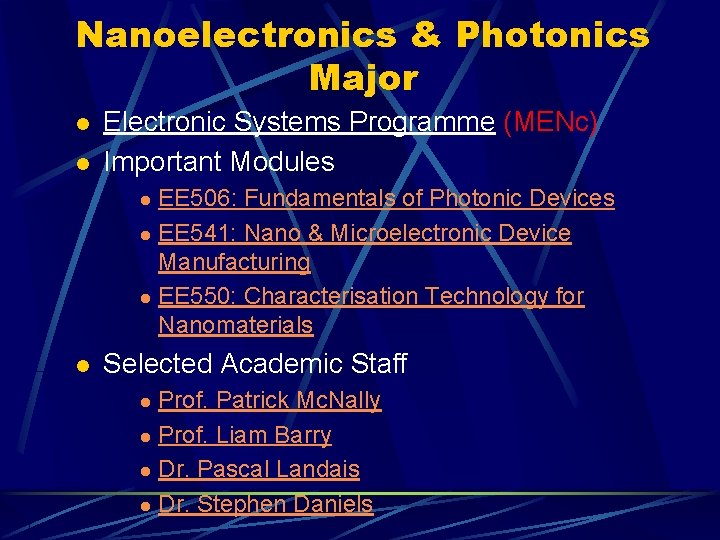
Nanoelectronics & Photonics Major l l Electronic Systems Programme (MENc) Important Modules EE 506: Fundamentals of Photonic Devices l EE 541: Nano & Microelectronic Device Manufacturing l EE 550: Characterisation Technology for Nanomaterials l l Selected Academic Staff Prof. Patrick Mc. Nally l Prof. Liam Barry l Dr. Pascal Landais l Dr. Stephen Daniels l
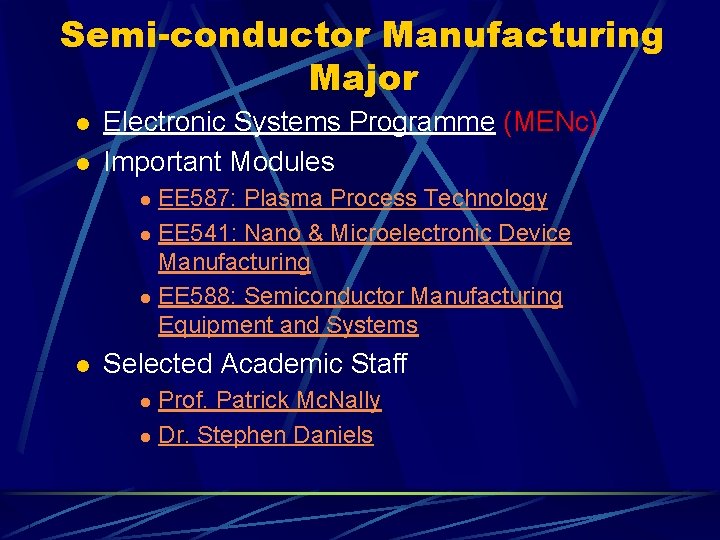
Semi-conductor Manufacturing Major l l Electronic Systems Programme (MENc) Important Modules EE 587: Plasma Process Technology l EE 541: Nano & Microelectronic Device Manufacturing l EE 588: Semiconductor Manufacturing Equipment and Systems l l Selected Academic Staff Prof. Patrick Mc. Nally l Dr. Stephen Daniels l
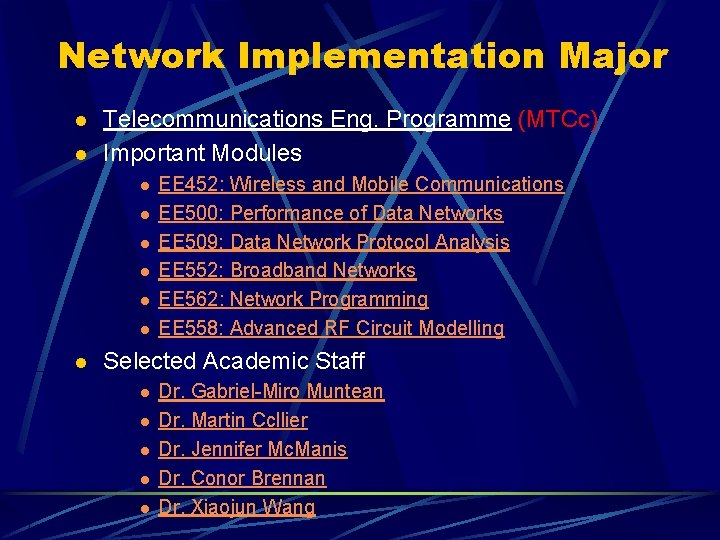
Network Implementation Major l l Telecommunications Eng. Programme (MTCc) Important Modules l l l l EE 452: Wireless and Mobile Communications EE 500: Performance of Data Networks EE 509: Data Network Protocol Analysis EE 552: Broadband Networks EE 562: Network Programming EE 558: Advanced RF Circuit Modelling Selected Academic Staff l l l Dr. Gabriel-Miro Muntean Dr. Martin Ccllier Dr. Jennifer Mc. Manis Dr. Conor Brennan Dr. Xiaojun Wang
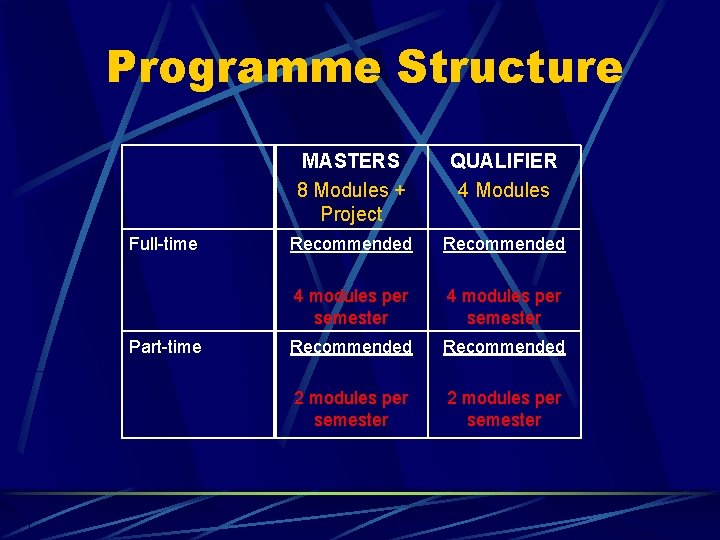
Programme Structure Full-time Part-time MASTERS 8 Modules + Project QUALIFIER 4 Modules Recommended 4 modules per semester Recommended 2 modules per semester
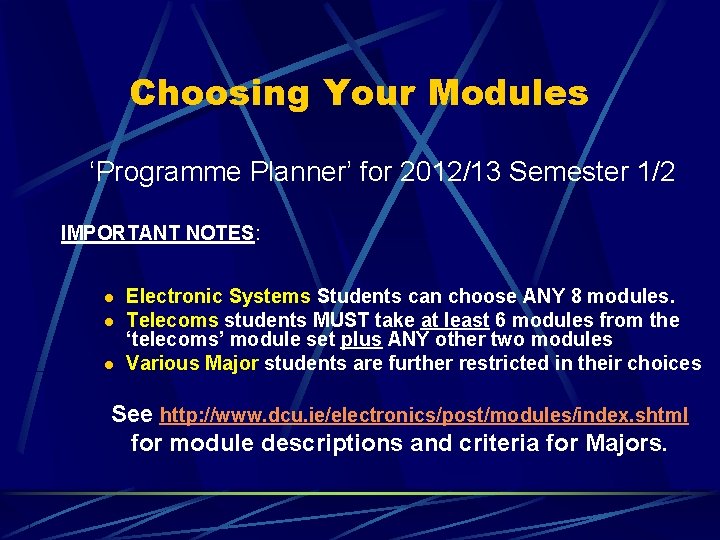
Choosing Your Modules ‘Programme Planner’ for 2012/13 Semester 1/2 IMPORTANT NOTES: l l l Electronic Systems Students can choose ANY 8 modules. Telecoms students MUST take at least 6 modules from the ‘telecoms’ module set plus ANY other two modules Various Major students are further restricted in their choices See http: //www. dcu. ie/electronics/post/modules/index. shtml for module descriptions and criteria for Majors.
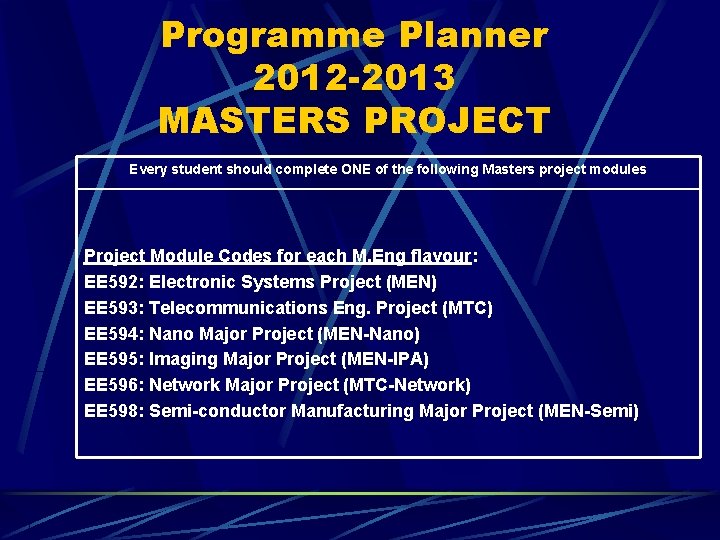
Programme Planner 2012 -2013 MASTERS PROJECT Every student should complete ONE of the following Masters project modules Project Module Codes for each M. Eng flavour: EE 592: Electronic Systems Project (MEN) EE 593: Telecommunications Eng. Project (MTC) EE 594: Nano Major Project (MEN-Nano) EE 595: Imaging Major Project (MEN-IPA) EE 596: Network Major Project (MTC-Network) EE 598: Semi-conductor Manufacturing Major Project (MEN-Semi)
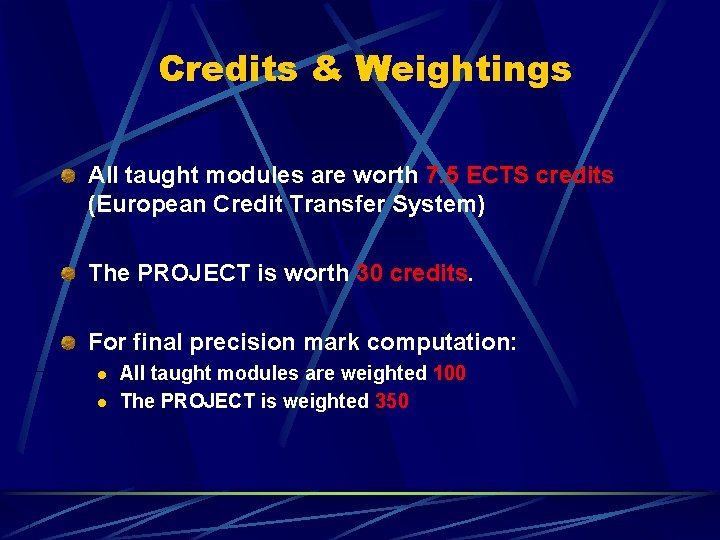
Credits & Weightings All taught modules are worth 7. 5 ECTS credits (European Credit Transfer System) The PROJECT is worth 30 credits. For final precision mark computation: l l All taught modules are weighted 100 The PROJECT is weighted 350
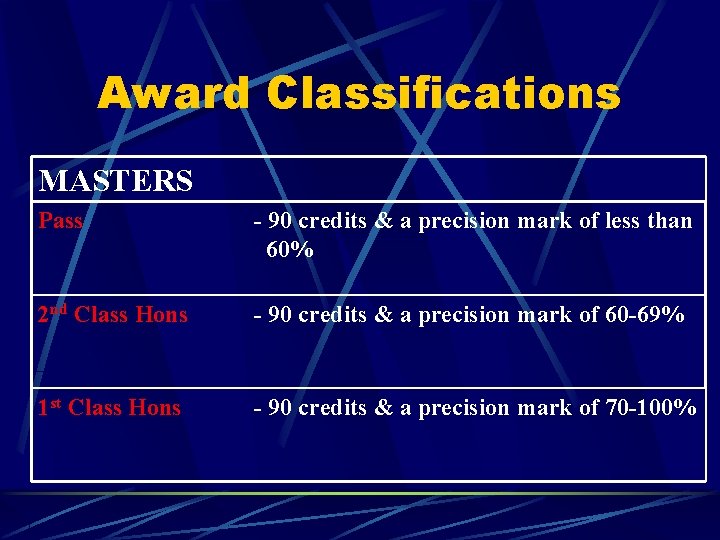
Award Classifications MASTERS Pass - 90 credits & a precision mark of less than 60% 2 nd Class Hons - 90 credits & a precision mark of 60 -69% 1 st Class Hons - 90 credits & a precision mark of 70 -100%
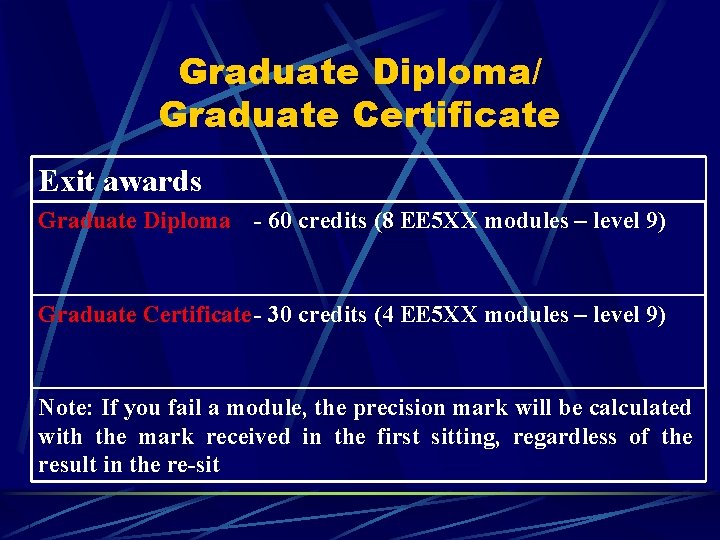
Graduate Diploma/ Graduate Certificate Exit awards Graduate Diploma - 60 credits (8 EE 5 XX modules – level 9) Graduate Certificate- 30 credits (4 EE 5 XX modules – level 9) Note: If you fail a module, the precision mark will be calculated with the mark received in the first sitting, regardless of the result in the re-sit
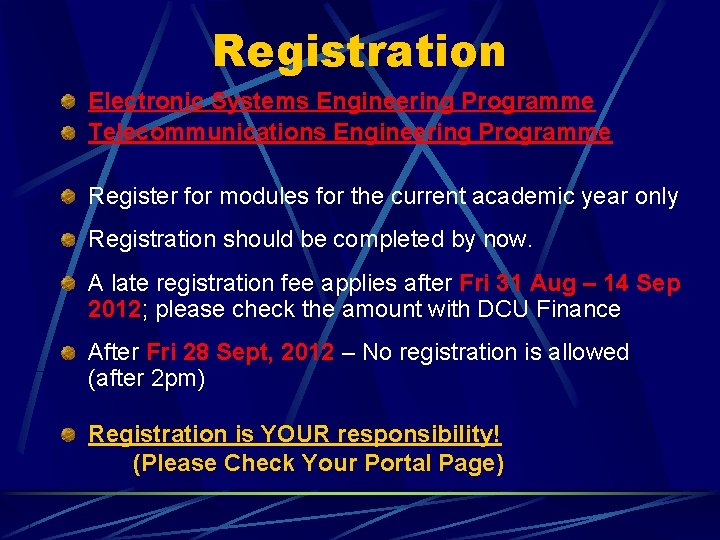
Registration Electronic Systems Engineering Programme Telecommunications Engineering Programme Register for modules for the current academic year only Registration should be completed by now. A late registration fee applies after Fri 31 Aug – 14 Sep 2012; please check the amount with DCU Finance After Fri 28 Sept, 2012 – No registration is allowed (after 2 pm) Registration is YOUR responsibility! (Please Check Your Portal Page)
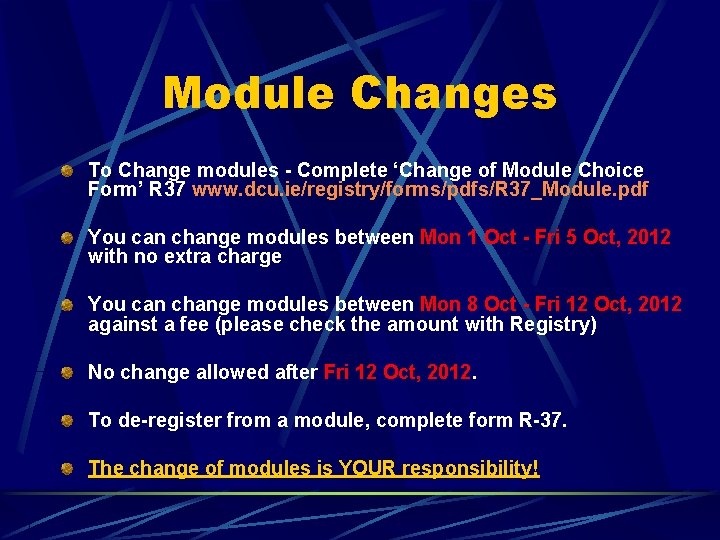
Module Changes To Change modules - Complete ‘Change of Module Choice Form’ R 37 www. dcu. ie/registry/forms/pdfs/R 37_Module. pdf You can change modules between Mon 1 Oct - Fri 5 Oct, 2012 with no extra charge You can change modules between Mon 8 Oct - Fri 12 Oct, 2012 against a fee (please check the amount with Registry) No change allowed after Fri 12 Oct, 2012. To de-register from a module, complete form R-37. The change of modules is YOUR responsibility!
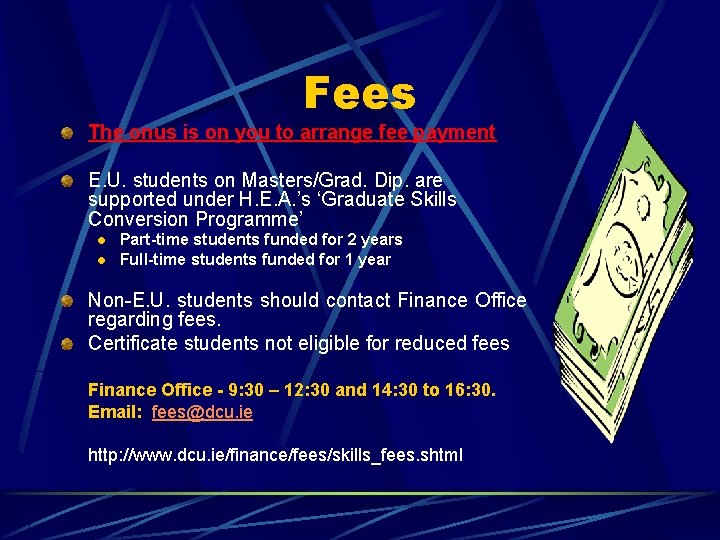
Fees The onus is on you to arrange fee payment E. U. students on Masters/Grad. Dip. are supported under H. E. A. ’s ‘Graduate Skills Conversion Programme’ l l Part-time students funded for 2 years Full-time students funded for 1 year Non-E. U. students should contact Finance Office regarding fees. Certificate students not eligible for reduced fees Finance Office - 9: 30 – 12: 30 and 14: 30 to 16: 30. Email: fees@dcu. ie http: //www. dcu. ie/finance/fees/skills_fees. shtml
Timetables Available for all Elec. Eng. postgraduate programmes on the web under the course code – ‘MEN’, Year C www. dcu. ie/timetables/search. shtml
Examinations • • SEMESTER 1 Mon 14 Jan - Fri 25 Jan 2013 SEMESTER 2 Mon 13 May - Sat 25 May 2013 Autumn Resits – to be confirmed The exam timetable is displayed by the DCU Exams Office on student portal pages and DCU site 4 -6 weeks prior to exams For 2012/13 examination timetable, see: http: //www. dcu. ie/timetables/examinations. shtml
Examinations Students are NOT PERMITTED to retake exams or CA already passed Marks & Standards – http: //www. dcu. ie/registry/examinations/marks_and_standards. pdf Exam Regulations – http: //www. dcu. ie/registry/examinations/regulations. shtml Past Exam Papers – http: //www. dcu. ie/internal/examinations/papers. php 3
Student Pitfalls According to DCU Regulations 1) The four year rule - there is a maximum of 4 year anybody can spend on our Masters programme, - this includes deferred years and work or illness-related issues 2) The one session repeat rule - there a max of four attempts at any module except the project - there a maximum of two attempts at the project 3) There are three different CA categories - 1: resit is available for all components of the module - 2: no resit is available for a 100% CA module - 3: no resit is available for the CA component only
Deferrals and Absences To defer an entire academic year, complete a “Deferral of Academic Year” form (R-32) https: //www 4. dcu. ie/sites/default/files/registry/pdfs/R 32. pdf To defer exams, complete a “Deferral of Examination Form” (R-33) https: //www 4. dcu. ie/sites/default/files/registry/pdfs/R 33. pdf - Separate forms are required for each exam session (including re-sit) Unexplained absences from exams result in a FAILED ATTEMPT. Therefore: - Ensure you are registered correctly - If absent, complete an “Absent from Examination Form” (R-41) https: //www 4. dcu. ie/sites/default/files/registry/pdfs/R 41. pdf For other forms, please see: http: //www. dcu. ie/registry/application_forms. shtml Submission of forms will be accepted at the Faculty Office (L 115)
Project Dr. Martin Collier Literature Review Interim Presentation Project Implementation Final Report Research paper l Appendices l Final Oral Examination
Project Dr. Martin Collier Project Selection: - October 2012 (Part-time students submitting the project in August 2013) - February 2013 (Full-time students submitting The project in August 2013) - October 2013 (Part-time students submitting the project in August 2014)
Plagiarism, Copying and Collusion Plagiarism is a serious offence in the university. Familiarise yourself with DCU’s ‘Regulation on Plagiarism, Copying & Collusion’ at http: //www. dcu. ie/registry/examinations/plagiarism. shtml
Masters/Grad Dip/Grad Cert in Electronic Systems or Telecommunications Engineering School of Electronic Engineering http: //www. dcu. ie/electronic_engineering/index. shtml Contact: munteang@eeng. dcu. ie or faculty. ec. assistant@dcu. ie