
Mastering Stress and Boosting Resiliency Session 4 Themis
Mastering Stress and Boosting Resiliency: Session 4 Themis A. Yiaslas, Psy. D Prevention. Forward Clinic Cardiac Rehabilitation Program

Today’s Class Welcome to the “Mastering Stress and Boosting Resiliency” class series Tuesdays, 5: 00 - 6: 00 pm, Zoom Meeting Today’s Topics Dealing with Negative Thinking Cognitive Distortions Self-Monitoring Our Internal Dialogue Learning to Relax on Demand Guided Exercise: Progressive Muscle Relaxation
What is Stress Management? Stress Management Training = Enhancing skills to withstand adverse situations by directly addressing problems, improving emotional flexibility, increasing the sense of control, cultivating optimism, and possibly finding greater meaning in life Stress management training is NOT: Just for “mentally weak people” Helpful only if you are overwhelmed

Stress Management Training: 3 -Month Series Build Stress Awareness Learn to Relax on Demand Identify and Change Unhelpful Thinking Build Coping Skills Solving Problems Managing Emotions & Acceptance Making Sense and Meaning Improve Social Support Promote Lifestyle and Medication Treatments Nutrition, Exercise, Medication Treatments
Best Time To Reverse Chronic Disease is NOW Our Mission: Comprehensive lifestyle changes, with the high aim of reversing hypertension, diabetes, and atherosclerotic heart disease Directly targets the factors that appear associated with higher risk of severe COVID-19 Reverse chronic disease for today’s threat (COVID 19), and for the long-term threat of premature death and disability

Robert Allan, Ph. D, Figure 24. 1, pg 483, Heart and Mind, 2 nd Ed. (2012)
Dealing with Negative Thinking Strategy #4
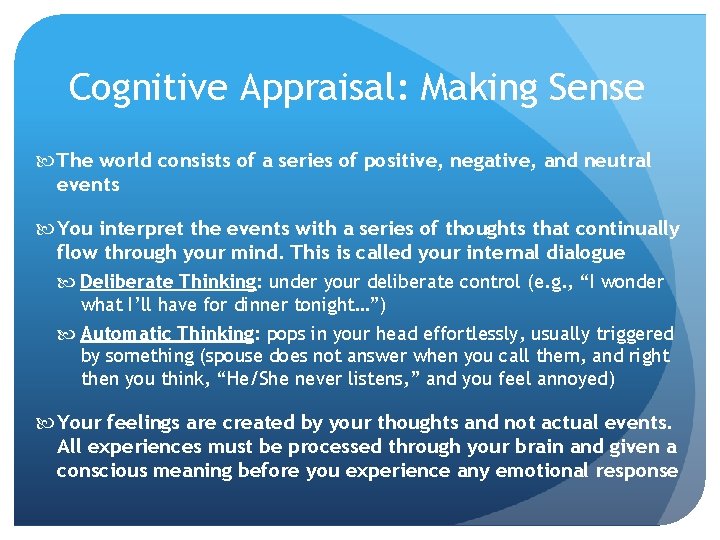
Cognitive Appraisal: Making Sense The world consists of a series of positive, negative, and neutral events You interpret the events with a series of thoughts that continually flow through your mind. This is called your internal dialogue Deliberate Thinking: under your deliberate control (e. g. , “I wonder what I’ll have for dinner tonight…”) Automatic Thinking: pops in your head effortlessly, usually triggered by something (spouse does not answer when you call them, and right then you think, “He/She never listens, ” and you feel annoyed) Your feelings are created by your thoughts and not actual events. All experiences must be processed through your brain and given a conscious meaning before you experience any emotional response
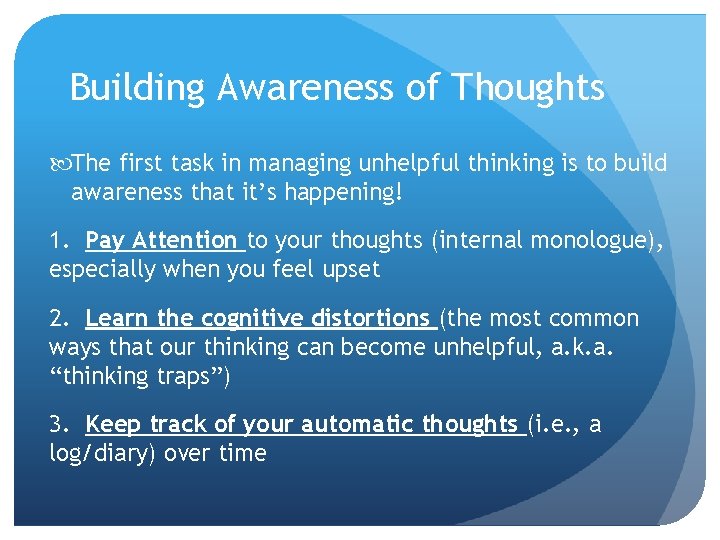
Building Awareness of Thoughts The first task in managing unhelpful thinking is to build awareness that it’s happening! 1. Pay Attention to your thoughts (internal monologue), especially when you feel upset 2. Learn the cognitive distortions (the most common ways that our thinking can become unhelpful, a. k. a. “thinking traps”) 3. Keep track of your automatic thoughts (i. e. , a log/diary) over time

Common Styles of Distorted Thinking Filtering: You take all the negative details and magnify them while filtering out all positive aspects of a situation. All-or-Nothing Thinking: Things are black or white, good or bad. You have to be perfect or you are a failure. Overgeneralization: You come to a general conclusion based on a single incident or piece of evidence. If something bad happens once, you expect it to happen over and over again. Over-estimating: You believe that a negative outcome is more likely that it actually is. Catastrophizing: You think that if something negative happens, it will become a disaster with a terrible outcome – often this follows over-estimating.
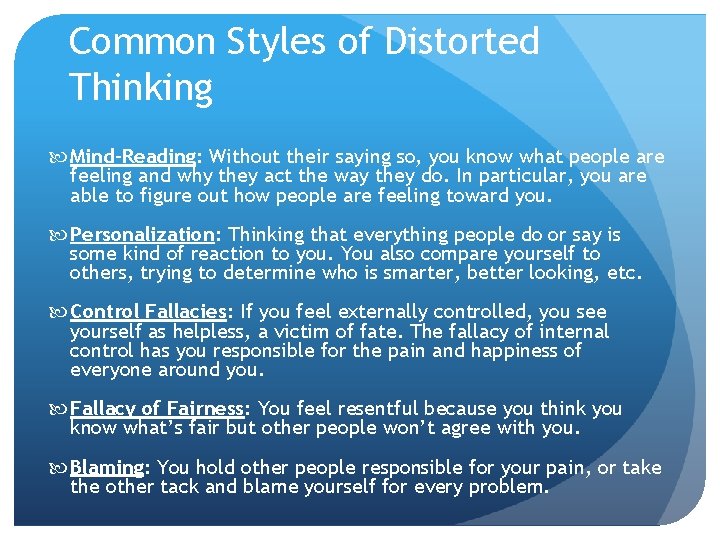
Common Styles of Distorted Thinking Mind-Reading: Without their saying so, you know what people are feeling and why they act the way they do. In particular, you are able to figure out how people are feeling toward you. Personalization: Thinking that everything people do or say is some kind of reaction to you. You also compare yourself to others, trying to determine who is smarter, better looking, etc. Control Fallacies: If you feel externally controlled, you see yourself as helpless, a victim of fate. The fallacy of internal control has you responsible for the pain and happiness of everyone around you. Fallacy of Fairness: You feel resentful because you think you know what’s fair but other people won’t agree with you. Blaming: You hold other people responsible for your pain, or take the other tack and blame yourself for every problem.

Common Styles of Distorted Thinking Shoulds: You have a list of ironclad rules about how you and other people should act. People who break the rules anger you and you feel guilty if you violate the rules. Emotional Reasoning: You believe that what you feel must be trueautomatically. If you feel stupid and boring, then you must be stupid and boring. Fallacy of Change: You expect other people will change to suit you if you just pressure them enough. You need to change people because your hopes for happiness seem to depend entirely on them. Global Labeling: You generalize one or two qualities into a negative global judgement. Being Right: You are continually on trial to prove that your opinions and actions are correct. Being wrong is unthinkable and you will go to any length to demonstrate your rightness. Heaven’s Reward Fallacy: You expect all your sacrifice and self-denial to pay off, as if there were someone keeping score. You feel bitter when the reward doesn’t come.
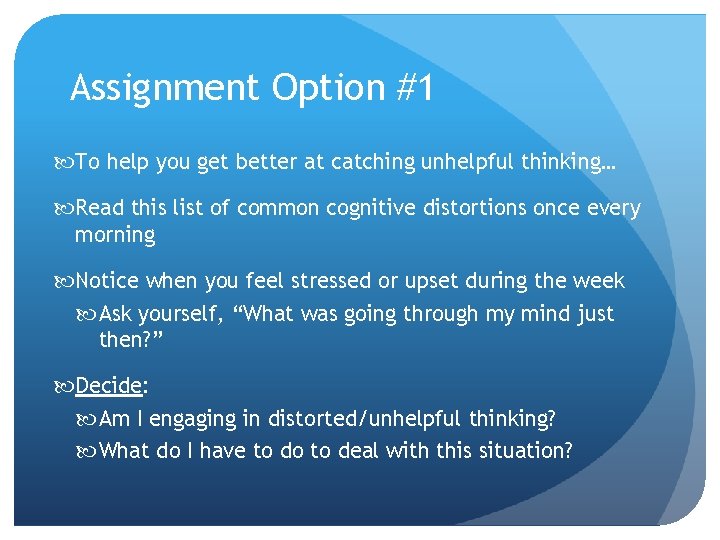
Assignment Option #1 To help you get better at catching unhelpful thinking… Read this list of common cognitive distortions once every morning Notice when you feel stressed or upset during the week Ask yourself, “What was going through my mind just then? ” Decide: Am I engaging in distorted/unhelpful thinking? What do I have to do to deal with this situation?

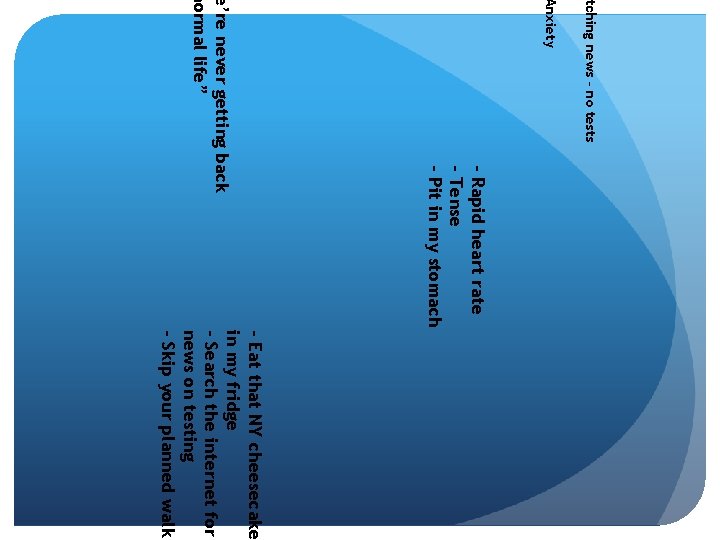
atching news – no tests Anxiety - Rapid heart rate - Tense - Pit in my stomach e’re never getting back normal life” - Eat that NY cheesecake in my fridge - Search the internet for news on testing - Skip your planned walk
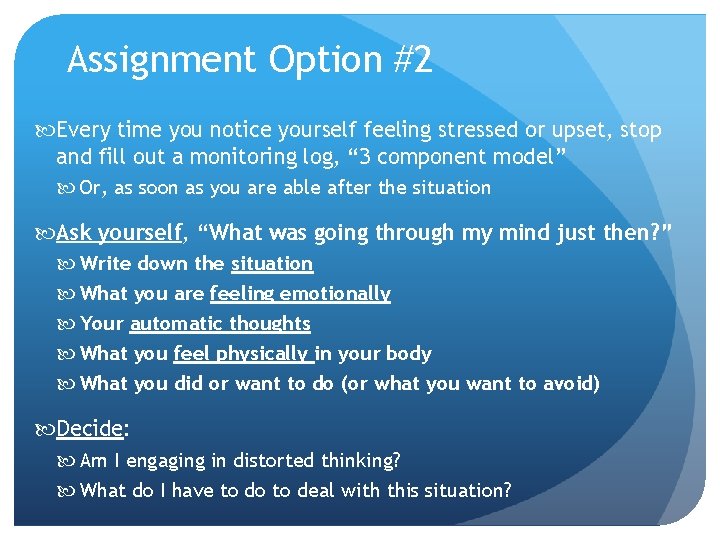
Assignment Option #2 Every time you notice yourself feeling stressed or upset, stop and fill out a monitoring log, “ 3 component model” Or, as soon as you are able after the situation Ask yourself, “What was going through my mind just then? ” Write down the situation What you are feeling emotionally Your automatic thoughts What you feel physically in your body What you did or want to do (or what you want to avoid) Decide: Am I engaging in distorted thinking? What do I have to do to deal with this situation?
Why write down how I feel? Writing down forces us to clarify what happened Clarifies the different parts of our stress Allows us to stand back and have more perspective Builds our awareness over time to the subtle changes in our body, our emotions, and our internal dialogue This leads us to be less reactive, and more flexible in the moment Eventually stop keeping track (process becomes second nature)

Resources Reminders for All
Seek Professional Help When Needed Seeking treatment from a professional can help: Counseling (marital) Psychotherapy Psychiatric medication UC Davis Behavioral Health Center (Adult/EDAPT Clinic): (916)7343574 UC Davis Children’s Behavioral Health Center: (916)734 -3574 Psychology Today Find a Therapist: https: //www. psychologytoday. com/us/therapists Association for Behavioral and Cognitive Therapies, Find a Therapist: http: //www. findcbt. org/FAT/ Therapy Apps: Talkspace, Better. Help, Regain – Couples Therapy
Hotlines Friendship Line (Institute on Aging) Toll Free 800 -971 -0016 Friendship and support for older adults who may be lonely, isolated, grieving, depressed, or anxious Services & Advocacy for LGBT Elders (SAGE) Hotline Toll Free 877 -360 -5428 Offer support without judgment, answer questions factually and confidentially Provide info about community resources such as healthcare, transportation, counseling, legal services, and emotional support programs Available in English and Spanish, in 180 languages sageusa. org National Suicide Prevention Lifeline 800 -273 -8255, or online chat Veterans Crisis Line (confidential, 24/7) www. veteranscrisisline. net 800 -273 -8255 (Press 1 at the prompt if you are a veteran) Text 838255 Chat (connect online) Support for deaf and hard of hearing: 800 -799 -4889
More Hotlines & Other Resources For Caregivers Caregiver. Action. org, free hotline 855 -227 -3640. Lots of resources related to caregiving during COVID-19 The Family Caregiver Alliance: 800 -445 -8106 Alzheimer’s Association: if you are caring for someone with Alzheimer’s or any type of dementia, they can help (24/7 Helpline: 800 -272 -3900) Domestic Violence WEAVE 24 Hour Support & Information Line: (916) 920 -2952 Counseling and Service Locations: WEAVE Midtown Counseling Center 1900 K Street Sacramento, CA 95811 Phone: 916. 448. 2321 Other 24/7 Support Lines: National Domestic Violence Hotline 1. 800. 799. 7233 National Sexual Assault Hotline 1. 800. 656. 4673
Progressive Muscle Relaxation Today’s Guided Relaxation
My challenge to you: What are at least 1 -2 things you can do (from today’s presentation, or your own ideas) to help you better manage stress, and/or help you be resilient moving forward? How can you use this time to make your life better, in some way?
Your Stress Management Plan What are my most common sources of stress (triggers)? What are the signs and symptoms I get when stressed? What are my helpful ways of coping? What are my unhelpful ways of coping? What problem or source of stress have I been avoiding dealing with? Is it time to deal with it more actively? What resource(s) could I turn to for help with this problem? What are 1 -2 practices I could start doing, to help me cope better with stress?
Questions and Comments?
- Slides: 25