
Master thesis introduction Statistics and Machine Learning Deparment

- Slides: 25
Master thesis - introduction Statistics and Machine Learning Deparment of Computer and Information Science Linköping University 732 A 64
Admission requirements – the hard facts • You must have passed (grade A-E) every compulsory course within the study program. • You must have passed at least 65 ECTS credits in programme courses. 732 A 64
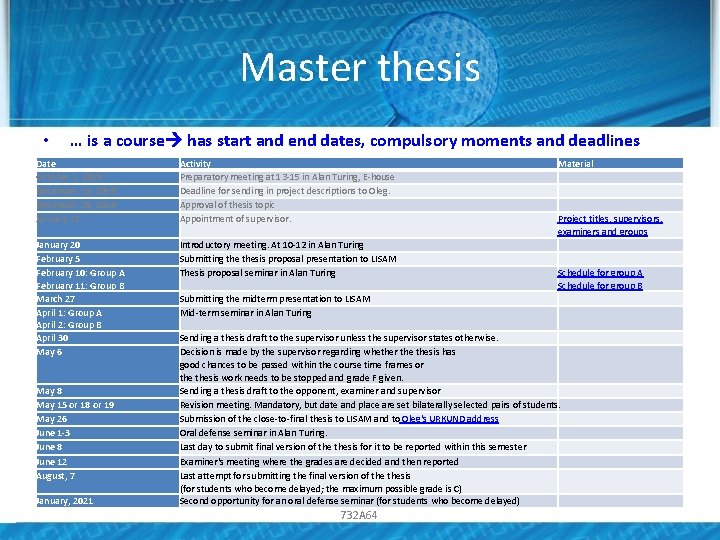
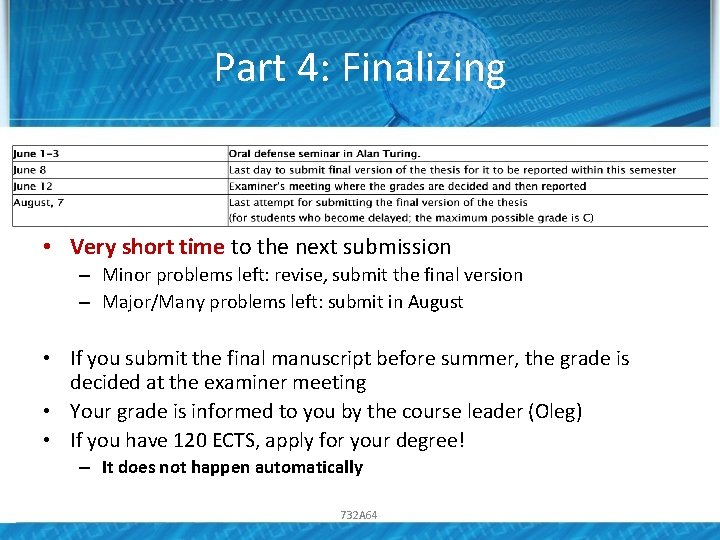
Master thesis • … is a course has start and end dates, compulsory moments and deadlines Date October 1, 2019 December 13, 2019 December 20, 2019 January 17 Activity Preparatory meeting at 13 -15 in Alan Turing, E-house Deadline for sending in project descriptions to Oleg. Approval of thesis topic Appointment of supervisor. January 20 February 5 February 10: Group A February 11: Group B March 27 April 1: Group A April 2: Group B April 30 May 6 Introductory meeting. At 10 -12 in Alan Turing Submitting thesis proposal presentation to LISAM Thesis proposal seminar in Alan Turing May 8 May 15 or 18 or 19 May 26 June 1 -3 June 8 June 12 August, 7 January, 2021 Material Project titles, supervisors, examiners and groups Schedule for group A Schedule for group B Submitting the midterm presentation to LISAM Mid-term seminar in Alan Turing Sending a thesis draft to the supervisor unless the supervisor states otherwise. Decision is made by the supervisor regarding whether thesis has good chances to be passed within the course time frames or thesis work needs to be stopped and grade F given. Sending a thesis draft to the opponent, examiner and supervisor Revision meeting. Mandatory, but date and place are set bilaterally selected pairs of students. Submission of the close-to-final thesis to LISAM and to Oleg's URKUND address Oral defense seminar in Alan Turing. Last day to submit final version of thesis for it to be reported within this semester Examiner's meeting where the grades are decided and then reported Last attempt for submitting the final version of thesis (for students who become delayed; the maximum possible grade is C) Second opportunity for an oral defense seminar (for students who become delayed) 732 A 64
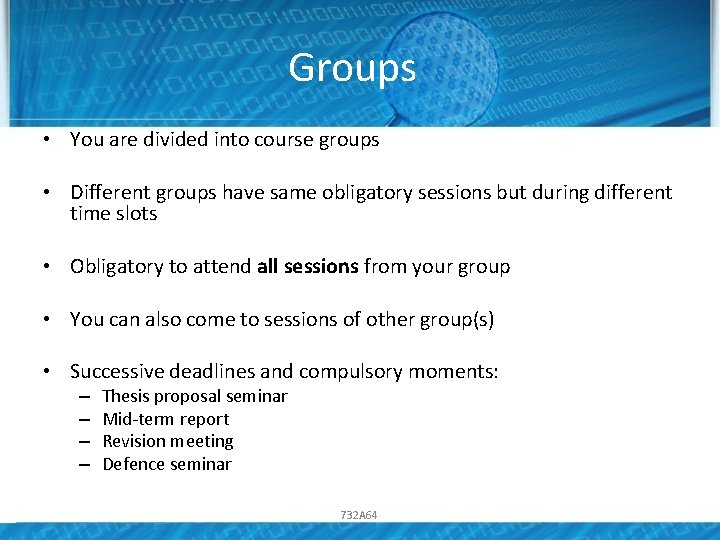
Groups • You are divided into course groups • Different groups have same obligatory sessions but during different time slots • Obligatory to attend all sessions from your group • You can also come to sessions of other group(s) • Successive deadlines and compulsory moments: – – Thesis proposal seminar Mid-term report Revision meeting Defence seminar 732 A 64
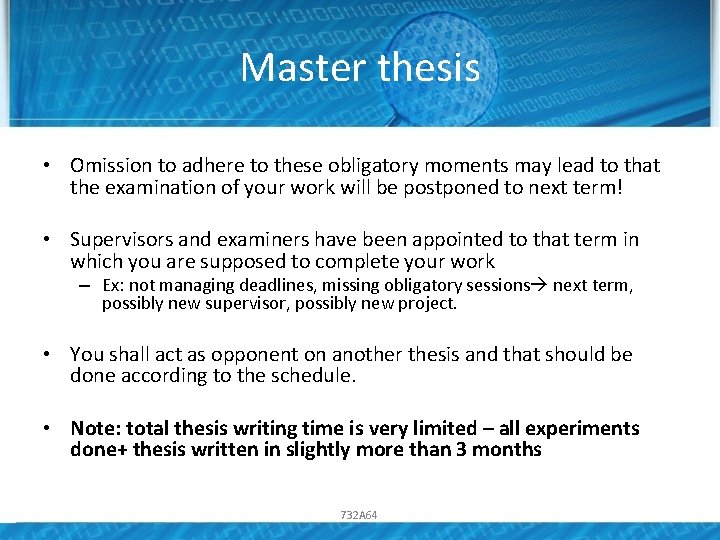
Master thesis • Omission to adhere to these obligatory moments may lead to that the examination of your work will be postponed to next term! • Supervisors and examiners have been appointed to that term in which you are supposed to complete your work – Ex: not managing deadlines, missing obligatory sessions next term, possibly new supervisor, possibly new project. • You shall act as opponent on another thesis and that should be done according to the schedule. • Note: total thesis writing time is very limited – all experiments done+ thesis written in slightly more than 3 months 732 A 64
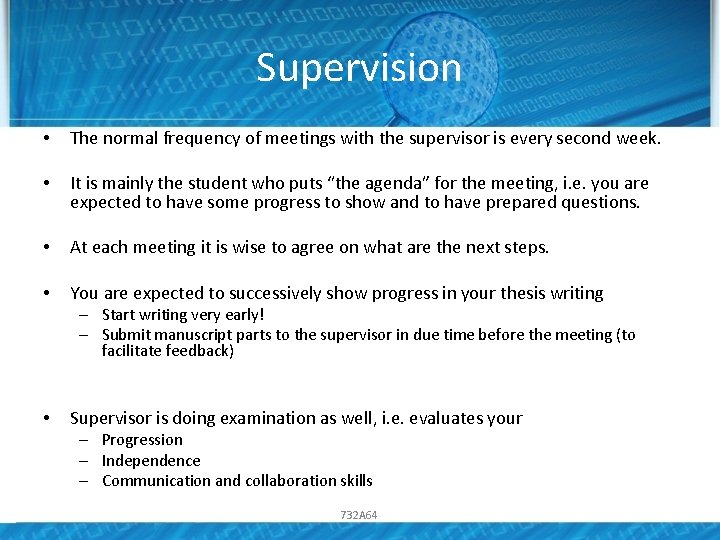
Supervision • The normal frequency of meetings with the supervisor is every second week. • It is mainly the student who puts “the agenda” for the meeting, i. e. you are expected to have some progress to show and to have prepared questions. • At each meeting it is wise to agree on what are the next steps. • You are expected to successively show progress in your thesis writing – Start writing very early! – Submit manuscript parts to the supervisor in due time before the meeting (to facilitate feedback) • Supervisor is doing examination as well, i. e. evaluates your – Progression – Independence – Communication and collaboration skills 732 A 64
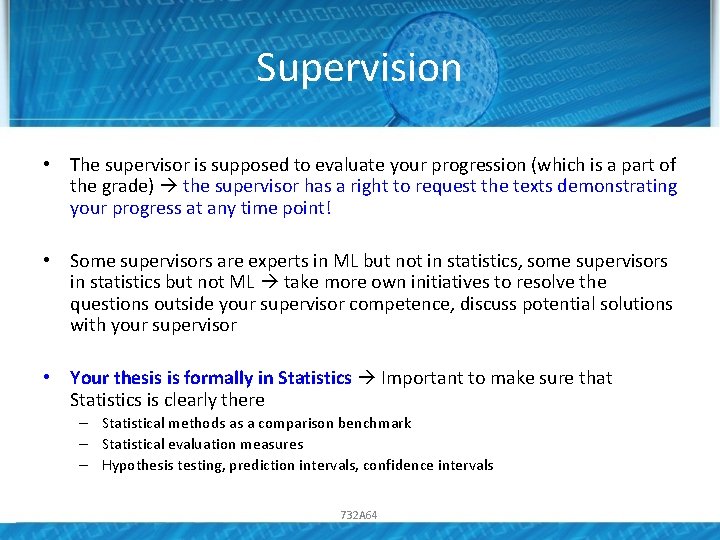
Supervision • The supervisor is supposed to evaluate your progression (which is a part of the grade) the supervisor has a right to request the texts demonstrating your progress at any time point! • Some supervisors are experts in ML but not in statistics, some supervisors in statistics but not ML take more own initiatives to resolve the questions outside your supervisor competence, discuss potential solutions with your supervisor • Your thesis is formally in Statistics Important to make sure that Statistics is clearly there – Statistical methods as a comparison benchmark – Statistical evaluation measures – Hypothesis testing, prediction intervals, confidence intervals 732 A 64
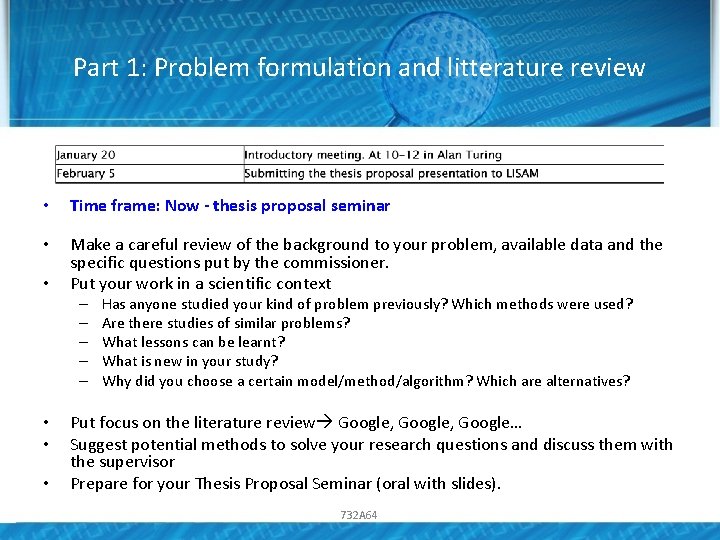
Part 1: Problem formulation and litterature review • Time frame: Now - thesis proposal seminar • Make a careful review of the background to your problem, available data and the specific questions put by the commissioner. Put your work in a scientific context • – – – • • • Has anyone studied your kind of problem previously? Which methods were used? Are there studies of similar problems? What lessons can be learnt? What is new in your study? Why did you choose a certain model/method/algorithm? Which are alternatives? Put focus on the literature review Google, Google… Suggest potential methods to solve your research questions and discuss them with the supervisor Prepare for your Thesis Proposal Seminar (oral with slides). 732 A 64
Thesis proposal seminar • Each student presents their thesis topic – Data description – Background information and research questions – Potential methods to solve the research questions • 15 mins presentation + 5 mins questions • You are not supposed to have a completely defined strategy/plan for your thesis work at this stage • Why putting on LISAM in advance? – Will be checked by the examiner Better feedback opportunities 732 A 64
Thesis proposal seminar • Thesis proposal is meant to help you with your research questions completely OK if you don’t know how to optimally solve all stated research questions give some space for improvement suggestions from us in your speech where needed: – ”I propose to use this method, but I am not sure whether this one is the optimal…” – ”These approaches might be suitable but I ’m not sure which one is better to use…” – ”Me and my supervisor still not sure about how to approach this subproblem…” • Clear explanation + informative presentation = more feedback • Expected outcomes: – Each course attendant, supervisors and examiners should have been informed about and understood the objectives of thesis projects and possible ways to achieve these objectives – A feedback on the research planning is obtained by the course attendants when appropriate. • Compulsory to attend all sessions of your group! 732 A 64
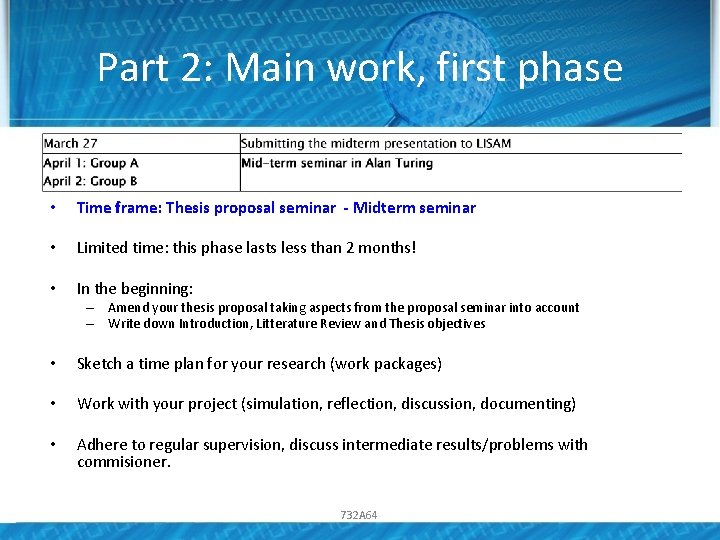
Part 2: Main work, first phase • Time frame: Thesis proposal seminar - Midterm seminar • Limited time: this phase lasts less than 2 months! • In the beginning: – Amend your thesis proposal taking aspects from the proposal seminar into account – Write down Introduction, Litterature Review and Thesis objectives • Sketch a time plan for your research (work packages) • Work with your project (simulation, reflection, discussion, documenting) • Adhere to regular supervision, discuss intermediate results/problems with commisioner. 732 A 64
Part 2: Main work, first phase • Write draft texts containing results and their analysis send/show your texts to the supervisor regularly • By the end of the phase, at least 60% of the work needs to be done – Including thesis writing part • Ends by Mid-term seminar 732 A 64
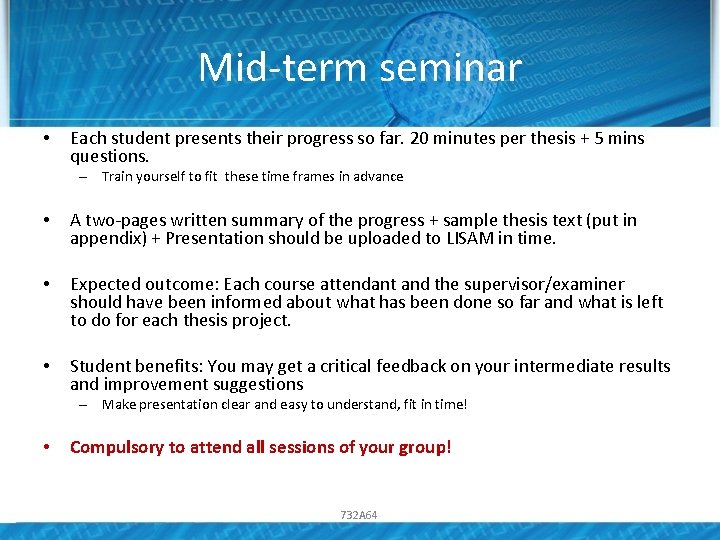
Mid-term seminar • Each student presents their progress so far. 20 minutes per thesis + 5 mins questions. – Train yourself to fit these time frames in advance • A two-pages written summary of the progress + sample thesis text (put in appendix) + Presentation should be uploaded to LISAM in time. • Expected outcome: Each course attendant and the supervisor/examiner should have been informed about what has been done so far and what is left to do for each thesis project. • Student benefits: You may get a critical feedback on your intermediate results and improvement suggestions – Make presentation clear and easy to understand, fit in time! • Compulsory to attend all sessions of your group! 732 A 64
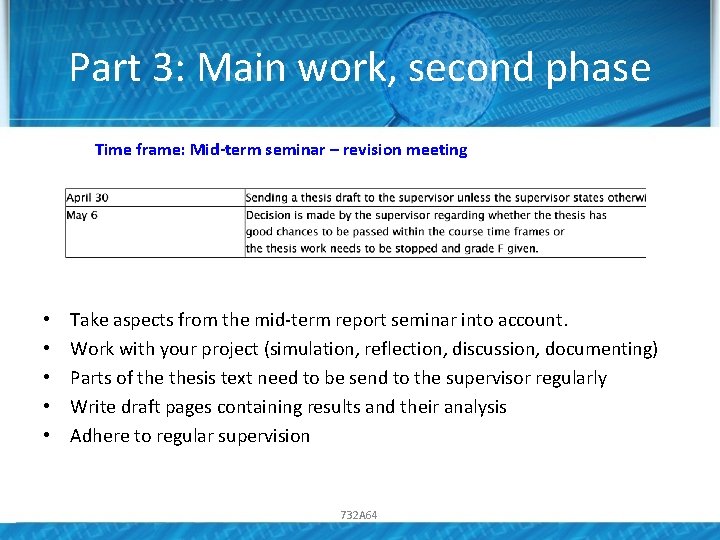
Part 3: Main work, second phase Time frame: Mid-term seminar – revision meeting • • • Take aspects from the mid-term report seminar into account. Work with your project (simulation, reflection, discussion, documenting) Parts of thesis text need to be send to the supervisor regularly Write draft pages containing results and their analysis Adhere to regular supervision 732 A 64
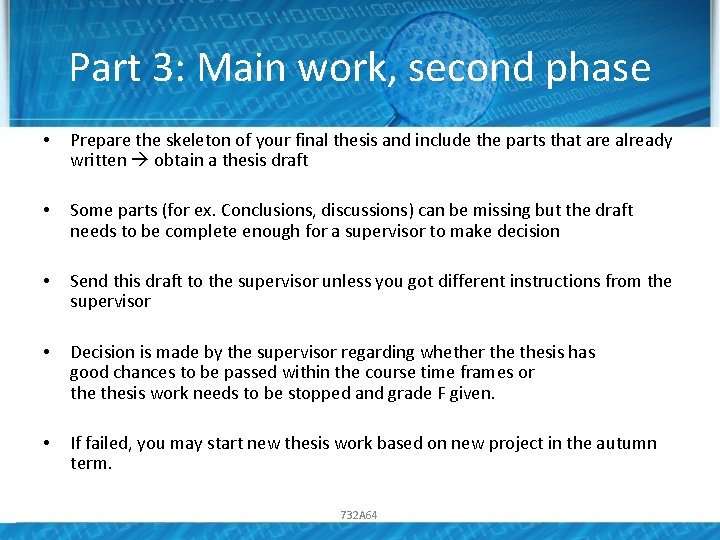
Part 3: Main work, second phase • Prepare the skeleton of your final thesis and include the parts that are already written obtain a thesis draft • Some parts (for ex. Conclusions, discussions) can be missing but the draft needs to be complete enough for a supervisor to make decision • Send this draft to the supervisor unless you got different instructions from the supervisor • Decision is made by the supervisor regarding whether thesis has good chances to be passed within the course time frames or thesis work needs to be stopped and grade F given. • If failed, you may start new thesis work based on new project in the autumn term. 732 A 64
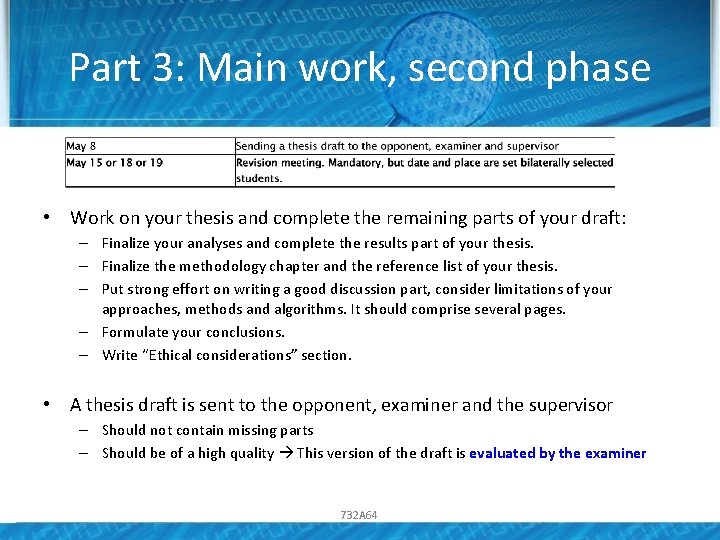
Part 3: Main work, second phase • Work on your thesis and complete the remaining parts of your draft: – Finalize your analyses and complete the results part of your thesis. – Finalize the methodology chapter and the reference list of your thesis. – Put strong effort on writing a good discussion part, consider limitations of your approaches, methods and algorithms. It should comprise several pages. – Formulate your conclusions. – Write “Ethical considerations” section. • A thesis draft is sent to the opponent, examiner and the supervisor – Should not contain missing parts – Should be of a high quality This version of the draft is evaluated by the examiner 732 A 64
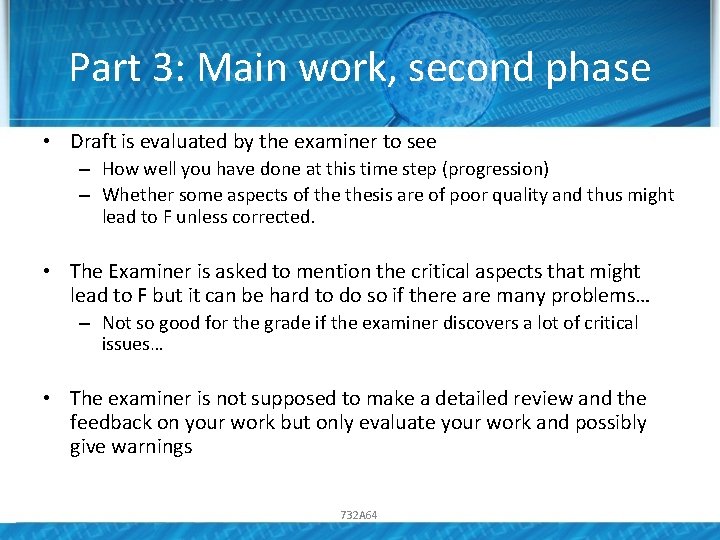
Part 3: Main work, second phase • Draft is evaluated by the examiner to see – How well you have done at this time step (progression) – Whether some aspects of thesis are of poor quality and thus might lead to F unless corrected. • The Examiner is asked to mention the critical aspects that might lead to F but it can be hard to do so if there are many problems… – Not so good for the grade if the examiner discovers a lot of critical issues… • The examiner is not supposed to make a detailed review and the feedback on your work but only evaluate your work and possibly give warnings 732 A 64
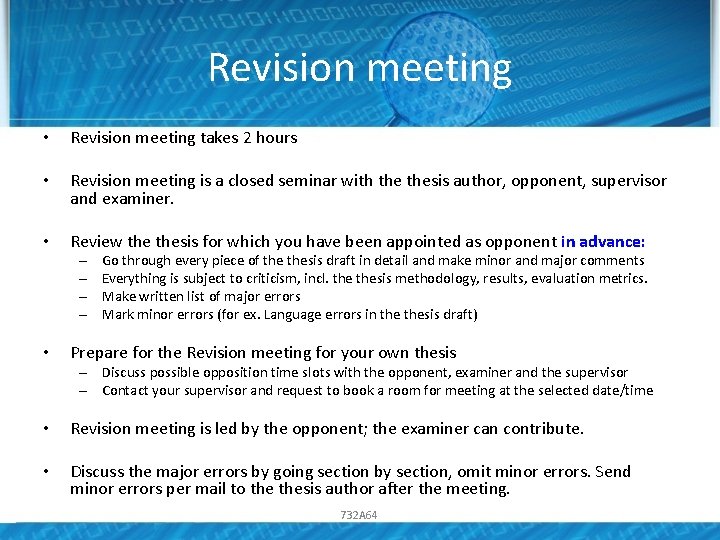
Revision meeting • Revision meeting takes 2 hours • Revision meeting is a closed seminar with thesis author, opponent, supervisor and examiner. • Review thesis for which you have been appointed as opponent in advance: – – • Go through every piece of thesis draft in detail and make minor and major comments Everything is subject to criticism, incl. thesis methodology, results, evaluation metrics. Make written list of major errors Mark minor errors (for ex. Language errors in thesis draft) Prepare for the Revision meeting for your own thesis – Discuss possible opposition time slots with the opponent, examiner and the supervisor – Contact your supervisor and request to book a room for meeting at the selected date/time • Revision meeting is led by the opponent; the examiner can contribute. • Discuss the major errors by going section by section, omit minor errors. Send minor errors per mail to thesis author after the meeting. 732 A 64
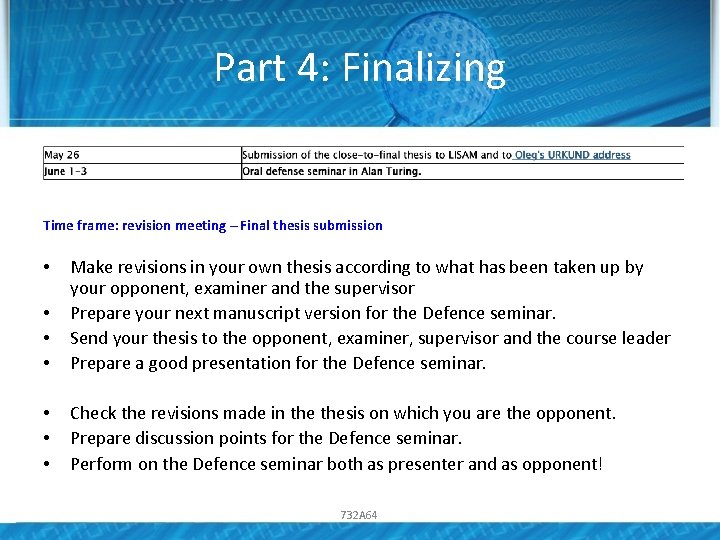
Part 4: Finalizing Time frame: revision meeting – Final thesis submission • • • Make revisions in your own thesis according to what has been taken up by your opponent, examiner and the supervisor Prepare your next manuscript version for the Defence seminar. Send your thesis to the opponent, examiner, supervisor and the course leader Prepare a good presentation for the Defence seminar. • • • Check the revisions made in thesis on which you are the opponent. Prepare discussion points for the Defence seminar. Perform on the Defence seminar both as presenter and as opponent! • 732 A 64
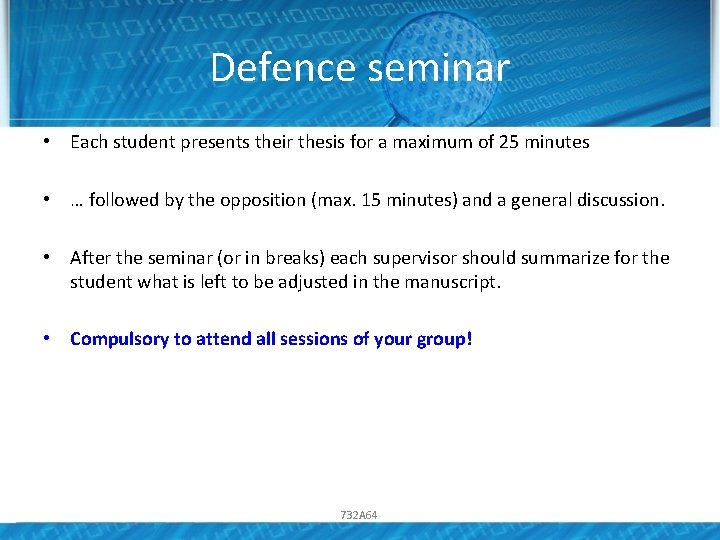
Defence seminar • Each student presents their thesis for a maximum of 25 minutes • … followed by the opposition (max. 15 minutes) and a general discussion. • After the seminar (or in breaks) each supervisor should summarize for the student what is left to be adjusted in the manuscript. • Compulsory to attend all sessions of your group! 732 A 64
Part 4: Finalizing • Very short time to the next submission – Minor problems left: revise, submit the final version – Major/Many problems left: submit in August • If you submit the final manuscript before summer, the grade is decided at the examiner meeting • Your grade is informed to you by the course leader (Oleg) • If you have 120 ECTS, apply for your degree! – It does not happen automatically 732 A 64
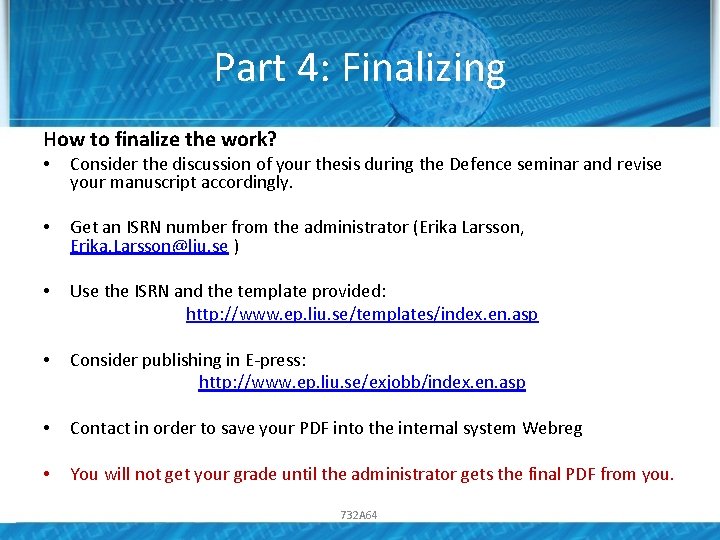
Part 4: Finalizing How to finalize the work? • Consider the discussion of your thesis during the Defence seminar and revise your manuscript accordingly. • Get an ISRN number from the administrator (Erika Larsson, Erika. Larsson@liu. se ) • Use the ISRN and the template provided: http: //www. ep. liu. se/templates/index. en. asp • Consider publishing in E-press: http: //www. ep. liu. se/exjobb/index. en. asp • Contact in order to save your PDF into the internal system Webreg • You will not get your grade until the administrator gets the final PDF from you. 732 A 64
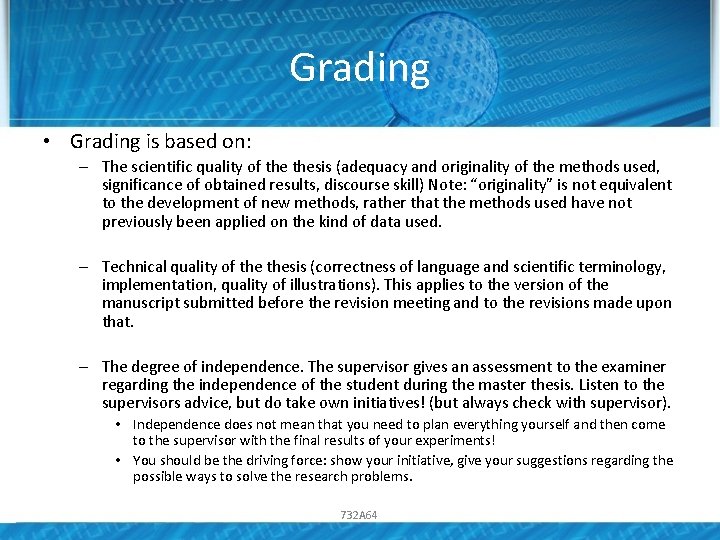
Grading • Grading is based on: – The scientific quality of thesis (adequacy and originality of the methods used, significance of obtained results, discourse skill) Note: “originality” is not equivalent to the development of new methods, rather that the methods used have not previously been applied on the kind of data used. – Technical quality of thesis (correctness of language and scientific terminology, implementation, quality of illustrations). This applies to the version of the manuscript submitted before the revision meeting and to the revisions made upon that. – The degree of independence. The supervisor gives an assessment to the examiner regarding the independence of the student during the master thesis. Listen to the supervisors advice, but do take own initiatives! (but always check with supervisor). • Independence does not mean that you need to plan everything yourself and then come to the supervisor with the final results of your experiments! • You should be the driving force: show your initiative, give your suggestions regarding the possible ways to solve the research problems. 732 A 64
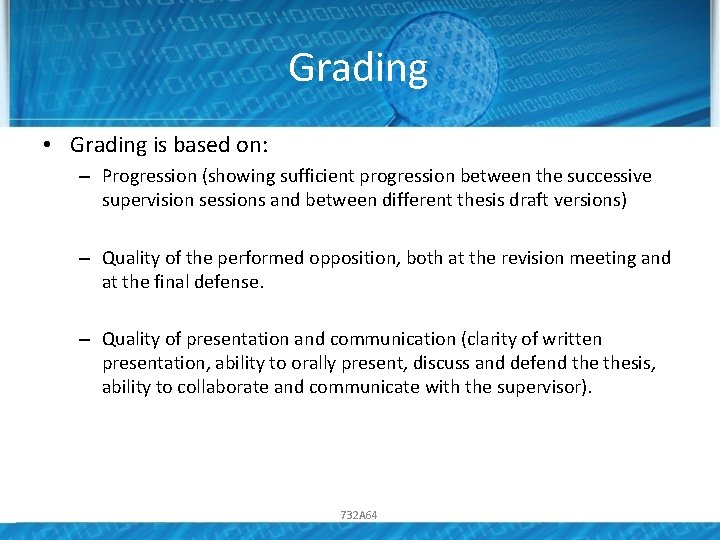
Grading • Grading is based on: – Progression (showing sufficient progression between the successive supervision sessions and between different thesis draft versions) – Quality of the performed opposition, both at the revision meeting and at the final defense. – Quality of presentation and communication (clarity of written presentation, ability to orally present, discuss and defend thesis, ability to collaborate and communicate with the supervisor). 732 A 64
Good luck! 732 A 64