
Master Theorem Section 7 3 of Rosen Fall
- Slides: 13
Master Theorem Section 7. 3 of Rosen Fall 2008 CSCE 235 Introduction to Discrete Structures Course web-page: cse. unl. edu/~cse 235 Questions: cse 235@cse. unl. edu
Outline • Motivation • The Master Theorem – Pitfalls – 3 examples • 4 th Condition – 1 example CSCE 235, Fall 2008 Master Theorem 2
Motivation: Asymptotic Behavior of Recursive Algorithms • When analyzing algorithms, recall that we only care about the asymptotic behavior • Recursive algorithms are no different • Rather than solving exactly the recurrence relation associated with the cost of an algorithm, it is sufficient to give an asymptotic characterization • The main tool for doing this is the master theorem CSCE 235, Fall 2008 Master Theorem 3
Outline • Motivation • The Master Theorem – Pitfalls – 3 examples • 4 th Condition – 1 example CSCE 235, Fall 2008 Master Theorem 4
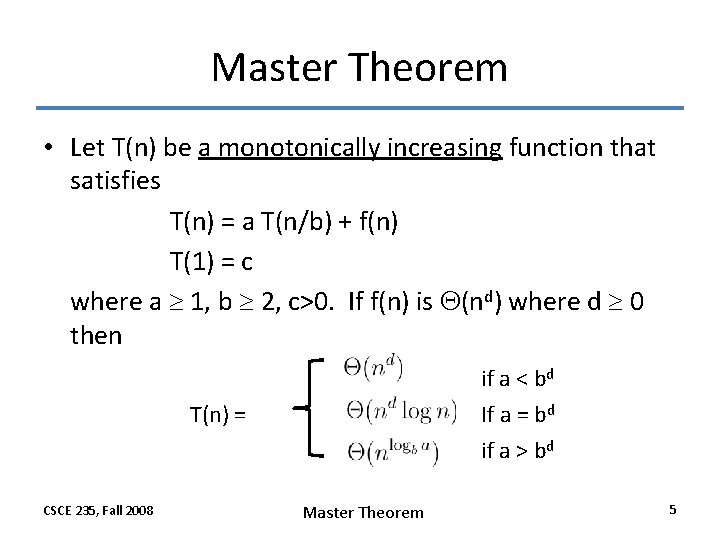
Master Theorem • Let T(n) be a monotonically increasing function that satisfies T(n) = a T(n/b) + f(n) T(1) = c where a 1, b 2, c>0. If f(n) is (nd) where d 0 then if a < bd If a = bd if a > bd T(n) = CSCE 235, Fall 2008 Master Theorem 5
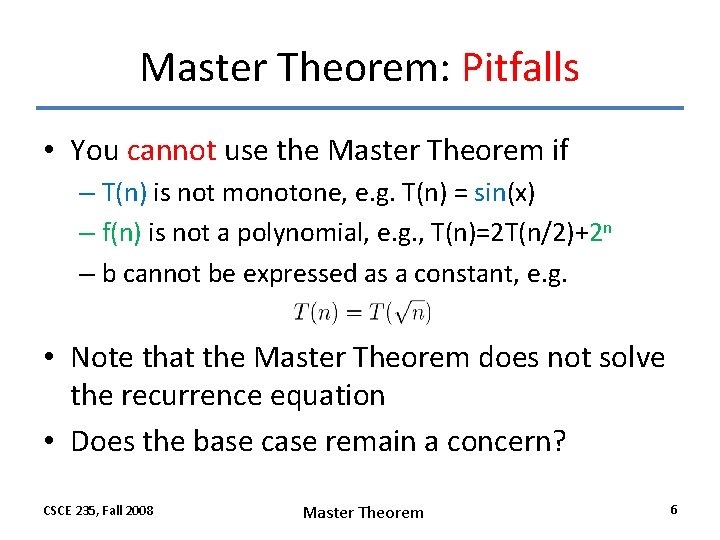
Master Theorem: Pitfalls • You cannot use the Master Theorem if – T(n) is not monotone, e. g. T(n) = sin(x) – f(n) is not a polynomial, e. g. , T(n)=2 T(n/2)+2 n – b cannot be expressed as a constant, e. g. • Note that the Master Theorem does not solve the recurrence equation • Does the base case remain a concern? CSCE 235, Fall 2008 Master Theorem 6
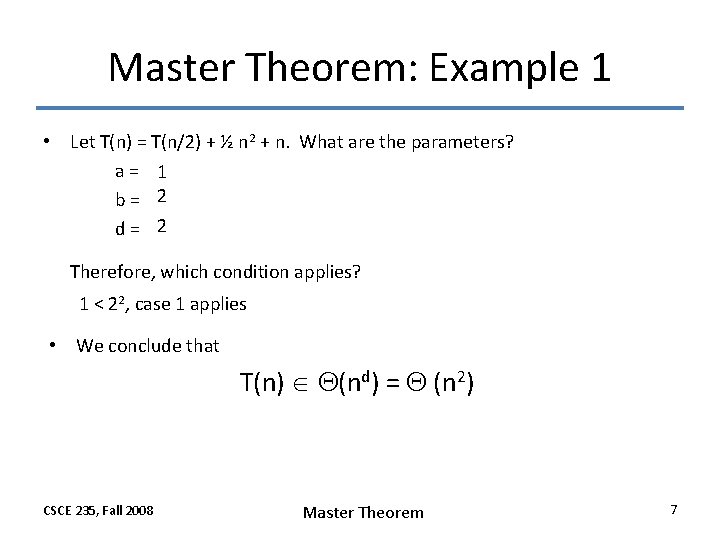
Master Theorem: Example 1 • Let T(n) = T(n/2) + ½ n 2 + n. What are the parameters? a= 1 b= 2 d= 2 Therefore, which condition applies? 1 < 22, case 1 applies • We conclude that T(n) (nd) = (n 2) CSCE 235, Fall 2008 Master Theorem 7
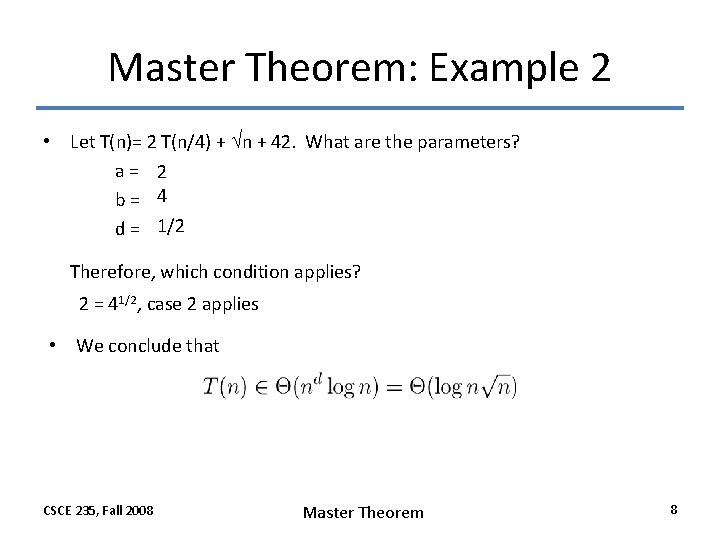
Master Theorem: Example 2 • Let T(n)= 2 T(n/4) + n + 42. What are the parameters? a= 2 b= 4 d = 1/2 Therefore, which condition applies? 2 = 41/2, case 2 applies • We conclude that CSCE 235, Fall 2008 Master Theorem 8
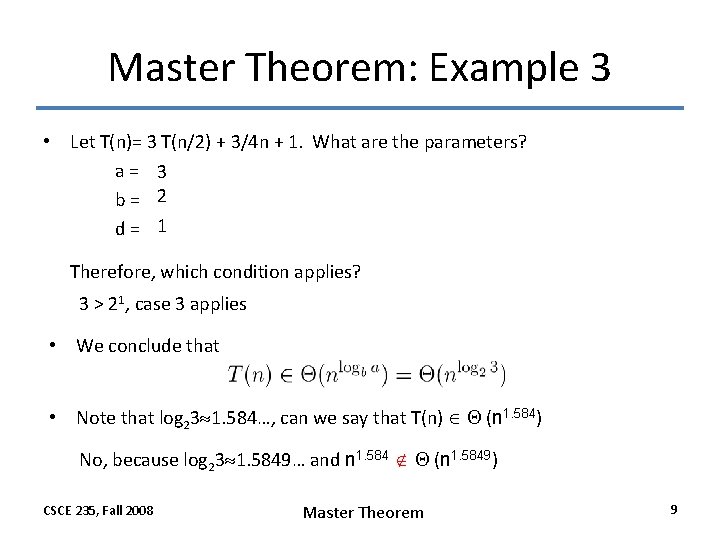
Master Theorem: Example 3 • Let T(n)= 3 T(n/2) + 3/4 n + 1. What are the parameters? a= 3 b= 2 d= 1 Therefore, which condition applies? 3 > 21, case 3 applies • We conclude that • Note that log 23 1. 584…, can we say that T(n) (n 1. 584) No, because log 23 1. 5849… and n 1. 584 (n 1. 5849) CSCE 235, Fall 2008 Master Theorem 9
Outline • Motivation • The Master Theorem – Pitfalls – 3 examples • 4 th Condition – 1 example CSCE 235, Fall 2008 Master Theorem 10
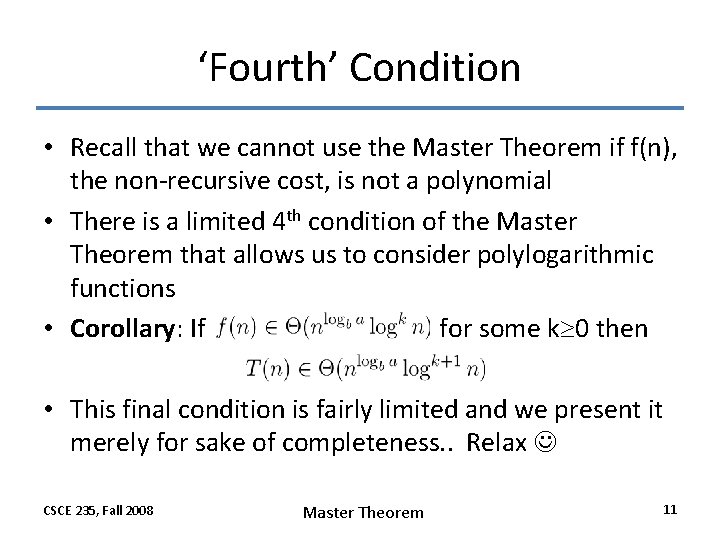
‘Fourth’ Condition • Recall that we cannot use the Master Theorem if f(n), the non-recursive cost, is not a polynomial • There is a limited 4 th condition of the Master Theorem that allows us to consider polylogarithmic functions • Corollary: If for some k 0 then • This final condition is fairly limited and we present it merely for sake of completeness. . Relax CSCE 235, Fall 2008 Master Theorem 11
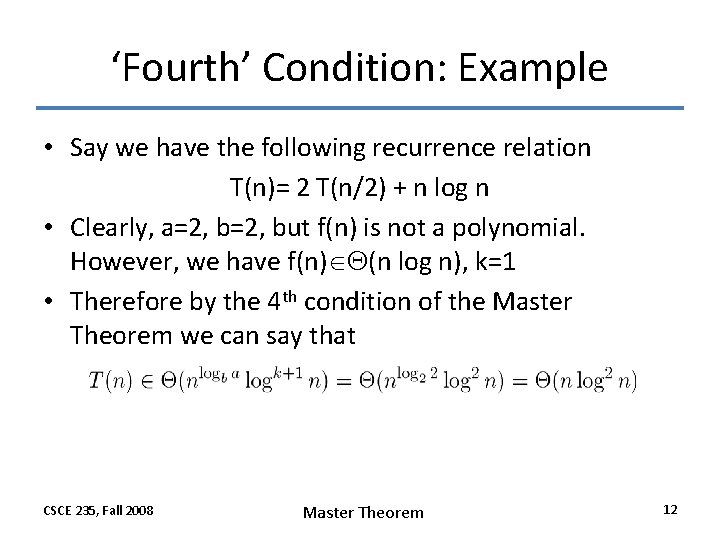
‘Fourth’ Condition: Example • Say we have the following recurrence relation T(n)= 2 T(n/2) + n log n • Clearly, a=2, but f(n) is not a polynomial. However, we have f(n) (n log n), k=1 • Therefore by the 4 th condition of the Master Theorem we can say that CSCE 235, Fall 2008 Master Theorem 12
Summary • Motivation • The Master Theorem – Pitfalls – 3 examples • 4 th Condition – 1 example CSCE 235, Fall 2008 Master Theorem 13