
Master the Secrets of VMware Licensing to Maximize
- Slides: 12
Master the Secrets of VMware Licensing to Maximize Your Investment Learn the essential steps to avoid overspending and to maximize negotiation leverage with VMware. Info-Tech Research Group, Inc. is a global leader in providing IT research and advice. Info-Tech’s products and services combine actionable insight and relevant advice with Info-Tech's products and services combine actionable insight and advice ready-to-use tools and templates that cover the fullrelevant spectrum of IT with concerns. and templates that cover the full spectrum IT concerns. © 1997 -2018 Info-Tech Group © of 1997 -2018 Info-Tech Research Group Research Inc. Info-Tech Research Group 1
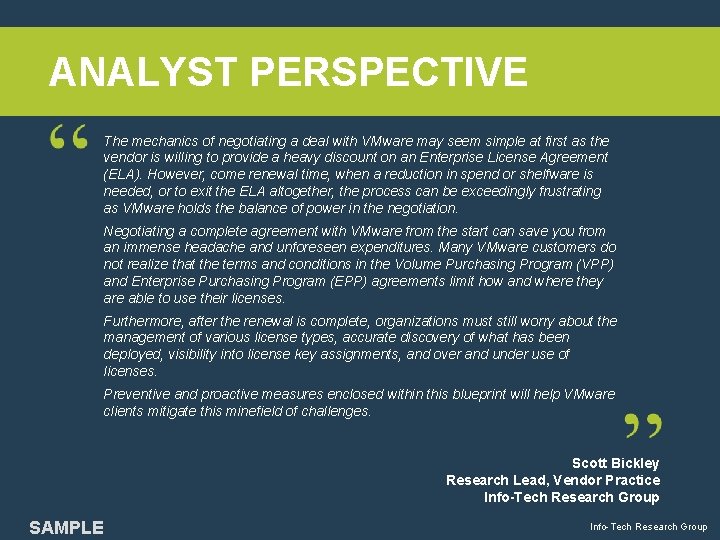
ANALYST PERSPECTIVE The mechanics of negotiating a deal with VMware may seem simple at first as the vendor is willing to provide a heavy discount on an Enterprise License Agreement (ELA). However, come renewal time, when a reduction in spend or shelfware is needed, or to exit the ELA altogether, the process can be exceedingly frustrating as VMware holds the balance of power in the negotiation. Negotiating a complete agreement with VMware from the start can save you from an immense headache and unforeseen expenditures. Many VMware customers do not realize that the terms and conditions in the Volume Purchasing Program (VPP) and Enterprise Purchasing Program (EPP) agreements limit how and where they are able to use their licenses. Furthermore, after the renewal is complete, organizations must still worry about the management of various license types, accurate discovery of what has been deployed, visibility into license key assignments, and over and under use of licenses. Preventive and proactive measures enclosed within this blueprint will help VMware clients mitigate this minefield of challenges. Scott Bickley Research Lead, Vendor Practice Info-Tech Research Group SAMPLE Info-Tech Research Group 2
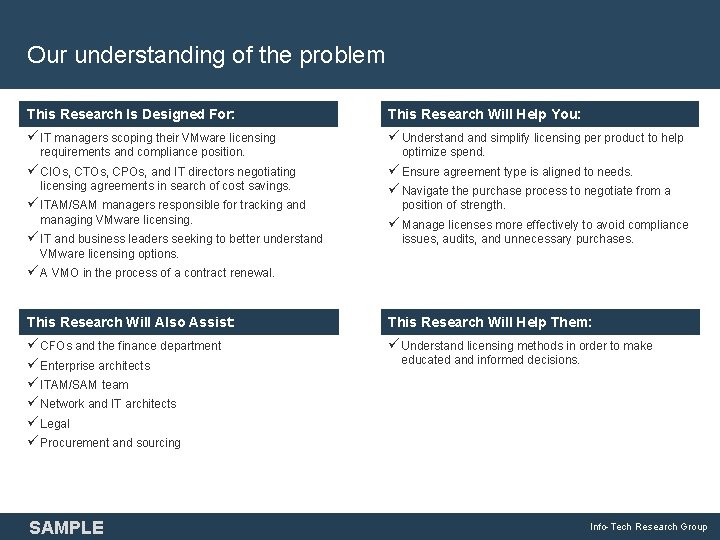
Our understanding of the problem This Research Is is Designed For: This Research Will Help You: ü IT managers scoping their VMware licensing ü Understand simplify licensing per product to help requirements and compliance position. ü CIOs, CTOs, CPOs, and IT directors negotiating licensing agreements in search of cost savings. ü ITAM/SAM managers responsible for tracking and managing VMware licensing. ü IT and business leaders seeking to better understand optimize spend. ü Ensure agreement type is aligned to needs. ü Navigate the purchase process to negotiate from a position of strength. ü Manage licenses more effectively to avoid compliance issues, audits, and unnecessary purchases. VMware licensing options. ü A VMO in the process of a contract renewal. This Research Will Also Assist: This Research Will Help Them: You: ü CFOs and the finance department ü Enterprise architects ü ITAM/SAM team ü Network and IT architects ü Legal ü Procurement and sourcing ü Understand licensing methods in order to make SAMPLE educated and informed decisions. Info-Tech Research Group 3
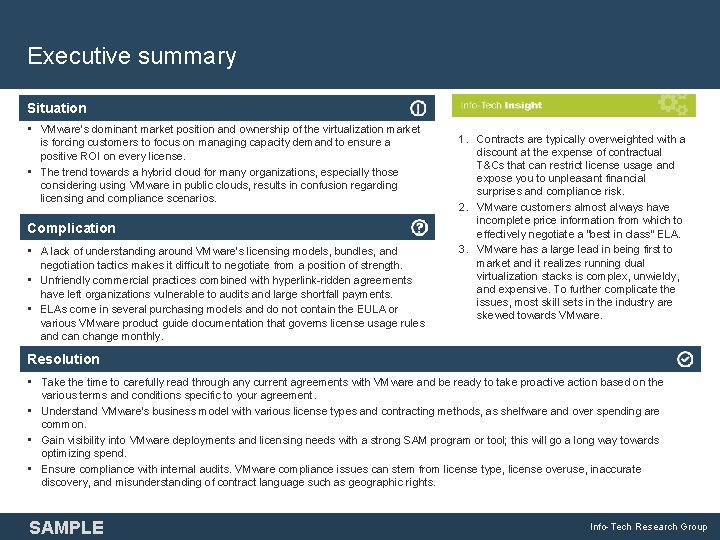
Executive summary Situation • VMware’s dominant market position and ownership of the virtualization market • is forcing customers to focus on managing capacity demand to ensure a positive ROI on every license. The trend towards a hybrid cloud for many organizations, especially those considering using VMware in public clouds, results in confusion regarding licensing and compliance scenarios. Complication • A lack of understanding around VMware’s licensing models, bundles, and • • negotiation tactics makes it difficult to negotiate from a position of strength. Unfriendly commercial practices combined with hyperlink-ridden agreements have left organizations vulnerable to audits and large shortfall payments. ELAs come in several purchasing models and do not contain the EULA or various VMware product guide documentation that governs license usage rules and can change monthly. 1. Contracts are typically overweighted with a discount at the expense of contractual T&Cs that can restrict license usage and expose you to unpleasant financial surprises and compliance risk. 2. VMware customers almost always have incomplete price information from which to effectively negotiate a “best in class” ELA. 3. VMware has a large lead in being first to market and it realizes running dual virtualization stacks is complex, unwieldy, and expensive. To further complicate the issues, most skill sets in the industry are skewed towards VMware. Resolution • Take the time to carefully read through any current agreements with VMware and be ready to take proactive action based on the • • • various terms and conditions specific to your agreement. Understand VMware’s business model with various license types and contracting methods, as shelfware and over spending are common. Gain visibility into VMware deployments and licensing needs with a strong SAM program or tool; this will go a long way towards optimizing spend. Ensure compliance with internal audits. VMware compliance issues can stem from license type, license overuse, inaccurate discovery, and misunderstanding of contract language such as geographic rights. SAMPLE Info-Tech Research Group 4
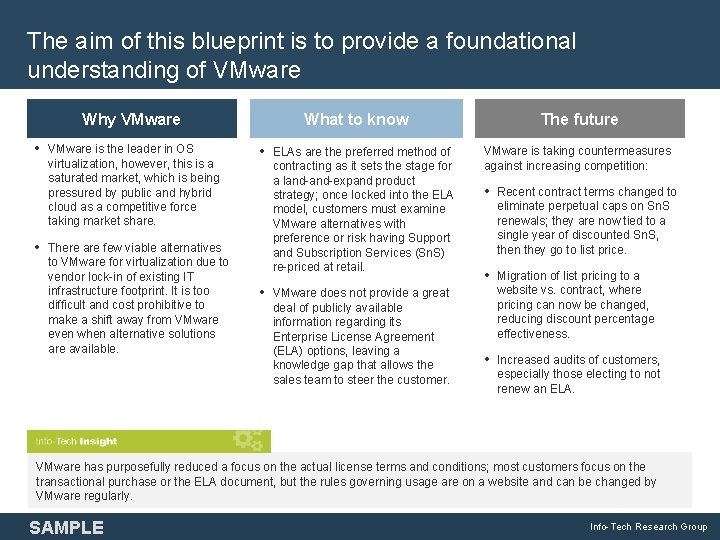
The aim of this blueprint is to provide a foundational understanding of VMware Why VMware • VMware is the leader in OS virtualization, however, this is a saturated market, which is being pressured by public and hybrid cloud as a competitive force taking market share. • There are few viable alternatives to VMware for virtualization due to vendor lock-in of existing IT infrastructure footprint. It is too difficult and cost prohibitive to make a shift away from VMware even when alternative solutions are available. What to know The future • ELAs are the preferred method of VMware is taking countermeasures against increasing competition: contracting as it sets the stage for a land-expand product strategy; once locked into the ELA model, customers must examine VMware alternatives with preference or risk having Support and Subscription Services (Sn. S) re-priced at retail. • VMware does not provide a great deal of publicly available information regarding its Enterprise License Agreement (ELA) options, leaving a knowledge gap that allows the sales team to steer the customer. • Recent contract terms changed to eliminate perpetual caps on Sn. S renewals; they are now tied to a single year of discounted Sn. S, then they go to list price. • Migration of list pricing to a website vs. contract, where pricing can now be changed, reducing discount percentage effectiveness. • Increased audits of customers, especially those electing to not renew an ELA. VMware has purposefully reduced a focus on the actual license terms and conditions; most customers focus on the transactional purchase or the ELA document, but the rules governing usage are on a website and can be changed by VMware regularly. SAMPLE Info-Tech Research Group 5
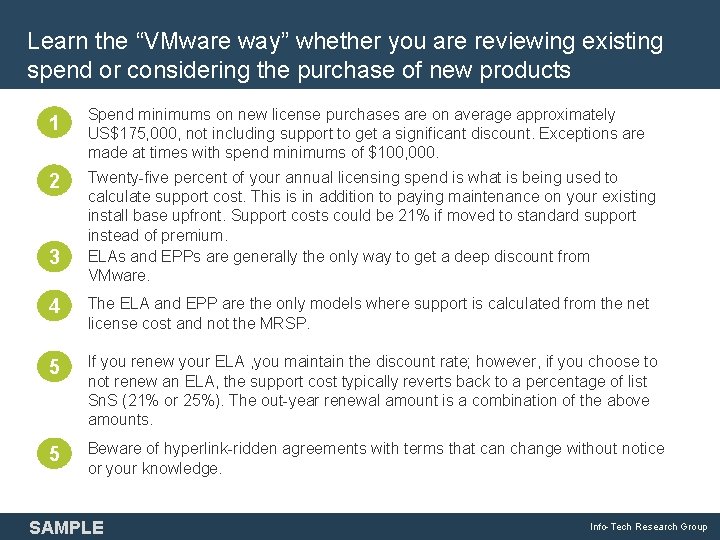
Learn the “VMware way” whether you are reviewing existing spend or considering the purchase of new products 1 Spend minimums on new license purchases are on average approximately US$175, 000, not including support to get a significant discount. Exceptions are made at times with spend minimums of $100, 000. 2 Twenty-five percent of your annual licensing spend is what is being used to calculate support cost. This is in addition to paying maintenance on your existing install base upfront. Support costs could be 21% if moved to standard support instead of premium. ELAs and EPPs are generally the only way to get a deep discount from VMware. 3 4 The ELA and EPP are the only models where support is calculated from the net license cost and not the MRSP. 5 If you renew your ELA , you maintain the discount rate; however, if you choose to not renew an ELA, the support cost typically reverts back to a percentage of list Sn. S (21% or 25%). The out-year renewal amount is a combination of the above amounts. 5 Beware of hyperlink-ridden agreements with terms that can change without notice or your knowledge. SAMPLE Info-Tech Research Group 6
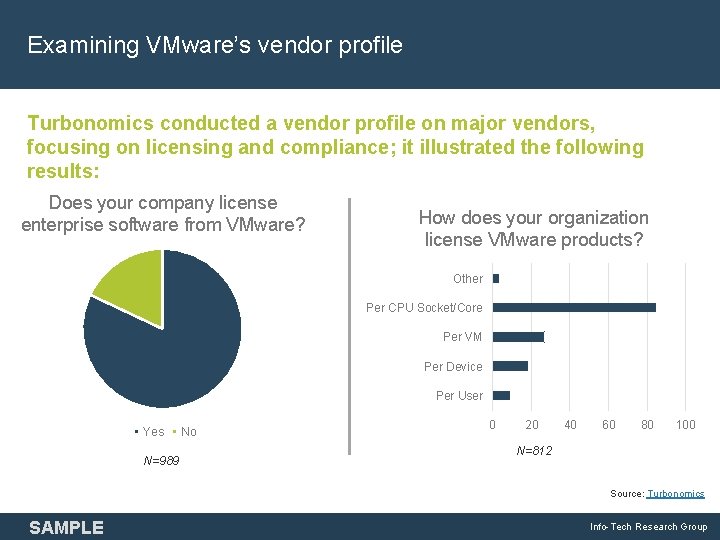
Examining VMware’s vendor profile Turbonomics conducted a vendor profile on major vendors, focusing on licensing and compliance; it illustrated the following results: Does your company license enterprise software from VMware? How does your organization license VMware products? Other Per CPU Socket/Core Per VM Per Device Per User Yes N=989 No 0 20 40 60 80 100 N=812 Source: Turbonomics SAMPLE Info-Tech Research Group 7
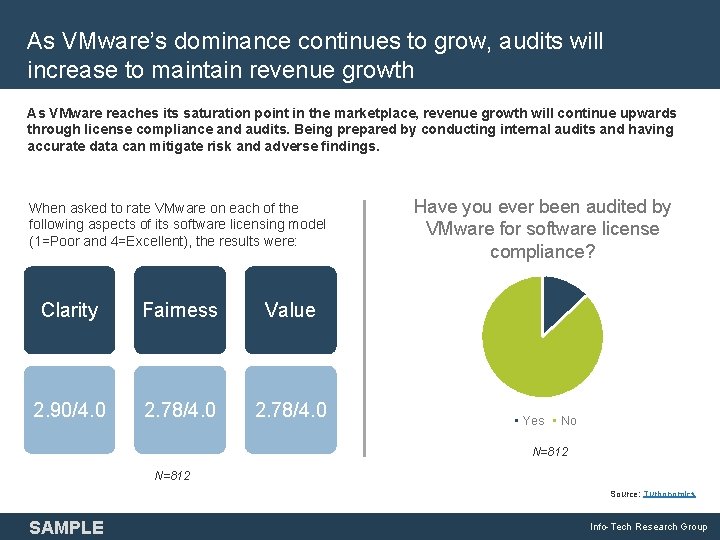
As VMware’s dominance continues to grow, audits will increase to maintain revenue growth As VMware reaches its saturation point in the marketplace, revenue growth will continue upwards through license compliance and audits. Being prepared by conducting internal audits and having accurate data can mitigate risk and adverse findings. When asked to rate VMware on each of the following aspects of its software licensing model (1=Poor and 4=Excellent), the results were: Clarity Fairness Value 2. 90/4. 0 2. 78/4. 0 Have you ever been audited by VMware for software license compliance? Yes No N=812 Source: Turbonomics SAMPLE Info-Tech Research Group 8
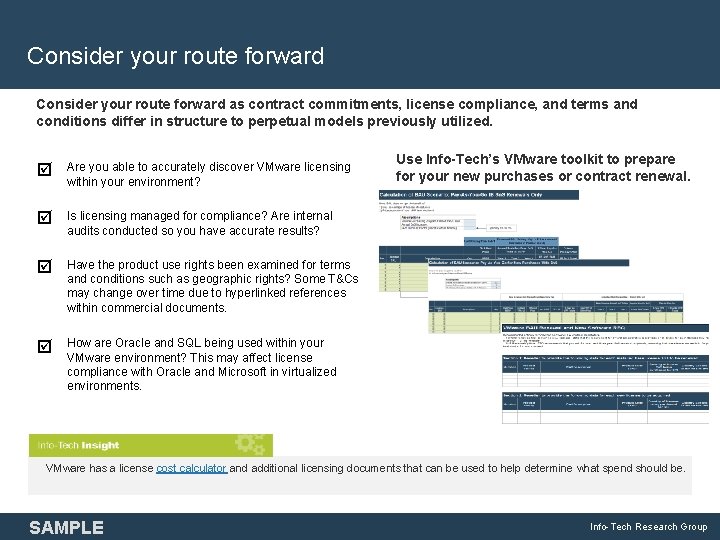
Consider your route forward as contract commitments, license compliance, and terms and conditions differ in structure to perpetual models previously utilized. Are you able to accurately discover VMware licensing within your environment? Is licensing managed for compliance? Are internal audits conducted so you have accurate results? Have the product use rights been examined for terms and conditions such as geographic rights? Some T&Cs may change over time due to hyperlinked references within commercial documents. How are Oracle and SQL being used within your VMware environment? This may affect license compliance with Oracle and Microsoft in virtualized environments. Use Info-Tech’s VMware toolkit to prepare for your new purchases or contract renewal. VMware has a license cost calculator and additional licensing documents that can be used to help determine what spend should be. SAMPLE Info-Tech Research Group 9
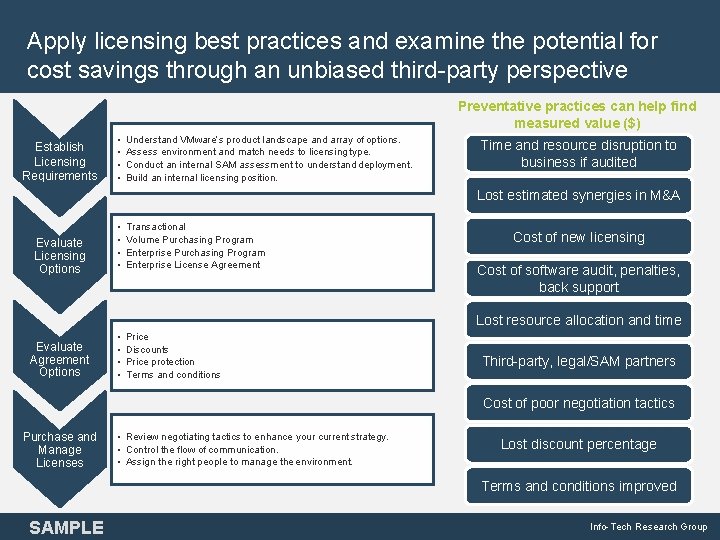
Apply licensing best practices and examine the potential for cost savings through an unbiased third-party perspective Preventative practices can help find measured value ($) Establish Licensing Requirements • • Understand VMware’s product landscape and array of options. Assess environment and match needs to licensing type. Conduct an internal SAM assessment to understand deployment. Build an internal licensing position. Time and resource disruption to business if audited Lost estimated synergies in M&A Evaluate Licensing Options • • Transactional Volume Purchasing Program Enterprise License Agreement Cost of new licensing Cost of software audit, penalties, back support Lost resource allocation and time Evaluate Agreement Options • • Price Discounts Price protection Terms and conditions Third-party, legal/SAM partners Cost of poor negotiation tactics Purchase and Manage Licenses • Review negotiating tactics to enhance your current strategy. • Control the flow of communication. • Assign the right people to manage the environment. Lost discount percentage Terms and conditions improved SAMPLE Info-Tech Research Group 10
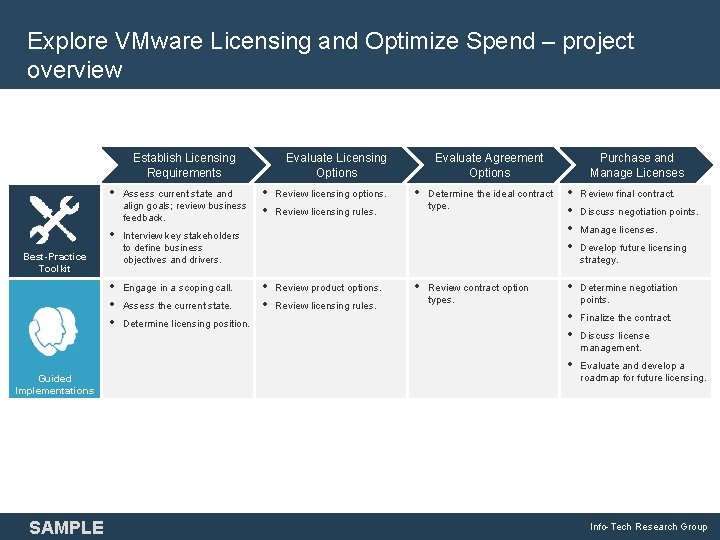
Explore VMware Licensing and Optimize Spend – project overview • • Interview key stakeholders to define business objectives and drivers. • • • Engage in a scoping call. Best-Practice Toolkit Guided Implementations SAMPLE Assess current state and align goals; review business feedback. Assess the current state. Determine licensing position. Evaluate Agreement Options Evaluate Licensing Options Establish Licensing Requirements • • Review licensing options. • Review licensing rules. Review product options. Review licensing rules. • Determine the ideal contract type. Review contract option types. Purchase and Manage Licenses • • Review final contract. • Determine negotiation points. • • Finalize the contract. • Evaluate and develop a roadmap for future licensing. Discuss negotiation points. Manage licenses. Develop future licensing strategy. Discuss license management. Info-Tech Research Group 11
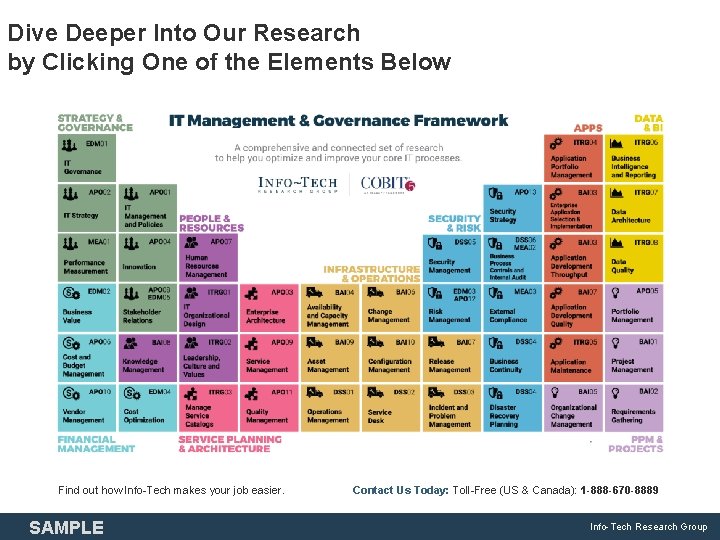
Dive Deeper Into Our Research by Clicking One of the Elements Below Find out how Info-Tech makes your job easier. SAMPLE Contact Us Today: Toll-Free (US & Canada): 1 -888 -670 -8889 Info-Tech Research Group 12