
MASTER SAMPLING FRAMEMSF FOR AGRICULTURAL STATISTICS Module 2


- Slides: 50
MASTER SAMPLING FRAME(MSF) FOR AGRICULTURAL STATISTICS Module 2 – Session 1: Defining the Master Sampling Frame for agricultural statistics: basic principles
Objectives of the presentation • Introduce the concept of MSF • Inform the audience about the benefit of constructing and using an MSF • Provide guidelines for the construction, maintenance and use of Master Sampling Frames (MSFs) in agricultural statistics 2
Outline • Introduction • Defining some important concepts, sampling frame and multiple frame sampling • Definition of a Master Sampling Frame • Reasons to build, use and maintain a MSF • Defining the integrated survey framework • How does MSF fit in AGRIS or integrated survey programs • The type of data that can be produced from using a MSF (relative to the SDGs and Minimum set of core data) • Which type of MSF is right for you? • Steps in the construction of an MSF 3
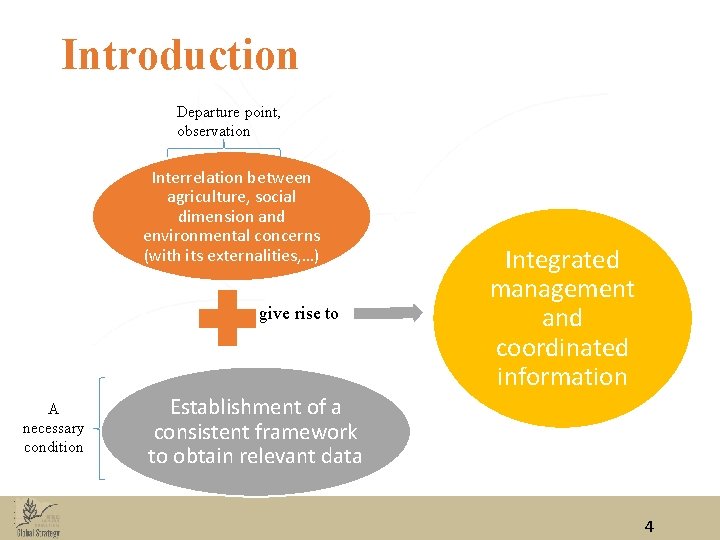
Introduction Departure point, observation Interrelation between agriculture, social dimension and environmental concerns (with its externalities, …) give rise to A necessary condition Establishment of a consistent framework to obtain relevant data Integrated management and coordinated information 4
Introduction • What about the agricultural sector? Establishment of a Master Sampling Frame Collect consistent information that best meets the needs of users and policy makers • How does an MSF fit in Global Strategy objectives? 5
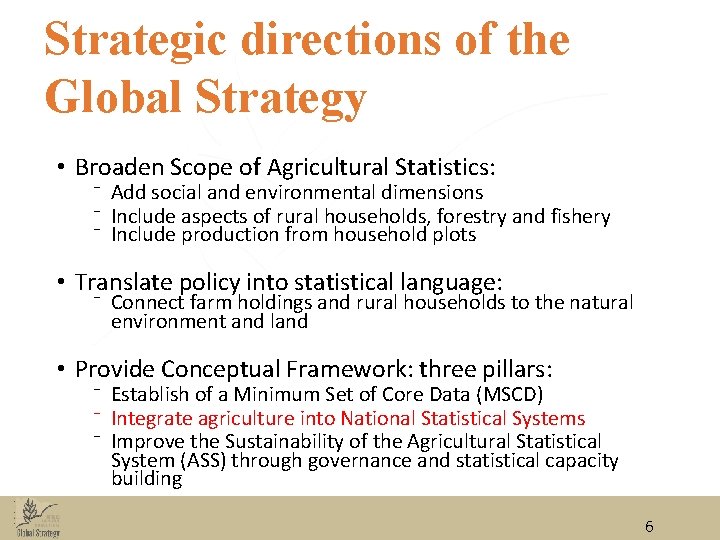
Strategic directions of the Global Strategy • Broaden Scope of Agricultural Statistics: ⁻ Add social and environmental dimensions ⁻ Include aspects of rural households, forestry and fishery ⁻ Include production from household plots • Translate policy into statistical language: ⁻ Connect farm holdings and rural households to the natural environment and land • Provide Conceptual Framework: three pillars: ⁻ Establish of a Minimum Set of Core Data (MSCD) ⁻ Integrate agriculture into National Statistical Systems ⁻ Improve the Sustainability of the Agricultural Statistical System (ASS) through governance and statistical capacity building 6
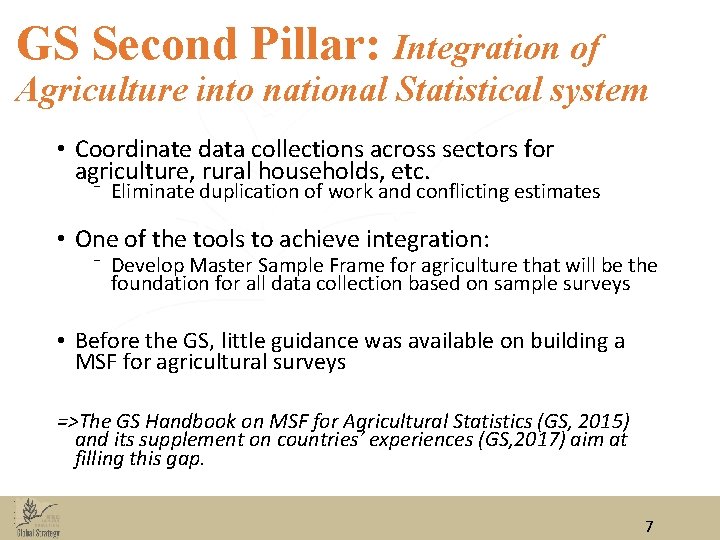
GS Second Pillar: Integration of Agriculture into national Statistical system • Coordinate data collections across sectors for agriculture, rural households, etc. ⁻ Eliminate duplication of work and conflicting estimates • One of the tools to achieve integration: ⁻ Develop Master Sample Frame for agriculture that will be the foundation for all data collection based on sample surveys • Before the GS, little guidance was available on building a MSF for agricultural surveys =>The GS Handbook on MSF for Agricultural Statistics (GS, 2015) and its supplement on countries’ experiences (GS, 2017) aim at filling this gap. 7
1 Definition of concepts 8
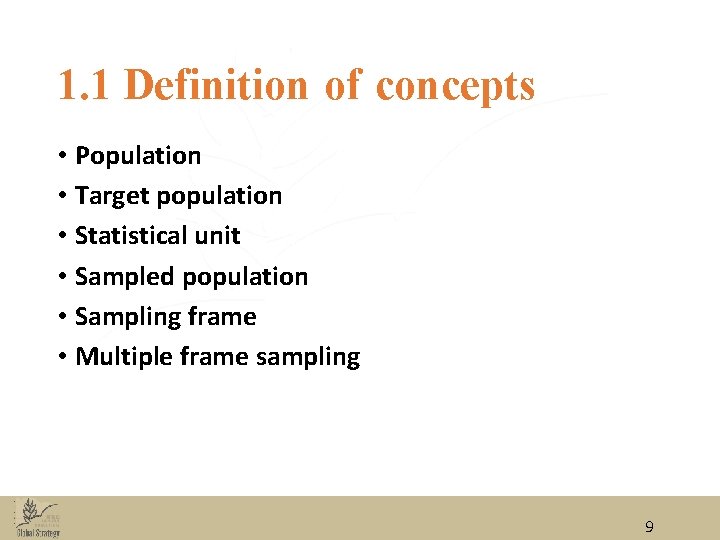
1. 1 Definition of concepts • Population • Target population • Statistical unit • Sampled population • Sampling frame • Multiple frame sampling 9
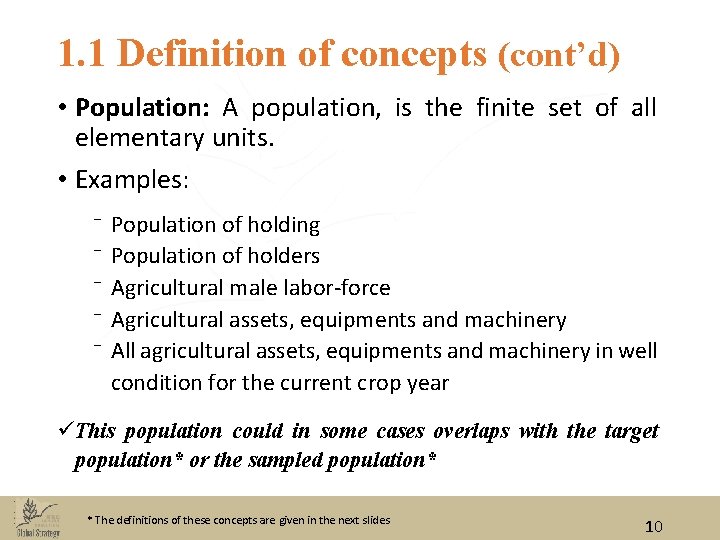
1. 1 Definition of concepts (cont’d) • Population: A population, is the finite set of all elementary units. • Examples: ⁻ ⁻ ⁻ Population of holding Population of holders Agricultural male labor-force Agricultural assets, equipments and machinery All agricultural assets, equipments and machinery in well condition for the current crop year üThis population could in some cases overlaps with the target population* or the sampled population* * The definitions of these concepts are given in the next slides 10
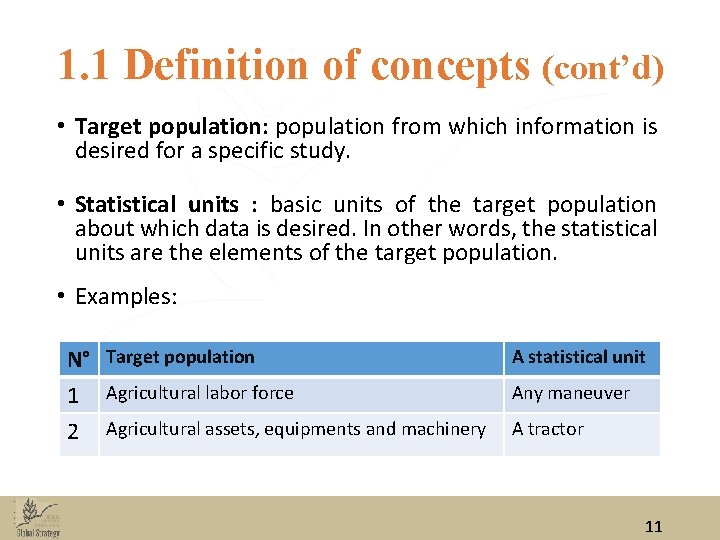
1. 1 Definition of concepts (cont’d) • Target population: population from which information is desired for a specific study. • Statistical units : basic units of the target population about which data is desired. In other words, the statistical units are the elements of the target population. • Examples: N° Target population 1 Agricultural labor force 2 Agricultural assets, equipments and machinery A statistical unit Any maneuver A tractor 11
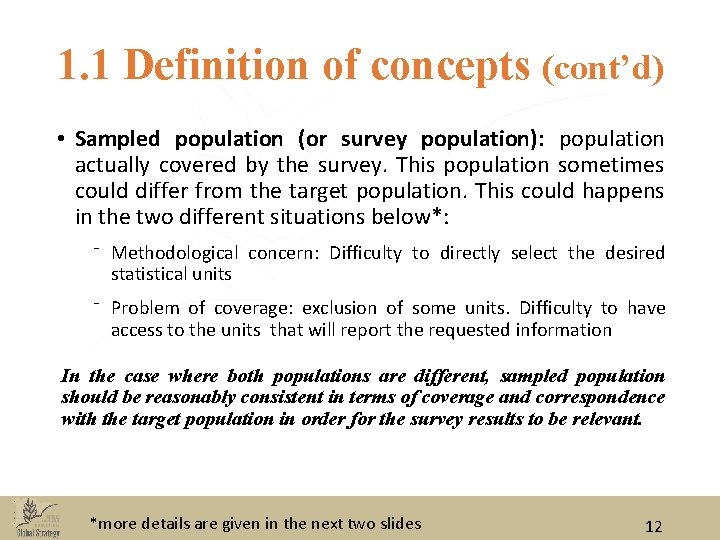
1. 1 Definition of concepts (cont’d) • Sampled population (or survey population): population actually covered by the survey. This population sometimes could differ from the target population. This could happens in the two different situations below*: ⁻ Methodological concern: Difficulty to directly select the desired statistical units ⁻ Problem of coverage: exclusion of some units. Difficulty to have access to the units that will report the requested information In the case where both populations are different, sampled population should be reasonably consistent in terms of coverage and correspondence with the target population in order for the survey results to be relevant. *more details are given in the next two slides 12
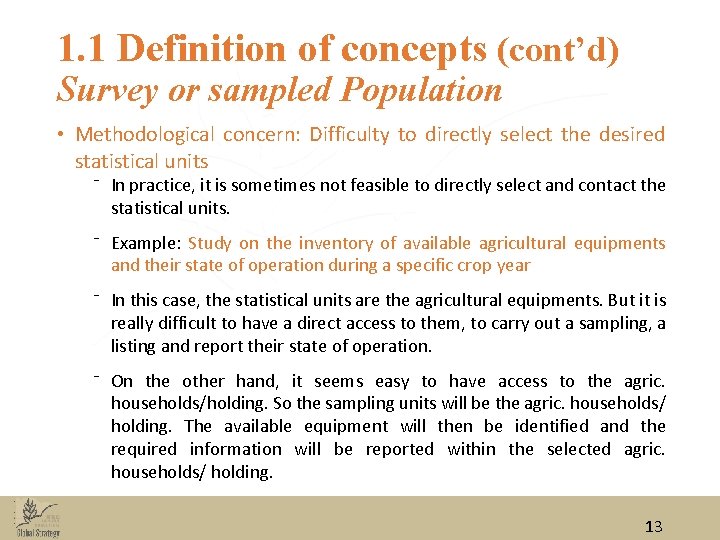
1. 1 Definition of concepts (cont’d) Survey or sampled Population • Methodological concern: Difficulty to directly select the desired statistical units ⁻ In practice, it is sometimes not feasible to directly select and contact the statistical units. ⁻ Example: Study on the inventory of available agricultural equipments and their state of operation during a specific crop year ⁻ In this case, the statistical units are the agricultural equipments. But it is really difficult to have a direct access to them, to carry out a sampling, a listing and report their state of operation. ⁻ On the other hand, it seems easy to have access to the agric. households/holding. So the sampling units will be the agric. households/ holding. The available equipment will then be identified and the required information will be reported within the selected agric. households/ holding. 13
1. 1 Definition of concepts (cont’d) Survey or sampled Population • Problem of coverage: exclusion of some units. Difficulty to have access to the units that will report the requested information. • Some examples: ⁻ Exclusion of the isolated areas due to high cost of collecting data ⁻ Exclusion of farming activities performed by some institutions (ex: prisons…) ⁻ Limitation of the sampling frame due to lack of information. 14
1. 1 Definition of concepts (cont’d) • Sample: the subset of units, selected from a population for the purpose of collecting information from those units. The inference about the population as a whole is drawn from the findings based on that sample. 15
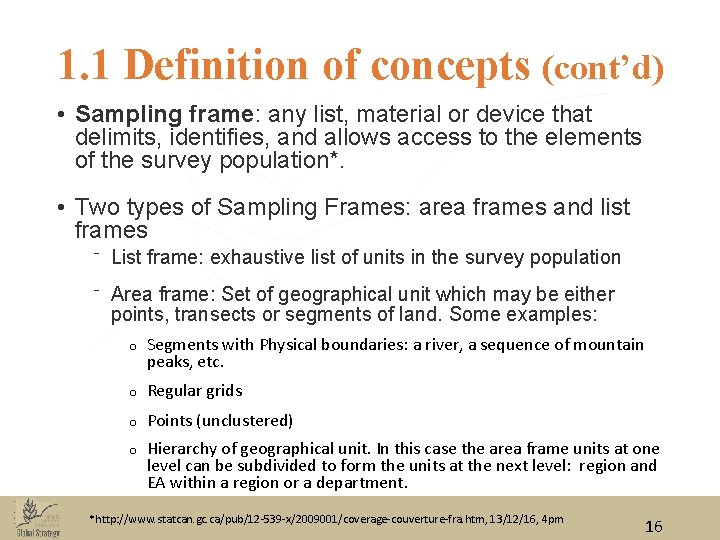
1. 1 Definition of concepts (cont’d) • Sampling frame: any list, material or device that delimits, identifies, and allows access to the elements of the survey population*. • Two types of Sampling Frames: area frames and list frames ⁻ List frame: exhaustive list of units in the survey population ⁻ Area frame: Set of geographical unit which may be either points, transects or segments of land. Some examples: o Segments with Physical boundaries: a river, a sequence of mountain peaks, etc. o Regular grids o Points (unclustered) o Hierarchy of geographical unit. In this case the area frame units at one level can be subdivided to form the units at the next level: region and EA within a region or a department. *http: //www. statcan. gc. ca/pub/12 -539 -x/2009001/coverage-couverture-fra. htm, 13/12/16, 4 pm 16
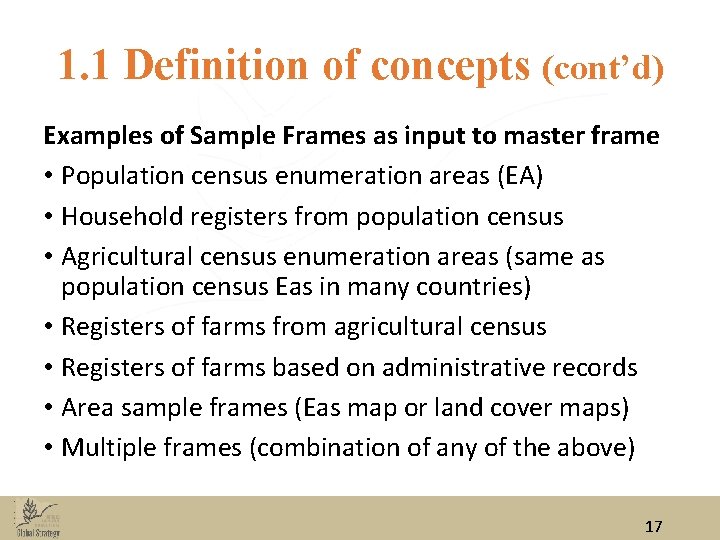
1. 1 Definition of concepts (cont’d) Examples of Sample Frames as input to master frame • Population census enumeration areas (EA) • Household registers from population census • Agricultural census enumeration areas (same as population census Eas in many countries) • Registers of farms from agricultural census • Registers of farms based on administrative records • Area sample frames (Eas map or land cover maps) • Multiple frames (combination of any of the above) 17
1. 1 Definition of concepts (cont’d) Multiple sampling frame: Joint use of two or more sample frames Examples of multiple frames in agricultural sector: • Use of several lists frames • List of food crop farmers, list of cash crop farmers… • Use of area and list frames • Land coverage maps and list of large holdings 18
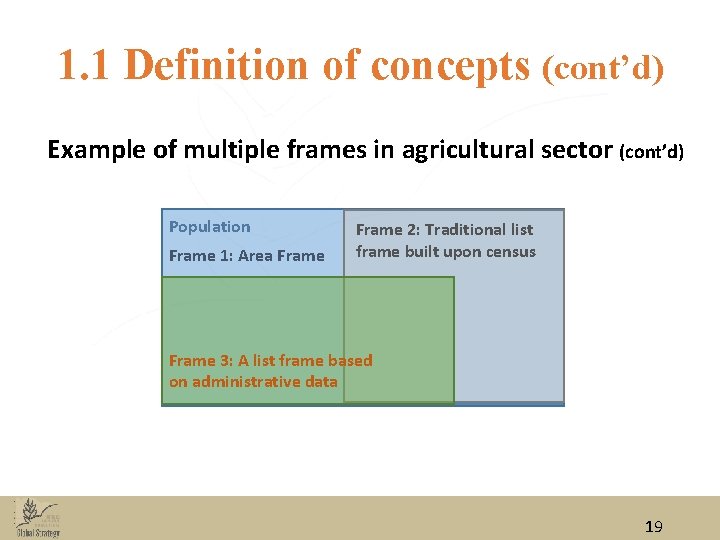
1. 1 Definition of concepts (cont’d) Example of multiple frames in agricultural sector (cont’d) Population Frame 1: Area Frame 2: Traditional list frame built upon census Frame 3: A list frame based on administrative data 19
1. 2 Example The Gambia’s National Agricultural Sample Survey • Target population: The set of all households in the country engaged in growing crops and/or breeding and raising livestock in private or in partnership with others, for a given period or point in time. • Subpopulation of interest: Given the population description, an example of subpopulation of interest for Gambia’s survey could be the set of livestock producers. 20
1. 2 Example The Gambia’s National Agricultural Sample Survey • Frame: The survey used a list of EAs available from the last population census. Once an EA was selected, a list of dabadas was built; • The DABADA seeks to group persons who pool their resources together to grow crops and raise livestock and is usually headed by one person who takes management decisions. • From these, the DABADA managers were identified to enable the selection. 21
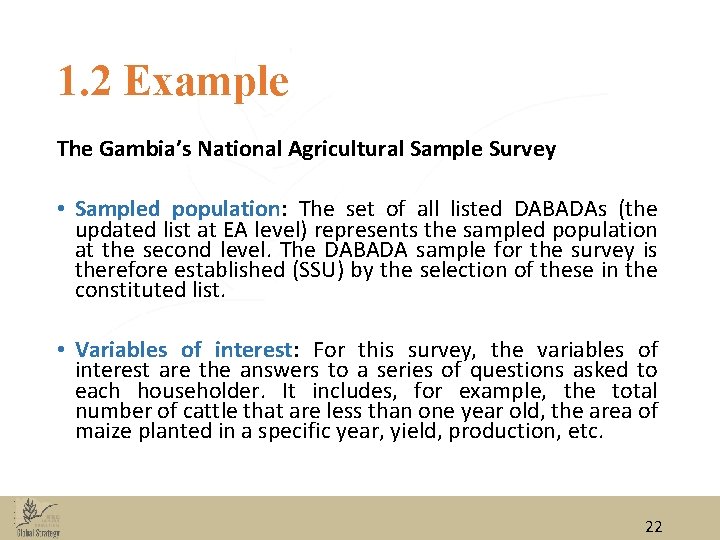
1. 2 Example The Gambia’s National Agricultural Sample Survey • Sampled population: The set of all listed DABADAs (the updated list at EA level) represents the sampled population at the second level. The DABADA sample for the survey is therefore established (SSU) by the selection of these in the constituted list. • Variables of interest: For this survey, the variables of interest are the answers to a series of questions asked to each householder. It includes, for example, the total number of cattle that are less than one year old, the area of maize planted in a specific year, yield, production, etc. 22
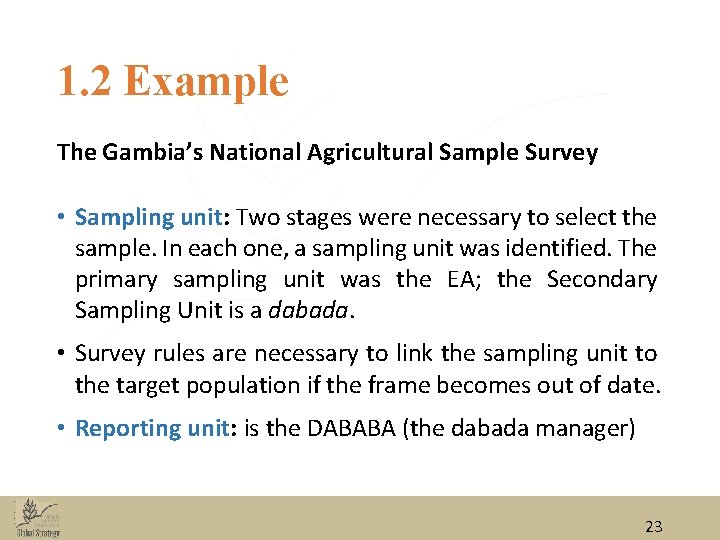
1. 2 Example The Gambia’s National Agricultural Sample Survey • Sampling unit: Two stages were necessary to select the sample. In each one, a sampling unit was identified. The primary sampling unit was the EA; the Secondary Sampling Unit is a dabada. • Survey rules are necessary to link the sampling unit to the target population if the frame becomes out of date. • Reporting unit: is the DABABA (the dabada manager) 23
2 What is an MSF and Why should we use an MSF for agricultural statistics? 24
2. 1 What is a Master Sampling Frame? “A Master Sampling Frame is a sampling frame that provides the basis for all data collections through sample surveys and censuses in a certain sector, allowing to select samples for several different surveys or different rounds of the same survey, as opposed to building an ad-hoc sampling frame for each survey. (Carfagna, E. , 2013)” 25
2. 1 What is a Master Sampling Frame (MSF) for agricultural statistics? For the agricultural sector and in the context of the Global Strategy: • The MSF is a sampling frame that can be used for several surveys or several rounds of the same survey • It enables the selection of different samples (including from different sampling designs) for specific purposes such as: • Agricultural surveys • Agricultural household surveys • Farm management surveys 26
2. 1 What is a Master Sampling Frame (MSF) for agricultural statistics? (cont’d) For the agricultural sector and in the context of the Global Strategy (cont’d): • “MSF is a frame or a combination of frames that covers the population of interest in its entirety, and that enables the linkage of the farm as an economic unit to the household as a social unit, and both of these to the land as an environmental unit. ”(Handbook on MFS, 2015, Glossary, paragraph 9) • It helps to avoid building an ad hoc frame for each survey 27
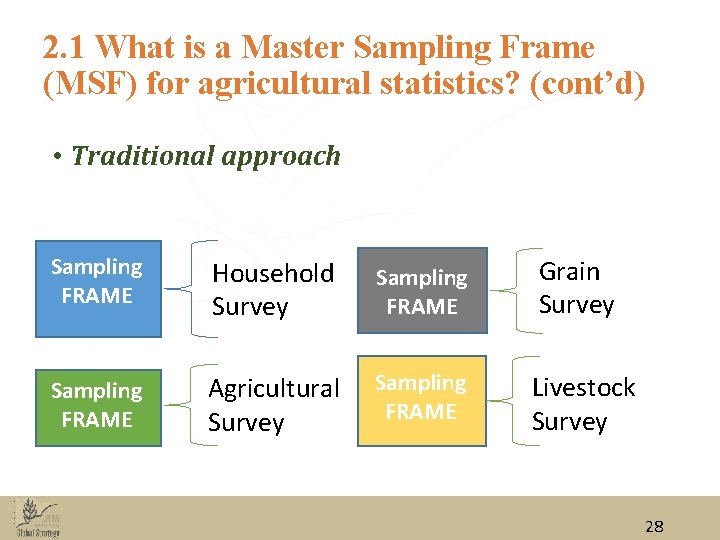
2. 1 What is a Master Sampling Frame (MSF) for agricultural statistics? (cont’d) • Traditional approach Sampling FRAME Household Survey Sampling FRAME Grain Survey Sampling FRAME Agricultural Survey Sampling FRAME Livestock Survey 28
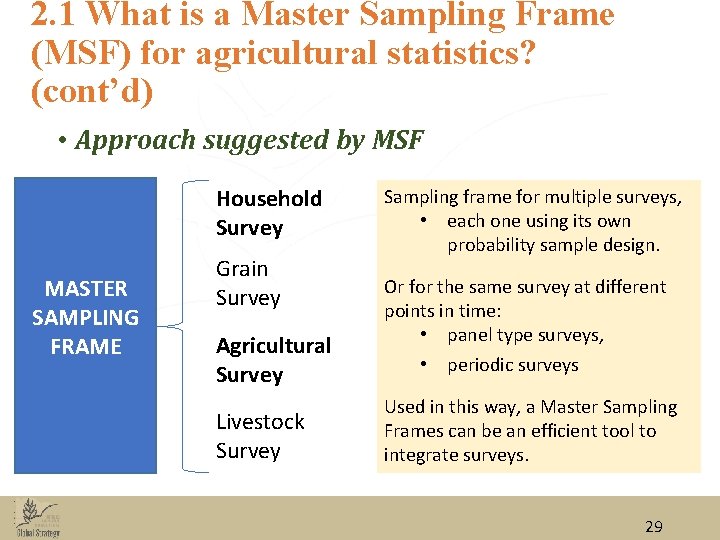
2. 1 What is a Master Sampling Frame (MSF) for agricultural statistics? (cont’d) • Approach suggested by MSF Household Survey MASTER SAMPLING FRAME Grain Survey Agricultural Survey Livestock Survey Sampling frame for multiple surveys, • each one using its own probability sample design. Or for the same survey at different points in time: • panel type surveys, • periodic surveys Used in this way, a Master Sampling Frames can be an efficient tool to integrate surveys. 29
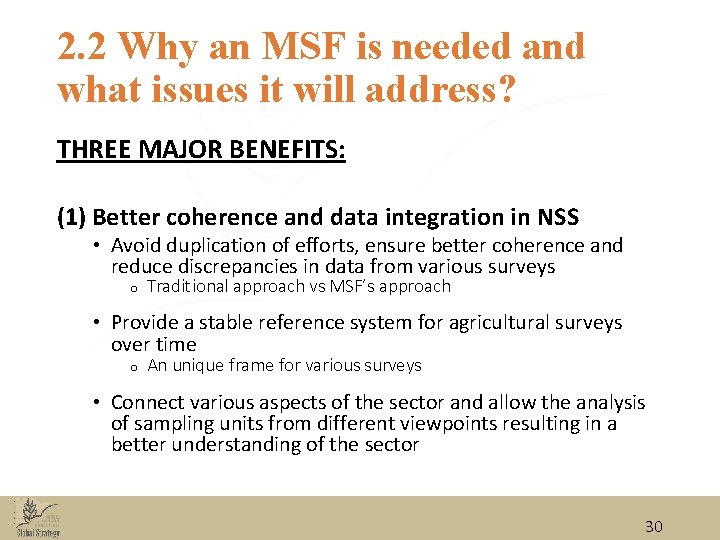
2. 2 Why an MSF is needed and what issues it will address? THREE MAJOR BENEFITS: (1) Better coherence and data integration in NSS • Avoid duplication of efforts, ensure better coherence and reduce discrepancies in data from various surveys o Traditional approach vs MSF’s approach • Provide a stable reference system for agricultural surveys over time o An unique frame for various surveys • Connect various aspects of the sector and allow the analysis of sampling units from different viewpoints resulting in a better understanding of the sector 30
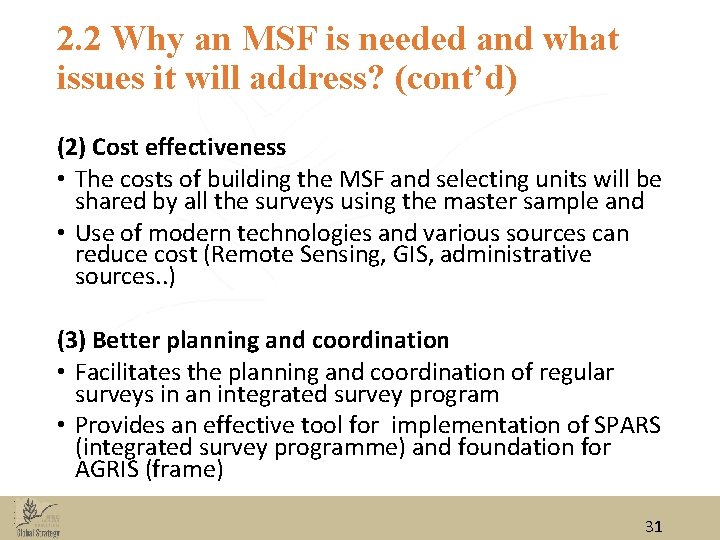
2. 2 Why an MSF is needed and what issues it will address? (cont’d) (2) Cost effectiveness • The costs of building the MSF and selecting units will be shared by all the surveys using the master sample and • Use of modern technologies and various sources can reduce cost (Remote Sensing, GIS, administrative sources. . ) (3) Better planning and coordination • Facilitates the planning and coordination of regular surveys in an integrated survey program • Provides an effective tool for implementation of SPARS (integrated survey programme) and foundation for AGRIS (frame) 31
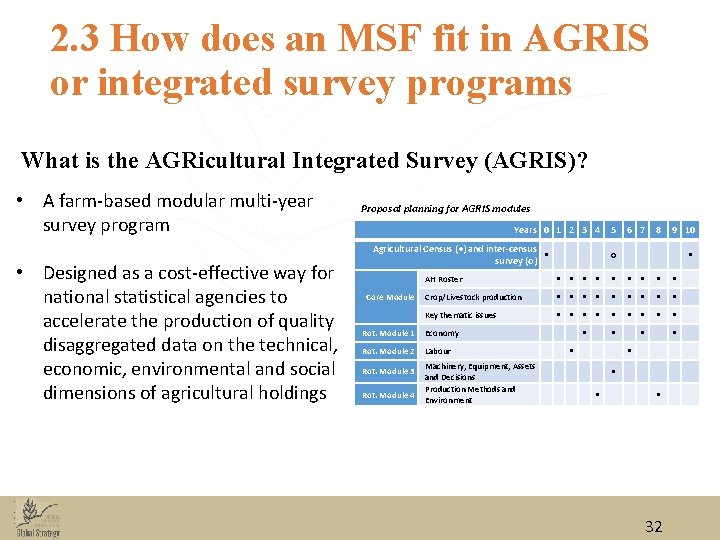
2. 3 How does an MSF fit in AGRIS or integrated survey programs What is the AGRicultural Integrated Survey (AGRIS)? • A farm-based modular multi-year survey program • Designed as a cost-effective way for national statistical agencies to accelerate the production of quality disaggregated data on the technical, economic, environmental and social dimensions of agricultural holdings Proposal planning for AGRIS modules Years 0 1 2 3 4 5 6 7 8 9 10 o • AH Roster • • • Crop/Livestock production • • • Key thematic issues • • • Economy • • • • • Agricultural Census ( • ) and inter-census • survey (o) Core Module Rot. Module 1 Rot. Module 2 Rot. Module 3 Rot. Module 4 • Labour • Machinery, Equipment, Assets and Decisions Production Methods and Environment • 32
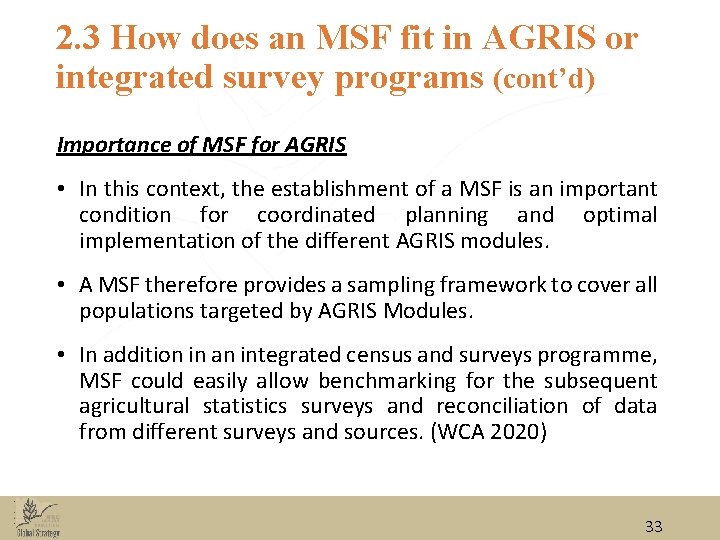
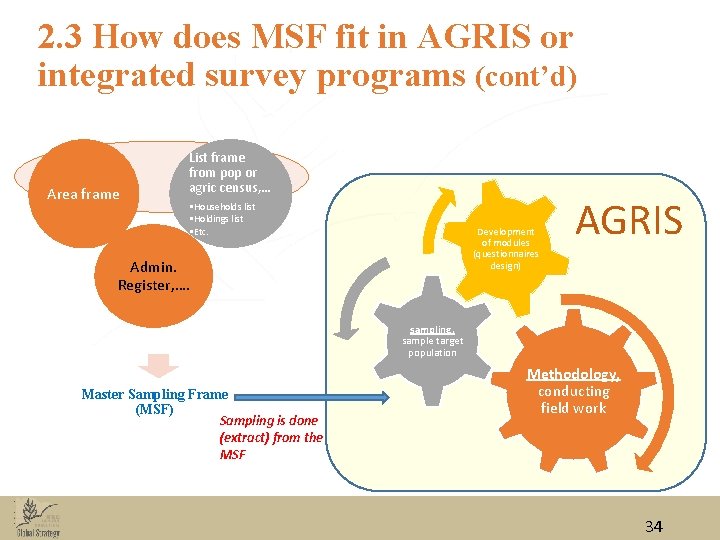
2. 3 How does an MSF fit in AGRIS or integrated survey programs (cont’d) Importance of MSF for AGRIS • In this context, the establishment of a MSF is an important condition for coordinated planning and optimal implementation of the different AGRIS modules. • A MSF therefore provides a sampling framework to cover all populations targeted by AGRIS Modules. • In addition in an integrated census and surveys programme, MSF could easily allow benchmarking for the subsequent agricultural statistics surveys and reconciliation of data from different surveys and sources. (WCA 2020) 33
2. 3 How does MSF fit in AGRIS or integrated survey programs (cont’d) Area frame List frame from pop or agric census, … • Households list • Holdings list • Etc. Development of modules (questionnaires design) Admin. Register, …. AGRIS sampling, sample target population Master Sampling Frame (MSF) Sampling is done (extract) from the MSF Methodology, conducting field work 34
3 • • Type of data that can be produced from an MSF? Minimum Set of Core Data (MSCD) Sustainable Development Goals (SDG) • • • Details could be found on the link below: SDG: https: //sustainabledevelopment. un. org/? menu=1300 MSCD: (Global Strategy, 2012) 35
3. MSF in connection with MSCD and SDG • Since the MSF intends to cover the scope of more than one indicator, it should be developed in connection with MSCD and SDG’s indicators that could be gathered from agricultural and rural population (in compliance with the 3 GS’ pillars) • The MSCD and data as input for a monitoring of SDG’s indicators, should be a starting point in the process of establishing a MSF • The scope of MSCD and SDG’s indicators will allow to better guide the identification of target populations and sampling units to consider in the construction of a MSF: o Each item of MSCD can be represented by different populations from which data can be collected o As well as SDG's indicators 36
4 Which type of MSF is right for you? 37
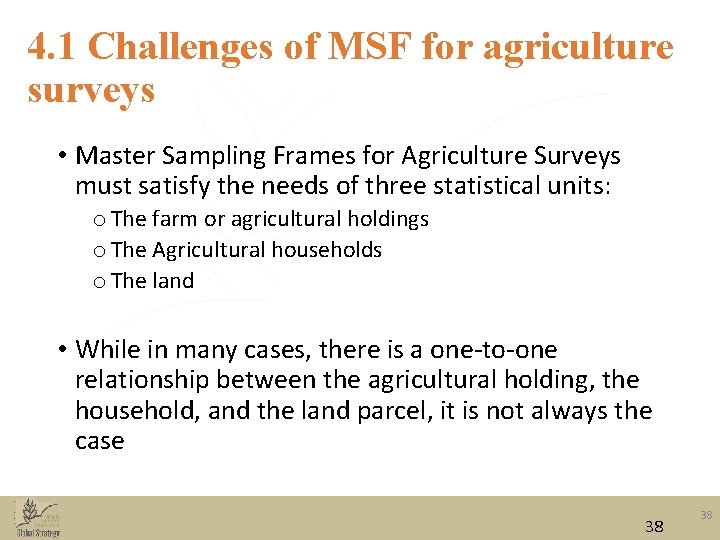
4. 1 Challenges of MSF for agriculture surveys • Master Sampling Frames for Agriculture Surveys must satisfy the needs of three statistical units: o The farm or agricultural holdings o The Agricultural households o The land • While in many cases, there is a one-to-one relationship between the agricultural holding, the household, and the land parcel, it is not always the case 38 38
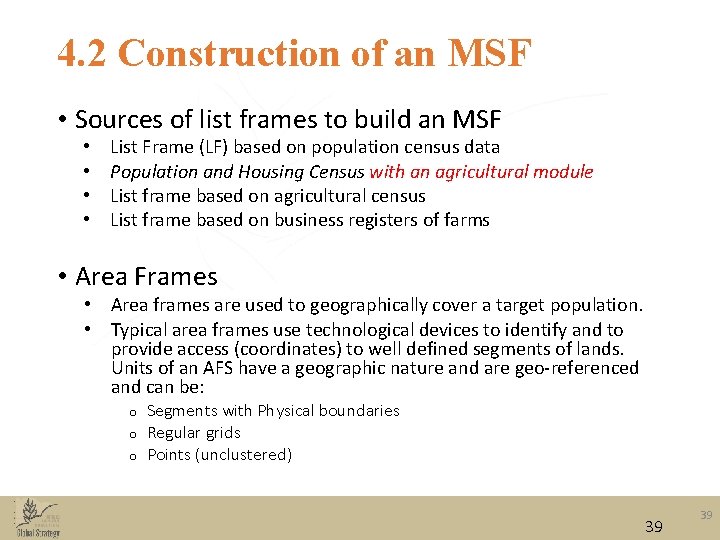
4. 2 Construction of an MSF • Sources of list frames to build an MSF • • List Frame (LF) based on population census data Population and Housing Census with an agricultural module List frame based on agricultural census List frame based on business registers of farms • Area Frames • Area frames are used to geographically cover a target population. • Typical area frames use technological devices to identify and to provide access (coordinates) to well defined segments of lands. Units of an AFS have a geographic nature and are geo-referenced and can be: o o o Segments with Physical boundaries Regular grids Points (unclustered) 39 39
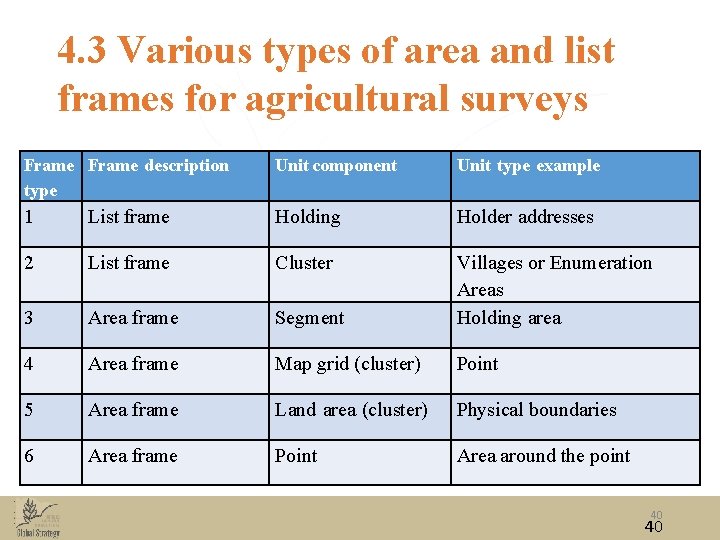
4. 3 Various types of area and list frames for agricultural surveys Frame description type Unit component Unit type example 1 List frame Holding Holder addresses 2 List frame Cluster 3 Area frame Segment Villages or Enumeration Areas Holding area 4 Area frame Map grid (cluster) Point 5 Area frame Land area (cluster) Physical boundaries 6 Area frame Point Area around the point 40 40
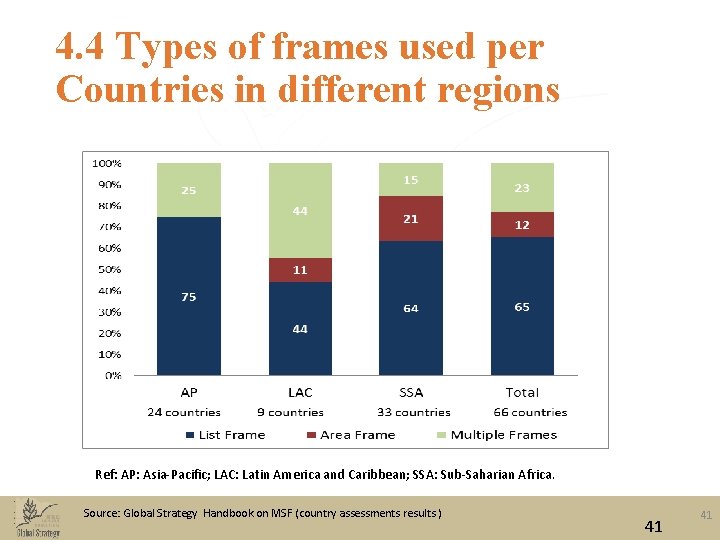
4. 4 Types of frames used per Countries in different regions Ref: AP: Asia-Pacific; LAC: Latin America and Caribbean; SSA: Sub-Saharian Africa. Source: Global Strategy Handbook on MSF (country assessments results ) 41 41
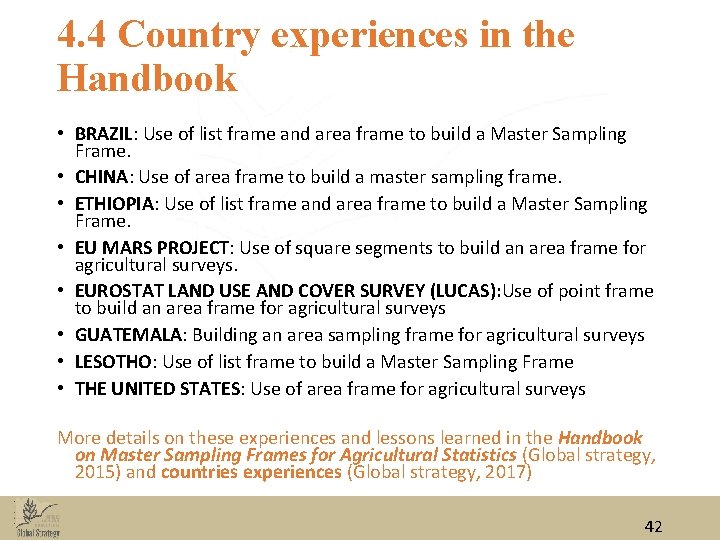
4. 4 Country experiences in the Handbook • BRAZIL: Use of list frame and area frame to build a Master Sampling Frame. • CHINA: Use of area frame to build a master sampling frame. • ETHIOPIA: Use of list frame and area frame to build a Master Sampling Frame. • EU MARS PROJECT: Use of square segments to build an area frame for agricultural surveys. • EUROSTAT LAND USE AND COVER SURVEY (LUCAS): Use of point frame to build an area frame for agricultural surveys • GUATEMALA: Building an area sampling frame for agricultural surveys • LESOTHO: Use of list frame to build a Master Sampling Frame • THE UNITED STATES: Use of area frame for agricultural surveys More details on these experiences and lessons learned in the Handbook on Master Sampling Frames for Agricultural Statistics (Global strategy, 2015) and countries experiences (Global strategy, 2017) 42
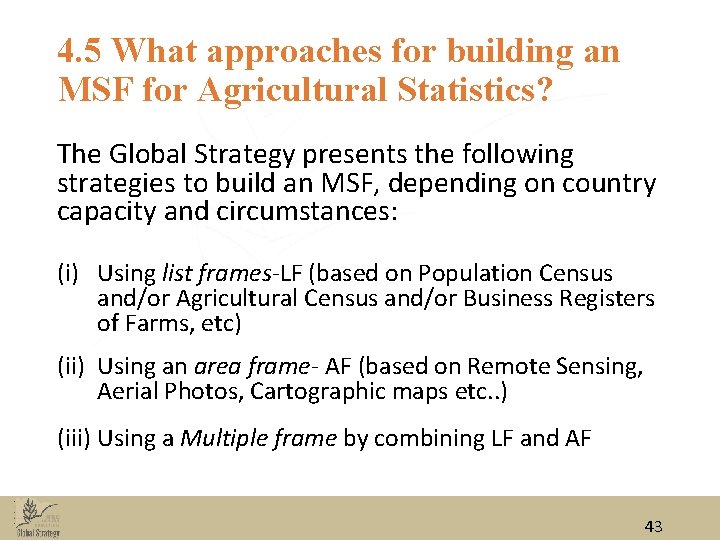
4. 5 What approaches for building an MSF for Agricultural Statistics? The Global Strategy presents the following strategies to build an MSF, depending on country capacity and circumstances: (i) Using list frames-LF (based on Population Census and/or Agricultural Census and/or Business Registers of Farms, etc) (ii) Using an area frame- AF (based on Remote Sensing, Aerial Photos, Cartographic maps etc. . ) (iii) Using a Multiple frame by combining LF and AF 43
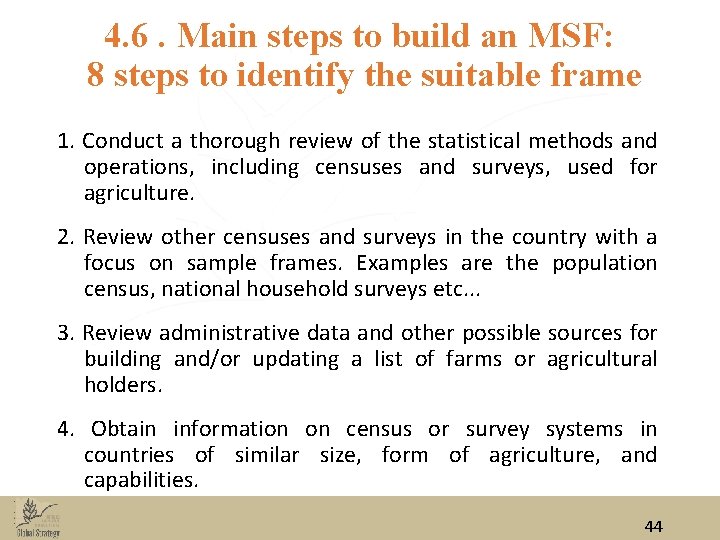
4. 6. Main steps to build an MSF: 8 steps to identify the suitable frame 1. Conduct a thorough review of the statistical methods and operations, including censuses and surveys, used for agriculture. 2. Review other censuses and surveys in the country with a focus on sample frames. Examples are the population census, national household surveys etc. . . 3. Review administrative data and other possible sources for building and/or updating a list of farms or agricultural holders. 4. Obtain information on census or survey systems in countries of similar size, form of agriculture, and capabilities. 44
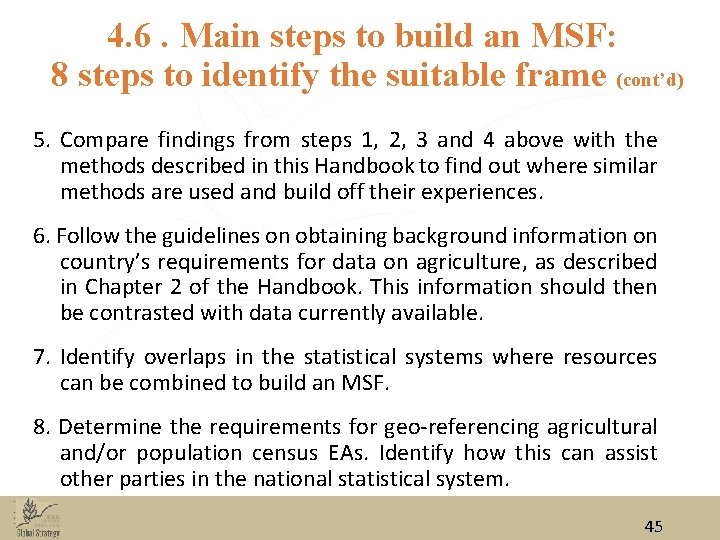
4. 6. Main steps to build an MSF: 8 steps to identify the suitable frame (cont’d) 5. Compare findings from steps 1, 2, 3 and 4 above with the methods described in this Handbook to find out where similar methods are used and build off their experiences. 6. Follow the guidelines on obtaining background information on country’s requirements for data on agriculture, as described in Chapter 2 of the Handbook. This information should then be contrasted with data currently available. 7. Identify overlaps in the statistical systems where resources can be combined to build an MSF. 8. Determine the requirements for geo-referencing agricultural and/or population census EAs. Identify how this can assist other parties in the national statistical system. 45
4. 7 Final choice of MSF Following the 8 steps, there should be enough information to: o Make a first recommendation on the choice of frame (list or area) or on a form of multiple frame sampling o Seek a peer review of the frame selection process; revise as necessary o Begin implementation in a portion of the country 46
4. 7 Final choice of MSF (cont’d) • The final choice of MSF should take into consideration not only the costs of frame development and data collection, but also the costs required for maintenance and updating. • The proposals should be realistic and reflect national capabilities, and include an indicative budget and timeframe for implementation. • An effective MSF will facilitate the integration of agriculture into the national statistical system and will benefit the entire statistical system. 47
Summary about MSF • A master sampling frame is a general purpose sampling frame, for use in selecting samples for different surveys or different rounds of a periodic survey. (WCA 2020). • A master sampling frame has several benefits. It is quick and easy to conduct surveys of any kind, because a ready-made frame is already available. • The cost of preparing sampling materials and selecting samples is also reduced. • Master sampling frames also make it easier to relate data from different surveys and to control the reporting burden on survey respondents. • It is a necessary condition to implement an integrated survey such as AGRIS 48
References • Publications and books ⁻ FAO, 2015. World Programme for the Census of Agriculture 2020. FAO Statistical Development Series 15. , Vol. 1. Rome ⁻ Global Strategy to improve agricultural and rural statistics. , 2015. Hanbook of Master Sampling Frame for Agricultural Statistics: Frame development, Sample design and Estimation. , Rome, Italy ⁻ Global Strategy to improve agricultural and rural statistics. , 2014. Plans Stratégiques Pour Les Statistiques Agricoles Et Rurales (PSSAR), Rome, Italy ⁻ Global Strategy to improve agricultural and rural statistics. , 2012. Action Plan, Rome, Italy ⁻ Pascal Ardilly, 2006, les techniques de sondage. PARIS: Editions TECHNIP, 675 p • Working document and web-references ⁻ Global strategy, 2016; Nepal’s Master Frame Test Protocol. ⁻ Cristiano, F. , Leite, A. , Ospina, R. , et al. 2016. workshop on master sampling frame for agriculture surveys, Harare, Zimbabwe. UNECA ⁻ World Bank. , 2010, Integrating Agriculture into National Statistical System, Workshop ⁻ http: //www. statcan. gc. ca/pub/12 -539 -x/2009001/coverage-couverture-fra. htm, 13/12/16, 4 pm 49
Thank You