
Master Protocols A Regulatory View Andrew Thomson PSI
- Slides: 20
Master Protocols – A Regulatory View Andrew Thomson PSI Webinar September 2020 An agency of the European Union
Disclaimer The views expressed are the personal views of the author and may not be understood or quoted as being made on behalf of or reflecting the position of the EMA or one of its committees or working parties. 1 Classified as public by the European Medicines Agency
Overview • 2 Regulatory positions and thoughts • Concurrent Controls • Type I Error • Information leakage Classified as public by the European Medicines Agency
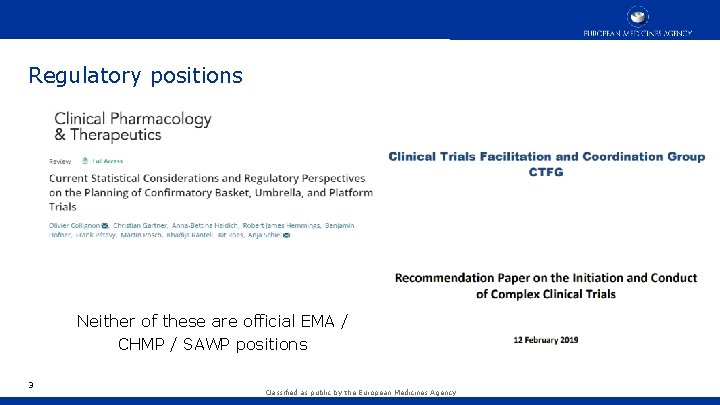
Regulatory positions Neither of these are official EMA / CHMP / SAWP positions 3 Classified as public by the European Medicines Agency
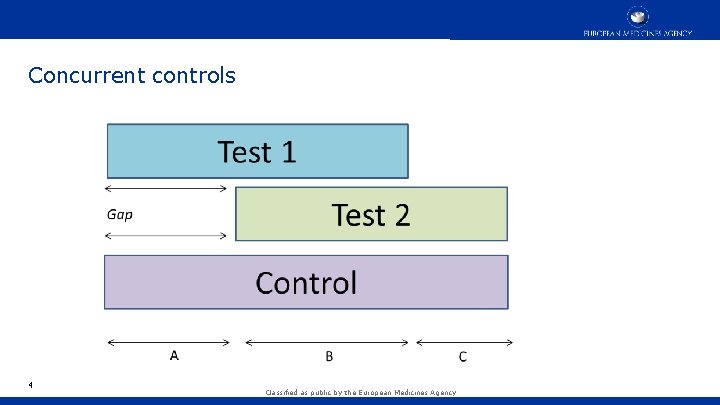
Concurrent controls 4 Classified as public by the European Medicines Agency
Concurrent Controls • Test 1 is compared to control subjects only from time epochs A and B • Test 2 is compared to control subjects only from time epochs B and C • This is non-negotiable • Do we need a period effect? • We know: 5 • In some conditions placebo response depends on whether the trial is active control • Randomisation ratios can affect response • Enrolled patient characteristics can change over time • Some diseases change over time, especially infectious disease epidemics Classified as public by the European Medicines Agency
Type I Error Control • We can’t be strict • • But we can’t be lenient • • • 6 If Test 1 fails, then Test 2 does not have a chance? Why would Test 2 developer include their product in the platform? 2 doses of the same drug Why is dose different? • We can hierarchically order doses. Knowledge of a successful lower dose implies (usually!) successful higher dose • Converse is not true, hence hierarchy possible Independence of test arms is key – incumbent upon developers to convince us Classified as public by the European Medicines Agency
Information Leakage • Perhaps not as widely appreciated • Focus is on Interim Analyses (very common in these proposals) • Different types of information • Affects trials differently depending on the design chosen • Regulatory impact depends on design chosen • 7 Hence why relevant to statisticians – impact of trial design on study integrity Classified as public by the European Medicines Agency
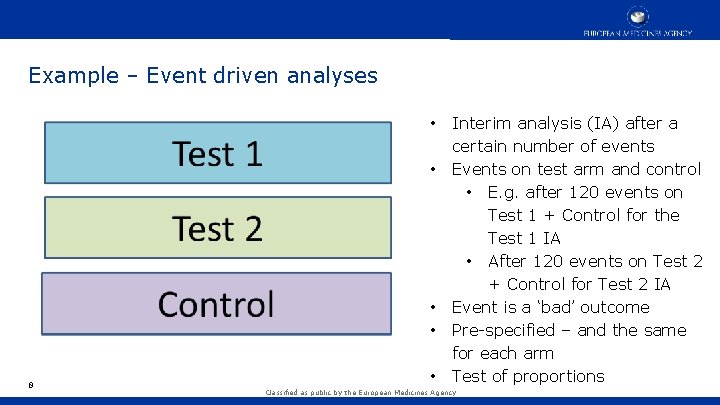
Example – Event driven analyses • • 8 • Interim analysis (IA) after a certain number of events Events on test arm and control • E. g. after 120 events on Test 1 + Control for the Test 1 IA • After 120 events on Test 2 + Control for Test 2 IA Event is a ‘bad’ outcome Pre-specified – and the same for each arm Test of proportions Classified as public by the European Medicines Agency
What does this mean in practice? • Lets say we need 120 events to trigger the IA • Success criteria is pre-defined such that 40 events on test and 80 events on control (or better) will be considered a success • Test 1 reaches IA first and is a success • • 9 Total events = 120, Total events on Control >=80 What do we know about Test 2? • Total events < 120, Total events on Control >=80, Total events on Test 2 < Total events on Test 1. Test 2 is numerically better than Test 1. So is also significant. • Test 2 will be better or as good as, at every possible analysis up until Test 2 + Control has 120 events. If Test 1 is positive, Test 2 is, and T 1 E is controlled Classified as public by the European Medicines Agency
Conclusions in this case • Not possible to have a SAP-defined stop as waiting for IA criteria to be met • • • 10 Even though we know Test 2 is better Information leakage is 100% • Don’t even need to know the actual results • Just knowing Test 1 is positive is enough to infer Test 2 is If you have multiple arms – numerically worst product ‘wins’ first • What happens if this become So. C – so e. g. Test 1 replaces placebo as control • What does Test 2 now need to beat? • Sample size for non-inferiority v Test 1 >> Superiority versus placebo Classified as public by the European Medicines Agency
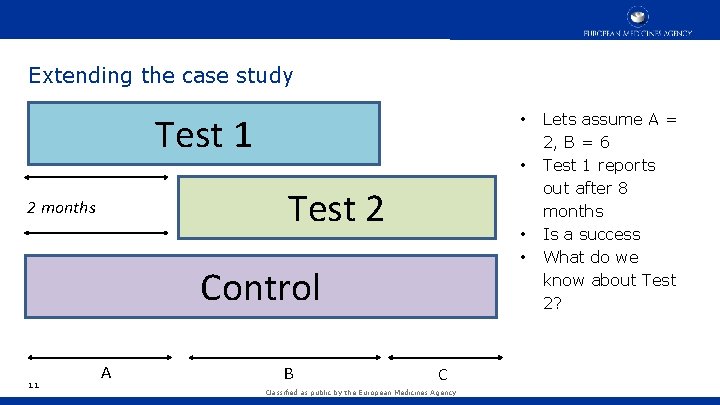
Extending the case study Test 1 • • Test 2 2 months • • Control 11 A B C Classified as public by the European Medicines Agency Lets assume A = 2, B = 6 Test 1 reports out after 8 months Is a success What do we know about Test 2?
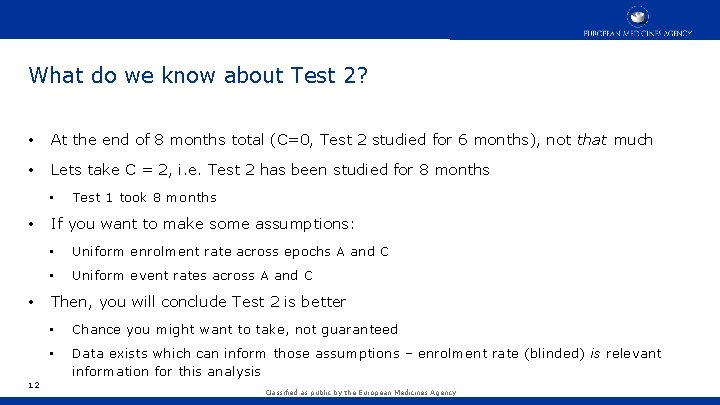
What do we know about Test 2? • At the end of 8 months total (C=0, Test 2 studied for 6 months), not that much • Lets take C = 2, i. e. Test 2 has been studied for 8 months • • • 12 Test 1 took 8 months If you want to make some assumptions: • Uniform enrolment rate across epochs A and C • Uniform event rates across A and C Then, you will conclude Test 2 is better • Chance you might want to take, not guaranteed • Data exists which can inform those assumptions – enrolment rate (blinded) is relevant information for this analysis Classified as public by the European Medicines Agency
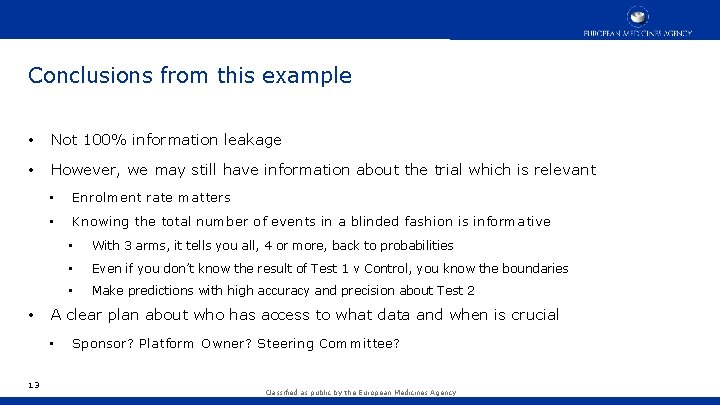
Conclusions from this example • Not 100% information leakage • However, we may still have information about the trial which is relevant • • Enrolment rate matters • Knowing the total number of events in a blinded fashion is informative With 3 arms, it tells you all, 4 or more, back to probabilities • Even if you don’t know the result of Test 1 v Control, you know the boundaries • Make predictions with high accuracy and precision about Test 2 A clear plan about who has access to what data and when is crucial • 13 • Sponsor? Platform Owner? Steering Committee? Classified as public by the European Medicines Agency
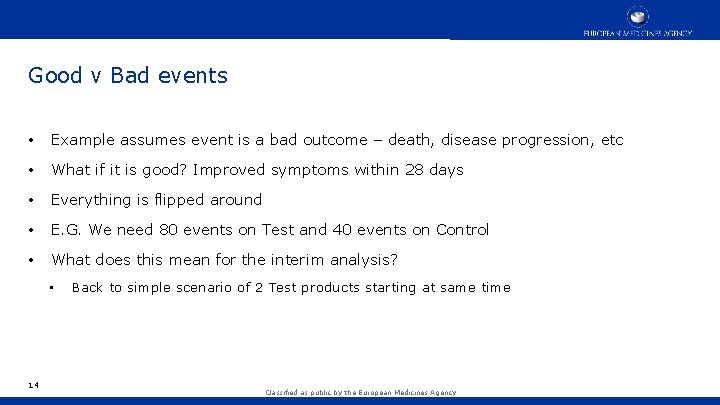
Good v Bad events • Example assumes event is a bad outcome – death, disease progression, etc • What if it is good? Improved symptoms within 28 days • Everything is flipped around • E. G. We need 80 events on Test and 40 events on Control • What does this mean for the interim analysis? • 14 Back to simple scenario of 2 Test products starting at same time Classified as public by the European Medicines Agency
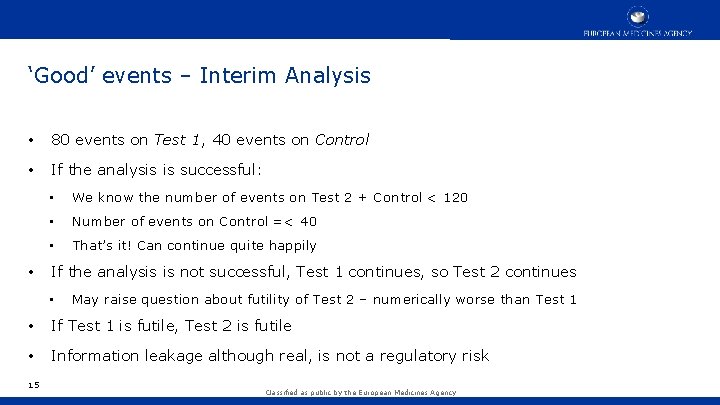
‘Good’ events – Interim Analysis • 80 events on Test 1, 40 events on Control • If the analysis is successful: • • We know the number of events on Test 2 + Control < 120 • Number of events on Control =< 40 • That’s it! Can continue quite happily If the analysis is not successful, Test 1 continues, so Test 2 continues • May raise question about futility of Test 2 – numerically worse than Test 1 • If Test 1 is futile, Test 2 is futile • Information leakage although real, is not a regulatory risk 15 Classified as public by the European Medicines Agency
What other approaches might we have? • Continuous outcomes • Time-to-event instead of pure proportions • • Interim analyses based on time epochs and not cases • • Analyses every X weeks, as long as an additional Y cases have been observed? IAs based on total information – i. e. after 160 cases across all arms • 16 Potential for small amount of information between analyses (No small steps) Time based interim analyses with minimum information? • • Not the 100% guarantee of success, just very, very likely Difficult unless all arms start at once Classified as public by the European Medicines Agency
Conclusions on case studies The following sources of platform information may allow inferences to be drawn, or probabilities of success to be estimated, depending on the endpoint chosen and the design of the platform • Whether one arm was successful or not • The actual results if that arm was successful or otherwise • Blinded event data without knowledge of treatment arm allocation • Trial accrual rates • Any changes in underlying disease throughout the study 17 Classified as public by the European Medicines Agency
Conclusions • The more platforms we see, the more we learn • Some regulatory positions are very well set • Sometimes there are no easy answers • There is no shortage of research opportunities to address these issues 18 Classified as public by the European Medicines Agency
Any questions? With Thanks to Benjamin Hofner and Lukas Aguirre Dávila andrew. thomson@ema. europa. eu Official address Domenico Scarlattilaan 6 ● 1083 HS Amsterdam ● The Netherlands Address for visits and deliveries Refer to www. ema. europa. eu/how-to-find-us Send us a question Go to www. ema. europa. eu/contact Telephone +31 (0)88 781 6000 Follow us on @EMA_News Classified as public by the European Medicines Agency