
Master of Science in INTERNATIONAL COOPERATION FINANCE AND
- Slides: 9
Master of Science in INTERNATIONAL COOPERATION, FINANCE AND DEVELOPMENT Lesson 8: Change and crisis of democracy: the seventies Prof. Daniel Pommier
Change and crisis of democracy: the seventies INTERNATIONAL COOPERATION, FINANCE AND DEVELOPMENT 2
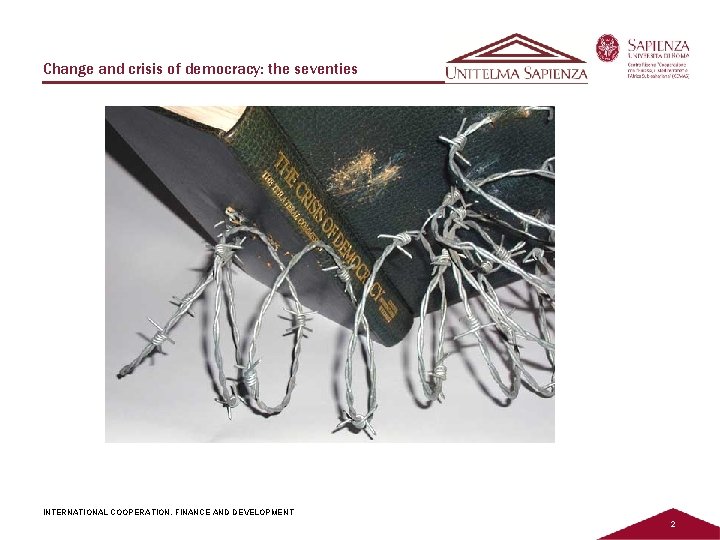
Change and crisis of democracy: the seventies The season of social unrest of the 1960's brought to a reconsideration of mass democracy in Western countries. A huge debate developed about the so-called crisis of democracy. We will discuss a conservative perspective in what is considered a very progressive decade. The Crisis of Democracy: On the Governability of Democracies was initially a 1975 report written by Michel Crozier, Samuel P. Huntington, and Joji Watanuki for the Trilateral Commission and later published as a book. The report observed the political state of the United States, Europe and Japan and says that in the United States the problems of governance "stem from an excess of democracy" and thus advocates "to restore the prestige and authority of central government institutions". The report serves as an important point of reference for studies focusing on the contemporary crisis of democracies. INTERNATIONAL COOPERATION, FINANCE AND DEVELOPMENT 3
The renewal of the Sixties in America and Western world The sixties as a decade of “democratic renewal”: “The 1960 s witnessed a dramatic renewal of the democratic spirit in America. The predominant trends of that decade involved the challenging of the authority of established political, social, and economic institutions, increased popular participation in and control over those institutions, a reaction against the concentration of power in the executive branch of the federal government and in favor of the reassertion of the power of Congress and of state and local government, renewed commitment to the idea of equality on the part of intellectuals and other elites, the emergence of the ‘public interest’ lobbying groups, increased concern for the rights of and provisions of opportunities for minorities and women to participate in the polity and economy, and a pervasive criticism of those who possessed or were even thought to possess excessive power or wealth. . It was a decade of democratic surge and of the reassertion of democratic egalitarianism” In addition to increased campaign activity, there was “a marked upswing in other forms of citizen participation, in the form of marches, demonstrations, protest movements, and ‘cause’ organizations. . . ” (61). There were “markedly higher levels of self-consciousness on the part of blacks, Indians, Chicanos, white ethnic groups, students, and women, ” all seeking “their appropriate share of the action and of the rewards” (61). INTERNATIONAL COOPERATION, FINANCE AND DEVELOPMENT 4
Consequences of the democratic surge Previously passive or unorganized groups in the population now embarked on concerted efforts to establish their claims to opportunities, positions, rewards, and privileges, which they had not considered themselves entitled to before The essence of the democratic surge of the 1960 s was a general challenge to existing systems of authority, public and private. . . People no longer felt the same compulsion to obey those whom they had previously considered superior to themselves in age, rank, status, expertise, character, or talents. Within most organizations, discipline eased and differences in status became blurred. . . More precisely, in American society, authority had been commonly based on: organizational position, economic wealth, specialized expertise, legal competence, or electoral representativeness. Authority based on hierarchy, expertise, and wealth all, obviously, ran counter to the democratic and egalitarian temper of the times. The vitality of democracy in the United States in the 1960 s produced a substantial increase in governmental activity and a substantial decrease in governmental authority” (64). Thus, “The vitality of democracy in the 1960 s raised questions about the governability of democracy in the 1970 s” (64). INTERNATIONAL COOPERATION, FINANCE AND DEVELOPMENT 5
Consequence of the “excess” of democracy Economic problems engendered by the democratic surge: “The expansion of governmental activity produced budgetary deficits and a major expansion of total governmental debt from $336 billion in 1960 to $557 billion in 1971. These deficits contributed to inflationary tendencies in the economy. They also brought to the fore in the early 1970 s the entire question of the incidence of the tax burden and the issues of tax reform”. Huntington also blames growing public sector unionization: “Unionization produced higher wages and more vigorous collective bargaining to secure higher wages” (103). In the tendency of government to capitulate to unions he sees an inflationary spiral: higher wages without higher taxes lead to larger deficits and more inflation, which justifies calls for still higher wages. Weak foreign policy engendered by the democratic surge: Huntington argues that political leaders, unable to win favor through their domestic policies, look to foreign policy achievements to rebuild their popularity. But “The dynamics of this search foreign policy achievements by democratic leaders lacking authority at home gives to dictatorships (whether communist party states or oil sheikdoms), which are free from such compulsions, a major advantage in the conduct of international relations” (105). INTERNATIONAL COOPERATION, FINANCE AND DEVELOPMENT 6
Consequence of the “excess” of democracy Encouragement of economic nationalism as an indirect result of the democratic surge: “The expansion of expenditures and the decrease in authority are also likely to encourage economic nationalism in democratic societies. Each country will have an interest in minimizing the export of some goods in order to keep prices down in its own society. At the same time, other interests are likely to demand protection against the import of foreign goods. . . The resulting unilateralism could well weaken still further the alliances among the Trilateral countries and increase their vulnerability to economic and military pressures from the Soviet bloc” (105). Restriction of military expenditures and action as a result of the democratic surge: “a government which lacks authority and which is committed to substantial domestic programs will have little ability, short of a cataclysmic crisis, to impose on its people the sacrifices which may be necessary to deal with foreign policy problems and defense” (105). Overall threat to global American hegemony: “For a quarter-century the United States was the hegemonic power in a system of world order. The manifestations of the democratic distemper, however, have already stimulated uncertainty among allies and could well stimulate adventurism among INTERNATIONAL COOPERATION, FINANCE AND DEVELOPMENT enemies”. 7
The conservative solution The need to restore ‘balance’: Based on theory above, Huntington looks forward to a decline in democratic activism. “Al Smith once remarked that ‘the only cure for the evils of democracy is more democracy. ’ Our analysis suggests that applying that cure at the present time could well be adding fuel to the flames. Instead, some of the problems of the governance in the United States today stem from an excess of democracy -- an ‘excess of democracy’ in much the same sense in which David Donald used the term to refer to the consequences of the Jacksonian revolution which helped to precipitate the Civil War. Needed instead is a greater degree of moderation in democracy”. There are potentially desirable limits to the indefinite extension of political democracy INTERNATIONAL COOPERATION, FINANCE AND DEVELOPMENT 8
Restraint of democracy This ‘moderation’ comes in two forms: reassertion of undemocratic authority and cultivation of political apathy. “First, democracy is only one way of constituting authority, and it is not necessarily a universally applicable one. In many situations the claims of expertise, seniority, experience, and special talents may override the claims of democracy as a way of constituting authority” (113). He goes on to say that democratization in the sixties often “only frustrate[d] the purposes of those institutions [to which it was applied]”-- a “more democratic university is not likely to be a better university”. “Second, the effective operation of a democratic political system usually requires some measure of apathy and noninvolvement on the part of some individuals and groups. In the past, every democratic society has had a marginal population, of greater or lesser size, which has not actively participated in politics. In itself, this marginality on the part of some groups is inherently undemocratic, but it has also been one of the factors which has enabled democracy to function effectively. ” Now, with the marginal groups participating more, “the danger of overloading the political system with demands which extend its functions and undermine its authority still remains. Less marginality on the part of some groups thus needs to be replaced by more self-restraint on the part of all groups” (114). INTERNATIONAL COOPERATION, FINANCE AND DEVELOPMENT 9