
Master of Engineering Sustainable Energy Sustainable Energy Systems
Master of Engineering (Sustainable Energy) Sustainable Energy Systems and Design MIET 2129 Semester 2, 2018 Week 2, Tuesday 6 March 2018 Professor John Andrews Sustainable Energy Systems and Design MIET 2129 RMIT
This week’s session Triple bottom line evaluation Economic and financial assessment Your biomimicry examples Triple Bottom Line evaluation – an example Sustainable Energy Systems and Design MIET 2129 RMIT
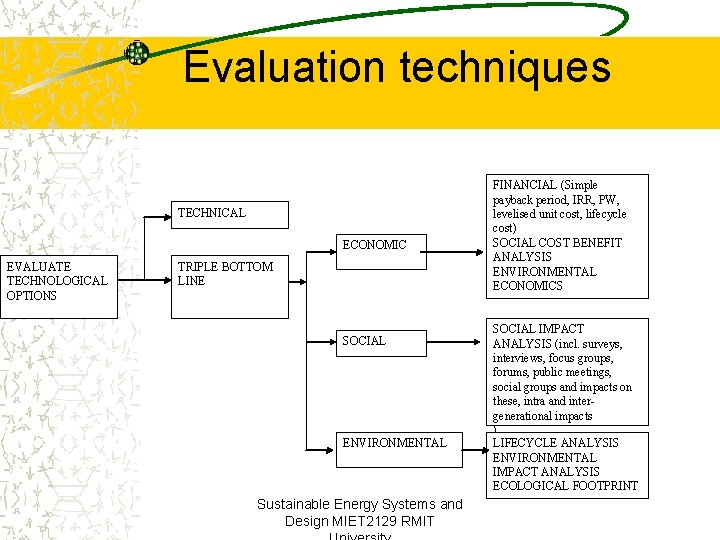
Evaluation techniques TECHNICAL ECONOMIC EVALUATE TECHNOLOGICAL OPTIONS TRIPLE BOTTOM LINE SOCIAL ENVIRONMENTAL Sustainable Energy Systems and Design MIET 2129 RMIT FINANCIAL (Simple payback period, IRR, PW, levelised unit cost, lifecycle cost) SOCIAL COST BENEFIT ANALYSIS ENVIRONMENTAL ECONOMICS SOCIAL IMPACT ANALYSIS (incl. surveys, interviews, focus groups, forums, public meetings, social groups and impacts on these, intra and intergenerational impacts ) LIFECYCLE ANALYSIS ENVIRONMENTAL IMPACT ANALYSIS ECOLOGICAL FOOTPRINT
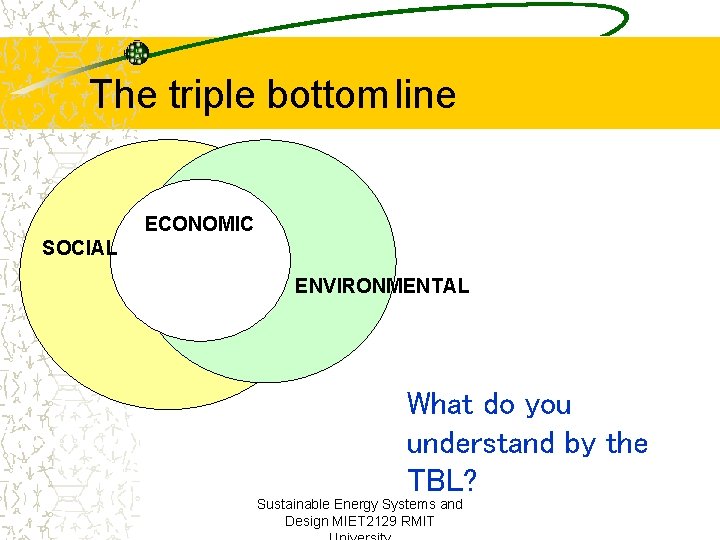
The triple bottom line ECONOMIC SOCIAL ENVIRONMENTAL What do you understand by the TBL? Sustainable Energy Systems and Design MIET 2129 RMIT
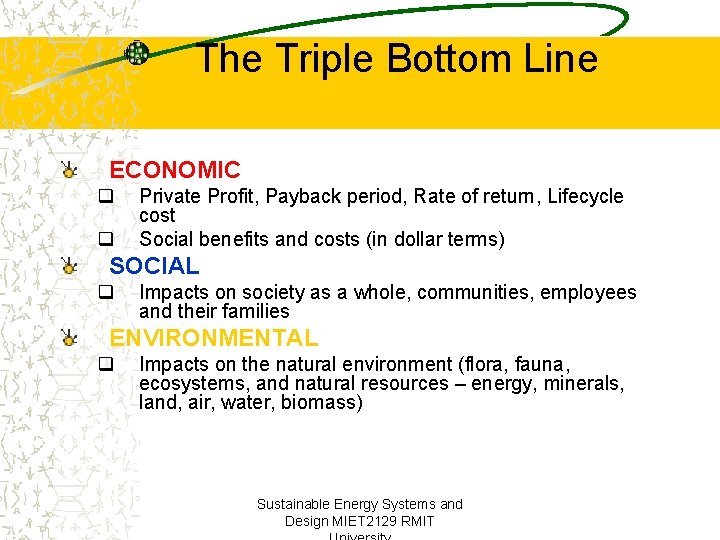
The Triple Bottom Line ECONOMIC q q Private Profit, Payback period, Rate of return, Lifecycle cost Social benefits and costs (in dollar terms) SOCIAL q Impacts on society as a whole, communities, employees and their families ENVIRONMENTAL q Impacts on the natural environment (flora, fauna, ecosystems, and natural resources – energy, minerals, land, air, water, biomass) Sustainable Energy Systems and Design MIET 2129 RMIT
Financial and economic analysis Simple payback period Discounting Present worth Internal rate of return Lifecycle costing Sustainable Energy Systems and Design MIET 2129 RMIT
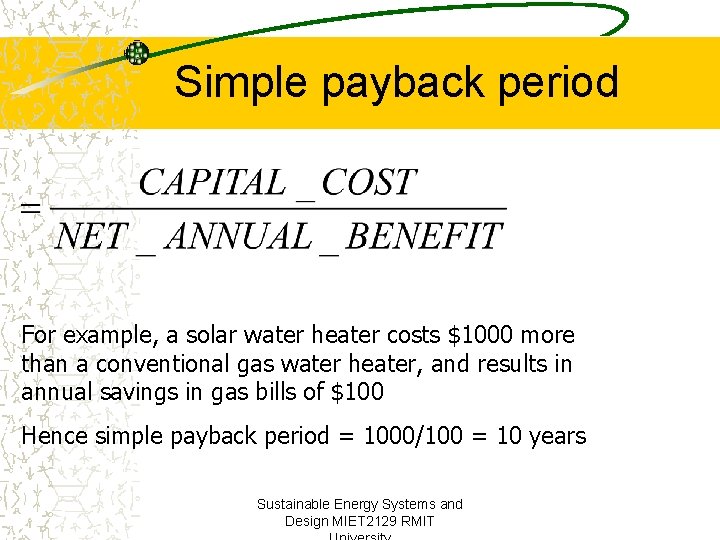
Simple payback period For example, a solar water heater costs $1000 more than a conventional gas water heater, and results in annual savings in gas bills of $100 Hence simple payback period = 1000/100 = 10 years Sustainable Energy Systems and Design MIET 2129 RMIT
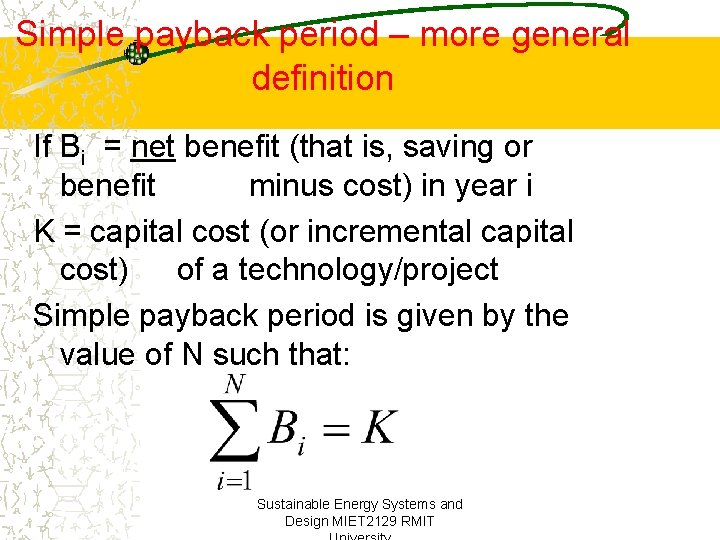
Simple payback period – more general definition If Bi = net benefit (that is, saving or benefit minus cost) in year i K = capital cost (or incremental capital cost) of a technology/project Simple payback period is given by the value of N such that: Sustainable Energy Systems and Design MIET 2129 RMIT
Discounting Having money in your pocket now is worth more than gaining the same amount of money at some time in the future Paying a bill at some time in the future is better for you financially than paying it now DISCOUNTING is the method used in economics and finance to convert future benefits and costs to PRESENT VALUES Sustainable Energy Systems and Design MIET 2129 RMIT
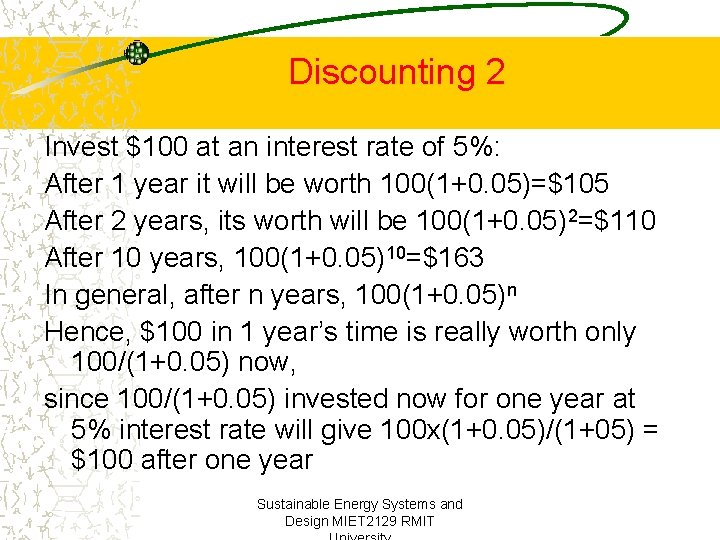
Discounting 2 Invest $100 at an interest rate of 5%: After 1 year it will be worth 100(1+0. 05)=$105 After 2 years, its worth will be 100(1+0. 05)2=$110 After 10 years, 100(1+0. 05)10=$163 In general, after n years, 100(1+0. 05)n Hence, $100 in 1 year’s time is really worth only 100/(1+0. 05) now, since 100/(1+0. 05) invested now for one year at 5% interest rate will give 100 x(1+0. 05)/(1+05) = $100 after one year Sustainable Energy Systems and Design MIET 2129 RMIT
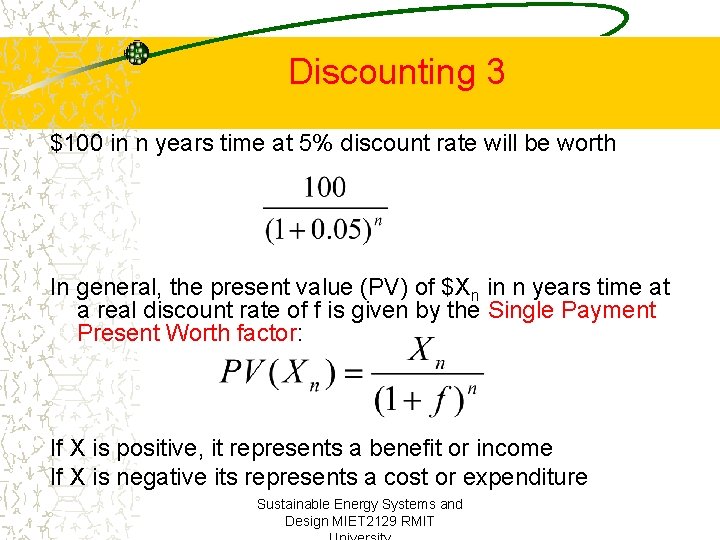
Discounting 3 $100 in n years time at 5% discount rate will be worth In general, the present value (PV) of $Xn in n years time at a real discount rate of f is given by the Single Payment Present Worth factor: If X is positive, it represents a benefit or income If X is negative its represents a cost or expenditure Sustainable Energy Systems and Design MIET 2129 RMIT
Discounting 4 Note: Discounting is NOT the same thing as allowing for inflation Work with constant $ values, e. g. $A(2017), that is, all costs and benefits expressed in terms of dollar values as in 2017, and real discount rates and you don’t need to worry about inflation Sustainable Energy Systems and Design MIET 2129 RMIT
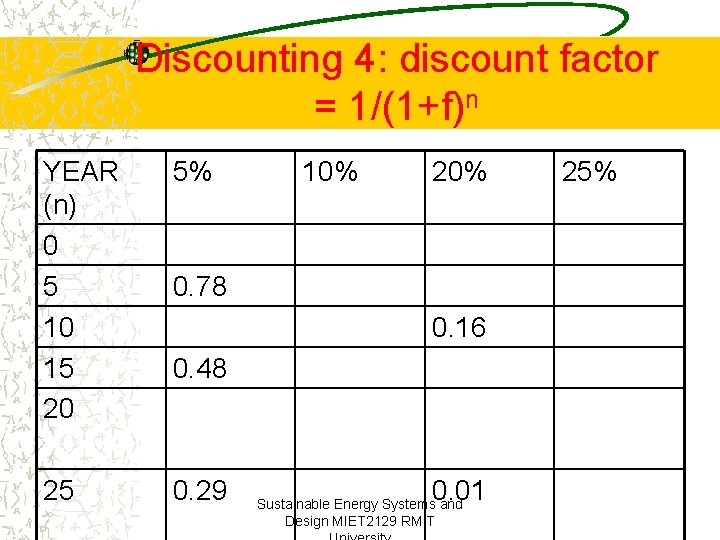
Discounting 4: discount factor = 1/(1+f)n YEAR (n) 0 5 10 15 20 5% 25 0. 29 10% 20% 0. 78 0. 16 0. 48 0. 01 Sustainable Energy Systems and Design MIET 2129 RMIT 25%
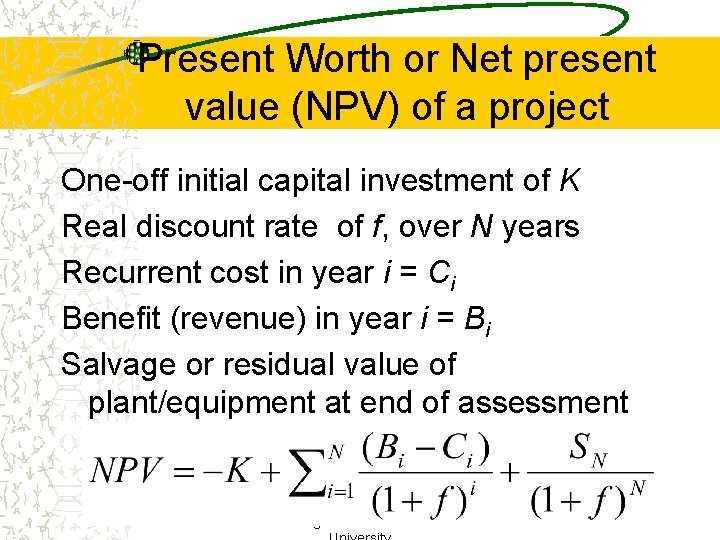
Present Worth or Net present value (NPV) of a project One-off initial capital investment of K Real discount rate of f, over N years Recurrent cost in year i = Ci Benefit (revenue) in year i = Bi Salvage or residual value of plant/equipment at end of assessment period = SN Sustainable Energy Systems and Design MIET 2129 RMIT
Present Worth (or NPV) Residual/salvage value: Positive if can sell equipment at end of year N Negative if have to pay to dispose of or clean up wastes Take care to get signs right in Class Exercise! Normally a project should show a positive NPV if it is to get the go-ahead The higher the NPV the more economically attractive the project is. Sustainable Energy Systems and Design MIET 2129 RMIT
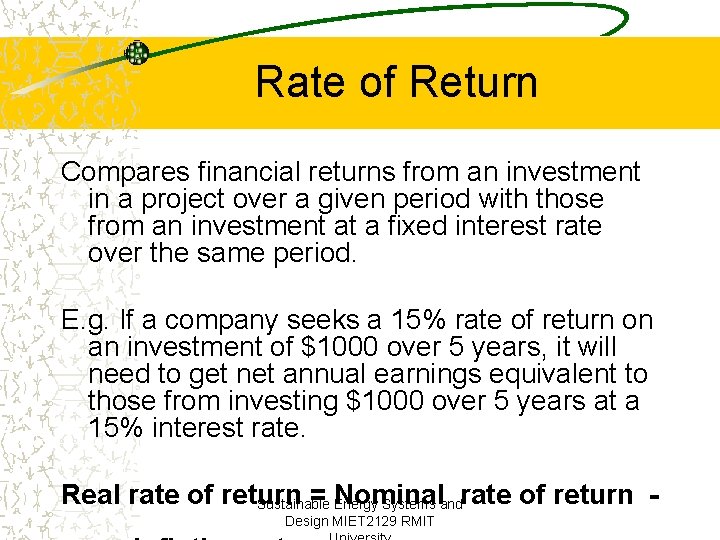
Rate of Return Compares financial returns from an investment in a project over a given period with those from an investment at a fixed interest rate over the same period. E. g. If a company seeks a 15% rate of return on an investment of $1000 over 5 years, it will need to get net annual earnings equivalent to those from investing $1000 over 5 years at a 15% interest rate. Real rate of return = Energy Nominal Sustainable Systems andrate of return Design MIET 2129 RMIT
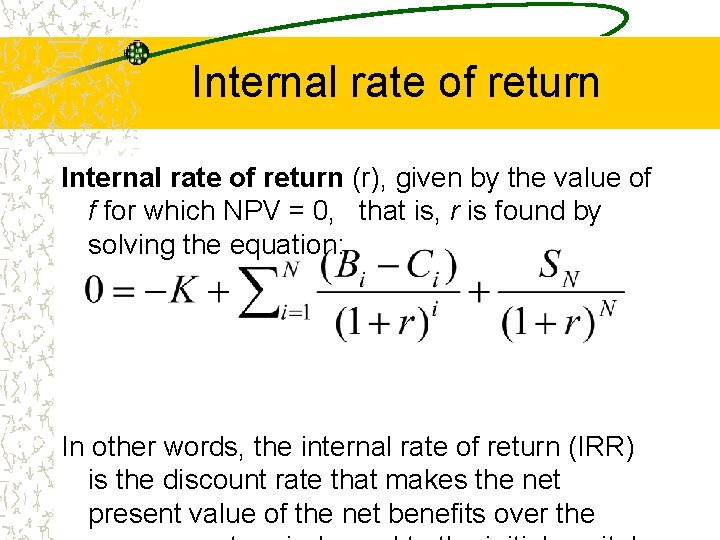
Internal rate of return (r), given by the value of f for which NPV = 0, that is, r is found by solving the equation: In other words, the internal rate of return (IRR) is the discount rate that makes the net Energy Systems and present value. Sustainable of. Design the. MIET 2129 net benefits over the RMIT
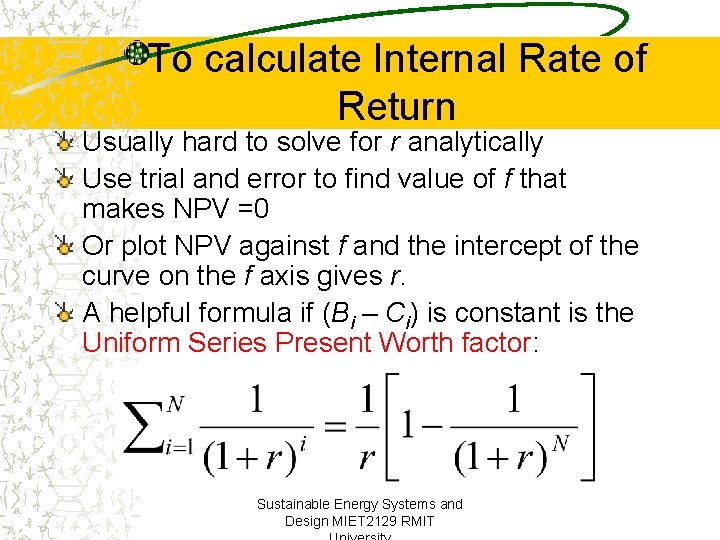
To calculate Internal Rate of Return Usually hard to solve for r analytically Use trial and error to find value of f that makes NPV =0 Or plot NPV against f and the intercept of the curve on the f axis gives r. A helpful formula if (Bi – Ci) is constant is the Uniform Series Present Worth factor: Sustainable Energy Systems and Design MIET 2129 RMIT
IRR methods 1. Excel spreadsheet + formulae Write PW = Formulae for component terms in spreadsheet keep discount rate f a variable in formulae, with value defined in a particular cell Iterate f (or use Solver) until PW=0 to desired level of accuracy IRR = value. Sustainable of that makes PW=0 Energy Systems and Design MIET 2129 RMIT
IRR methods 2. Excel spreadsheet: cash flow by year List costs and benefits in each year (0 – 20) Use Single Payment Present Worth factor to convert net benefit in each year to present values (keep f a variable in formulae, defined in a particular cell) Sum series of annual present values Iterate f (or use Solver) until sum annual present values=0 to desired level of accuracy Sustainable Energy Systems and Design MIET 2129 RMIT
IRR methods 3. Excel spreadsheet: graph List costs and benefits in each year (0 – 20) Use Single Payment Present Worth factor to convert net benefit in each year to present values (keep f a variable in formulae, defined in a particular cell) Sum series of annual present values to get PW Repeat for a few values of f Plot PW(f) vs f and find value of f that gives Sustainable Energy Systems and PW=0 (intercept of f-axis) Design MIET 2129 RMIT
IRR and payback period A technology paid for by a single capital payment at the beginning of its operational lifetime and yielding equal annual net benefits has a simple payback period of two years. Assuming the annual benefits keep accruing over each year, what is the internal rate of return of the technology over (a) 5 years, (b) 10 Sustainable years. Energy Systems and Design MIET 2129 RMIT
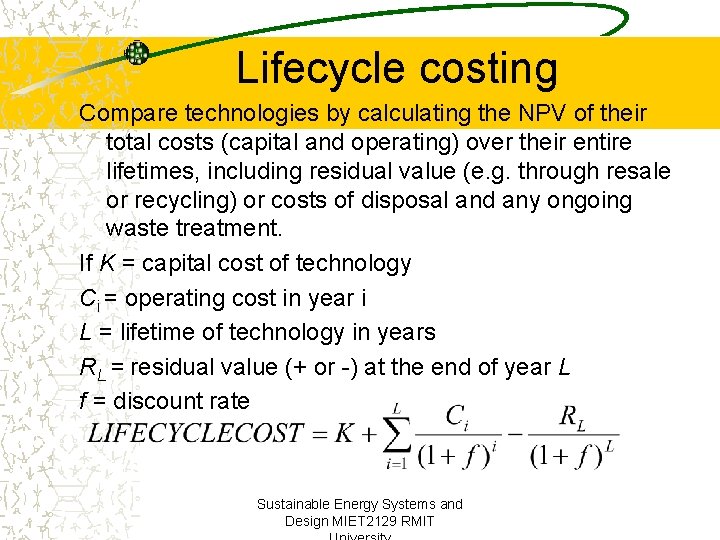
Lifecycle costing Compare technologies by calculating the NPV of their total costs (capital and operating) over their entire lifetimes, including residual value (e. g. through resale or recycling) or costs of disposal and any ongoing waste treatment. If K = capital cost of technology Ci = operating cost in year i L = lifetime of technology in years RL = residual value (+ or -) at the end of year L f = discount rate Sustainable Energy Systems and Design MIET 2129 RMIT
Your examples Biomimicry Constructive Technology Assessment Industrial Ecology Design for Environment TBL Other? Sustainable Energy Systems and Design MIET 2129 RMIT
Biomim egs Sustainable Energy Systems and Design MIET 2129 RMIT
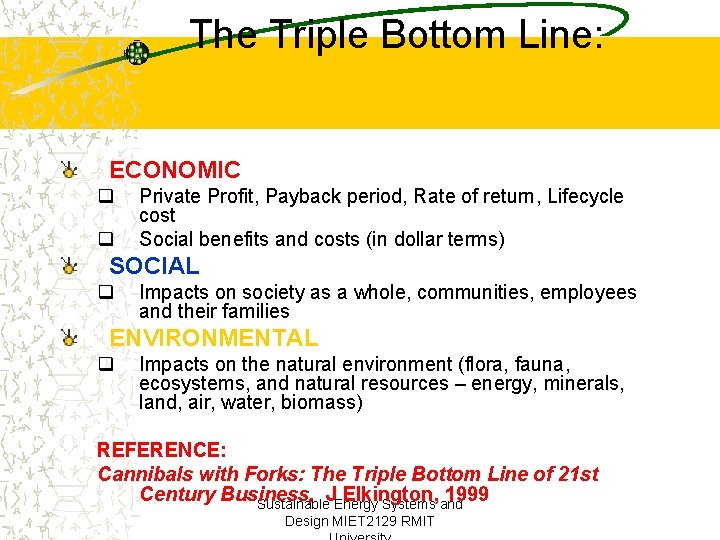
The Triple Bottom Line: ECONOMIC q q Private Profit, Payback period, Rate of return, Lifecycle cost Social benefits and costs (in dollar terms) SOCIAL q Impacts on society as a whole, communities, employees and their families ENVIRONMENTAL q Impacts on the natural environment (flora, fauna, ecosystems, and natural resources – energy, minerals, land, air, water, biomass) REFERENCE: Cannibals with Forks: The Triple Bottom Line of 21 st Century Business, J Elkington, 1999 Sustainable Energy Systems and Design MIET 2129 RMIT
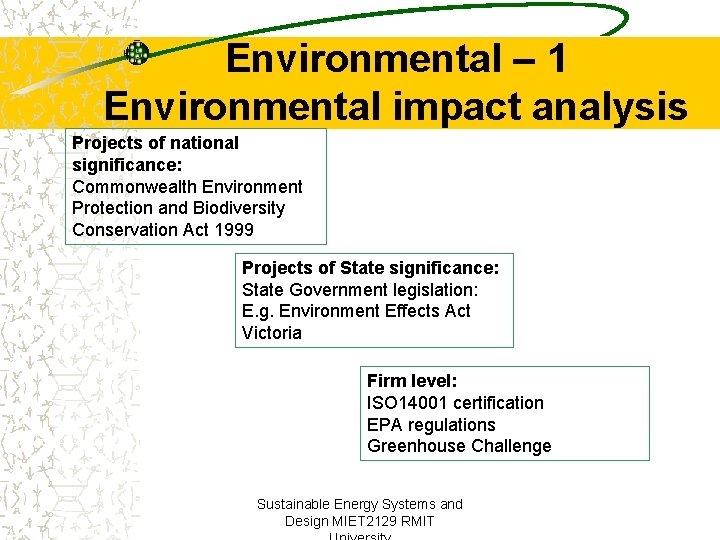
Environmental – 1 Environmental impact analysis Projects of national significance: Commonwealth Environment Protection and Biodiversity Conservation Act 1999 Projects of State significance: State Government legislation: E. g. Environment Effects Act Victoria Firm level: ISO 14001 certification EPA regulations Greenhouse Challenge Sustainable Energy Systems and Design MIET 2129 RMIT
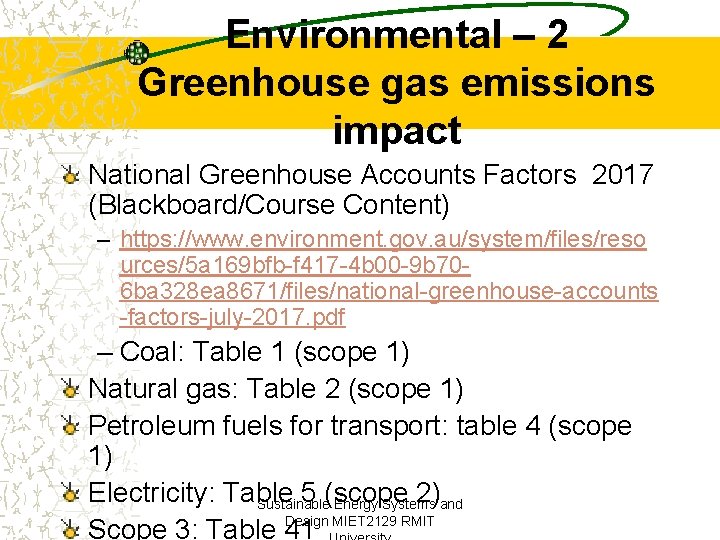
Environmental – 2 Greenhouse gas emissions impact National Greenhouse Accounts Factors 2017 (Blackboard/Course Content) – https: //www. environment. gov. au/system/files/reso urces/5 a 169 bfb-f 417 -4 b 00 -9 b 706 ba 328 ea 8671/files/national-greenhouse-accounts -factors-july-2017. pdf – Coal: Table 1 (scope 1) Natural gas: Table 2 (scope 1) Petroleum fuels for transport: table 4 (scope 1) Electricity: Table 5 (scope 2) Sustainable Energy Systems and Design MIET 2129 RMIT Scope 3: Table 41
NGA Factors 2015: Scope 1 emissions: – Direct (or point-source) emission factors – kilograms of carbon dioxide equivalent (CO 2 -e) emitted per unit of activity at the point of emission release (i. e. fuel use, energy use, manufacturing process activity, mining activity, on-site waste disposal, etc. ). Scope 2 emissions: – Indirect emission factors – Calculate kilograms of CO 2 -e per unit of electricity consumed by an organisation – Emissions produced by the burning of fuels (coal, natural gas, etc. ) at power station. Scope 3 emissions: – indirect emissions attributable to the extraction, production and transport of fuels to point of consumption – indirect emissions from the extraction, production and transport of fuel burned at power stations – indirect emissions attributable to the electricity lost in delivery in the transmission and distribution network. Sustainable Energy Systems and Use scope 1 + 2, or scope 2 + 3 factors in your project reports Design MIET 2129 RMIT
Environmental – 2 Life Cycle Assessment LCA lectures, weeks 6 and 7. Sustainable Energy Systems and Design MIET 2129 RMIT
Social: – Identify relevant social goups – How are they affected? – What are their interests, and how do these impact on design and implementation of a project/technology NB: Do not just talk about the impact alone, without mentioning the group(s) of people causing it, and the group(s) affected by it! Sustainable Energy Systems and Design MIET 2129 RMIT
Sustainable Energy Systems and Design MIET 2129 RMIT
Processes for social impact analysis No formal requirement for SIA as such. Usually covered at Federal and State level by issue/project specific processes, such as: • • • Health impact studies Employment impact studies Government Commissions of inquiry (e. g. current building industry inquiry) Parliamentary Committee inquiries (e. g. Senate inquiry into treatment of refugees) Inquiries by Government agencies (e. g. Productivity Commission report on gambling) Studies of impacts on indigenous people Also federal and state environmental impact legislation requires impacts of projects on the social environment to be considered Sustainable Energy Systems and Design MIET 2129 RMIT
METHODS OF ASSESSING SOCIAL IMPACTS Quantitative Social benefit-cost analysis Census Surveys Qualitative Interviews Focus groups Community/consultative meetings/forums Case studies Field research Comparative cross-cultural/historical research Sustainable Energy Systems and Design MIET 2129 RMIT
Social impacts - examples Employment – number, type of jobs, location, job satisfaction Distribution of costs and benefits OH&S Health and well-being generally – individual/community Noise, vibration Aesthetic – ‘visual pollution, scenic degradation Impacts on users (behaviour, convenience, acceptance…) Sustainable Energy Systems and Relocation… Design MIET 2129 RMIT
Start from here in week 3 Start with IRR for payback = 2 y over 5 and 10 years. From fin eval spreadsheet, worksheet 2 Sustainable Energy Systems and Design MIET 2129 RMIT
TBL Assessment: Case study Solar hydrogen systems for remote area power supply Sustainable Energy Systems and Design MIET 2129 RMIT
A basic stand-alone PV-hydrogen RAPS system Sustainable Energy Systems and Design MIET 2129 RMIT
Competing options PV array + battery storage Diesel generator + battery storage PV array + diesel generator + battery storage Solar – hydrogen energy system Sustainable Energy Systems and Design MIET 2129 RMIT
TBL evaluation criteria Economic – average unit cost of electricity energy supplied taking into account full lifecyle cost of each component – 5% real discount rate Environmental – Greenhouse gas emissions (in operation) – LCA of whole system (including components) [useful, but not done here] Sustainable Energy Systems and Design MIET 2129 RMIT
TBL criteria - continued Social – Level of service provided, including reliability – User attitudes and experience – Safety, including regulations and standards Sustainable Energy Systems and Design MIET 2129 RMIT
Economic evaluation Input data/ assumptions Sustainable Energy Systems and Design MIET 2129 RMIT
Economic evaluation - 2 Sustainable Energy Systems and Design MIET 2129 RMIT
Environmental evaluation Sustainable Energy Systems and Design MIET 2129 RMIT
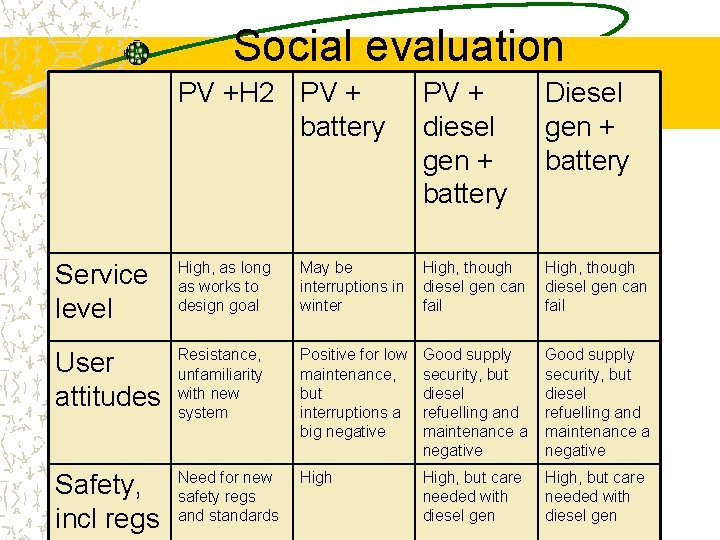
Social evaluation PV +H 2 PV + battery PV + diesel gen + battery Diesel gen + battery Service level High, as long as works to design goal May be interruptions in winter High, though diesel gen can fail User attitudes Resistance, unfamiliarity with new system Positive for low maintenance, but interruptions a big negative Good supply security, but diesel refuelling and maintenance a negative Safety, incl regs Need for new High, but care safety regs Sustainable Energy Systems needed with and standards Design MIET 2129 RMIT diesel gen High, but care needed with diesel gen
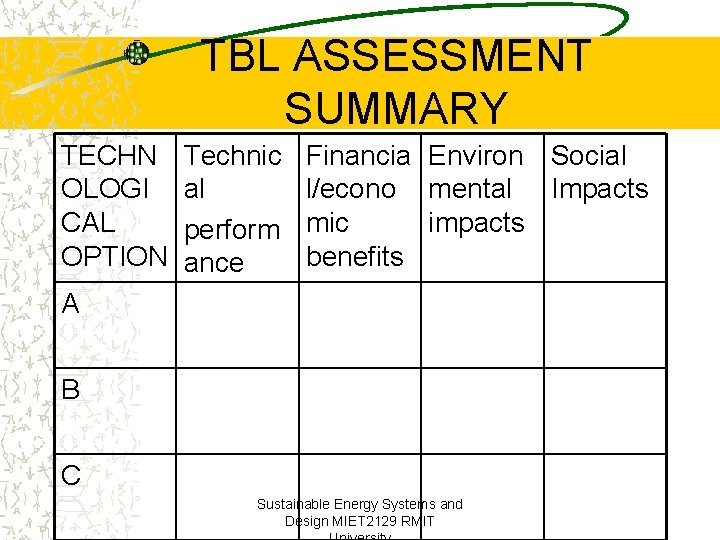
TBL ASSESSMENT SUMMARY TECHN OLOGI CAL OPTION Technic al perform ance Financia Environ Social l/econo mental Impacts mic impacts benefits A B C Sustainable Energy Systems and Design MIET 2129 RMIT
TBL ASSESSMENT SUMMARY – Solar H 2 system case study Sustainable Energy Systems and Design MIET 2129 RMIT
Conclusions Weigh up evaluations on all three criteria Recommend a preferred option if a clear preference is evident Sustainable Energy Systems and Design MIET 2129 RMITwith SGSP Low-temperature Multi-Effect Evaporation Desalination Systems coupled
Food providers See week 1 presn Sustainable Energy Systems and Design MIET 2129 RMIT
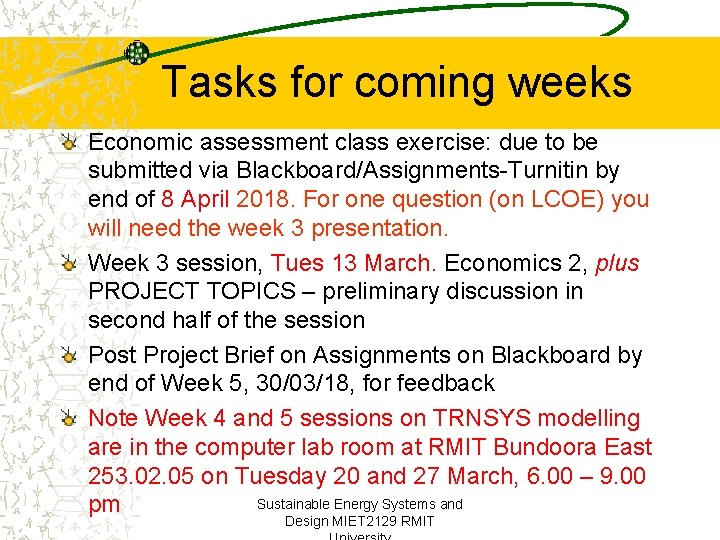
Tasks for coming weeks Economic assessment class exercise: due to be submitted via Blackboard/Assignments-Turnitin by end of 8 April 2018. For one question (on LCOE) you will need the week 3 presentation. Week 3 session, Tues 13 March. Economics 2, plus PROJECT TOPICS – preliminary discussion in second half of the session Post Project Brief on Assignments on Blackboard by end of Week 5, 30/03/18, for feedback Note Week 4 and 5 sessions on TRNSYS modelling are in the computer lab room at RMIT Bundoora East 253. 02. 05 on Tuesday 20 and 27 March, 6. 00 – 9. 00 Sustainable Energy Systems and pm Design MIET 2129 RMIT
- Slides: 50