
Master Gardener Safety Training EHS Office Agriculture Natural
- Slides: 20
Master Gardener Safety Training EH&S Office Agriculture & Natural Resources March 2012
Reasons for Safety Program Prevent Injuries and Illnesses ¬ Meet UC Policy Requirements ¬ Meet Master Gardener Administrative Handbook Requirements ¬ Respond to Master Gardener Safety Survey ¬ Reduce Incidents and Claims for Injury/Damage ¬ 2
Policies The University of California (UC) is committed to achieving excellence in providing a healthy and safe working environment, and to supporting environmentally sound practices in the conduct of UC activities. It is UC policy to comply with all applicable health, safety, and environmental protection laws, regulations and requirements. To meet this standard of excellence, UC implements management initiatives and best practices to systematically integrate health, safety, and environmental considerations and sustainable use of natural resources into all activities. All UC activities are to be conducted in a manner that ensures the protection of students, faculty, staff, visitors, the public, property, and the environment. UC’s goal is to prevent all workplace injuries and illnesses, environmental incidents, and property losses or damage. Achieving this goal is the responsibility of every member of the UC community. Supervisors have particular responsibility for the activities of those people who report to them. 3
Policies Master Gardener Program, Administrative Handbook (Chapter Five, Section XV) « « « Every employee or volunteer has the responsibility to follow safety rules and procedures and to help identify and correct potentially hazardous conditions. Consider the potentially hazardous conditions and steps to take to prevent injury or illness. Proper training and equipment to perform the task safely. 4
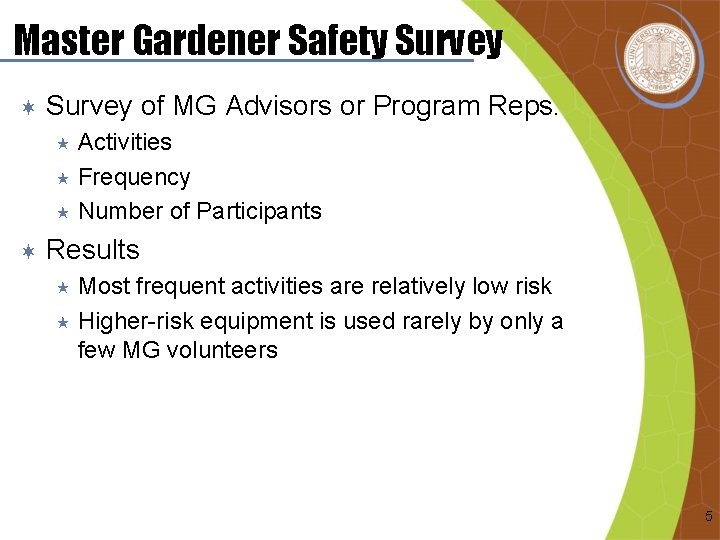
Master Gardener Safety Survey ¬ Survey of MG Advisors or Program Reps. Activities « Frequency « Number of Participants « ¬ Results Most frequent activities are relatively low risk « Higher-risk equipment is used rarely by only a few MG volunteers « 5
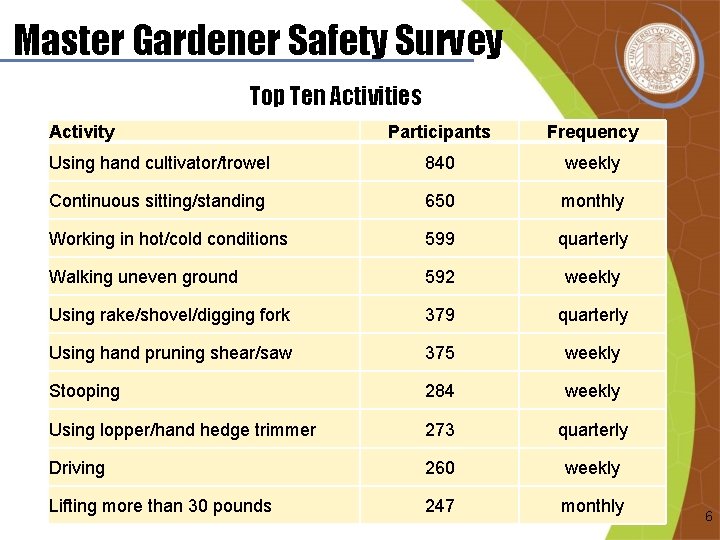
Master Gardener Safety Survey Top Ten Activities Activity Participants Frequency Using hand cultivator/trowel 840 weekly Continuous sitting/standing 650 monthly Working in hot/cold conditions 599 quarterly Walking uneven ground 592 weekly Using rake/shovel/digging fork 379 quarterly Using hand pruning shear/saw 375 weekly Stooping 284 weekly Using lopper/hand hedge trimmer 273 quarterly Driving 260 weekly Lifting more than 30 pounds 247 monthly 6
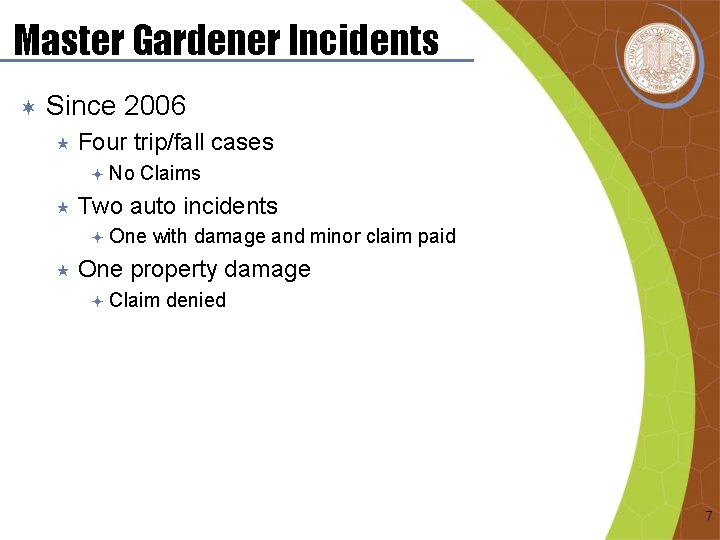
Master Gardener Incidents ¬ Since 2006 « Four trip/fall cases ª No « Claims Two auto incidents ª One « with damage and minor claim paid One property damage ª Claim denied 7
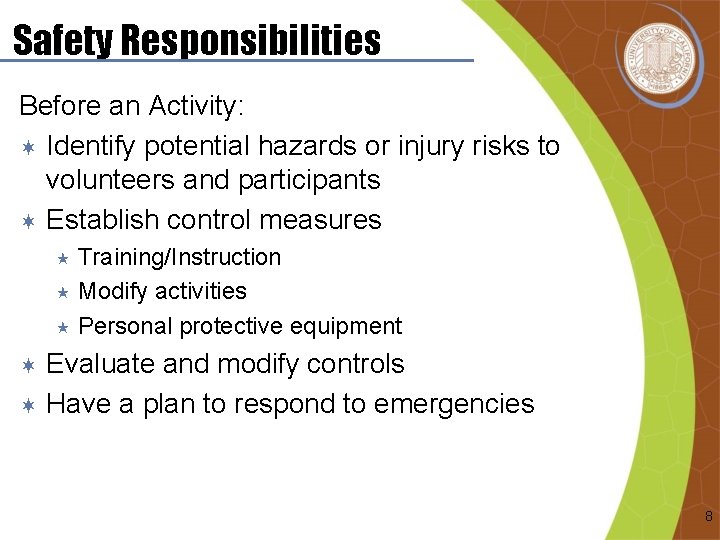
Safety Responsibilities Before an Activity: ¬ Identify potential hazards or injury risks to volunteers and participants ¬ Establish control measures Training/Instruction « Modify activities « Personal protective equipment « Evaluate and modify controls ¬ Have a plan to respond to emergencies ¬ 8
Safety Resources MG Safety Manual ¬ MG Thinking Safe & Green Notes ¬ ANR EH&S ¬ Additional Training materials « Videos « http: //safety/ucanr. edu « 9
Training Use your knowledge & experience ¬ Consult operator manuals ¬ Written materials ¬ Thinking Safe & Green Notes « Pest Notes « Safety videos ¬ Other expertise ¬ 10
Pesticide Safety Definition Of A Pesticide: A pesticide is any material (natural, organic, or synthetic) used to control, prevent, kill, suppress, or repel pests. ¬ Pesticides are designed to be toxic to the pests they target such as insects and weeds. ¬ Pesticides can be harmful to humans if used incorrectly and/or not using proper Personal Protective Equipment (PPE). 11
Pesticide Safety ¬ Personal Protective Equipment (PPE) Long-sleeved shirts and long pants « Eye protection « Chemical-resistant gloves « Closed-toed shoes « Other as directed by label « ¬ Environmental Considerations Avoid runoff to storm drains « Do not apply when windy or rain forecast « For indoor applications, avoid food preparation or storage areas, sinks or drains or areas that will be mopped with water. « 12
Pesticide Safety ¬ Personal Hygiene Always wash with soap and water after handling pesticides « Do not eat, drink, smoke, or put your fingers to the mouth when using pesticides « Wash contaminated clothes and gloves in loads separate from other clothes « ¬ Restricted Entry Intervals Most home use products do not have a restricted entry requirement « Posting and entry restrictions apply to materials that require professional application by a Qualified Applicator « 13
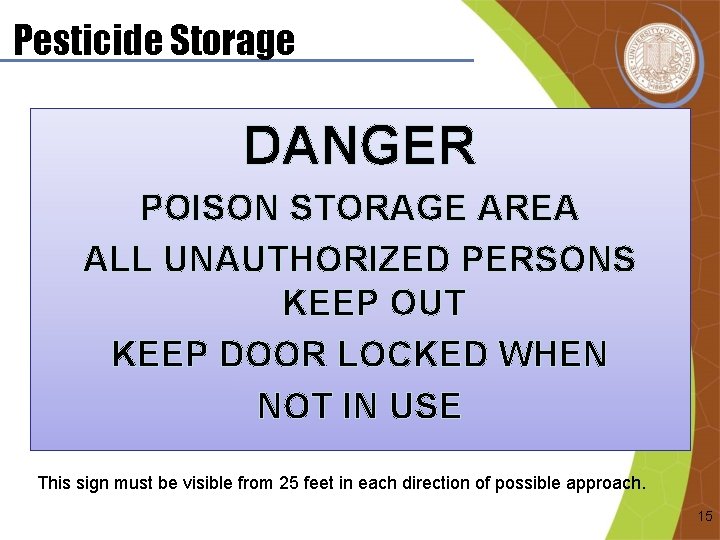
Pesticide Safety ¬ Use and Storage Keep products capped, and place in a locked cabinet « Keep pesticides in their original containers with label attached « Maintain an inventory of pesticide products – review annually to dispose of unwanted or expired materials « Be aware of emergency procedures « No posting is required for products labeled “Caution”, however products labeled “Warning” or “Danger” require posting with the following: « 14
Pesticide Storage DANGER POISON STORAGE AREA ALL UNAUTHORIZED PERSONS KEEP OUT KEEP DOOR LOCKED WHEN NOT IN USE This sign must be visible from 25 feet in each direction of possible approach. 15
Pesticide Safety ¬ Pesticide Disposal Apply excess diluted or mixed pesticides to plants or sites as listed on the label « Empty containers may be disposed in regular trash or recycled « Empty spray tanks should be triple rinsed and rinseate used on site in accordance with label « Leftover diluted or concentrated pesticides may be disposed as Household Hazardous Waste « ª See your local landfill or County Environmental Health Department for information 16
Insurance Coverage • • • UC insurance program provides secondary automobile liability coverage. Volunteer’s insurance provides primary coverage. Minimum vehicle insurance coverage shall be $50, 000/$100, 000/$50, 000: o For personal injury to death of one person. o For personal injury to death of two or more persons. o Property damage. UC has arranged for limited accident coverage through The Hartford insurance company for incidents that occur when taking part in MG activities. 17
Exercise ¬ Split into four groups General Physical Hazards « Power and Hand Tools « Ergonomics « Planning for Safety/Emergency Response « Develop 5 minute safety briefing on an activity common for Master Gardeners ¬ Use Thinking Safe & Green Notes and your knowledge/experience to outline: ¬ Potential hazards « Mitigation measures « Response procedures « 18
Exercise ¬ General Physical Hazards « ¬ Power and Hand Tools « ¬ Use Notes: 2, 5, 6, 13, 14 Ergonomics « ¬ Use Notes: 3, 7, 8, 15, 17, 18 Use Notes: 9, 19, 20, 21 Planning for Safety/Emergency Response « Use Notes: 1, 16, 22, 23 19
For More Information ANR EH&S Website: http: //ucanr. edu/mgsafety ¬ Submit a question: http: //ucanr. edu/askehs ¬ Contact us: Mark Barros: mjbarros@ucdavis. edu or 530 -750 -1262 Brian Oatman: baoatman@ucanr. edu or 530 -750 -1264 ¬ 20