
Master Degree in Physics of Data Marco Zanetti
- Slides: 19
Master Degree in Physics of Data Marco Zanetti, University of Padua and INFN 1
The project in a nutshell • A Master Degree (2 years) aiming at combine the classic competences of a Physicist with those of a Data Scientist • Twofold training goal – Match the job market requests – Provide physicists with tools to effectively tackle modern science challenges • A chance for us too to consolidate and formalize a research line • The project is approved, first classes starting in October! 2
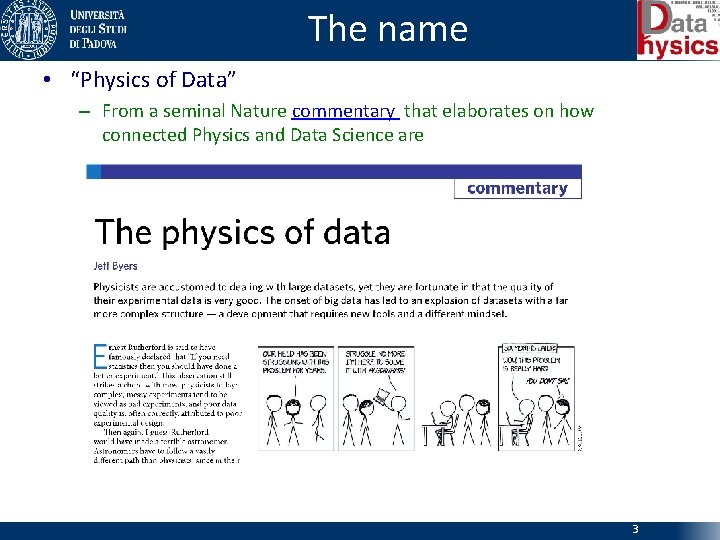
The name • “Physics of Data” – From a seminal Nature commentary that elaborates on how connected Physics and Data Science are 3
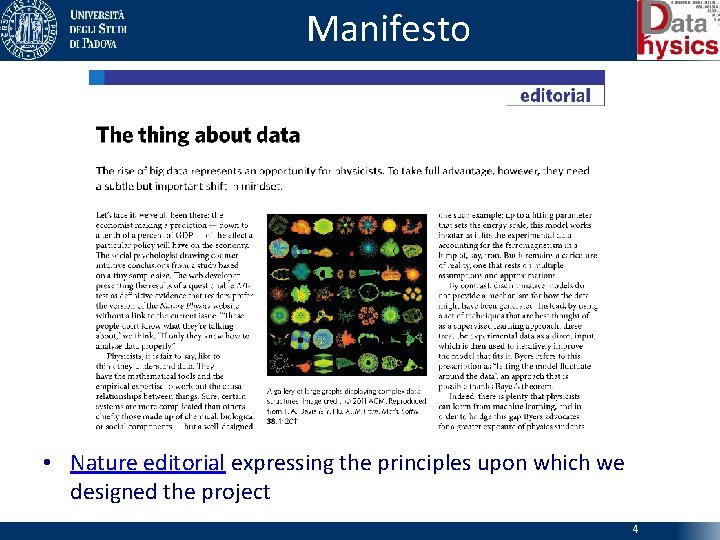
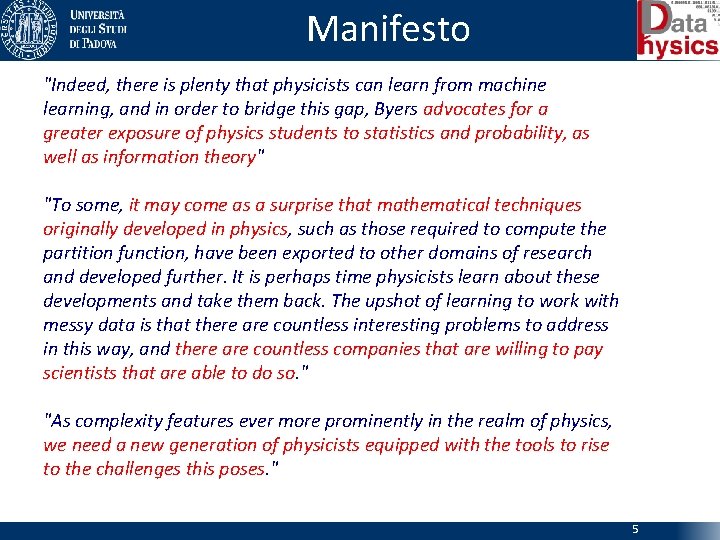
Manifesto • Nature editorial expressing the principles upon which we designed the project 4
Manifesto "Indeed, there is plenty that physicists can learn from machine learning, and in order to bridge this gap, Byers advocates for a greater exposure of physics students to statistics and probability, as well as information theory" "To some, it may come as a surprise that mathematical techniques originally developed in physics, such as those required to compute the partition function, have been exported to other domains of research and developed further. It is perhaps time physicists learn about these developments and take them back. The upshot of learning to work with messy data is that there are countless interesting problems to address in this way, and there are countless companies that are willing to pay scientists that are able to do so. " "As complexity features ever more prominently in the realm of physics, we need a new generation of physicists equipped with the tools to rise to the challenges this poses. " 5
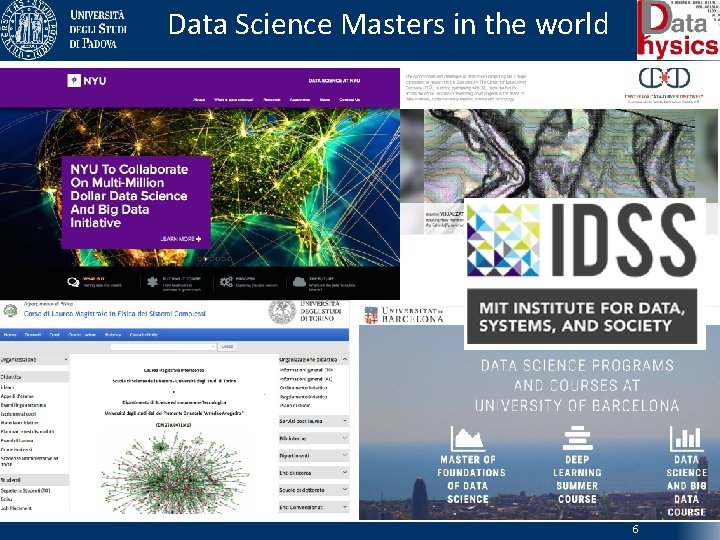
Data Science Masters in the world 6
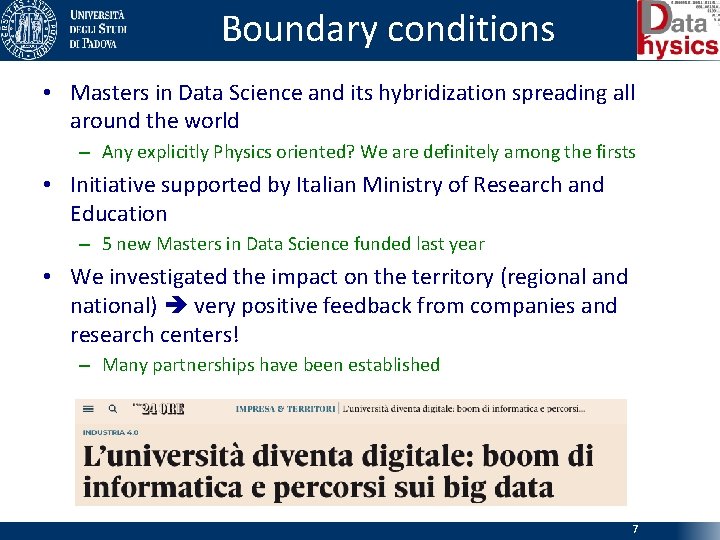
Boundary conditions • Masters in Data Science and its hybridization spreading all around the world – Any explicitly Physics oriented? We are definitely among the firsts • Initiative supported by Italian Ministry of Research and Education – 5 new Masters in Data Science funded last year • We investigated the impact on the territory (regional and national) very positive feedback from companies and research centers! – Many partnerships have been established 7
Generalities • Classes are in English • Admission – Max 40 students (30 EU + 10 non EU) – Bachelor in Physics or sufficient credits in Physics subjects • Physics labs and theory up to QM and Special Relativity • Mandatory internship in a private company or research institute • Close collaboration with related masters (“Physics”, “Computer Science” and “Data Science”) 8
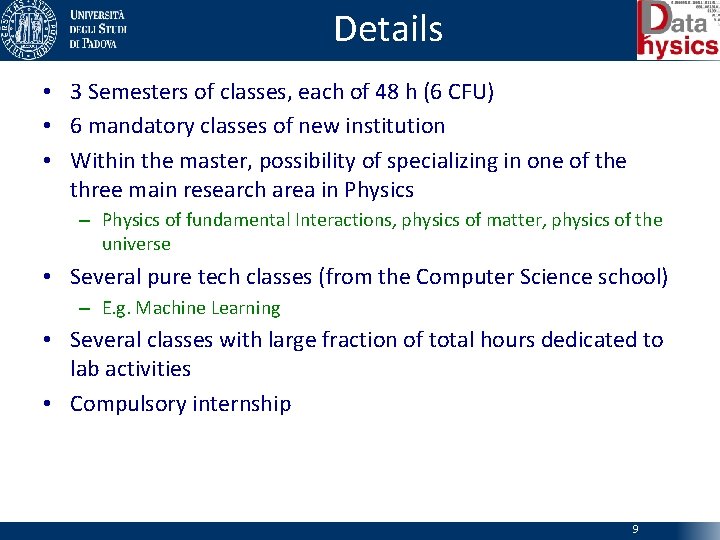
Details • 3 Semesters of classes, each of 48 h (6 CFU) • 6 mandatory classes of new institution • Within the master, possibility of specializing in one of the three main research area in Physics – Physics of fundamental Interactions, physics of matter, physics of the universe • Several pure tech classes (from the Computer Science school) – E. g. Machine Learning • Several classes with large fraction of total hours dedicated to lab activities • Compulsory internship 9
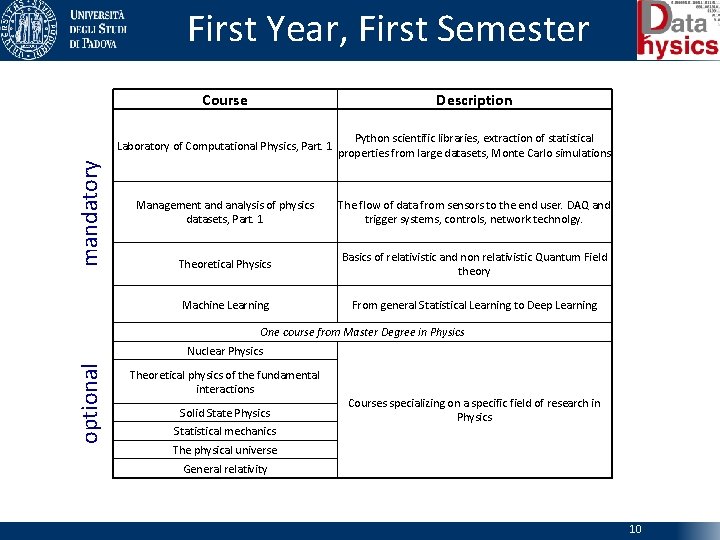
mandatory First Year, First Semester Course Description Laboratory of Computational Physics, Part. 1 Python scientific libraries, extraction of statistical properties from large datasets, Monte Carlo simulations Management and analysis of physics datasets, Part. 1 The flow of data from sensors to the end user. DAQ and trigger systems, controls, network technolgy. Theoretical Physics Basics of relativistic and non relativistic Quantum Field theory Machine Learning From general Statistical Learning to Deep Learning One course from Master Degree in Physics optional Nuclear Physics Theoretical physics of the fundamental interactions Solid State Physics Statistical mechanics Courses specializing on a specific field of research in Physics The physical universe General relativity 10
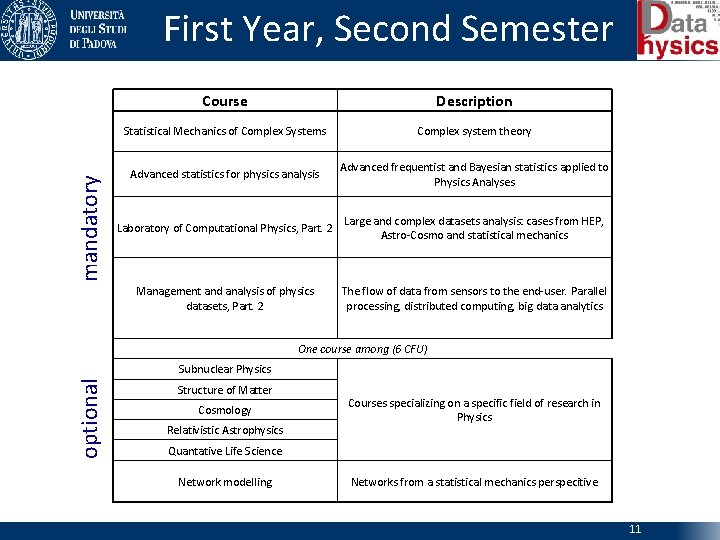
mandatory First Year, Second Semester Course Description Statistical Mechanics of Complex Systems Complex system theory Advanced statistics for physics analysis Advanced frequentist and Bayesian statistics applied to Physics Analyses Laboratory of Computational Physics, Part. 2 Large and complex datasets analysis: cases from HEP, Astro-Cosmo and statistical mechanics Management and analysis of physics datasets, Part. 2 The flow of data from sensors to the end-user. Parallel processing, distributed computing, big data analytics One course among (6 CFU) optional Subnuclear Physics Structure of Matter Cosmology Relativistic Astrophysics Courses specializing on a specific field of research in Physics Quantative Life Science Network modelling Networks from a statistical mechanics perspecitive 11
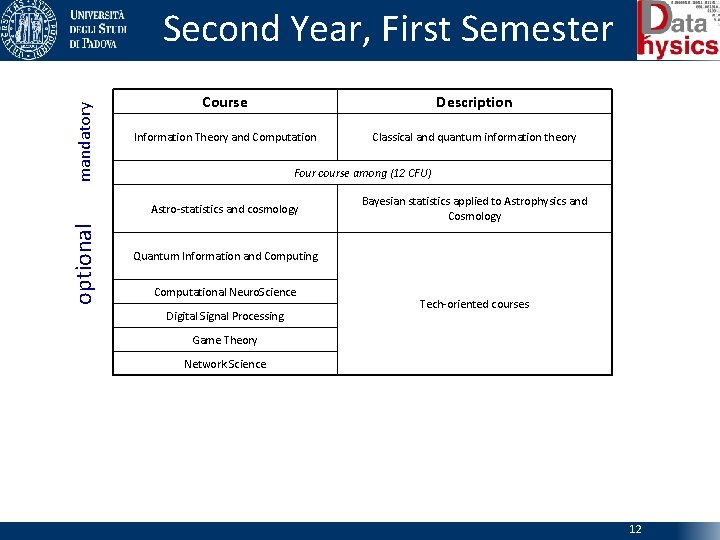
mandatory Second Year, First Semester Course Description Information Theory and Computation Classical and quantum information theory Four course among (12 CFU) optional Astro-statistics and cosmology Bayesian statistics applied to Astrophysics and Cosmology Quantum Information and Computing Computational Neuro. Science Digital Signal Processing Tech-oriented courses Game Theory Network Science 12
Lab of Computational Physics • Laboratory for Computational Physics, targeting the learning and practicing of modern techniques for data analysis and processing • 2 parts, on two semesters, 98 h total • Part 1: – Python ecosystem of scientific libraries, dataset manipulation, data visualization, data properties and features extraction and statistical assessment; Monte Carlo methods, simulations • Part 2: – Advanced Machine Learning – Lab experiences divided per research area • E. g. analysis of LHC data, Plank, genomic datasets • Infrastructure – 120 desktops lab – INFN cloud and HPC resources 13
Management and Analysis of Physics Datasets • The data flow from sensors to end users • 2 parts, on two semesters, 98 h total • Part 1: – Data Acquisitions systems, trigger systems; controls; networks and communication protocols • Part 2: – HPC; management of large datasets, distributed computing; big data and data analytics tools • All with practical activities and tests in lab 14
Applied Statistics for Physics Analysis • Detailed review and application of most relevant statistical tools for complex physics datasets – Parameters/point estimation, coverage – Bayesian statistics – Monte Carlo Markov Chains, Bayesian networks, multivariate analysis • Applications and examples with modern tools, in particular R and scikit-learn; several lab activities 15
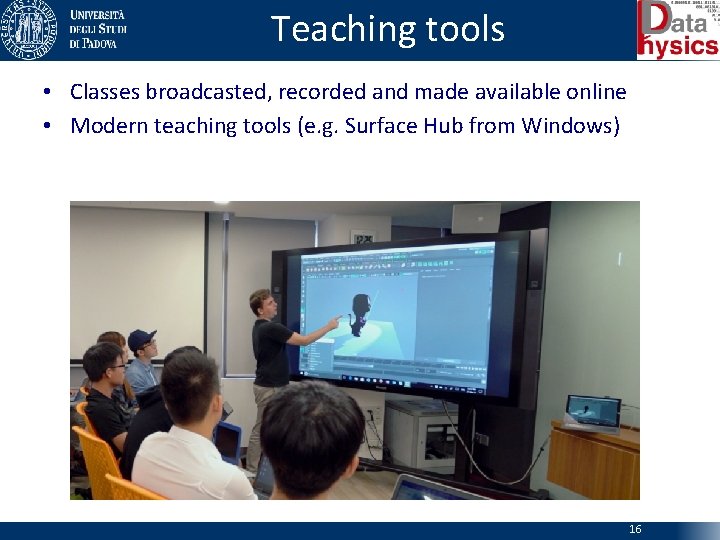
Teaching tools • Classes broadcasted, recorded and made available online • Modern teaching tools (e. g. Surface Hub from Windows) 16
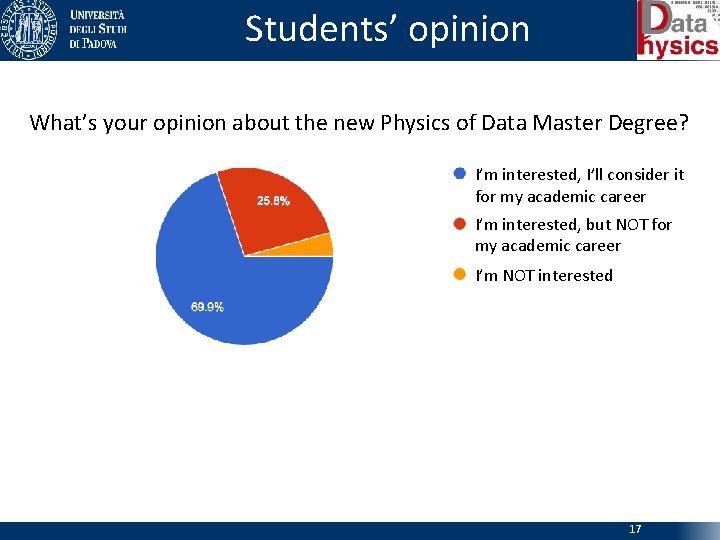
Students’ opinion What’s your opinion about the new Physics of Data Master Degree? I’m interested, I’ll consider it for my academic career I’m interested, but NOT for my academic career I’m NOT interested 17
Getting started • Publicity – In the socials (check us out on Facebook and Twitter) – Leaflets and posters (check your mailbox!) • Series of colloquia – The Physics of Data, J. Byers (April 19 th) – Data Science in High Energy Physics, M. Pierini (May 31 st) – Data Science in Astrophysics and Cosmology, S. Szalay (June 6 th) • Looking forward to collaborate! – Already a couple of visiting professors from CERN and Penn State, more would be welcome! 18
19