
Master Data Management Blending what Business Needs with
Master Data Management Blending what Business Needs with what I. T. Needs presented by Dawn Michels Information Architect of Andersen Corp. Feb 21, 2007
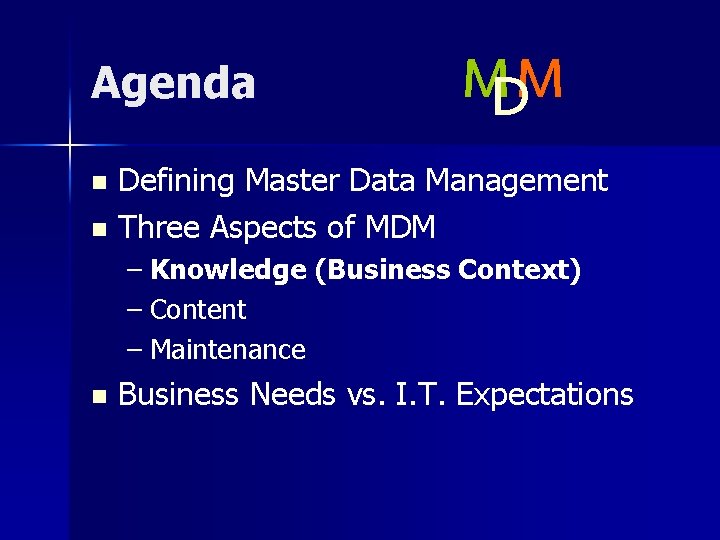
Agenda MM D Defining Master Data Management n Three Aspects of MDM n – Knowledge (Business Context) – Content – Maintenance n Business Needs vs. I. T. Expectations
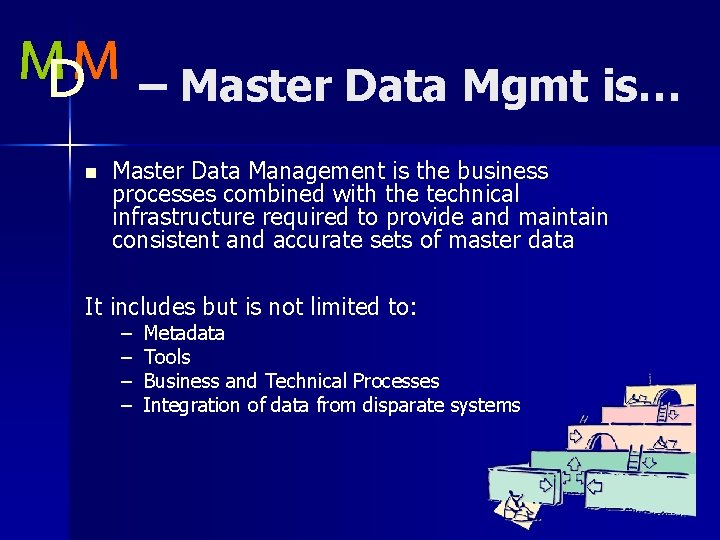
MM D n – Master Data Mgmt is… Master Data Management is the business processes combined with the technical infrastructure required to provide and maintain consistent and accurate sets of master data It includes but is not limited to: – – Metadata Tools Business and Technical Processes Integration of data from disparate systems
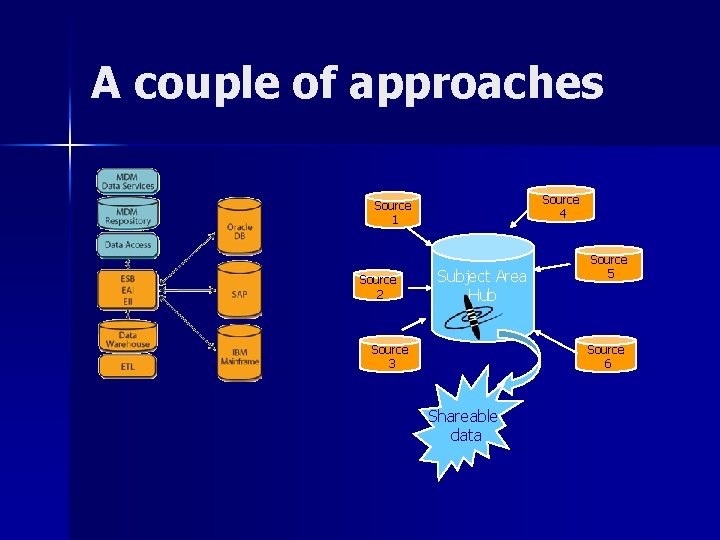
A couple of approaches Source 4 Source 1 Source 2 Subject Area Hub Source 3 Source 5 Source 6 Shareable data
Agenda MM D Defining Master Data Management n Three Aspects of MDM n – Knowledge (Business Context) – Content – Maintenance n Business Needs vs. I. T. Expectations

Master Data Knowledge Identification n Corporate Business Value n ROI n Data Governance & Stewardship n
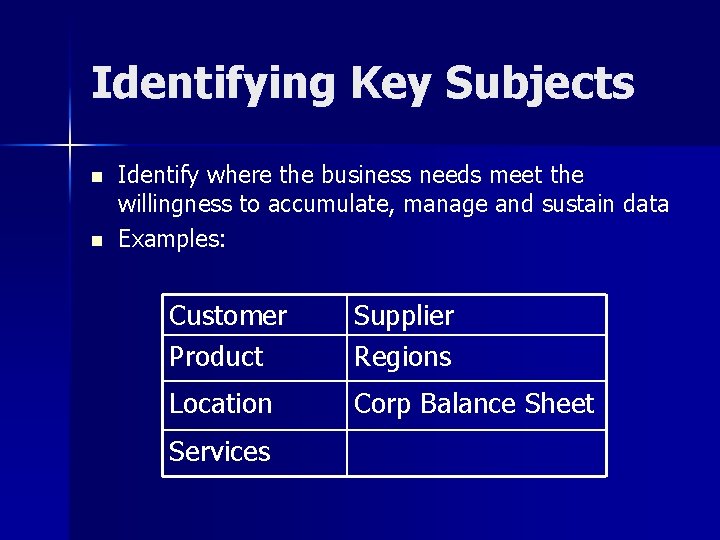
Identifying Key Subjects n n Identify where the business needs meet the willingness to accumulate, manage and sustain data Examples: Customer Product Supplier Regions Location Corp Balance Sheet Services
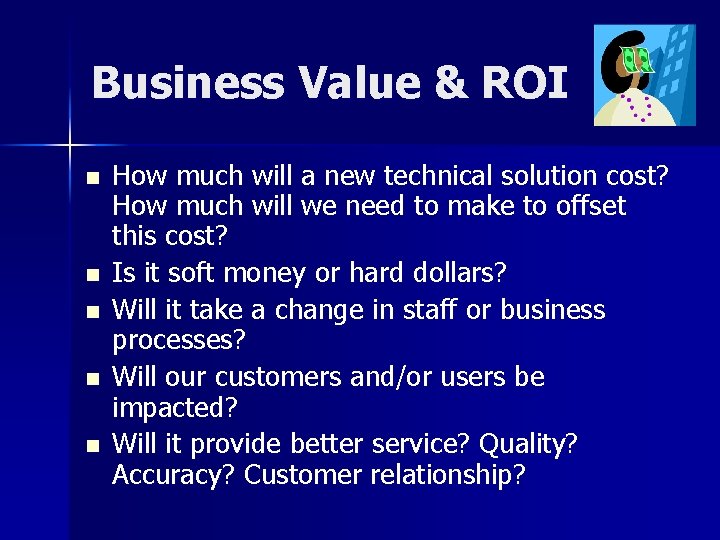
Business Value & ROI n n n How much will a new technical solution cost? How much will we need to make to offset this cost? Is it soft money or hard dollars? Will it take a change in staff or business processes? Will our customers and/or users be impacted? Will it provide better service? Quality? Accuracy? Customer relationship?
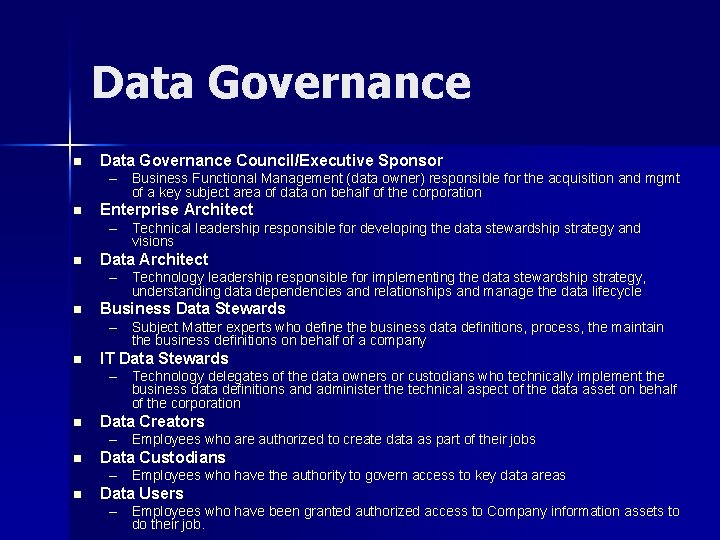
Data Governance n Data Governance Council/Executive Sponsor – Business Functional Management (data owner) responsible for the acquisition and mgmt of a key subject area of data on behalf of the corporation n Enterprise Architect – Technical leadership responsible for developing the data stewardship strategy and visions n Data Architect – Technology leadership responsible for implementing the data stewardship strategy, understanding data dependencies and relationships and manage the data lifecycle n Business Data Stewards – Subject Matter experts who define the business data definitions, process, the maintain the business definitions on behalf of a company n IT Data Stewards – Technology delegates of the data owners or custodians who technically implement the business data definitions and administer the technical aspect of the data asset on behalf of the corporation n Data Creators – Employees who are authorized to create data as part of their jobs n Data Custodians – Employees who have the authority to govern access to key data areas n Data Users – Employees who have been granted authorized access to Company information assets to do their job.
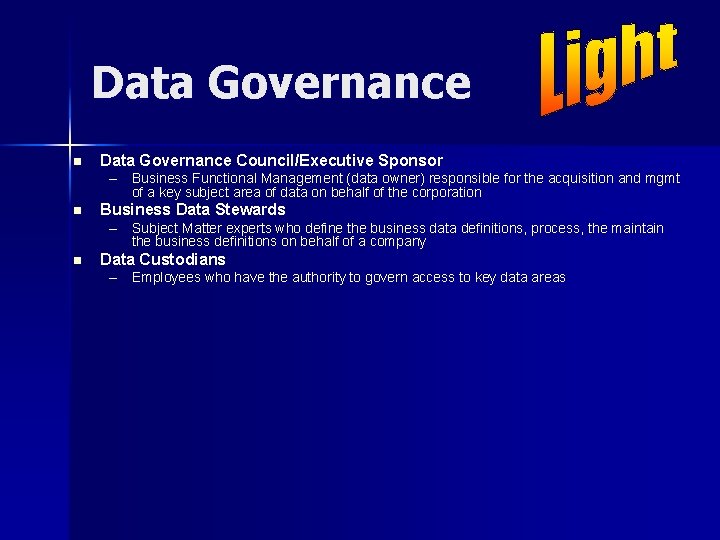
Data Governance n Data Governance Council/Executive Sponsor – Business Functional Management (data owner) responsible for the acquisition and mgmt of a key subject area of data on behalf of the corporation n Business Data Stewards – Subject Matter experts who define the business data definitions, process, the maintain the business definitions on behalf of a company n Data Custodians – Employees who have the authority to govern access to key data areas
Agenda MM D Defining Master Data Management n Three Aspects of MDM n – Knowledge (Business Context) – Content – Maintenance n Business Needs vs. I. T. Expectations
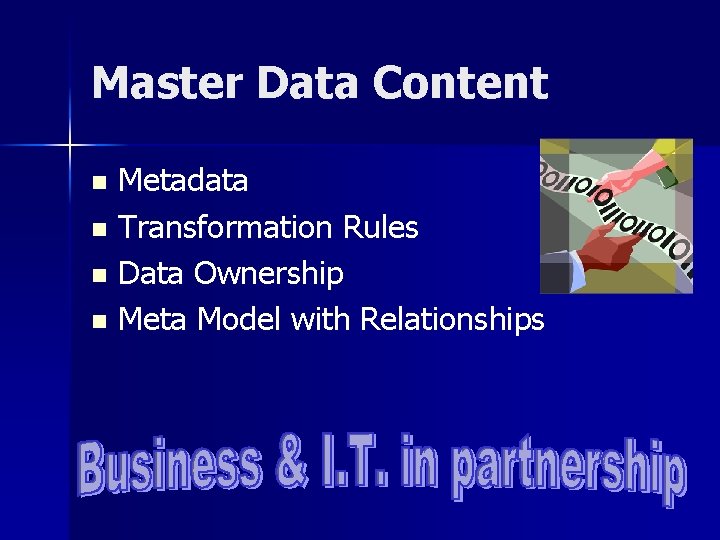
Master Data Content Metadata n Transformation Rules n Data Ownership n Meta Model with Relationships n

Metadata describes how, when and by whom a particular set of data was collected. It also captures how the data is formatted, and if any transformations were applied to the data along the way. n Business – – – – – Business Descriptions AKA ( Also Known As) Business Rules Valid Values Semantic Layer Ownership Reporting Data Dictionaries Quality Control Rules Change Control n Technical – Physical Location – Source to target transformations – Physical Characteristics – Key constraints – Indexes – Data Models – Audit Rules – Retention information – Table join recommendation – User Security
Transformation Rules n n n Documented changes, aggregations or adjustments to data as it is moved from one source to target location Inclusions or Exclusions of information that might be mistakenly assumed as part of a total Agreed upon by producers as well as consumers of the data
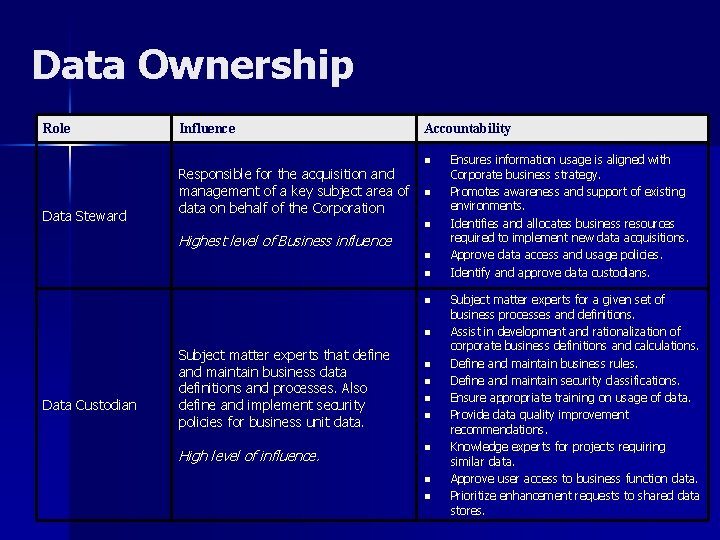
Data Ownership Role Data Steward Influence Responsible for the acquisition and management of a key subject area of data on behalf of the Corporation Accountability n n n Highest level of Business influence n n Data Custodian Subject matter experts that define and maintain business data definitions and processes. Also define and implement security policies for business unit data. High level of influence. n n n n Ensures information usage is aligned with Corporate business strategy. Promotes awareness and support of existing environments. Identifies and allocates business resources required to implement new data acquisitions. Approve data access and usage policies. Identify and approve data custodians. Subject matter experts for a given set of business processes and definitions. Assist in development and rationalization of corporate business definitions and calculations. Define and maintain business rules. Define and maintain security classifications. Ensure appropriate training on usage of data. Provide data quality improvement recommendations. Knowledge experts for projects requiring similar data. Approve user access to business function data. Prioritize enhancement requests to shared data stores.
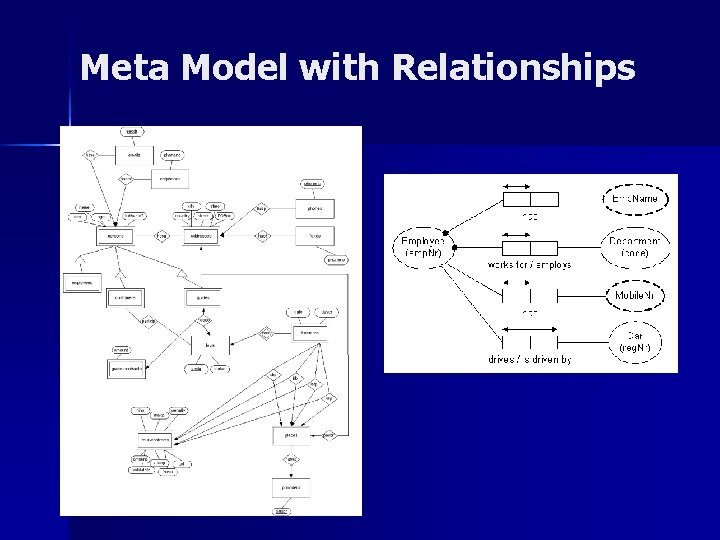
Meta Model with Relationships Models
Agenda MM D Defining Master Data Management n Three Aspects of MDM n – Knowledge (Business Context) – Content – Maintenance n Business Needs vs. I. T. Expectations
Master Data Maintenance Defining I. T. Support Model n Identifying relevant measurable Metrics n Valid Value Rules n Defining a workable Roadmap n
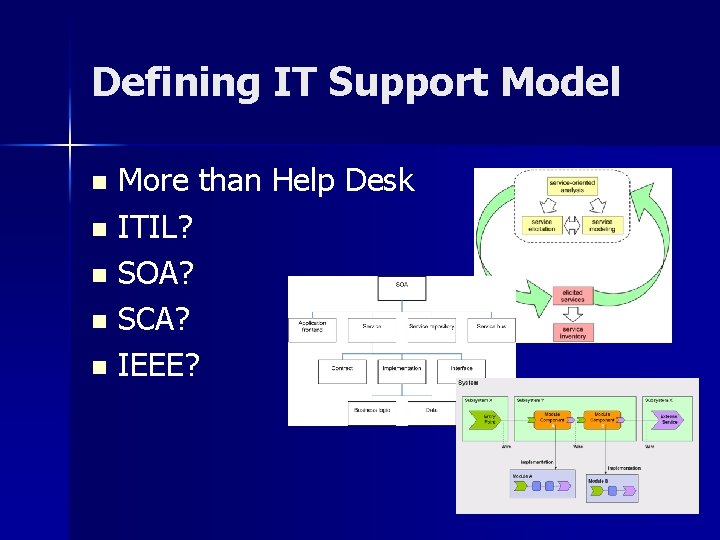
Defining IT Support Model More than Help Desk n ITIL? n SOA? n SCA? n IEEE? n
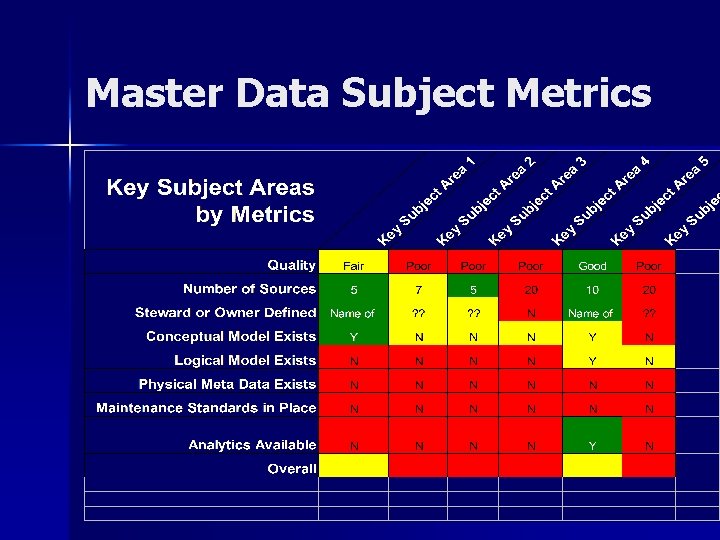
Master Data Subject Metrics
Relevant Measures n With the business identify what constitutes success – – – counts quality retrievability Report response time? n Minimal Redundancy? n
Valid Value Rules Are they programmatically enforced? n Does I. T. or the business maintain? n Determine how to measure n – Accuracy – Completeness – Consistence – Business Rules violation
Defining a workable roadmap n Back to the basics – Identify subject areas that matter to the business – Determine how much time, resources and money you have to accomplish your goals – Align the vision and execution of support to ongoing projects in the queue
Agenda MM D Defining Master Data Management n Three Aspects of MDM n – Knowledge (Business Context) – Content – Maintenance n Business Needs vs. I. T. Expectations
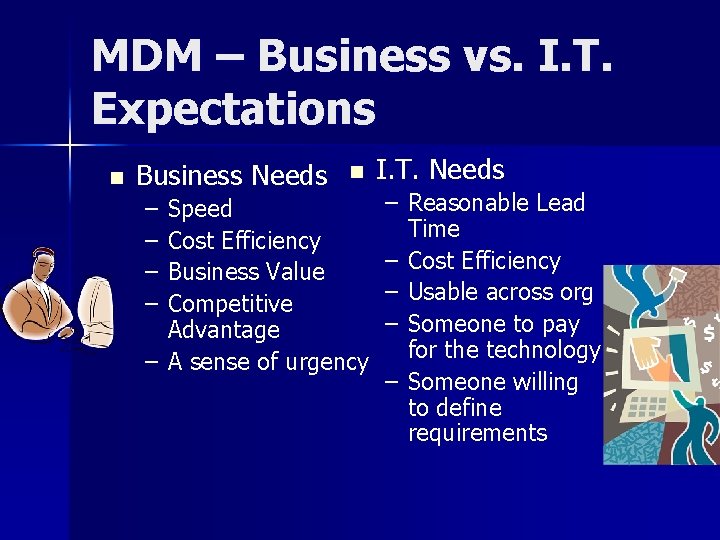
MDM – Business vs. I. T. Expectations n Business Needs – – n Speed Cost Efficiency Business Value Competitive Advantage – A sense of urgency I. T. Needs – Reasonable Lead Time – Cost Efficiency – Usable across org – Someone to pay for the technology – Someone willing to define requirements
Key Take Aways n n n Collaboration between business and IT essential Identifying what Master Data Matters to your business is critical Determine what Governance level your organization needs and staff accordingly Be clear about expectations Business & I. T. Metadata, Metadata!!!
References/Research http: //msdn 2. microsoft. com/en-us/architecture/bb 190163. aspx A good overview of MDM, with some fundamental steps n http: //www. rainingdata. com/products/soa/mdm/index. html Challenges of Enterprise data versus Master Data mgmt n http: //www. soamag. com/I 4/0207 -1. asp - good article on SOA – also see model on slide 15 n http: //xml. coverpages. org/ni 2005 -12 -07 -a. html - Describes in detail a service component architecture n http: //www. conceptdraw. com/en/sampletour/uml_erd / (great downloadable samples) n http: //searchcrm. techtarget. com/generic/0, 295582, sid 91_gci 114894 6, 00. html – excerpt on valid values and data strategy from Sid Adelmann and Larissa Moss n
Thanks for your time and Interest! t t t Dawn Michels t Enterprise Information Architect t Past Pres DAMA-Minnesota t Past VP Chapter Services DAMA-I t Adjunct Faculty Member College of St. Catherine t Passionate Data Architect dawnmichels@Andersencorp. com 651 -264 -7985
My background n n n Dawn Michels is the Enterprise Information Architect for Andersen Corporation, in Bayport Minnesota and has many years experience in relational database design, across several DBMS and applications. She has developed many data designs and modeling initiatives spanning the Insurance, Medical Devices, and Retail and Credit Card industries. Dawn has also worked for Guidant Corporation, Fair Isaac Inc, and Minnesota Life Insurance and was the project lead at General Mills on their first Corporate Wide DW. This included data design, internal marketing as well as hardware and software selection. To round out her professional career, Dawn is an adjunct faculty member at The College of St. Catherine, teaching courses in Mgmt Information Systems and Information Mgmt. She has spoken at five previous DAMA International Conferences on assorted topics of interest, and is scheduled to speak at DAMA-I 2007 in Boston, Mass. . Dawn was the VP of Chapter Services for DAMA International from 2000 -2002. Before taking on that role, Dawn was President of DAMA Minnesota chapter for 3 years, and VP of Education for DAMA MN, 3 years prior to that. She believes in sharing and mentoring to the best of her ability, as she considers the best way to continue to develop data architecture is through experience and learning from others experiences and networking with peers at all levels.
- Slides: 29